88. Which of the following budgets can be used for control?
89. Figure 7-9.
Capsaicin Company produces a line of salsas. Capsaicin’s estimated production of jars of salsa for the third
quarter of the year is as follows:
July
80,000
August
90,000
September
70,000
Each jar requires 1/4 pound of peppers. Capsaicin’s prefers to buy the freshest peppers, so its policy to have just 5% of the following month’s
production needs in ending inventory. On July 1, the company had 1,200 pounds of peppers in inventory. Capsaicin’s pays $0.40 per pound of
peppers. It buys all peppers on account and typically pays 50% of a month’s purchases in that month, and the remaining 50% the following month.
Refer to Figure 7-9. How many pounds of peppers will be purchased during the month of August?
90. Figure 7-9.
Capsaicin Company produces a line of salsas. Capsaicin’s estimated production of jars of salsa for the third
quarter of the year is as follows:
July
80,000
August
90,000
September
70,000
Each jar requires 1/4 pound of peppers. Capsaicin’s prefers to buy the freshest peppers, so its policy to have just 5% of the following month’s
production needs in ending inventory. On July 1, the company had 1,200 pounds of peppers in inventory. Capsaicin’s pays $0.40 per pound of
peppers. It buys all peppers on account and typically pays 50% of a month’s purchases in that month, and the remaining 50% the following month.
Refer to Figure 7-9. What is the dollar cost of purchases for July?
91. Figure 7-9.
Capsaicin Company produces a line of salsas. Capsaicin’s estimated production of jars of salsa for the third
quarter of the year is as follows:
July
80,000
August
90,000
September
70,000
Each jar requires 1/4 pound of peppers. Capsaicin’s prefers to buy the freshest peppers, so its policy to have just 5% of the following month’s
production needs in ending inventory. On July 1, the company had 1,200 pounds of peppers in inventory. Capsaicin’s pays $0.40 per pound of
peppers. It buys all peppers on account and typically pays 50% of a month’s purchases in that month, and the remaining 50% the following month.
Refer to Figure 7-9. How much cash is paid in August for pepper purchases (rounded to the nearest dollar)?
92. A company requires 200 pounds of plastic to meet the production needs of a product. It currently has 20
pounds of plastic inventory. The desired ending inventory of plastic is 60 pounds. How many pounds of plastic
should be budgeted for purchasing during the coming period?
93. A company plans on selling 400 units. The selling price per unit is $5. There are 40 units in beginning
inventory, and the company would like to have 75 units in ending inventory. How many units should be
produced for the coming period?
94. Suppose that a company has the following accounts receivable collection pattern:
Paid in the month of sale
30%
Paid in the month following sale
70%
All sales are on credit. If credit sales for January and February are $200,000 and $100,000 respectively, the cash collection for February are
95. Which of the following is not an advantage of participative budgeting?
96. Which of the following is an advantage of participative budgeting?
97. Which of the following is an example of myopic behavior?
98. In a ____, as one month expires, an additional month in the future is added to the budget so that the
company always has a 12-month plan on hand.
99. The ____ is the person responsible for directly and coordinating the organization’s overall budget process
100. Budgets are prepared in which of the following orders?
101. Which of the following statements is true?
102. Which of the following is not true?
103. A company has provided a sales budget for the next four months (January, February, March, and April). It
bases its production budget on the sales budget, and has a policy that each month’s ending inventory of finished
product must be equal to 25% of the following month’s sales needs. The direct materials purchases budget is
based on the production budget. The company’s policy for each month’s ending inventory of raw materials is
that they must be equal to 10% of the following month’s production needs for raw materials. Given this
information, the company can prepare direct materials purchases budgets for how many months?
104. Figure 7-10
Gentry Company produces speaker systems for trucks. Estimated sales (in units) in January are 20,000; in
February 25,000; and in March 22,000. Each unit is priced at $45. Gentry wants to have 25% of the following
month’s sales in ending inventory. That requirement was met on January 1.
Each speaker system requires 2 boxes and 10 yards of wire. Boxes cost $5 each and wire is $0.90 per yard.
Gentry wants to have 30% of the following month’s production needs in ending raw materials inventory. On
January 1, Gentry had 9,000 boxes and 100,000 yards of wire in inventory.
Refer to Figure 7-10. What is Gentry’s expected sales revenue for February?
105. Figure 7-10
Gentry Company produces speaker systems for trucks. Estimated sales (in units) in January are 20,000; in
February 25,000; and in March 22,000. Each unit is priced at $45. Gentry wants to have 25% of the following
month’s sales in ending inventory. That requirement was met on January 1.
Each speaker system requires 2 boxes and 10 yards of wire. Boxes cost $5 each and wire is $0.90 per yard.
Gentry wants to have 30% of the following month’s production needs in ending raw materials inventory. On
January 1, Gentry had 9,000 boxes and 100,000 yards of wire in inventory.
Refer to Figure 7-10. How many units does Gentry expect to produce in February?
106. Figure 7-10
Gentry Company produces speaker systems for trucks. Estimated sales (in units) in January are 20,000; in
February 25,000; and in March 22,000. Each unit is priced at $45. Gentry wants to have 25% of the following
month’s sales in ending inventory. That requirement was met on January 1.
Each speaker system requires 2 boxes and 10 yards of wire. Boxes cost $5 each and wire is $0.90 per yard.
Gentry wants to have 30% of the following month’s production needs in ending raw materials inventory. On
January 1, Gentry had 9,000 boxes and 100,000 yards of wire in inventory.
Refer to Figure 7-10. How many boxes does Gentry expect to purchase in January?
107. Ressen Company finds that typically 30% of a month’s sales are for cash. Payments on accounts receivable
are 60% in the month of sale and 38% in the month following sale. Budgeted sales for June are $100,000, for
July $140,000, and for August $120,000. What are the total cash receipts budgeted for July?
108. Figure 7-11.
Pallen Company estimated sales of 11,000 units at $40 each, unit cost of goods sold of $22, and marketing
expense of $65,000 and a 10% commission on price for each unit sold. Administrative expense is budgeted at
$50,000.
Refer to Figure 7-11. What is budgeted marketing expense?
109. Figure 7-11.
Pallen Company estimated sales of 11,000 units at $40 each, unit cost of goods sold of $22, and marketing
expense of $65,000 and a 10% commission on price for each unit sold. Administrative expense is budgeted at
$50,000.
Refer to Figure 7-11. What is Pallen’s budgeted operating income?
110. Looking backward, determining what actually happened and comparing it with the previously planned
outcomes is:
111. Budgets are:
112. The master budget is:
113. Varney Company makes rolling suitcases. Its sales budget for four months is:
Month
Unit Sales
March
15,000
April
20,000
May
40,000
June
60,000
Varney’s policy is that ending inventory of finished suitcases should equal 30% of the next month’s sales. Beginning inventory (March 1) is 5,300
suitcases.
Each suitcase required 1.5 yards of ballistic nylon. The ending inventory policy for nylon is that 20% of the following month’s production needs
must be on hand. On March 1, Varney had 10,450 yards of nylon in inventory.
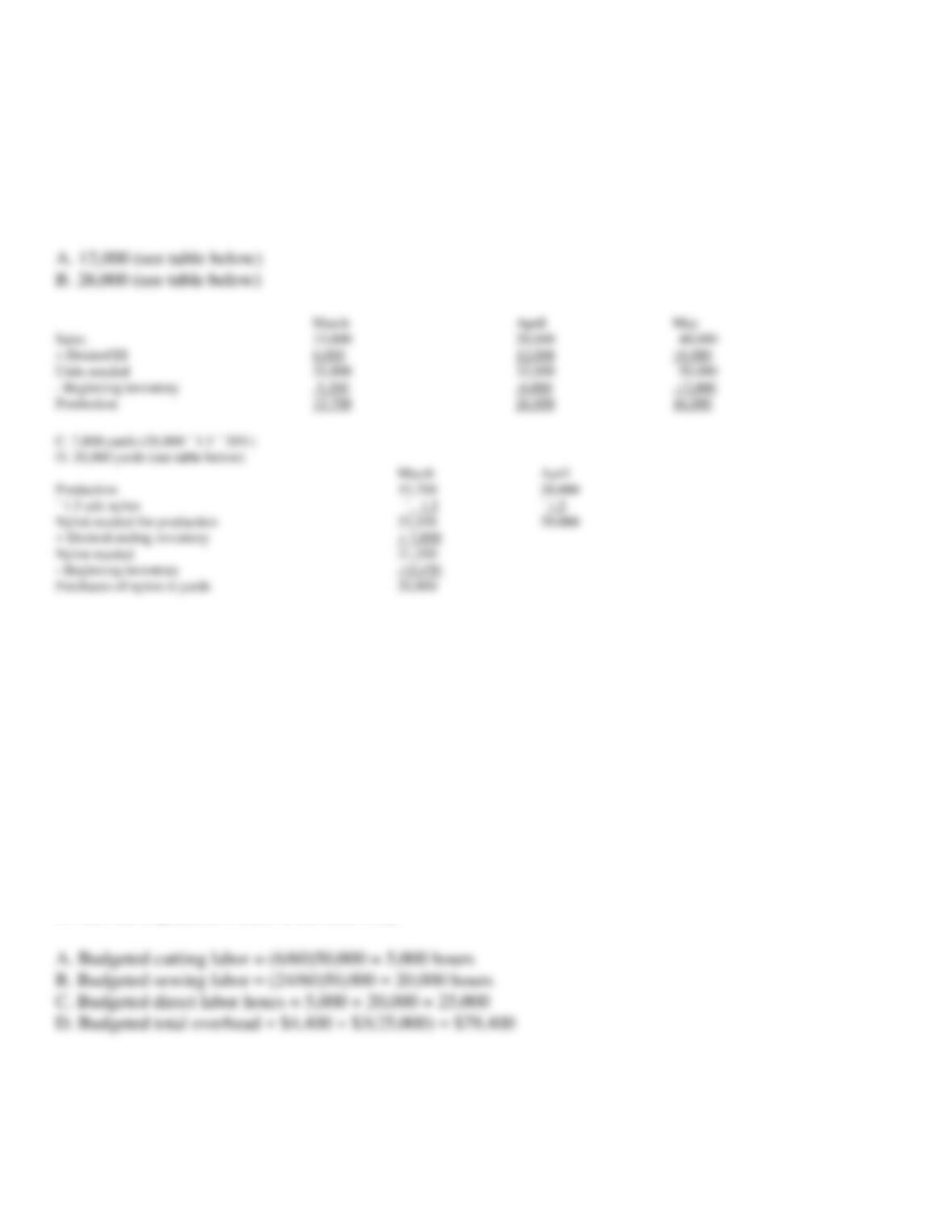
A. What is the desired ending inventory of suitcases for April?
B. What is the budgeted production of suitcases for April?
C. What is the desired ending inventory of nylon for March?
D. What are the budgeted yards of nylon to be purchased in March?
114. Borland Company makes backpacks. Its production budget for two months is:
Month
Budgeted production in units
June
35,000
July
50,000
Borland uses two types of labor to make the backpacks: cutting labor and sewing labor. Each backpack requires 6 minutes, on average, of cutting
labor. Each backpack requires 24 minutes of sewing labor.
Borland has fixed overhead of $4,400 per month and variable overhead of $3 per direct labor hour.
A. How many hours of cutting labor are budgeted for July?
B. How many hours of sewing labor are budgeted for July?
C. What is the total amount of budgeted direct labor hours for July?
D. What is the budgeted total overhead for the month of July?
March
April
May
Sales
15,000
20,000
40,000
+ Desired EI
6,000
12,000
18,000
Units needed
21,000
32,000
58,000
– Beginning inventory
-5,300
-6,000
-12,000
Production
15,700
26,000
46,000
March
April
Production
15,700
26,000
´ 1.5 yds nylon
´ 1.5
´ 1.5
Nylon needed for production
23,550
39,000
+ Desired ending inventory
+ 7,800
Nylon needed
31,350
– Beginning inventory
-10,450
Purchases of nylon in yards
20,900
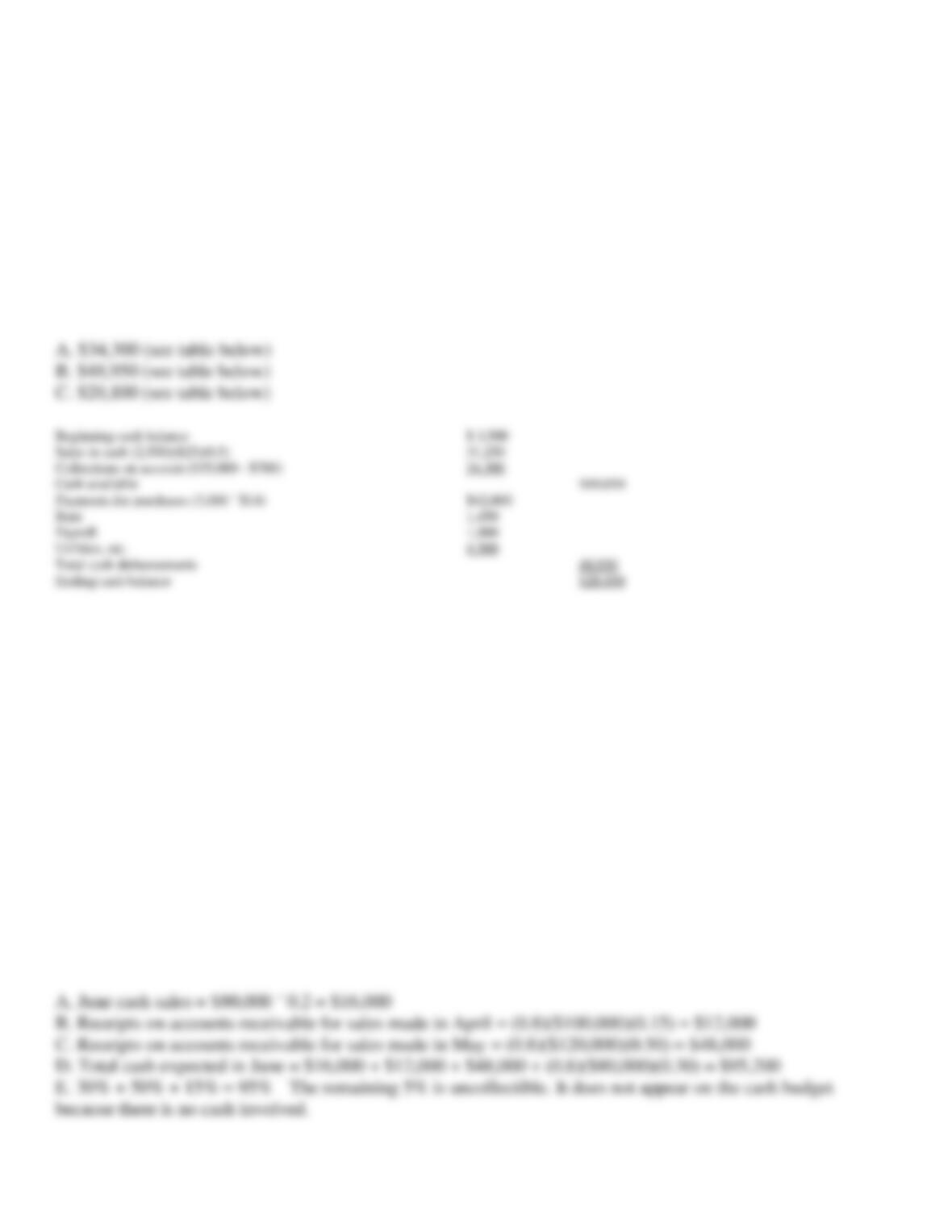
115. Quillin Company had the following budgeted information for October:
1. October 1 cash balance $3,500
2. Expected sales 2,500 units at $25 each (half in cash, remainder on credit due in November)
3. Inventory purchases 3,000 units at $14 each (all in cash)
4. Rent $1,450
5. Payroll $1,000
6. Utilities and other costs $4,500
7. Accounts receivable balance Oct. 1, $35,000 (includes $700 bad debts allowance)
A. What is the budgeted collection on accounts receivable for October?
B. What is the total cash disbursements for October?
C. What is the ending cash balance for October?
116. Fredder Company usually sells about 20% of its merchandise during a month for cash with the remaining
sales on account. The company’s accounts receivable payment history is as follows: 30% in the month of sale,
50% in the month following, and 15% in the second month following sale. Total budgeted sales for the second
quarter are as follows:
April
$100,000
May
120,000
June
80,000
Assume all questions relate to the month of June.
A. What are the expected cash sales?
B. What are the expected receipts from accounts receivable for sales made in April?
C. What are the expected receipts from accounts receivable for sales made in May?
D. What are the total expected cash receipts?
E. From the above accounts receivable history information, receipts from accounts receivable do not equal 100%. Why not? Does this amount appear
on the cash budget?
Beginning cash balance
$ 3,500
Sales in cash (2,500)($25)(0.5)
31,250
Collections on account ($35,000 – $700)
34,300
Cash available
$69,050
Payments for purchases (3,000 ´ $14)
$42,000
Rent
1,450
Payroll
1,000
Utilities, etc.
4,500
Total cash disbursements
48,950
Ending cash balance
$20,100
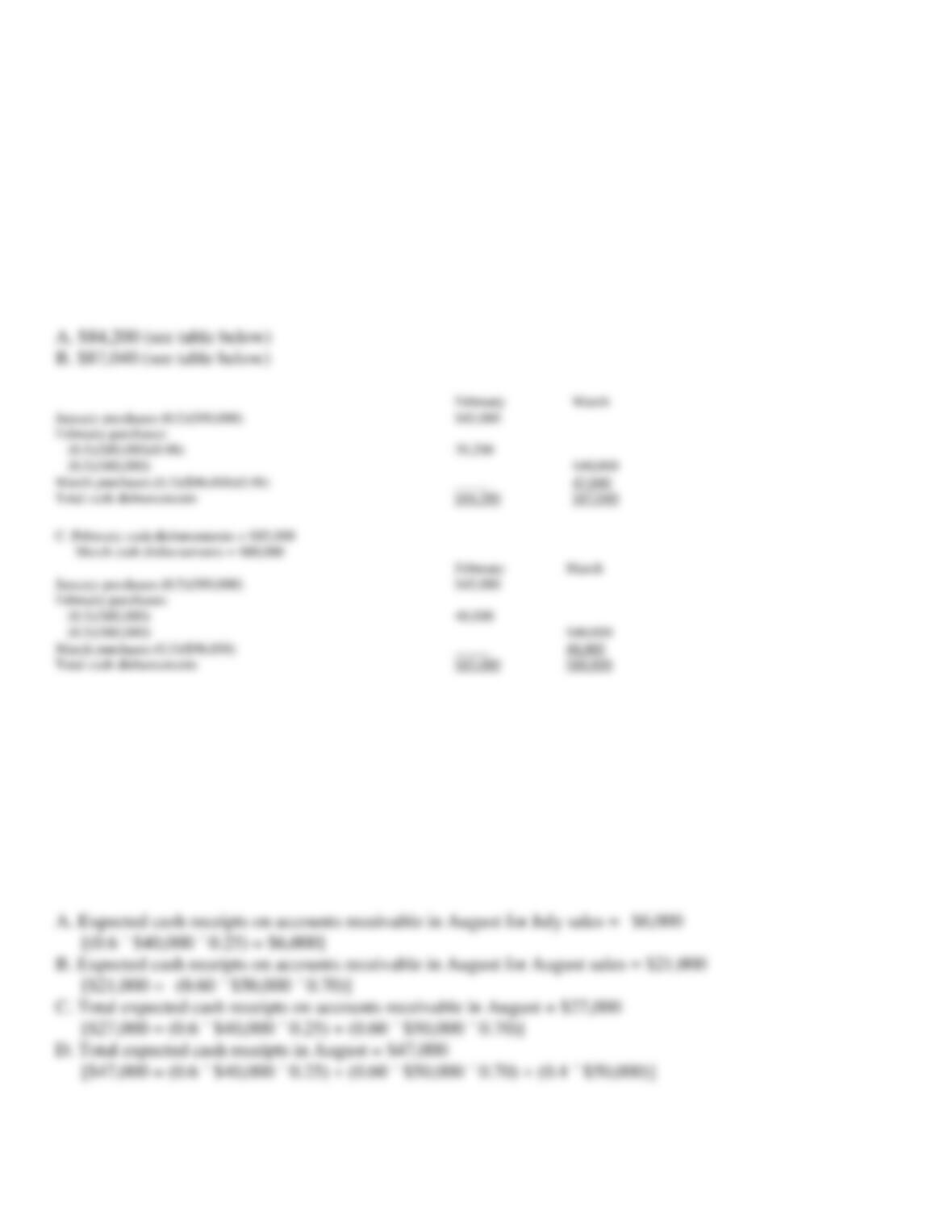
117. Rivers Company purchases merchandise on account. In general, Rivers pays 50% in the month of purchase
and 50% in the following month. All payments in the month of purchase qualify for a 2% cash discount. First
quarter budgeted purchases are:
January
$90,000
February
80,000
March
96,000
A. What are the total cash disbursements expected in February?
B. What are the total cash disbursements expected in March?
C. Now suppose that there is no cash discount for purchases made in the month of purchase. Now what are the total cash disbursements expected in
February? In March?
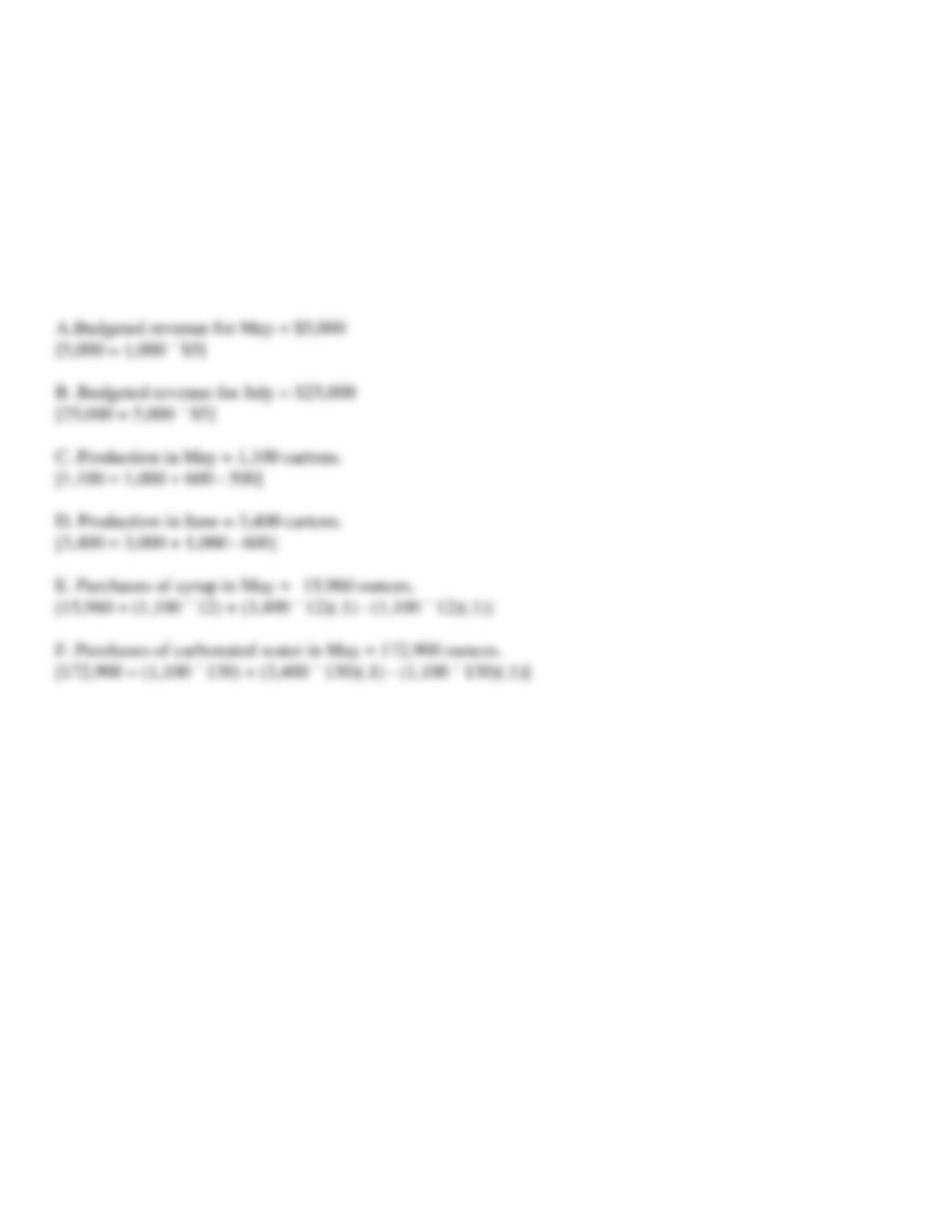
118. Wexler Company expects sales of $40,000 in July, $50,000 in August, and $30,000 in September.
Wexler’s experience is that 40% of sales are cash, and the remainder are on account. Accounts receivable are
paid: 70% in the month of sale, and 25% in the following month.
A. What are the expected cash receipts on accounts receivable in August for July sales?
B. What are the expected cash receipts on accounts receivable in August for August sales ?
C. What are the total expected cash receipts on accounts receivable in August?
D. What are the total expected cash receipts in August?
February
March
January purchases (0.5)($90,000)
$45,000
February purchases:
(0.5)($80,000)(0.98)
39,200
(0.5)($80,000)
$40,000
March purchases (0.5)($96,000)(0.98)
_____
47,040
Total cash disbursements
$84,200
$87,040
February
March
January purchases (0.5)($90,000)
$45,000
February purchases:
(0.5)($80,000)
40,000
(0.5)($80,000)
$40,000
March purchases (0.5)($96,000)
_____
48,000
Total cash disbursements
$85,000
$88,000
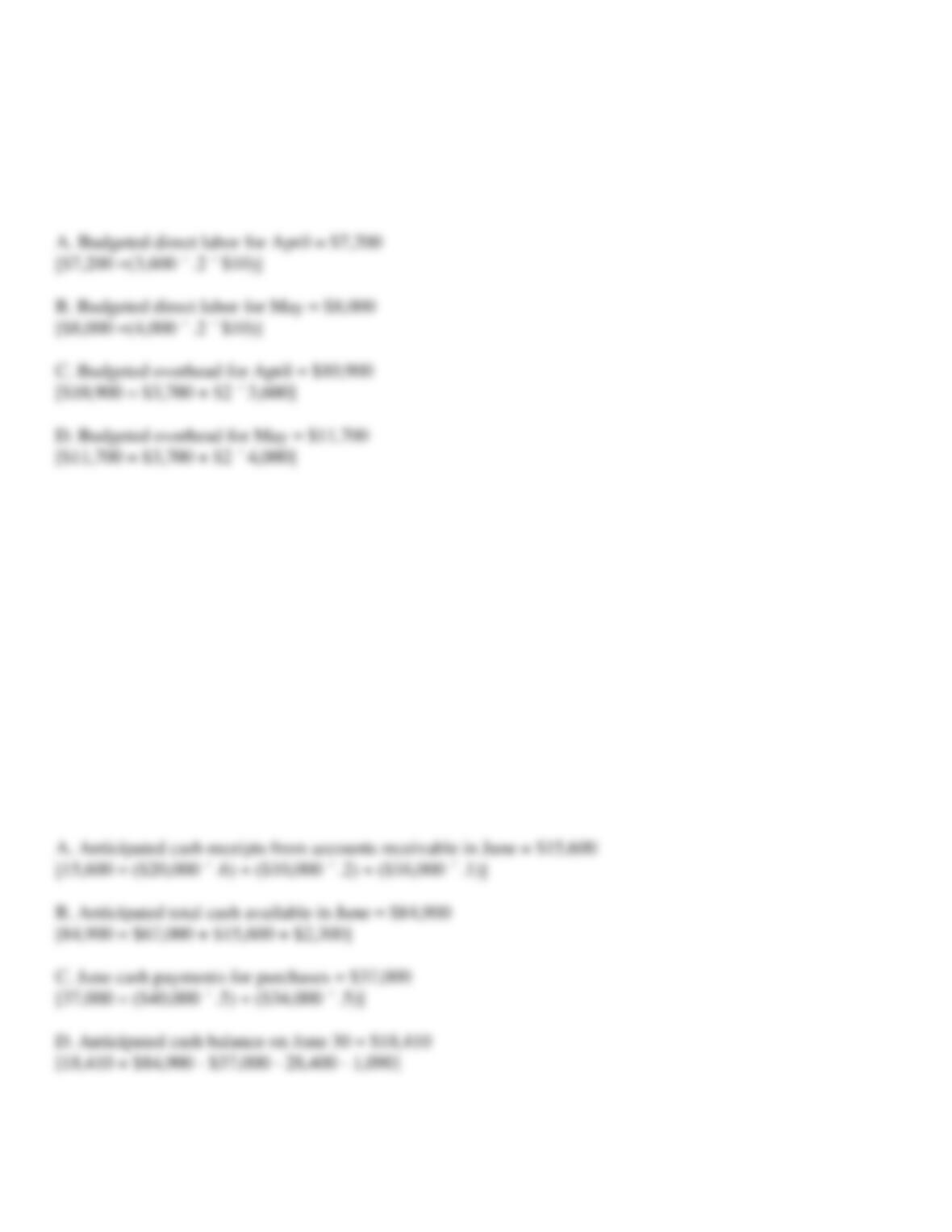
119. Abrams Bottling Company sells fruit-flavored colas. Estimated sales in cartons for May, June, and July are
1,000, 3,000 and 5,000 respectively. The price is forecast at $5 per carton. Abrams requires that finished goods
ending inventory be 20% of the next month’s sales. Inventory was 500 units on May 1. Each carton requires 12
oz of fruit syrup and 130 oz of carbonated water. Materials ending inventory is 10% of the next month’s
production needs. May 1 inventory met that requirement.
A. Budgeted revenue for May is $__________________.
B. Budgeted revenue for July is $__________________.
C. Production in May is __________________ cartons.
D. Production in June is __________________ cartons.
E. Purchases of syrup in May is __________________ ounces.
F. Purchases of carbonated water in May is __________________ ounces.
120. Rapid-Lube provides oil changes and lubes. The estimated number of oil changes for April and May are
3,600 and 4,000. Each oil change takes 12 minutes of direct labor. The wage rate is $10 per hour. Overhead is
$3,700 per month and $2 per oil change.
A. Budgeted direct labor for April is $__________________.
B. Budgeted direct labor for May is $__________________.
C. Budgeted overhead for April is $__________________.
D. Budgeted overhead for May is $__________________.
121. Shorter Company developed the following data for the month of June.
A. June 1 cash balance $2,300
B. Cash sales in June $67,000
C. Credit sales for June are $20,000; for May $10,000; and for April $16,000. 60% of credit sales are paid in the
month of purchase, 20% in the following month, and 10% in the second month following the sale.
D. Purchases for May were $34,000 and for June are $40,000. Half of purchases are paid in the month of
purchase and the remainder in the following month.
E. June salaries are $28,400, utilities are $1,090, and depreciation on the building is $1,000.
A. Anticipated cash receipts from accounts receivable in June equal $__________________.
B. Anticipated total cash available in June is $__________________.
C. June cash payments for purchases are $__________________.
D. Anticipated cash balance on June 30 is $__________________.
122. Terrill Company makes and sells two types of shaving cream: foamy, and gel. Last year, Foamy sold for
$2.30 per can, and Gel sold for $3.15 per can. Sales volume was as follows:
Quarter 1
Quarter 2
Quarter 3
Quarter 4
Foamy
76,000
80,000
82,000
70,000
Gel
50,000
80,000
90,000
60,000
Terrill expects sales for foamy to increase by 5% in each quarter as long as price remains constant. The gel price will increase to $3.50, but an
aggressive advertising is expected to raise volume by 5% in quarters 1 and 4 and by 10% in quarters 2 and 3.
123. Allison Company makes luggage. One popular model is the Traveller (a 21″ wheeled carry-on). Budgeted
sales for this model are:
Month
Unit Sales
March
25,000
April
34,000
May
50,000
June
70,000
Desired ending inventory is 20% of the next month’s sales. Inventory on March 1 is 3,100 units. Prepare a production budget for as many months as
possible.
March
April
May
Sales
25,000
34,000
50,000
+ Desired ending inventory
6,800
10,000
14,000
Units needed
31,800
44,000
64,000
– Beginning inventory
-3,100
-6,800
-10,000
Production
28,700
37,200
54,000
Quarter 1
Quarter 2
Quarter 3
Quarter 4
Foamy
$183,540
$193,200
$198,030
$169,050
Gel
183,750
308,000
346,500
220,500
124. CutMaster Salons anticipates giving 100 permanents in May, 130 in June, and 120 in July. CutMaster
needs one permanent wave kit for each perm, along with 2 boxes of wave tissues. Its inventory policy is to have
10% of the following month’s materials needs on hand. On May 1, there were 15 wave kits and 4 boxes of wave
tissues on hand. (Round any fractions of a unit to the nearest whole unit.)
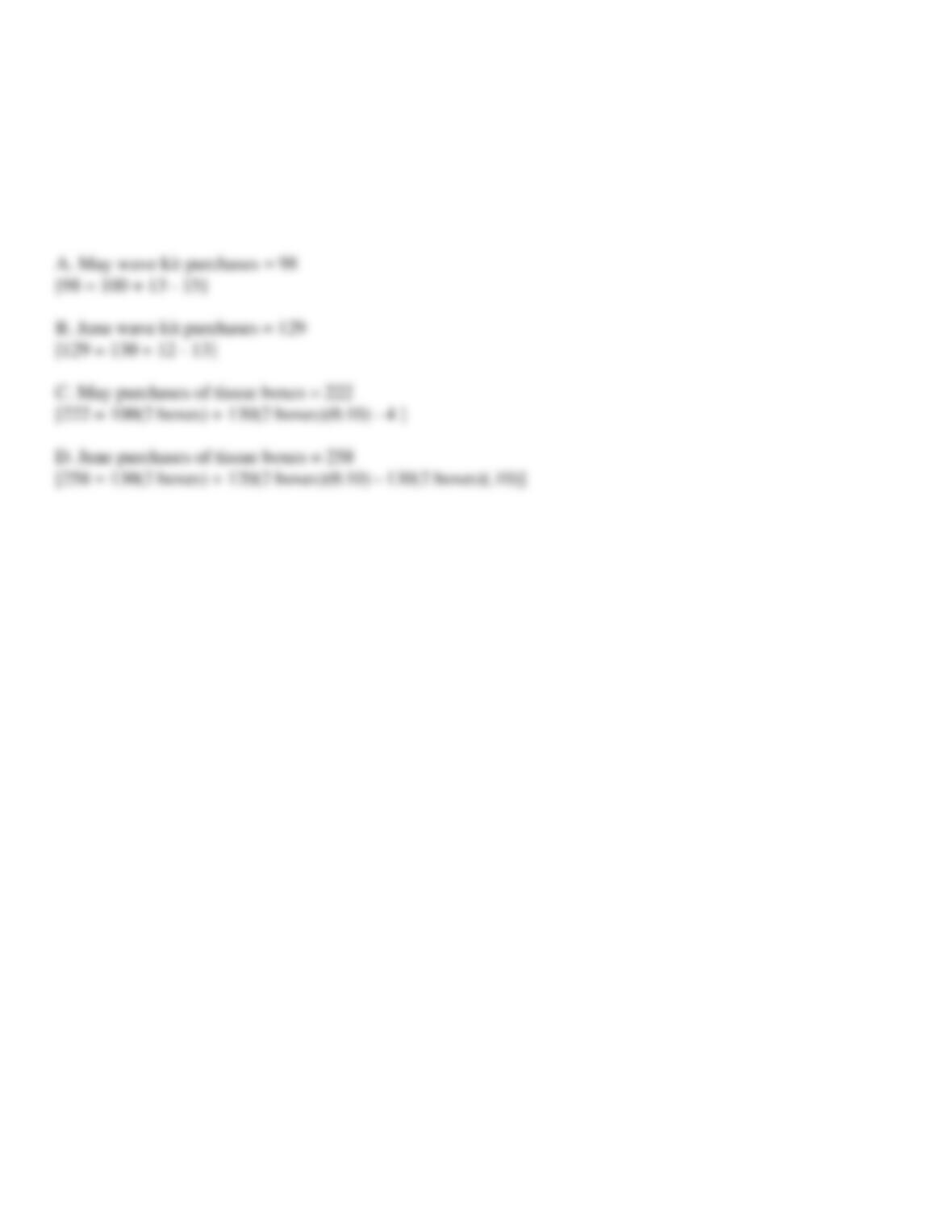
A. The wave kits to be purchased in May equal __________________.
B. The wave kits to be purchased in June equal __________________.
C. The boxes of tissues to be purchased in May equal __________________.
D. The boxes of tissues to be purchased in June equal __________________.
125. Foster Company makes power tools. The sales budget for drills for the first four months of the year is:
Month
Unit Sales
January
20,000
February
15,000
March
22,000
April
25,000
Foster has taken a just-in-time approach to production and wants only 5% of the next month’s sales needs in ending inventory. January 1 inventory of
drills was zero. Each drill takes 15 minutes of direct labor at $18 per hour. The factory overhead formula is $27,000 + $1.20 per direct labor hour.
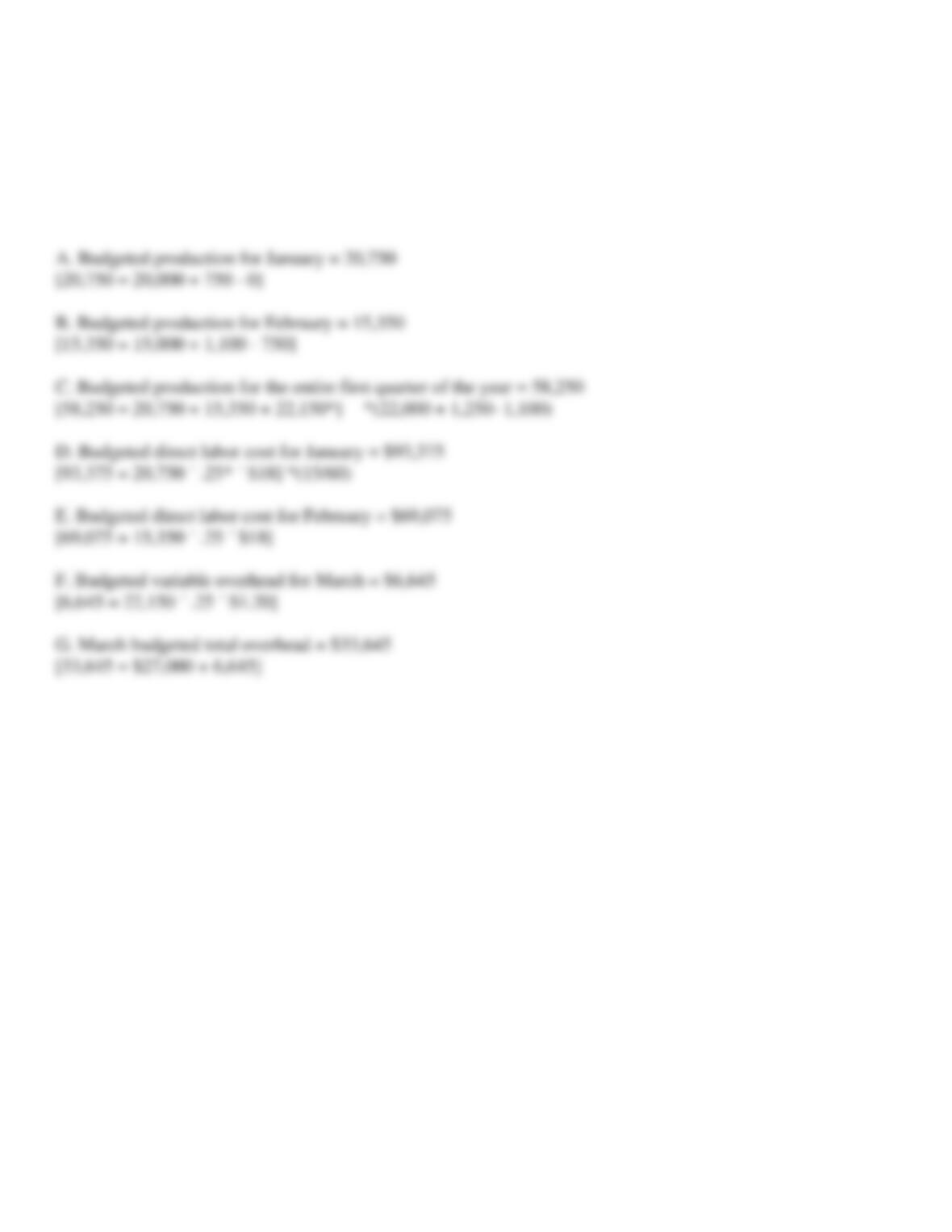
A. Budgeted production for January is __________________.
B. Budgeted production for February is __________________.
C. Budgeted production for the entire first quarter of the year is __________________.
D. Budgeted direct labor cost for January is $__________________.
E. Budgeted direct labor cost for February is $__________________.
F. Budgeted variable overhead for March is __________________.
G. Budgeted total overhead for March is __________________.
126. Uma Company production has variable overhead costs of $8 per direct labor hour and fixed overhead costs
of $56,000 per month. Budgeted production for the next three months is as follows:
Month
Production
October
6,000
November
5,500
December
8,000
Each unit requires 3 hours of direct labor.
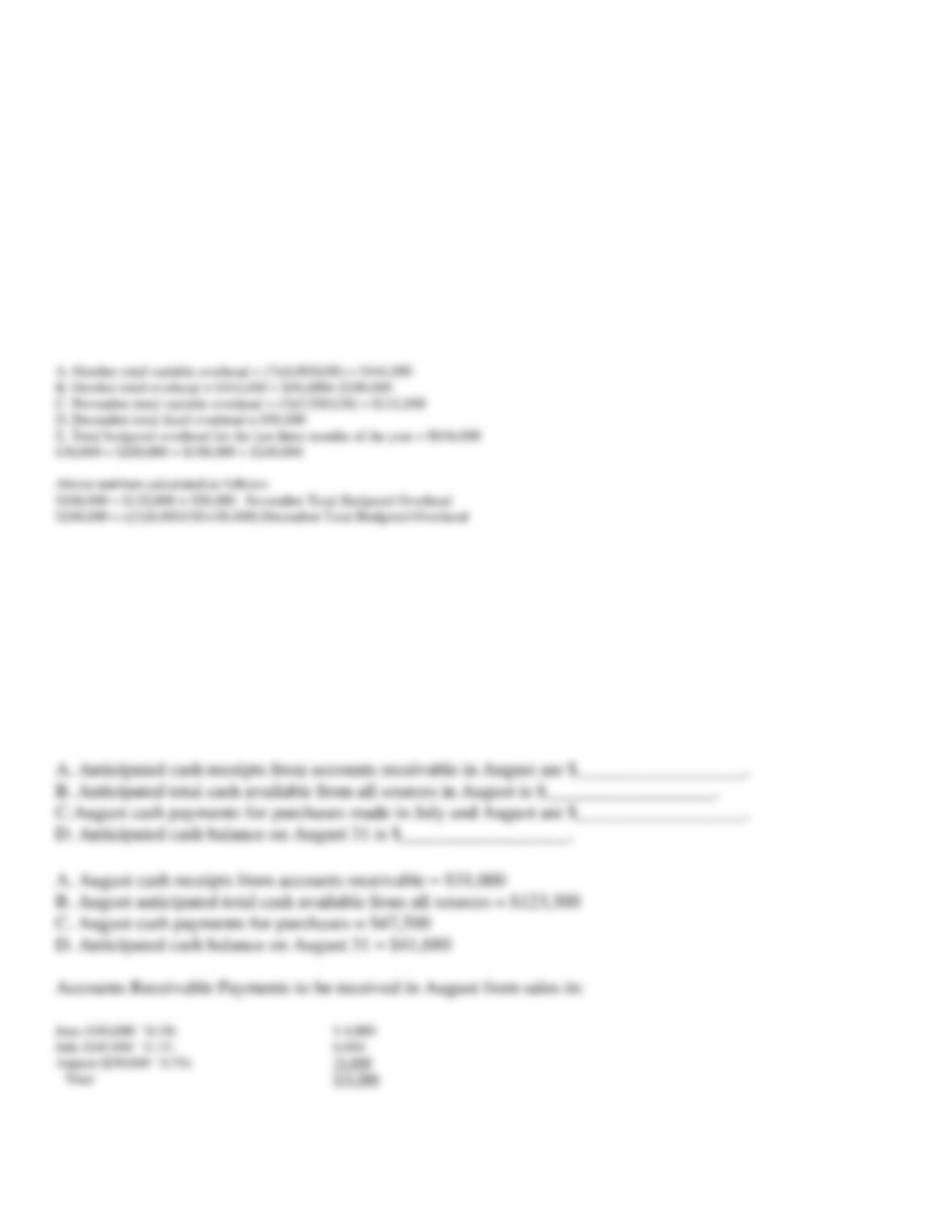
A. Uma’s total variable overhead for October is $__________________.
B. Uma’s total overhead for October is $__________________.
C. Uma’s total variable overhead for November is $__________________.
D. Uma’s total fixed overhead for December is $__________________.
E. Uma’s total budgeted overhead for the last three months of the year equals $__________________.
Month
Variable
Overhead
Fixed
Overhead
Total
Overhead
October
$144,000
$56,000
$200,000
November
$132,000
$56,000
$188,000
December
$192,000
$56,000
$248,000
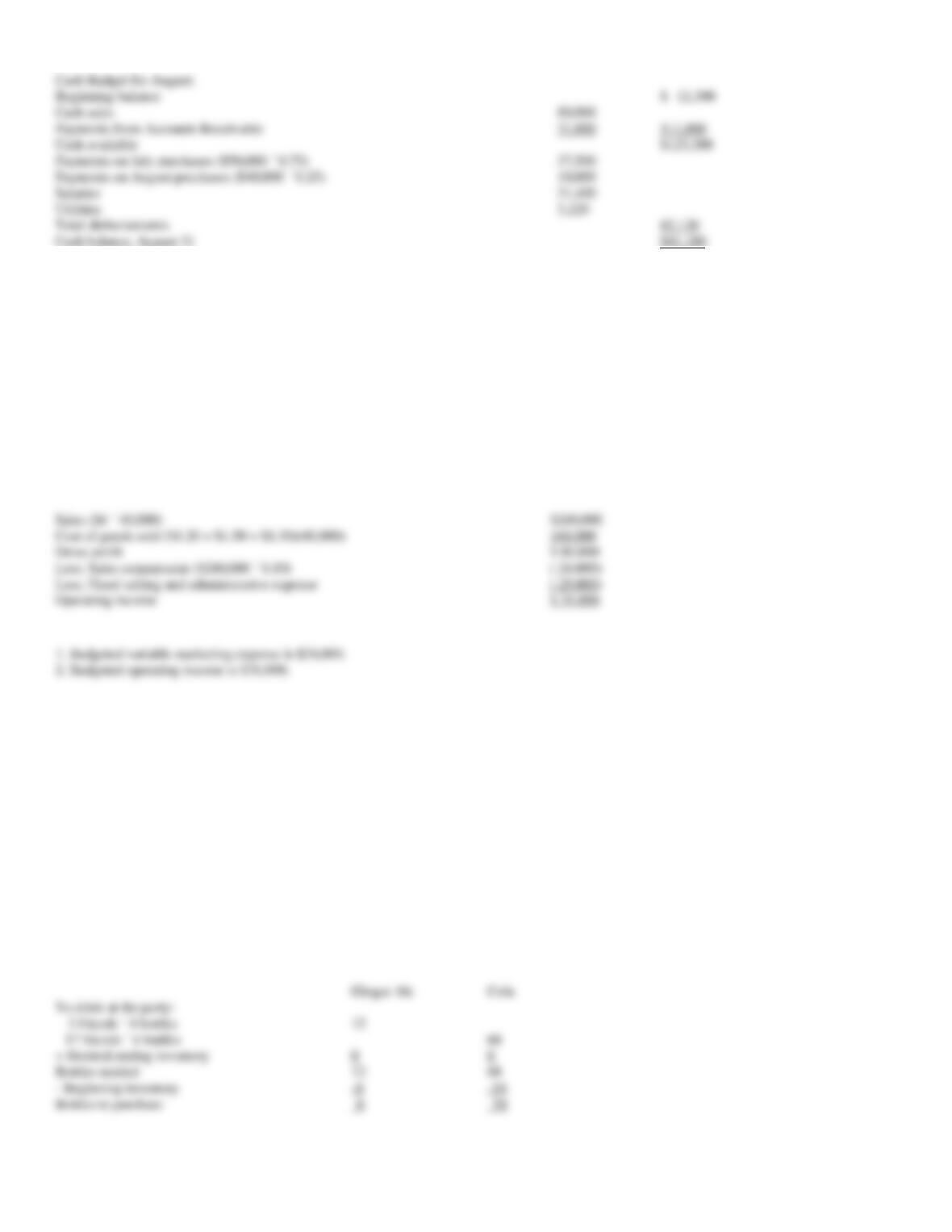
127. Calino Company developed the following data for the month of August.
A. August 1 cash balance $12,300
B. Cash sales in August $80,000
C. Credit sales for August are $30,000; for July $40,000; and for June $40,000. 70% of credit sales are paid in
the month of purchase, 15% in the following month, and 10% in the second month following the sale.
D. Purchases for July were $50,000 and for August are $40,000. One-fourth of purchases are paid in the month
of purchase and the remaining three-quarters in the following month.
E.August salaries are $31,400, utilities are $3,220, and depreciation on the building and equipment is $10,000.
June ($40,000 ´ 0.10)
$ 4,000
July ($40,000 ´ 0.15)
6,000
Total
$31,000
128. Kanban Company estimated sales of 40,000 units at $6 each. Budgeted cost of goods sold per unit includes
$1.20 of direct materials, six minutes of direct labor time at $15 per hour, and unit overhead cost of $1.30.
Kanban pays a sales commission of ten percent of sales revenue. Fixed selling and administrative expense are
budgeted at $25,000. Prepare a statement of operating income.
1. Budgeted variable marketing expense is $__________________.
2. Budgeted operating income is $__________________.
129. You have decided to throw a party next weekend for 20 friends. The friends are going to bring health food,
so all you have to have available are the drinks. You estimate that, on average, each person will drink four
bottles of soft drinks. Three of your friends will drink only natural soda without unneeded color – so Sulo
Ginger Ale should work well for them. For the others, you decide to buy Sulo Cola. Before going online, you
check the refrigerator – you already have 6 bottles of Sulo Ginger Ale and 14 of Sulo Cola. Since this is the end
of the semester – you decide that you don’t really want any of the soft drinks on hand after the party. Now, you
are ordering on the Internet.
A. How many bottles of Sulo Ginger Ale do you plan to buy?
B. How many bottles of Sulo Cola do you plan to buy?
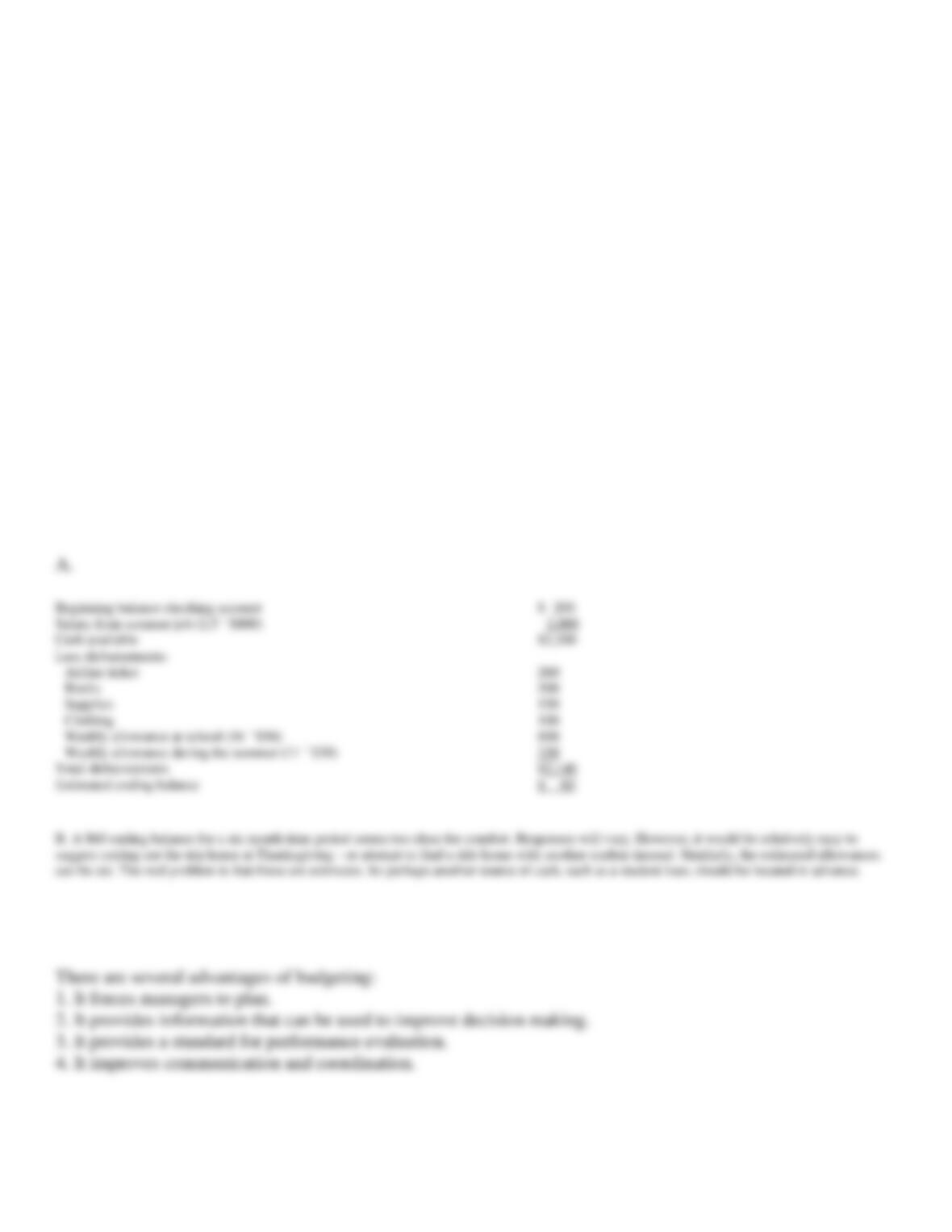
130. It is May 28 and you have just gotten a summer job that will pay you (net of taxes) $800 per month. You
start June 1 and will work until school starts – halfway through August. Your scholarship pays for tuition, room
and board. But you must buy books, pay for transportation to and from school, and pay for clothing, any extra
meal, entertainment, and so on. You have gathered the following data:
1. One round trip airline ticket is $260, and you’d like to come home for Thanksgiving (your parents will drive
you there in August, and you will try to catch a ride home with another student in December).
2. Books are estimated to cost about $500 per semester for your anticipated major
3. Supplies should be another $150
4. Clothing might run $100 – you already have almost everything you think you’ll need.
5. There are 16 weeks in the semester, and you think you’ll need $50 per week for allowance -to cover extra
meals and entertainment
6. Before school even starts, you need to cover any summer expenses, including going out with friends. $30 a
week sounds about right, since all your friends will be working and saving for college as well. There are 11
weeks of summer.
Right now, you have $200 in your checking account.
A. Prepare a cash budget for the summer and the first semester of college. (Do the entire time period, do not
break it down by week or by month.)
B. Comment on the estimated ending balance. What actions can you take, if any, to increase it?
131. What are the advantages of budgeting?
132. Which budget is the first one that must be done in the master budgeting process and why?
133. Does a not-for-profit agency need to budget? Why or why not?
134. Briefly describe the attributes of an ideal budgetary system. What features of budgeting have been
identified that encourage positive behavior?
135. Describe some problems with participative budgeting.