3) Which of the following is true in the long run for both monopoly and perfectly competitive
industries?
A) There are low barriers to entry.
B) Firms can earn positive economic profits in the long run.
C) Firms produce at levels that are economically efficient.
D) Firms will go out of business if they cannot charge a price that is at least equal to average
total cost.
4) Relative to a competitive market equilibrium, the profit maximizing quantity chosen by a
monopolist will result in a deadweight loss because
A) the monopolist will produce at a quantity lower than the competitive equilibrium.
B) the monopolist will produce at a quantity higher than the competitive equilibrium.
C) the monopolist will charge a price lower than the competitive equilibrium.
D) the monopolist will keep producing at a quantity even though the MR < MC.
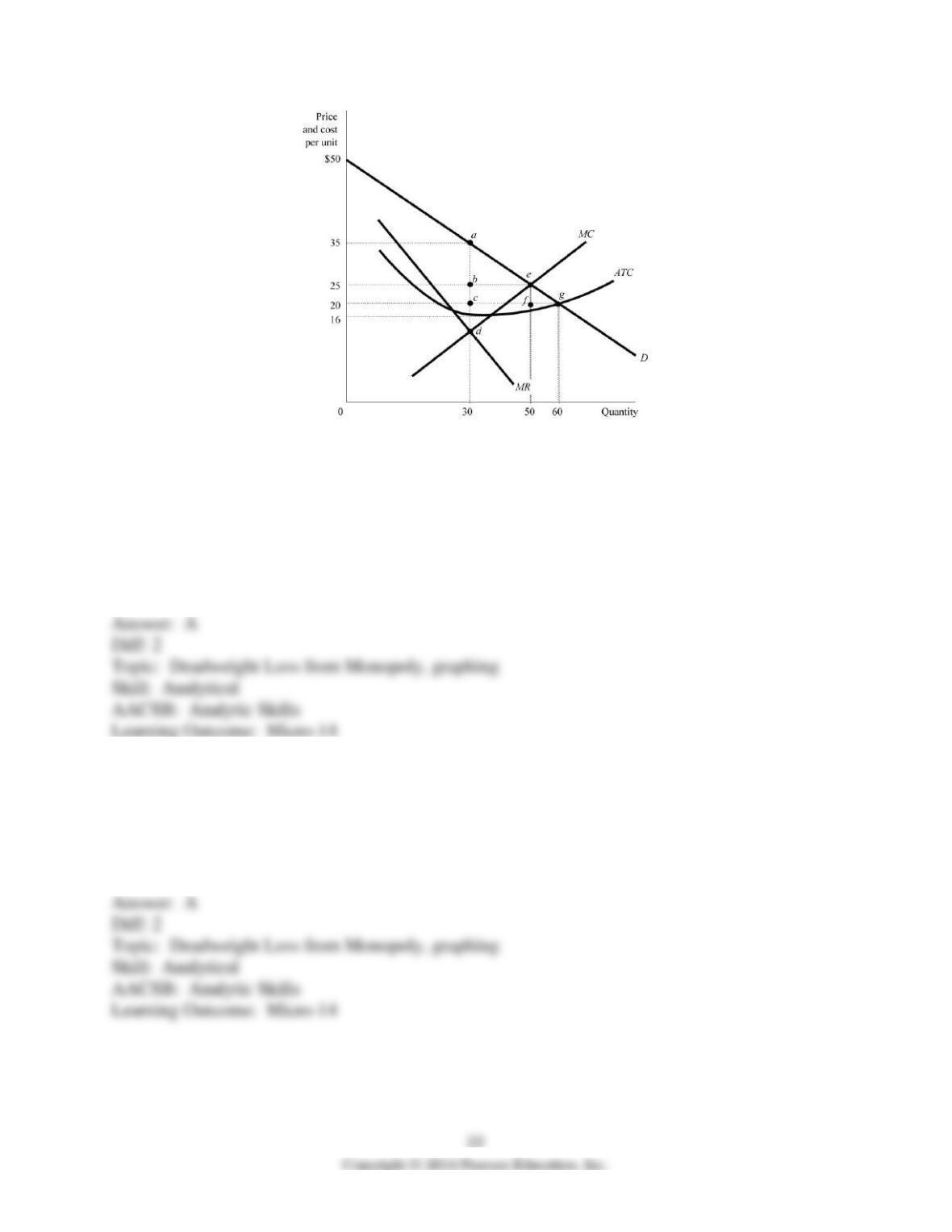
Figure 7.4
5) Suppose that Figure 7.4 shows a monopolist’s demand curve, marginal revenue, and its costs.
The monopolist would maximize its profit by producing a quantity of
A) 30 units.
B) 50 units.
C) 60 units.
D) There is not sufficient information.
6) Suppose that Figure 7.4 shows a monopolist’s demand curve, marginal revenue, and its costs.
The monopolist would maximize its profit by charging a price of
A) $35.
B) $25.
C) $20.
D) $16.
7) Suppose that Figure 7.4 shows a monopolist’s demand curve, marginal revenue, and its costs.
At the profit maximizing output level, the monopolist’s profit would be
A) $730.
B) $570.
C) $320.
D) $150.
8) Suppose that Figure 7.4 shows an industry’s market demand, its marginal revenue, and the
production costs of a representative firm. If the industry was perfectly competitive, it would
produce a quantity of
A) 30 units.
B) 50 units.
C) 60 units.
D) There is not sufficient information.
9) Suppose that Figure 7.4 shows an industry’s market demand, its marginal revenue, and the
production costs of a representative firm. If the industry was perfectly competitive, a
representative firm would charge a price of
A) $35.
B) $25.
C) $20.
D) $16.
10) Suppose that Figure 7.4 shows an industry’s market demand, its marginal revenue, and the
production costs of a representative firm. If the industry was perfectly competitive, a
representative firm’s profit would be
A) $1,250.
B) $450.
C) $250.
D) There is not sufficient information.
11) Refer to Figure 7.4. If the market was perfectly competitive, the consumer surplus would be
A) $850.
B) $625.
C) $300.
D) $100.
12) Refer to Figure 7.4. If the market was a monopoly, the consumer surplus would be
A) $625.
B) $450.
C) $300
D) $225.
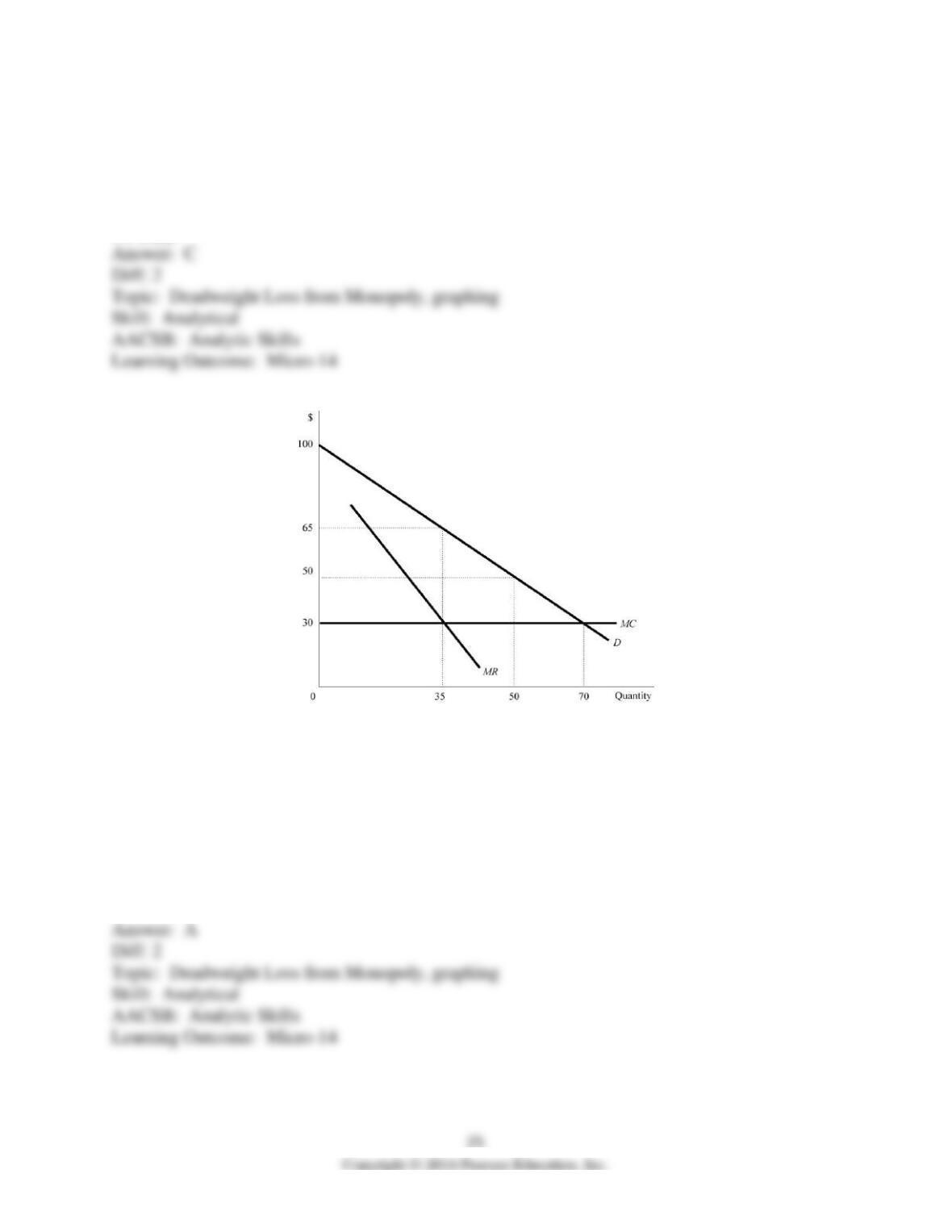
13) Refer to Figure 7.4. The deadweight loss associated with the monopoly would be represented
by the area
A) △abe.
B) △ace.
C) △ade.
D) △efg.
Figure 7.5
14) Suppose that Figure 7.5 shows a monopolist’s demand curve, marginal revenue, and its cost.
The monopolist would maximize its profit by producing a quantity of ________ and by charging
a price of ________.
A) 35; $65
B) 50; $50
C) 70; $30
D) There is not sufficient information.
15) Suppose that Figure 7.5 shows a monopolist’s demand curve, marginal revenue, and its cost.
At the profit maximizing output level and price, the consumer surplus would be
A) $2,450.
B) $1,225.
C) $612.5.
D) $262.5.
16) Suppose that Figure 7.5 shows an industry’s market demand, its marginal revenue, and the
production costs of a representative firm. If the industry was perfectly competitive, it will
produce a quantity of ________ and charge a price of ________.
A) 35; $65
B) 50; $50
C) 70; $30
D) There is not sufficient information.
17) Suppose that Figure 7.5 shows an industry’s market demand, its marginal revenue, and the
production costs of a representative firm. If the industry was perfectly competitive, the consumer
surplus would be
A) $2,450.
B) $1,225.
C) $612.5.
D) $262.5.
18) Refer to Figure 7.5. The deadweight loss associated with the monopoly would be
A) $787.5.
B) $612.5.
C) $262.5.
D) There is not sufficient information.
19) The term “rent seeking” best describes a situation in which
A) individuals expend effort searching for a good price on an apartment.
B) consumers compete for a limited quantity of the good.
C) firms use resources to secure or preserve a monopoly in providing a good or service.
D) None of the above are good descriptions of rent-seeking behavior.
20) When a pharmaceutical firm spends millions of dollars to lobby and convince Congress to
extend the number of years a firm is awarded patent protection, then the pharmaceutical firm is
engaging in
A) rent seeking.
B) fraud.
C) price discrimination.
D) marginal cost pricing.
21) When a local casino spends millions in TV ads convincing town residents to reject another
casino’s bid to operate in the area, the casino is
A) rent seeking.
B) seeking rent controls.
C) acting fraudulently.
D) allocating resources efficiently.
22) When a local casino spends millions in TV ads convincing town residents to reject another
casino’s bid to operate in the area, the most that the casino would be willing to spend is
A) the producer surplus gained by being a monopoly.
B) the consumer surplus gained by being a monopoly.
C) deadweight loss.
D) total economic surplus.
23) In the case of rent-seeking behavior in a monopoly market
A) the net loss to society is greater than it would have been in the absence of rent-seeking
behavior.
B) the net loss to society is less than it would have been in the absence of rent-seeking behavior.
C) the net loss to society is the same as it would have been in the absence of rent-seeking
behavior.
D) monopoly profit is higher than if the monopolist did not engage in rent-seeking behavior, but
the net loss to society is lower.
Recall the Application about the developer who is interested in building a casino in
Creswell, Oregon to answer the following question(s).
24) Recall the Application. By offering the citizens of Creswell, Oregon a yearly cash payment if
they voted to approve his casino, the developer was engaged in
A) price discrimination.
B) rent seeking.
C) applying for a patent.
D) network externalities.
25) Recall the Application. The developer who was interested in building a casino in Creswell,
Oregon was willing to offering the citizens of Creswell a yearly cash payment if they voted to
approve his casino because in Creswell, the casino market would most likely be
A) perfectly competitive.
B) monopolistically competitive.
C) an oligopoly.
D) a monopoly.
26) Part of the efficiency cost resulting from a switch from perfect competition to monopoly is
the loss of consumer surplus caused by the decrease in quantity produced.
27) Monopolists earn excessive profits by increasing their quantity produced above the
competitive market outcome.
28) If a market switches from being a perfectly competitive market to being a monopoly market,
the decrease in consumer surplus is more than offset by an increase in producer profits.
29) Monopolists reduce producer surplus.
30) Monopoly reduces market efficiency compared to perfect competition.
31) Firms that expend resources for lobbying that could have been used for productive services
are engaging in rent-seeking behavior.
32) Explain why a monopolist must lower its quantity relative to a competitive market to
maximize its profits.
33) What does the deadweight loss of monopoly measure?
34) Why does monopoly necessarily reduce consumer surplus compared to perfect competition?
35) What is rent seeking?
7.3 Patents and Monopoly Power
1) When governments grant patents
A) producers earn profits that are substantially higher than would occur in a competitive market.
B) consumers pay a higher price than they would in a competitive market.
C) consumers are likely to pay lower prices than they would in a competitive market.
D) Both A and B are correct.
2) Why do pharmaceutical firms benefit most from patent protection?
A) because research and development of drugs require large expenditures that need to be
recouped while the patent is still valid
B) because pharmaceutical drugs need to be controlled by the government
C) because pharmaceutical companies pay large taxes to the government
D) because only physicians can legally prescribe pharmaceutical drugs
3) In which of the following situations can a firm or individual apply for a patent?
A) A firm develops a new tool that makes cutting grass much easier.
B) An author publishes a new novel.
C) Nicki Minaj, a recording artist, releases a new CD in the market.
D) All of the above are activities that can be patented.
4) Suppose that it would cost a firm $10 million to develop a new drug. In the absence of a
patent, other firms will be able to copy and bring to market a generic equivalent of the drug in
three years. In each of these three years, the firm would earn monopoly profits of $3 million. A
patent will generate monopoly status for the firm for twenty years. If the government knew this
information ahead of time, which of the following is most correct?
A) The government should not grant a patent to the firm, because the firm would earn monopoly
profits for three years even without the patent.
B) The government should not grant a patent to the firm, because monopoly leads to efficiency
losses relative to the competitive market.
C) The government should grant a patent to the firm, because even with a patent the firm will not
earn a monopoly profits.
D) The government should grant a patent to the firm, because the firm would not produce the
drug at all without a patent.
5) Suppose that it would cost a firm $9 million to develop a new drug. In the absence of a patent,
other firms will be able to copy and bring to market a generic equivalent of the drug in three
years. In each of these three years, the firm would earn monopoly profits of $4 million. A patent
will generate monopoly status for the firm for twenty years. If the government knew this
information ahead of time, which of the following is most correct?
A) The government should grant a patent to the firm, because the firm would not produce the
drug at all without a patent.
B) The government should grant a patent to the firm, because it does not have the resources to
determine on a case-by-case basis exactly which inventions merit award of the patent.
C) The government should grant a patent to the firm, because even with a patent the firm will not
earn a monopoly profits.
D) The government should not grant a patent to the firm, because the firm would earn sufficient
profits to develop the drug without the patent.
6) The merits of a patent system is
A) the patent system gives firms strong incentives to take the risk of substantial research and
development costs.
B) the patent system may precipitate the development of new products.
C) granting monopoly power through a patent may be beneficial from society’s perspective.
D) all of the above
Recall the Application about allegations that the makers of branded drugs made deals with
generic drug makers once the patents expired on branded drugs to answer the following
question(s).
7) Recall the Application. When a patent ends and generic drugs are introduced, there is
A) downward pressure on the price of the patent version of the drug.
B) upward pressure on the price of the patent version of the drug.
C) no pressure on the price of the patent version of the drug.
D) no demand for the patent version of the drug.
8) Recall the Application. Because when a patent ends and generic drugs are introduced there is
downward pressure on price, the makers of the brand name drug will
A) raise their price.
B) abandon the product.
C) claim the generic is not as good as the patent version of the drug.
D) price discriminate.
9) A patent is a government granted exclusive right to sell a product for a period of time.
10) Patents encourage firms to engage in innovation.
11) Since patents lead to lower quantities and higher prices for new products, society is
necessarily worse off when patents are awarded.
12) All patent protected products would not have been developed without patent protection.
13) Society gains from a patent if the product would not otherwise be developed.
14) What is a patent?
15) What would happen if the government chooses to increase the number of years that a firm
can enjoy patent protection from 20 years to 25 years?
16) Why does the government grant patents to companies that research new drugs?
17) Why does the government grant patents universally rather than just to those products that
would not be developed without a patent?
7.4 Price Discrimination
1) Price discrimination is when a firm charges
A) the same price to all consumers.
B) different prices for different goods to different consumers.
C) different prices for the same goods to different consumers.
D) None of the above is correct.
2) The government allows firms to engage in price discrimination unless the practice
A) allows the firm to earn positive economic profits.
B) reduces consumer surplus.
C) drives rival firms out of business.
D) increases prices to consumers.
3) Which of the following situations would be examples of price discrimination?
A) United Airlines charges customers who book 14 days ahead a lower price than those who
don’t.
B) Chevron gas stations charges customers 20 cents more per gallon if they choose the premium
grade over the regular unleaded.
C) The local carwash charges drivers of minivans and large SUVs a $2.00 “large vehicle”
surcharge.
D) GEICO, an insurance company, charges higher rates to those who received more than one
speeding ticket in the last 6 months.
4) Which conditions must hold if a firm is to engage in price discrimination?
A) It must be extremely difficult, if not impossible, for one consumer to resell a product to
another.
B) Firms must have a sufficiently low amount of market power.
C) Consumers must have very similar preferences for the product.
D) all of the above
5) In order to practice price discrimination a firm must
A) avoid detection by the government.
B) be able to divide consumers into groups with different demands for their product.
C) have a homogeneous product.
D) advertise their product.
6) In order to practice price discrimination a firm must
A) avoid detection by the government.
B) have some degree of market power.
C) have a homogeneous product.
D) advertise their product.
7) The reason that the local telephone company is able to engage in price discrimination between
business and residential customers in providing local phone service is that
A) it is the only provider of local (landline) telephone service.
B) it must be extremely difficult, if not impossible, for one consumer to resell phone service to
another.
C) business and residential customers differ in their willingness to pay for phone service.
D) All of the above are correct.
8) A school bookstore tried to engage in price discrimination by selling novels to students and
faculty for different prices. Its strategy was to increase prices to faculty and decrease prices to
students. What is the most likely reason that this strategy failed?
A) Novels are sold in a competitive market.
B) There was nothing to prevent students from purchasing novels and reselling them to faculty.
C) Everyone had inelastic demand for novels.
D) There was no easy way to distinguish the students from the faculty.
9) If we observe a firm engaging in price discrimination, it must be true that
A) the firm is enjoying higher total profits than it would have earned if it charged a single price
for the product.
B) the firm can identify the preferences of every customer it serves.
C) the firm earns higher profits per unit than it would have earned if it charged a single price for
the product.
D) All of the above are correct.