Sarbanes-Oxley, Internal Control, and Cash ♦ 363
ESSAY
1. What is the purpose of the Sarbanes-Oxley Act of 2002 and why was it enacted?
2. What are the three objectives of internal control?
3. Explain what is meant by employee fraud.
4. Explain what is meant by the business’s control environment and list three factors that influence it.
5. Discuss what would be included under personnel policies.
364 ♦ Chapter 7
6. Explain why one person should NOT be permitted to purchase, receive and pay for supplies.
7. What is the purpose of control procedures and list several examples of control procedures.
8. Discuss several warning signs with regard to employees that may signal potential internal control
problems.
9. If the cash short and over account has a credit balance, on what financial statement and where is it
listed?
10. Explain the purpose of a voucher system and describe what a voucher is.
Sarbanes-Oxley, Internal Control, and Cash ♦ 365
11. Describe what a bank statement is for a checking account and discuss what a credit ending balance
would indicate.
12. If a customer’s check does not clear the bank, what is this referred to as on the bank reconciliation?
How is it treated on the bank reconciliation and how is it recorded?
13. What is a petty cash fund? What is the purpose, how is it created , how is it replenished?.
14. Explain the purpose of the petty cash fund.
15. What is a special-purpose cash fund? What is the purpose and give two examples.
366 ♦ Chapter 7
16. Define cash equivalents, list some examples and indicate where they appear on the financial
statements.
17. Where is cash presented on the financial statements? What is meant by cash equivalents, a
compensating balance, and a line of credit?
18. Explain what the ratio of cash to monthly cash expenses measures.
Sarbanes-Oxley, Internal Control, and Cash ♦ 367
PROBLEM
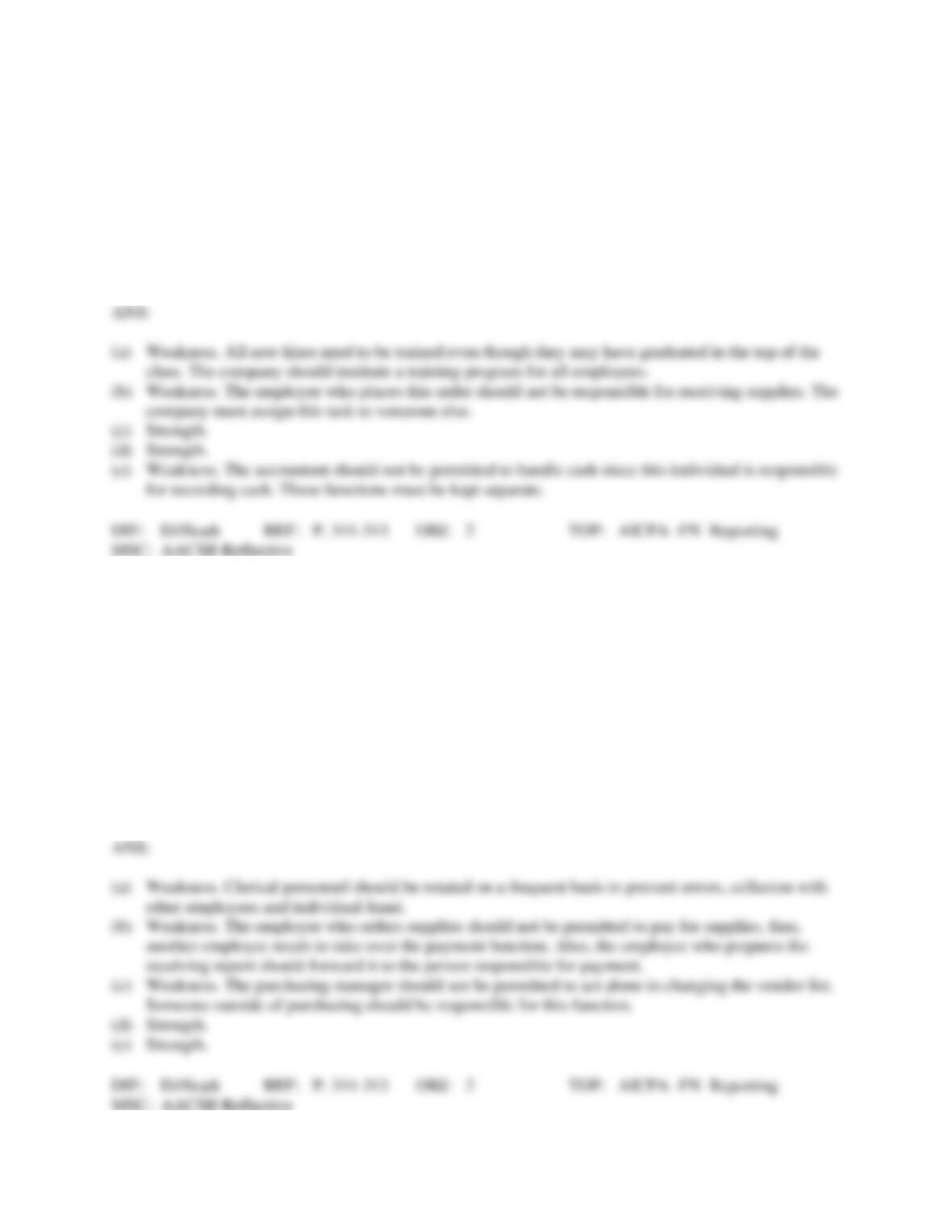
1. A-Tech Company collects most of its revenues through customer checks received in the mail. An
employee in the mail room opens the mail and prepares a tally of all customer checks for bank
deposit and forwards them to the accountant. The company accountant in turn deposits the checks
and records the customer payments. Also, the accountant completes the bank reconciliation at
month end to insure that there are no errors on the bank’s or company’s books.
Indicate any weak links you observe in A-Tech’s internal controls.
2. Fashion Designs sells exclusive women apparel. In order to maintain an adequate inventory stock,
the sales manager places all orders with vendors in order to prevent possible stockouts. The sales
manager is responsible for comparing vendor pricing and places the order with the vendor having
the best price. When inventory orders are received, an employee working the stockroom verifies
that the items were received and forwards the receiving report to the sales manager who also
checks for accuracy. The sales manager then forwards the receiving report to headquarters for
payment. The accounting department then sends payment to the vendor.
Discuss any weak links you observe in Fashion Design’s internal controls and make suggestions
for improvement.
368 ♦ Chapter 7
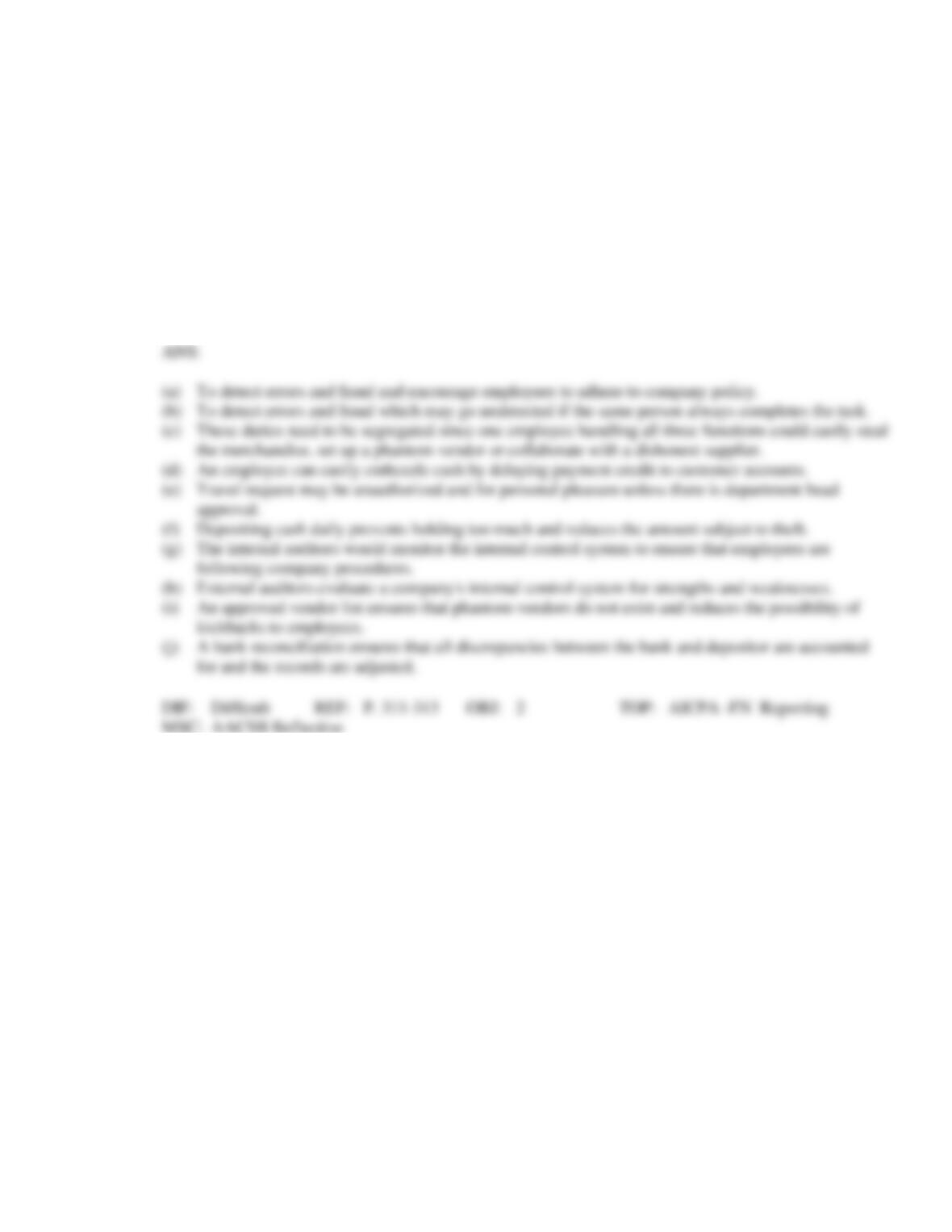
3. For each of the following procedures, indicate whether it is a strength or a weakness. Also, for
each weakness, explain why it is a weakness and how it can be corrected.
(a)
Only the best accounting graduates are hired to eliminate the need for training.
(b)
The person responsible for ordering and receiving supplies is not permitted to record or pay for the
supplies.
(c)
Company policy mandates that all employees take vacation time.
(d)
Internal auditors constantly monitor the internal control system.
(e)
The accountant deposits cash at least once each day to prevent holding large amounts of cash on
hand.
4. For each of the following procedures indicate whether it is a strength or a weakness. Also, explain
why it is a weakness and how it can be corrected.
(a)
To promote efficiency and accuracy, the company offers generous financial incentives to clerical
personnel to continue at their assigned positions unless promoted.
(b)
To prevent errors and fraud a company has one employee order supplies and another employee
receive supplies. Only after the employee who receives the supplies verifies that what was ordered is
received, is the payment made by the employee who placed the order.
(c)
A company prepares an approved vendor list for the purchases of supplies and inventory. Any
changes to the list must be approved by the purchasing manager.
(d)
External auditors are hired to evaluate the internal control system.
(e)
The board of directors establishes an audit committee which is independent of management.
(b)
Weakness. The employee who orders supplies should not be permitted to pay for supplies, thus,
another employee needs to take over the payment function. Also, the employee who prepares the
receiving report should forward it to the person responsible for payment.
(c)
Weakness. The purchasing manager should not be permitted to act alone in changing the vendor list.
Someone outside of purchasing should be responsible for this function.
(d)
Strength.
(e)
Strength.
(a)
Weakness. All new hires need to be trained even though they may have graduated in the top of the
class. The company should institute a training program for all employees.
(b)
Weakness. The employee who places this order should not be responsible for receiving supplies. The
company must assign this task to someone else.
(c)
Strength.
(d)
Strength.
(e)
Weakness. The accountant should not be permitted to handle cash since this individual is responsible
for recording cash. These functions must be kept separate.
Sarbanes-Oxley, Internal Control, and Cash ♦ 369
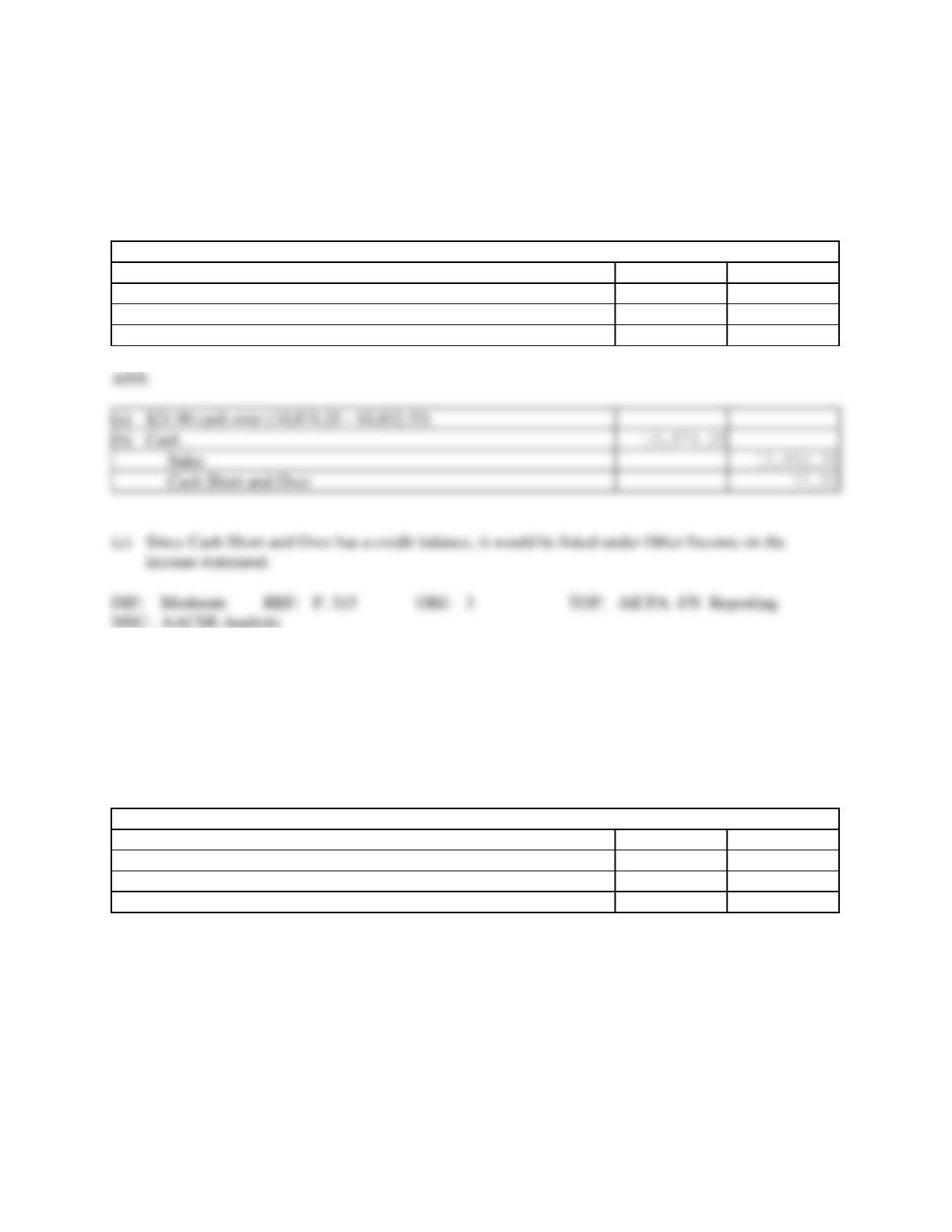
5. For each of the internal control procedures, explain why they are necessary.
(a)
Duties of clerical personnel are rotated.
(b)
Mandatory vacations are imposed.
(c)
The same person cannot order, receive or pay for supplies
(d)
Employees who handle cash are not permitted to record cash.
(e)
Travel requests are approved by department managers.
(f)
Cash is deposited daily.
(g)
The company has an internal audit department.
(h)
The company hires an external auditor.
(i)
An approved vendor list is prepared.
(j)
A bank reconciliation is prepared.
(a)
To detect errors and fraud and encourage employees to adhere to company policy.
(b)
To detect errors and fraud which may go undetected if the same person always completes the task.
the merchandise, set up a phantom vendor or collaborate with a dishonest supplier.
(d)
An employee can easily embezzle cash by delaying payment credit to customer accounts.
(f)
Depositing cash daily prevents holding too much and reduces the amount subject to theft.
(h)
External auditors evaluate a company’s internal control system for strengths and weaknesses.
kickbacks to employees.
370 ♦ Chapter 7
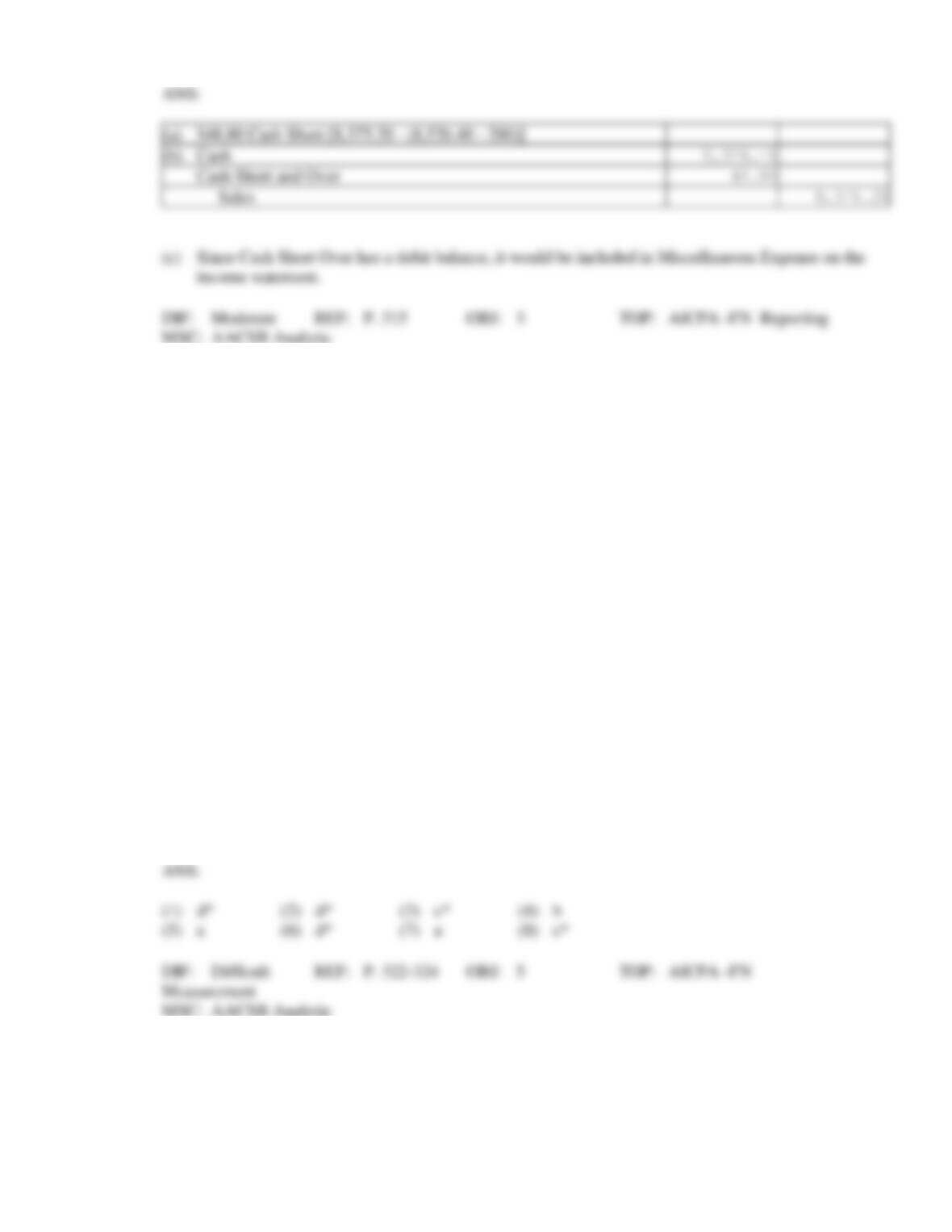
6. The actual cash received from cash sales was $10,874.25 and the amount indicated by the cash
register total was $10,852.35.
(a)
Determine the amount of cash short and over.
(b)
Prepare the entry to record the cash receipts and cash sales.
(c)
Indicate on which statement and where the cash short and over would be reported.
General Journal
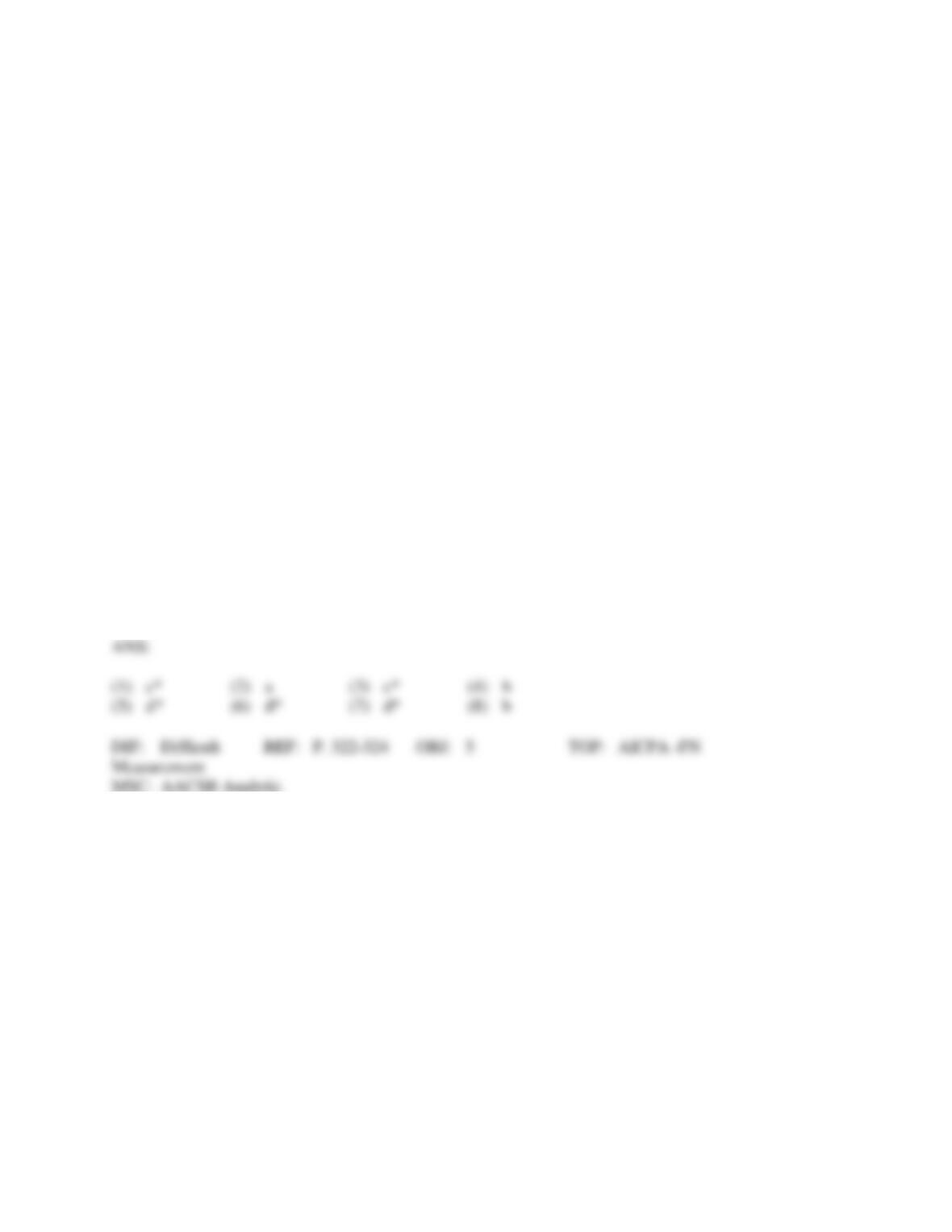
7. A cash register begins with $200 and recorded cash sales for the day are $8,375.20. The actual
cash count of the cash register at the end of the day is $8,526.40.
(a)
Determine the amount of cash short and over.
(b)
Prepare the entry to record the cash receipts and cash sales.
(c)
Indicate on which statement and where the cash short and over would be reported.
General Journal
(a)
$21.90 cash over (10,874.25 – 10,852.35)
(b)
Cash
Sales
Cash Short and Over
Sarbanes-Oxley, Internal Control, and Cash ♦ 371
8. Identify each of the following reconciling items as:
a.
an addition to the cash balance according to the bank statement,
b.
a deduction from the cash balance according to the bank statement,
c.
an addition to the cash balance according to the depositor’s records, or
d.
a deduction from the cash balance according to the depositor’s records.
(Assume none of the transactions reported by bank debit and credit memorandums have been
recorded by the depositor.)
Next, indicate which reconciling items would require an entry in the depositor’s accounts by
placing an “*” after your response to Part 1.
Reconciling Items
(1)
Bank debit memorandum for service charges $185.
(2)
A check written for $530 in payment of an account payable was erroneously recorded by the
depositor as $350.
(3)
Bank collected a $10,000 note on the company’s behalf.
(4)
A check for $210 was erroneously charged by the bank for $120.
(5)
Deposits in transit total $4,600.
(6)
A customer’s NSF check for $500 was returned by the bank.
(7)
A deposit for $5,400 was erroneously credited to the depositor’s account by the bank for $4,500.
(8)
A deposit for $3,650 was incorrectly recorded by the depositor at $3,560.
(1)
d*
(2)
d*
(3)
c*
(4)
b
(5)
a
(6)
d*
(7)
a
(8)
c*
(a)
$48.80 Cash Short [8,375.20 – (8,526.40 – 200)]
(b)
Cash
Cash Short and Over
Sales
income statement.
372 ♦ Chapter 7
9. Part 1
Identify each of the following reconciling items as:
a.
an addition to the cash balance according to the bank statement,
b.
a deduction from the cash balance according to the bank statement,
c.
an addition to the cash balance according to the depositor’s records, or
d.
a deduction from the cash balance according to the depositor’s records.
(Assume none of the transactions reported by bank debit and credit memorandums have been
recorded by the depositor.)
Part 2
Next, indicate which reconciling items would require an entry in the depositor’s accounts by
placing an “*” after your response to Part 1.
Reconciling Items
(1)
Interest credited to the depositor’s account according to the bank statement is $110.
(2)
Deposits in transit total $2,200.
(3)
A check written for $1,450 in payment of an account payable was erroneously recorded by the
depositor for $1,540.
(4)
Outstanding checks total $4,200.
(5)
A customer’s NSF check for $250 was returned by the bank
(6)
A deposit for $2,670 was incorrectly recorded by the depositor for $2,760.
(7)
Bank services charges total $80.
(8)
A deposit for $780 was erroneously credited to the depositor’s account by the bank for $870.
(1)
c*
(2)
a
(3)
c*
(4)
b
(5)
d*
(6)
d*
(7)
d*
(8)
b
Sarbanes-Oxley, Internal Control, and Cash ♦ 373
10. Prepare a bank reconciliation with the following information:
a.
Cash balance according to the bank statement at September 30, $12,654.50
b.
Cash balance according to the depositor’s records at September 30, $11,282.98
c.
Bank service charges, $85
d.
Customer’s NSF check returned by the bank $65.20
e.
Deposit in transit at September 30, $3,460.40
f.
Outstanding checks at September 30, $5,675.12
g.
A deposit for $2,120 was erroneously credited to the depositor’s account by the bank for $2,210
h.
A check written for $870 in payment of an account payable was incorrectly recorded by the
depositor for $87
Bank Reconciliation
Cash balance according to the bank statement
Add deposit in transit
Deduct: outstanding checks
Error by bank in recording deposit
Adjusted balance
Cash balance according to depositor’s records
Less: bank service charges
Customer’s NSF check
Error in recording check
Adjusted balance