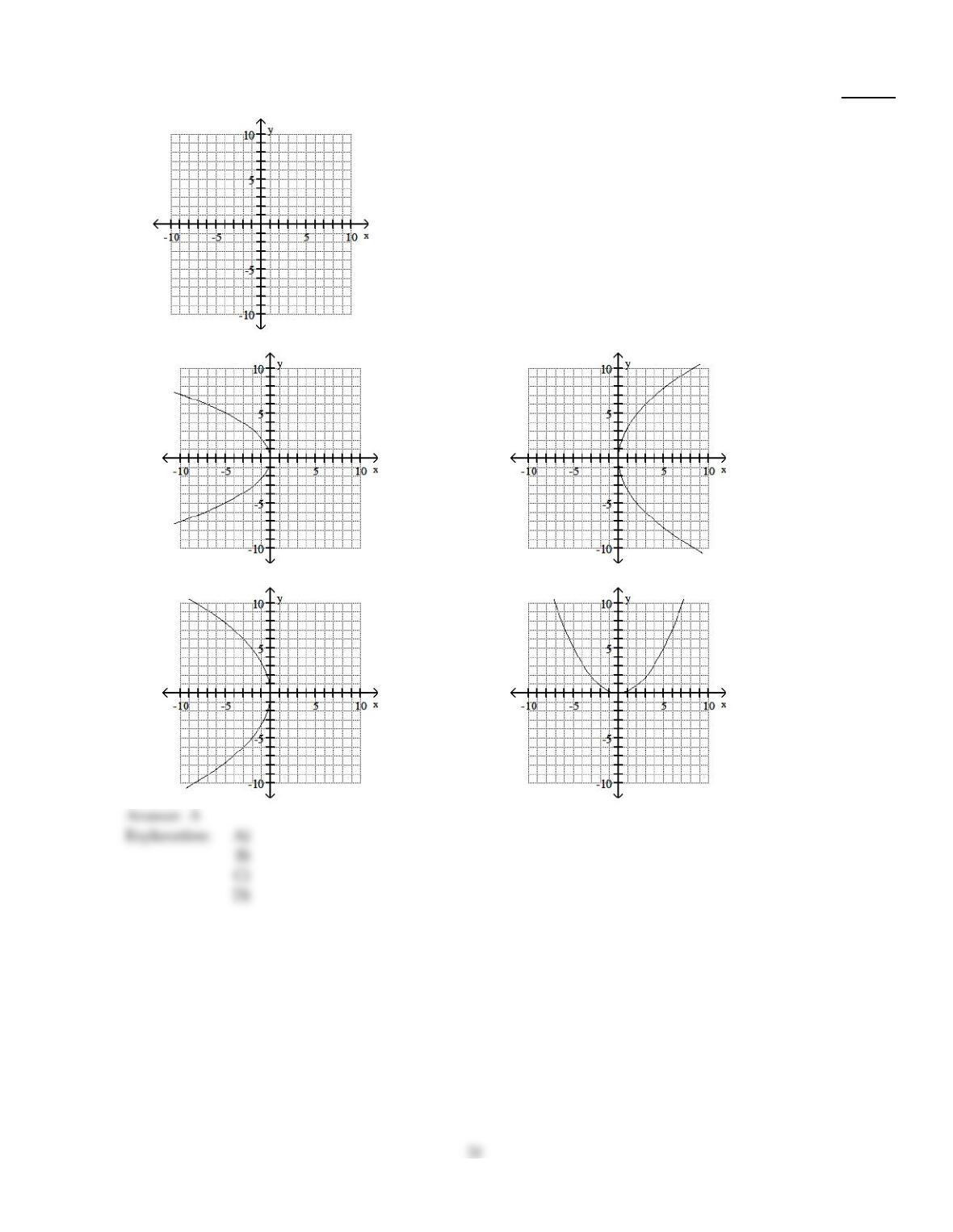
30)
y2= – 5x
30)
A)
B)
C)
D)
Convert the equation to the standard form for a hyperbola by completing the square on x and y.
31)
x2–y2+ 6x + 2y + 7 = 0
31)
A)
(y + 3)2–(x – 1)2= 1
B)
(y + 3)2
4–(x – 1)2
36 = 1
C)
(x + 3)2+(y – 1)2= 1
D)
(x + 3)2–(y – 1)2= 1
Solve the problem.
32)
An experimental model for a suspension bridge is built. In one section, cable runs from the top of
one tower down to the roadway, just touching it there, and up again to the top of a second tower.
The towers stand 80 inches apart. At a point between the towers and 20 inches along the road from
the base of one tower, the cable is 4 inches above the roadway. Find the height of the towers.
32)
A)
16.5 in.
B)
18 in.
C)
15.5 in.
D)
16 in.
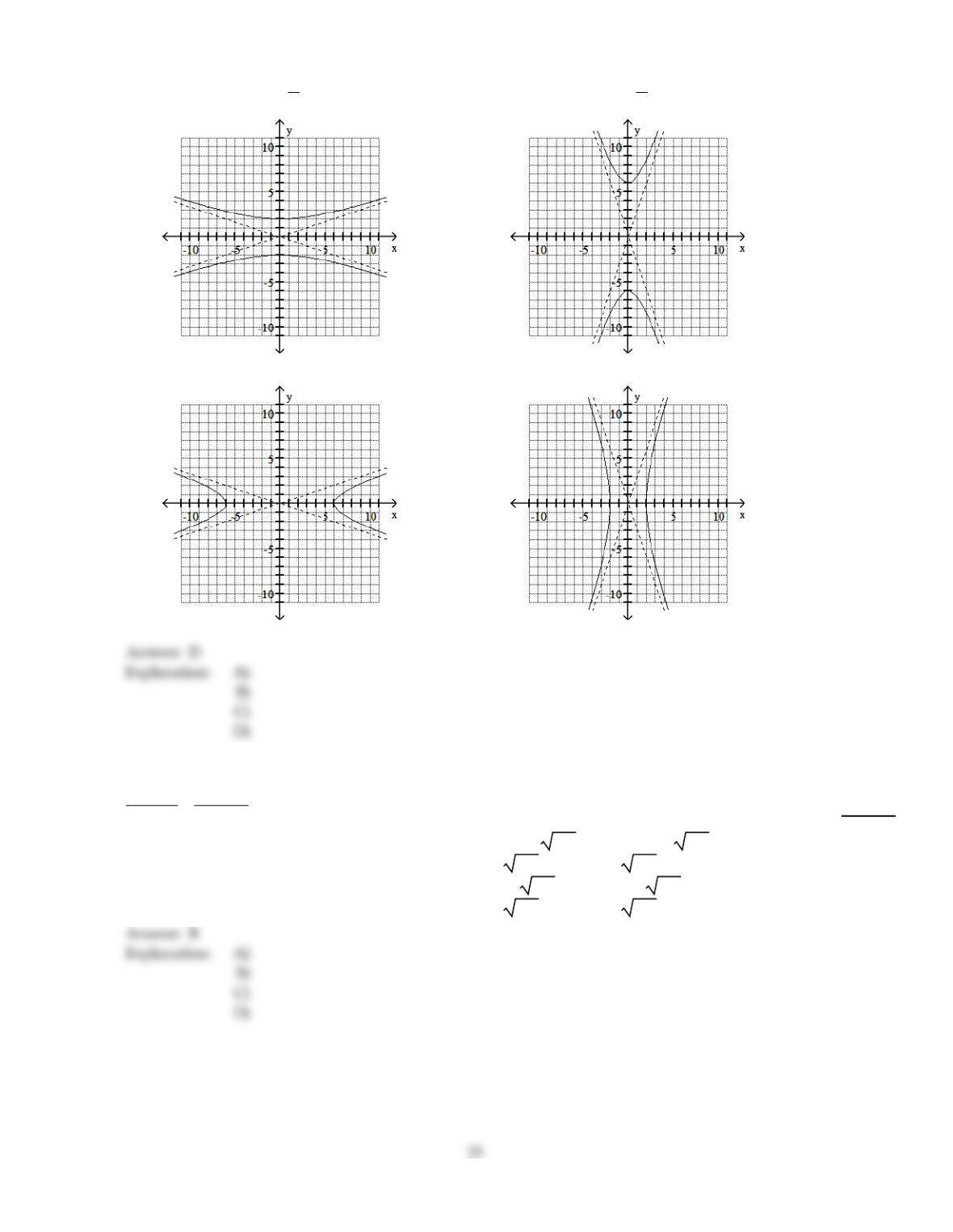
Use vertices and asymptotes to graph the hyperbola. Find the equations of the asymptotes.
33)
x2
4–y2
36 = 1
33)
22
A)
Asymptotes: y = ± 1
3x
B)
Asymptotes: y = ± 1
3x
C)
Asymptotes: y = ± 3x
D)
Asymptotes: y = ± 3x
Find the location of the center, vertices, and foci for the hyperbola described by the equation.
34)
(x – 1)2
81 –(y – 2)2
100 = 1
34)
A)
Center: (–1, –2); Vertices: (–10, –2) and (8, –2); Foci: (–1–181, –2) and (–1+181, –2)
B)
Center: (1, 2); Vertices: (–8, 2) and (10, 2); Foci: (1 –181, 2) and (1+181, 2)
C)
Center: (1, 2); Vertices: (–8, –2) and (10, –2); Foci: (1–181, –2) and (1+181, –2)
D)
Center: (1, 2); Vertices: (–7, 2) and (11, 2); Foci: (2+181, 3) and (3+181, 3)
Find the focus and directrix of the parabola with the given equation.
35)
x =7y2
35)
A)
focus: ( 1
28 , 0)
directrix: x = – 1
28
B)
focus: ( 1
28 , 0)
directrix: x =1
28
C)
focus: ( 1
7, 0)
directrix: x = – 1
7
D)
focus: (0, 1
28 )
directrix: y = – 1
28
Solve the problem.
36)
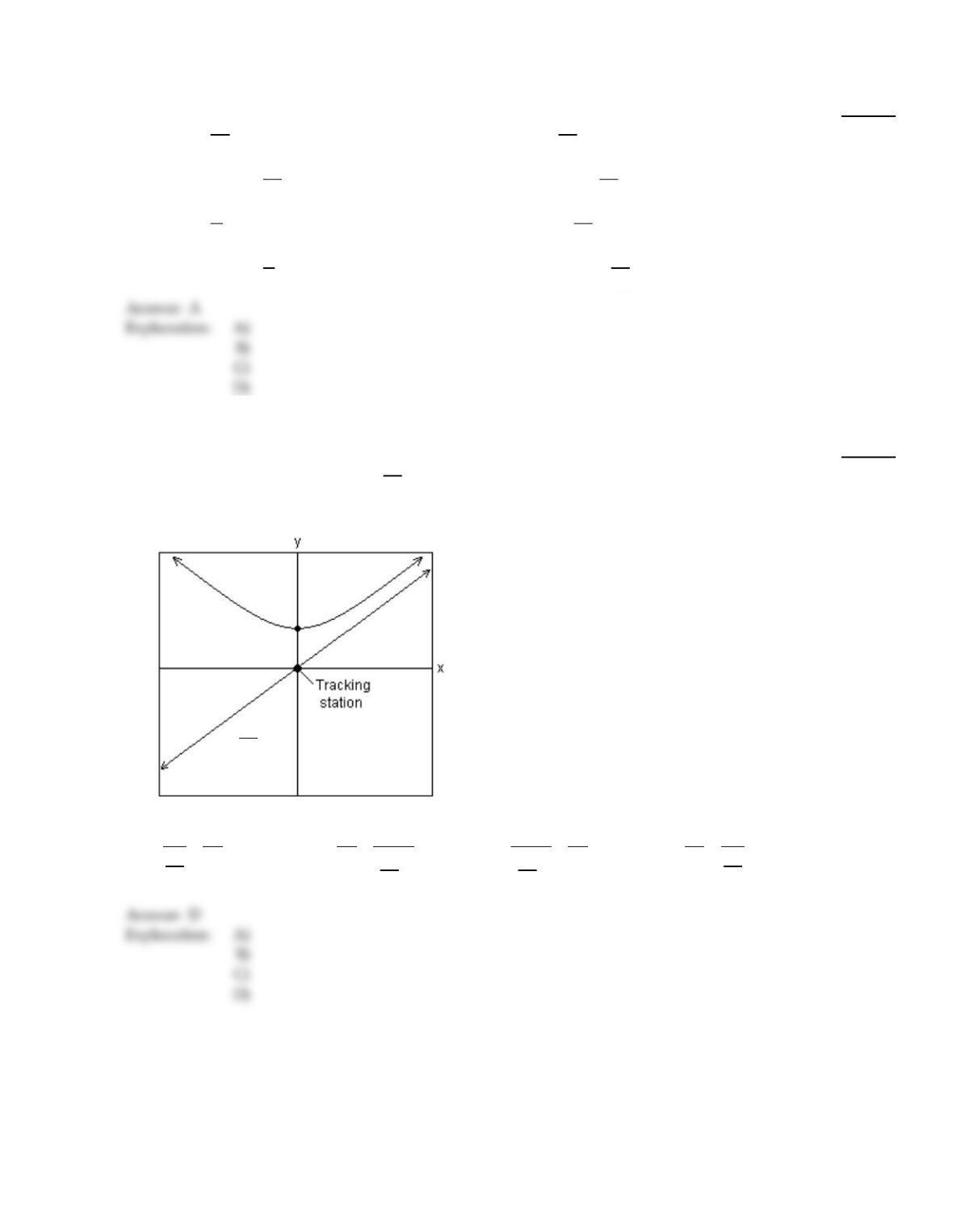
A satellite following the hyperbolic path shown in the picture turns rapidly at (0, 4) and then
moves closer and closer to the line y =12
5x as it gets farther from the tracking station at the origin.
Find the equation that describes the path of the satellite if the center of the hyperbola is at (0, 0).
(0, 4)
y =12
5x
36)
A)
y2
25
9
–x2
16 = 1
B)
x2
16 –y2
(36
5)2= 1
C)
x2
(36
5)2–y2
16 = 1
D)
y2
16 –x2
25
9
= 1
24
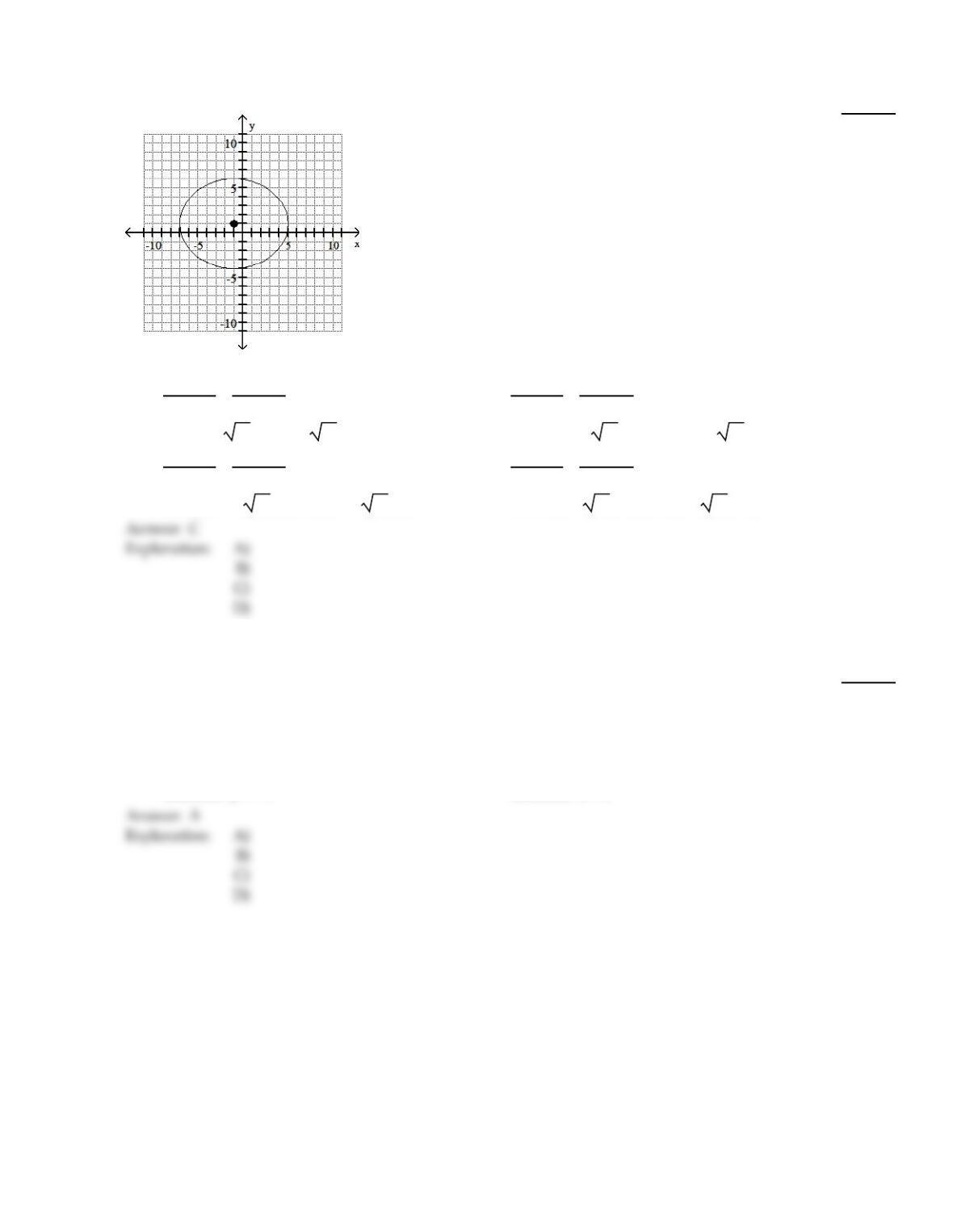
Find the standard form of the equation of the ellipse and give the location of its foci.
37)
Center at (–1, 1)
37)
A)
(x – 1)2
25 +(y + 1)2
36 = 1
foci at (–11, 1) and ( 11, 1)
B)
(x – 1)2
36 +(y + 1)2
25 = 1
foci at (–1+11, –1) and (–1–11, –1)
C)
(x + 1)2
36 +(y – 1)2
25 = 1
foci at (–1+11, 1) and (–1–11, 1)
D)
(x + 1)2
25 +(y – 1)2
36 = 1
foci at (1+11, –1) and (1–11, –1)
Find the vertex, focus, and directrix of the parabola with the given equation.
38)
(x + 1)2=16(y + 3)
38)
A)
vertex: (–1, –3)
focus: (–1, 1)
directrix: y = – 7
B)
vertex: (–3, –1)
focus: (–3, 3)
directrix: y = – 5
C)
vertex: (1, 3)
focus: (1, 7)
directrix: y = – 1
D)
vertex: (–1, –3)
focus: (–1, –7)
directrix: x =1
25
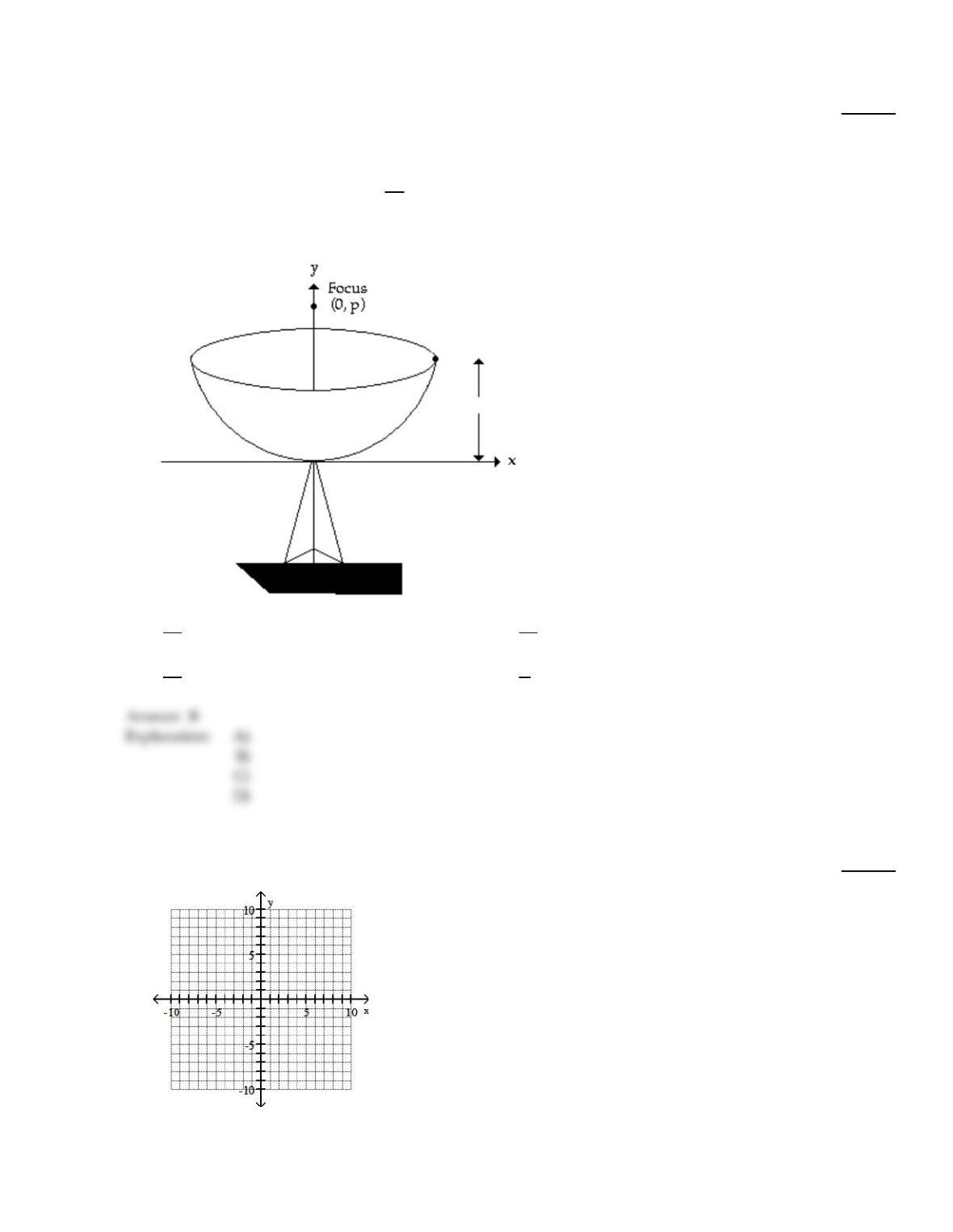
Solve the problem.
39)
A satellite dish is in the shape of a parabolic surface. Signals coming from a satellite strike the
surface of the dish and are reflected to the focus, where the receiver is located. The satellite dish
shown has a diameter of 10 feet and a depth of 3 feet. The parabola is positioned in a rectangular
coordinate system with its vertex at the origin. The receiver should be placed at the focus (0, p). The
value of p is given by the equation a =1
4p . How far from the base of the dish should the receiver be
placed?
(5, 3)
3 feet
39)
A)
3
25 feet from the base
B)
21
12 feet from the base
C)
12
25 feet from the base
D)
81
3 feet from the base
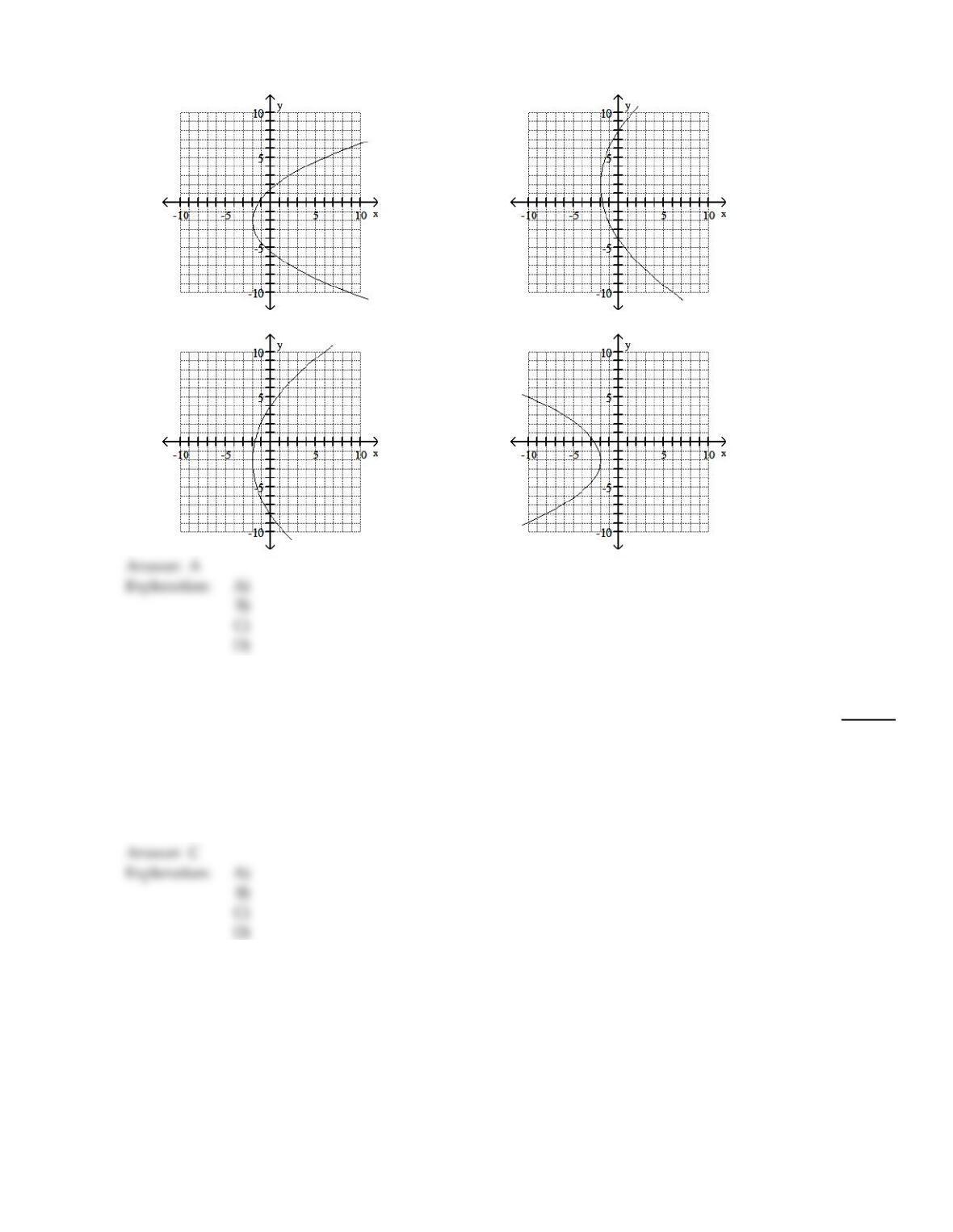
Graph the parabola with the given equation.
40)
(y + 2)2=6(x + 2)
40)
26
A)
B)
C)
D)
Find the vertex, focus, and directrix of the parabola with the given equation.
41)
(y + 3)2=8x
41)
A)
vertex: (–3, 0)
focus: (2, –3)
directrix: x = – 5
B)
vertex: (0, –3)
focus: (–4, –3)
directrix: x = – 2
C)
vertex: (0, –3)
focus: (2, –3)
directrix: x = – 2
D)
vertex: (0, 3)
focus: (4, 3)
directrix: x =0
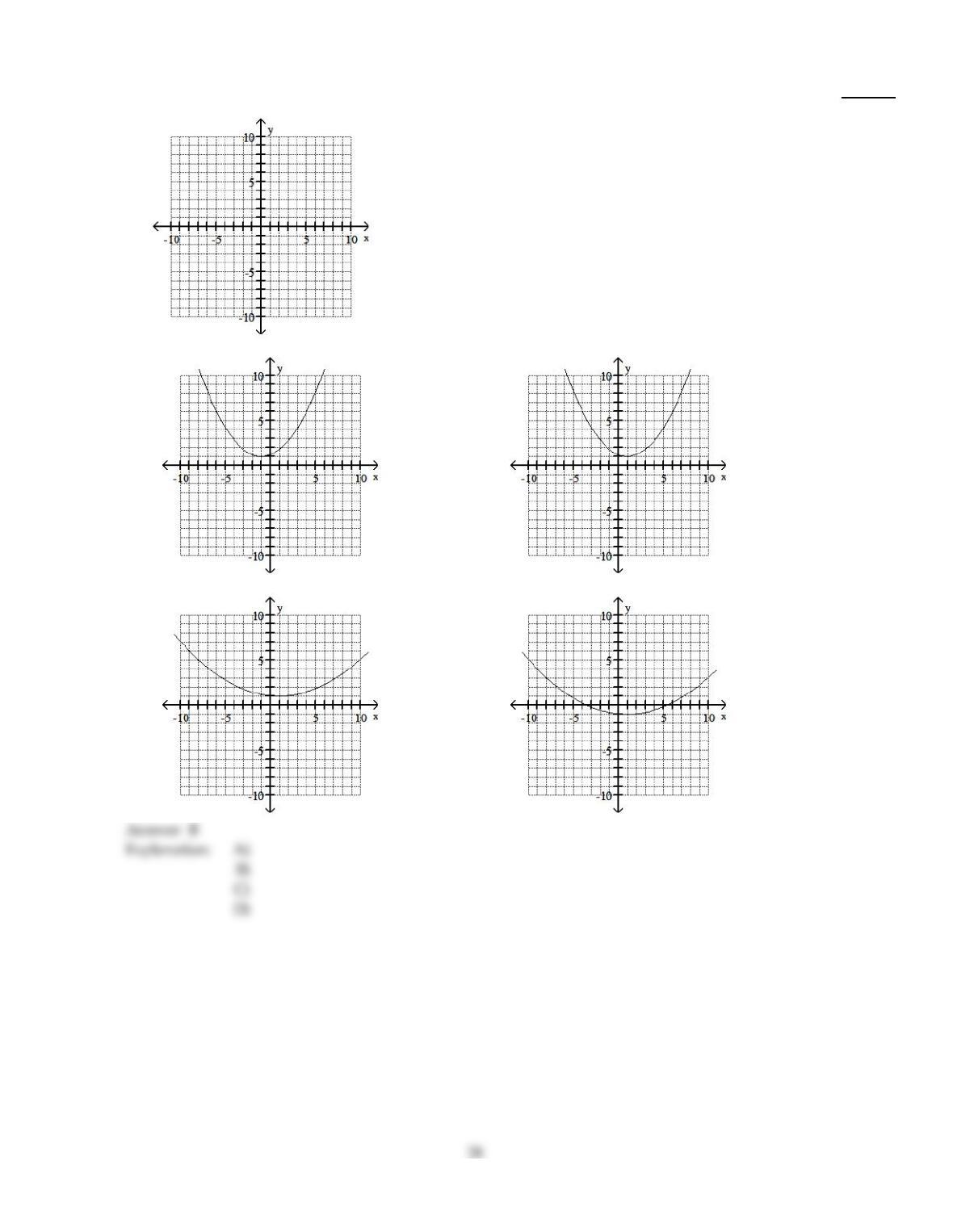
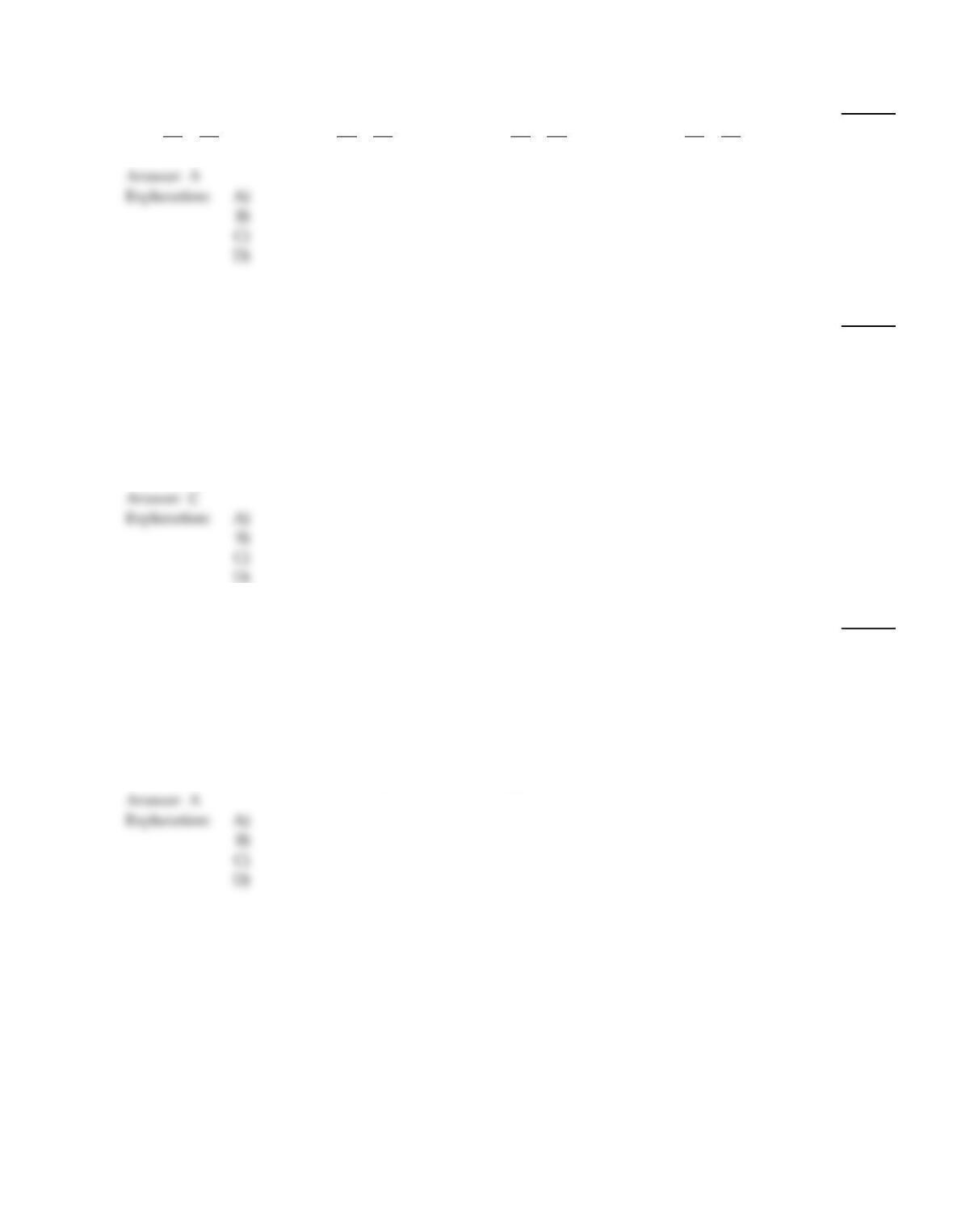
Graph the parabola with the given equation.
27
42)
(x – 1)2=5(y – 1)
42)
A)
B)
C)
D)
Find the standard form of the equation of the ellipse satisfying the given conditions.
43)
Foci: (–3, 0), (3, 0); vertices: (–4, 0), (4, 0)
43)
A)
x2
16 +y2
7= 1
B)
x2
9+y2
16 = 1
C)
x2
7+y2
16 = 1
D)
x2
9+y2
7= 1
Solve the problem.
44)
The arch beneath a bridge is semi–elliptical, a one–way roadway passes under the arch. The width
of the roadway is 38 feet and the height of the arch over the center of the roadway is 13 feet. Two
trucks plan to use this road. They are both 10 feet wide. Truck 1 has an overall height of 12 feet and
Truck 2 has an overall height of 13 feet. Draw a rough sketch of the situation and determine which
of the trucks can pass under the bridge.
44)
A)
Truck 2 can pass under the bridge, but Truck 1 cannot.
B)
Neither Truck 1 nor Truck 2 can pass under the bridge.
C)
Truck 1 can pass under the bridge, but Truck 2 cannot.
D)
Both Truck 1 and Truck 2 can pass under the bridge.
45)
The arch beneath a bridge is semi–elliptical, a one–way roadway passes under the arch. The width
of the roadway is 36 feet and the height of the arch over the center of the roadway is 13 feet. Two
trucks plan to use this road. They are both 12 feet wide. Truck 1 has an overall height of 12 feet and
Truck 2 has an overall height of 11 feet. Draw a rough sketch of the situation and determine which
of the trucks can pass under the bridge.
45)
A)
Both Truck 1 and Truck 2 can pass under the bridge.
B)
Truck 2 can pass under the bridge, but Truck 1 cannot.
C)
Truck 1 can pass under the bridge, but Truck 2 cannot.
D)
Neither Truck 1 nor Truck 2 can pass under the bridge.
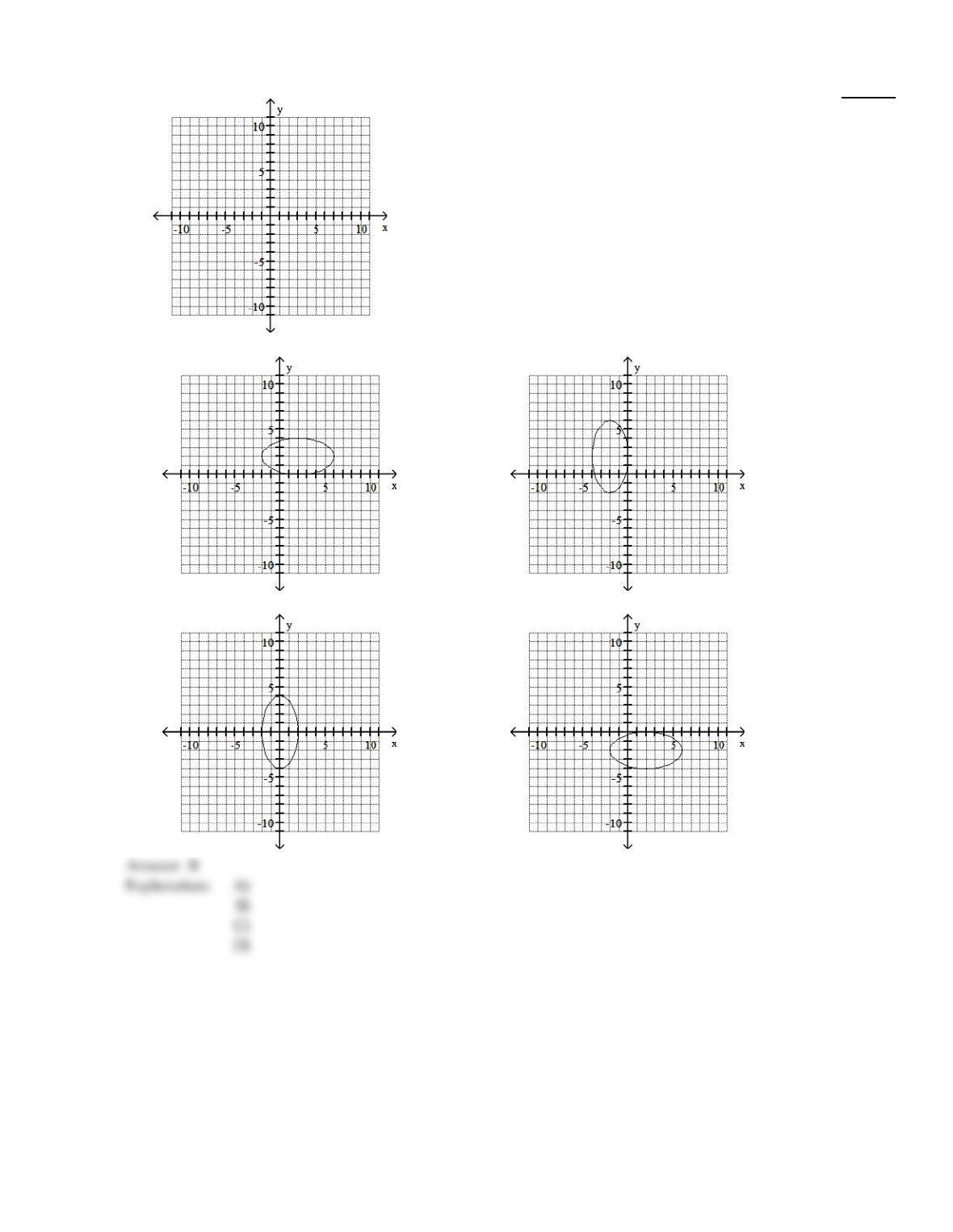
Graph the ellipse.
29
46)
16(x + 2)2+4(y – 2)2=64
46)
A)
B)
C)
D)
30
Find the standard form of the equation of the ellipse satisfying the given conditions.
47)
Foci: (0, –3), (0, 3); y–intercepts: –8 and 8
47)
A)
x2
9+y2
64 = 1
B)
x2
9+y2
55 = 1
C)
x2
55 +y2
64 = 1
D)
x2
64 +y2
55 = 1
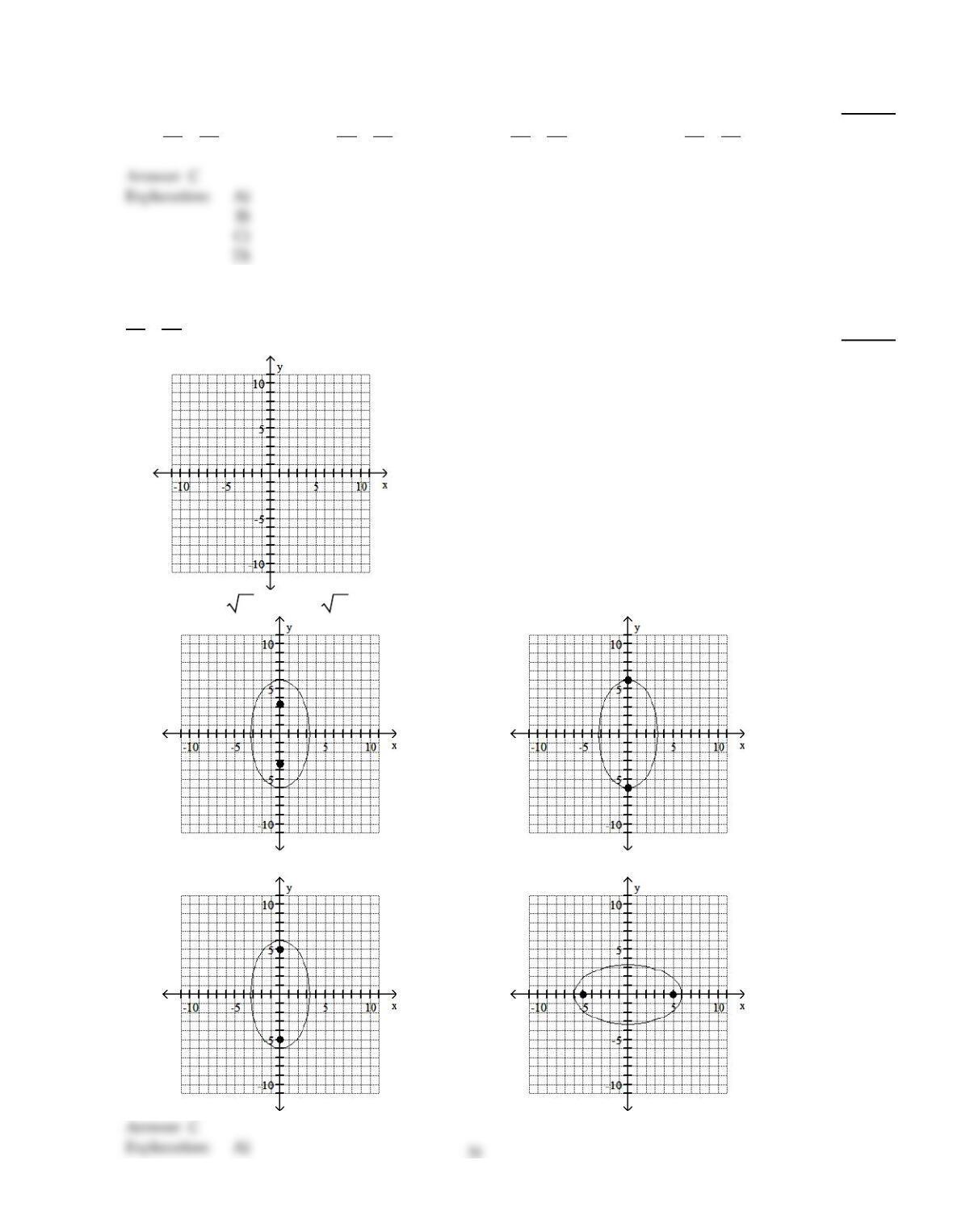
Graph the ellipse and locate the foci.
48)
x2
11 +y2
36 = 1
48)
A)
foci at (0, 11) and (0, –11)
B)
foci at (0, 6) and (0, –6)
C)
foci at (0, 5) and (0, –5)
D)
foci at (5, 0) and (–5, 0)
C
C
Find the standard form of the equation of the ellipse satisfying the given conditions.
49)
Major axis horizontal with length 20; length of minor axis =10; center (0, 0)
49)
A)
x2
25 +y2
100 = 1
B)
x2
100 +y2
25 = 1
C)
x2
400 +y2
100 = 1
D)
x2
20 +y2
25 = 1
50)
Endpoints of major axis: (–2, –10) and (–2, 2); endpoints of minor axis: (–7, –4) and (3, –4);
50)
A)
(x – 2)2
25 +(y – 4)2
36 = 1
B)
(x + 4)2
25 +(y + 2)2
36 = 1
C)
(x – 5)2
25 +(y – 6)2
36 = 1
D)
(x + 2)2
25 +(y + 4)2
36 = 1
Find the vertex, focus, and directrix of the parabola with the given equation.
51)
(x – 1)2= – 8(y – 2)
51)
A)
vertex: (1, 2)
focus: (1, 4)
directrix: x =0
B)
vertex: (–1, –2)
focus: (–1, –4)
directrix: y =0
C)
vertex: (2, 1)
focus: (2, –1)
directrix: y =3
D)
vertex: (1, 2)
focus: (1, 0)
directrix: y =4
Find the standard form of the equation of the parabola using the information given.
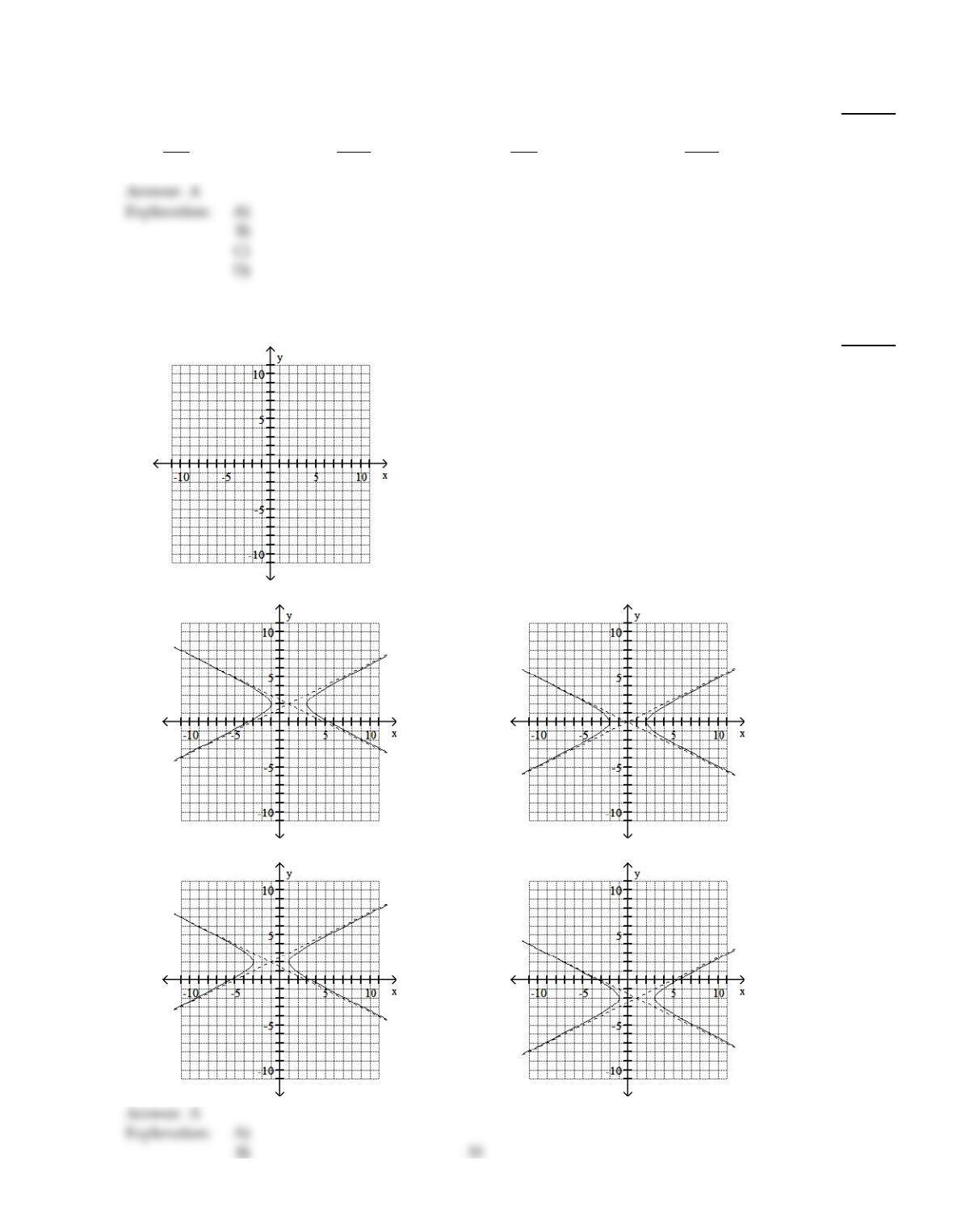
52)
Focus: (2, 0); Directrix: x = – 2
52)
A)
x2=8y
B)
y2=2x
C)
y2= – 8x
D)
y2=8x
Solve the problem.
53)
A reflecting telescope has a parabolic mirror for which the distance from the vertex to the focus is
35 feet. If the distance across the top of the mirror is 76 inches, how deep is the mirror in the center?
53)
A)
361
420 in.
B)
361
5040 in.
C)
361
35 in.
D)
1225
152 in.
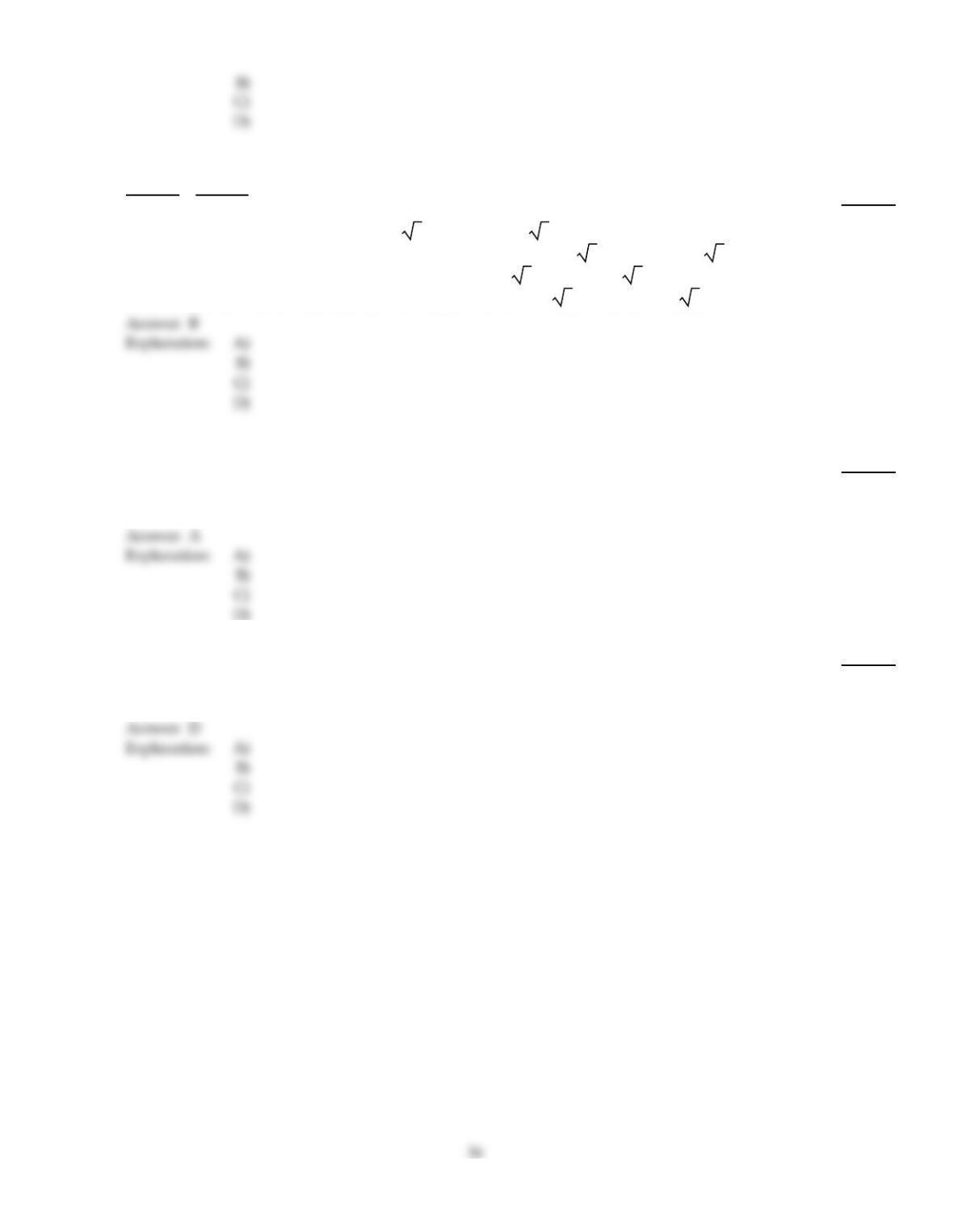
Use the center, vertices, and asymptotes to graph the hyperbola.
54)
(x – 1)2–4(y – 2)2=4
54)
A)
B)
C)
D)
Find the location of the center, vertices, and foci for the hyperbola described by the equation.
55)
(y + 4)2
9–(x + 2)2
36 = 1
55)
A)
Center: (–2, –4); Vertices: (–2, –4–3 5) and (–2, –4+3 5); Foci: (–2, –7) and (–2, –1)
B)
Center: (–2, –4); Vertices: (–2, –7) and (–2, –1); Foci: (–2, –4–3 5) and (–2, –4+3 5)
C)
Center: (2, 4); Vertices: (2, 1) and (2, 7); Foci: (2, 4–3 5) and (2, 4+3 5)
D)
Center: (–2, –4); Vertices: (7, –6) and (–1, 0); Foci: (7, –3–3 5) and (–1, –3+3 5)
Find the standard form of the equation of the parabola using the information given.
56)
Vertex: (3, –6); Focus: (5, –6)
56)
A)
(y +6)2=8(x –3)
B)
(x +3)2= – 4(y –6)
C)
(y +6)2= – 8(x –3)
D)
(x +3)2=4(y –6)
57)
Vertex: (9, –8); Focus: (9, –2)
57)
A)
(y –8)2= – 28(x +9)
B)
(x –9)2= – 24(y +8)
C)
(y –8)2=28(x +9)
D)
(x –9)2=24(y +8)
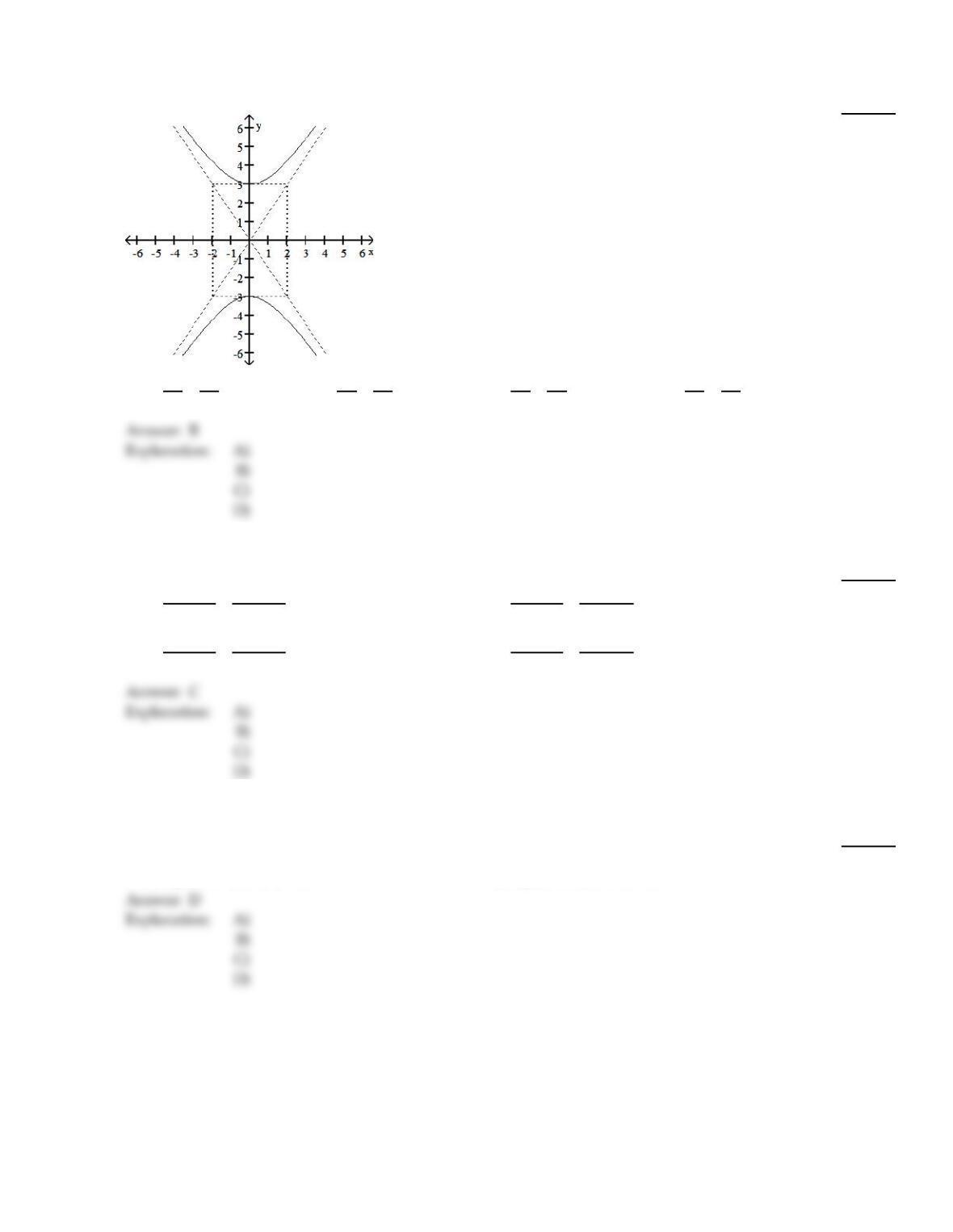
Find the standard form of the equation of the hyperbola.
58)
58)
A)
x2
9–y2
4= 1
B)
y2
9–x2
4= 1
C)
x2
4–y2
9= 1
D)
y2
4–x2
9= 1
Find the standard form of the equation of the ellipse satisfying the given conditions.
59)
Endpoints of major axis: (–7, 4) and (9, 4); endpoints of minor axis: (1, 6) and (1, 2)
59)
A)
(x – 4)2
4+(y – 1)2
64 = 1
B)
(x + 1)2
64 +(y + 2)2
4= 1
C)
(x – 1)2
64 +(y – 4)2
4= 1
D)
(x + 1)2
64 +(y + 2)2
4= 0
Determine the direction in which the parabola opens, and the vertex.
60)
x = – (y + 2)2– 4
60)
A)
Opens to right; (–2, –4)
B)
Opens to left; (–4, 2)
C)
Opens to left; (–2, –4)
D)
Opens to left; (–4, –2)
35
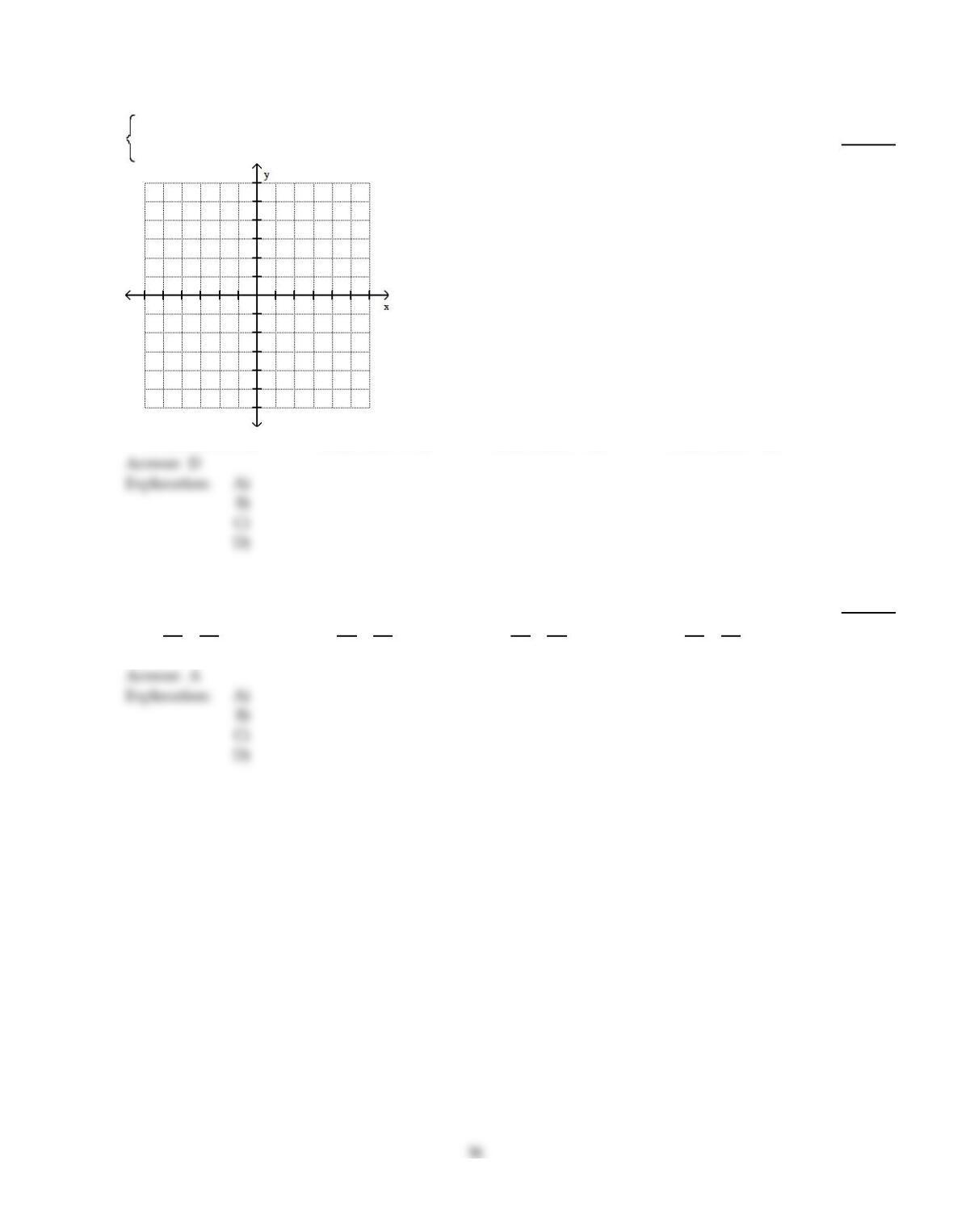
Find the solution set for the system by graphing both of the system’s equations in the same rectangular coordinate system
and finding points of intersection.
61)
x2+y2=16
16x2+4y2=64
61)
A)
{(2, 0), (–2, 0)}
B)
{(4, 0), (–4, 0)}
C)
{(0, 2), (0, –2)}
D)
{(0, 4), (0, –4)}
Find the standard form of the equation of the ellipse satisfying the given conditions.
62)
Foci: (0, –3), (0, 3); vertices: (0, –7), (0, 7)
62)
A)
x2
40 +y2
49 = 1
B)
x2
9+y2
40 = 1
C)
x2
49 +y2
40 = 1
D)
x2
9+y2
49 = 1
A
D
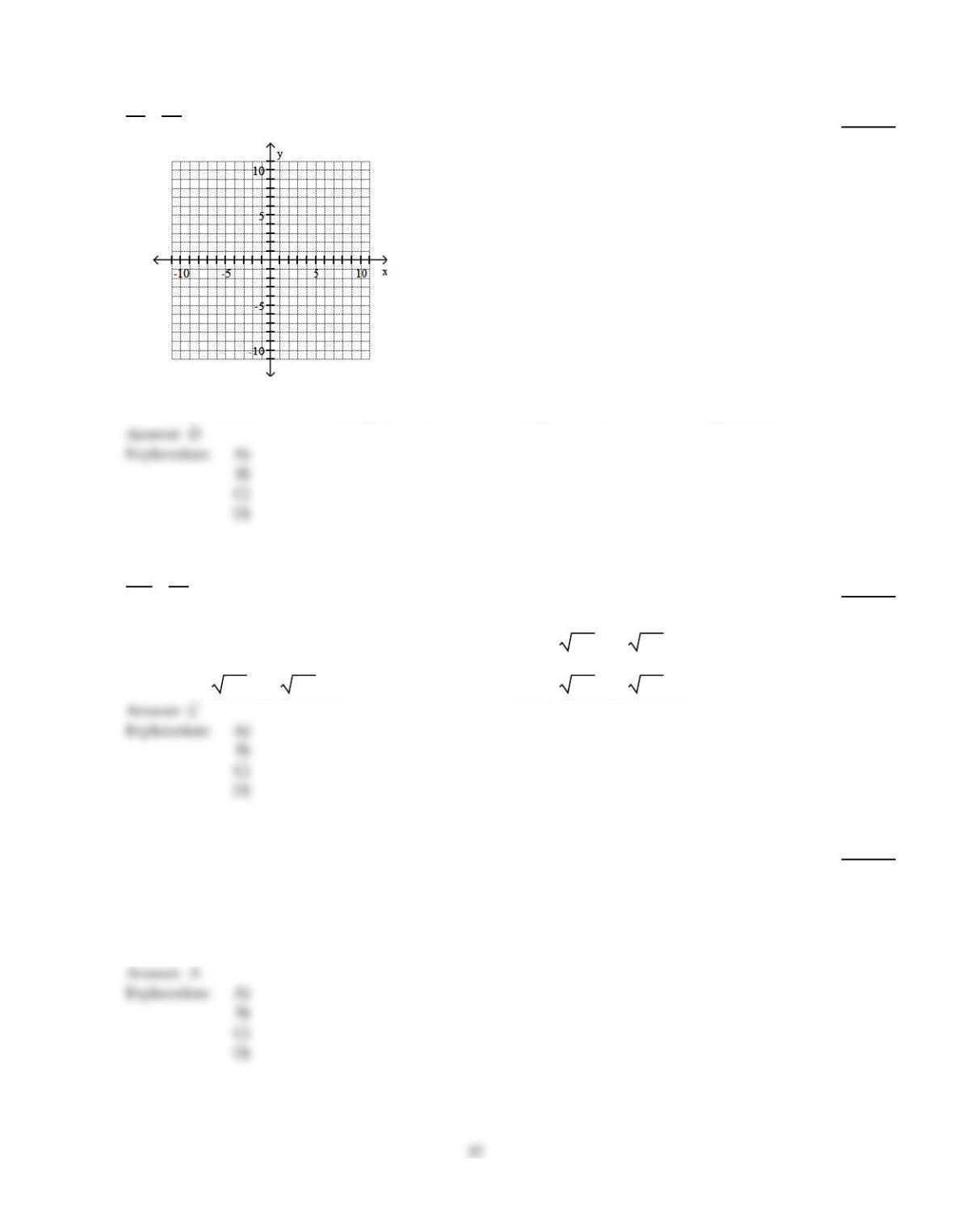
Use the relation’s graph to determine its domain and range.
63)
x2
9+y2
4= 1
63)
A)
Domain: (–3, 3)
Range: (–2, 2)
B)
Domain: [–2, 2]
Range: [–3, 3]
C)
Domain: [–3, 3]
Range: (–, )
D)
Domain: [–3, 3]
Range: [–2, 2]
Find the vertices and locate the foci for the hyperbola whose equation is given.
64)
x2
121 –y2
81 = 1
64)
A)
vertices: (–11, 0), (11, 0)
foci: (–9, 0), (9, 0)
B)
vertices: (–9, 0), (9, 0)
foci: (–202, 0), ( 202, 0)
C)
vertices: (–11, 0), (11, 0)
foci: (–202, 0), ( 202, 0)
D)
vertices: (0, –11), (0, 11)
foci: (–202, 0), ( 202, 0)
Solve the problem.
65)
Two recording devices are set 2200 feet apart, with the device at point A to the west of the device at
point B. At a point on a line between the devices, 200 feet from point B, a small amount of explosive
is detonated. The recording devices record the time the sound reaches each one. How far directly
north of site B should a second explosion be done so that the measured time difference recorded by
the devices is the same as that for the first detonation?
65)
A)
444.44 feet
B)
1081.67 feet
C)
3420.53 feet
D)
998.76 feet
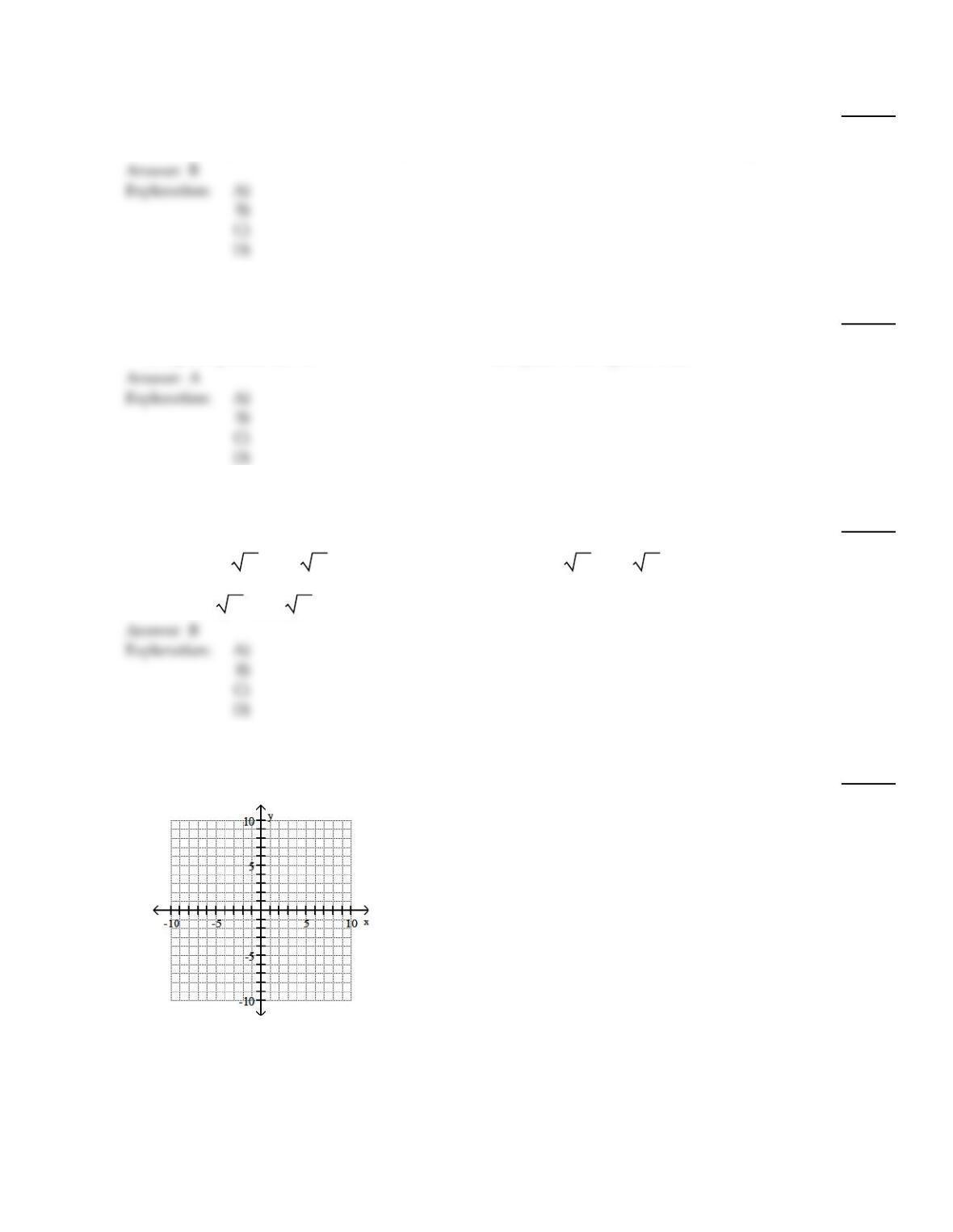
Find the focus and directrix of the parabola with the given equation.
66)
x2= – 36y
66)
A)
focus: (0, 9)
directrix: y = – 9
B)
focus: (0, –9)
directrix: y =9
C)
focus: (–18, 0)
directrix: x =9
D)
focus: (0, –9)
directrix: y = – 9
Determine the direction in which the parabola opens, and the vertex.
67)
y =x2+ 4x – 1
67)
A)
Opens upward; (–2, –5)
B)
Opens to the right; (–5, –2)
C)
Opens upward; (2, –5)
D)
Opens to the right; (–5, 2)
Find the vertices and locate the foci for the hyperbola whose equation is given.
68)
64x2–100y2=6400
68)
A)
vertices: (0, –10), (0, 10)
foci: (0, –241), (0, 241)
B)
vertices: (–10, 0), (10, 0)
foci: (–241, 0), (241, 0)
C)
vertices: (–8, 0), (8, 0)
foci: (–241, 0), (241, 0)
D)
vertices: (–10, 0), (10, 0)
foci: (–6, 0), (6, 0)
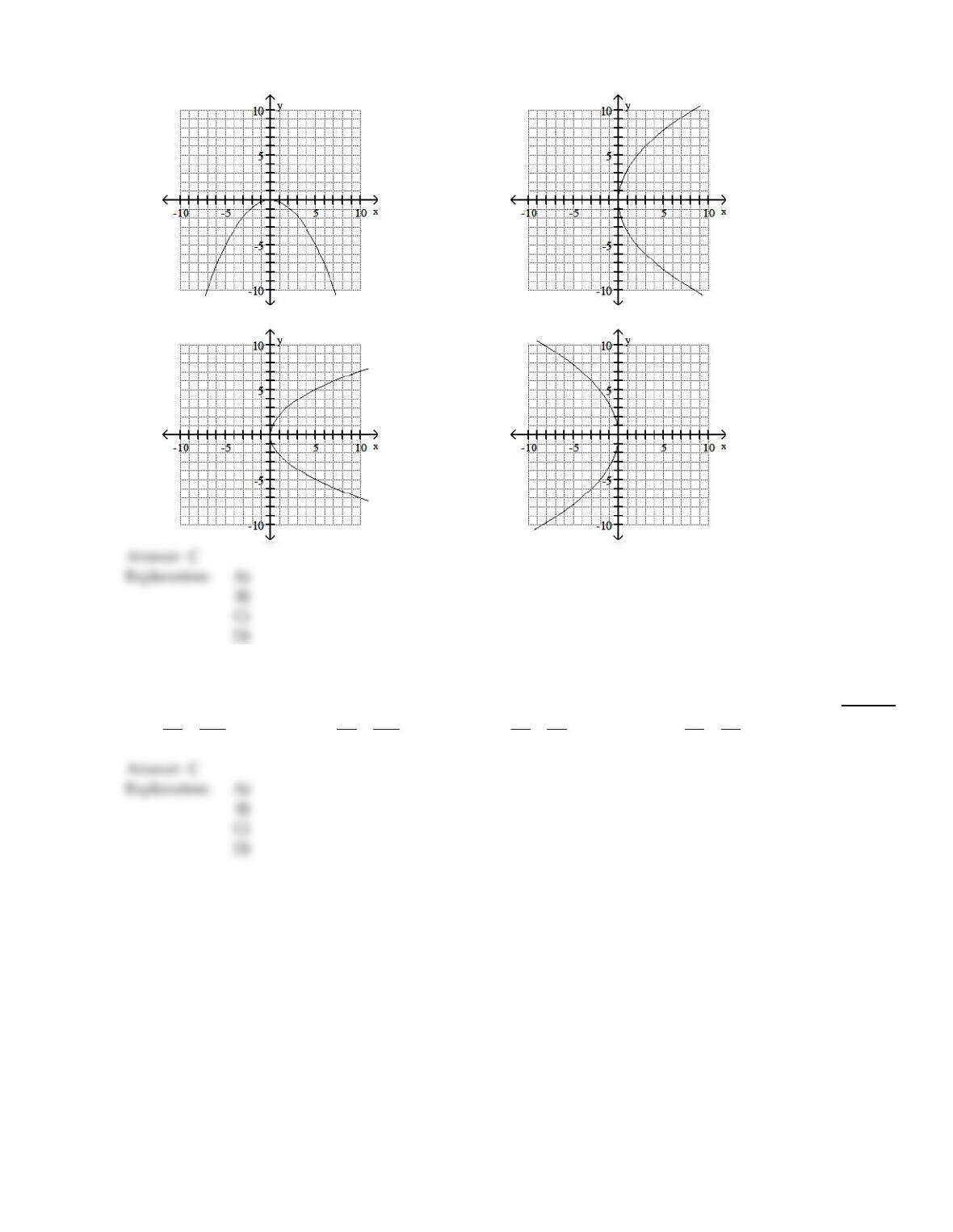
Graph the parabola.
69)
y2=5x
69)
38
A)
B)
C)
D)
Find the standard form of the equation of the hyperbola satisfying the given conditions.
70)
Foci: (–10, 0), (10, 0); vertices: (–4, 0), (4, 0)
70)
A)
y2
16 –x2
100 = 1
B)
x2
16 –y2
100 = 1
C)
x2
16 –y2
84 = 1
D)
y2
16 –x2
84 = 1
Graph the ellipse and locate the foci.
39
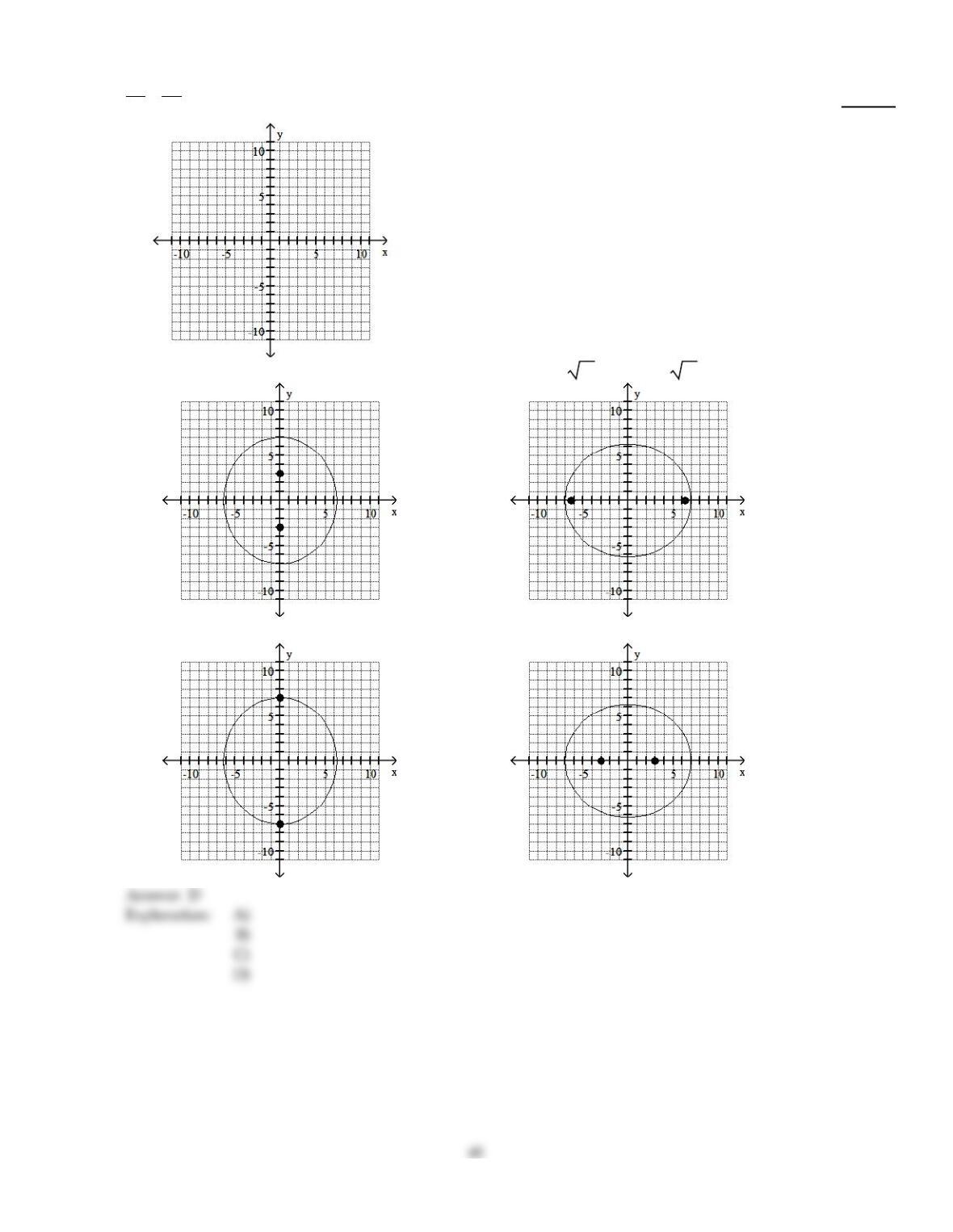
71)
x2
49 +y2
40 = 1
71)
A)
foci at (0, 3) and (0, –3)
B)
foci at (210, 0) and (–210, 0)
C)
foci at (0, 7) and (0, –7)
D)
foci at (3, 0) and (–3, 0)