
Cash and Receivables
7 – 21
98. Wellington Corp. has outstanding accounts receivable totaling $6.5 million as of
December 31 and sales on credit during the year of $24 million. There is also a credit
balance of $12,000 in the allowance for doubtful accounts. If the company estimates that
8% of its outstanding receivables will be uncollectible, what will be the amount of bad debt
expense recognized for the year?
a. $ 532,000.
b. $ 520,000.
c. $1,920,000.
d. $ 508,000.
99. Wellington Corp. has outstanding accounts receivable totaling $5 million as of December
31 and sales on credit during the year of $25 million. There is also a debit balance of
$20,000 in the allowance for doubtful accounts. If the company estimates that 8% of its
outstanding receivables will be uncollectible, what will be the balance in the allowance for
doubtful accounts after the year-end adjustment to record bad debt expense?
a. $2,000,000.
b. $ 380,000.
c. $ 400,000.
d. $ 420,000.
100. At the close of its first year of operations, December 31, 2014, Ming Company had
accounts receivable of $1,080,000, after deducting the related allowance for doubtful
accounts. During 2014, the company had charges to bad debt expense of $180,000 and
wrote off, as uncollectible, accounts receivable of $80,000. What should the company
report on its balance sheet at December 31, 2014, as accounts receivable before the
allowance for doubtful accounts?
a. $1,340,000
b. $1,180,000
c. $980,000
d. $880,000
101. Before year-end adjusting entries, Dunn Company’s account balances at December 31,
2014, for accounts receivable and the related allowance for uncollectible accounts were
$1,200,000 and $90,000, respectively. An aging of accounts receivable indicated that
$125,000 of the December 31 receivables are expected to be uncollectible. The net
realizable value of accounts receivable after adjustment is
a. $1,165,000.
b. $1,075,000.
c. $985,000.
d. $1,110,000.
102. During the year, Kiner Company made an entry to write off a $16,000 uncollectible
account. Before this entry was made, the balance in accounts receivable was $200,000
and the balance in the allowance account was $18,000. The net realizable value of
accounts receivable after the write-off entry was
a. $200,000.
b. $198,000.
c. $166,000.
d. $182,000.

Test Bank for Intermediate Accounting, Fifteenth Edition
7 – 22
103. The following information is available for Murphy Company:
Allowance for doubtful accounts at December 31, 2013 $ 16,000
Credit sales during 2014 800,000
Accounts receivable deemed worthless and written off during 2014 18,000
As a result of a review and aging of accounts receivable in early January 2015, it has
been determined that an allowance for doubtful accounts of $11,000 is needed at
December 31, 2014. What amount should Murphy record as “bad debt expense” for the
year ended December 31, 2014?
a. $9,000
b. $11,000
c. $13,000
d. $27,000
Use the following information for questions 104 and 105.
A trial balance before adjustments included the following:
Debit Credit
Sales $850,000
Sales returns and allowance $28,000
Accounts receivable 86,000
Allowance for doubtful accounts 1,520
104. If the estimate of uncollectibles is made by taking 2% of net sales, the amount of the
adjustment is
a. $13,400.
b. $16,440.
c. $17,000.
d. $19,480.
105. If the estimate of uncollectibles is made by taking 10% of gross account receivables, the
amount of the adjustment is
a. $7,080.
b. $8,600.
c. $8,448.
d. $10,120.
106. Lankton Company has the following account balances at year-end:
Accounts receivable $80,000
Allowance for doubtful accounts 4,800
Sales discounts 3,200
Lankton should report accounts receivable at a net amount of
a. $72,000.
b. $75,200.
c. $76,800.
d. $80,000.

Cash and Receivables
7 – 23
107. Smithson Corporation had a 1/1/14 balance in the Allowance for Doubtful Accounts of
$20,000. During 2014, it wrote off $14,400 of accounts and collected $4,200 on accounts
previously written off. The balance in Accounts Receivable was $400,000 at 1/1 and
$480,000 at 12/31. At 12/31/14, Smithson estimates that 5% of accounts receivable will
prove to be uncollectible. What is Bad Debt Expense for 2014?
a. $4,000.
b. $14,200.
c. $18,400.
d. $24,000.
108. Black Corporation had a 1/1/14 balance in the Allowance for Doubtful Accounts of
$18,000. During 2014, it wrote off $12,960 of accounts and collected $3,780 on accounts
previously written off. The balance in Accounts Receivable was $360,000 at 1/1 and
$432,000 at 12/31. At 12/31/14, Black estimates that 5% of accounts receivable will prove
to be uncollectible. What should Black report as its Allowance for Doubtful Accounts at
12/31/14?
a. $8,640.
b. $8,820.
c. $12,420.
d. $21,600.
109. Shelton Company has the following account balances at year-end:
Accounts receivable $120,000
Allowance for doubtful accounts 7,200
Sales discounts 4,800
Shelton should report accounts receivable at a net amount of
a. $108,000.
b. $112,800.
c. $115,200.
d. $120,000.
110. Vasguez Corporation had a 1/1/14 balance in the Allowance for Doubtful Accounts of
$30,000. During 2014, it wrote off $21,600 of accounts and collected $6,300 on accounts
previously written off. The balance in Accounts Receivable was $600,000 at 1/1 and
$720,000 at 12/31. At 12/31/14, Vasguez estimates that 5% of accounts receivable will
prove to be uncollectible. What is Bad Debt Expense for 2014?
a. $6,000.
b. $21,300.
c. $27,600.
d. $36,000.
111. McGlone Corporation had a 1/1/14 balance in the Allowance for Doubtful Accounts of
$25,000. During 2014, it wrote off $18,000 of accounts and collected $5,250 on accounts
previously written off. The balance in Accounts Receivable was $500,000 at 1/1 and
$600,000 at 12/31. At 12/31/14, McGlone estimates that 5% of accounts receivable will
prove to be uncollectible. What should McGlone report as its Allowance for Doubtful
Accounts at 12/31/14?
a. $12,000.
b. $12,250.
c. $17,250.
d. $30,000.

Test Bank for Intermediate Accounting, Fifteenth Edition
7 – 24
112. Lester Company received a seven-year zero-interest-bearing note on February 22, 2014,
in exchange for property it sold to Porter Company. There was no established exchange
price for this property and the note has no ready market. The prevailing rate of interest for
a note of this type was 7% on February 22, 2014, 7.5% on December 31, 2014, 7.7% on
February 22, 2015, and 8% on December 31, 2015. What interest rate should be used to
calculate the interest revenue from this transaction for the years ended December 31,
2014 and 2015, respectively?
a. 0% and 0%
b. 7% and 7%
c. 7% and 7.7%
d. 7.5% and 8%
113. On December 31, 2014, Flint Corporation sold for $100,000 an old machine having an
original cost of $180,000 and a book value of $80,000. The terms of the sale were as
follows:
$20,000 down payment
$40,000 payable on December 31 each of the next two years
The agreement of sale made no mention of interest; however, 9% would be a fair rate for
this type of transaction. What should be the amount of the notes receivable net of the
unamortized discount on December 31, 2014 rounded to the nearest dollar? (The present
value of an ordinary annuity of 1 at 9% for 2 years is 1.75911.)
a. $70,364
b. $90,364.
c. $80,000.
d. $140,728.
114. Assume Royal Palm Corp., an equipment distributor, sells a piece of machinery with a list
price of $600,000 to Arch Inc. Arch Inc. will pay $650,000 in one year. Royal Palm Corp.
normally sells this type of equipment for 90% of list price. How much should be recorded
as revenue?
a. $540,000.
b. $585,000.
c. $600,000.
d. $650,000.
115. Equestrain Roads sold $80,000, of goods and accepted the customer’s $80,000 10%,
1-year note receivable in exchange. Assuming 10% approximates the market rate of
return, what would be the debit in this journal entry to record the sale?
a. No journal entry until cash is collected.
b. Debit Notes Receivable for $80,000.
c. Debit Accounts Receivable for $80,000.
d. Debit Notes Receivable for $72,000.
116. Equestrain Roads sold $80,000, of goods and accepted the customer’s $80,000 10%,
1-year note payable in exchange. Assuming 10% approximates the market rate of return,
how much interest would be recorded for the year ending December 31 if the sale was
made on June 30?
a. $0.
b. $2,000.
c. $4,000.
d. $8,000.

Cash and Receivables
7 – 25
117. Equestrain Roads accepted a customer’s $50,000 zero-interest-bearing six-month note
payable in a sales transaction. The product sold normally sells for $46,000. If the sale was
made on June 30, how much interest revenue from this transaction would be recorded for
the year ending December 31?
a. $0.
b. $2,000.
c. $4,000.
d. $5,000.
118. Assuming the market interest rate is 10% per annum, how much would Green Co. record
as a note payable if the terms of the loan with a bank are that it would have to make one
$80,000 payment in two years? (The present value of $1 for two periods at 10% is
0.82645).
a. $80,000.
b. $72,563.
c. $72,727.
d. $66,116.
119. Jones Company has notes receivable that have a fair value of $570,000 and a carrying
amount of $750,000. Jones decides on December 31, 2014, to use the fair value option
for these recently-acquired receivables. Which of the following entries will be made on
December 31, 2014 to record the unrealized holding gain/loss?
a. Unrealized Holding Gain or Loss⎯Income ……. 180,000
Notes Receivable ……………………………….. 180,000
b. Unrealized Holding Gain or Loss⎯Equity ……… 180,000
Notes Receivable ……………………………….. 180,000
c. Notes Receivable………………………………………. 180,000
Unrealized Holding Gain or Loss⎯Income 180,000
d. Notes Receivable………………………………………. 180,000
Unrealized Holding Gain or Loss⎯Equity . 180,000
120. Sun Inc. factors $3,000,000 of its accounts receivables without recourse for a finance
charge of 5%. The finance company retains an amount equal to 10% of the accounts
receivable for possible adjustments. Sun estimates the fair value of the recourse liability at
$115,000. What would be recorded as a gain (loss) on the transfer of receivables?
a. Loss of $150,000.
b. Gain of $265,000.
c. Loss of $565,000.
d. Loss of $115,000.
121. Sun Inc. factors $3,000,000 of its accounts receivables with recourse for a finance charge
of 3%. The finance company retains an amount equal to 10% of the accounts receivable
for possible adjustments. Sun estimates the fair value of the recourse liability at $150,000.
What would be recorded as a gain (loss) on the transfer of receivables?
a. Gain of $90,000.
b. Loss of 240,000.
c. Gain of $540,000.
d. Loss of $150,000.

Test Bank for Intermediate Accounting, Fifteenth Edition
7 – 26
122. Sun Inc assigns $3,000,000 of its accounts receivables as collateral for a $1 million 8%
loan with a bank. Sun Inc. also pays a finance fee of 1% on the transaction upfront. What
would be recorded as a gain (loss) on the transfer of receivables?
a. Loss of $30,000.
b. Loss of $240,000.
c. Loss of $270,000.
d. $0.
123. Moon Inc. factors $2,000,000 of its accounts receivables with recourse for a finance
charge of 4%. The finance company retains an amount equal to 8% of the accounts
receivable for possible adjustments. Moon estimates the fair value of the recourse liability
at $200,000. What would be the debit to Cash in the journal entry to record this
transaction?
a. $2,000,000.
b. $1,920,000.
c. $1,760,000.
d. $1,560,000.
124. Moon Inc assigns $3,000,000 of its accounts receivables as collateral for a $2 million loan
with a bank. The bank assesses a 3% finance charge on the loan amount and charges
interest on the note at 6%. What would be the journal entry to record this transaction?
a. Debit Cash for $1,940,000, debit Interest Expense for $60,000, and credit Notes
payable for $2,000,000.
b. Debit Cash for $1,940,000, debit Interest Expense for $60,000, and credit Accounts
Receivable for $2,000,000.
c. Debit Cash for $1,940,000, debit Interest Expense for $60,000, debit Due from Bank
for $1,000,000, and credit Accounts Receivable for $3,000,000.
d. Debit Cash for $1,820,000, debit Interest Expense for $180,000, and credit Notes
Payable for $2,000,000.
125. Geary Co. assigned $800,000 of accounts receivable to Kwik Finance Co. as security for
a loan of $670,000. Kwik charged a 2% commission on the amount of the loan; the
interest rate on the note was 10%. During the first month, Geary collected $220,000 on
assigned accounts after deducting $760 of discounts. Geary accepted returns worth
$2,700 and wrote off assigned accounts totaling $5,960.
The amount of cash Geary received from Kwik at the time of the assignment was
a. $603,000.
b. $654,000.
c. $656,600.
d. $670,000.
126. Geary Co. assigned $800,000 of accounts receivable to Kwik Finance Co. as security for
a loan of $670,000. Kwik charged a 2% commission on the amount of the loan; the
interest rate on the note was 10%. During the first month, Geary collected $220,000 on
assigned accounts after deducting $760 of discounts. Geary accepted returns worth
$2,700 and wrote off assigned accounts totaling $5,960.
Entries during the first month would include a
a. debit to Cash of $220,760.
b. debit to Bad Debt Expense of $5,960.
c. debit to Allowance for Doubtful Accounts of $5,960.
d. debit to Accounts Receivable of $229,420.

Cash and Receivables
7 – 27
127. On February 1, 2014, Henson Company factored receivables with a carrying amount of
$500,000 to Agee Company. Agee Company assesses a finance charge of 3% of the
receivables and retains 5% of the receivables. Relative to this transaction, you are to
determine the amount of loss on sale to be reported in the income statement of Henson
Company for February.
Assume that Henson factors the receivables on a without recourse basis. The loss to be
reported is
a. $0.
b. $15,000.
c. $25,000.
d. $40,000.
128. On February 1, 2014, Henson Company factored receivables with a carrying amount of
$500,000 to Agee Company. Agee Company assesses a finance charge of 3% of the
receivables and retains 5% of the receivables. Relative to this transaction, you are to
determine the amount of loss on sale to be reported in the income statement of Henson
Company for February.
Assume that Henson factors the receivables on a with recourse basis. The recourse
obligation has a fair value of $2,500. The loss to be reported is
a. $15,000.
b. $17,500.
c. $25,000.
d. $42,500.
129. Maxwell Corporation factored, with recourse, $100,000 of accounts receivable with Huskie
Financing. The finance charge is 3%, and 5% was retained to cover sales discounts, sales
returns, and sales allowances. Maxwell estimates the recourse obligation at $2,400. What
amount should Maxwell report as a loss on sale of receivables?
a. $ -0-.
b. $3,000.
c. $5,400.
d. $10,400.
130. Wilkinson Corporation factored, with recourse, $400,000 of accounts receivable with
Huskie Financing. The finance charge is 3%, and 5% was retained to cover sales
discounts, sales returns, and sales allowances. Wilkinson estimates the recourse
obligation at $9,600. What amount should Wilkinson report as a loss on sale of
receivables?
a. $ -0-.
b. $12,000.
c. $21,600.
d. $41,600.
131. Remington Corporation had accounts receivable of $100,000 at 1/1. The only transactions
affecting accounts receivable were sales of $750,000 and cash collections of $700,000.
The accounts receivable turnover is
a. 5.0.
b. 5.5.
c. 6.0.
d. 7.5.

Test Bank for Intermediate Accounting, Fifteenth Edition
7 – 28
132. Laventhol Corporation had accounts receivable of $100,000 at 1/1. The only transactions
affecting accounts receivable were sales of $1,200,000 and cash collections of
$1,150,000. The accounts receivable turnover is
a. 8.0.
b. 8.8.
c. 9.6.
d. 12.0.
133. The opening balance of Accounts Receivable for George Company was $25,000. Net
sales (all on account) for the year amounted to $150,000. The Company doesn’t offer any
cash discount. During the year $130,000 was collected on accounts receivable. Compute
accounts receivable turnover ratio for the year.
a. 4.29 times
b. 3.71 times
c. 2.89 times
d. 7.50 times
134. During the year Tulip reported net sales of $800,000. The company had accounts
receivable of $75,000 at the beginning of the year and $120,000 at the end of the year
Compute Tulip’s average collection period (assume 365 days a year.)
a. 34.2 days
b. 44.5 days.
c. 54.8 days.
d. 89.0 days.
*135. If a petty cash fund is established in the amount of $250, and contains $150 in cash and
$95 in receipts for disbursements when it is replenished, the journal entry to record
replenishment should include credits to the following accounts
a. Petty Cash, $75.
b. Petty Cash, $100.
c. Cash, $95; Cash Over and Short, $5.
d. Cash, $100.
*136. If the month-end bank statement shows a balance of $72,000, outstanding checks are
$24,000, a deposit of $8,000 was in transit at month end, and a check for $1,000 was
erroneously charged by the bank against the account, the correct balance in the bank
account at month end is
a. $55,000.
b. $57,000.
c. $41,000.
d. $87,000.
*137. In preparing its bank reconciliation for the month of April 2014, Henke, Inc. has the
following information available.
Balance per bank statement, 4/30/14 $34,140
NSF check returned with 4/30/14 bank statement 450
Deposits in transit, 4/30/14 5,000
Outstanding checks, 4/30/14 5,200
Bank service charges for April 20
What should be the correct balance of cash at April 30, 2014?
a. $34,370
b. $33,940
c. $33,490
d. $33,470

Cash and Receivables
7 – 29
*138. Finley, Inc.’s checkbook balance on December 31, 2014 was $42,400. In addition, Finley
held the following items in its safe on December 31.
(1) A check for $900 from Peters, Inc. received December 30, 2014, which was not
included in the checkbook balance.
(2) An NSF check from Garner Company in the amount of $1,800 that had been
deposited at the bank, but was returned for lack of sufficient funds on December
29. The check was to be redeposited on January 3, 2015. The original deposit
has been included in the December 31 checkbook balance.
(3) Coin and currency on hand amounted to $2,900.
The proper amount to be reported on Finley’s balance sheet for cash at December 31,
2014 is
a. $42,600.
b. $40,800.
c. $44,400.
d. $43,550.
*139. The cash account shows a balance of $90,000 before reconciliation. The bank statement
does not include a deposit of $4,600 made on the last day of the month. The bank
statement shows a collection by the bank of $1,880 and a customer’s check for $640 was
returned because it was NSF. A customer’s check for $900 was recorded on the books as
$1,080, and a check written for $158 was recorded as $194. The correct balance in the
cash account was
a. $91,024.
b. $91,096.
c. $91,456.
d. $95,696.
*140. In preparing its May 31, 2014 bank reconciliation, Catt Co. has the following information
available:
Balance per bank statement, 5/31/14 $35,000
Deposit in transit, 5/31/14 5,400
Outstanding checks, 5/31/14 4,900
Note collected by bank in May 1,250
The correct balance of cash at May 31, 2014 is
a. $40,400.
b. $34,250.
c. $35,500.
d. $36,750.
Test Bank for Intermediate Accounting, Fifteenth Edition
7 – 30
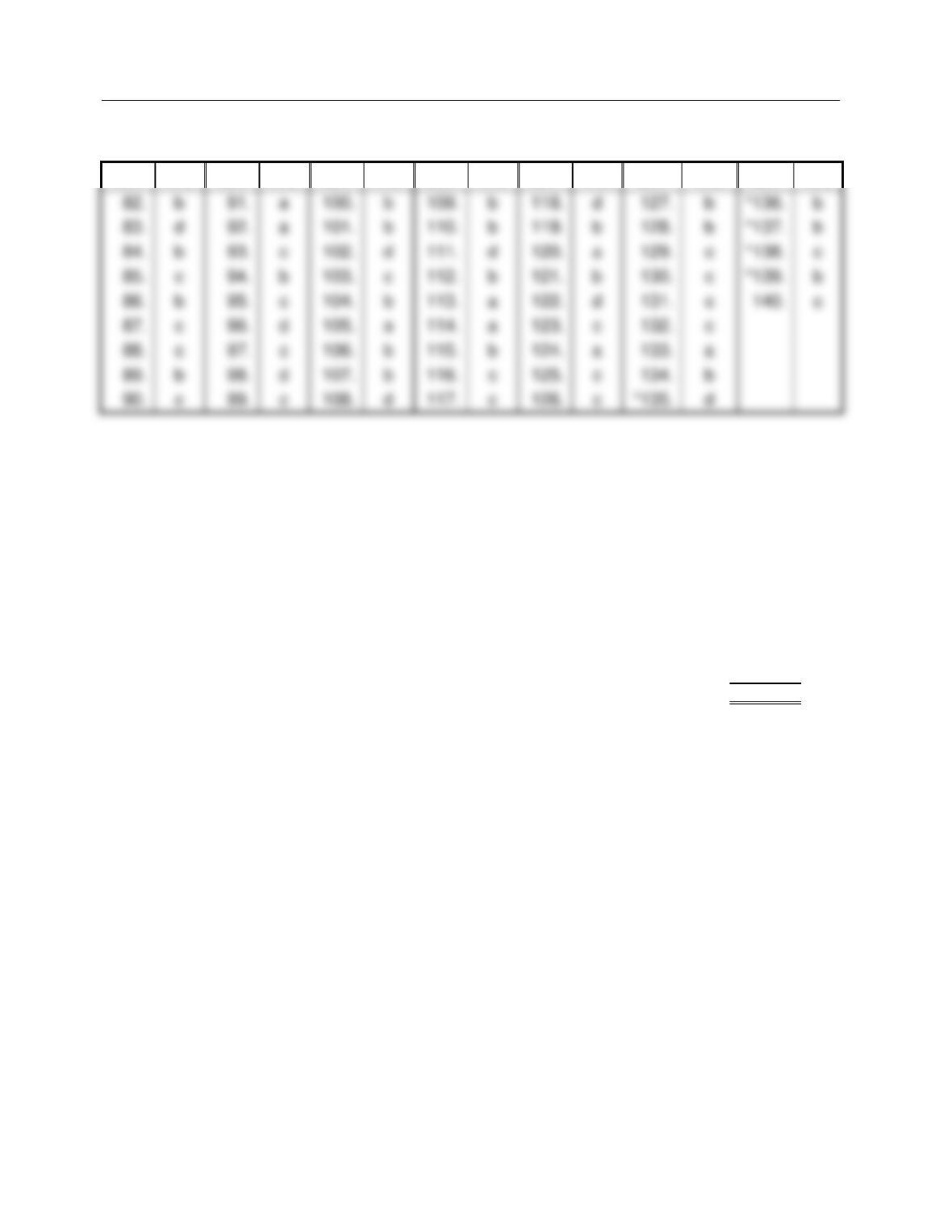
Multiple Choice Answers—Computational
Item
Ans.
Item
Ans.
Item
Ans.
Item
Ans.
Item
Ans.
Item
Ans.
Item
Ans
MULTIPLE CHOICE—CPA Adapted
141. On the December 31, 2014 balance sheet of Vanoy Co., the current receivables consisted
of the following:
Trade accounts receivable $ 60,000
Allowance for uncollectible accounts (2,000)
Claim against shipper for goods lost in transit (November 2014) 3,000
Selling price of unsold goods sent by Vanoy on consignment
at 130% of cost (not included in Vanoy ‘s ending inventory) 26,000
Security deposit on lease of warehouse used for storing
some inventories 30,000
Total $117,000
At December 31, 2014, the correct total of Vanoy’s current net receivables was
a. $61,000.
b. $87,000.
c. $91,000.
d. $117,000.
142. Ace Co. prepared an aging of its accounts receivable at December 31, 2014 and
determined that the net realizable value of the receivables was $600,000. Additional
information is available as follows:
Allowance for uncollectible accounts at 1/1/14—credit balance $ 68,000
Accounts written off as uncollectible during 2014 46,000
Accounts receivable at 12/31/14 650,000
Uncollectible accounts recovered during 2014 10,000
For the year ended December 31, 2014, Ace’s uncollectible accounts expense would be
a. $50,000.
b. $46,000.
c. $32,000.
d. $18,000.

Cash and Receivables
7 – 31
143. For the year ended December 31, 2014, Dent Co. estimated its allowance for uncollectible
accounts using the year-end aging of accounts receivable. The following data are available:
Allowance for uncollectible accounts, 1/1/14 $84,000
Provision for uncollectible accounts during 2014
(2% on credit sales of $3,000,000) 60,000
Uncollectible accounts written off, 11/30/14 69,000
Estimated uncollectible accounts per aging, 12/31/14 104,000
After year-end adjustment, the uncollectible accounts expense for 2014 should be
a. $69,000.
b. $60,000.
c. $104,000.
d. $89,000.
144. Nenn Co.’s allowance for uncollectible accounts was $190,000 at the end of 2014 and
$180,000 at the end of 2013. For the year ended December 31, 2014, Nenn reported bad
debt expense of $26,000 in its income statement. What amount did Nenn debit to the
appropriate account in 2014 to write off actual bad debts?
a. $10,000
b. $16,000
c. $26,000
d. $36,000
145. Under the allowance method of recognizing uncollectible accounts, the entry to write off
an uncollectible account
a. increases the allowance for uncollectible accounts.
b. has no effect on the allowance for uncollectible accounts.
c. has no effect on net income.
d. decreases net income.
146. The following accounts were abstracted from Starr Co.’s unadjusted trial balance at
December 31, 2014:
Debit Credit
Accounts receivable $750,000
Allowance for uncollectible accounts 8,000
Net credit sales $3,000,000
Starr estimates that 4% of the gross accounts receivable will become uncollectible. After
adjustment at December 31, 2014, the allowance for uncollectible accounts should have a
credit balance of
a. $120,000.
b. $112,000.
c. $38,000.
d. $30,000.
147. On January 1, 2014, West Co. exchanged equipment for a $600,000 zero-interest-bearing
note due on January 1, 2017. The prevailing rate of interest for a note of this type at
January 1, 2014 was 10%. The present value of $1 at 10% for three periods is 0.75. What
amount of interest revenue should be included in West’s 2015 income statement?
a. $0
b. $45,000
c. $49,500
d. $60,000

Test Bank for Intermediate Accounting, Fifteenth Edition
7 – 32
148. On June 1, 2014, Yang Corp. loaned Gant $400,000 on a 12% note, payable in five
annual installments of $80,000 beginning January 2, 2015. In connection with this loan,
Gant was required to deposit $4,000 in a zero-interest-bearing escrow account. The
amount held in escrow is to be returned to Gant after all principal and interest payments
have been made. Interest on the note is payable on the first day of each month beginning
July 1, 2014. Gant made timely payments through November 1, 2014. On January 2, 2015,
Yang received payment of the first principal installment plus all interest due. At
December 31, 2014, Yang’s interest receivable on the loan to Gant should be
a. $0.
b. $4,000.
c. $8,000.
d. $12,000.
149. Which of the following is a method to generate cash from accounts receivable?
Assignment Factoring
a. Yes No
b. Yes Yes
c. No Yes
d. No No
*150. In preparing its August 31, 2014 bank reconciliation, Bing Corp. has available the
following information:
Balance per bank statement, 8/31/14 $18,650
Deposit in transit, 8/31/14 3,900
Return of customer’s check for insufficient funds, 8/30/14 600
Outstanding checks, 8/31/14 2,750
Bank service charges for August 100
At August 31, 2014, Bing‘s correct cash balance is
a. $19,800.
b. $19,200.
c. $19,100.
d. $17,500.
*151. Tresh, Inc. had the following bank reconciliation at March 31, 2014:
Balance per bank statement, 3/31/14 $37,200
Add: Deposit in transit 10,300
47,500
Less: Outstanding checks 12,600
Balance per books, 3/31/14 $34,900
Data per bank for the month of April 2014 follow:
Deposits $43,700
Disbursements 49,700
All reconciling items at March 31, 2014 cleared the bank in April. Outstanding checks at
April 30, 2014 totaled $6,000. There were no deposits in transit at April 30, 2014. What is
the cash balance per books at April 30, 2014?
a. $25,200
b. $28,900
c. $31,200
d. $35,500
Cash and Receivables
7 – 33
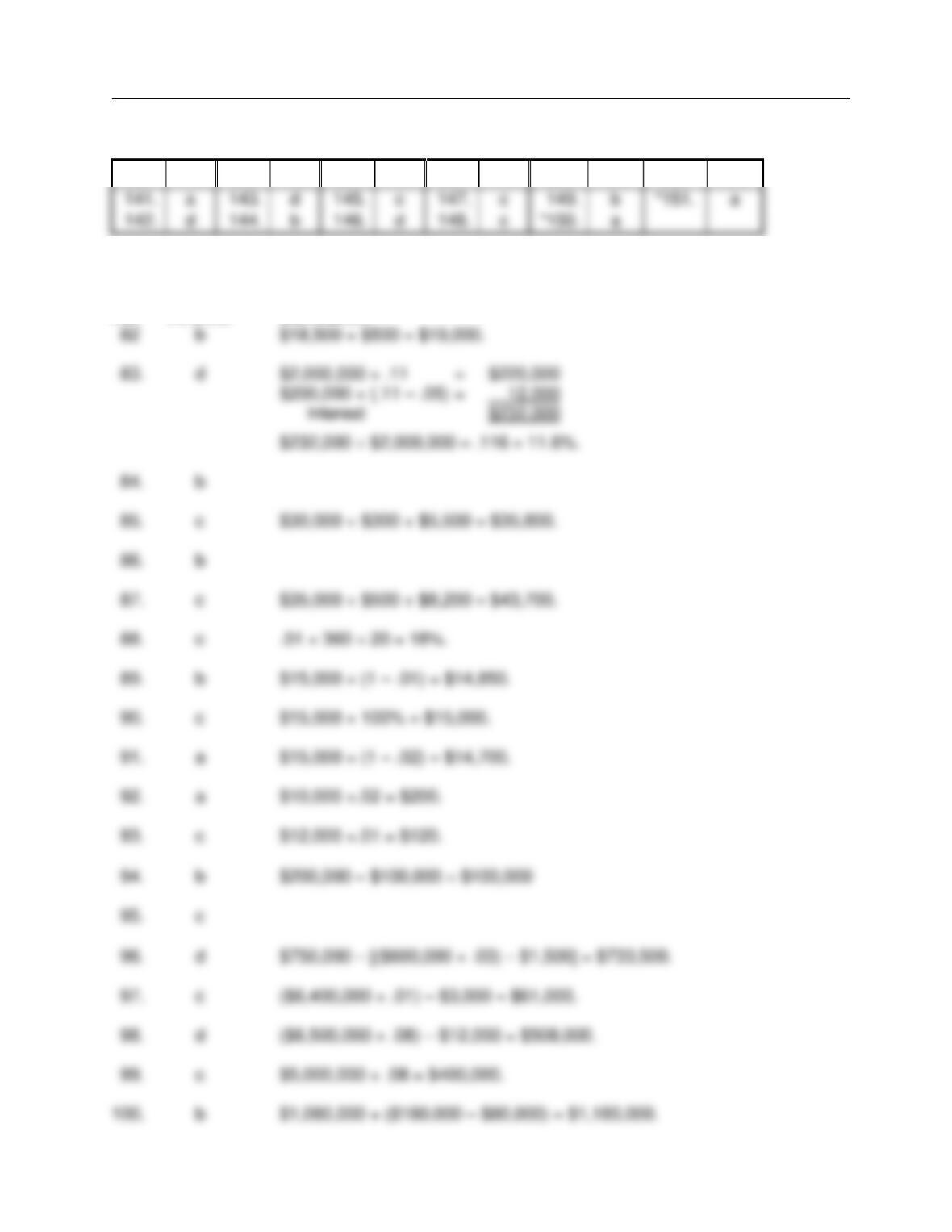
Multiple Choice Answers—CPA Adapted
Item
Ans.
Item
Ans.
Item
Ans.
Item
Ans.
Item
Ans.
Item
Ans.
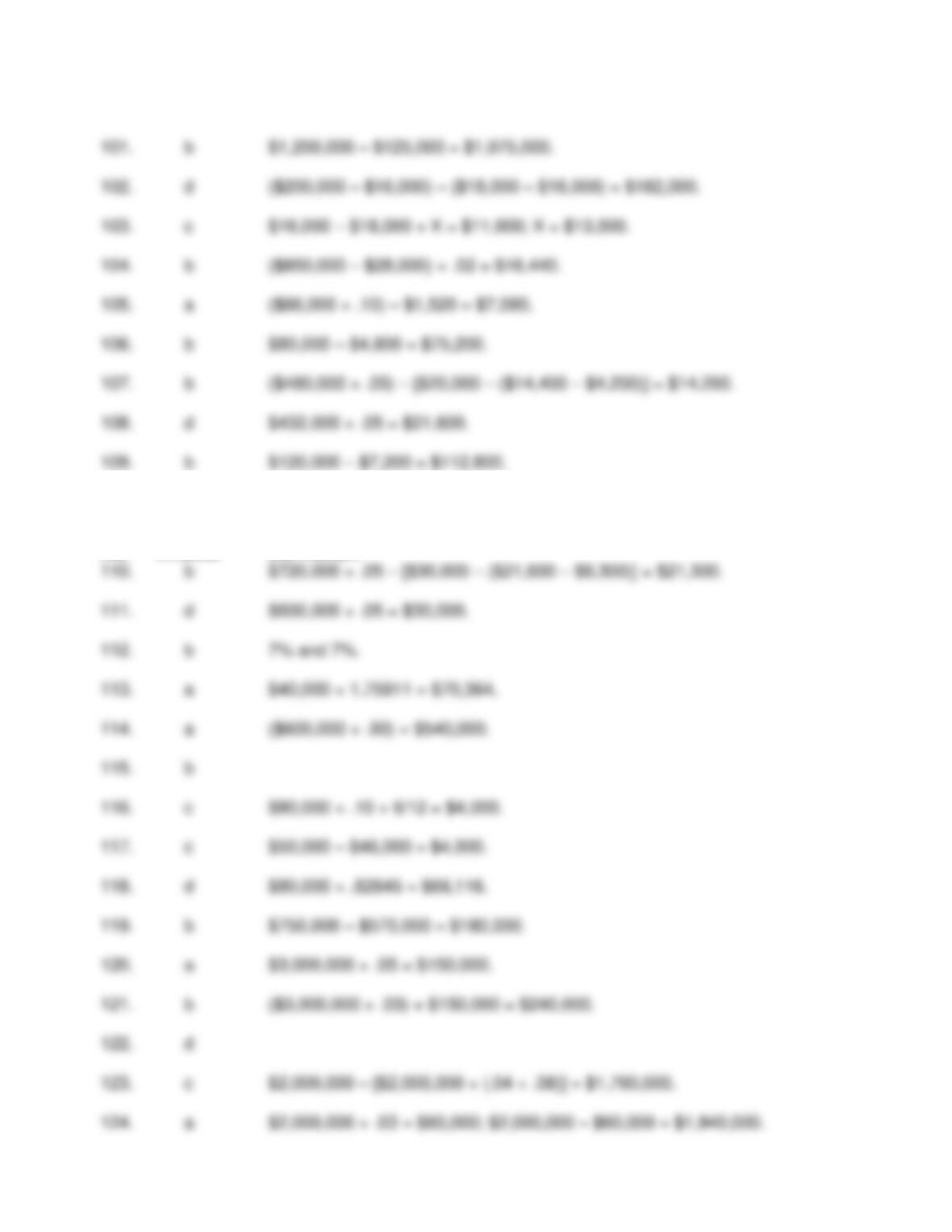
DERIVATIONS — Computational
No. Answer Derivation
Test Bank for Intermediate Accounting, Fifteenth Edition
7 – 34
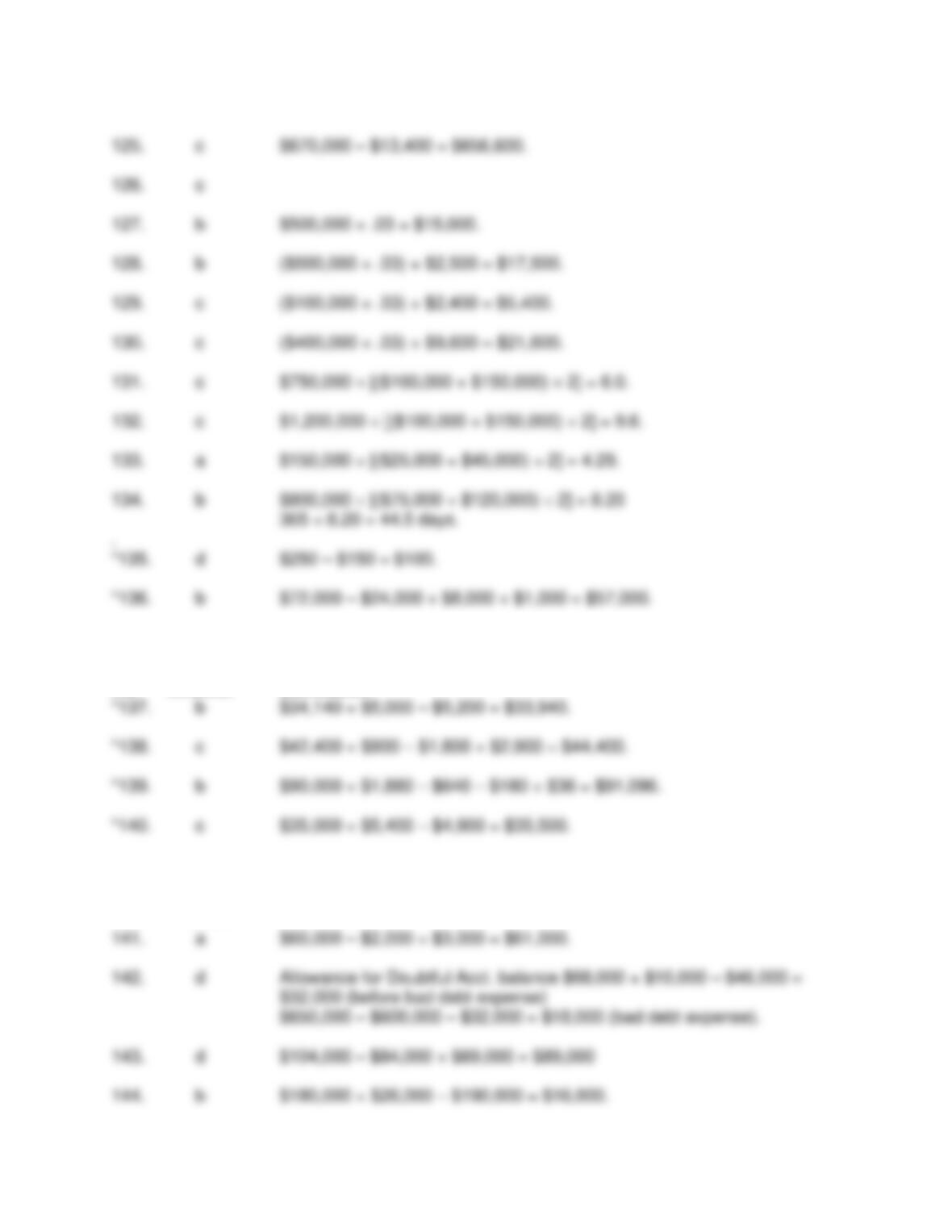
DERIVATIONS — Computational (cont.)
No. Answer Derivation
Cash and Receivables
7 – 35
DERIVATIONS — Computational (cont.)
No. Answer Derivation
DERIVATIONS — CPA Adapted
No. Answer Derivation