
47) A wheel rotates through an angle of 13.8 rad as it slows down uniformly from 22.0 rad/s to
13.5 rad/s. What is the magnitude of the angular acceleration of the wheel?
A) 0.616 rad/s2
B) 5.45 rad/s2
C) 111 rad/s2
D) 22.5 rad/s2
E) 10.9 rad/s2
48) A pulley has an initial angular speed of 12.5 rad/s and a constant angular acceleration of 3.41
rad/s2. Through what angle does the pulley turn in 5.26 s?
A) 113 rad
B) 22.6 rad
C) 42.6 rad
D) 19.3 rad
E) 160 rad
49) An old 78 rpm record rotates through an angle of 320° as it slows down uniformly from 78.0
rpm to 22.8 rpm. What is the magnitude of the angular acceleration of the record?
A) 2.34 rad/s2
B) 5.46 rad/s2
C) 6.50 rad/s2
D) 8.35 rad/s2
E) 10.9 rad/s2
50) A turntable 45 cm in diameter starts from rest and makes its first complete revolution in 3.4 s
with constant angular acceleration. If it maintains the same acceleration, how long will it take the
turntable to make its second complete revolution?
51) A Ferris wheel rotating at 20 rad/s slows down with a constant angular acceleration of
magnitude 5.0 rad/s2. How many revolutions does it make while slowing down before coming
to rest?
A) 40
B) 20
C) 6.4
D) 3.2
52) A centrifuge in a medical laboratory rotates at a rotational speed of 3600 rev/min. When
switched off, it makes 50 complete turns at a constant angular acceleration before coming to rest.
(a) What was the magnitude of the angular acceleration of the centrifuge as it slowed down?
(d) How long did it take for the centrifuge to come to rest after being turned off?
53) A majorette fastens two batons together at their centers to form an X shape. Each baton
consists of an extremely light 1.2-m bar with small 0.25-kg balls at each end. What is the
moment of inertia of this baton about an axis through the center of the X?
54) A triatomic molecule is oriented as follows along the x-axis: mass m is at the origin, mass
2m is at x = a, and, mass 3m is at x = 2a. What is the moment of inertia of this molecule about
the y-axis?
A) 2ma2
B) 3ma2
C) 12ma2
D) 14ma2
55) Two uniform solid spheres have the same mass, but one has twice the radius of the other.
The ratio of the larger sphere’s moment of inertia about a central axis to that of the smaller sphere
is
A) 4/5.
B) 8/5.
C) 1/2.
D) 2.
E) 4.
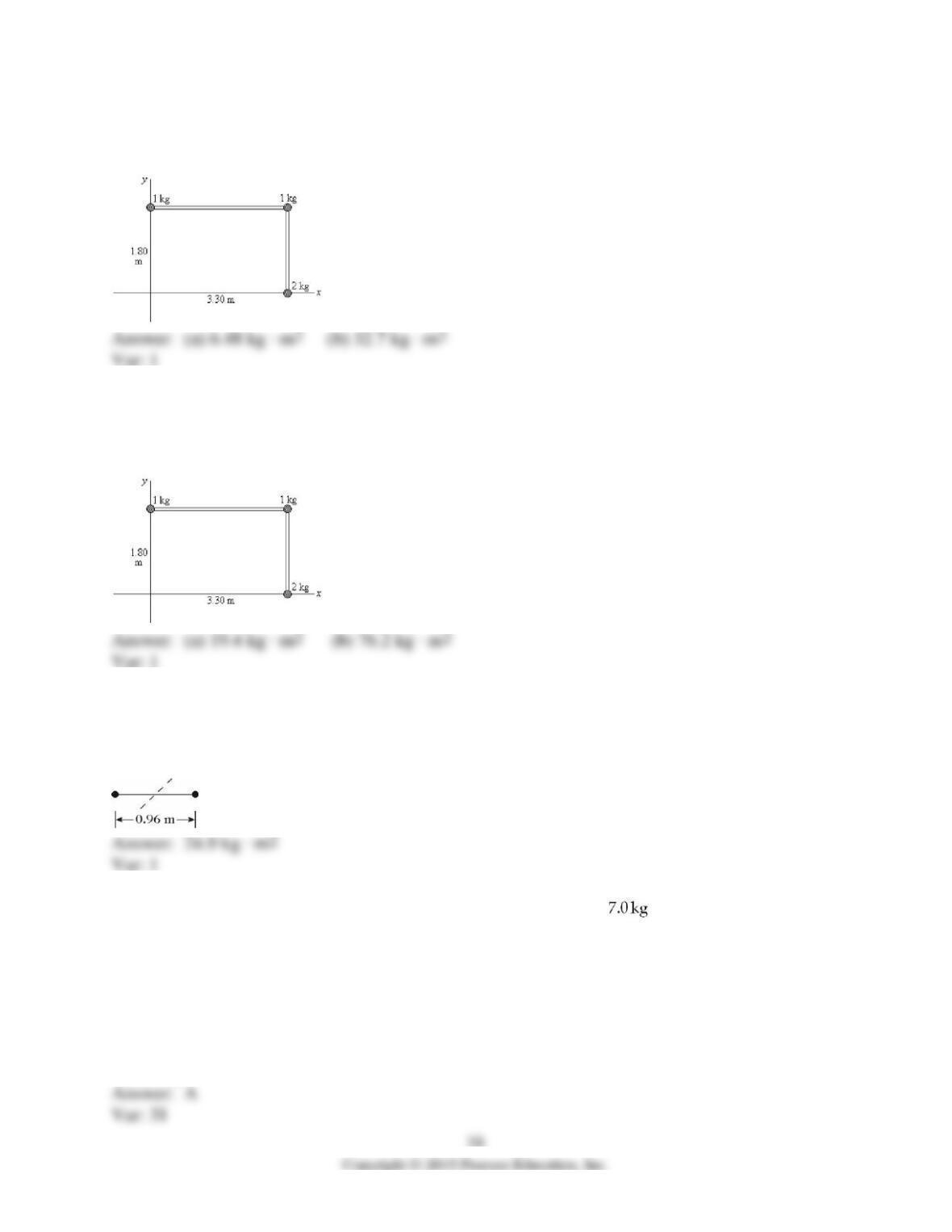
56) The L-shaped object shown in the figure consists of three small masses connected by
extremely light rods. Assume that the masses shown are accurate to three significant figures.
What is the moment of inertia of this object (a) about the x-axis, and (b) about the y-axis?
57) The L-shaped object shown in the figure consists of three small masses connected by thin
uniform rods, each rod of mass 3.00 kg. Assume that the masses shown are accurate to three
significant figures. What is the moment of inertia of this object (a) about the x-axis, and (b) about
the y-axis?
58) In the figure, a weightlifter’s barbell consists of two identical small but dense spherical
weights, each of mass 50 kg. These weights are connected by a thin 0.96-m rod with a mass of
24 kg. Find the moment of inertia of the barbell through the axis perpendicular to the rod at its
center, assuming the two weights are small enough to be treated as point masses.
59) A potter’s wheel has the shape of a solid uniform disk of mass and radius 0.65 m. It
spins about an axis perpendicular to the disk at its center. A small 2.1 kg lump of very dense clay
is dropped onto the wheel at a distance 0.41 m from the axis. What is the moment of inertia of
the system about the axis of spin?
A) 1.8 kg ∙ m2
B) 1.5 kg ∙ m2
C) 0.40 kg ∙ m2
D) 2.5 kg ∙ m2

60) The lug nuts on a car wheel require tightening to a torque of 90 N ∙ m. If a 30-cm long
wrench is used, what is the magnitude of the minimum force required using the wrench?
A) 300 N
B) 150 N
C) 30 N
D) 15 N
61) A man in a gym is holding an 8.0-kg weight at arm’s length, a distance of 0.55 m from his
shoulder joint. What is the torque about his shoulder joint due to the weight if his arm is
horizontal?
A) 0.24 N ∙ m
B) 4.4 N ∙ m
C) 43 N ∙ m
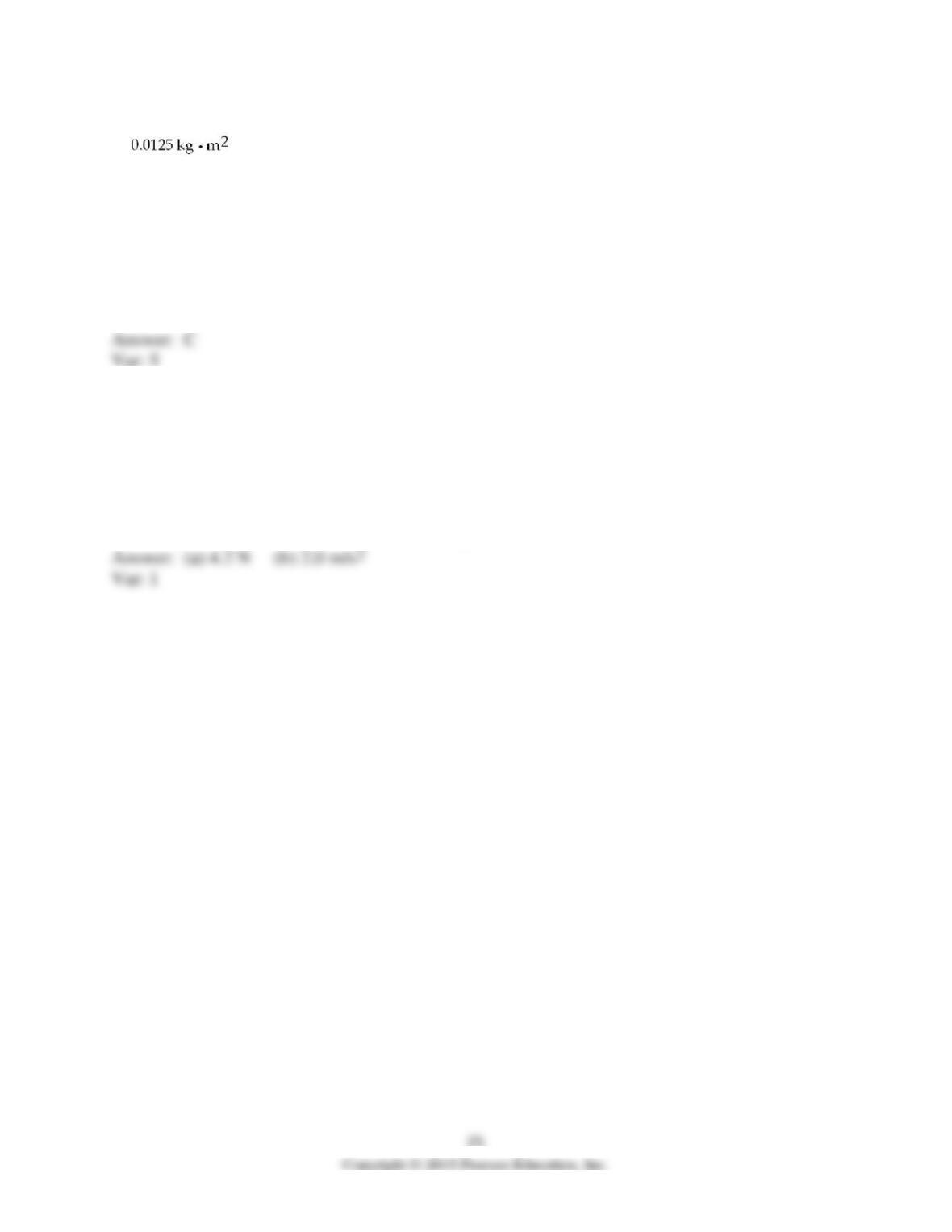
D) 15 N ∙ m
E) 0 N ∙ m
62) A man in a gym is holding an 8.0-kg weight at arm’s length, a distance of 0.55 m from his
shoulder joint. What is the torque about his shoulder joint due to the weight if his arm is held at
30° below the horizontal?
A) 22 N ∙ m
B) 2.2 N ∙ m
C) 4.4 N ∙ m
D) 13 N ∙ m
E) 37 N ∙ m
63) A force of 17 N is applied to the end of a 0.63-m long torque wrench at an angle 45° from a
line joining the pivot point to the handle. What is the magnitude of the torque about the pivot
point produced by this force?
A) 7.6 N ∙ m
B) 10.7 N ∙ m
C) 12.0 N ∙ m
D) 9.7 N ∙ m
64) A 95-N force exerted at the end of a 0.32-m long torque wrench produces a torque of 15 N ∙
m. What is the angle (less than 90°) between the wrench handle and the direction of the applied
force?
A) 30°
B) 24°
C) 36°
D) 42°
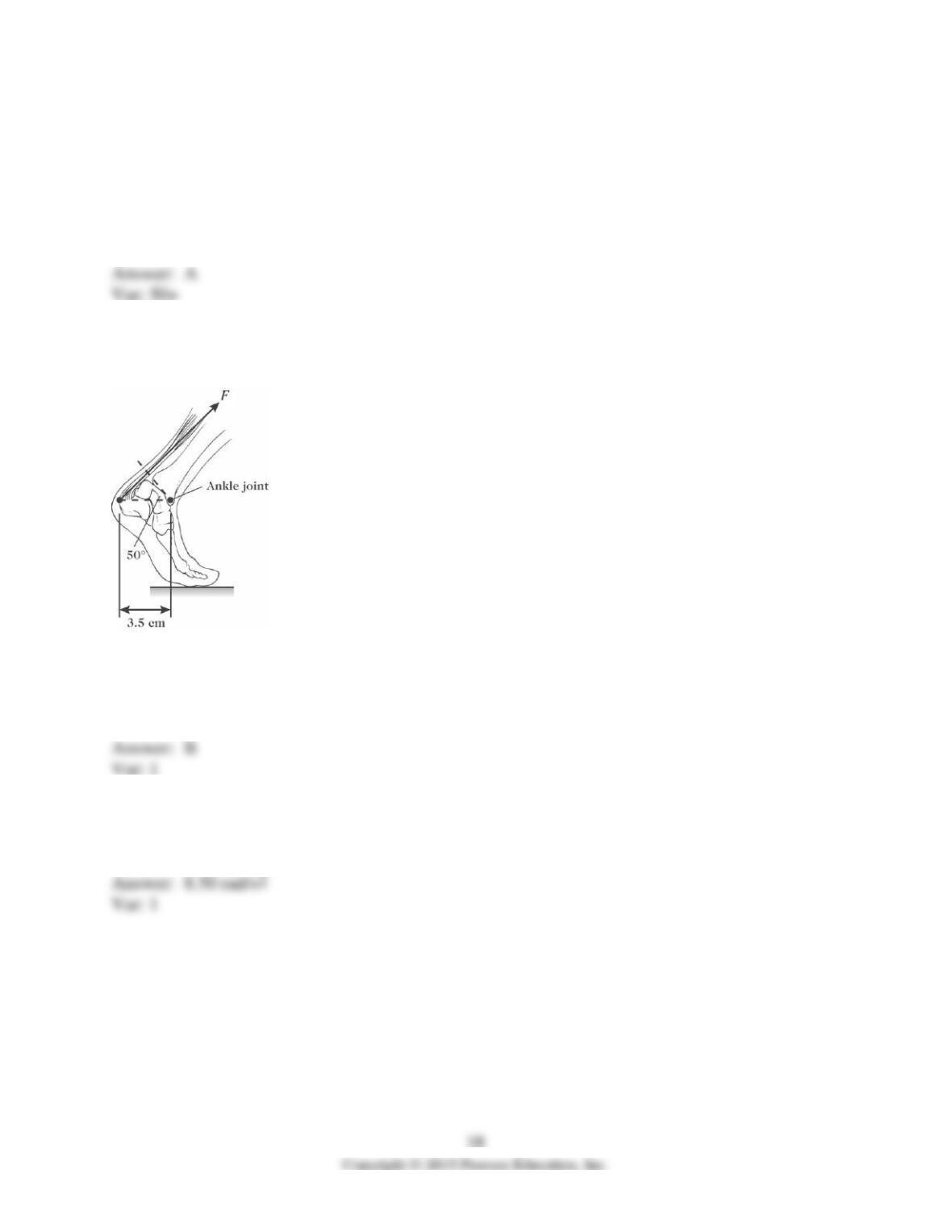
65) The figure shows a person’s foot. In that figure, the Achilles tendon exerts a force of
magnitude F = 720 N. What is the magnitude of the torque that this force produces about the
ankle joint?
A) 12 N ∙ m
B) 16 N ∙ m
C) 21 N ∙ m
D) 26 N ∙ m
E) 36 N ∙ m
66) The drive chain in a bicycle is applying a torque of 0.850 N ∙ m to the wheel of the bicycle.
The wheel has a moment of inertia of 0.100 kg ∙ m2. What is the angular acceleration of the
wheel?

67) The drive chain in a bicycle is applying a torque of 0.850 N ∙ m to the wheel of the bicycle.
You can treat the wheel as a thin uniform hoop (or ring) with a mass of 0.750 kg and a radius of
33.0 cm. What is the angular acceleration of the wheel?
A) 10.4 rad/s2
B) 20.8 rad/s2
C) 5.20 rad/s2
D) 3.43 rad/s2
E) 1.06 rad/s2
68) A mechanic is examining the wheel of a bicycle to adjust the brake. With the bicycle off the
ground, he manually rotates the wheel until it reaches an angular speed of 12.0 rad/s and then
allows it to coast to a stop. If the wheel has a moment of inertia of 0.100 kg ∙ m2, and the wheel
slows uniformly to a stop in 160 s, what is the magnitude of the retarding torque?
A) 1.00 N ∙ m
B) 0.00750 N ∙ m
C) 0.0787 N ∙ m
D) 1.33 N ∙ m
E) 1.67 N ∙ m
69) A force of is applied tangentially to a wheel of radius 0.340 m and causes an angular
acceleration of 1.20 rad/s2. What is the moment of inertia of the wheel?
A) 4.78 kg ∙ m2
B) 3.59 kg ∙ m2
C) 5.98 kg ∙ m2
D) 7.17 kg ∙ m2
70) A torque of 12 N ∙ m is applied to a solid, uniform disk of radius 0.50 m. If the disk
accelerates at what is the mass of the disk?
A) 60 kg
B) 45 kg
C) 30 kg
D) 15 kg
71) A particular motor can provide a maximum torque of 110 N ∙ m. Assuming that all of this
torque is used to accelerate a solid, uniform, cylindrical flywheel of mass 10.0 kg and radius 3.00
m, how long will it take for the flywheel to accelerate from rest to
A) 3.33 s
B) 2.83 s
C) 4.03 s
D) 4.36 s
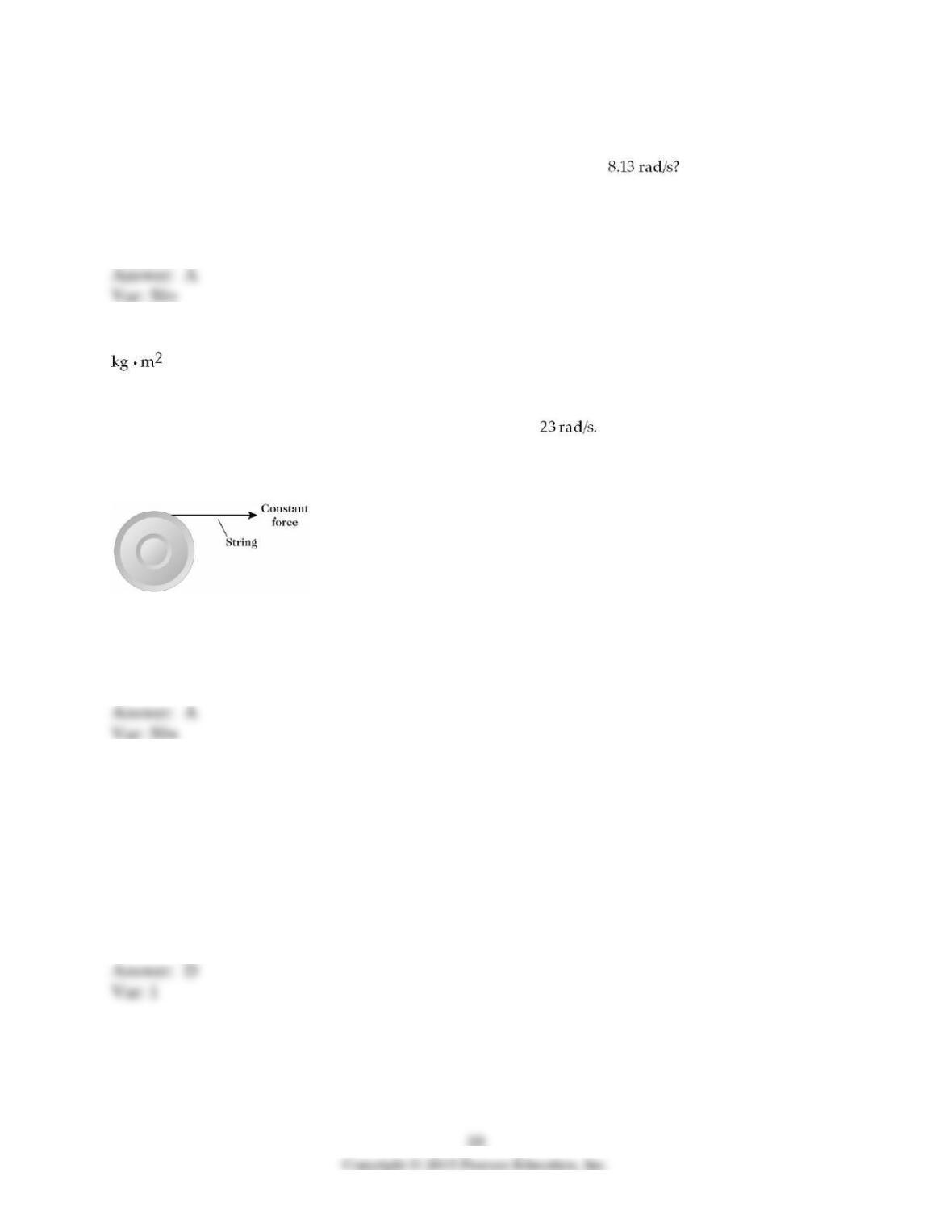
72) The drum shown in the figure has a radius of 0.40 m and a moment of inertia of 2.3
about an axis perpendicular to it through its center. The frictional torque at the drum axle
is 3.0 N ∙ m. A 14-m length of rope is wound around the rim. The drum is initially at rest. A
constant force is applied to the free end of the rope until the rope is completely unwound and
slips off. At that instant, the angular speed of the drum is The drum then slows down at a
constant rate and comes to a halt. In this situation, what was the magnitude of the constant force
applied to the rope?
A) 51 N
B) 40 N
C) 29 N
D) 18 N
E) 7.5 N
73) In a laboratory experiment, a student brings up the rotational speed of a flywheel to 30.0
rpm. She then allows it to slow down on its own, and counts 240 revolutions before the apparatus
uniformly comes to a stop. The moment of inertia of the flywheel is 0.0850 kg ∙ m2. What is the
magnitude of the retarding torque on the flywheel?
A) 0.0425 N ∙ m
B) 0.159 N ∙ m
C) 0.0787 N ∙ m
D) 0.000278 N ∙ m
E) 0.0000136 N ∙ m
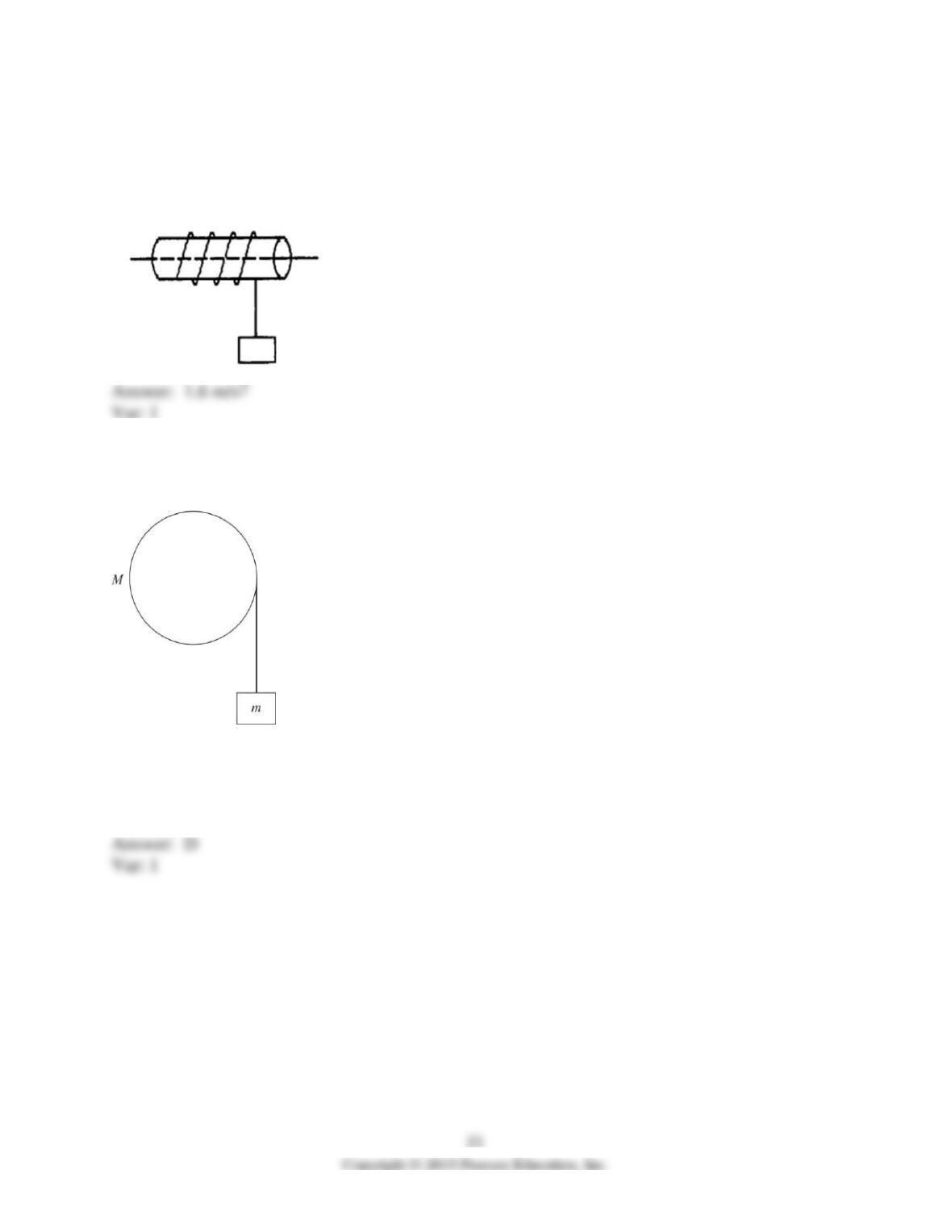
74) A uniform, solid, 100-kg cylinder with a diameter of 1.0 m is mounted so it is free to rotate
about fixed, horizontal, frictionless axis that passes through the centers of its circular ends. A 10-
kg block is hung from a very light thin cord wrapped around the cylinder’s circumference. When
the block is released, the cord unwinds and the block accelerates downward, as shown in the
figure. What is the acceleration of the block?
75) A cinder block of mass m = 4.0 kg is hung from a nylon string that is wrapped around a
frictionless pulley having the shape of a cylindrical shell, as shown in the figure. If the cinder
block accelerates downward at 4.90 m/s2 when it is released, what is the mass M of the pulley?
A) 2.0 kg
B) 4.0 kg
C) 6.0 kg
D) 8.0 kg
E) 10 kg
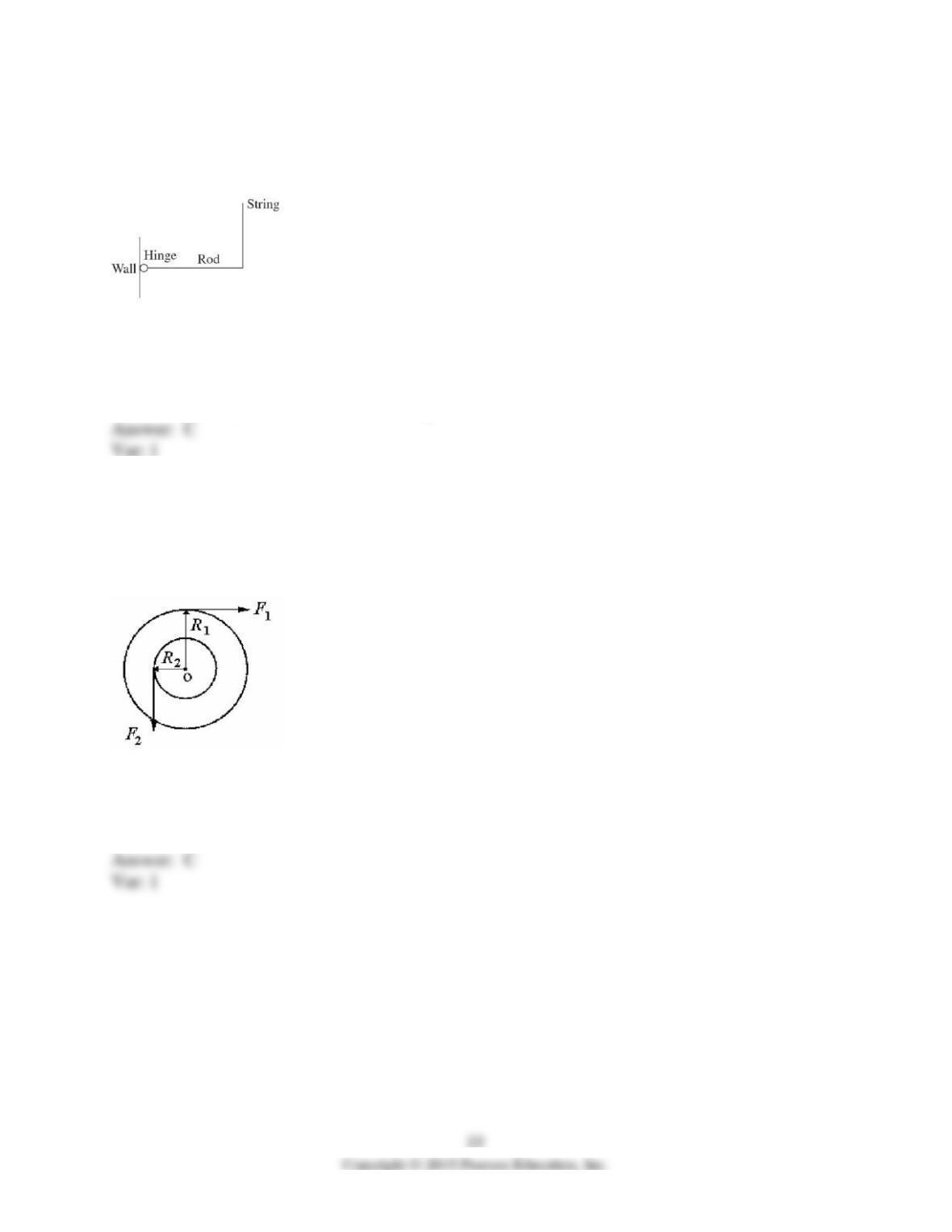
76) A uniform rod is 2.0 m long. It is hinged to a wall at its left end, and held in a horizontal
position at its right end by a vertical very light string, as shown in the figure. What is the angular
acceleration of the rod at the moment after the string is released if there is no friction in the
hinge?
A) 15 rad/s2
B) 3.3 rad/s2
C) 7.4 rad/s2
D) 11 rad/s2
E) It cannot be calculated without knowing the mass of the rod.
77) A uniform solid cylinder of mass 10 kg can rotate about a frictionless axle through its center
O, as shown in the cross-sectional view in the figure. A rope wrapped around the outer radius R1
= 1.0 m exerts a force of magnitude F1 = 5.0 N to the right. A second rope wrapped around
another section of radius R2 = 0.50 m exerts a force of magnitude F2 = 6.0 N downward. What is
the angular acceleration of the cylinder?
A) 1.0 rad/s2
B) 0.60 rad/s2
C) 0.40 rad/s2
D) 0.80 rad/s2
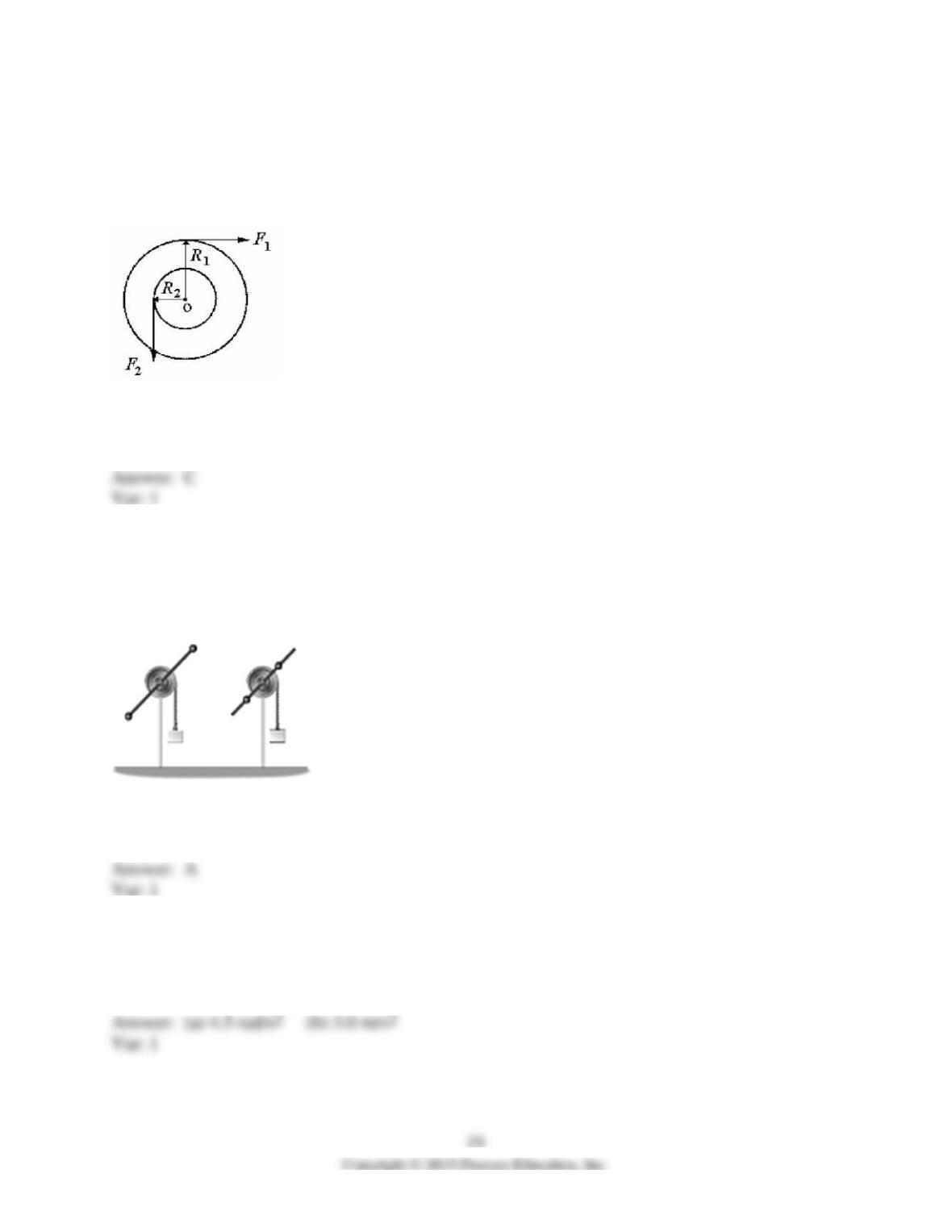
78) A uniform solid cylinder of mass 10 kg can rotate about a frictionless axle through its center
O, as shown in the cross-sectional view in the figure. A rope wrapped around the outer radius R1
= 1.0 m exerts a force of magnitude F1 = 5.0 N to the right. A second rope wrapped around
another section of radius R2 = 0.50 m exerts a force of magnitude F2 = 6.0 N downward. How
many radians does the cylinder rotate through in the first 5.0 seconds, if it starts from rest?
A) 13 rad
B) 7.5 rad
C) 5.0 rad
D) 10 rad
79) The rotating systems shown in the figure differ only in that the two identical movable masses
are positioned a distance r from the axis of rotation (left), or a distance r/2 from the axis of
rotation (right). If you release the hanging blocks simultaneously from rest, and call tL the time
taken by the block on the left and tR the time taken by the block on the right to reach the bottom,
respectively, then
A) tL > tR.
B) tL = tR.
C) tL < tR.
80) A 1.53-kg bucket hangs on a rope wrapped around a pulley of mass 7.07 kg and radius 66
cm. This pulley is frictionless in its axle, and has the shape of a solid uniform disk. After the
bucket has been released, (a) what is the angular acceleration of the pulley, and (b) what is the
acceleration of the bucket?
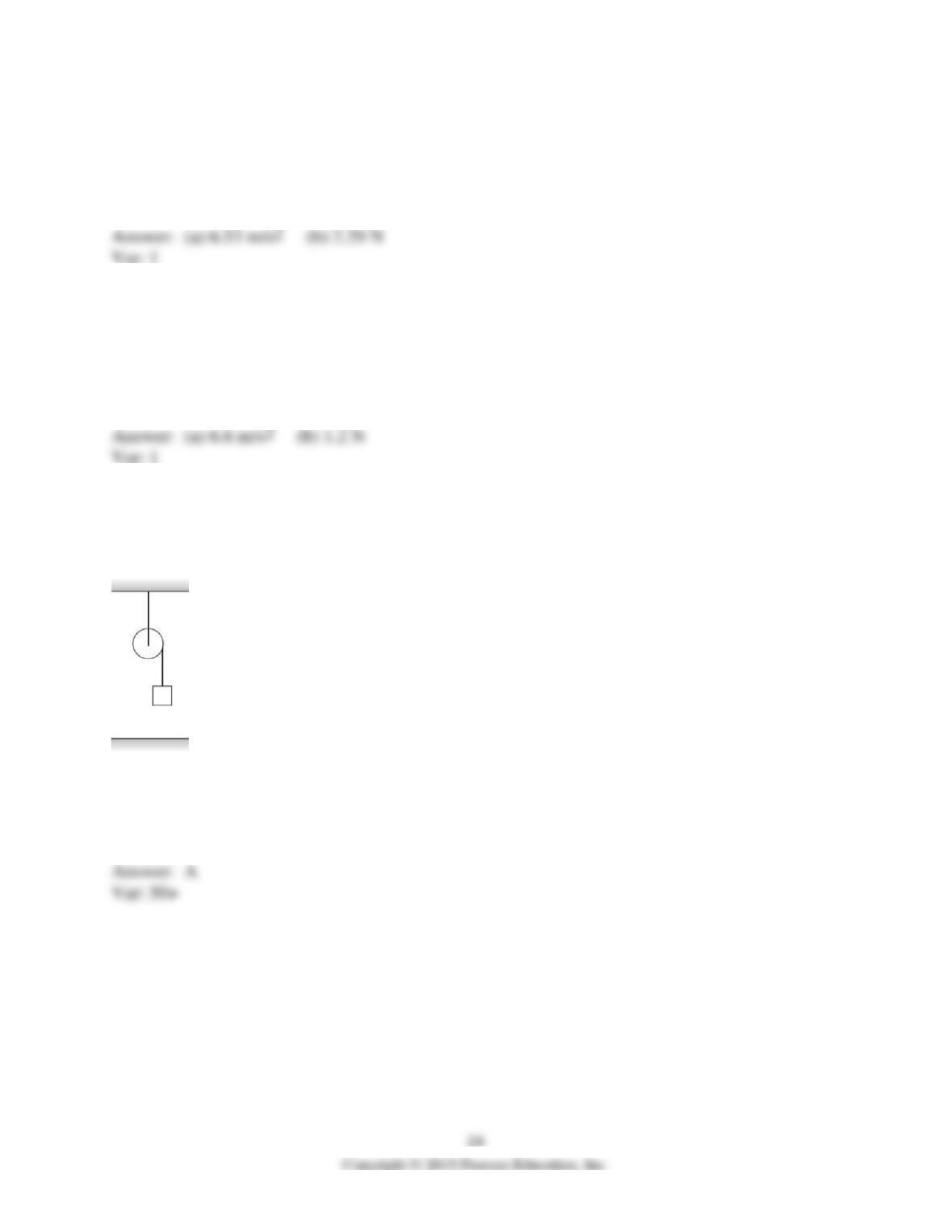
81) A 350-g air track cart on a horizontal air track is attached to a string that goes over a
frictionless pulley with a moment of inertia of 6.00 × 10⁻⁶ kg ∙ m2 and a radius of 1.35 cm. If the
string is pulled vertically downward by a force of 2.50 N, (a) what is the magnitude of the
acceleration of the cart, and (b) what is the tension in the horizontal string between the pulley
and the cart?
82) A 375-g stone hangs from a thin light string that is wrapped around the circumference of a
frictionless pulley with a moment of inertia of 0.0125 kg ∙ m2 and a radius of 26 cm. When the
stone is released, the stone accelerates downward and the pulley rotates about its axis as the
string unwinds.
(a) What is the magnitude of the acceleration of the stone?
(b) What is the tension in the string?
83) As shown in the figure, a 35.30-kg box is attached to a light string that is wrapped around a
cylindrical frictionless spool of radius 10.0 cm and moment of inertia 4.00 kg ∙ m2. The spool is
suspended from the ceiling, and the box is then released from rest a distance 3.50 m above the
floor. How long does it take for the box to reach the floor?
A) 2.97 s
B) 2.85 s
C) 0.892 s
D) 4.18 s
E) 5.89 s
84) A 385-g tile hangs from one end of a string that goes over a pulley with a moment of inertia
of and a radius of 15.0 cm. A mass of 710 g hangs from the other end of the string.
When the tiles are released, the larger one accelerates downward while the lighter one
accelerates upward. The pulley has no friction in its axle and turns without the string slipping.
What is the tension in the string on the side of the 710-g tile?
A) 9.77 N
B) 6.87 N
C) 5.59 N
D) 4.41 N
E) 3.68 N
85) A small 355-g box hangs from one end of a thin light string that goes over a frictionless
pulley having a moment of inertia of 0.0125 kg ∙ m2 and a radius of 15 cm. A second small
package, this one of mass 680 g, hangs from the other end of the string. When the packages are
released, the larger one accelerates downward, the lighter one accelerates upward, and the pulley
turns without the string slipping.
(a) What is the tension in the string on the side of the 355-g package?
(b) At what rate do the packages change their speeds?