
7.4-9) Assuming inflation, if a company wanted to maximize net income, it would select which of the
following inventory valuation methods?
A) FIFO
B) LIFO
C) Weighted–average
D) The selection of an inventory valuation method does not affect the net income.
E) Specific identification
7.4-10) Which of the following statements best describes how management selects an inventory valuation
method?
A) If a company generally sells its oldest inventory first, it must use the FIFO inventory valuation
method.
B) If a company generally sells its oldest inventory first, it must use the LIFO inventory valuation
method.
C) If a company generally sells its newest inventory first, it must use the FIFO inventory valuation
method.
D) If a company sometimes sells its newest inventory and sometimes sells its oldest inventory, then it
must use the weighted average inventory valuation method.
E) A company may choose any inventory valuation method even if it is contradictory to the physical flow
of inventory.
7.4-11) Assuming inflation, which of the following relationships among inventory valuation methods is
incorrectly stated?
A) FIFO has a higher inventory balance and a higher net income than LIFO.
B) FIFO has a higher inventory balance and a higher net income than weighted–average.
C) LIFO has a higher inventory balance and a higher net income than weighted–average.
D) Weighted–average has a higher inventory balance and a lower cost of goods sold than LIFO.
E) LIFO has a lower inventory balance and a higher cost of goods sold than FIFO.

7.4-12) Assuming inflation, which of the following statements incorrectly describes an attribute of, or the
relationship among, inventory valuation methods?
A) Specific identification is used primarily when inventory consists of relatively few but very expensive
and distinctive items.
B) Given inflation and in order to minimize taxes, most firms have tended to switch to LIFO if they had
been using FIFO.
C) LIFO tends to provide inventory valuations that closely approximate the actual market value of the
inventory at the balance sheet date.
D) LIFO tends to combine current sales prices and current acquisition costs through cost of goods sold.
E) Weighted average provides less extreme balance sheet and income statement results than either FIFO
or LIFO.
Table 7–3
Alton Company had the following activity in its inventory account during April 20X9.
Cost per
Date Activity Units Unit Cost Total
April 1 Beginning inventory 100 $3.00 $300
April 3 Purchase 40 3.10 124
April 7 Sale 50
April 12 Purchase 50 3.20 160
April 16 Sale 70
April 23 Sale 40
April 30 Purchase 60 3.30 198
Units in beginning inventory 100 units
Units purchased 150 units
Units sold 160 units
7.4-13) Referring to Table 7–3, what is the ending inventory balance at April 30, 20X9, for Alton Company
if the company uses perpetual FIFO as its inventory valuation method?
A) $198.00
B) $270.00
C) $294.00
D) $297.50
E) $358.00

7.4-14) Referring to Table 7–3, what is the cost of goods sold for the month ended April 30, 20X9, for Alton
Company if the company uses periodic FIFO as its inventory valuation method?
A) $424.00
B) $485.00
C) $488.00
D) $500.00
E) $584.00
7.4-15) Referring to Table 7–3, what is the ending inventory at April 30, 20X9, for Alton Company if the
company uses periodic weighted average as its inventory valuation method (round all calculations to the
nearest penny)?
A) $281.70
B) $285.60
C) $290.22
D) $290.70
E) $294.00
7.4-16) Referring to Table 7–3, what is the ending inventory balance at April 30, 20X9, for Alton Company
if the company uses perpetual LIFO as its inventory valuation method?
A) $240
B) $270
C) $288
D) $300
E) $438
7.4-17) Referring to Table 7–3, what is the cost of goods sold for the month ended April 30, 20X9, for Alton
Company if the company uses perpetual LIFO as its inventory valuation method?
A) $344
B) $482
C) $494
D) $502
E) $542

7.4-18) Referring to Table 7–3, what is the ending inventory balance at April 30, 20X9, for Alton Company
if the company uses periodic LIFO as its inventory valuation method?
A) $240
B) $270
C) $288
D) $300
E) $438
7.4-19) FIFO tends to decrease taxes when
A) costs are increasing.
B) costs are decreasing.
C) costs are constant.
D) FIFO will always yield the lowest possible taxes.
E) Impossible to determine without specific cost data
7.4-20) LIFO tends to decrease taxes when
A) costs are declining.
B) costs are constant.
C) costs are increasing.
D) LIFO will always yield the lowest possible taxes.
E) Impossible to determine without specific cost data
7.4-21) Bryer Company has used the FIFO method of valuing its inventory for the prior 12 years. The
accountants at Bryer Company would like to switch to LIFO since the economy is suffering from severe
inflation. For the switch to occur
A) Bryer Company must remain consistent and keep LIFO in place for a minimum of 15 years.
B) Bryer Company must remain consistent with or without auditor approval.
C) Bryer Company must remain consistent with or without placing a note in the financial statements.
D) Bryer Company must have its auditor’s approval and place a note in its financial statements, also, the
auditor must refer to the change in its audit opinion.
E) Bryer Company cannot make a change to its inventory valuation method once a method is chosen.

7.4-22) If unit costs and prices did not fluctuate, specific identification, LIFO, FIFO, and weighted–average
would show the same ending inventory and cost of goods sold balances.
7.4-23) The specific identification method is frequently used for items with common characteristics, such
as tons of coal.
7.4-24) Under the FIFO method, ending inventory is valued based on the oldest unit costs.
7.4-25) When prices are rising, LIFO generally results in the lowest taxable income, and therefore helps
reduce taxes paid.
7.4-26) FIFO will report the highest cost of goods sold on the income statement when prices are falling.
7.4-27) LIFO results in a more accurate portrayal of ending inventory on the balance sheet than does
FIFO.
7.4-28) LIFO matches cost of goods sold to sales on the income statement more accurately than does FIFO.
7.4-29) Assuming inflation, FIFO will result in a higher net income than LIFO.
7.4-30) Assuming inflation, weighted–average will result in a net income that is higher than LIFO and an
ending inventory valuation that is lower than FIFO.

7.4-31) The consistency convention does not expect that companies will show consistent levels of earnings
from year to year.
7.4-32) An attribute associated with inventory valuation methods is that the lower the cost of goods sold
the higher the ending inventory.
7.4-33) U.S. tax law contains a conformity requirement that allows companies to use LIFO for tax
purposes only if the companies use LIFO for financial reporting purposes.
7.4-34) The LIFO costing method can result in misleading inventory costs on the balance sheet because
the oldest costs are left in ending inventory.
7.4-35) The ending inventory under LIFO will have one total value, but it may contain prices from many
different periods.
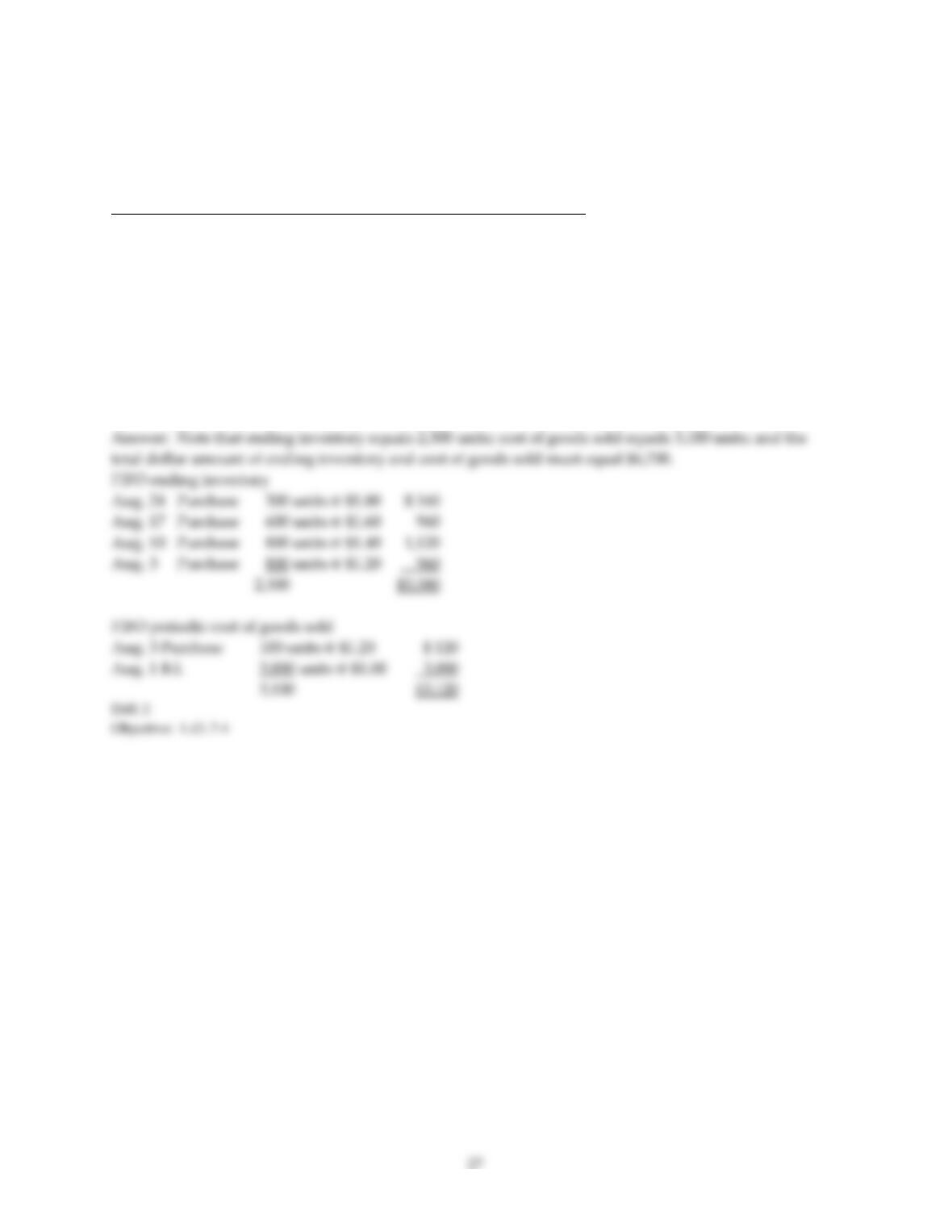
Table 7–4
Ploxy Company uses the periodic inventory method and recorded the following inventory and purchase
transactions for the month of October 20X9.
Date Transaction Units Unit Cost Total
Aug 1 Beginning inventory 3,000 units @ $1.00 $3,000
Aug 3 Purchases 900 units @ $1.20 1,080
Aug 10 Purchases 800 units @ $1.40 1,120
Aug 17 Purchases 600 units @ $1.60 960
Aug 24 Purchases 300 units @ $1.80 540
7.4-36) Referring to the information in Table 7–4, determine the ending inventory balance at October 31
and the cost of goods sold for the month of October, 20X9 for Ploxy Company. Ploxy Company sold 3,100
units during October, 20X9. On October 31, a physical inventory count was conducted, and 2,500 units
were on hand. Assume the company uses the first–in–first–out (FIFO) cost flow assumption.
28
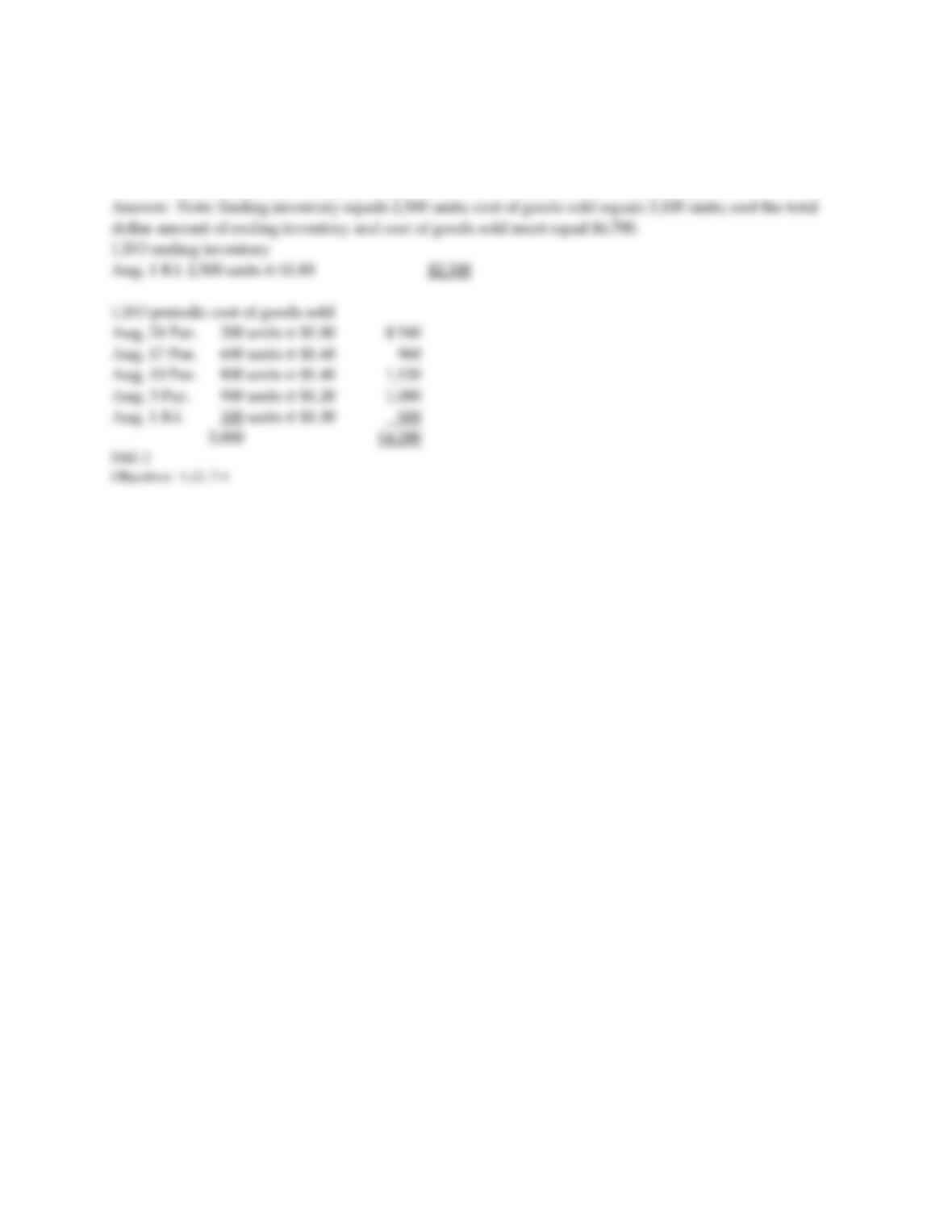
7.4-37) Referring to the information in Table 7–4, determine the ending inventory balance at October 31
and the cost of goods sold for the month of October, 20X9 for Ploxy Company. Ploxy Company sold 3,100
units during October, 20X9. On October 31, a physical inventory count was conducted, and 2,500 units
were on hand. Assume the company uses the last–in–first–out (LIFO) cost flow assumption.
Table 7–5
Gabby Company operates under a perpetual inventory system. It began operations on January 1, 20X9,
and had the following transactions affecting inventory during January 20X9.
March 1 Purchase 500 units @ $5.00 $2,500
March 5 Sale 200 units
March 10 Purchase 300 units @ $5.20 $1,560
March 15 Sale 320 units
March 20 Purchase 400 units @ $5.40 $2,160
March 25 Sale 230 units
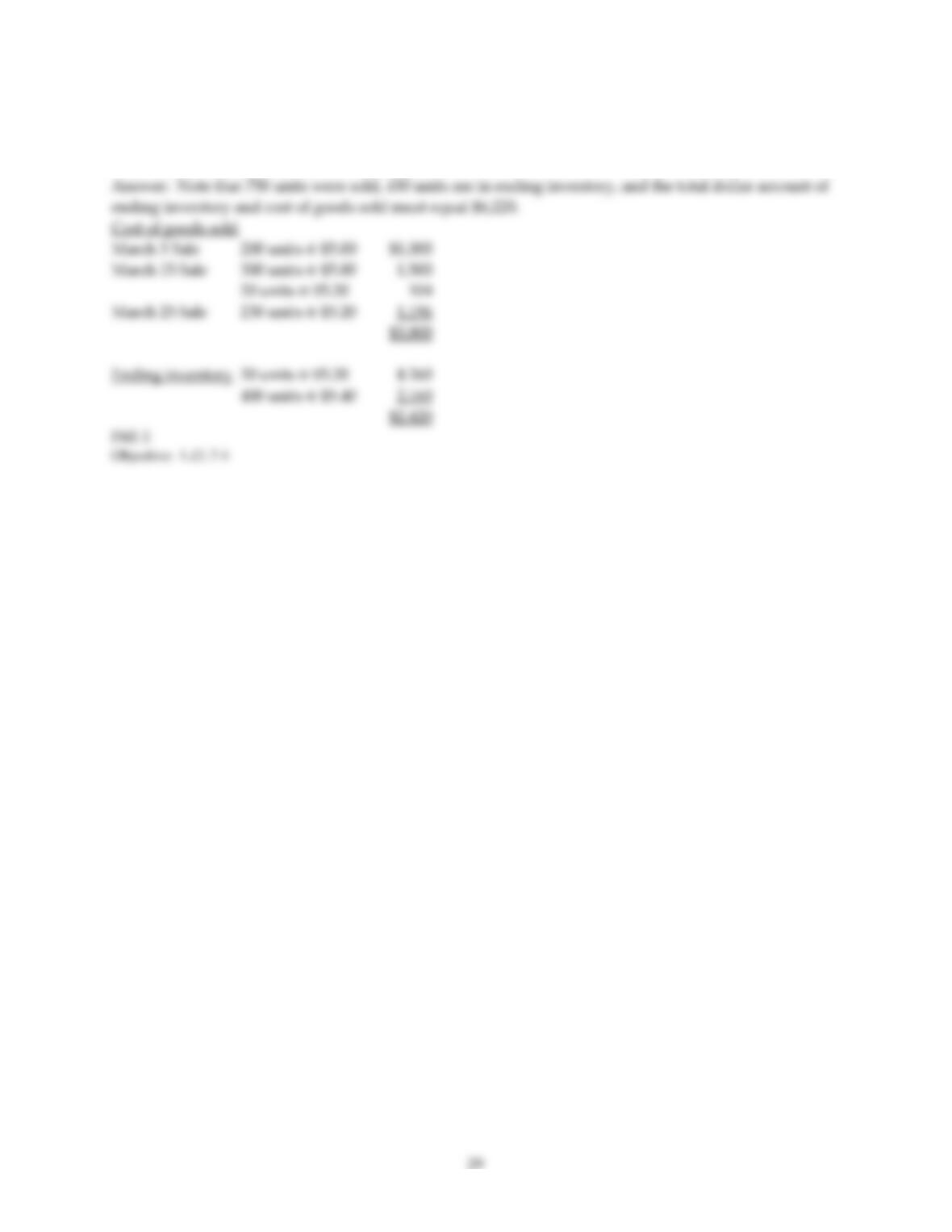
7.4-38) Referring to Gabby Company information in Table 7–5, determine the cost of goods sold for the
month of January, 20X9 and the ending inventory balance at January 31, 20X9. Assume the company uses
the first–in–first–out (FIFO) cost flow assumption.
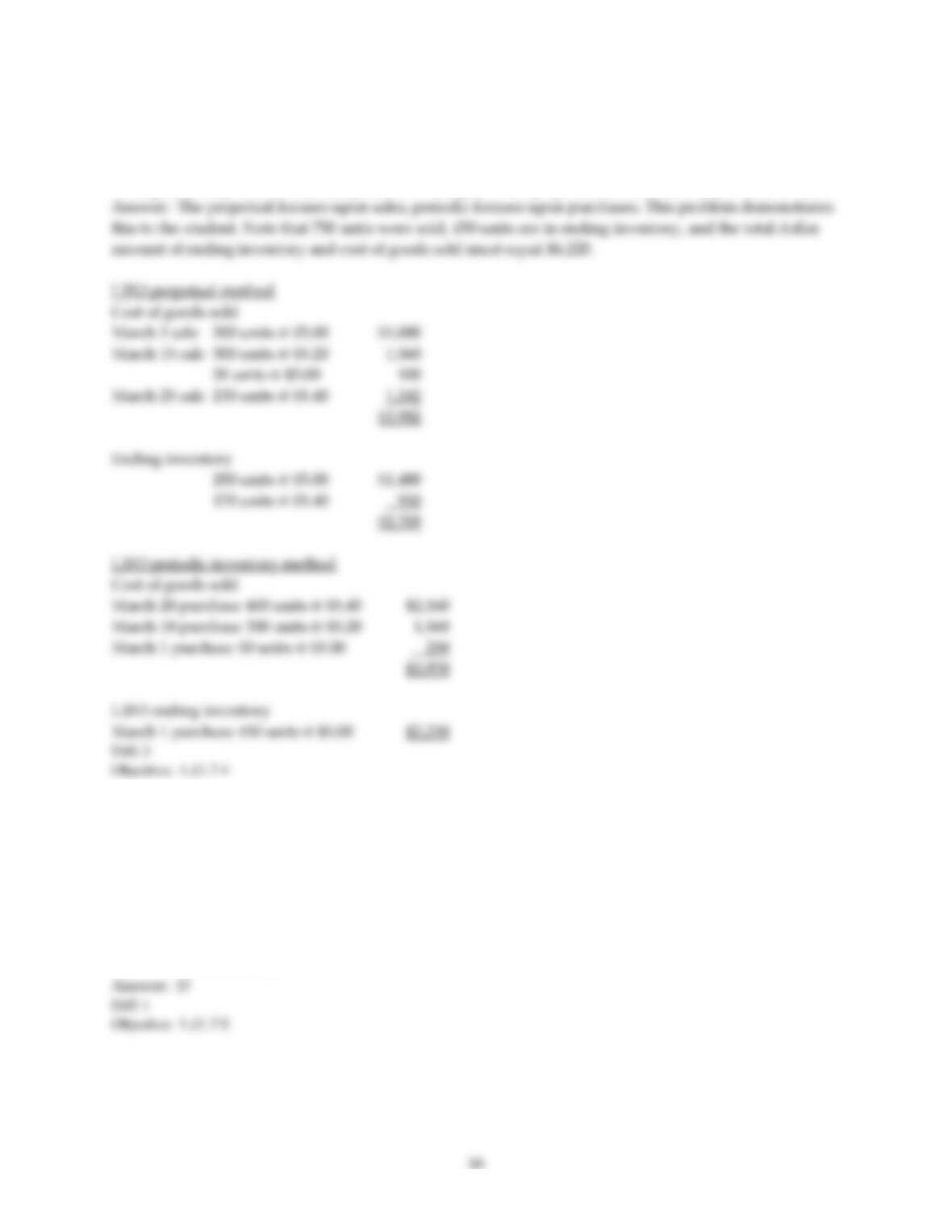
7.4-39) Referring to the Gabby Company information in Table 7–5. Assume the company is trying to
decide between the periodic method and the perpetual method. Gabby has decided to use the last–in–first–
out cost flow assumption. Determine the cost of goods sold for the month of January, 20X9 and the
ending inventory balance at January 31, 20X9, using both the perpetual method and the periodic method.
Learning Objective 7.5 Questions
7.5-1) The lower–of–cost–or–market practice is based on the
A) consistency principle.
B) entity concept.
C) reliability principle.
D) conservatism principle.
E) historical cost concept.

7.5-2) The replacement costs have increased from $2.90 per unit to 3.40 per unit from the time 500 units of
inventory were purchased. The year–end audit found 200 units remaining in stock. The company should
take what following step?
A) Cost of goods sold 750
Inventory 750
B) Inventory 750
Cost of goods sold 750
C) Cost of goods sold 100
Inventory 100
D) Inventory 100
Cost of goods sold 100
E) Make no entry.
7.5-3) Sandork, Inc., has 200 units of inventory which are currently priced $4.90 per unit at the market.
Originally this inventory cost $5.50 per unit from an order of 400. Sandork, Inc., should take what
following step?
A) Loss on inventory write–down 120
Inventory 120
B) Inventory 120
Loss on inventory write–down 120
C) Loss on inventory write–down 240
Inventory 240
D) Inventory 240
Loss on inventory write–down 240
E) Make no entry.
7.5-4) Compared with a pure cost method, the lower–of–cost–or–market method reports less net income in
the period of decline in the market value of the inventory and more net income in the period of sale.
7.5-5) The lower–of–cost–or–market method affects how much income is reported in each year but not the
total income over the company’s life.
7.5-6) If replacement costs rise after the physical inventory count is taken, then the inventory value must
be increased.