
78. Blue Ridge Ski Resort produces a variety of snow skis. Snow skis are produced in large batches and 10
batches are produced per year. The company’s controller has recently implemented an activity-based costing
(ABC) system. The following information is also available:
Average selling price per pair of skis
$300 per pair
Direct materials
$30 per pair
Direct labor
$15 per pair
Variable overhead
$5 per pair
Setup cost
$1,000 per batch
Total Fixed costs
$30,000
Calculate the number of skis that need to be sold in order for the company to break even.
79. Bert’s Surfboards produces a variety of surfboards. Surfboards are produced in large batches and 30 batches
are produced per year. The company’s controller has recently implemented an activity-based costing (ABC)
system. The following information is also available:
Average selling price
$400 per unit
Direct materials
$45 per unit
Direct labor
$20 per unit
Variable overhead
$15 per unit
Setup cost
$1,000 per batch
Total Fixed costs
$250,000
Calculate the number of surfboards that need to be sold in order for the company to break even. (Round up to the nearest whole board)
80. Grisham Inc. wishes to have an after-tax profit of $400,000. If Grisham’s tax rate is 35%, what is their
before-tax profit?
81. Mulvaney Inc. ignored the effect of income taxes in its calculation of the sales volume needed to achieve a
target profit of $1,000,000. If the company considers the impact of income taxes in its calculation, which of the
following statements would be true?
82. When considering the impact of income taxes on the sales volume needed to achieve a desired after-tax
profit, which of the following statements is true?
83. Harrison Manufacturing has the following product information available:
Sales price
$50 per unit
Variable costs
$26 per unit
Fixed costs
$87,600
If Harrison is in the 35% tax bracket, how many units need to be sold in order to earn an after-tax target profit of $260,000?
84. Poole Products Inc. has the following product information available:
Sales price
$25 per unit
Variable costs
$10 per unit
Fixed costs
$36,000
If Poole is in the 40% tax bracket, how many units need to be sold in order to earn an after-tax target profit of $249,000?
85. LeBlanc Manufacturing has the following product information available:
Sales price
$60 per unit
Variable costs
$20 per unit
Fixed costs
$50,000
If LeBlanc is in the 30% tax bracket, how many units need to be sold in order to earn an after-tax target profit of $490,000?
86. Blinson Manufacturing has the following product information available:
Sales price
$75 per unit
Variable costs
$25 per unit
Before-tax profit
$180,000
If Blinson has calculated that it needs to sell 20,000 units in order to earn an after-tax target profit of $126,000, what were Blinson’s fixed costs?
87. Howard Enterprises has a contribution margin ratio of 65% and fixed costs of $15,000. What would sales
have to be in order for Howard to earn an after-tax profit of $50,000? The company is in the 40% tax bracket.
88. Which of the following is an assumption of CVP analysis?
89. Which of the following is not an assumption of CVP analysis?
90. One of the major assumptions used in CVP analysis is:
91. Cost structure refers to the relative proportion of:
92. Operating leverage measures:
93. Carson Cabana’s Inc. has the following information available regarding last year’s operations:
Sales
$1,500,000
Variable costs
600,000
Contribution margin
900,000
Fixed costs
300,000
Net income
$ 600,000
The company’s operating leverage was:
94. Hillary’s Restaurant has the following information available regarding last year’s operations:
Sales
$900,000
Variable costs
300,000
Contribution margin
600,000
Fixed costs
175,000
Net income
$425,000
The company’s operating leverage was:
95. Which of the following statements is most likely true if Red Inc. has an operating leverage of 2.0 while Blue
Corp. has an operating leverage of 1.4?
96. A company with a high level of operating leverage will:
97. Your boss read a recent magazine article about income statements, but he was unclear about the differences
between a traditional income statement and a contribution margin income statement. Explain the difference by:
a) presenting a sample format for each statement, b) describing the focus of each statement, and c) discussing
how and by whom each statement is used.
a.
Traditional format:
Contribution margin format:
Sales
$XX
Sales
$XX
Less: Cost of goods sold
(XX)
Less: Variable costs
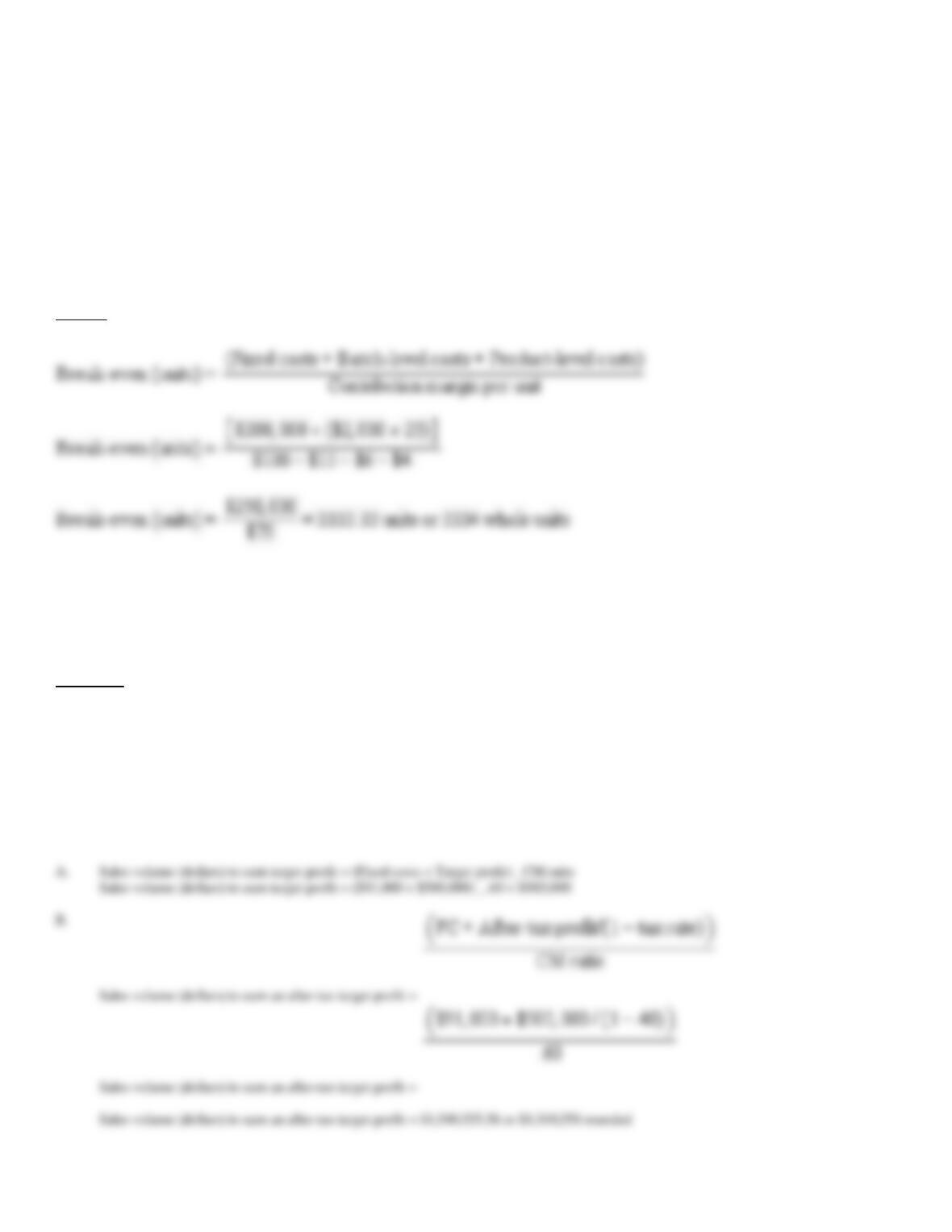
(XX)
Gross profit
XX
Contribution margin
XX
Less: Selling, general, and admin. costs
(XX)
Less: Fixed costs
(XX)
Net income
$XX
Net income
$XX
98. For each of the following statements, fill in the blank with either the word increase, decrease, or stay the
same.
a.
All else being equal, as the sales price per unit increases, the contribution margin per unit will _________________.
b.
All else being equal, as variable costs per unit increase, the contribution margin per unit will _________________.
c.
All else being equal, as total fixed costs increase, the contribution margin per unit will ________________.
d.
All else being equal, as sales volume increases, total fixed costs will _______________.
e.
All else being equal, as sales volume increases, total variable costs will _____________.
a.
increase
b.
decrease
c.
stay the same
stay the same
e.
increase
99. How are both the contribution margin per unit and the contribution margin ratio computed? Explain the
difference between what each of them indicates.
100. In 2009 Dillon Inc. had a total contribution margin of $100,000 and net income of $60,000. For the
upcoming year, the company would like to earn a target profit of $80,000. Assuming sales volume is expected
to be the same in the upcoming year as it was in the past year, give three separate options the company could
implement in order to achieve their target profit in the upcoming year.
101. When using CVP analysis, why is it important to consider qualitative factors? Provide one example of a
qualitative factor and explain how it might affect a decision.
102. What does operating leverage reveal about a company?
103. What is meant by the term “break-even point” and how is it computed in a single versus a multi-product
environment?
104. All else being equal, explain how each of the following independent changes will affect a company’s
break-even point in terms of the number of units that need to be sold.
a.
Fixed costs increase
b.
Sales price per unit increases
c.
Variable costs per unit increase
d.
Fixed costs decrease
e.
Variable costs per unit decrease
105. When and why should income taxes be considered in profit planning? What is the impact on target profit
when income taxes are taken into account?
106. In a multi-product environment, what are the four assumptions used in CVP analysis?
a.
b.
c.
d.
a.
The selling price is constant throughout the entire relevant range.
Costs are linear throughout the relevant range.
c.
In a multi-product environment, the sales mix is constant.
a.
Increase
Decrease
c.
Increase
d.
Decrease
e.
Decrease
107. Trenton Inc. manufactures a single product. The following information is available for 2009
Number of units produced and sold
25,000 units
Sales price per unit
$20 per unit
Variable manufacturing costs
$8 per unit
Variable selling and administrative costs
$2 per unit
Total fixed manufacturing costs
$10,000
Total fixed selling and administrative costs
$8,000
Required:
A.
Prepare a traditional format income statement (ignore taxes).
B.
Prepare a contribution margin format income statement (ignore taxes).
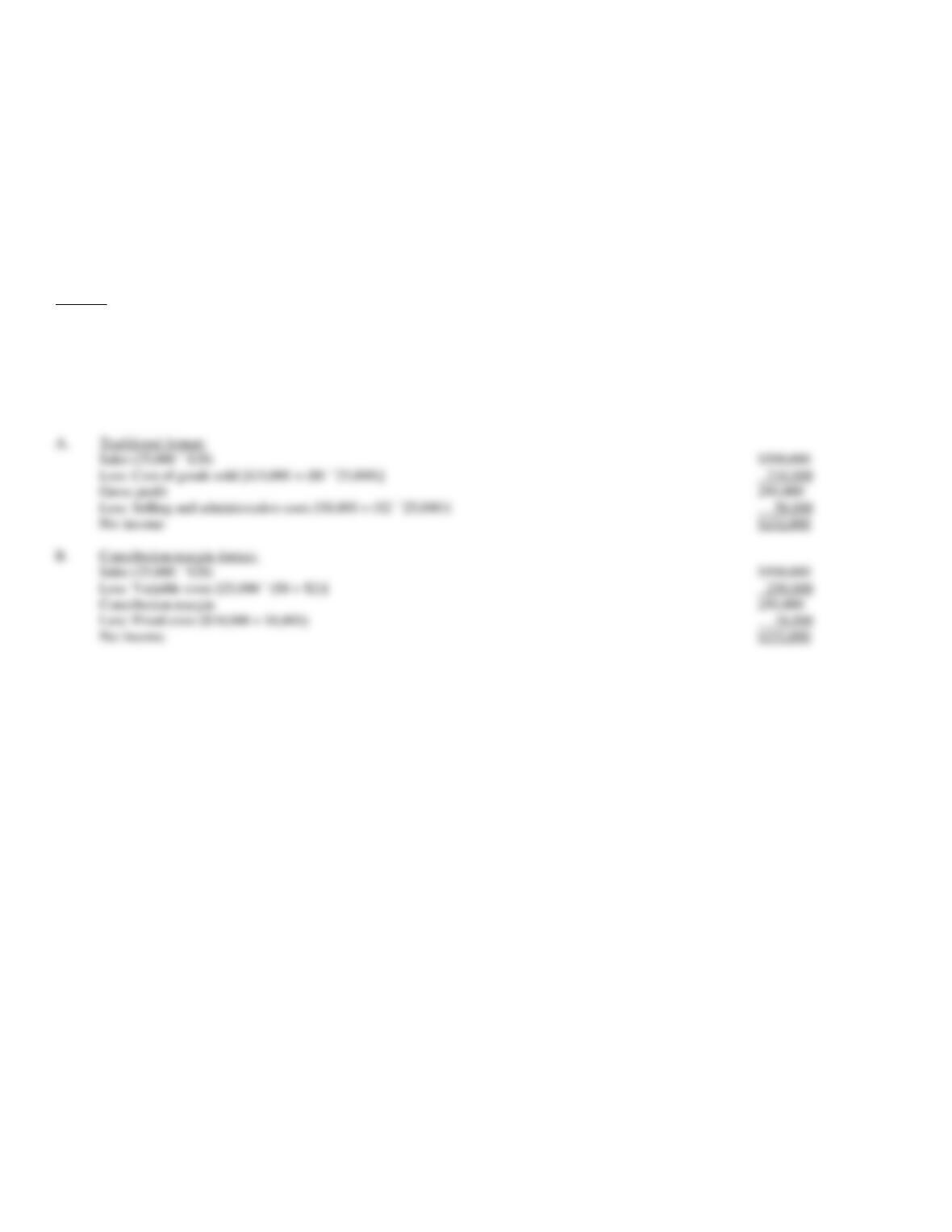
A.
Traditional format:
Sales (25,000 ´ $20)
$500,000
Less: Cost of goods sold [$10,000 + ($8 ´ 25,000)]
210,000
Gross profit
290,000
Less: Selling and administrative costs [$8,000 + ($2 ´ 25,000)]
58,000
Net income
$232,000
B.
Contribution margin format:
Sales (25,000 ´ $20)
$500,000
Less: Variable costs [25,000 ´ ($8 + $2)]
250,000
Contribution margin
250,000
Less: Fixed costs ($10,000 + $8,000)
18,000
Net income
$232,000
108. Vincent Products manufactures a particular item with the following information:
Sales price
$80 per unit
Variable costs
$30 per unit
Fixed Costs
$5 per unit
Units produced and sold
10,000
Required: Calculate the following based on the above information:
A.
Contribution margin per unit
B.
Contribution margin ratio
C.
Break-even point in units
D.
Break-even point in sales dollars
A.
Contribution margin per unit = $80 – $30 = $50
B.
Contribution margin ratio = $50 ¸ $80 = .625 or 62.5%
C.
Break-even point in units = Fixed costs ¸ CM per unit = $50,000 ¸ $50 = 1,000 units
(note: Fixed costs = 10,000 units ´ $5 = $50,000)
D.
Break-even point in sales dollars = Fixed costs ¸ CM ratio = $50,000 ¸ .625 = $80,000
109. Amanda’s Silver Company produces a unique item with the following information:
Sales price
$40 per unit
Variable costs
$10 per unit
Fixed Costs
$15,000
Units produced and sold
2,000
Required: Calculate the following based on the above information:
A.
Net income
B.
Contribution margin per unit
C.
Contribution margin ratio
D.
If Amanda’s sells 100 more additional units, by what amount will net income increase?
E.
If Amanda’s has an additional $2,000 in sales, by what amount will net income increase?
A.
Sales (2,000 ´ $40)
$80,000
Less: Variable costs (2,000 ´ $10)
20,000
Contribution margin
60,000
Less: Fixed costs
15,000
Net income
$45,000
B.
Contribution margin per unit: $40 – $10 = $30
C.
Contribution margin ratio = $30/$40 = .75 or 75%
D.
Net income will increase by $3,000 ($30 ´ 100)
E.
Net income will increase by $1,500 ($2,000 ´ .75)
110. Chapman Products produces a unique item with the following information:
Sales price
$100 per unit
Variable costs
$40 per unit
Fixed Costs (total)
$60,000
Units sold
5,000
Required: Calculate the following based on the above information:
A.
Net income
B.
Contribution margin per unit
C.
Contribution margin ratio
D.
If Chapman sells 500 more additional units, by what amount will net income increase?
E.
If Chapman has an additional $20,000 in sales, by what amount will net income increase?
A.
Sales (5,000 ´ $100)
$500,000
Less: Variable costs (5,000 ´ $40)
200,000
Contribution margin
300,000
Less: Fixed costs
60,000
Net income
$240,000
B.
Contribution margin per unit: $100 – $40 = $60
C.
Contribution margin ratio = $60/$100 = .60 or 60%
D.
Net income will increase by $30,000 ($60 ´ 500)
E.
Net income will increase by $12,000 ($20,000 ´ .60)
111. Sienna Manufacturing has the following product information:
Sales price
$20.00 per unit
Variable costs
$8.00 per unit
Fixed Costs (total)
$45,000
Required: Calculate the following based on the above information:
A.
What is the break-even point in units?
B.
What is the break-even point in sales dollars?
C.
How many units need to be sold in order for the company to earn a target-profit of $499,800? (ignore taxes)
112. Greenwood Manufacturing has the following product information:
Sales price
$40.00 per unit
Variable costs
$18.00 per unit
Fixed Costs (total)
$99,000
Required: Calculate the following based on the above information:
A.
What is the break-even point in units?
B.
What is the break-even point in sales dollars?
C.
How many units need to be sold in order for the company to earn a target-profit of $429,000? (ignore taxes)
Break-even units = $99,000 ¸ $22.00 = 4,500 units
B.
Contribution margin ratio = $22.00 ¸ $40.00 = .55
Break-even sales dollars = $99,000 ¸ .55 = $180,000
C.
Sales volume to reach a target profit = ($99,000 + $429,000) ¸ $22.00 = 24,000 units
Break-even units = $45,000 ¸ $12.00 = 3,750 units
B.
Contribution margin ratio = $12.00 ¸ $20.00 = .60
Break-even sales dollars = $45,000 ¸ .60 = $75,000
C.
Sales volume to reach a target profit = ($45,000 + $499,800) ¸ $12.00 = 45,400 units
113. Carolina Products has the following product information:
Sales price
$25.00 per unit
Variable costs
$15.00 per unit
Fixed costs (total)
$50,000
Required: Calculate the following based on the above information:
A.
How many units need to be sold in order to break even?
B.
Calculate the increase in net income if an additional 1,000 units over the break-even point are sold.
C.
How many units need to be sold in order to earn a target profit of $600,000? (Ignore taxes)
114. The following information is available for the Blue and Red Companies for 2009
Blue
Red
Sales (200,000 units)
$1,800,000
$1,800,000
Variable costs
800,000
1,200,000
Contribution margin
1,000,000
600,000
Fixed costs
500,000
100,000
Net income
$ 500,000
$ 500,000
Required:
A.
Compute the operating leverage for each company and explain what operating leverage measures.
B.
If both companies experience a 20% increase in sales volume, will they continue to have the same net income? Why or why not? Explain
your answer with respect to each company’s operating leverage.
Blue Company’s operating leverage = $1,000,000 ¸ $500,000 = 2
Red Company’s operating leverage = $600,000 ¸ $500,000 = 1.2
Break-even units = $50,000 ¸ $10.00 = 5,000 units
B.
1,000 units ´ $10 contribution margin per unit = $10,000 increase in net income
C.
Sales volume to reach a target profit = ($50,000 + $600,000) ¸ $10.00 = 65,000 units
115. Bradford Products has the following product information available:
Sales price
$25.00 per unit
Variable costs
$15.00 per unit
Fixed Costs (total)
$50,000
Required: Answer each of the following independent questions.
A.
What is the contribution margin per unit?
B.
What is the contribution margin ratio?
C.
How many units must be sold in order to break even?
D.
How many units must be sold in order to earn a target profit of $400,000? (ignore taxes)
E.
Bradford is considering an advertising campaign that has a cost of $70,000. The marketing department estimates that the campaign will
increase sales by $250,000. Should the company have the advertising campaign? Why or why not? Show your calculations.
A.
Contribution margin per unit = $10 ($25 – $15)
B.
Contribution margin ratio = $10 ¸ $25 = .40 or 40%
C.
Break-even units = $50,000 ¸ $10 = 5,000 units
B.
Sales volume to earn target profit = ($50,000 + $400,000) ¸ $10 = 45,000 units
Yes, net profit will increase if they have the advertising campaign.
Calculations:
The effect on contribution margin if sales increase $250,000:
$250,000 ´ 40% = $100,000 increase in contribution margin
116. Lowman Inc. sells a product with a sales price of $25 per unit, variable costs of $7 per unit, and total fixed
costs of $100,000. Lowman is looking into implementing an aggressive advertising campaign that will cost
$50,000.
117. Sweet Baby Inc. produces two types of children’s specialty bed products – Baby Cribs and Toddler Beds.
The following information is available related to each product:
Baby Crib
Toddler Bed
Sales price per unit
$600
$500
Variable costs per unit
150
200
Baby cribs account for 60% of total product sales and toddler beds account for the rest. Sweet Baby’s total fixed costs are $1,170,000.
Required:
A.
How many total children’s bed products does the company need to produce and sell in order to break even?
B.
How many baby cribs need to be sold in order to break even?
Weighted-average CM per unit
follows:
Baby crib weighted contribution margin = $450 ´ 60% = $270, and
118. Hugo Inc. sells three sizes of umbrellas: small, medium, and large. The company has annual fixed costs of
$390,400. For the past several years, 20% of Hugo’s sales have been the small and large umbrellas with the
remaining 60% being the medium size. Hugo does not expect this to change in the upcoming year.
The following information is also available for each of the umbrellas:
Small
Medium
Large
Sales price per unit
$8
$14
$35
Variable costs per unit
3
4
9
Required:
A.
How many total umbrellas does the company need to produce and sell in order to break even?
B.
How many medium umbrellas need to be sold in order to break even?
C.
If Hugo experiences a higher demand of large umbrellas than it anticipated, will the break-even point increase, decrease, or stay the same?
Why?
Break-even units in a multiproduct environment = FC ¸
Weighted-average CM per unit
119. Keever Manufacturing produces a variety of skateboards. Skateboards are produced in large batches and
25 batches are produced per year. The company’s controller has recently implemented an activity-based costing
(ABC) system. The following information is also available:
Average selling price per unit
$100 per board
Direct materials
$15 per board
Direct labor
$6 per board
Variable overhead
$4 per board
Setup cost
$2,000 per batch
Total Fixed costs
$200,000
Required: Calculate the number of skateboards that need to be sold in order for the company to break even. Round up to the nearest whole unit.
120. Harrison Inc. has a contribution margin ratio of 60% and fixed costs of $91,000.
Required:
A.
If Harrison ignores income taxes, what do sales dollars need to be in order to have net income of $500,000?
B.
If Harrison takes into account income taxes, and the company is in the 40% tax bracket, what do sales dollars need to be in order to have
an after-tax net income of $500,000?
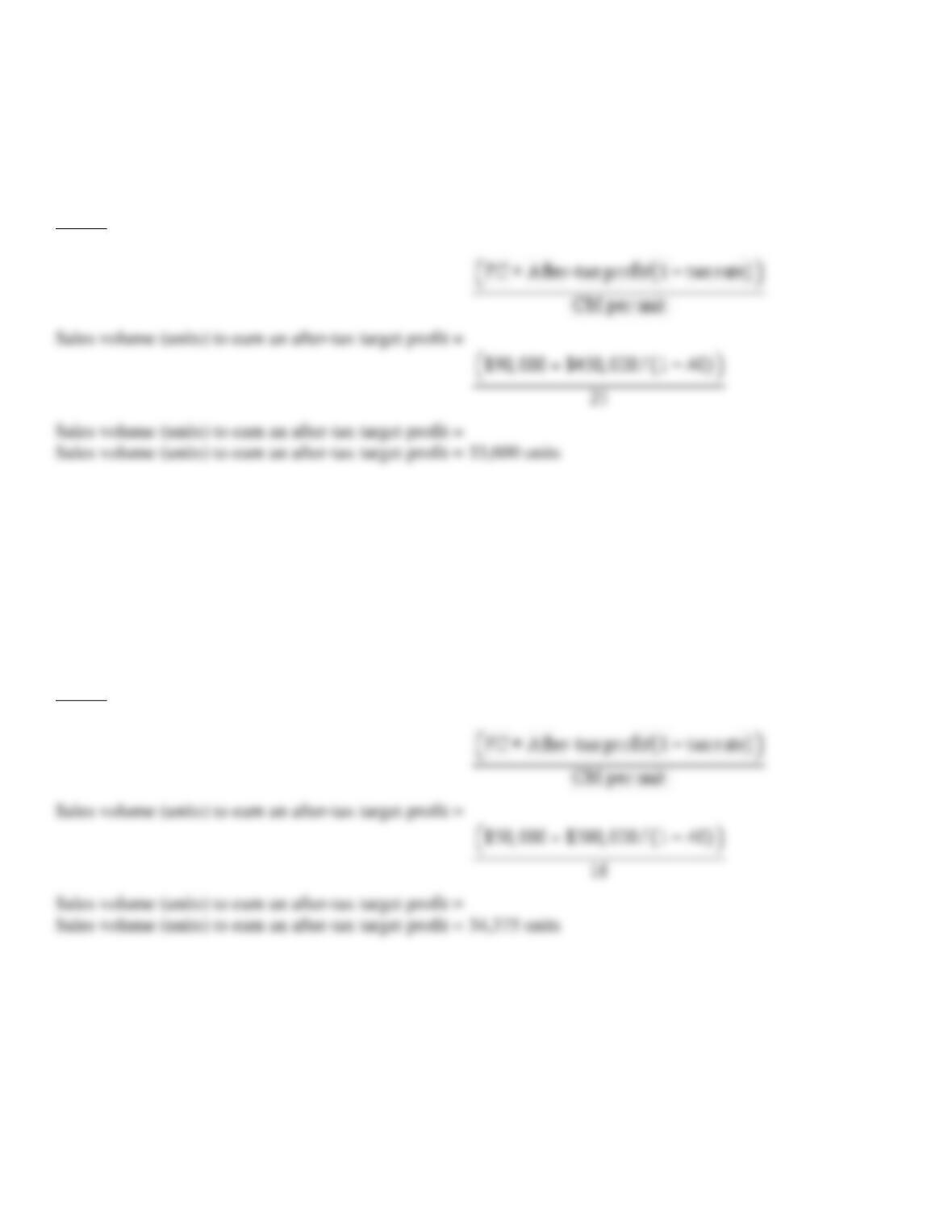
A.
Sales volume (dollars) to earn target profit = (Fixed costs + Target profit) ¸ CM ratio
Sales volume (dollars) to earn target profit = ($91,000 + $500,000) ¸ .60 = $985,000
Sales volume (dollars) to earn an after-tax target profit =
Sales volume (dollars) to earn an after-tax target profit = $1,540,555.56 or $1,540,556 rounded
121. Eason Products has the following product information available:
Sales price
$35 per unit
Variable costs
$10 per unit
Fixed costs
$90,000
Required: If Eason is in the 40% tax bracket, how many units need to be sold in order to earn an after-tax target profit of $450,000?
122. Carson Products has the following product information available:
Sales price
$20 per unit
Variable costs
$4 per unit
Fixed costs
$50,000
Required: If Carson is in the 40% tax bracket, how many units need to be sold in order to earn an after-tax target profit of $300,000?