64. Estuaries and coastal wetlands are important for all of the following reasons except
a.
nursery grounds for a variety of marine species
b.
filtering out waterborne pollutants
c.
reduction of storm damage
d.
providing coral for limestone production and the tourist trade
e.
high productivity
65. When the algae in coral reefs die off due to environmental stresses, the coral subsequently dies
because of lack of food. This process is referred to as
a.
coral acidification
b.
algal blooming
c.
erosion
d.
coral bleaching
e.
parasitism
66. In lakes, the nutrient-rich water near the shore is part of the
a.
limnetic zone
b.
benthic zone
c.
littoral zone
d.
profundal zone
e.
abyssal zone
67. Fish adapted to cool, dark water are most likely found in the zone of lakes called the
a.
limnetic zone
b.
benthic zone
c.
littoral zone
d.
profundal zone
e.
abyssal zone
68. A lake that is described as oligotrophic is typically
a.
low in primary productivity
b.
low in plant nutrients
c.
high in plant nutrients
d.
both low in primary productivity and low in plant nutrients
e.
both low in primary productivity and high in plant nutrients
69. The majority of photosynthesis in a lake takes place in the
a.
profundal zone
b.
limnetic zone
c.
phototropic zone
d.
littoral zone
e.
benthic zone
70. Inland wetlands include all of the following except
a.
prairie potholds
b.
wet Arctic tundra
c.
Marshes
d.
Swamps
e.
Estuaries
71. In typical, fairly deep, temperate zone lakes, the vast majority of animals are found in the
a.
benthic zone
b.
profundal and benthic zones
c.
limnetic zone only
d.
limnetic and littoral zones
e.
littoral zone only
72. Lakes that fall between the two extremes of nutrient enrichment are called
a.
Oligotrophic
b.
Mesotrophic
c.
Eutrophic
d.
Trophic
e.
Metatrophic
73. Which of the following terms does not belong with the others?
a.
Floodplains
b.
Marshes
c.
Swamps
d.
Streams
e.
prairie potholes
74. The land area around a stream that delivers runoff, sediment, and dissolved substances into the water
is called the
a.
Watershed
b.
drainage basin
c.
floodplain zone
d.
transition zone
e.
watershed and drainage basin
75. Crater Lake in Oregon is an example of a lake depression caused by
a.
displacement of the Earth’s crust
b.
glaciation
c.
intentional digging by man to create a reservoir
d.
volcanic activity
e.
a meteor strike millions of years ago
TRUE/FALSE
1. Deserts are primarily located in the hot, tropical regions.
2. Some desert animals are able to exist without drinking any water.
3. Deciduous forests are typically located at higher altitudes than coniferous forests.
4. The euphotic zone is that region of the ocean just below the limit of light absorption.
5. The global circulation of air is determined by the properties of air only.
6. In terms of diversity, coral reefs are the marine equivalents to tropical rainforests.
7. Terrestrial ecosystems are referred to as biomes, but water-based ecosystems are not.
8. Ocean currents in the southern hemisphere move in a clockwise fashion.
9. At the equator, warm air rises and then moves north and south, toward the poles.
10. The tropical rainforest terrestrial ecosystem has been disturbed by human activity more than any other.
11. A connected loop of deep and shallow ocean currents transports warm and cool water to various parts
of the earth.
12. The general effects of elevation and latitude are the same on climate and biomes.
13. Warm, dry air rises and hot, wet air sinks.
14. Overgrazing is most severe in grassland ecosystems.
15. Economic services and ecological services are always the same.
16. Most large commercial marine fisheries are located in estuaries.
17. The profundal zone is the deepest zone in an ocean ecosystem.
COMPLETION
1. Climate and vegetation vary with changes in latitude and with changes in ____________________.
2. The vertical zones of the open sea (euphotic, bathyal, and abyssal) are based primarily on
____________________.
3. The earth would be a cold and mostly lifeless planet without the natural _____________
________________.
4. The three types of deserts are _____________, _______________, and ___________.
5. Some desert plants reduce evaporation by closing their pores during the day and opening them at night
to take up___________ ____________.
6. Biomes are large terrestrial regions characterized by certain types of ____________________ and
____________________.
7. Tropical savannas in East Africa are home to ____________________ and ____________________
animals.
8. Tropical rainforests are dominated by ____________________plants.
9. A biome found in the tropics that is known to have very low nutrient content in its soil is the
____________________.
10. The biome that has been disturbed by human activity more than any other, on a global basis, is the
____________________.
11. The continental shelf contains about 90% of all ______________ ______________.
12. About 15% of the world’s coastlines are protected from erosion by____________________.
13. As surface water travels from land and merges with water in a stream, it
becomes____________________.
14. A lake with a small supply of nutrients would be called ____________________.
15. We tend to associate the term “potholes” with problems in roadways that are not paved properly.
However, an important type of inland wetland is the ____________pothole.
156
MATCHING
Match the items listed below with the appropriate choice
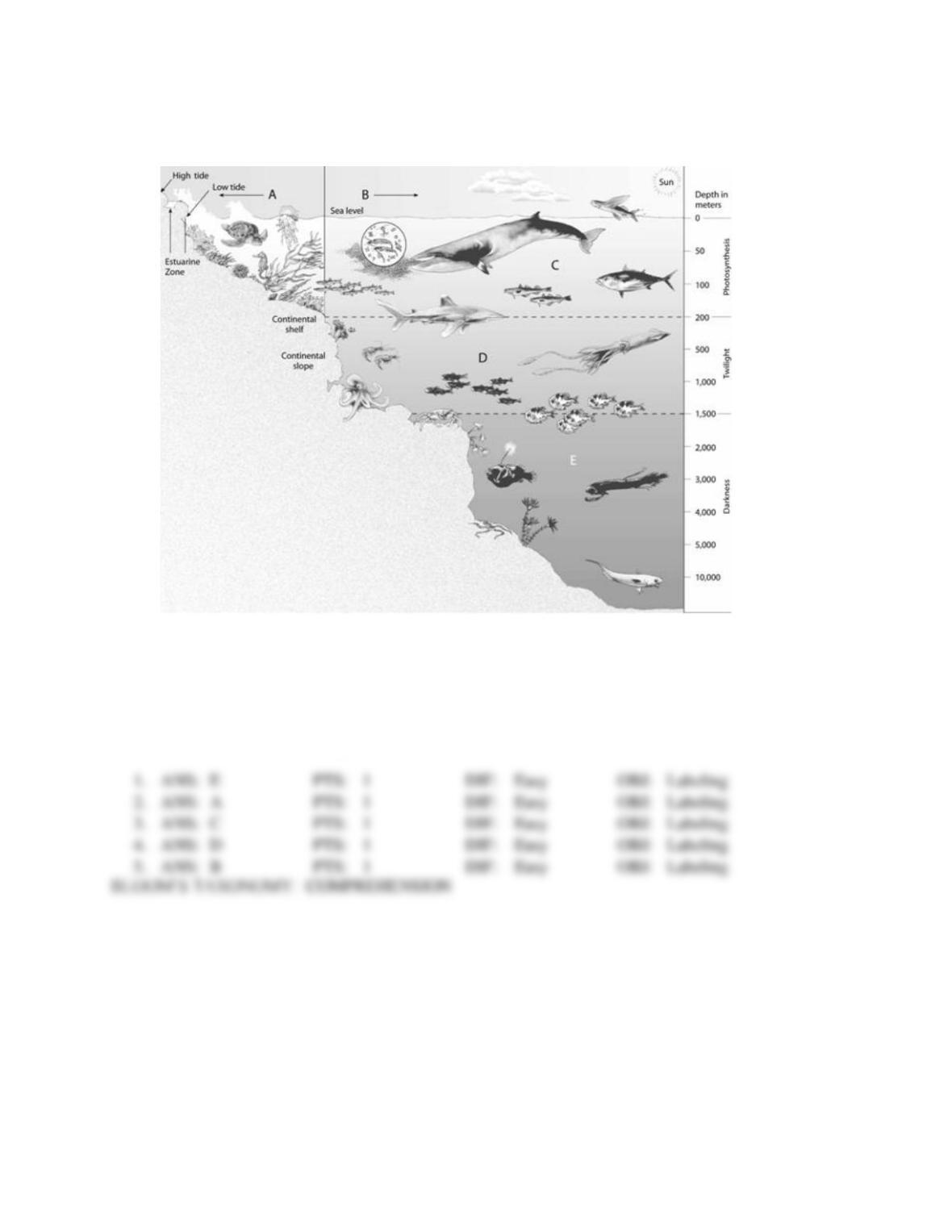
1. On the ocean life zones figure, choose the zone in which most organisms get their food from marine
snow.
2. On the ocean life zones figure, choose the zone that contains the majority of all marine species.
3. On the ocean life zones figure, choose the zone that receives enough sunlight for photosynthesis.
4. On the ocean life zones figure, choose the zone that is dimly lit and contains zooplankton.
5. On the ocean life zones figure, choose the zone where coral reefs would be located.
157
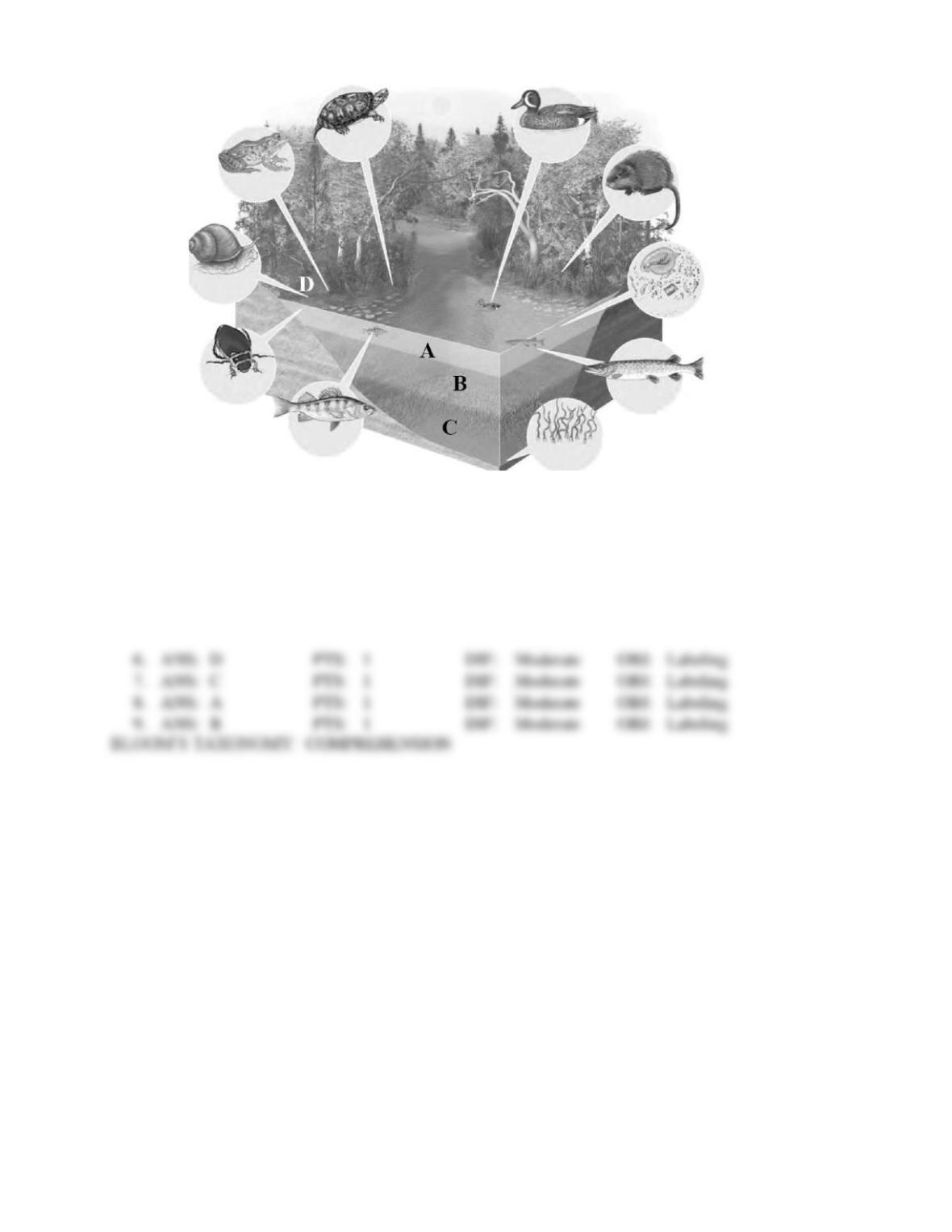
6. On the temperate-zone lake figure, choose the zone close to shore in which light reaches all the way to
the bottom.
7. On the temperate-zone lake figure, choose the zone primarily inhabited by invertebrates, such as
decomposers, which can live in the low oxygen.
8. On the temperate-zone lake figure, choose the zone of open water where photosynthesis can occur.
9. On the temperate-zone lake figure, choose the zone that is usually cold and barely penetrated by
sunlight.
Match the biome or aquatic system listed below with the description that best characterizes it.
a.
euphotic zone
d.
tropical grassland
b.
coral reef
e.
cold forest
c.
Lake
f.
temperate desert
10. a few species of coniferous trees
11. upper layer where large, fast-swimming predatory fishes are found
12. supports large grazing and browsing animals in East Africa
13. created by polyps and zooxanthellae
14. contains widely spaced, drought-resistant plants
15. phytoplankton carry out about 40% of the world’s photosynthesis here
16. benthic zone is closest to the bottom
17. daytime temperatures are very high in summer, but low in winter
18. scattered clumps of trees may have thorns to discourage herbivores
19. small, needle-shaped leaves on trees can withstand cold winters
158
Match the time of year in a temperate deciduous forest with the correct event or situation described
below.
a.
summer and spring
b.
Winter
c.
Fall
d.
all year
20. trees are bare of leaves, dormant
21. warm weather
22. wolves and bears are present
23. leaves turn colors
24. leaves are present, and are green
25. robins, warblers and other birds are present
26. cold weather and snow
27. precipitation is abundant
28. birds migrate to warmer regions
SHORT ANSWER
1. Explain why conservation measures to maintain a healthy mountain range would be simpler to
establish than conservation measures to maintain the health of one of the four major oceans in the
world.
2. Explain briefly how global warming negatively impacts coral reefs.
3. A small rodent called the desert kangaroo rat lives in the deserts of the southwestern United States.
This animal is somewhat unique among mammals in that it does not drink water, but gets all of its
liquid needs met from the water in the seeds it eats. What benefit would this physiological feature have
to an animal that lives in a hot, dry climate where water is sparse?
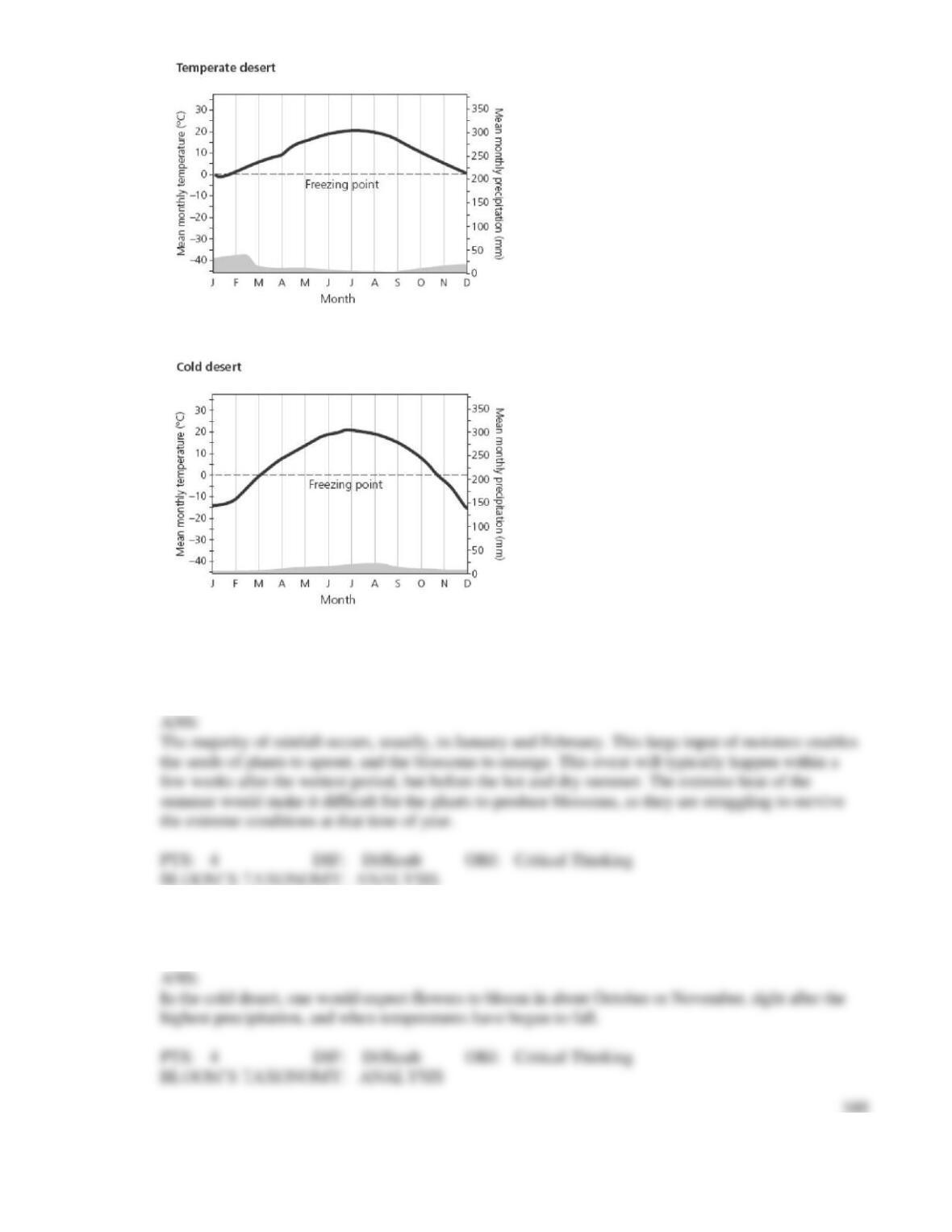
4. Referring to the above graph from a temperate desert observe that the months of March and April are
not the warmest, coldest or wettest months in this biome. However, the bloom of desert wildflowers
will typically occur in these two months. Explain why this is.
5. Observe the second graph which is from a cold desert. What month of the year would you expect to
see flowers bloom in the cold desert?
6. Briefly describe how mountains can offset global warming.
ESSAY
1. Assume you are a biologist and you have taken a job as a watershed manager. You are studying the
characteristics of a particular stream as it leaves its source. The stream forms at the base of a mountain,
from melting snow. It then travels through a transition zone and eventually drains into a river in a
floodplain area.
Describe how you will explain that the nutrient content of this stream is variable as it travels from its
source to its drainage point.
2. Which one of the three major principles of sustainability is a driving force behind climate and
biodiversity? Include in your answer an explanation of why this is true.
3. Explain what the difference is between major climate zones and major biomes, and how the two
interact.
4. Assume for the sake of discussion that you had been considering the purchase of an off-road vehicle
for recreational use. Now that you have studied this chapter and are familiar with some of the issues
of human disturbance of ecosystems, will this change your thinking? If so, how. If not, also explain
why.