81) What are the coefficients in front of Fe(s) and O3(g) when the following equation is balanced
in a basic solution:
___ Fe(s) + ___ O3(g) → ___ Fe2O3(s) + ___ O2(g)?
A) 2, 2
B) 2, 3
C) 3, 2
D) 3, 4
82) What are the coefficients in front of BrO3–(aq) and Br–(aq) when the following equation is
balanced in an acidic solution:
___ BrO3–(aq) + ___ Br–(aq) → ___ Br2(aq)?
A) 1, 3
B) 1, 5
C) 2, 3
D) 2, 5
83) Determine the number of water molecules necessary to balance the following chemical
equation
___Cr2O72-(aq) + ___Cl–(aq) + ___H+(aq) → ___Cr3+(aq) +___ Cl2(g) + ___ H2O(l).
A) 3
B) 5
C) 7
D) 14
84) Determine the number of water molecules necessary to balance the reduction half reaction of
that occurs in a basic solution.
A) 2
B) 3
C) 4
D) 5
85) Determine the number of water molecules necessary to balance the reduction half reaction of
that occurs in an acidic solution.
A) 2
B) 4
C) 5
D) 7
86) Determine the number of water molecules necessary to balance the reduction half reaction of
that occurs in an acidic solution.
A) 1
B) 3
C) 5
D) 7
87) What is the oxidation half reaction in the chemical reaction
Zn(s) + 2 H+(aq) → Zn2+(aq) + H2(g)?
A) Zn(s) → Zn2+(aq) + 2e–
B) Zn2+(aq) + 2e– → Zn(s)
C) 2 H+(aq) + 2e– → H2(g)
D) H2(g) → 2 H+(aq) + 2e–
88) What is the oxidation half reaction in the chemical reaction
Cr2O72-(aq) + 6 Cl–(aq) + 14 H+(aq) → 2 Cr3+(aq) + 3 Cl2(aq) + 7 H2O(l)?
A) Cr2O72-(aq) + 14 H+(aq) + 6e– → 2 Cr3+(aq) + 7 H2O(l)
B) Cr2O72-(aq) + 14 H+(aq) → 2 Cr3+(aq) + 7 H2O(l) + 6e–
C) 2 Cl–(aq) → Cl2(aq) + 2e–
D) Cl2(aq) + 2e– → 2 Cl–(aq)
23
89) What is the reduction half reaction for the chemical reaction in a basic solution
Mn2+(aq) + 2 ClO3–(aq) + OH–(aq) → MnO2(s) + 2 ClO2(aq) + H2O(l)?
A) Mn2+(aq) + 4 OH–(aq) → MnO2(s) + 2 H2O(l) + 2e–
B) Mn2+(aq) + 2 H2O(l) → MnO2(s) + 4 H+(aq) + 2e–
C) ClO3–(aq) + H2O(l) + e– → ClO2(aq) + 2 OH–(aq)
D) ClO3–(aq) + 2 H+(aq) + e– → ClO2(aq) + H2O(l)
90) What is the reduction half reaction for the chemical reaction in a basic solution
ClO–(aq) + Cr(OH)4–(aq) → CrO42-(aq) + Cl–(aq)?
A) ClO–(aq) + 2 H+(aq) + 2e– → Cl–(aq) + H2O(l)
B) ClO–(aq) + H2O(l) + 2e– → Cl–(aq) + 2 OH–(aq)
C) Cr(OH)4–(aq) + 4 OH–(aq) → CrO42-(aq) + 4 H2O(l) + 3e–
D) Cr(OH)4–(aq) → CrO42-(aq) + 4 H+(aq) + 3e–
91) According to the balanced equation shown below, 1.00 mole of oxalic acid, H2C2O4, reacts
with ________ moles of permanganate ion, MnO4–.
5 H2C2O4(aq) + 2 MnO4–(aq) + 6 H+(aq) → 10 CO2(g) + 2 Mn2+(aq) + 8 H2O(l)
A) 0.400
B) 1.00
C) 2.00
D) 2.25
92) According to the balanced chemical equation
5 H2C2O4(aq) + 2 MnO4–(aq) + 6 H+(aq) → 10 CO2(g) + 2 Mn2+(aq) + 8 H2O(l)
0.3500 grams of oxalic acid, H2C2O4 will react with ________ moles of permanganate, MnO4–.
A) 0.001554
B) 0.003887
C) 0.007774
D) 0.009718
93) According to the balanced chemical equation
5 H2C2O4(aq) + 2 MnO4–(aq) + 6 H+(aq) → 10 CO2(g) + 2 Mn2+(aq) + 8 H2O(l)
0.3500 grams of oxalic acid, H2C2O4 will react with ________ mL of 0.100 M potassium
permanganate, KMnO4 solution.
A) 15.5 mL
B) 38.9 mL
C) 77.7 mL
D) 97.2 mL
94) Based on the balanced chemical equation shown below, what volume of 0.250 M
K2S2O3(aq) is needed to completely react with 12.44 mL of 0.125 M KI3(aq)?
2 S2O32-(aq) + I3–(aq) → S4O62-(aq) + 3 I–(aq).
A) 3.11 mL
B) 6.22 mL
C) 12.4 mL
D) 49.8 mL
95) What is the molarity of a potassium triiodide solution, KI3(aq), if 30.00 mL of the solution is
required to completely react with 25.00 mL of a 0.200 M thiosulfate solution, Na2S2O3(aq)?
The chemical equation for the reaction is
2 S2O32-(aq) + I3–(aq) → S4O62-(aq) + 3 I–(aq).
A) 0.0833 M
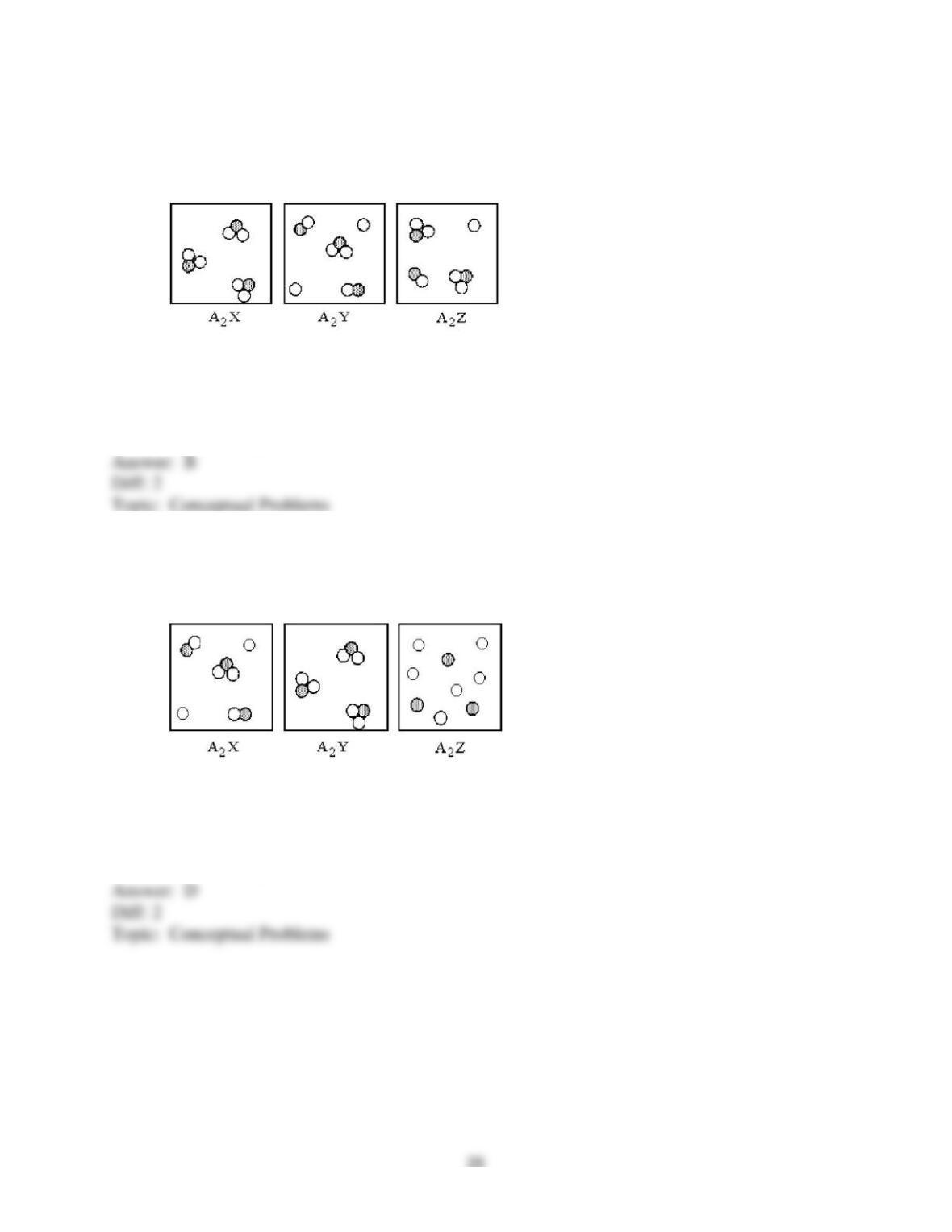
B) 0.120 M
C) 0.167 M
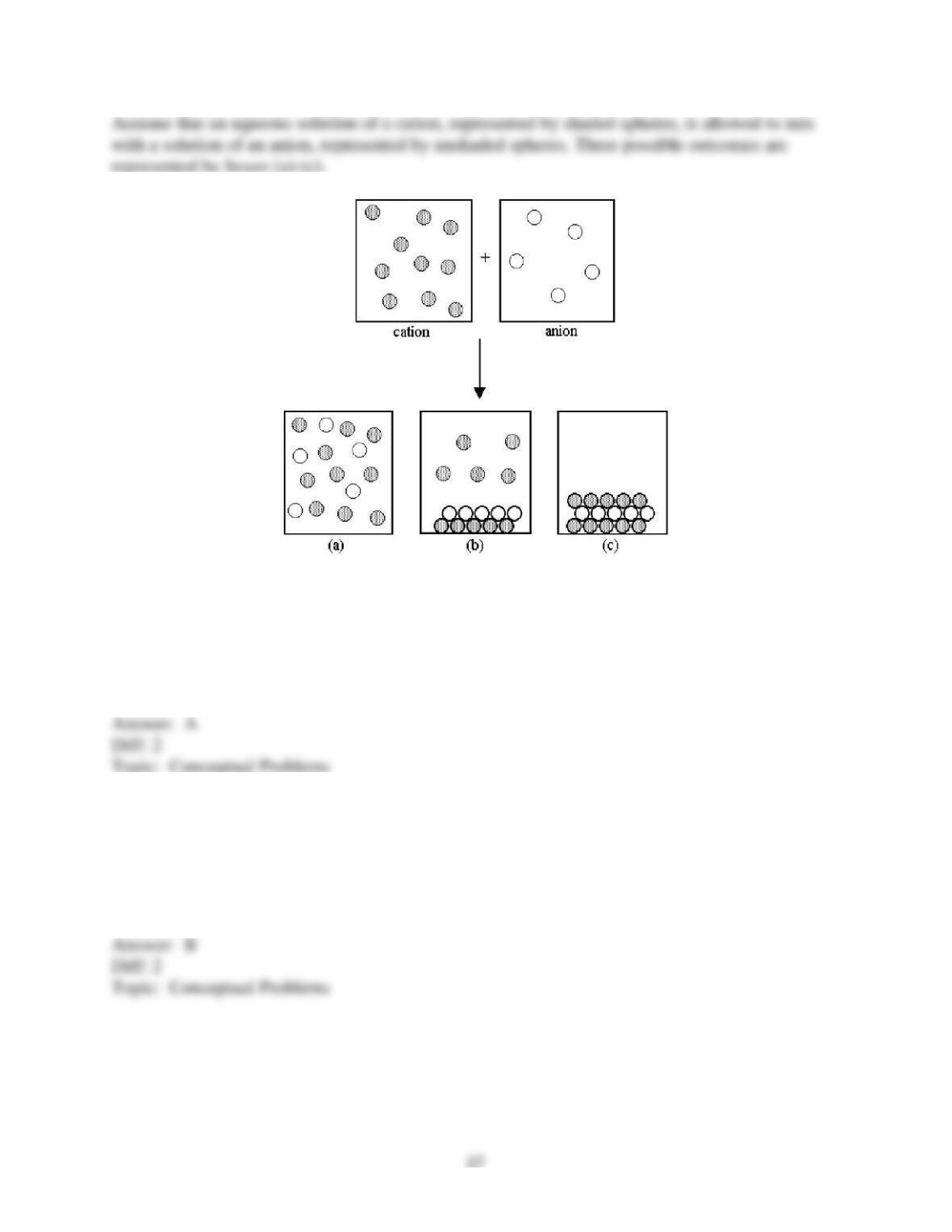
D) 0.333 M
25
96) Based on the balanced chemical equation shown below, determine the molarity of a solution
containing Fe2+(aq), if 40.00 mL of the Fe2+(aq) solution is required to completely react with
30.00 mL of a 0.125 M potassium bromate, KBrO3(aq), solution.The chemical equation for the
reaction is
6 Fe2+(aq) + BrO3–(aq) + 6 H+(aq) → 6 Fe3+(aq) + Br–(aq) + 3 H2O(l)
A) 0.0156 M
B) 0.0938 M
C) 0.562 M
D) 1.00 M
97) Based on the balanced chemical equation shown below, determine the mass percent of Fe3+
in a 0.6450 gram sample of iron ore, if 22.40 mL of a 0.1000 M stannous chloride, SnCl2(aq),
solution is required to completely react with the Fe3+ present in the ore sample. The chemical
equation for the reaction is
2 Fe3+(aq) + Sn2+(aq) → 2 Fe2+(aq) + Sn4+(aq)
A) 6.196%
B) 9.697%
C) 19.40%
D) 38.79%
98) Three different substances, A2X, A2Y, and A2Z, were dissolved in water with the following
results. (Water molecules are omitted for clarity.) Which of the substances is the strongest
electrolyte, and which is the weakest?
A) A2X is the strongest electrolyte and A2Y is the weakest electrolyte.
B) A2Y is the strongest electrolyte and A2X is the weakest electrolyte.
C) A2Y is the strongest electrolyte and A2Z is the weakest electrolyte.
D) A2Z is the strongest electrolyte and A2Y is the weakest electrolyte.
99) Three different substances, A2X, A2Y, and A2Z, were dissolved in water with the following
results. (Water molecules are omitted for clarity.) Which of the substances is the strongest
electrolyte, and which is the weakest?
A) A2X is the strongest electrolyte and A2Y is the weakest electrolyte.
B) A2Y is the strongest electrolyte and A2X is the weakest electrolyte.
C) A2Y is the strongest electrolyte and A2Z is the weakest electrolyte.
D) A2Z is the strongest electrolyte and A2Y is the weakest electrolyte.
100) Which outcome corresponds to the mixing of potassium and sulfide ions:
2 K+(aq) + S2-(aq) → ?
A) box (a)
B) box (b)
C) box (c)
D) none of the above
101) Which outcome corresponds to the combination of calcium and carbonate ions:
Ca2+(aq) + CO32-(aq) → ?
A) box (a)
B) box (b)
C) box (c)
D) none of the above
102) Which outcome corresponds to the combination of silver and chromate ions:
Ag+(aq) + CrO42-(aq) → ?
A) box (a)
B) box (b)
C) box (c)
D) none of the above
103) Which outcome corresponds to the mixing of sodium and sulfate ions:
2 Na+(aq) + SO42-(aq) → ?
A) box (a)
B) box (b)
C) box (c)
D) none of the above
104) Which outcome corresponds to the combination of copper(II) and sulfide ions:
Cu2+(aq) + S2-(aq) → ?
A) box (a)
B) box (b)
C) box (c)
D) none of the above
105) Which outcome corresponds to the combination of silver and carbonate ions:
Ag+(aq) + CO32-(aq) → ?
A) box (a)
B) box (b)
C) box (c)
D) none of the above
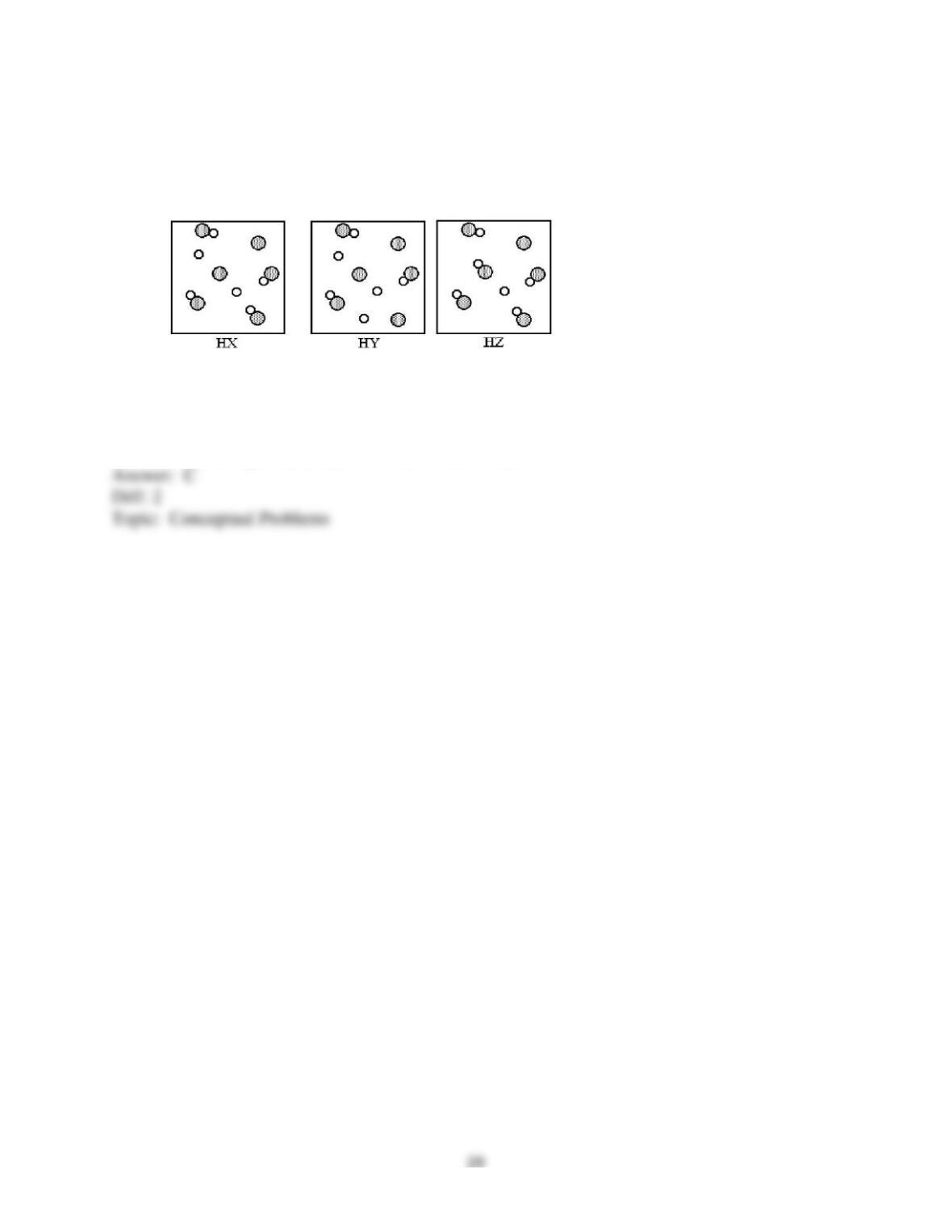
106) The following pictures represent aqueous solutions of three acids HA (A = X, Y, or Z), with
water molecules omitted for clarity. Unshaded spheres represent hydrogen atoms or ions and
gray spheres represent A atoms or ions. Which of the three is the strongest acid, and which is the
weakest?
A) HX is the strongest acid and HY is the weakest acid.
B) HY is the strongest acid and HX is the weakest acid.
C) HY is the strongest acid and HZ is the weakest acid.
D) HZ is the strongest acid and HY is the weakest acid.
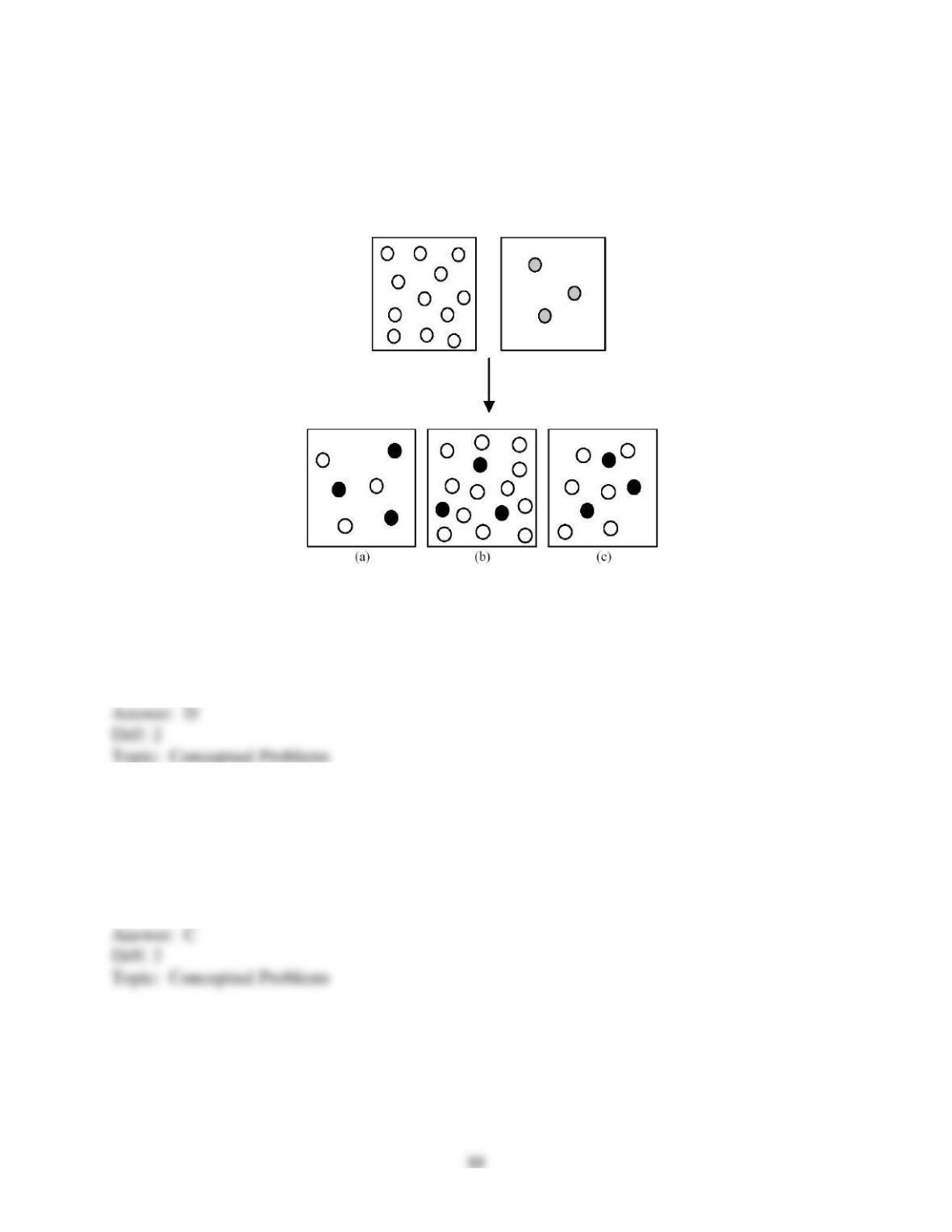
Assume that an aqueous solution of hydroxide ion, OH–, represented by unshaded spheres, is
allowed to mix with a solution of an acid, HnA, represented by gray spheres. Three possible
outcomes are represented by boxes (a)-(c), where the black spheres represent An–, the anion of
the acid. For clarity H2O molecules are not shown.
107) Which outcome corresponds to the reaction:
HCN + OH– → H2O + CN–?
A) box (a)
B) box (b)
C) box (c)
D) none of the above
108) Which outcome corresponds to the reaction:
H2SO4 + 2 OH– → 2 H2O + SO42-?
A) box (a)
B) box (b)
C) box (c)
D) none of the above
109) Which outcome corresponds to the reaction:
H3AsO4 + 3 OH– → 3 H2O + AsO43-?
A) box (a)
B) box (b)
C) box (c)
D) none of the above
110) The concentration of an aqueous solution of NaOCl can be determined by a redox titration
with iodide ion in acidic solution:
OCl– (aq) + 2 I– (aq) + 2 H⁺ (aq) → Cl⁻ (aq) + I2 (aq) + H2O (l)
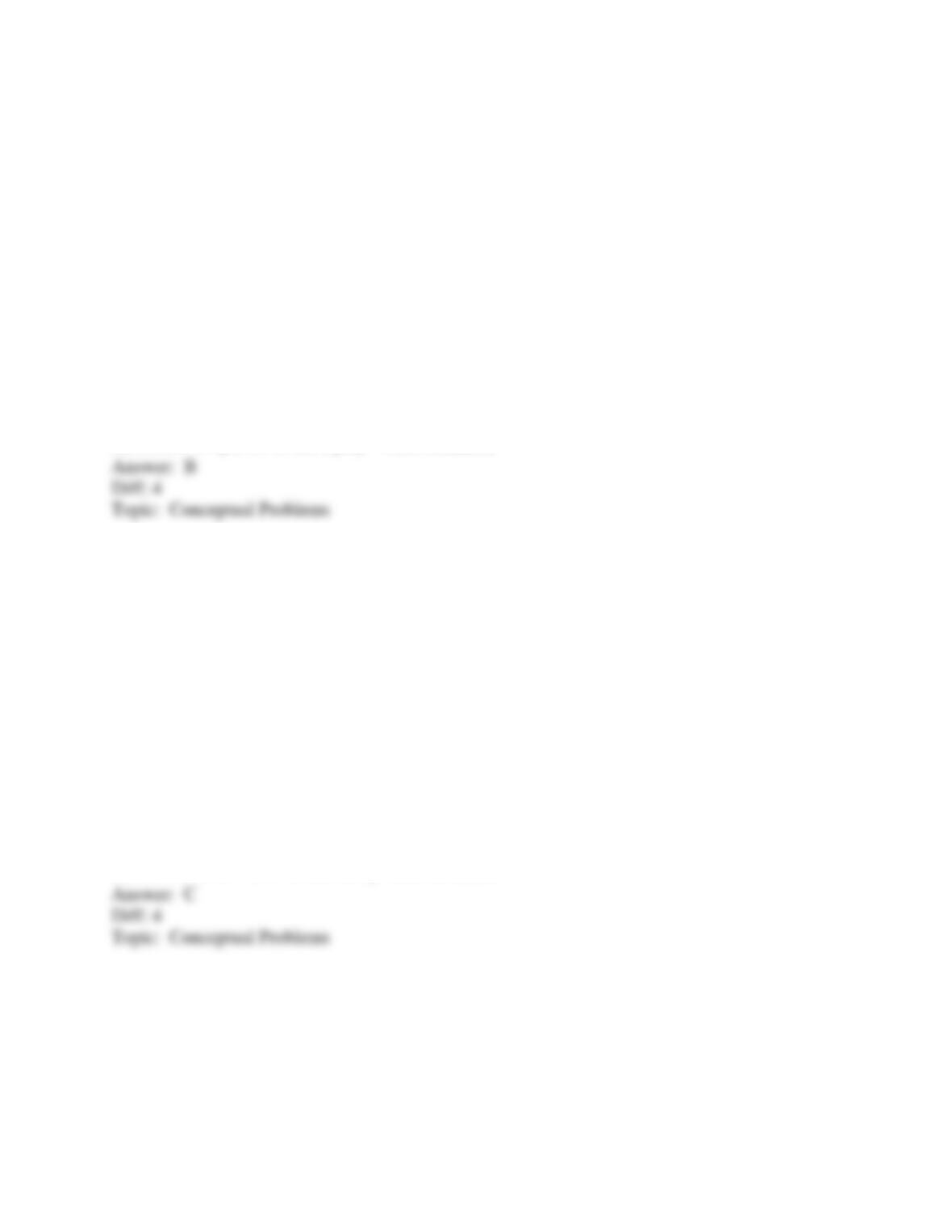
Assume that the black spheres in the buret represent I⁻ ions, the gray spheres in the flask
represent OCl⁻ ions, the concentration of the I⁻ ions in the buret is 0.120 M, and the volumes in
the buret and the flask are identical. What is the concentration of the NaOCl in the flask, and
what fraction of the I⁻ solution in the buret must be added to the flask to react with all the OCl⁻
ions?
A) 0.0400 M NaOCl; 1/3 of the I⁻ must be added.
B) 0.0400 M NaOCl; 2/3 of the I⁻ must be added.
C) 0.0600 M NaOCl; 1/3 of the I⁻ must be added.
D) 0.0600 M NaOCl; 2/3 of the I⁻ must be added.
32
111) The concentration of an aqueous solution of I3⁻ can be determined by a redox titration with
aqueous sodium thiosulfate, Na2S2O3:
2 S2O32- (aq) + I3⁻ (aq) + → S4O62- (aq) + 3 I⁻ (aq)
Assume that the black spheres in the buret represent S2O32- ions, the gray spheres in the flask
represent I3– ions, the concentration of the S2O32- ions in the buret is 0.120 M, and the volumes
in the buret and the flask are identical. What is the concentration of the I3– in the flask, and what
fraction of the S2O32- solution in the buret must be added to the flask to react with all the I3–
ions?
A) 0.0400 M I3–; 1/3 of the S2O32- must be added.
B) 0.0400 M I3–; 2/3 of the S2O32- must be added.
C) 0.0600 M I3–; 1/3 of the S2O32- must be added.
D) 0.0600 M I3–; 2/3 of the S2O32- must be added.
112) The concentration of an aqueous solution of Fe2+ can be determined by a redox titration
with aqueous bromate ion, BrO3⁻:
Fe2+ (aq) + BrO3⁻ (aq) + 6 H⁺ (aq) → 6 Fe3+ (aq) + Br⁻ (aq) + 3 H2O (l)
Assume that the black spheres in the buret represent BrO3⁻ ions, the gray spheres in the flask
represent Fe2+ ions, the concentration of the BrO3⁻ ions in the buret is 0.120 M, and the volumes
in the buret and the flask are identical. What is the concentration of the Fe2+ in the flask, and
what fraction of the BrO3⁻ solution in the buret must be added to the flask to react with all the
Fe2+ ions?
A) 0.0200 M Fe2+; 1/18 of the BrO3⁻ must be added.
B) 0.0200 M Fe2+; 1/3 of the BrO3⁻ must be added.
C) 0.0400 M Fe2+; 1/18 of the BrO3⁻ must be added.
D) 0.0400 M Fe2+; 1/3 of the BrO3⁻ must be added.