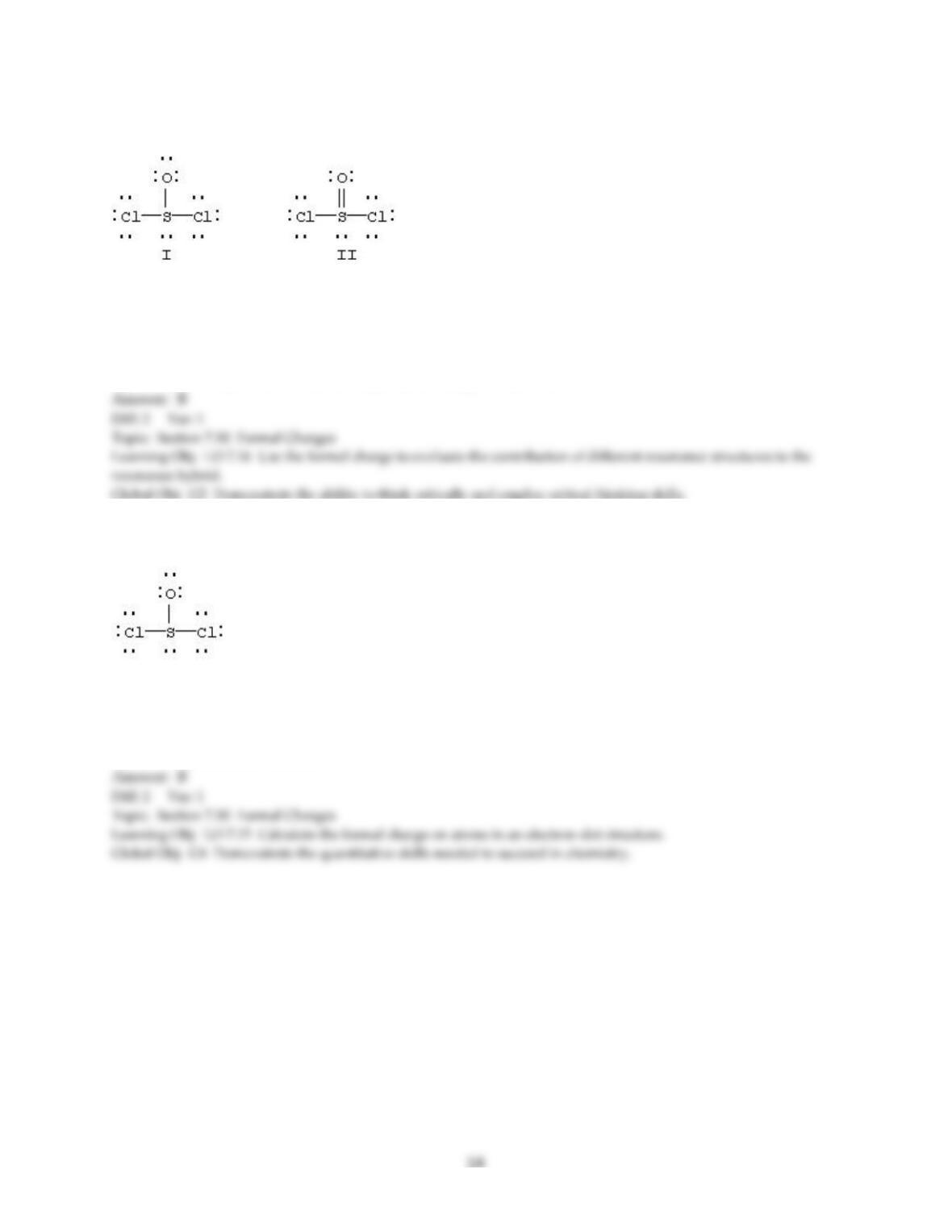
45) Two resonance forms for SOCl2 are given below.
Which is favored by the octet rule and which by formal charge considerations?
A) I is favored by the octet rule and by formal charge considerations.
B) I is favored by the octet rule and II by formal charge considerations.
C) II is favored by the octet rule and I by formal charge considerations.
D) II is favored by the octet rule and by formal charge considerations.
46) Assign formal charges to each atom in the resonance form for SOCl2 given below.
A) 0 for Cl, 0 for S, and 0 for O
B) 0 for Cl, +1 for S, and –1 for O
C) -1 for Cl, +4 for S, and –2 for O
D) -1 for Cl, -2 for S, and -2 for O
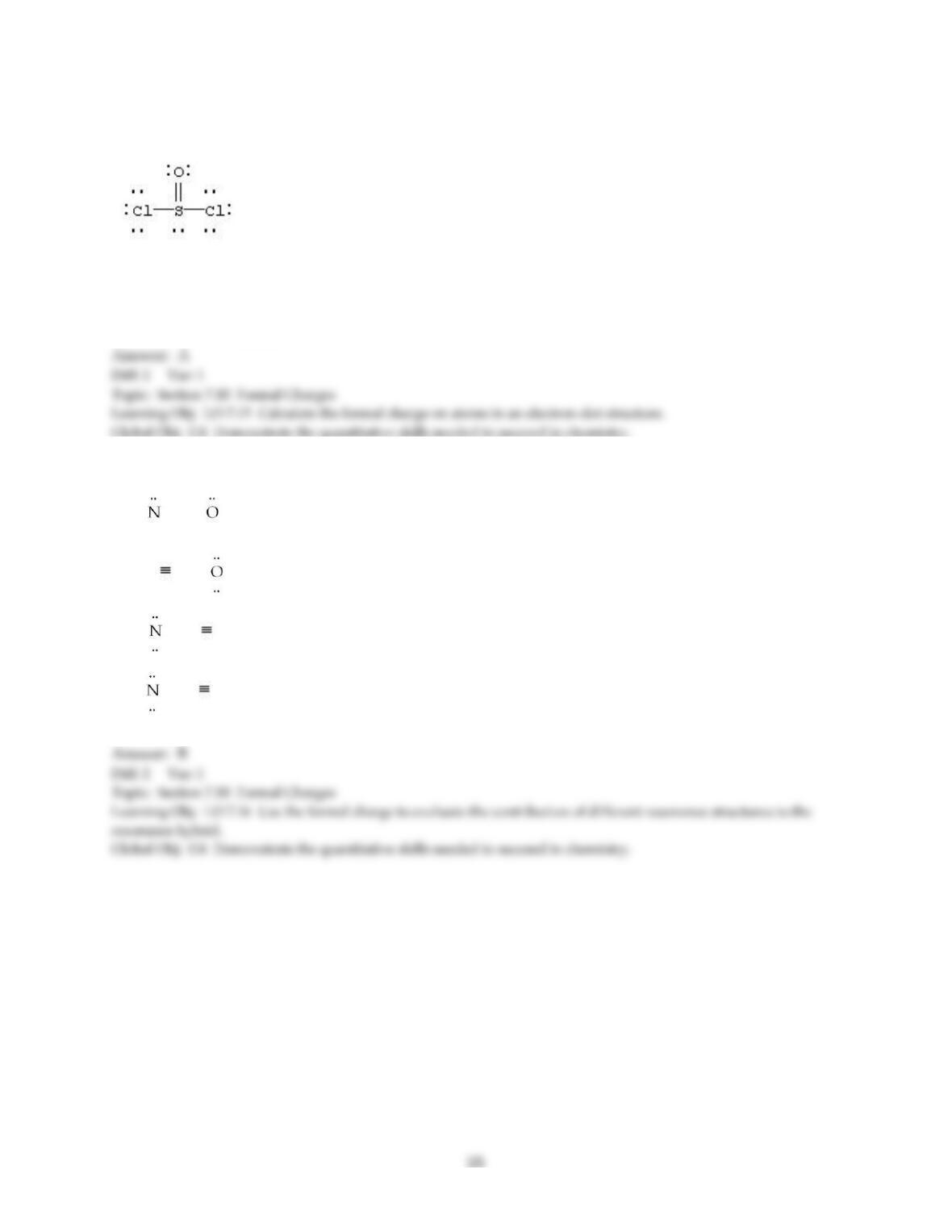
47) Assign formal charges to each atom in the resonance form for SOCl2 given below.
A) 0 for Cl, 0 for S, and 0 for O
B) 0 for Cl, +1 for S, and –1 for O
C) -1 for Cl, +4 for S, and –2 for O
D) -1 for Cl, -2 for S, and -2 for O
48) Which electron dot structure for OCN– has a formal charge of -1 on the most electronegative atom?
A) [: = C = :] –
B) [: N C —:] –
C) [: — C O :] –
D) [: — O C :] –
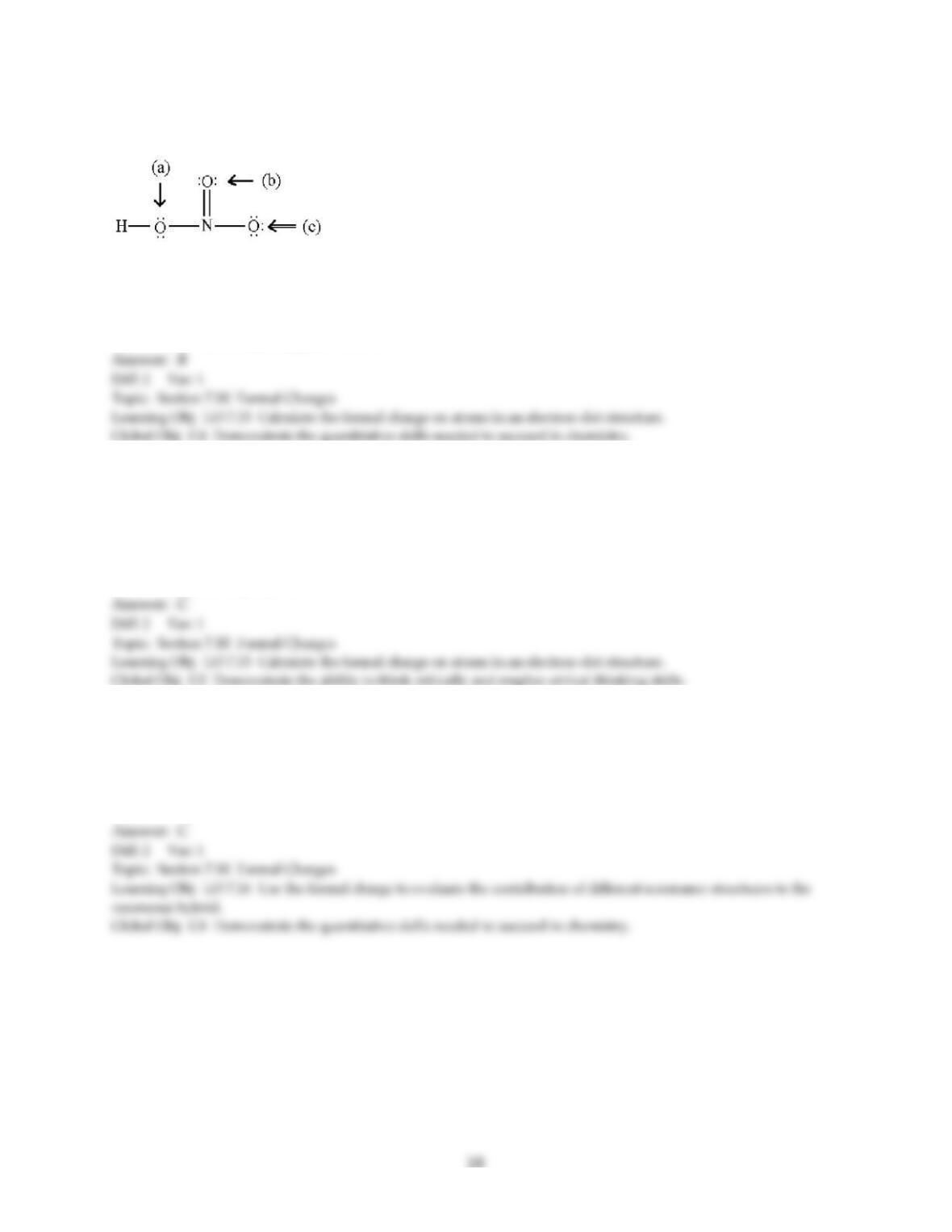
49) Assign formal charges to all atoms in the following resonance form for HNO3.
A) 0 for all atoms
B) +1 for N, -1 for oxygen (c), 0 for all other atoms
C) +1 for N and H, -1 for oxygen (a) and oxygen (c), 0 for oxygen (b)
D) +1 for H, -2 for each oxygen, +5 for N
50) How many double and single bonds are in the resonance form for SO2 in which the formal charges on
each atom are zero?
A) two single bonds and no double bonds
B) one single bond and one double bond
C) no single bonds and two double bonds
D) Each of these is possible.
51) Based on formal charges, what is the S—O bond order in SO42-?
A) 1
B) 1.3
C) 1.5
D) 2
7.2 Algorithmic Questions
1) The Cl—Cl bond energy is 199 kJ/mol. Therefore the formation of a single bond between atoms
A) should require the absorption of 199 kJ per mole of Cl—Cl formed.
B) should require the absorption of 398 kJ per mole of Cl—Cl formed.
C) should result in the release of 199 kJ per mole of Cl—Cl formed.
D) should result in the release of 398 kJ per mole of Cl—Cl formed.
2) Of the following elements, which has the highest electronegativity?
A) As
B) Se
C) Y
D) Sb
3) Of the following elements, which has the lowest electronegativity?
A) Ba
B) I
C) Ra
D) At
4) The electronegativity is 2.1 for H and 1.9 for Sb. Based on these electronegativities SbH3 would be
expected to
A) be ionic and contain H– ions.
B) be ionic and contain H+ ions.
C) have polar covalent bonds with a partial negative charges on the H atoms.
D) have polar covalent bonds with a partial positive charges on the H atoms.
5) The compound ICl contains
A) ionic bonds.
B) nonpolar covalent bonds.
C) polar covalent bonds with partial negative charges on the Cl atoms.
D) polar covalent bonds with partial negative charges on the I atoms.
6) The phosphorus atom in PCl5 would be expected to have a
A) partial positive (δ+) charge.
B) partial negative (δ-) charge.
C) 3+ charge.
D) 3- charge.
7) The chlorine atom in Cl2 would be expected to have a
A) charge of 1-.
B) partial charge δ-.
C) partial charge δ+.
D) charge of 0.
8) Which molecule contains the most polar bonds?
A) CF4
B) TeO2
C) NO–
D) CCl4
9) The electronegativity value of C is 2.5 while the electronegativity value of F is 3.98. What is the
expected electronegativity value for the C-F bond?
A) 0
B) 6.48
C) 1.48
D) -1.48
10) Which compound is most likely to exist as a gas or liquid at room temperature?
A) Al4C3
B) CBr4
C) CaBr2
D) WC
11) Compound A is a solid with a melting point of 85°C, and compound B is a gas at 75°C and one
atmosphere pressure. Based on these data, one would expect
A) both compounds to be covalent.
B) compound A to be ionic and compound B to be covalent.
C) compound A to be covalent and compound B to be ionic.
D) both compounds to be ionic.
12) How many lone pairs of electrons are on the P atom in PF3?
A) 0
B) 1
C) 2
D) 3
13) How many lone pairs of electrons are on the N atom in NBr3?
A) 0
B) 1
C) 2
D) 3
14) Which molecule contains a triple bond?
A) O2
B) O3
C) HCCH
D) Br2SO
15) Which element can expand its valence shell to accommodate more than eight electrons?
A) C
B) F
C) Xe
D) He
16) Which element can accommodate more than eight electrons in its valence shell?
A) N
B) O
C) Ga
D) Ne
17) Which of the following contains an atom that does not obey the octet rule?
A) NaCl
B) SiO2
C) BrF3
D) BrF
18) Which of the following contains an atom that does not obey the octet rule?
A) LiBr
B) CO2
C) PCl3
D) CCl4
19) How many lone pairs of electrons are on the Xe atom in XeF6?
A) 0
B) 1
C) 2
D) 3
20) How many lone pairs are on the central Br atom in Br3–?
A) 0
B) 1
C) 2
D) 3
21) How many carbon-carbon bonds are present in C3H8?
A) 3
B) 1
C) 2
D) 0
22) How many lone pairs are there in the Lewis structure of O2?
A) 3
B) 1
C) 0
D) 4
23) What is the approximate carbon-oxygen bond order in CO32–?
A) 2
B) 4/3
C) 5/3
D) 4
24) Which is expected to have the strongest C—O bond?
A) CH3OH
B) Cl2CO
C) CF3CO2–
D) CO32-
25) Which one of the following is expected to exhibit resonance?
A) NH4+
B) HCN
C) CS2
D) NO3–
26) In the best Lewis structure for CN –, what is the formal charge on the N atom?
A) -1
B) 0
C) +1
D) +2
27) A molecular compound that obeys the octet rule in which all atoms have a zero formal charge is
A) SrBr2.
B) BrF3.
C) NH3.
D) XeF4.
7.3 Short Answer Questions
1) Among the compounds H3C—CH3, H2C=CH2, and HC CH, the compound with the strongest
carbon-carbon bond is ________, and the compound with the longest carbon-carbon bond is ________.
2) Classify bonds in As4 as largely ionic, nonpolar covalent, or polar covalent.
3) Classify bonds in BeS as largely ionic, nonpolar covalent, or polar covalent.
4) Using only the elements Be, Cl, and/or P, give the formula of a compound having largely ionic bonds.
5) Using only the elements Mg, Cl, and/or P, give the formula of a compound having largely polar
covalent bonds.
6) Of the bonds C—C, C—N, C—O, and C—F, the bond that is most polar is ________.
25
7) Ionic compounds consist of a single three–dimensional network of ions that are attracted to one another
by strong ________ and usually exist in the solid state at room temperature, whereas covalent compounds
consist of molecules that are attracted to one another by weak ________ and can exist in gaseous, liquid,
or solid state at room temperature.
8) Which compound is most likely to exist as a gas at room temperature?
9) The Lewis electron-dot structure of N2 has ________ nonbonding electrons pairs, ________ bonding
electron pairs, and a bond order of ________.
10) The Lewis electron-dot structure of H2CO has ________ nonbonding electron pairs, ________ bonding
electron pairs, and a carbon-oxygen bond order of ________.
11) Of H2CO and CO and CO2, the compound having the strongest C—O bond is ________.
12) The number of Lewis electron dot resonance structures required to describe NO2– is ________.
13) Based on formal charges, the best Lewis electron-dot structure of BF3 has a B—F bond order equal to
________.
14) Based on formal charges, the P—O bond order in POCl3 is expected to be ________.