Survey of Economics, 6e (O’Sullivan/Sheffrin/Perez)
Chapter 7 Monopoly and Price Discrimination
7.1 The Monopolist’s Output Decision
1) A market served by only one firm is called a(n)
A) perfectly competitive market.
B) monopoly.
C) oligopoly.
D) Any of the above could be correct.
2) A firm that has market power has the ability
A) to affect the price of its own product.
B) to conduct illegal activities without fear of prosecution.
C) to command consumer to buy any quantity from them.
D) to drive its competition out of the market.
3) Which of the following firms have market power?
A) private universities
B) fast food chains such as McDonald’s
C) theme parks
D) All of the above have market power.
4) Which of the following firms have no market power?
A) clothing companies
B) fast food chains such as McDonald’s
C) theme parks
D) gold panners during the gold rush
5) Which of the following is NOT a characteristic of a monopoly?
A) There is only one seller.
B) A monopolist is a price-taker.
C) There exist barriers to entry.
D) A monopolist’s sales revenue is constrained by the market demand.
6) Which of the following is NOT a barrier to entry for monopoly?
A) a patent
B) government licensing
C) large economies of scale
D) a large number of existing firms in a market
7) When economists say a market has “barriers to entry” they refer to
A) monopolists being prohibited from selling their products to certain customers.
B) a policy that some countries establish to reduce imports from other countries.
C) factors that prevent other firms from challenging a firm with market power.
D) economic profits that are positive, but too high to encourage entry.
8) Which of the following is an example of a barrier to entry?
A) A firm is open for business only at certain hours of the day, and has its doors locked at other
times.
B) The government grants licenses to taxicab drivers, without which it is illegal to operate a
taxicab.
C) A newspaper sells advertising space to businesses.
D) lack of a Web site
9) Which of the following is NOT an artificial barrier to entry?
A) a patent
B) government franchise
C) large economies of scale
D) government licensing
10) When a firm is awarded a patent, it is given monopoly rights to the production of that
product for ________ years.
A) 10
B) 20
C) 30
D) 50
11) Which of the following firms rely on patents the most as the barrier to keep other firms from
entering the industry?
A) pharmaceutical firms
B) textbook publishers
C) law firms
D) wine makers
12) A monopoly may arise due to
A) a patent.
B) network externalities.
C) large economies of scale.
D) all of the above
13) ________ is a monopoly that exists in an industry where the large economies of scale acts as
its barrier to entry.
A) A natural monopoly
B) A monopolistic competitor
C) A regulated monopoly
D) A price discriminator
14) A network externality occurs when
A) a firm has a patent.
B) the value of a product to a consumer increase with the number of other consumers who use it.
C) a firm has large economies of scale.
D) the value of a product to a consumer requires another product.
15) Facebook is a social networking Web site that is used by a growing number of individuals.
Because of its popularity, it is now more difficult for new networking Web sites to enter and
compete with Facebook. Facebook enjoys ________ as a barrier for others to enter the market.
A) a network externality
B) price discrimination
C) a negative externality
D) economies of scale
16) The demand curve that a monopolist faces is
A) the market demand curve.
B) the same as the demand curve that faces a perfectly competitive firm.
C) not affected by changes in the prices of other goods.
D) generally flatter than the demand curve that faces a perfectly competitive firm.
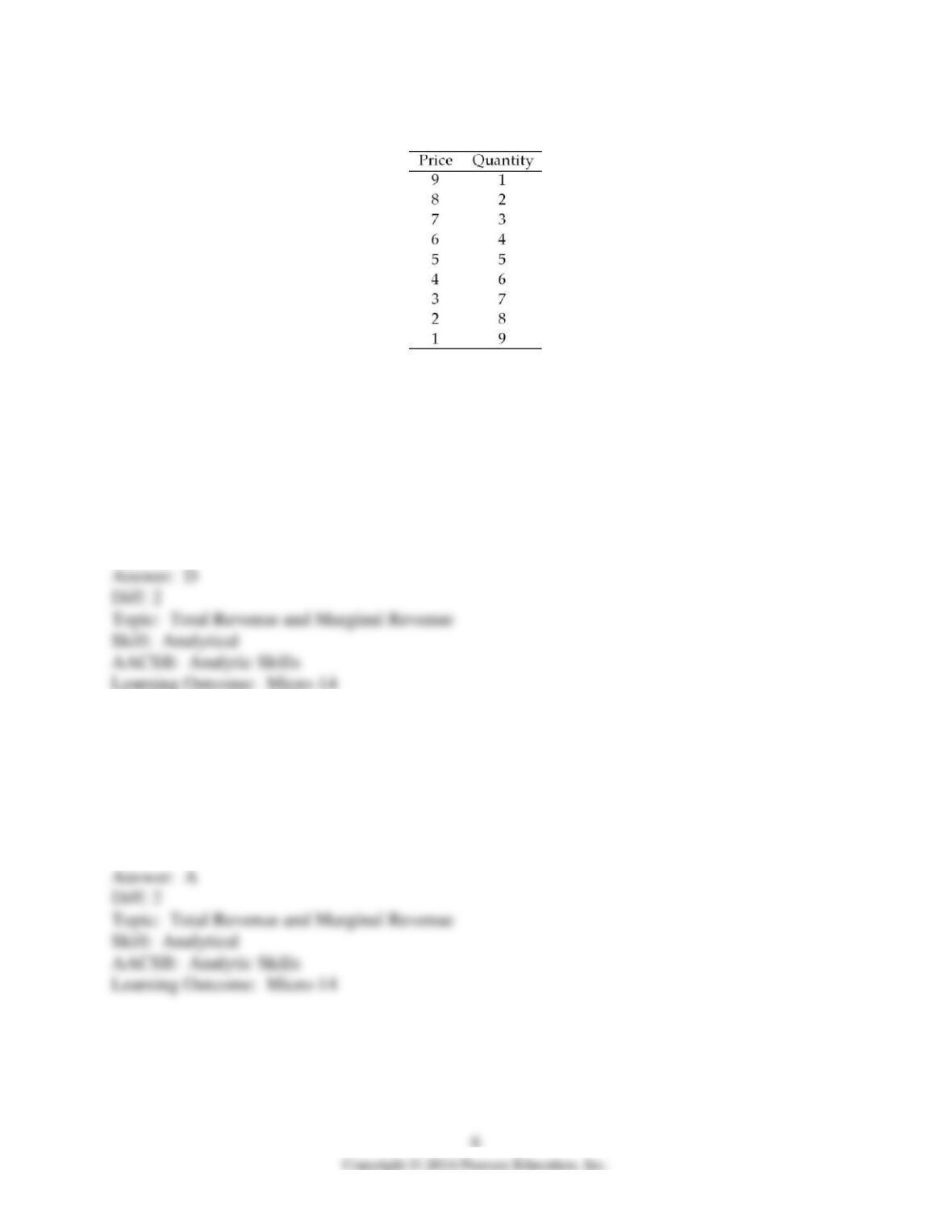
Table 7.1
17) Refer to Table 7.1, which shows the relationship between the price that Gladys charges for a
product and the quantity of that product that Gladys sells. The total revenue that Gladys receives
from selling four units of output is
A) $4.
B) $6.
C) $10.
D) $24.
18) Refer to Table 7.1, which shows the relationship between the price that Gladys charges for a
product and the quantity of that product that Gladys sells. The marginal revenue that Gladys
receives from selling the fourth unit of output is
A) $3.
B) $6.
C) $10.
D) $24.
19) Refer to Table 7.1, which shows the relationship between the price that Gladys charges for a
product and the quantity of that product that Gladys sells. The marginal revenue that Gladys
receives from selling the fifth unit of output is
A) $5, because that is the price per unit of output that Gladys receives.
B) $5, because that is the quantity that Gladys sells.
C) $25, because Gladys sells five unit of output at a price of $5.
D) $1, because Gladys earns $1 more in revenues by increasing her output to five units from four
units.
20) Refer to Table 7.1, which shows the relationship between the price that Gladys charges for a
product and the quantity of that product that Gladys sells. Gladys’ marginal revenue becomes
negative starting with the production of which unit?
A) 2
B) 4
C) 6
D) None of the above; marginal revenue is always positive or zero.
21) Which of the following is NOT a characteristic of a monopoly?
A) A monopolist faces a downward-sloping demand curve.
B) There are no close substitutes for a monopolist’s product.
C) After the first unit, the monopolist’s marginal revenue is always less than its price.
D) A monopolist is a price-taker.
22) Which of the following best characterizes the tradeoff faced by a monopolist when deciding
what quantity to produce?
A) The firm can increase its output, but needs to lower its price for only the marginal unit of
output.
B) The firm can increase its output, but to do so it must charge a higher price to all customers.
C) The firm gets more revenue from new customers by increasing output, but gets less revenue
from existing customers given that it lowered its price.
D) The firm gets less revenue from new customers by increasing output, but gets more revenue
from existing customers given that it lowered its price.
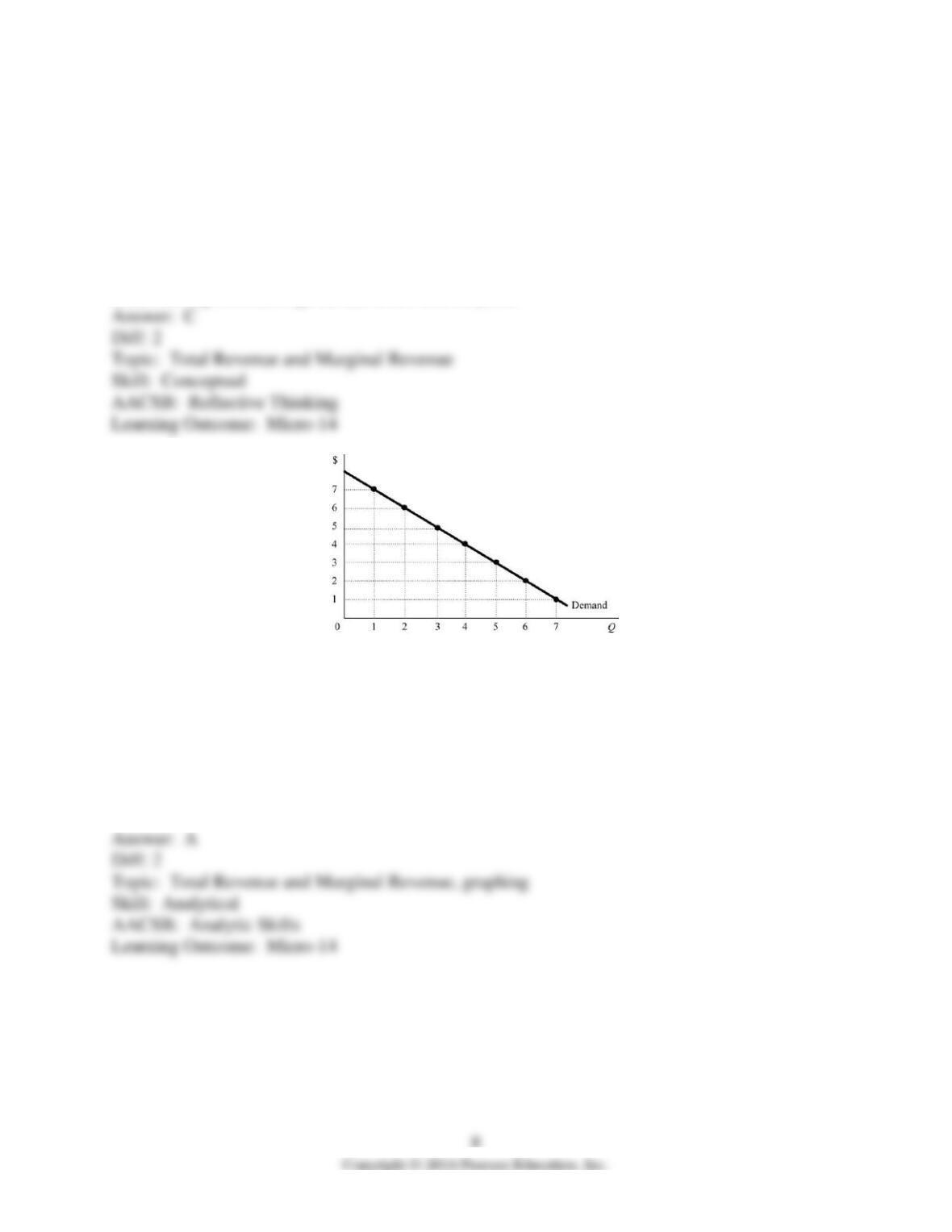
Figure 7.1
23) Figure 7.1 shows a monopolist’s demand curve. If the monopolist increases output from two
to three units, what is its marginal revenue?
A) $3
B) $5
C) $12
D) $15
24) Figure 7.1 shows a monopolist’s demand curve. If the monopolist increases output from four
to five units, what is its marginal revenue?
A) $16
B) $15
C) $3
D) -$1
25) Figure 7.1 shows a monopolist’s demand curve. If the monopolist were to maximize its total
revenue, it would produce ________ units of output and charge a price of ________.
A) 3; $5
B) 4; $4
C) 5; $3
D) 6; $2
26) When a monopolist sells two units of output its total revenues are $100. When the
monopolist sells three units of output its total revenues are $120. When the monopolist sells three
units of output, the price per unit is
A) $6.67.
B) $20.
C) $33.33.
D) $40.
27) When a monopolist sells two units of output its total revenues are $100. When the
monopolist sells three units of output, its price per unit is $35. The monopolist’s marginal
revenue from selling the third unit of output is
A) $5.
B) $33.33.
C) $35.
D) $105.
28) For a monopolist, marginal revenue ________ for all units of output except the first unit.
A) is greater than the price of output
B) is less than the price of output
C) is equal to the price of output
D) may be either greater than or less than the price of output
29) If a monopolist charges the same price for all of the units of the good that it sells, then
beyond the first unit sold
A) P = MR because the firm maximizes profit.
B) P = MR because the monopolist holds price constant.
C) P < MR because the monopolist must decrease price on all units in order to sell another unit.
D) P > MR because the monopolist must decrease price on all units in order to sell another unit.
30) A monopolist will never produce at a quantity where the
A) MR < 0.
B) MR > 0.
C) P > MR.
D) MR= MC.
Figure 7.2
31) Figure 7.2 shows a monopolist’s demand curve. The marginal revenue from selling the third
unit is
A) $6.
B) $8.
C) $10.
D) $44.
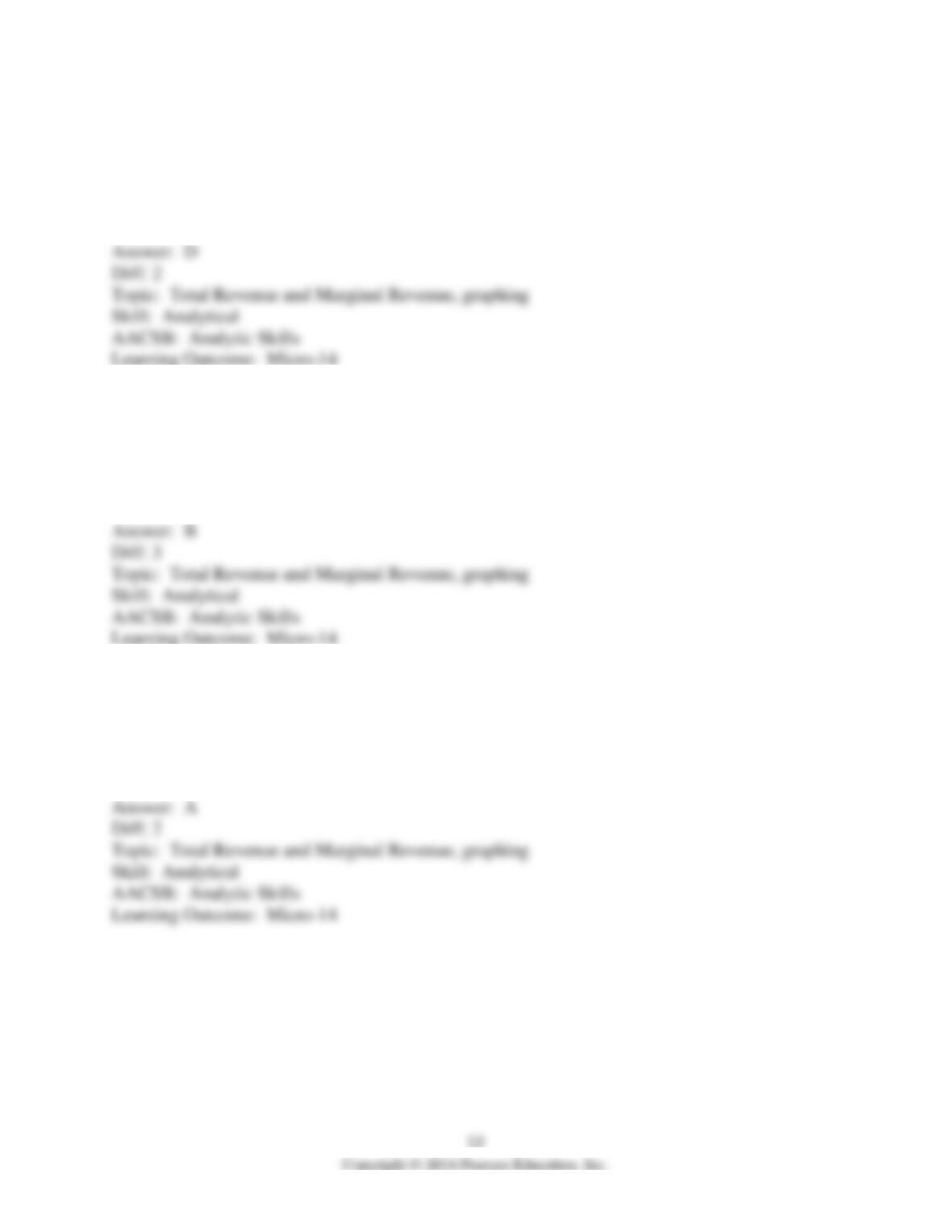
32) Figure 7.2 shows a monopolist’s demand curve. The marginal revenue from selling the fourth
unit is
A) $8.
B) $6.
C) $4.
D) $2.
33) Figure 7.2 shows a monopolist’s demand curve. Suppose that the marginal cost is $6 for all
units and the current output level is 4 units. Then what would you recommend to the firm?
A) Lower the price to sell more units.
B) Raise the price and sell fewer units.
C) Maintain the current price and output level.
D) There is not sufficient information.
34) Figure 7.2 shows a monopolist’s demand curve. Suppose that the marginal cost is $6 for all
units and the current output level is 4 units. Then which of the following is true?
A) The marginal revenue is less than the marginal cost.
B) The price is greater than the average total cost.
C) The firm is producing the profit maximizing level of output.
D) All of the above.
35) How do monopoly prices and quantities produced differ from perfectly competitive
outcomes, all other things equal?
A) Monopoly prices and quantities are both lower than competitive outcomes.
B) Monopoly prices and quantities are both higher than competitive outcomes.
C) Monopoly prices are lower than competitive prices but monopoly quantities are higher than
competitive quantities.
D) Monopoly prices are higher than competitive prices but monopoly quantities are lower than
competitive quantities.
36) A monopolist maximizes profits by setting the quantity where
A) marginal revenue equal to marginal cost.
B) marginal revenue greater than marginal cost.
C) marginal revenue less than marginal cost.
D) total revenue as high as possible.
37) If a monopolist is maximizing its profits, we know that it has
A) maximized total revenue.
B) maximized marginal revenue.
C) minimized total cost.
D) equated marginal cost and marginal revenue.
38) At a price of $10, the marginal revenue of a monopolist is $6. If the marginal cost of
production is $8, what should the monopolist do in order to maximize profits?
A) Increase its price.
B) Decrease its price.
C) Keep its price at the same level.
D) not enough information to solve
39) At a price of $20, the marginal revenue of a monopolist is $12. If the marginal cost of
production is $10, what should the monopolist do in order to maximize profits?
A) Increase its price.
B) Decrease its price.
C) Keep its price at the same level.
D) not enough information to solve
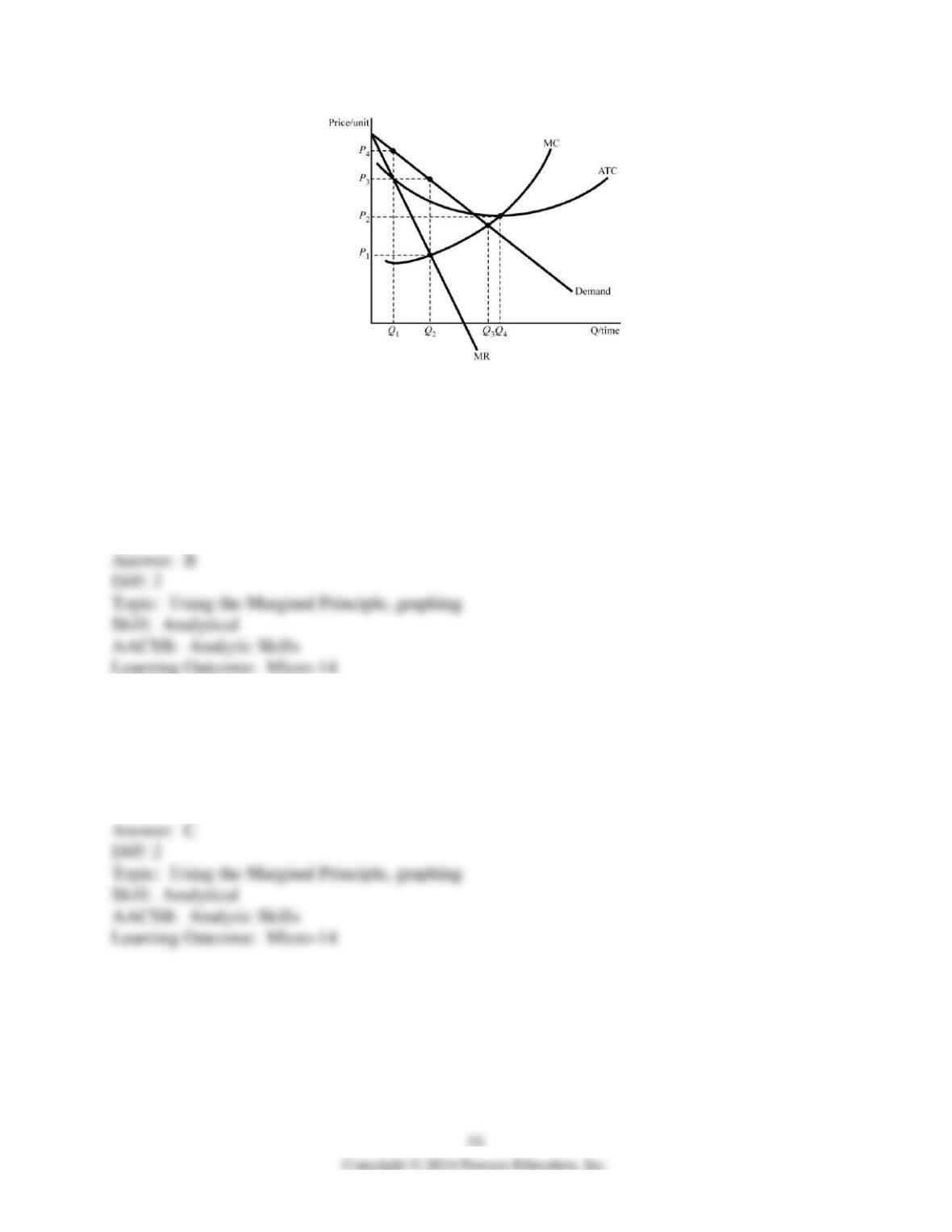
Figure 7.3
40) The firm in Figure 7.3 will produce
A) Q1.
B) Q2.
C) Q3.
D) Q4.
41) The firm in Figure 7.3 will charge
A) P1.
B) P2.
C) P3.
D) P4.
42) Where it wants to produce the firm in Figure 7.3 will
A) make a zero economic profit.
B) suffer a loss.
C) make a positive economic profit.
D) break even.
Recall the Application about setting the price of tickets for Major League Baseball games
to answer the following question(s).
43) Recall the application. The marginal revenue from ticket sales for a typical Major League
Baseball team is
A) positive.
B) zero.
C) negative.
D) infinity.
44) Recall the application. Due to the marginal revenue from ticket sales for a typical Major
League Baseball team, the team could increase total revenue from ticket sales by ________ the
price of tickets and ________ the quantity of tickets sold.
A) increasing; increasing
B) increasing; decreasing
C) decreasing; increasing
D) decreasing; decreasing
45) A network externality acts as a barrier to entry.
46) A monopolist’s marginal cost is less than the price it charges.
47) After the first unit, a monopolist’s marginal revenue is less than the price it charges because
to sell an additional unit it needs to lower its price.
48) A monopolist will never produce a level of output where MR < 0.
49) At a price of $15, a firm sells 80 CDs per day. If the slope of the demand curve is 0.10,
marginal revenue is $5.
50) Monopolist marginal revenue rises with output.
51) A monopolist picks the quantity of output at which price equals marginal cost.
52) A monopolist maximizes profit by producing the output at which marginal revenue equals
marginal cost.
53) At a price of $18, the marginal revenue of a movie seller is $12. If the marginal cost of a
movie is $9, the firm should increase its price.
54) Why do barriers to entry create market power?
55) Why do some markets have more firms than others?
56) What is a network externality?
57) How does a monopolist’s marginal revenue change as output increases? Why?
58) Why is a monopolist’s marginal revenue less than the price?
59) Will a profit maximizing monopolist who is not subject to government regulation produce a
quantity where the MR < 0?
60) Should a monopolist charge the highest price for its good that anyone in the market will pay?
7.2 The Social Cost of Monopoly
1) Which of the following is most accurate?
A) In all cases, competitive markets yield more consumer surplus than would be enjoyed in a
monopoly market with the same cost structure.
B) In all cases, competitive markets yield less consumer surplus than would be enjoyed in a
monopoly market with the same cost structure.
C) In some cases, competitive markets can yield less consumer surplus than would be enjoyed in
a monopoly market with the same cost structure.
D) In all cases, competitive markets yield the same consumer surplus that would be enjoyed in a
monopoly market with the same cost structure.
2) In the long run, the main reason that a monopolist can earn positive economic profits while a
perfectly competitive firm cannot is
A) monopolists enjoy greater economies of scale.
B) there are no barriers to entry in a perfectly competitive market.
C) the monopolist faces an inelastic demand for its product.
D) perfectly competitive firms face greater opportunity costs.