Chemistry, 6e (McMurry/Fay)
Chapter 7 Covalent Bonds and Molecular Structure
7.1 Multiple-Choice Questions
1) Covalent bonding is a
A) gain of electrons.
B) loss of electrons.
C) transfer of electrons.
D) sharing of electrons.
2) Which electrostatic forces hold atoms together in a molecule?
A) electron-electron forces
B) electron-nucleus forces
C) nucleus-nucleus forces
D) all three forces
3) At the equilibrium bond length
A) the attractive forces holding the atoms together are less than the repulsive forces.
B) the potential energy is a maximum.
C) the potential energy is a minimum.
D) the repulsive forces are greater than the attractive forces holding the atoms together.
4) Which is the longest bond?
A) N N
B) N=N
C) N N
D) All three bond lengths should be about the same.
5) Which bond should have the highest bond dissociation energy?
A) N N
B) N N
C) N N
D) All three bonds should have about the same dissociation energy.
6) Which molecule contains the most easily broken carbon-carbon bond?
A) H3C–CH3
B) H2C=CH2
C) F2C=CF2
D) HC CH
7) Which molecule has the weakest bonds?
A) CF4
B) CCl4
C) CBr4
D) CI4
8) The Cl Cl bond energy is 243 kJ/mol. Therefore the formation of a single bond between chlorine
atoms
A) should require the absorption of 243 kJ per mole of Cl2 formed.
B) should require the absorption of 486 kJ per mole of Cl2 formed.
C) should result in the release of 243 kJ per mole of Cl2 formed.
D) should result in the release of 486 kJ per mole of Cl2 formed.
9) In general, at room temperature
A) ionic compounds are all solids and covalent compounds are all gases.
B) ionic compounds are all solids, but covalent compounds may be solids, liquids, or gases.
C) ionic compounds are all solids, and covalent compounds are liquids or gases.
D) covalent compounds are all gases, but ionic compounds may be solids, liquids, or gases.
10) Which compound is most likely to exist as a gas at room temperature?
A) Al4C3
B) CF4
C) CaF2
D) WC
11) Compound A is a solid with a melting point of 125°C, and compound B is a gas at 25°C and one
atmosphere pressure. Based on these data, one would expect
A) both compounds to be covalent.
B) compound A to be ionic and compound B to be covalent.
C) compound A to be covalent and compound B to be ionic.
D) both compounds to be ionic.
12) When melting S8, ________ forces must be overcome and S8 is expected to have a ________
melting point than MgS.
A) covalent bonding, higher
B) covalent bonding, lower
C) intermolecular, higher
D) intermolecular, lower
13) Of the following elements, which has the highest electronegativity?
A) P
B) S
C) Sc
D) As
14) Of the following elements, which has the lowest electronegativity?
A) Mg
B) Cl
C) Ca
D) Br
15) The electronegativity is 2.1 for H and 1.8 for Si. Based on these electronegativities, SiH4 would be
expected to
A) be ionic and contain H– ions.
B) be ionic and contain H+ ions.
C) have polar covalent bonds with a partial negative charges on the H atoms.
D) have polar covalent bonds with a partial positive charges on the H atoms.
16) A reactive element with a relatively high electronegativity would be expected to have a relatively
A) small negative electron affinity and a relatively low ionization energy.
B) small negative electron affinity and a relatively high ionization energy.
C) large negative electron affinity and a relatively low ionization energy.
D) large negative electron affinity and a relatively high ionization energy.
17) The compound ICl contains
A) ionic bonds.
B) nonpolar covalent bonds.
C) polar covalent bonds, with partial negative charges on the Cl atoms.
D) polar covalent bonds, with partial negative charges on the I atoms.
18) The greater the electronegativity difference between two bonded atoms, the
A) greater the bond order.
B) greater the covalent character of the bond.
C) greater the ionic character of the bond.
D) more unstable the bond.
19) Which molecule contains the most polar bonds?
A) CF4
B) CO2
C) CN–
D) CH4
20) The electronegativity for both sulfur and carbon is 2.5. Therefore the compound CS2 would be
expected to
A) be ionic with C as the anion.
B) be ionic with C as the cation.
C) have nonpolar covalent bonds between C and S.
D) have polar covalent bonds between C and S.
21) The phosphorus atom in PCl3 would be expected to have a
A) partial positive (δ+) charge.
B) partial negative (δ-) charge.
C) 3+ charge.
D) 3- charge.
22) A chlorine atom in Cl2 should have a
A) charge of 1-.
B) partial charge δ-.
C) partial charge δ+.
D) charge of 0.
23) Element A has an electronegativity of 0.8 and element B has an electronegativity of 3.0. Which
statement best describes the bonding in A3B?
A) The AB bond is largely covalent with a δ– on A.
B) The AB bond is largely covalent with a δ+ on A.
C) The compound is largely ionic with A as the cation.
D) The compound is largely ionic with A as the anion.
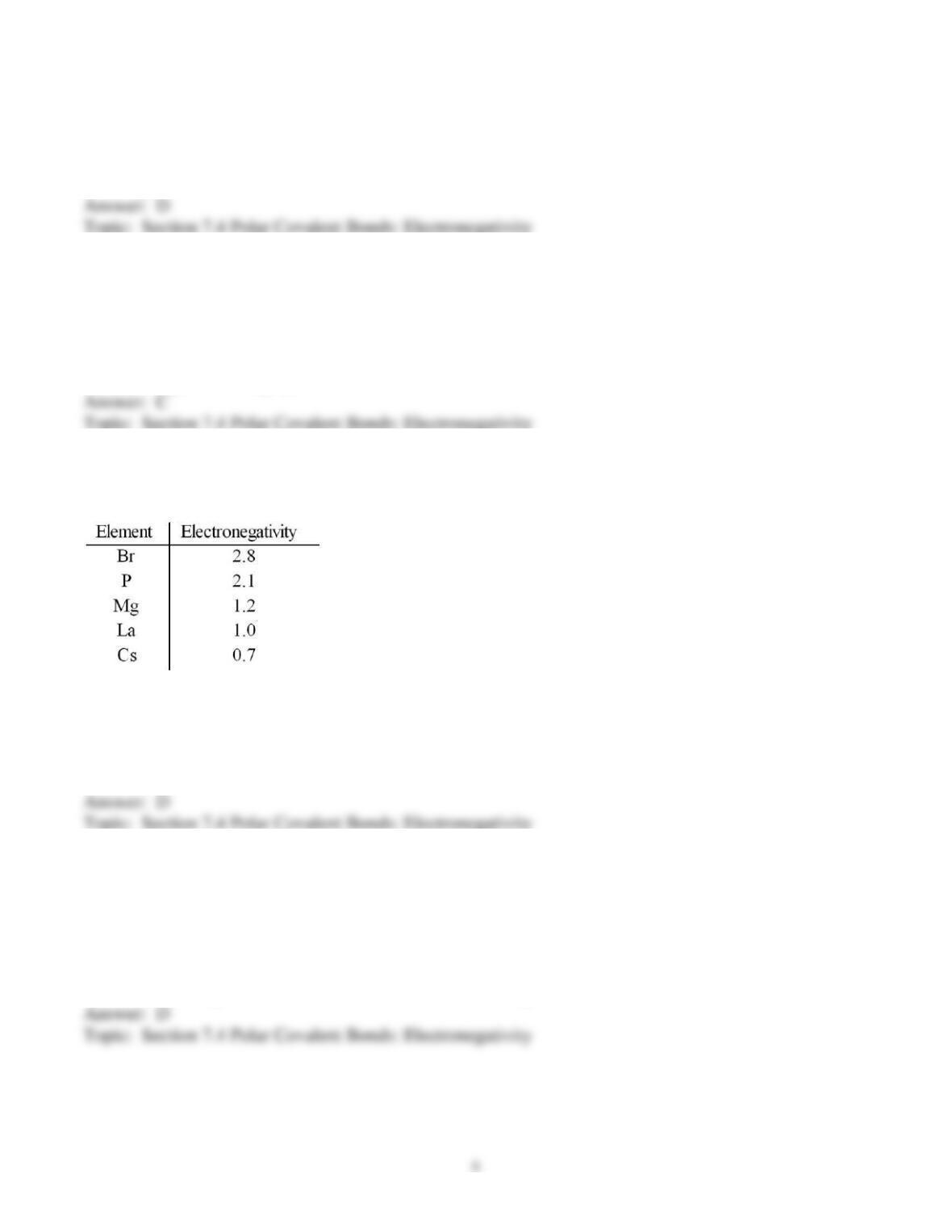
24) Based on the indicated electronegativities, arrange the following in order of increasing ionic
character: CsBr, LaBr3, PBr3, MgBr2.
A) CsBr, LaBr3, MgBr2, PBr3
B) CsBr, MgBr2, PBr3, LaBr3
C) PBr3, LaBr3, MgBr2, CsBr
D) PBr3, MgBr2, LaBr3, CsBr
25) The electronegativities for the elements vary from 0.7 for cesium to 4.0 for fluorine. The
electronegativity for iodine is 2.5. Based entirely on the general guidelines for electronegativities and
bond character,
A) binary compounds with iodine should all be polar covalent with a δ– on I.
B) binary compounds with iodine should all be polar covalent with a δ+ on I.
C) compounds with iodine may be ionic, polar covalent, or nonpolar covalent.
D) no binary compounds with iodine should be substantially ionic.
26) Arrange the following in order of increasing ionic character: Al2S3, MgS, Na2S, P4S3, S8.
A) MgS, Na2S, Al2S3, P4S3, S8
B) Na2S, MgS, Al2S3, P4S3, S8
C) S8, P4S3, Al2S3, MgS, Na2S
D) S8, P4S3, Al2S3, Na2S, MgS
27) A::A represents
A) a double bond.
B) a quadruple bond.
C) one lone pair of electrons.
D) two lone pairs of electrons.
28) The nitrogen-nitrogen bond in :N N: has a bond order of
A) 3
B) 1
C) 2
D) 6
29) How many of the σ bonds in H2SO4 are coordinate covalent bonds?
A) 0
B) 2
C) 4
D) 6
30) How many lone pairs of electrons are on the P atom in PF3?
A) 0
B) 1
C) 2
D) 3
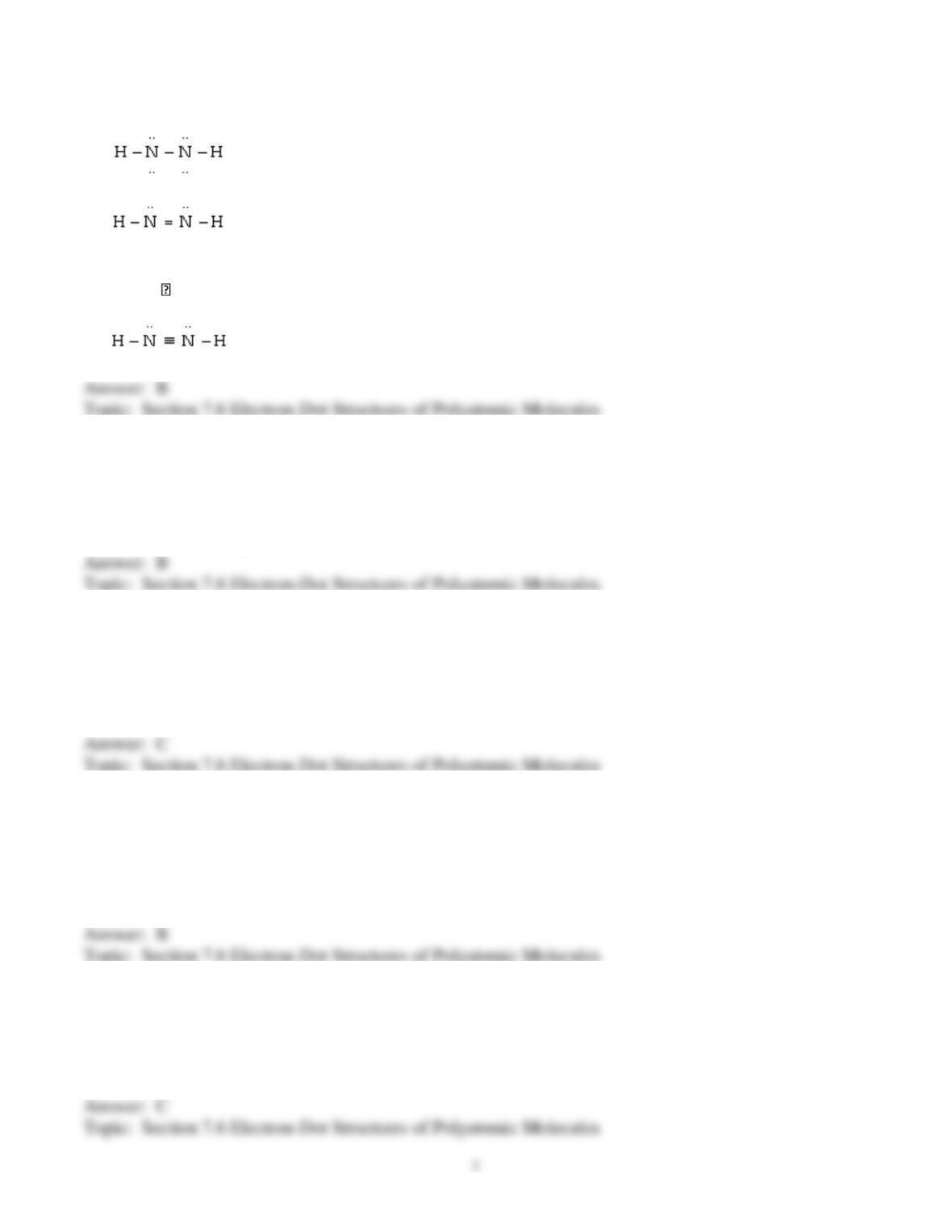
31) Which is the most acceptable electron dot structure for N2H2?
A)
B)
C)
H – N N – H
D)
32) In the most acceptable electron-dot structure for carbonyl fluoride, COF2 the central atom is
A) C, which is singly-bonded to O.
B) C, which is doubly-bonded to O.
C) O, which is singly-bonded to C
D) O, which is doubly-bonded to C.
33) Which molecule contains a triple bond?
A) F2
B) O3
C) HCN
D) H2CO
34) Elements that can accommodate more than eight electrons in their valence shell occur only in
periodic table period
A) 2 or lower.
B) 3 or lower.
C) 4 or lower.
D) 5 or lower.
35) Which element can accommodate more than eight electrons in its valence shell?
A) C
B) O
C) P
D) He
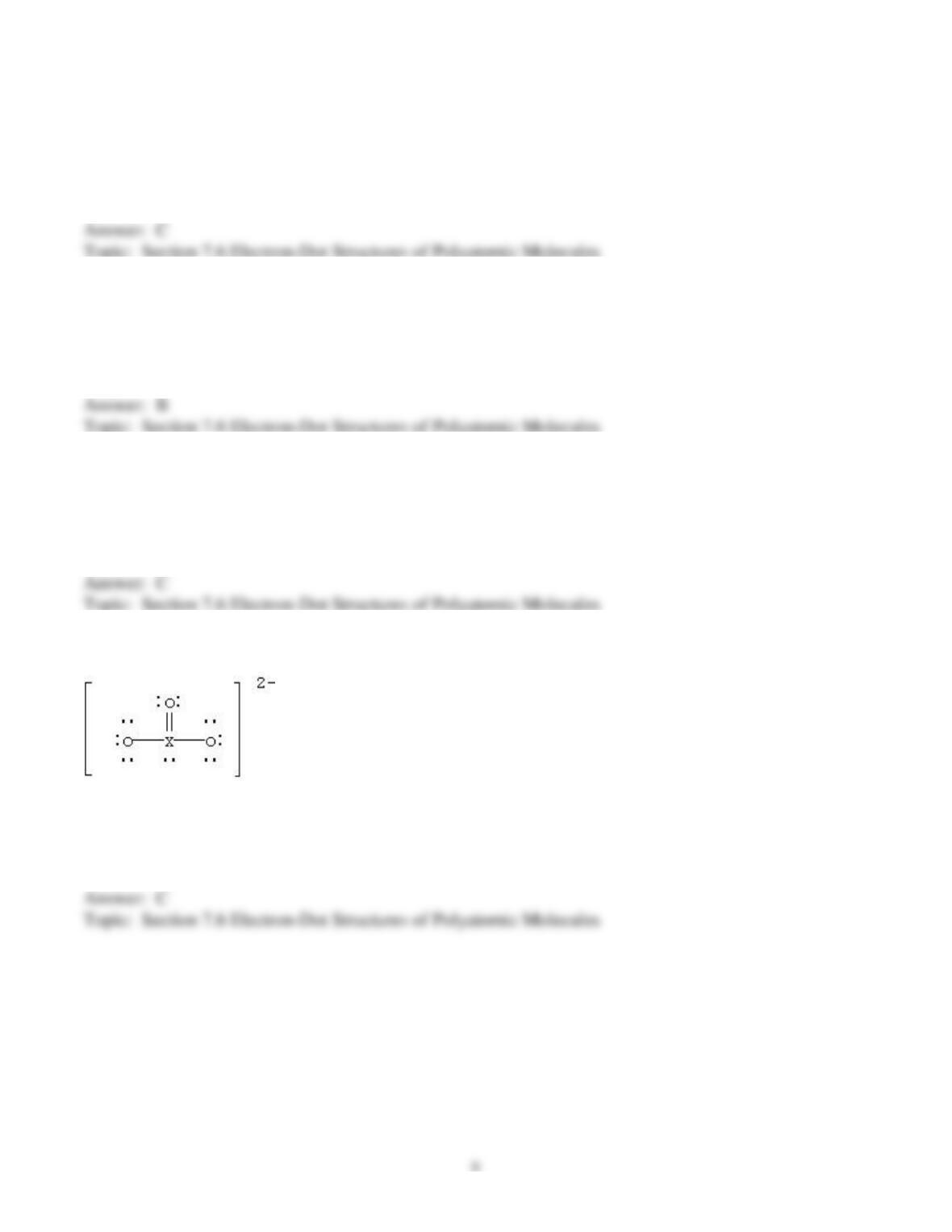
36) Which of the following contains an atom that does not obey the octet rule?
A) KBr
B) CO2
C) ClF3
D) ICl
37) How many lone pairs of electrons are on the Xe atom in XeF6?
A) 0
B) 1
C) 2
D) 3
38) How many electrons are in the valence shell of I in IF4–?
A) 8
B) 10
C) 12
D) 14
39) Identify the fourth-row element X that forms the ion.
A) Ge
B) As
C) Se
D) Kr
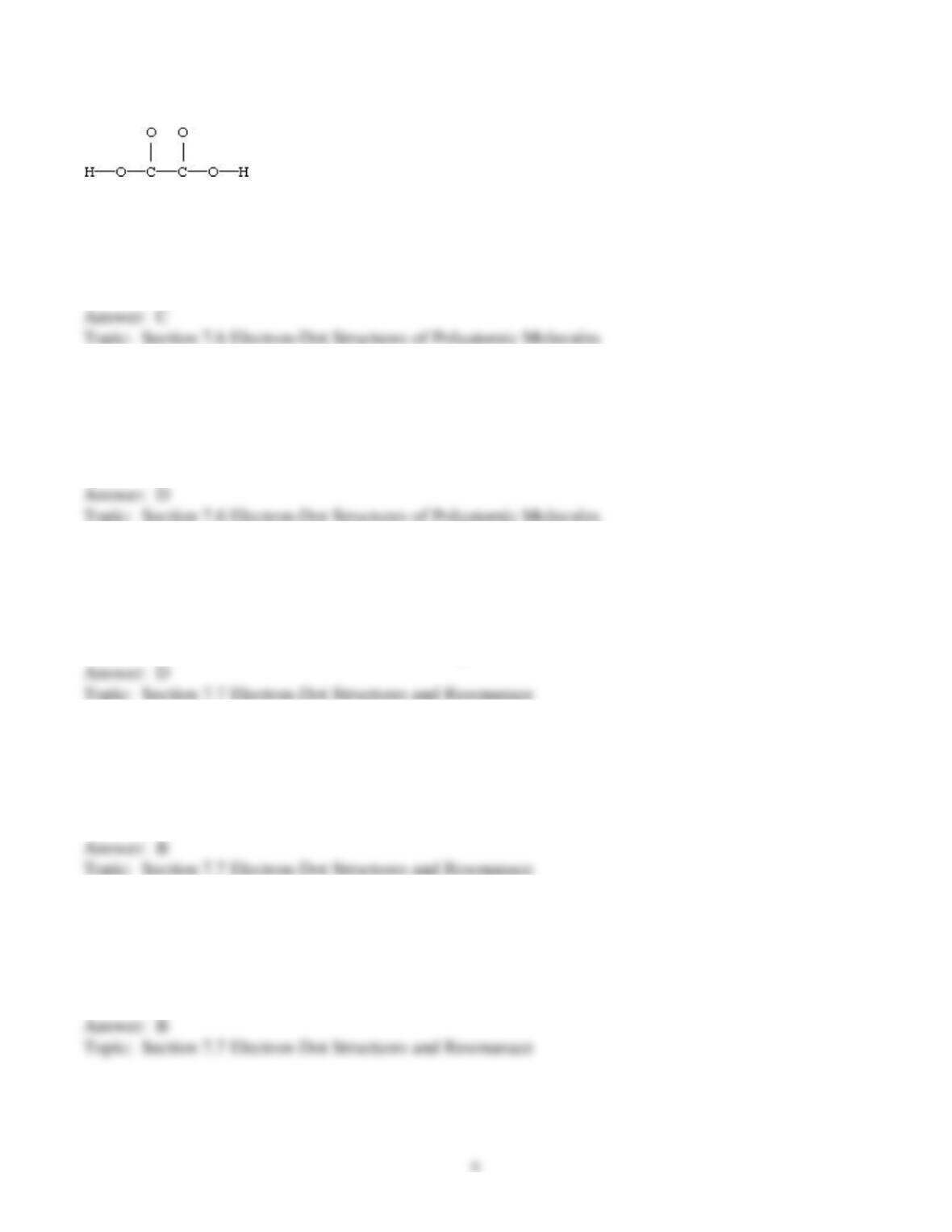
40) Consider a molecule with the following connections:
When a valid electron dot structure is written, how many double bonds will the molecule contain?
A) 0
B) 1
C) 2
D) 4
41) How many lone pairs are on the Br atom in BrF2–?
A) 0
B) 1
C) 2
D) 3
42) NO2– is be expected to have
A) two single bonds.
B) one single and one double bond.
C) two double bonds.
D) two identical bonds intermediate between a single and a double bond.
43) How many resonance structures are required in the electron-dot structure of CO32-?
A) two
B) three
C) four
D) five
44) What is the approximate carbon-oxygen bond order in CO32-?
A) 1
B) 4/3
C) 5/3
D) 2
45) Which is expected to have the strongest C—O bond?
A) CH3OH
B) COCl2
C) CH3CO2–
D) CO32-
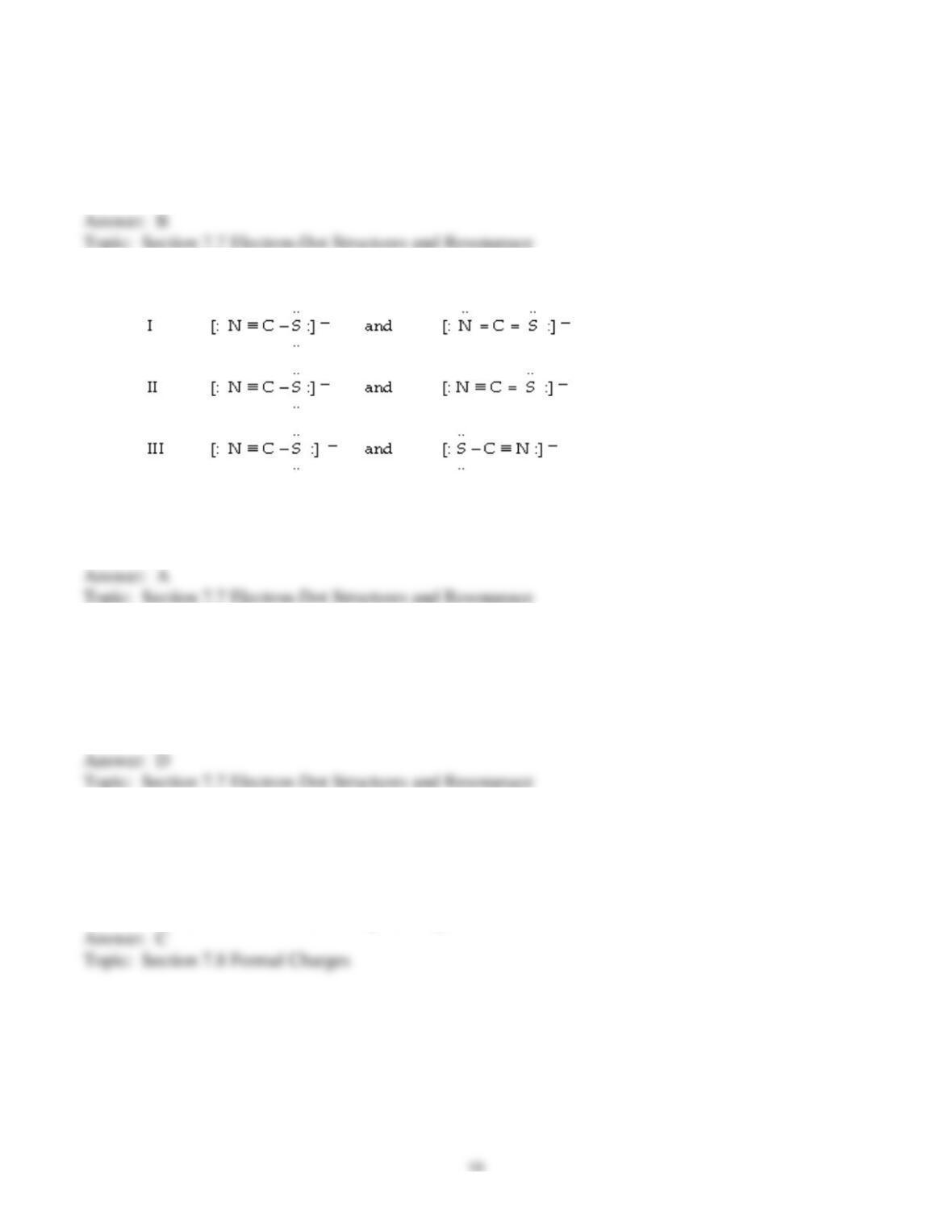
46) Which of the following are allowed resonance forms of NCS–?
A) only I
B) only II
C) only III
D) I and III
47) Which one of the following is expected to exhibit resonance?
A) NH4+
B) HCN
C) CO2
D) NO2–
48) Based on formal charge considerations, the electron-dot structure of CO32– ion has
A) two resonance structures involving two single bonds and one double bond.
B) two resonance structures involving one single bond and two double bonds.
C) three resonance structures involving two single bonds and one double bond.
D) three resonance structures involving one single bond and two double bonds.
49) In the best Lewis structure for NO+, what is the formal charge on the N atom?
A) -1
B) 0
C) +1
D) +2
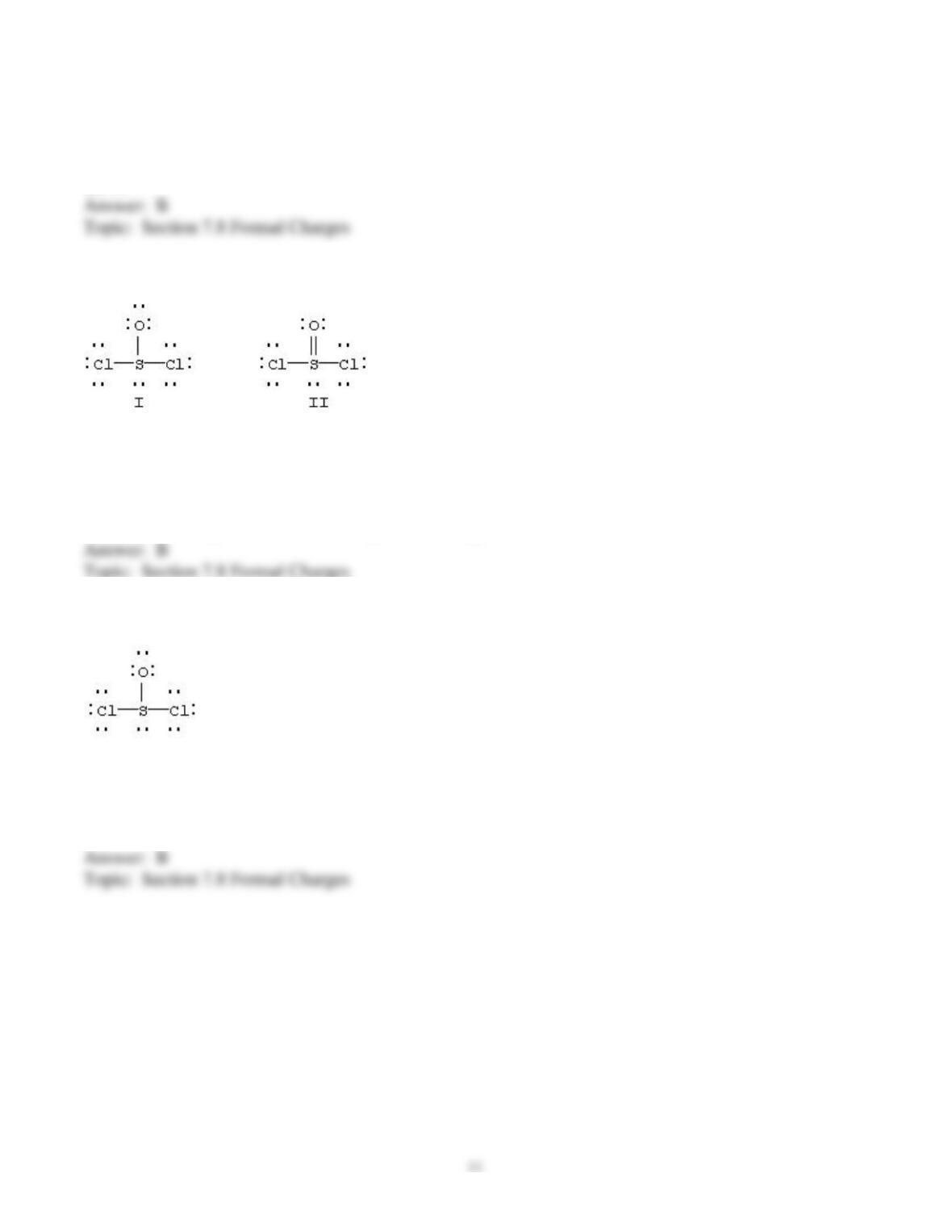
50) Two resonance forms for SOCl2 are given below.
Which is favored by the octet rule and which by formal charge considerations?
A) I is favored by the octet rule and by formal charge considerations.
B) I is favored by the octet rule and II by formal charge considerations.
C) II is favored by the octet rule and I by formal charge considerations.
D) II is favored by the octet rule and by formal charge considerations.
51) Assign formal charges to each atom in the resonance form for SOCl2 given below.
A) 0 for Cl, 0 for S, and 0 for O
B) 0 for Cl, +1 for S, and -1 for O
C) -1 for Cl, +4 for S, and -2 for O
D) -1 for Cl, -2 for S, and -2 for O
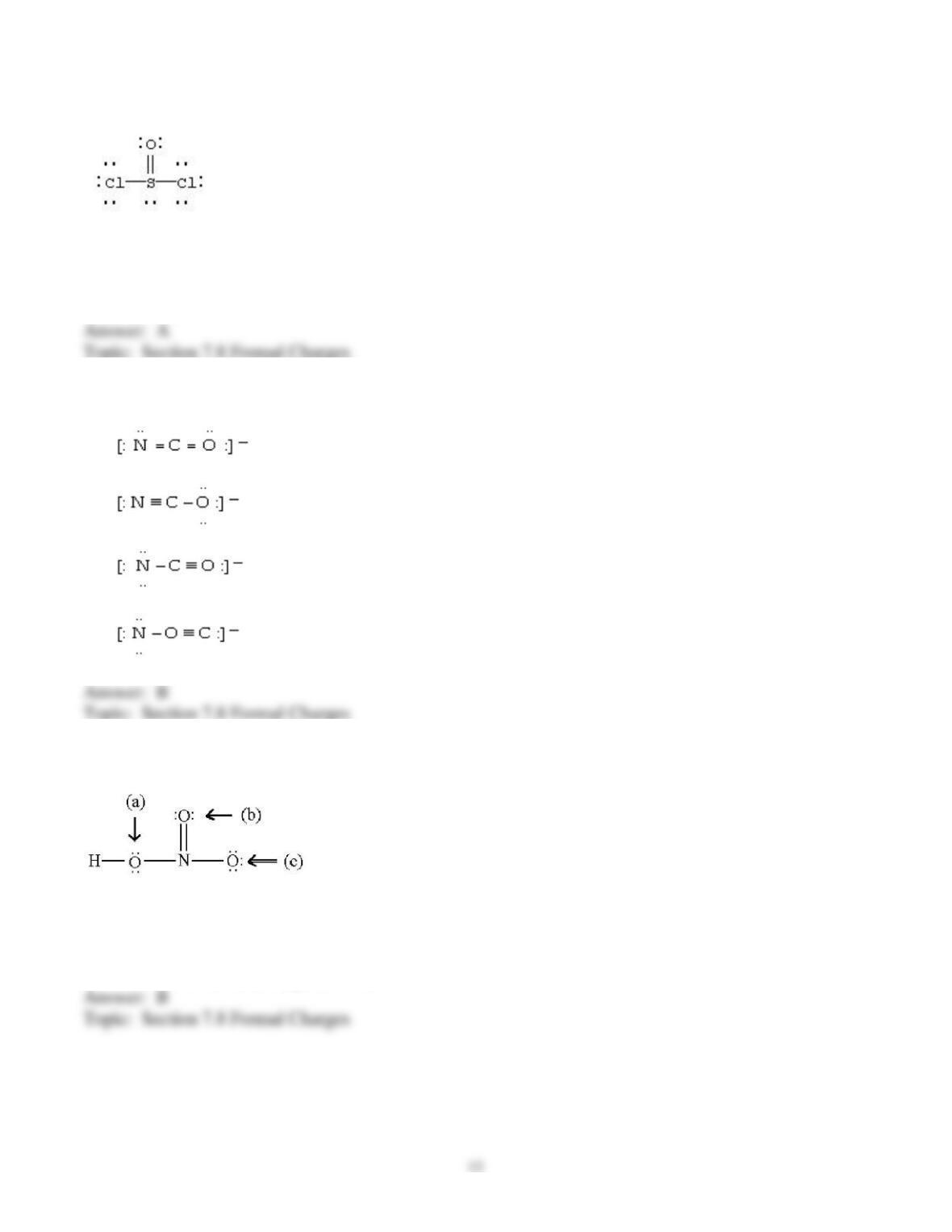
52) Assign formal charges to each atom in the resonance form for SOCl2 given below.
A) 0 for Cl, 0 for S, and 0 for O
B) 0 for Cl, +1 for S, and -1 for O
C) -1 for Cl, +4 for S, and -2 for O
D) -1 for Cl, -2 for S, and -2 for O
53) Which electron dot structure for OCN– has a formal charge of -1 on the most electronegative atom?
A)
B)
C)
D)
54) Assign formal charges to all atoms in the following resonance form for HNO3.
A) 0 for all atoms
B) +1 for N, -1 for oxygen (c), 0 for all other atoms
C) +1 for N and H, -1 for oxygen (a) and oxygen (c), 0 for oxygen (b)
D) +1 for H, -2 for each oxygen, +5 for N
55) How many double and single bonds are in the resonance form for SO2 in which the formal charges
on each atom are zero?
A) two single bonds and no double bonds
B) one single bond and one double bond
C) no single bonds and two double bonds
D) Each of these is possible.
56) Based on formal charges, what is the S—O bond order in SO42-?
A) 1
B) 1.3
C) 1.5
D) 2
57) A molecular compound that obeys the octet rule in which all atoms have a zero formal charge is
A) BaCl2
B) BrF3
C) NCl3
D) XeF4
58) What geometric arrangement of charge clouds is expected for an atom that has five charge clouds?
A) tetrahedral
B) square planar
C) trigonal bipyramidal
D) octahedral
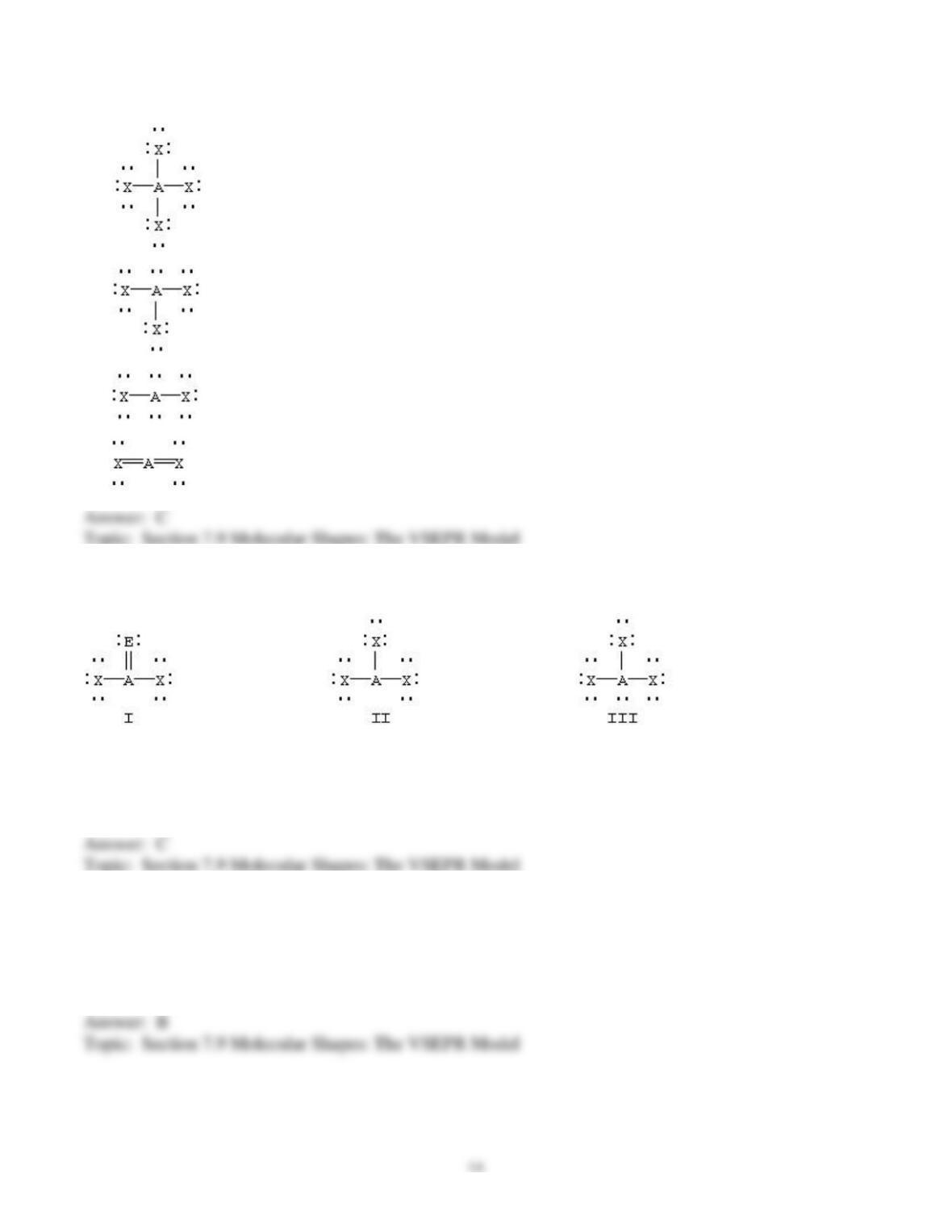
59) Based on VSEPR theory, which should have the smallest XAX bond angle?
A)
B)
C)
D)
60) Which of the following should be nonplanar?
A) only I
B) only II
C) only III
D) I and III
61) What is the molecular geometry of BrF4–?
A) seesaw
B) square planar
C) square pyramidal
D) tetrahedral
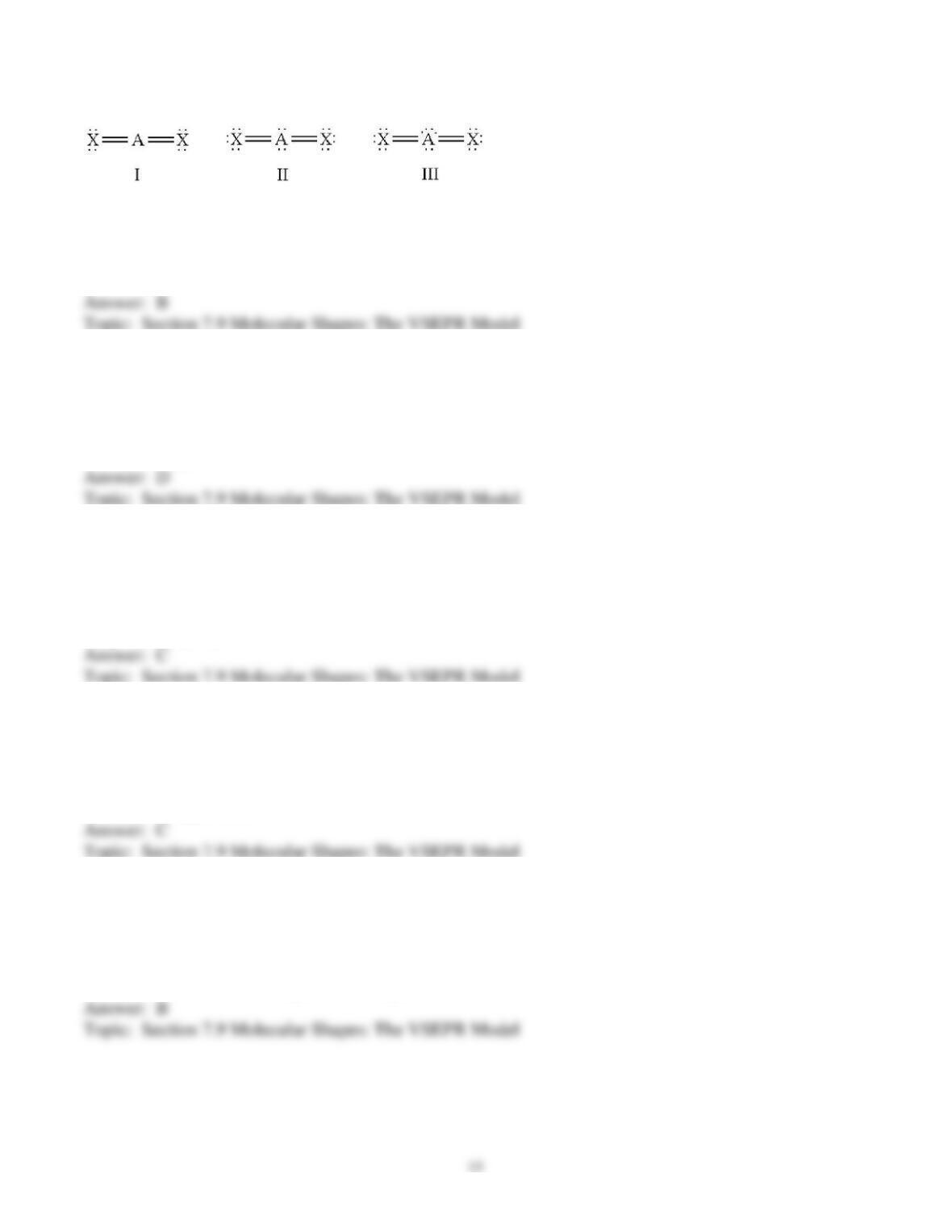
62) Which of the following should be nonlinear?
A) only I
B) only II
C) only III
D) II and III
63) What is the molecular geometry of AsCl3?
A) T-shaped
B) tetrahedral
C) trigonal planar
D) trigonal pyramidal
64) What is the O-N-O bond angle in NO3–?
A) less than 109.5°
B) 109.5°
C) 120°
D) greater than 120°
65) What is the molecular geometry of IF5?
A) octahedral
B) seesaw
C) square pyramidal
D) trigonal bipyramidal
66) Which of the following best describes ICl2–? It has a molecular geometry that is
A) linear molecular shape with no lone pairs on the I atom.
B) linear molecular shape with lone pairs on the I atom.
C) non-linear molecular shape with no lone pairs on the I atom.
D) non-linear molecular shape with lone pairs on the I atom.
67) What is the molecular geometry of TeCl4?
A) seesaw
B) square planar
C) square pyramidal
D) tetrahedral
68) What is the smallest bond angle in SF6?
A) 60°
B) 90°
C) 109.5°
D) 120°
69) Arrange in order from the smallest to the largest bond angle: CH3+, NF3, NH4+, XeF4.
A) CH3+, NF3, NH4+, XeF4
B) NF3, NH4+, XeF4, CH3+
C) XeF4, NH4+, NF3, CH3+
D) XeF4, NF3, NH4+, CH3+
70) The VSEPR model predicts the O O O bond angle in O3 to be
A) 90°.
B) 109.5°.
C) less than 120° but greater than 109.5°.
D) 120°.
71) Which of the following is not a valence bond concept?
A) The greater the overlap between the orbitals on two atoms, the stronger the bond.
B) Lone pair electrons are in atomic orbitals or in hybrid atomic orbitals.
C) Atomic orbitals on two atoms may overlap to form antibonding orbitals.
D) A pair of electrons in a bond is shared by both atoms.
72) A single sp3 hybrid orbital has
A) one lobe.
B) two lobes of equal size.
C) two lobes of unequal size.
D) four lobes of equal size.
73) Which orbital hybridization is associated with a tetrahedral charge cloud arrangement?
A) sp
B) sp2
C) sp3
D) None of these
74) What is the angle between adjacent sp3 hybrid orbitals?
A) 90°
B) 109.5°
C) 120°
D) 180°
75) Which of the following is not true?
A) The sp3 hybrid orbitals are degenerate.
B) An sp3 hybrid orbital may hold a lone pair of electrons.
C) An sp3 hybrid orbital may form a sigma bond by overlap with an orbital on another atom.
D) An sp3 hybrid orbital may form a pi bond by overlap with an orbital on another atom.
76) The number of sp2 hybrid orbitals on the carbon atom in CO32– is
A) one.
B) two.
C) three.
D) four.
77) A triple bond is generally composed of
A) three π bonds.
B) two π bonds and one σ bond.
C) one π bond and two σ bonds.
D) three σ bonds.
78) The orbital hybridization on the carbon atom in HCN is
A) sp.
B) sp2.
C) sp3.
D) None of these
79) What orbital hybridization is expected for the central atom in a molecule with a trigonal planar
geometry?
A) sp
B) sp2
C) sp3
D) None of these
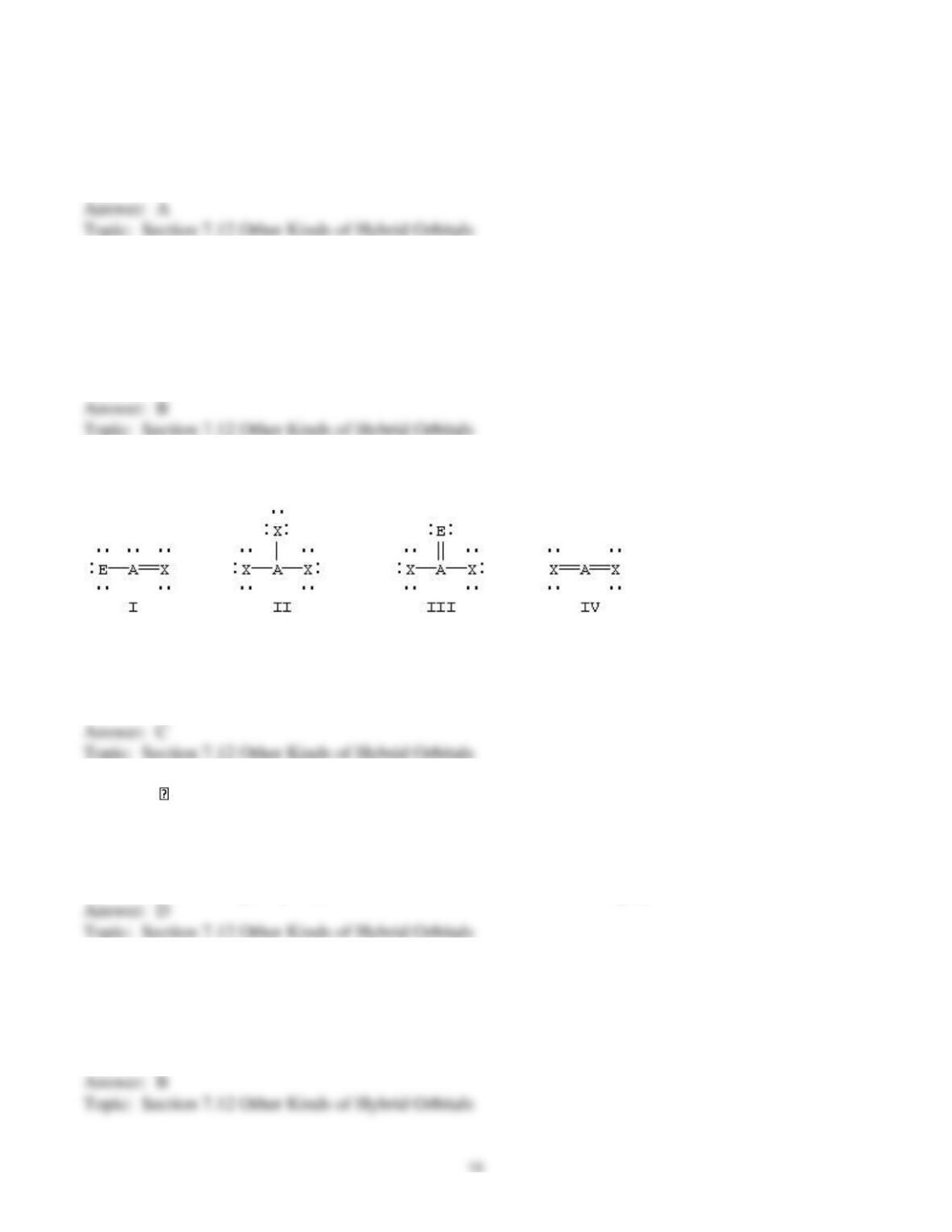
80) Which of the following would be expected to have sp2 hybridization on atom A?
A) II
B) I and III
C) I, II, and III
D) I and IV
81) The C O bond in COCl2 can be described as
A) a σ bond and a π bond, both involving sp hybrid orbitals on C.
B) a σ bond involving an sp hybrid orbital on C and a π bond involving a p orbital on C.
C) a σ bond and a π bond, both involving sp2 hybrid orbitals on C.
D) a σ bond involving an sp2 hybrid orbital on C and a π bond involving a p orbital on C.
82) Which type of bond produces a charge cloud with a nodal plane containing the bond axis?
A) σ
B) π
C) σ and π
D) neither σ nor π
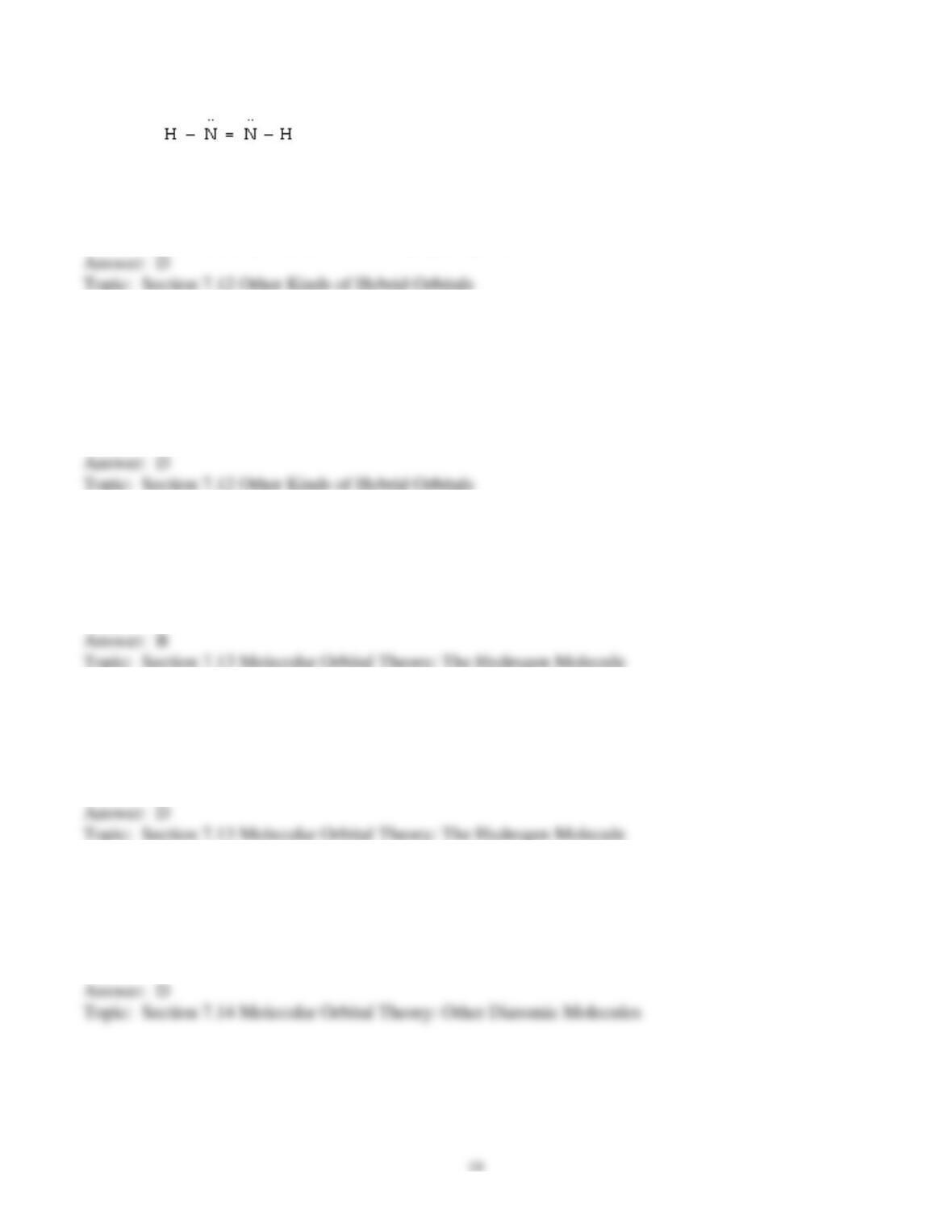
83) Which atomic orbitals are involved in bonding and which as lone pair orbitals for N2H2?
A) bonding: s on H, sp2 on N lone pair: p on N
B) bonding: sp2 on both H and N lone pair: p on N
C) bonding: s on H, p on N lone pair: sp2 on N
D) bonding: s on H, sp2 and p on N lone pair: sp2 on N
84) What is the hybridization on the N atom in NO2– and in NO3–?
A) sp2 for NO2– and sp3 for NO3–
B) sp3 for NO2– and sp2 for NO3–
C) sp for NO2– and sp2 for NO3–
D) sp2 for both
85) Which molecular orbital resembles a p-orbital?
A) σ
B) σ*
C) π
D) π*
86) If an electron is added to H2 it would go into a
A) σ molecular orbital and strengthen the H–H bond.
B) σ molecular orbital and weaken the H–H bond.
C) σ* molecular orbital and strengthen the H–H bond.
D) σ* molecular orbital and weaken the H–H bond.
87) Which molecular orbital resembles a d-orbital?
A) σ
B) σ*
C) π
D) π*
88) Compare the energies of molecular orbitals of homonuclear diatomic molecules with the energies of
the atomic orbitals with which they correlate.
A) Both bonding and antibonding molecular orbitals lie lower in energy than the atomic orbitals.
B) Bonding orbitals are lower and antibonding orbitals are higher in energy than the atomic orbitals.
C) Bonding orbitals are higher and antibonding orbitals are lower in energy than the atomic orbitals.
D) Both bonding and antibonding molecular orbitals are higher in energy than the atomic orbitals.
89) Which molecular orbitals for homonuclear diatomic molecules are degenerate?
A) π molecular orbitals
B) σ molecular orbitals
C) π molecular orbitals and σ molecular orbitals
D) neither π molecular orbitals nor σ molecular orbitals
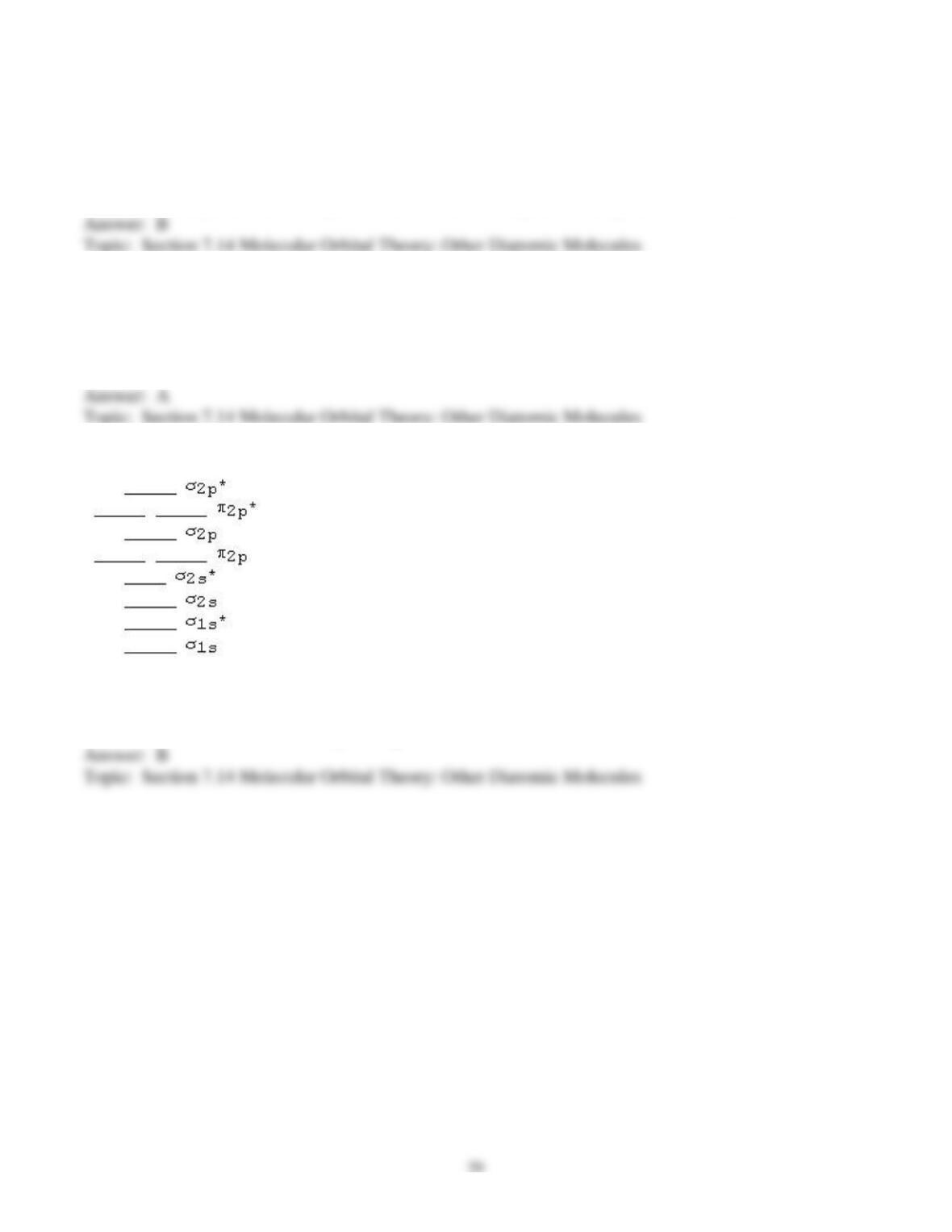
90) The MO diagram below is appropriate for B2. Based on this diagram, B2
A) has a bond order of one and is diamagnetic.
B) has a bond order of one and is paramagnetic.
C) has a bond order of two and is diamagnetic.
D) has a bond order of two and is paramagnetic.