Exam
Name___________________________________
MULTIPLE CHOICE. Choose the one alternative that best completes the statement or answers the question.
Provide the proper response.
1)
When we use Simpson’s rule, it is necessary that the number of subintervals be ? .
1)
A)
even
B)
a multiple of 3
C)
odd
D)
a multiple of 4
2)
If f(x) gives the rate of change of F(x) for x in [a, b], then
b
a
f(x) dx represents
i) the total change in F(x) as y goes from a to b.
ii) the total change in F(x) as x goes from a to b.
iii) the total change in f(x) as x goes from a to b.
2)
A)
Only iii is correct.
B)
Only ii is correct.
C)
Either ii or iii could be correct.
D)
Only i is correct.
Answer the question, concerning the use of substitution in integration.
3)
If we use u =x2 as a substitution to find xex2 dx, then which of the following would be a correct
result?
3)
A)
2eu du
B)
eu
2 du
C)
du
D)
None of the above
Provide the proper response.
4)
Which of the following numerical integration methods generally gives the best approximation for
the same number of subintervals?
4)
A)
the trapezoidal rule
B)
Simpson’s rule
C)
summation of areas of rectangles
D)
No method is generally best.
5)
The definite integral represents area only if the function involved is ? at every x–value in the
interval [a, b].
5)
A)
rational
B)
nonnegative
C)
negative
D)
positive
6)
Why might we want to use numerical integration?
i) The integral cannot be evaluated by any technique.
ii) The antidifferentiation is complicated.
iii) f(x) is not known.
6)
A)
Both ii and iii
B)
Both i and iii
C)
Both i and ii
D)
All of the above
7)
If f(a) = 3 and f(x) is increasing on the interval [a, b], then which method of estimating the area
under the graph of f(x) and above the x–axis will yield the highest value? Assume that n = 10 in all
cases.
7)
A)
Using right endpoints
B)
Using midpoints
C)
Using left endpoints
D)
Cannot be determined
8)
Which of the following expressions is associated with Simpson’s rule?
8)
A)
b – a
n
B)
b – a
2n
C)
b – a
3n
D)
a – b
3n
9)
In estimating the definite integral for f(x) on the interval [5, 10], we compute x =b – a
n. If n = 5,
then what is the value of x?
9)
A)
2
B)
2.5
C)
5
D)
None of the above
Answer the question, concerning the use of substitution in integration.
10)
If we use u = x2+ 2 as a substitution to find (x2+ 2) dx, then which of the following would be a
correct result?
10)
A)
(u – 2) du
B)
u
2 du
C)
u du
D)
None of the above
D
11)
Suppose that we are using substitution to find an antiderivative. If, after making the substitution,
we find that there is still an x–term left in the integrand, what should we do?
11)
A)
This would never happen if we made the correct substitution.
B)
Go back to the equation relating x and u, solve for x, and substitute in the integrand.
C)
Use an alternative method, because substitution will never give the antiderivative.
D)
None of the above
B
Provide the proper response.
12)
If f(b) = 4 and f(x) is decreasing on the interval [a, b], then which method of estimating the area
under the graph of f(x) and above the x–axis will yield the lowest value? Assume that n = 10 in all
cases.
12)
A)
Using left endpoints
B)
Using midpoints
C)
Using right endpoints
D)
Cannot be determined
C
D
Answer the question, concerning the use of substitution in integration.
13)
If we use u = x + e as a substitution to find (x + e)n dx, then which of the following would be a
correct result?
13)
A)
un dx
B)
un du
C)
un+1 du
D)
None of the above
SHORT ANSWER. Write the word or phrase that best completes each statement or answers the question.
Provide the proper response.
14)
What is the difference between the indefinite integral and the definite integral?
14)
MULTIPLE CHOICE. Choose the one alternative that best completes the statement or answers the question.
Solve the problem.
15)
The flow of blood in a blood vessel is faster toward the center of the vessel and slower toward the
outside. The speed of the blood is given by V =p
4Lv (R2–r2), where R is the radius of the blood
vessel, r is the distance of the flowing blood from the center of the blood vessel, and p, v, and L are
physical constants related to the pressure and viscosity of the blood and the length of the blood
vessel. If R is constant, we can think of V as a function of r: V(r) =p
4Lv (R2–r2). The total blood
flow Q is given by Q(R) =
R
0
2rV(r) dr . Find Q for a blood vessel of radius R =0.4 mm.
15)
A)
8
375
p
Lv
B)
4
625
p
Lv
C)
2
625
p
Lv
D)
8
1875
p
Lv
Find the integral.
16)
(ln x)75
x dx
16)
A)
(ln x)76
x+ C
B)
(ln x)76
76x+ C
C)
75(ln x)74 + C
D)
(ln x)76
76 + C
Evaluate the definite integral.
17)
1
0
4x 21 +x2 dx
17)
A)
8
3(23/2 – 1)
B)
2(23/2 – 1)
C)
4
3(23/2 – 1)
D)
8
3
22
Find the exact value of the integral using a formula from geometry.
18)
3
1
f(x)dx for the indicated region.
18)
A)
5
B)
7.5
C)
12.5
D)
10
Find the integral.
19)
1
x(ln x5) dx
19)
A)
ln x5+ C
B)
1
5 ln x5+ C
C)
ln ln x5+ C
D)
1
5 ln ln x5+ C
20)
1
x+2
x2+3
x3 dx
20)
A)
2
x2+6
x3+12
x4+ C
B)
ln x+ 2 ln x2+ 3 ln x3+ C
C)
2x +2 ln x2+ 3 ln x3+ C
D)
ln x–2
x–3
2x2+ C
Find the area between the curves.
21)
x = – 4, x =4, y =2x/(1 +x2), y = 0
21)
A)
0
B)
ln 17
C)
2 e17
D)
2 ln 17
Find the integral.
22)
5e1/y
3y2 dy
22)
A)
–5e1/y
3+ C
B)
5e1/y
3+ C
C)
5e1/y
y3+ C
D)
10ye1/y + C
23)
(3x8– 7x3+ 4) dx
23)
A)
1
3x9–7
4x4+ 4x + C
B)
1
3x9–7
3x4+ 4x + C
C)
9x9–7
4x4+ 4x + C
D)
9x9–7
3x4+ 4x + C
24)
1
x(ln x)10 dx
24)
A)
–1
11(ln x)11 + C
B)
–1
9x(ln x)9+ C
C)
–1
9(ln x)9+ C
D)
1
x(ln x)11 + C
Find the area of the shaded region.
25)
y =x– 3
25)
A)
29
3
B)
38
3
C)
22
3
D)
16
3
Solve the problem.
26)
Find the producers’ surplus if the supply function of some item is given by S(q) = q2+ 2q + 8.
Assume supply and demand are in equilibrium at q = 30.
26)
A)
18,900
B)
17,200
C)
12,700
D)
19,800
Find the integral.
27)
6x5 dx
(8 +x6)3
27)
A)
–6x5
(8 +x6)2+ C
B)
1
4(8 +x6)4+ C
C)
–1
4(8 +x6)4+ C
D)
–1
2(8 +x6)2+ C
Use the definite integral to find the area between the x–axis and f(x) over the indicated interval.
28)
f(x) = x2+ 1; [0, 1]
28)
A)
1
3
B)
4
3
C)
2
3
D)
5
3
Use your calculator to approximate the integral using the method indicated, with n = 100. Round your answer to four
decimal places.
29)
4
0
ex dx (Simpson’s rule)
29)
A)
53.6053
B)
53.5982
C)
53.6843
D)
54.5982
Find the integral.
30)
1
6x(ln x) dx
30)
A)
ln 6 ln x + C
B)
ln ln x
6+ C
C)
6 ln ln x + C
D)
ln x+ ln ln x
6+ C
Solve the problem.
31)
Suppose the supply function of a certain item is given by S(q) =2eq, and the demand function is
given by D(q) =8e–q. Find the producers’ surplus. Round your answer to three decimal places.
31)
A)
0.664
B)
0.773
C)
1.228
D)
1.337
Use n = 4 to approximate the value of the integral by Simpson’s rule.
32)
1
0
1
1 + x dx
32)
A)
1747
2520
B)
1171
2520
C)
1747
5040
D)
1171
1680
Find the integral.
33)
(x4/3 – 3x5/2) dx
33)
A)
3
4x7/3 –3
7x7/2 + C
B)
3
7x7/3 –6
7x7/2 + C
C)
3
4x7/3 –4
7x7/2 + C
D)
3
7x7/3 –2
7x7/2 + C
Approximate the area under the graph of f(x) and above the x–axis using n rectangles.
34)
f(x) = 2x + 3 from x = 0 to x = 2; n = 4; use right endpoints
34)
A)
11
B)
15
C)
13
D)
17
Evaluate the definite integral.
35)
e
1
8x –11
xdx
35)
A)
4e2–4
B)
8e2–11
C)
4e2– 15
D)
4e2–11
Solve the problem. Round your answer, if appropriate.
36)
Suppose that the accompanying table shows the velocity of a car every second for 8 seconds. Use
the trapezoidal rule to approximate the distance traveled by the car in the 8 seconds.
Time (sec) Velocity (ft/sec)
018
119
220
322
421
523
620
718
819
36)
A)
180 feet
B)
161.5 feet
C)
245.5 feet
D)
323 feet
Evaluate the definite integral.
37)
5
1
x4–x–1
x2dx
37)
A)
3064
25
B)
3062
75
C)
3064
75
D)
6253
150
Find the integral.
38)
4x2/3 dx
38)
A)
12
5x5/3 + C
B)
4
3x5/3 + C
C)
6x5/3 + C
D)
8
3x5/3 + C
Solve the problem.
39)
Find the consumers’ surplus if the demand function for an item is given by D(q) = 30 – q2,
assuming supply and demand are in equilibrium at q = 4.
39)
A)
128
3
B)
64
3
C)
64
D)
128
Approximate the area under the graph of f(x) and above the x–axis using n rectangles.
40)
f(x) =e–x+4 from x = – 2 to x =6; n = 4; use right endpoints
40)
A)
49.09
B)
34.31
C)
38.29
D)
32.02
11
Use the definite integral to find the area between the x–axis and f(x) over the indicated interval.
41)
f(x) = 2x + 7; [1, 5]
41)
A)
26
B)
18
C)
9
D)
52
Find the integral.
42)
5
x2–4
x dx
42)
A)
5
x– 8 x– C
B)
5
x– 8
x
+ C
C)
–5
x–8
x
+ C
D)
–5
x– 8 x+ C
Solve the problem.
43)
The current (in amperes) in an inductor of constant inductance L (in henries) is given by
i =1
LV dt , where V is the voltage (in volts) and t is the time (in seconds). Find a formula for i, if
V = 9t(t2– 6).
43)
A)
i =1
L
9
4t4–27t2+ C
B)
i =1
L
9
4t4–54t2+ C
C)
i =1
L
9
4t4–54t + C
D)
i =L9
4t4–27t2+ C
Find the integral.
44)
(7 + ln x)5
x dx
44)
A)
6x2(7 + ln x)6+ C
B)
(7 + ln x)6
6+ C
C)
(7 + ln x)6
6x2+ C
D)
(7 + ln x)6
6x + C
Use n = 4 to approximate the value of the integral by Simpson’s rule.
45)
2
0
(x4+6) dx
45)
A)
305
16
B)
221
24
C)
361
24
D)
221
12
Use n = 4 to approximate the value of the integral by the trapezoidal rule.
46)
4
0
16 –x2 dx
46)
A)
24.0
B)
12.0
C)
6.0
D)
47.9
Find the integral.
47)
x– 4
2x x dx
47)
A)
1
2 ln x– 4x–1/2 + C
B)
1
2x ln x+ 4x–1/2 + C
C)
1
2x ln x– 4x–1/2 + C
D)
1
2 ln x+ 4x–1/2 + C
48)
t2 ln(t3+5)
t3+5 dt
48)
A)
[ln(t3+5)]2+ C
B)
t3 ln(t3+5)
t3+5
+ C
C)
(ln t)2
6+ C
D)
[ln(t3+5)]2
6+ C
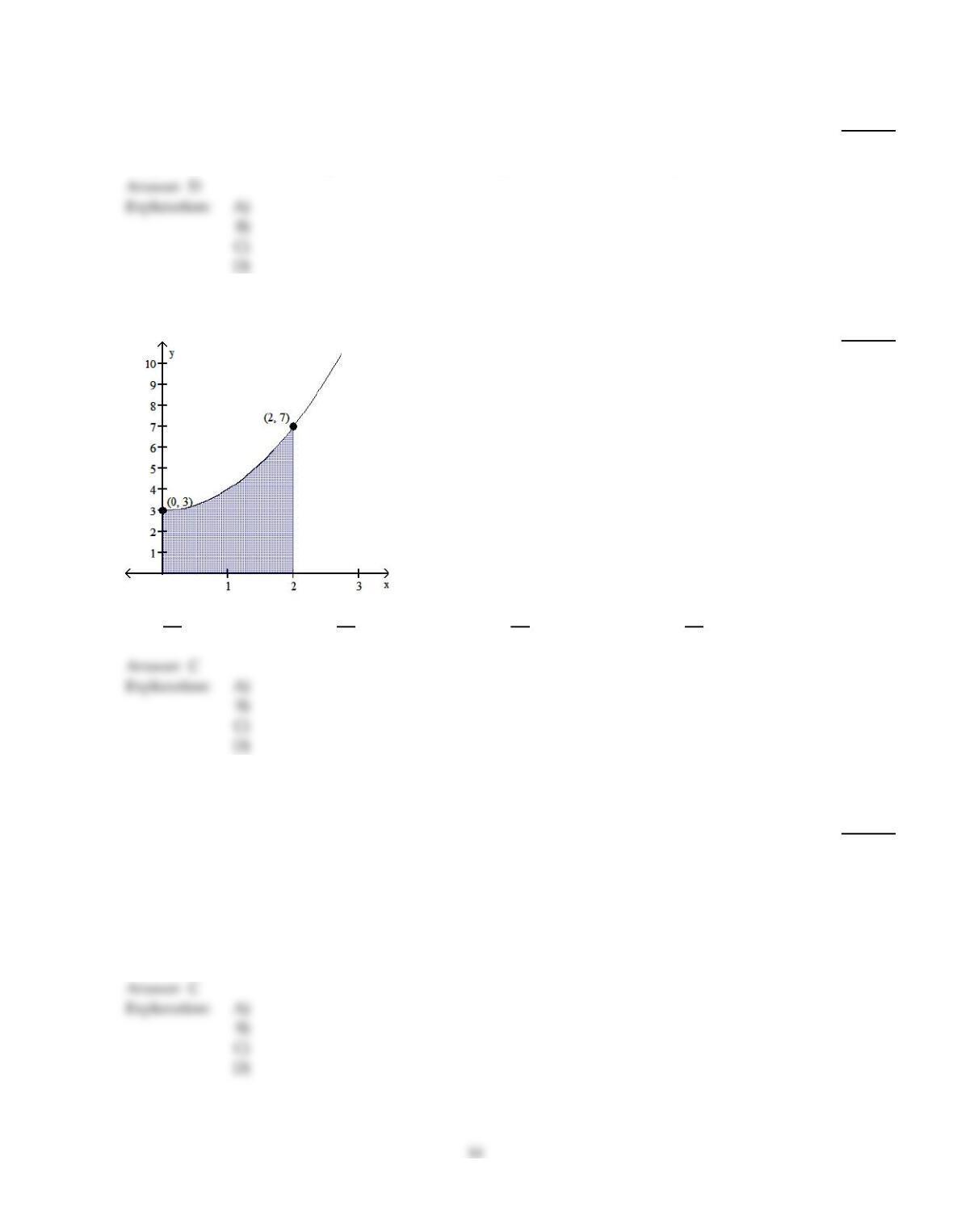
Find the exact value of the integral using a formula from geometry.
49)
8
4
(2 + 3x) dx
49)
A)
34
B)
40
C)
68
D)
80
Find the area of the shaded region.
50)
y =x2+ 3
50)
A)
23
3
B)
22
3
C)
26
3
D)
25
3
Provide the proper response.
51)
If f(x) 0 on the interval [a, b], then
b
a
f(x) dx represents
i) the area to the right of the y–axis between y = a and y = b.
ii) the area above the x–axis between x = a and x = b.
iii) the area below the x–axis between x = a and x = b.
51)
A)
Either ii or iii could be correct.
B)
Only i is correct.
C)
Only ii is correct.
D)
None of the above is correct.
Find the area between the curves.
52)
x = 2, x = 5, y =1
x, y =1
x2
52)
A)
ln 5
2+1
10
B)
ln 5
2+3
10
C)
ln 5
2–1
10
D)
ln 5
2–3
10
Solve the problem.
53)
The population of a city, in millions, since 1990 has grown at a rate of P(t) =0.49e0.044t million
people per year, where t is the number of years after 1990. If there were 1.84 million people in 2000,
estimate (to two decimal places) the population in 2006.
53)
A)
P(16) 22.52 million
B)
P(16) 37.97 million
C)
P(16) 7.06 million
D)
P(16) –15.45 million
Evaluate the definite integral.
54)
4
3
dt
1 + t
54)
A)
1
6
B)
–5
36
C)
ln 4
3
D)
ln 5
4
55)
1
0
5x4
(1 +x5)4 dx
55)
A)
1
3
B)
7
8
C)
5
16
D)
7
24
Find the integral.
56)
11x2e–4x3 dx
56)
A)
12e–4x3+ C
B)
11
12 e–4x3+ C
C)
–11
12 e–4x3+ C
D)
–11e–4x3+ C
Solve the problem.
57)
A company has found that the marginal cost of a new production line (in thousands) is
C'(x) =9
x + e , where x is the number of years the line is in use. Find the total cost function for the
production line (in thousands). The fixed cost is $20,000.
57)
A)
C(x) = 9 ln(x + e) + 11
B)
C(x) =ln(x + e)
9+ 20
C)
C(x) = 9 ln(x + e) + 20
D)
C(x) =ln(x + e)
9+ 11
Evaluate the definite integral.
58)
4
1
x–1/2 dx
58)
A)
2
B)
0
C)
3
D)
1
Solve the problem. Round your answer, if appropriate.
59)
The growth rate of a certain tree (in feet) is given by
y =2
t + 1 +e–t2/2 ,
where t is time in years. Estimate the total growth of the tree through the end of the second year by
using Simpson’s rule with n = 2.
59)
A)
5.11 feet
B)
3.41 feet
C)
2.34 feet
D)
3.68 feet
Use n = 4 to approximate the value of the integral by the trapezoidal rule.
60)
1
–1
(x2+7) dx
60)
A)
59
2
B)
44
3
C)
75
8
D)
59
4
Use the definite integral to find the area between the x–axis and f(x) over the indicated interval.
61)
f(x) = – x2+ 9; [0, 5]
61)
A)
98
3
B)
10
3
C)
10
9
D)
5
9
Solve the problem.
62)
Suppose the supply function of a certain item is given by S(q) = 2q + 7, and the demand function is
given by D(q) = 27 – q2/3. Find the consumers’ surplus. (Hint: The equilibrium quantity q0 is a
perfect cube.)
62)
A)
32
5
B)
64
5
C)
32
D)
64
17
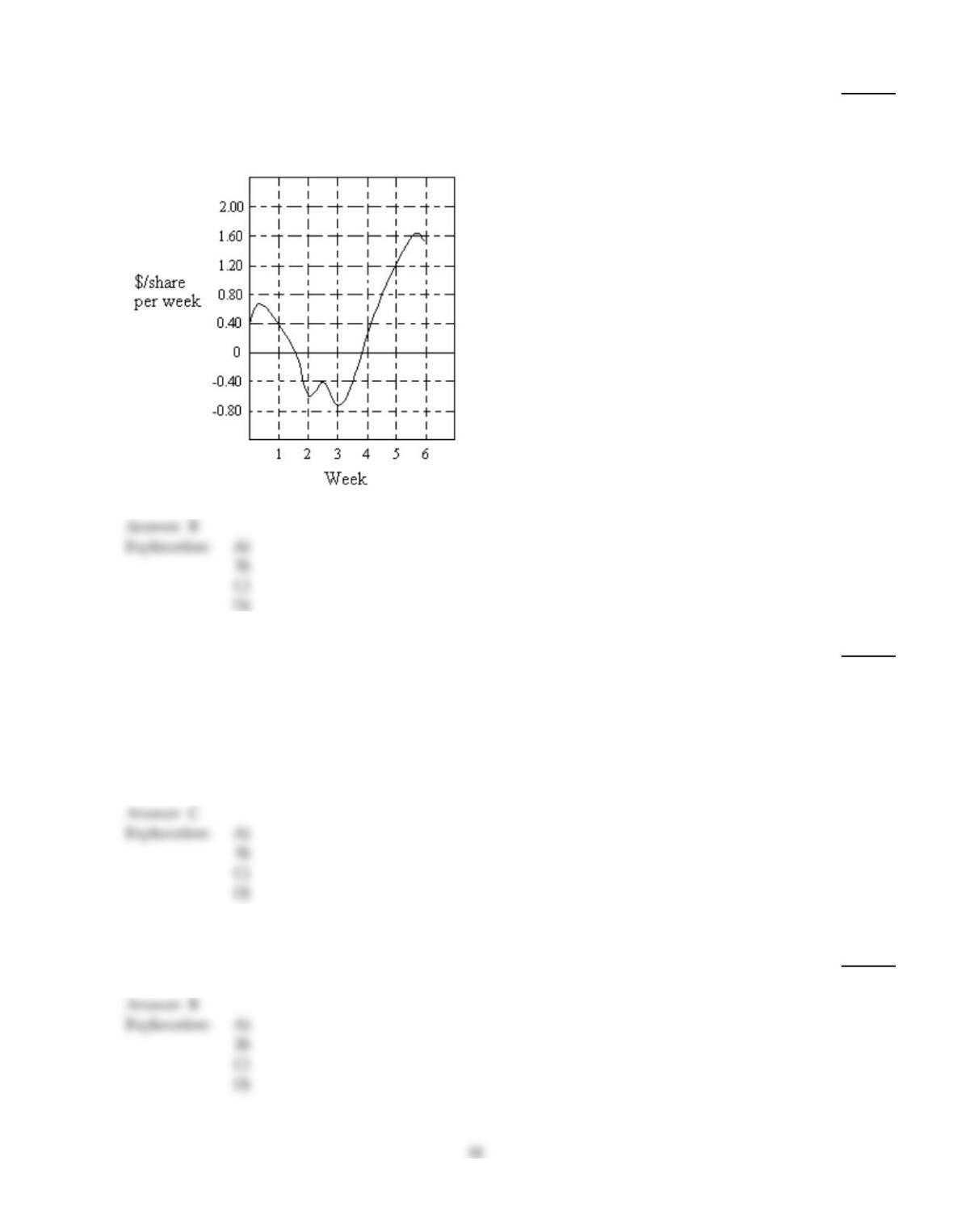
63)
The graph below shows the rate of change of the price of a stock (in dollars per share per week)
over a period of 6 weeks. Estimate the total change in dollars per share of the stock during this
period. Use rectangles with widths of 1 week, and let the function value at the midpoint of the
rectangle give the height of the rectangle.
63)
A)
$1.60/share
B)
$2.20/share
C)
$0.90/share
D)
$2.00/share
64)
For a particular circuit, the current (in amperes) after time t (in seconds) at a certain point P is given
by
i = 0.005t0.24.
Find the charge (in coulombs) that passes point P during the first second by evaluating
1
0
0.005t0.24 dt.
64)
A)
0.005 coulombs
B)
1.24 coulombs
C)
0.004 coulombs
D)
250 coulombs
Use the definite integral to find the area between the x–axis and f(x) over the indicated interval.
65)
f(x) = ex– 1; [–2, 3]
65)
A)
–e3–e–2– 5
B)
e3–e–2– 5
C)
e3+e–2– 5
D)
e–2–e3– 5
Evaluate the definite integral.
66)
7
2
(z–7) dz
66)
A)
–7
B)
–11
27
C)
–11
2+ 2 7
D)
–7
27
Find the integral.
67)
12e0.2x dx
67)
A)
60e0.2x+ C
B)
12e0.2x + 1
0.2x + 1 + C
C)
12e0.2x+ C
D)
2.4e0.2x+ C
Solve the problem.
68)
The velocity of particle A, t seconds after its release is given by
va(t) =8.1t –0.6t2 meters per second. The velocity of particle B, t seconds after its release is given by
vb(t) =13.3t –0.4t2 meters per second. If velocity is measured in meters per second, how much
farther does particle B travel than particle A during the first ten seconds (from t = 0 to t = 10)?
Round to the nearest meter.
68)
A)
460 m
B)
327 m
C)
720 m
D)
4 m
69)
Suppose that an object’s acceleration function is given by a(t) =4t +10. The object‘s initial velocity,
v(0), is 3, and the object’s initial position, s(0), is 12. Find s(t).
69)
A)
s(t) =2
3t3+5t2+3t
B)
s(t) =2
3t3+5t2+3t +12
C)
s(t) =4
3t3+5t2+12t +3
D)
s(t) =2t2+10t +3
19
Find the integral.
70)
x4x5+2 dx
70)
A)
10
3(x5+2)3/2 + C
B)
2
15 (x5+2)3/2 + C
C)
2
3(x5+2)3/2 + C
D)
–2
5(x5+2)–1/2 + C
71)
7
x–5e–0.7x dx
71)
A)
7 ln x–50
7e–0.7x + C
B)
–7
x2+7
2e–0.7x + C
C)
14
x2–7
2e–0.7x + C
D)
7 ln x+50
7e–0.7x + C
Use n = 4 to approximate the value of the integral by the trapezoidal rule.
72)
2
0
(x4+5) dx
72)
A)
197
12
B)
273
8
C)
273
16
D)
377
16
Solve the problem.
73)
Find the consumers’ surplus if the demand for an item is given by D(q) = 72 – q2, assuming supply
and demand are in equilibrium at q = 6.
73)
A)
432
B)
216
C)
144
D)
72