Business Communication Essentials, 6e (Bovee/Thill)
Chapter 7 Writing Routine and Positive Messages
1) When developing routine requests and positive messages, you should ________.
A) slowly build up to the request or main idea
B) not assume that your audience will comply
C) demand action to ensure compliance
D) be non-specific when stating what you want
E) state precisely what you want
2) Routine requests should begin with ________.
A) a clear statement of request
B) a buffer that builds up to the main request
C) a justification for the request
D) an attention-getting statement, fact or question
E) the phrase “thank you in advance” or similar words of appreciation
3) When stating your routine request up front, you should ________.
A) use a demanding tone to ensure compliance
B) assume that your audience will comply
C) avoid spelling out exactly what you want
D) first offer a justification for the request
E) use the phrase “thank you in advance”
4) When stating your routine request upfront, you should ________.
A) use the phrase “thank you in advance”
B) first offer a justification for the request
C) use a demanding tone to ensure compliance
D) state precisely what you want
E) not assume that your audience will comply
5) When making a routine request, the body of your message should ________.
A) put your most important request at the end
B) explain and justify your request
C) address multiple topics in one question
D) offer apologies for any inconvenience caused
E) include information about how you can be reached
6) When explaining and justifying multiple requests or questions in the body of your message,
you should ________.
A) address all topics in one question
B) offer apologies for any inconvenience caused
C) start with your most important request
D) not assume that your audience will comply
E) avoid asking questions of the reader
7) When explaining and justifying your routine request in the body of your message, you should
________.
A) address multiple topics in one question
B) offer apologies for any inconvenience caused
C) put your most important request at the end
D) not assume that your audience will comply
E) break down complex requests into specific questions
8) The closing of a routine request message should include ________.
A) a sincere apology for the inconvenience caused
B) explanations and justifications for the request
C) the phrase “thank you in advance” to ensure compliance
D) information about how you can be reached
E) questions that will help you organize the message
9) The closing of a routine request message should include ________.
A) a sincere apology for the inconvenience caused
B) explanations and justifications for the request
C) the phrase “thank you in advance” to ensure compliance
D) a specific request that includes any relevant deadlines
E) questions that will help you organize the message
10) You are developing a routine request asking the sales personnel in your team to submit their
sales figures for the month. Which of the following would most effectively close your message?
A) Please send me the information by Thursday evening so that I can include the information in
the monthly sales report. Thank you.
B) These figures should reach my office as soon as possible.
C) I would like to have these figures at the earliest since they need to be included in the monthly
sales report. Thanks in advance.
D) Please ensure that this request is complied with by Thursday evening so that I can include the
figures in the monthly sales report.
E) I expect this information to be sent by Thursday. Please note that time is of the essence here.
11) A message sent by an HR manager asking all employees to submit details about overtime
performed in the previous quarter is an example of a routine request asking for ________.
A) settlements to claims
B) recommendations
C) adjustments
D) information or action
E) references
12) You write to your college professor, asking her to vouch for your skills and abilities to a
prospective employer. This is an example of a routine request asking for ________.
A) settlements to claims
B) recommendations
C) adjustments
D) information or action
E) mediation
13) Which of the following is a point to keep in mind when developing routine requests for
recommendations?
A) Use the indirect approach for requests for recommendations.
B) Avoid stating why the recommendation is required.
C) Always ask for permission before using someone as a reference.
D) Always offer to pay for the favor.
E) Avoid pressuring the receiver by mentioning a deadline.
14) When developing routine requests for recommendations, one should ________.
A) use the direct approach for requests for recommendations
B) avoid stating why the recommendation is required
C) ask the referee to sign the letter
D) offer to pay for the favor
E) avoid pressuring the receiver by mentioning a deadline
15) The opening of a request for recommendation should ________.
A) include the full name and address of the person to whom the letter should be sent
B) mention the deadline for sending the letter
C) trigger the reader’s memory of the relationship he/she had with the person referred
D) include an offer to pay for the service rendered
E) contain a neutral buffer statement or statements
16) The opening of a request for recommendation should ________.
A) contain a sincere apology for the trouble caused
B) clearly state why the recommendation is required
C) include an offer to pay for the service rendered
D) include the full name and address of the person to whom the letter should be sent
E) contain a neutral buffer statement or statements
17) The body of a request for recommendations should ________.
A) clearly state the deadline for recommendation
B) include an offer to pay for the service rendered
C) contain a sincere apology for the trouble caused
D) mention the deadline for sending the letter
E) list all the information the recipient would need in order to write the recommendation
18) The body of a request for recommendations should ________.
A) include the full name and address of the person to whom the letter should be sent.
B) mention a deadline for recommendation
C) include an offer to pay for the service rendered
D) contain a sincere apology for the trouble caused
E) contain an expression of appreciation
19) You should close a request for recommendation with ________.
A) the full name and address of the person to whom the letter should be sent
B) a complete career summary
C) a sincere apology for the trouble caused
D) an expression of appreciation
E) a statement that triggers the reader’s memory of the relationship you had
20) You should close a request for immediate recommendation with ________.
A) the full name and address of the person to whom the letter should be sent
B) a complete career summary
C) a sincere apology for the trouble caused
D) a mention of the deadline
E) a statement that triggers the reader’s memory of the relationship you had
21) When sending a request for printed recommendation, you should always ________.
A) offer to pay for the service rendered by the person providing the reference
B) enclose a pre-written letter that the receiver only needs to sign
C) enclose a stamped, preaddressed envelope as a convenience to the other party
D) apologize sincerely for the trouble caused
E) use the indirect approach
22) Sandra’s new laptop is not running some key applications. She sends an email to the
company’s customer care center explaining the problem. This is an example of a routine request
for ________.
A) making a claim
B) information
C) recommendations
D) finalizing a decision
E) adjustment
23) Zack’s dishwasher has broken down several times since he bought it six months ago. Zack
writes a letter to the company’s customer care center, explaining his problem and requesting that
he receive a replacement for the defective product. This is an example of a routine message
________.
A) asking for information
B) requesting recommendations
C) asking for a decision
D) requesting adjustment
E) requesting action
24) When making claims or requesting adjustments, you should ________.
A) avoid revealing your contact information
B) use the indirect approach
C) always maintain a professional tone
D) not request specific action; leave that to the reader
E) warn the reader of the consequences of inaction
25) When making claims or requesting adjustments, you should ________.
A) warn the reader of the consequences of inaction
B) apologize for the inconvenience caused
C) clearly convey your anger and frustration
D) keep your cool, no matter how angry or frustrated you are
E) use the indirect approach
26) When making claims or requesting adjustments, you should open with a(n) ________.
A) apology for the inconvenience caused
B) straightforward statement of the problem
C) neutral buffer statement
D) expression of your anger and frustration
E) complete and specific explanation of the details of the problem
27) In the body of your routine message making claims or requesting actions, you should
________.
A) clearly express your anger and frustration
B) warn the reader of the consequences of inaction
C) apologize for the inconvenience caused
D) request specific action
E) give a complete and specific explanation of the details
28) In the close of your routine message making claims or requesting actions, you should
________.
A) politely request specific action
B) apologize for the inconvenience caused
C) warn the reader of the consequences of inaction
D) give a complete, specific explanation of the details of the claim
E) clearly express your anger and frustration
29) Which of the following is a guideline for making effective claims or requesting adjustments?
A) Always close with a sincere apology for the inconvenience caused.
B) Clearly convey your anger and frustration through your message.
C) Avoid giving a detailed explanation of your claim in the message.
D) Be prepared to back up your claim with relevant documents.
E) Warn the reader of the consequences of non-compliance.
30) As the HR manager at Greenview Insurance, you wish to communicate to a job applicant that
he has been selected for the final interview process for the position of Financial Analyst. Which
of the following sentences is the best opening line to use when using the direct approach for
positive messages?
A) At Greenview Insurance, we believe in hiring people who share our vision of excellence in
customer service.
B) We are pleased to inform you that, after much deliberation and an exhaustive review of your
qualifications and test results, we have decided to select you from the pool of applicants for the
final interview stage for the position of Financial Analyst at Greenview Insurance.
C) This is to let you know that we have carefully considered your qualifications and test results
and compared them with those of our other job applicants and have concluded that you should be
shortlisted for the final interview process for the position of Financial Analyst at Greenview
Insurance.
D) You have been selected for the final interview for the position of Financial Analyst at
Greenview Insurance.
E) Did you know that Greenview Insurance has consistently been rated one of the best employers
in the financial sector since its inception in 1984?
31) Which of the following is a strategy for routine replies and positive messages?
A) using the indirect approach
B) placing your main idea in the opening of the message
C) opening with an interesting fact or question
D) avoiding embedding negative information in a positive context
E) introducing your main idea in the body of the message
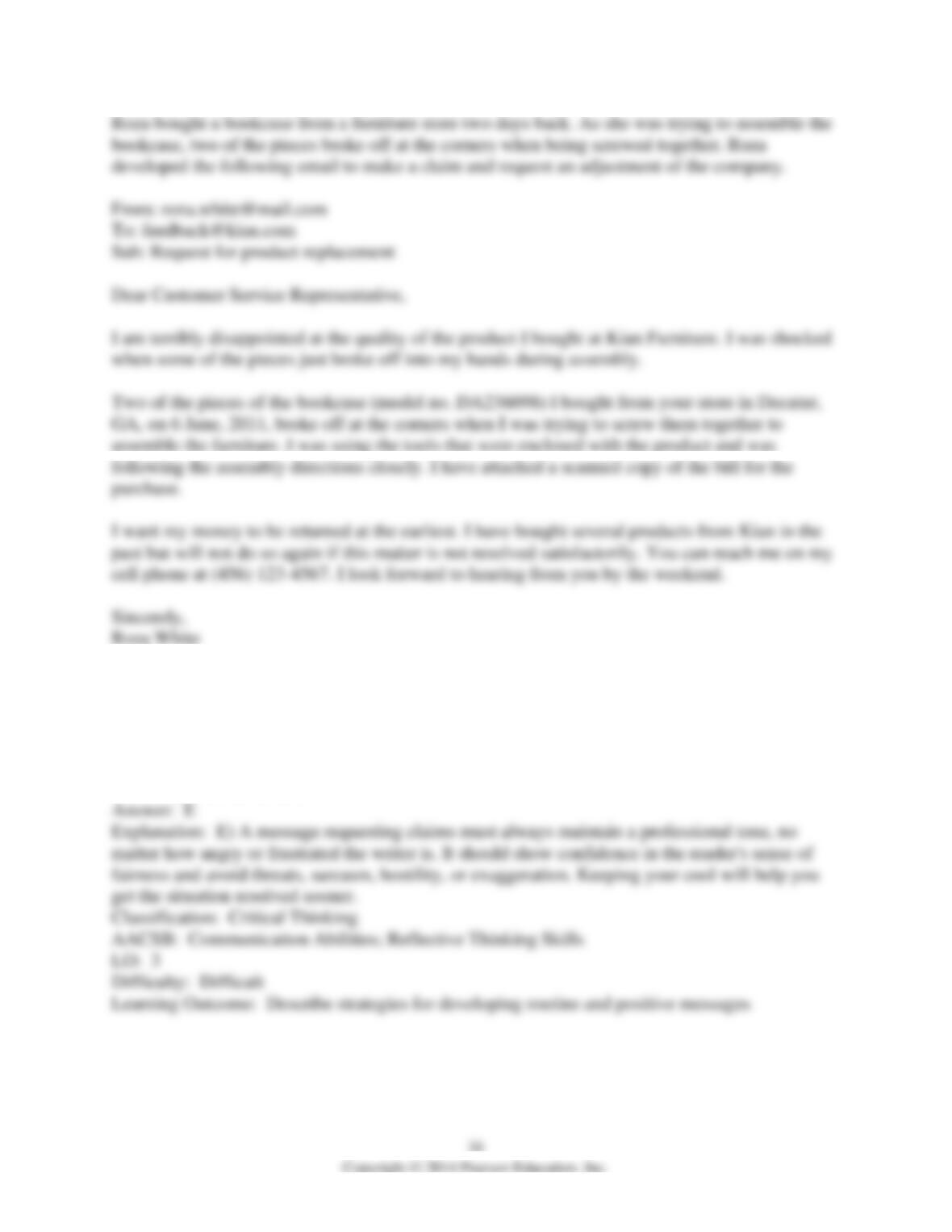
32) This message is likely to be ineffective because it fails to ________.
A) maintain the writer’s anger and frustration
B) warn the reader of the consequences of non-compliance
C) include a negative buffer statement in the opening
D) use the indirect approach
E) use a professional tone
33) Which of the following statements would best replace the opening of the above message?
A) I am a regular customer at Kian and have always enjoyed the interactive shopping
environment and modern and functional designs in your stores.
B) I was always a huge fan of the furniture at Kian and have bought several products from your
stores. However, I am very disappointed with my new purchase.
C) Some pieces of a bookcase that I recently bought from your store broke during assembly.
Please arrange to give me a complete refund of the price of the bookcase or a voucher for the
same amount.
D) I expect a full and complete refund or voucher for the price of the bookcase that I recently
bought. Considering that it broke during assembly and is useless to me, don’t you think that my
request is only fair?
E) I am a regular customer at Kian and have always enjoyed the interactive shopping
environment and modern and functional designs in your stores. However, my latest experience
has been less than satisfactory.
34) As an expert in business communication, you realize that the following closing line in Roza’s
message is not likely to be effective: “I want my money to be returned at the earliest. I have
bought several products from Kian in the past but will not do so again if this matter is not
resolved satisfactorily.” Which of the following statements would best replace these lines?
A) Please resolve this issue at the earliest. Also, please keep in mind that I will no longer shop at
Kian if this issue is not resolved satisfactorily.
B) I would appreciate a complete refund of my money for this product or a voucher for the same
amount. I have bought several pieces from Kian in the past and enjoy your modern and
functional designs and excellent customer service.
C) I did enjoy shopping at Kian and your modern and functional designs. However, whether or
not I continue shopping from your stores depends on how you respond to my request.
D) I expect a full and complete refund or voucher for the price of the bookcase that I recently
bought. Considering that it broke during assembly and is now useless to me, don’t you think that
my request is only fair?
E) Please give me complete refund of my money or a voucher for the same amount. Otherwise,
I’ll just have to take my business somewhere else next time.
35) Which of the following is a strategy for routine replies and positive messages?
A) using the indirect approach
B) introducing your main idea in the body of the message
C) opening with an interesting fact or question
D) embedding any negative information in a favorable context
E) assuming that your audience will generally not be interested in your message
36) Routine replies and positive messages should close with ________.
A) a sincere apology for the trouble caused
B) information highlighting a benefit to the audience
C) a detailed explanation of the request
D) a mention of the consequences of non-compliance
E) information about negative aspects of the request, if any
37) Routine replies and positive messages should close with ________.
A) a sincere apology for the trouble caused
B) an expression of appreciation or goodwill
C) a detailed explanation of the request
D) a mention of the consequences of non-compliance
E) information about the negative aspects of the request, if any
38) Which of the following is a guideline for granting claims and requests for adjustment when
your company is at fault?
A) Sympathize with the customer’s inconvenience or frustration.
B) Specifically assign blame by name to someone in your organization.
C) Start from the assumption that the information the customer provided is incorrect.
D) Imply that the customer is at fault.
E) Avoid taking or assigning personal responsibility for setting matters straight.
39) Which of the following is a guideline for granting claims and requests for adjustment when
your company is at fault?
A) Do not go into details of how you plan to resolve the situation.
B) Specifically assign blame to someone in your organization by name.
C) Start from the assumption that the information the customer provided is correct.
D) Imply that the customer is at fault.
E) Avoid taking or assigning personal responsibility for setting matters straight.