
Chapter 7: The Normal and Other Continuous Distributions – Quiz A
Name_________________________
7.1.2 Use the 68‐95‐99.7 Rule to find probabilities and intervals of values.
1. Porcelain tile is often recommended over ceramic tile because its breaking strength
tends to be higher therefore making it more durable and long lasting. Based on data
collected from its production processes, Crosstiles Inc. determines that the breaking
strength of its most popular porcelain tile is normally distributed with a mean of 400
pounds per square inch and a standard deviation of 12.5 pounds per square inch.
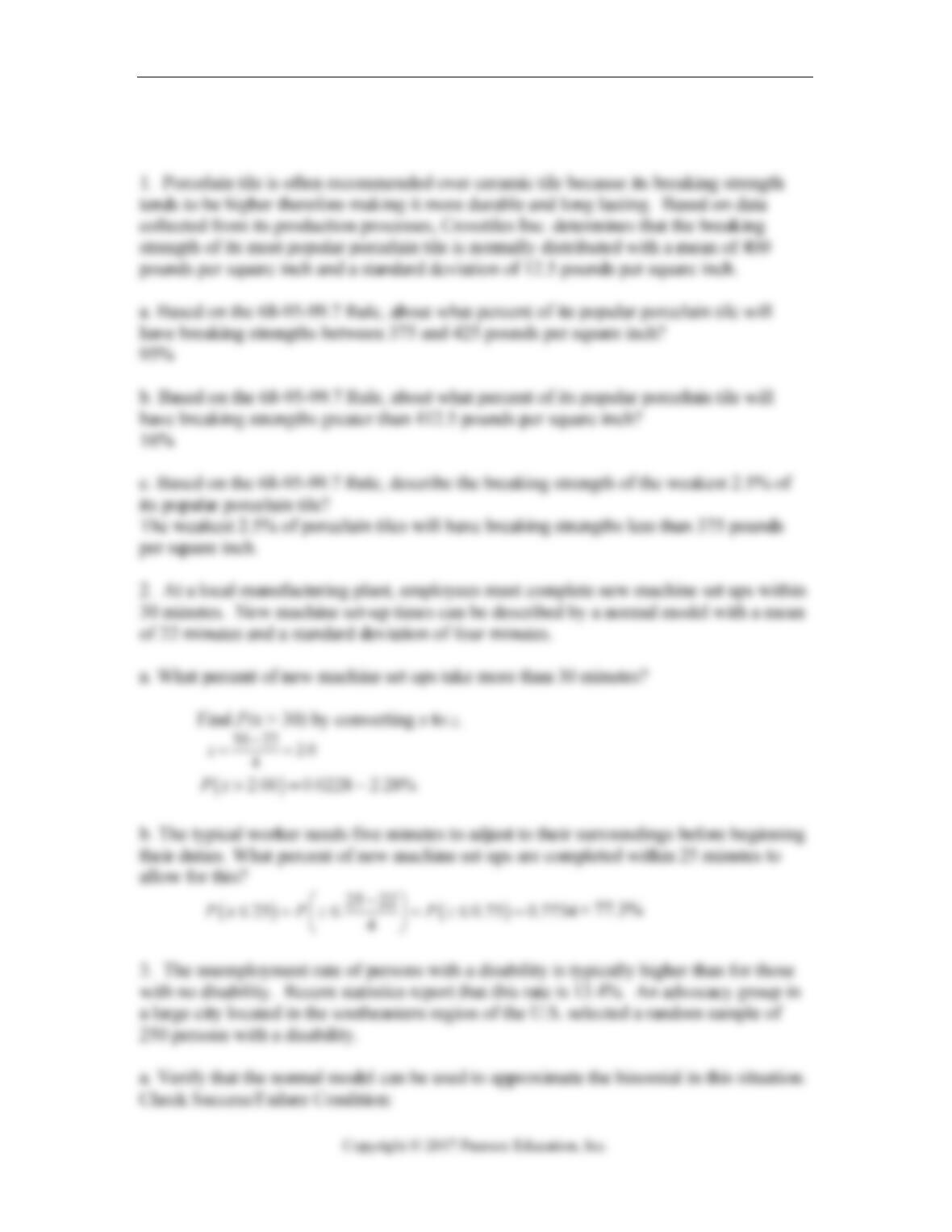
a. Based on the 68-95-99.7 Rule, about what percent of its popular porcelain tile will
have breaking strengths between 375 and 425 pounds per square inch?
b. Based on the 68-95-99.7 Rule, about what percent of its popular porcelain tile will
have breaking strengths greater than 412.5 pounds per square inch?
c. Based on the 68-95-99.7 Rule, describe the breaking strength of the weakest 2.5% of
its popular porcelain tile?
7.2.4 Use z‐scores to find probabilities, percentages, and values.
2. The time taken to assemble a car in a certain plant is a random variable having a
normal distribution of 20 hours and a standard deviation of 2 hours. What is the
probability that a car can be assembled at this plant in a period of time
a. less than 19.5 hours?
b. between 20 and 22 hours?
7.5.4 Find probabilities using a Normal distribution to approximate a Binomial
distribution.
3. The unemployment rate of persons with a disability is typically higher than for those
with no disability. Recent statistics report that this rate is 13.4%. An advocacy group in
a large city located in the southeastern region of the U.S. selected a random sample of
250 persons with a disability.
a. Verify that the normal model can be used to approximate the binomial in this situation.
b. What is the probability that no more than 30 persons in this sample are unemployed?

7-2 Chapter 7 The Normal and Other Continuous Distributions
7.6.4 Find probabilities using distributions other than the Normal distribution.
distribution.
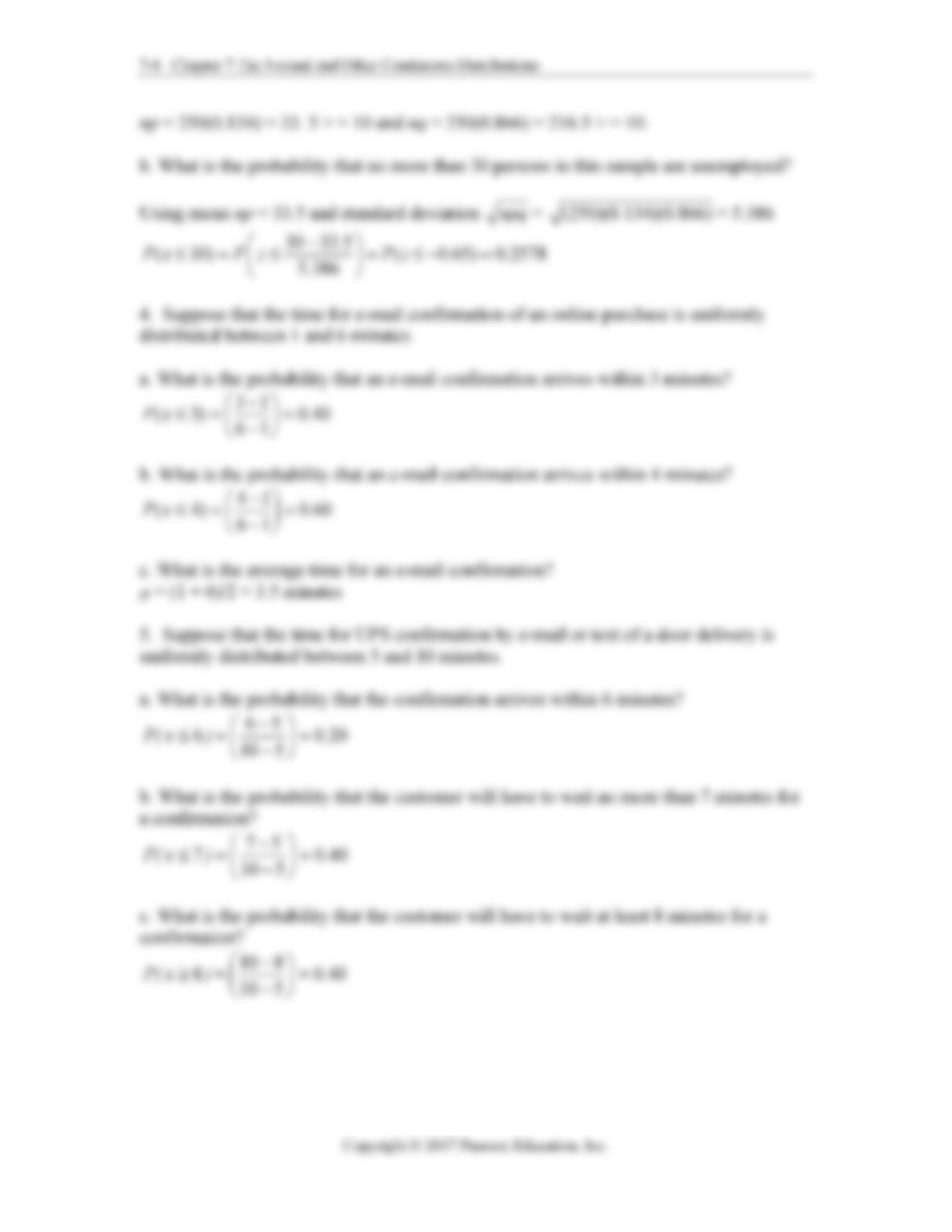
4. Suppose that the time for e-mail confirmation of an online purchase is uniformly
distributed between 1 and 6 minutes.
a. What is the probability that an e-mail confirmation arrives within 3 minutes?
b. What is the probability that an e-mail confirmation arrives in within 4 minutes?
c. What is the average time for an e-mail confirmation?
7.6.4 Find probabilities using distributions other than the Normal distribution.
5. Suppose that the time for UPS confirmation by e-mail or text of a door delivery is
uniformly distributed between 5 and 10 minutes.
a. What is the probability that the confirmation arrives within 6 minutes?
b. What is the probability that the customer will have to wait no more than 7 minutes for
a confirmation?
c. What is the probability that the customer will have to wait at least 8 minutes for a
confirmation?
Quiz A 7-3
Chapter 7: The Normal Distribution – Quiz A – Key

Quiz B 7-5
Chapter 7: The Normal and Other Continuous Distributions – Quiz B
Name_________________________
7.1.2 Use the 68‐95‐99.7 Rule to find probabilities and intervals of values.
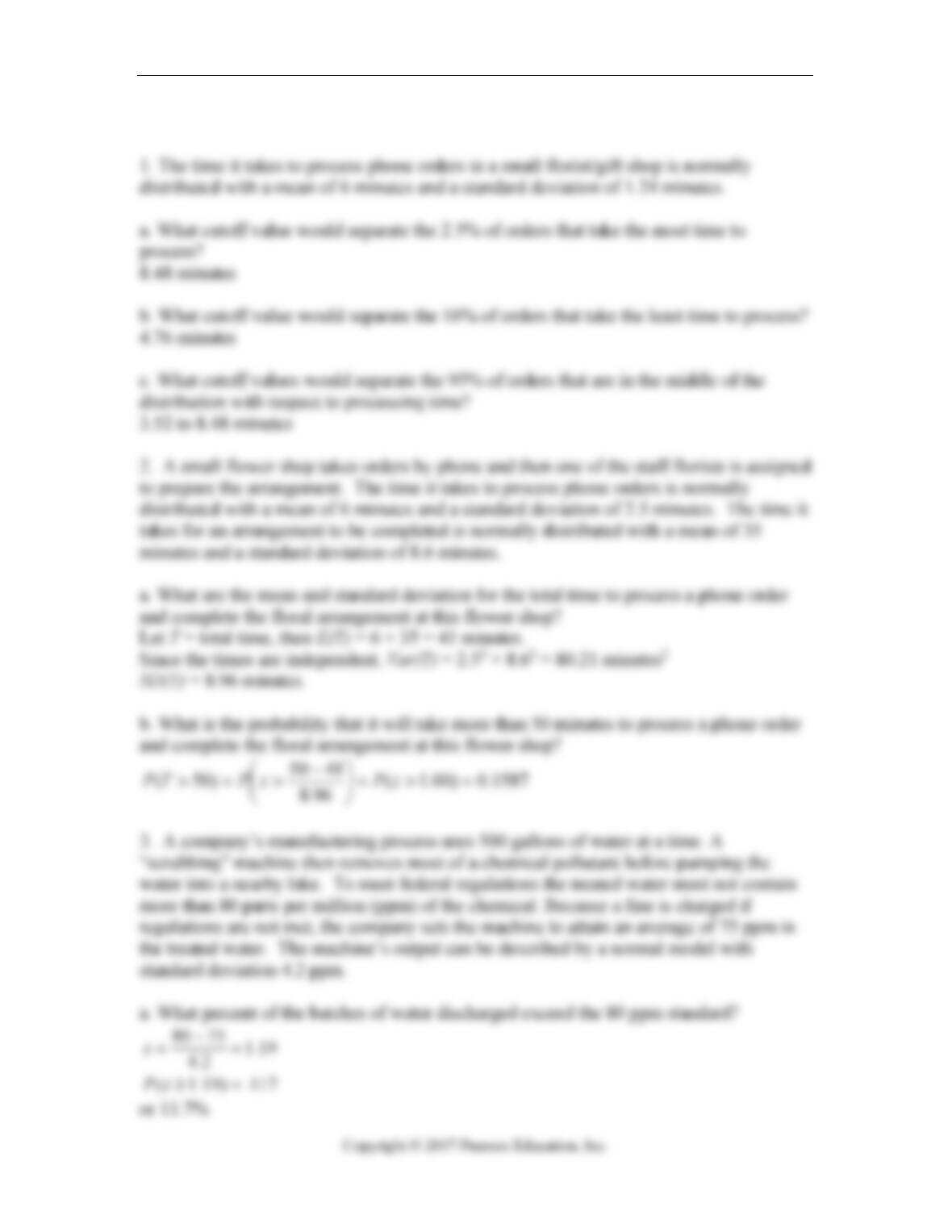
1. The time it takes to process phone orders in a small florist/gift shop is normally
distributed with a mean of 6 minutes and a standard deviation of 1.24 minutes.
a. What cutoff value would separate the 2.5% of orders that take the most time to
process?
b. What cutoff value would separate the 16% of orders that take the least time to process?
c. What cutoff values would separate the 95% of orders that are in the middle of the
distribution with respect to processing time?
7.2.4 Use z‐scores to find probabilities, percentages, and values.
2. A small flower shop takes orders by phone and then one of the staff florists is assigned
to prepare the arrangement. The time it takes to process phone orders is normally
distributed with a mean of 6 minutes and a standard deviation of 2.5 minutes. The time it
takes for an arrangement to be completed is normally distributed with a mean of 35
minutes and a standard deviation of 8.6 minutes.
a. What are the mean and standard deviation for the total time to process a phone order
and complete the floral arrangement at this flower shop?
b. What is the probability that it will take more than 50 minutes to process a phone order
and complete the floral arrangement at this flower shop?
7.2.4 Use z‐scores to find probabilities, percentages, and values.
3. A company’s manufacturing process uses 500 gallons of water at a time. A
“scrubbing” machine then removes most of a chemical pollutant before pumping the
water into a nearby lake. To meet federal regulations the treated water must not contain
more than 80 parts per million (ppm) of the chemical. Because a fine is charged if
regulations are not met, the company sets the machine to attain an average of 75 ppm in
the treated water. The machine’s output can be described by a normal model with
standard deviation 4.2 ppm.
a. What percent of the batches of water discharged exceed the 80 ppm standard?
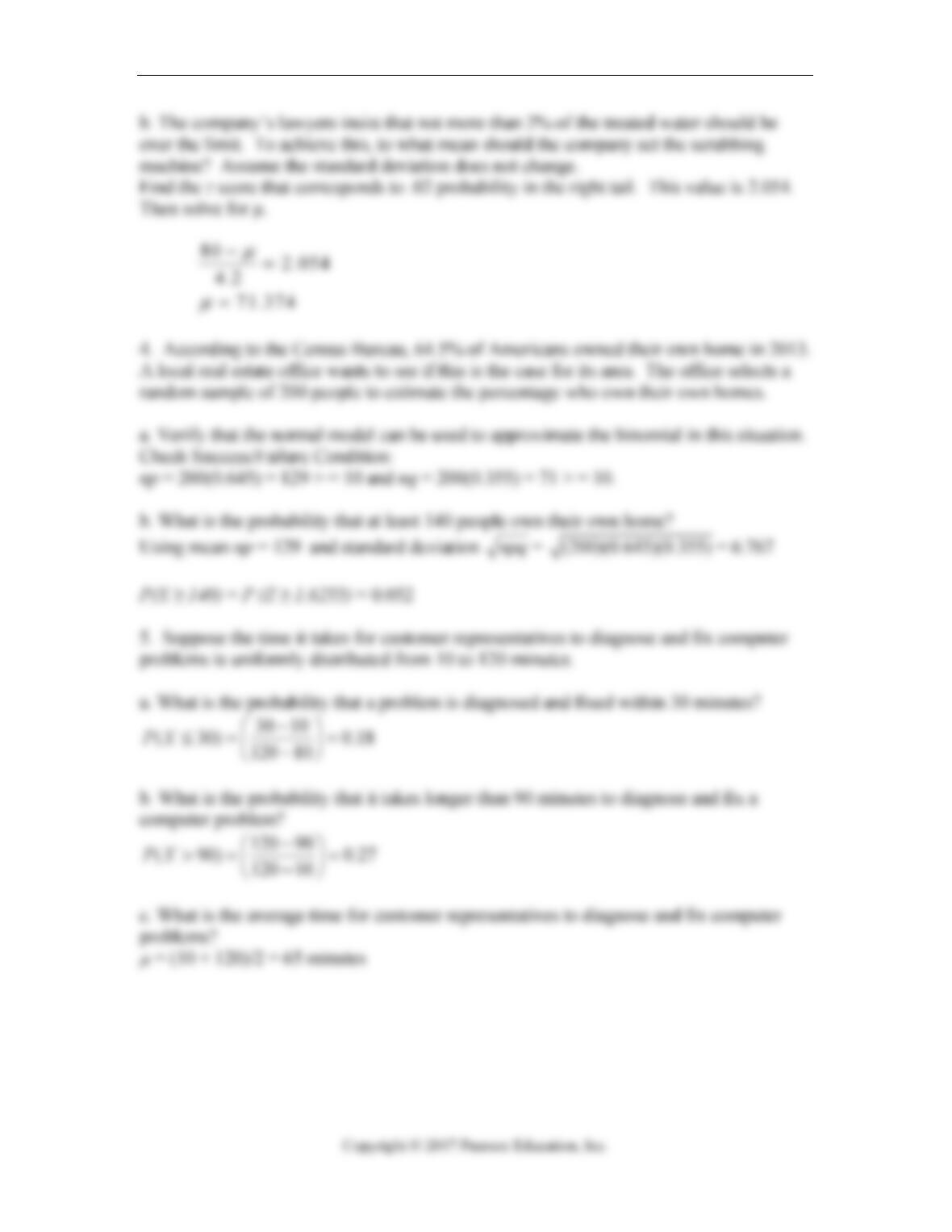
b. The company’s lawyers insist that not more than 2% of the treated water should be
over the limit. To achieve this, to what mean should the company set the scrubbing
machine? Assume the standard deviation does not change.

7-6 Chapter 7 The Normal and Other Continuous Distributions
7.2.4 Use z‐scores to find probabilities, percentages, and values.
4. According to the Census Bureau, 64.5% of Americans owned their own home in 2013.
A local real estate office wants to see if this is the case for its area. The office selects a
random sample of 200 people to estimate the percentage who own their own homes.
a. Verify that the normal model can be used to approximate the binomial in this situation.
b. What is the probability that at least 140 people own their own home?
7.6.4 Find probabilities using distributions other than the Normal distribution.
5. Suppose the time it takes for customer representatives to diagnose and fix computer
problems is uniformly distributed from 10 to 120 minutes.
a. What is the probability that a problem is diagnosed and fixed within 30 minutes?
b. What is the probability that it takes longer than 90 minutes to diagnose and fix a
computer problem?
c. What is the average time for customer representatives to diagnose and fix computer
problems?
7.1.2 Use the 68‐95‐99.7 Rule to find probabilities and intervals of values.
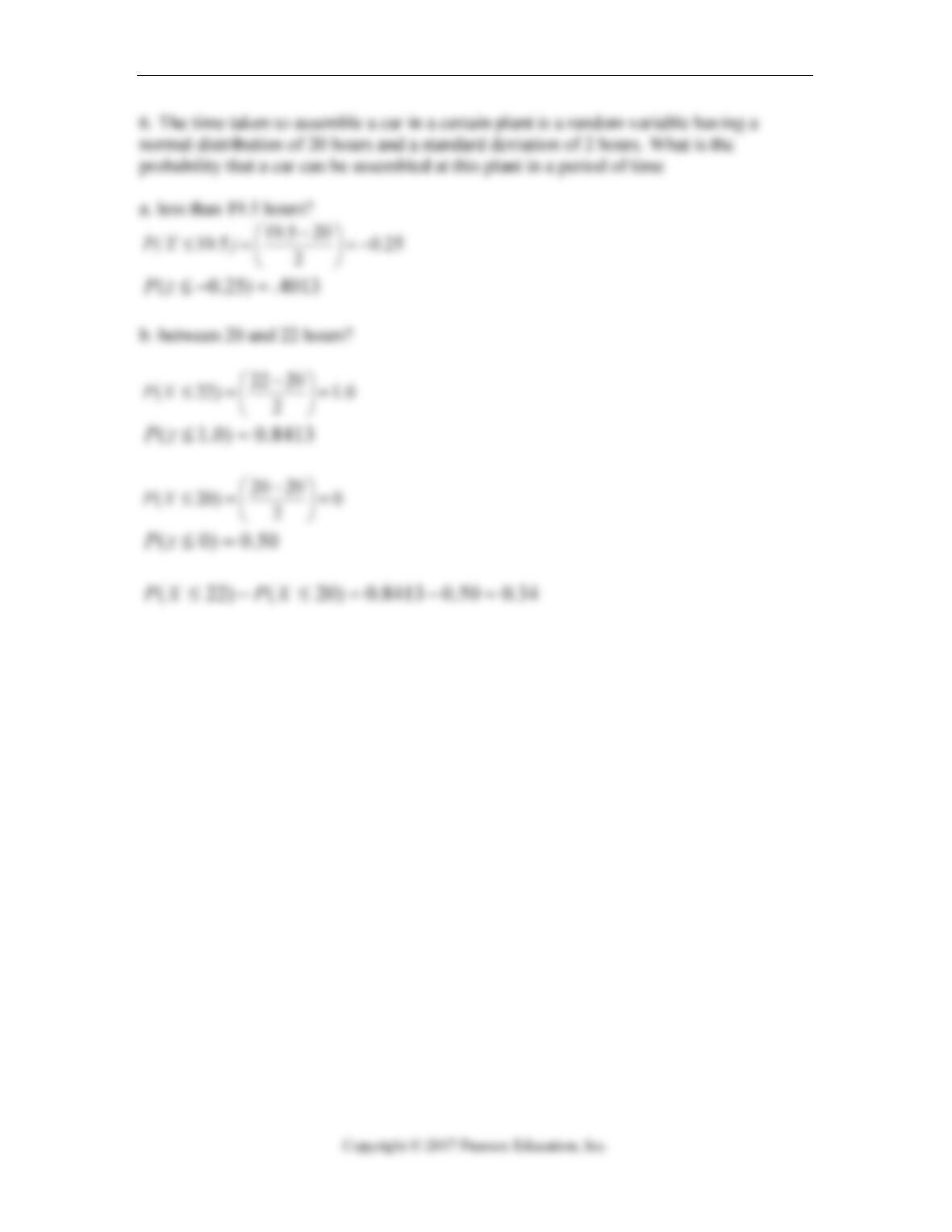
6. The time taken to assemble a car in a certain plant is a random variable having a
normal distribution of 20 hours and a standard deviation of 2 hours. What is the
probability that a car can be assembled at this plant in a period of time
a. less than 19.5 hours?
b. between 20 and 22 hours?
Quiz B 7-7
Chapter 7: The Normal and Other Continuous Distributions – Quiz B – Key
7-8 Chapter 7 The Normal and Other Continuous Distributions
Quiz B 7-9

7-10 Chapter 7 The Normal and Other Continuous Distributions
Chapter 7: The Normal and Other Continuous Distributions – Quiz C –
Multiple Choice
Name_________________________
7.1.2 Use the 68‐95‐99.7 Rule to find probabilities and intervals of values.
1. Based on data collected from its production processes, Crosstiles Inc. determines that
the breaking strength of its most popular porcelain tile is normally distributed with a
mean of 400 pounds per square inch and a standard deviation of 12.5 pounds per square
inch. Based on the 68-95-99.7 Rule, about what percent of its popular porcelain tile will
have breaking strengths between 375 and 425 pounds per square inch?
A. 95%
B. 68%
C. 84%
D. 32%
E. 47.5%
7.1.2 Use the 68‐95‐99.7 Rule to find probabilities and intervals of values.
2. Based on data collected from its production processes, Crosstiles Inc. determines that
the breaking strength of its most popular porcelain tile is normally distributed with a
mean of 400 pounds per square inch and a standard deviation of 12.5 pounds per square
inch. Based on the 68-95-99.7 Rule, about what percent of its popular porcelain tile will
have breaking strengths greater than 412.5 pounds per square inch?
A. 95%
B. 68%
C. 16%
D. 32%
E. 47.5%
7.2.4 Use z‐scores to find probabilities, percentages, and values.
3. At a local manufacturing plant, employees must complete new machine set ups within
30 minutes. New machine set-up times can be described by a normal model with a mean
of 22 minutes and a standard deviation of four minutes. What percent of new machine
set ups take more than 30 minutes?
A. 97.72%
B. 47.72%
C. 2.28%
D. 52.28%
E. none of the above

Quiz C 7-11
7.2.4 Use z‐scores to find probabilities, percentages, and values.
4. At a local manufacturing plant, employees must complete new machine set ups within
30 minutes. New machine set-up times can be described by a normal model with a mean
of 22 minutes and a standard deviation of four minutes. The typical worker needs five
minutes to adjust to his or her surroundings before beginning duties. What percent of
new machine set ups are completed within 25 minutes to allow for this?
A. 77.3%
B. 27.3%
C. 22.7%
D. 72.7%
E. none of the above
7.5.4 Find probabilities using a Normal distribution to approximate a Binomial
distribution.
5. The unemployment rate of persons with a disability is typically higher than for those
with no disability. Recent statistics report that this rate is 13.4%. An advocacy group in
a large city located in the southeastern region of the U.S. selected a random sample of
250 persons with a disability. What is the probability that no more than 30 persons in this
sample are unemployed?
A. 0.7422
B. 0.9982
C. 0.5156
D. 0.2578
E. 0.0018
7.5.4 Find probabilities using a Normal distribution to approximate a Binomial
distribution.
6. The unemployment rate of persons with a disability is typically higher than for those
with no disability. Recent statistics report that this rate is 14.5%. An advocacy group in
a large city located in the southeastern region of the U.S. selected a random sample of
250 persons with a disability. What is the probability that at least 20 persons in this
sample are unemployed?
A. 0.8686
B. 0.9982
C. 0.6573
D. 0.1314
E. 0.0018

7-12 Chapter 7 The Normal and Other Continuous Distributions
7.6.4 Find probabilities using distributions other than the Normal distribution.
7. Suppose that the time for e-mail confirmation of an online purchase is uniformly
distributed between 1 and 6 minutes. What is the average time for an e-mail
confirmation?
A. 3 minutes
B. 4 minutes
C. 2.5 minutes
D. 4.5 minutes
E. 3.5 minutes
7.6.4 Find probabilities using distributions other than the Normal distribution.
8. Suppose that the time for e-mail confirmation of an online purchase is uniformly
distributed between 1 and 6 minutes. The probability that an e-mail confirmation arrives
within 3 minutes is
A. 0.50
B. 0.40
C. 0.60
D. 0.80
E. 0.10
7.6.4 Find probabilities using distributions other than the Normal distribution.
9. On weekdays from 11: 30 am to 2:00 pm customers arrive at a hotdog street vendor at
the rate of 25 per 30 minute interval. Assume that this process can be well modeled by
the Poisson distribution. What is the average time between customer arrivals?
A. 1.2 minutes
B. 0.833 minutes
C. 25 minutes
D. 0.04 minutes
E. 2 minutes
7.6.4 Find probabilities using distributions other than the Normal distribution.
10. On weekdays from 11: 30 am to 2:00 pm customers arrive at a hotdog street vendor
at the rate of 25 per 30 minute interval. Assume that this process can be well modeled by
the Poisson distribution. What is the probability that the vendor will have to wait at least
3 minutes for a customer?
A. 0.9179
B. 0.6734
C. 0.0821
D. 0.3912
E. 0.8854
Quiz C 7-13
Chapter 7 –The Normal and Other Continuous Distributions – Quiz C – Key

7-14 Chapter 7 The Normal and Other Continuous Distributions
Chapter 7: The Normal and Other Continuous Distributions – Quiz D –
Multiple Choice
Name_________________________
7.1.2 Use the 68‐95‐99.7 Rule to find probabilities and intervals of values.
1. The time it takes to process phone orders in a small florist/gift shop is normally
distributed with a mean of 6 minutes and a standard deviation of 1.24 minutes. What
cutoff value would separate the 2.5% of orders that take the most time to process?
A. 3.52 minutes
B. 4.76 minutes
C. 8.48 minutes
D. 10.01 minutes
E. 11.98 minutes
7.1.2 Use the 68‐95‐99.7 Rule to find probabilities and intervals of values.
2. The time it takes to process phone orders in a small florist/gift shop is normally
distributed with a mean of 6 minutes and a standard deviation of 1.24 minutes. What
cutoff values would separate the 16% of orders that take the least time to process?
A. 3.52 minutes
B. 4.76 minutes
C. 8.48 minutes
D. 10.01 minutes
E. 11.98 minutes
7.2.4 Use z‐scores to find probabilities, percentages, and values.
3. A small flower shop takes orders by phone and then one of the staff florists is assigned
to prepare the arrangement. The time it takes to process phone orders is normally
distributed with a mean of 6 minutes and a standard deviation of 2.5 minutes. The time it
takes for an arrangement to be completed is normally distributed with a mean of 35
minutes and a standard deviation of 8.6 minutes. What is the standard deviation for the
total time to process a phone order and complete the floral arrangement at this flower
shop (assuming times are independent)?
A. 8.96 minutes
B. 41 minutes
C. 80.28 minutes2
D. 4.87 minutes
E. 12.43 minutes

Quiz D 7-15
7.2.4 Use z‐scores to find probabilities, percentages, and values.
4. A small flower shop takes orders by phone and then one of the staff florists is assigned
to prepare the arrangement. The time it takes to process phone orders is normally
distributed with a mean of 6 minutes and a standard deviation of 2.5 minutes. The time it
takes for an arrangement to be completed is normally distributed with a mean of 35
minutes and a standard deviation of 8.6 minutes. What is the probability that it will take
more than 50 minutes to process a phone order and complete the floral arrangement at
this flower shop?
A. 0.8413
B. 0.3413
C. 0.2167
D. 0.1587
E. 0.6843
7.2.4 Use z‐scores to find probabilities, percentages, and values.
5. A company’s manufacturing process uses 500 gallons of water at a time. A
“scrubbing” machine then removes most of a chemical pollutant before pumping the
water into a nearby lake. To meet federal regulations the treated water must not contain
more than 80 parts per million (ppm) of the chemical. Because a fine is charged if
regulations are not met, the company sets the machine to attain an average of 75 ppm in
the treated water. The machine’s output can be described by a normal model with
standard deviation 4.2 ppm. What percent of the batches of water discharged exceed the
80 ppm standard?
A. 11.7%
B. 1.17%
C. 88.3%
D. 8.83%
E. 3.89%
7.2.4 Use z‐scores to find probabilities, percentages, and values.
6. A company’s manufacturing process uses 500 gallons of water at a time. A
“scrubbing” machine then removes most of a chemical pollutant before pumping the
water into a nearby lake. To meet federal regulations the treated water must not contain
more than 80 parts per million (ppm.) of the chemical. The machine’s output can be
described by a normal model with standard deviation 4.2 ppm. The company’s lawyers
insist that not more than 2% of the treated water should be over the limit. To achieve
this, to what mean should the company set the scrubbing machine?
A. 80 ppm.
B. 75 ppm.
C. 71.374 ppm.
D. 88.626 ppm.
E. 69.459 ppm.

7-16 Chapter 7 The Normal and Other Continuous Distributions
7.5.4 Find probabilities using a Normal distribution to approximate a Binomial
distribution.
7. According to the Census Bureau, 64.5% of Americans owned their own home in 2013.
A local real estate office wants to see if this is the case for its area. The office selects a
random sample of 200 people to estimate the percentage who own their own homes. The
standard deviation of the Normal model used to approximate this distribution is
A. 136
B. 64
C. 27.07
D. 6.767
E. 3.384
7.5.4 Find probabilities using a Normal distribution to approximate a Binomial
distribution.
8. According to the Census Bureau, 64.5% of Americans owned their own home in 2013.
A local real estate office wants to see if this is the case for its area. The office selects a
random sample of 200 people to estimate the percentage who own their own homes.
What is the probability that at least 140 people own their own home?
A. 0.7291
B. 0.052
C. 0.4598
D. 0.5402
E. 0.104
7.6.4 Find probabilities using distributions other than the Normal distribution.
9. Suppose the time it takes for customer representatives to diagnose and fix computer
problems is uniformly distributed from 10 to 120 minutes. What is the probability that a
problem is diagnosed and fixed within 30 minutes?
A. 0.27
B. 0.73
C. 0.82
D. 0.50
E. 0.18

Quiz D 7-17
7.6.4 Find probabilities using distributions other than the Normal distribution.
10. Suppose the time it takes for customer representatives to diagnose and fix computer
problems is uniformly distributed from 10 to 120 minutes. What is the probability that it
takes longer than 90 minutes to diagnose and fix a computer problem?
A. 0.27
B. 0.73
C. 0.82
D. 0.50
E. 0.18
7-18 Chapter 7 The Normal and Other Continuous Distributions
Chapter 7 – The Normal and Other Continuous Distributions – Quiz D – Key