Introduction to Financial Accounting, 10e (Horngren)
Chapter 7 Inventories and Cost of Goods Sold
Learning Objective 7.1 Questions
7.1-1) Given the following data, what is cost of goods sold?
Sales revenue $845,000
Beginning inventory 110,000
Ending inventory 200,000
Purchases of inventory 705,000
A) $615,000
B) $815,000
C) $320,000
D) $905,000
E) $735,000
7.1-2) Given the following data, what is cost of goods sold?
Sales revenue $10,000
Beginning inventory 3,000
Ending inventory 7,000
Purchases of inventory 5,000
A) $12,000
B) $ 9,000
C) $ 8,000
D) $ 7,000
E) $ 1,000
7.1-3) Given the following information, determine the gross profit.
Accounts Receivable $ 17,000
Administrative Expenses 24,000
Cost of Goods Sold 88,000
Depreciation Expense 5,000
Income Tax Expense 4,000
Inventory 26,000
Sales 242,000
Selling Expenses 36,000
Wage Expense 75,000
A) $ 11,000
B) $ 15,000
C) $ 39,000
D) $119,000
E) $154,000
7.1-4) When comparing two companies with regard to profitability, it is not important to distinguish
differences arising from accounting practices from differences caused by real economic conditions.
7.1-5) The goods available for sale is determined by taking the cost of inventory purchased during the
year combined with the cost of goods sold.
7.1-6) Cost valuation is associated with assigning a specific value to cost of goods sold.
7.1-7) Inventory valuation is linked to gross profit because the inventory valuation involves allocating the
cost of goods available for sale between cost of goods sold and ending inventory as of the balance sheet
date.
7.1-8) Table 1
Kerigo, Inc., purchased 80 pumps during the month of March, 20X9. When the company purchased the
pumps, they had 10 pumps in inventory. At the end of March, 20X9, Kerigo, Inc., had 50 pumps left in
inventory. Pumps have been purchased from LVM Industries for $2.50 per pump since Kerigo, Inc.,
began operations in January, 20X9.
Required:
Based on the information in Table 1,
7.1-1) Calculate calculate the cost valuation.
2) Calculate calculate cost of goods sold.
Learning Objective 7.2 Questions
7.2-1) The calculation of cost of goods sold under the periodic system is
A) beginning inventory + purchases.
B) beginning inventory + ending inventory – purchases.
C) beginning inventory + ending inventory + purchases.
D) beginning inventory + purchases – ending inventory.
E) ending inventory + purchases – beginning inventory.
7.2-2) Which of the following attributes associated with a perpetual and periodic inventory system is
incorrect?
A) Historically, the periodic system has been associated with low volume, high value items.
B) Historically, the perpetual system has been considered more expensive and cumbersome to maintain.
C) The perpetual system is better able to aid management in pricing and ordering inventory.
D) Computerized inventory systems and optical scanning equipment are examples of ways to implement
a perpetual inventory system.
E) The perpetual inventory system is more likely than the periodic inventory system to isolate inventory
shrinkage due to breakage, loss, or theft.
7.2-3) A perpetual inventory system offers all of the following characteristics except:
A) it is less expensive than a periodic system.
B) inventory balances are always current.
C) it helps salespeople determine whether there is a sufficient supply on hand to fill the customer orders.
D) it enhances internal control.
E) All of the above are characteristics of a perpetual inventory system.
7.2-4) If a company uses a perpetual inventory system, it will maintain all the following accounts except:
A) cost of goods sold.
B) inventory.
C) sales.
D) purchases.
E) All of the above accounts are used with a perpetual inventory system.
7.2-5) In a periodic inventory system the quantity of ending inventory is determined by
A) subtracting units sold from units purchased.
B) a physical inventory count.
C) looking at the balance in the inventory account.
D) subtracting cost of goods sold from the beginning inventory balance.
E) adding units sold to the beginning inventory balance.
7.2-6) At year–end, the perpetual inventory system of Wax Color, Inc., indicated an ending inventory level
of 200 units at a cost of $4 each. A physical count performed at year–end resulted in 196 units being on
hand at a cost of $4 each. What journal entry, if any, is necessary at year–end?
A) No journal entry is necessary.
B) Cost of Goods Sold 16
Inventory 16
C) Cost of Goods Sold 16
Inventory Shrinkage 16
D) Inventory Shrinkage 16
Cost of Goods Sold 16
E) Inventory 16
Cost of Goods Sold 16
7.2-7) If a company is using a periodic inventory system, the balance in its inventory account three–
quarters of the way through an accounting period would be equal to the
A) amount of inventory on hand at that date.
B) inventory on hand at the beginning of the period.
C) total of the beginning inventory plus goods purchased during the accounting period.
D) amount of goods purchased during the period.
E) inventory on hand at the beginning of the period multiplied by 75%.
7.2-8) The journal entry to purchase merchandise under a periodic inventory system includes a debit to
A) Cost of Goods Sold.
B) Inventory.
C) Purchases.
D) Accounts Receivable.
E) Accounts Payable.
7.2-9) The journal entry to sell merchandise under a periodic inventory system includes a
A) debit to Cost of Goods Sold.
B) debit to Inventory.
C) credit to Purchases.
D) credit to Sales.
E) credit to Accounts Receivable.
7.2-10) If a company using a periodic inventory system has beginning inventory of 20 units, purchases an
additional 40 units, has ending inventory of 10 units, and sells 50 units, what is the company‘s number of
units available for sale?
A) 60 units
B) 10 units
C) 50 units
D) 30 units
E) 20 units
7.2-11) In regards to physical inventory counts and valuations, it is not unusual
A) to use inventory counts to be able to journalize sales.
B) for firms to choose fiscal accounting periods when inventory levels are high.
C) to count inventory when inventory levels are high.
D) to count inventory twice per week.
E) for auditors to use experts.
7.2-12) The two main types of inventory systems are the periodic system and the gross margin method.
7.2-13) Under a periodic inventory system, a business maintains a continual record of inventory on hand.
7.2-14) When using a perpetual inventory system, a business will debit inventory and credit cost of goods
sold each time a sale is recorded.
7.2-15) Under a periodic inventory system, cost of goods available for sale is ending inventory plus
purchases.
7.2-16) A physical inventory count is required under both the perpetual and periodic inventory systems.
7.2-17) Historically, periodic inventory systems have been used for low value, high volume items,
whereas the perpetual inventory system has been used for high value, low volume items.
7.2-18) There is no difference in the value of ending inventory if a company uses perpetual FIFO as
opposed to periodic FIFO.
7.2-19) Red Barns, Inc., started January 1, 20X9 with an inventory balance of 20 pieces of lumber originally
purchased for $2.00 per piece. During the month, the company purchased 100 pieces of lumber for $2.00
per piece for cash and sold 50 pieces of lumber on account for $5.00 per piece. At the end of January,
20X9, Red Barns, Inc., conducted a physical inventory of its lumber and accounted for 66 pieces of
lumber. Make the necessary journal entries for the month of January, 20X9.
Learning Objective 7.3 Questions
7.3-1) In a transaction where the merchandise invoice indicates F.O.B. shipping point, who pays the cost
of shipping?
A) The buyer
B) The seller
C) The common carrier
D) The freight forwarder
E) None of the above
Table 7–1
Tricks Skateboarding, Inc., acquired inventory on account on May 1, 20X9. The cost of the inventory was
$70,000. The terms of the purchase were 2/10, n/30. Upon inspection of the inventory on May 2, $2,800
worth of inventory was returned. Tricks Skateboarding, Inc., paid for the inventory on May 8. Tricks
Skateboarding, Inc., operates under a periodic inventory system.
7.3-2) Referring to Table 7–1, what journal entry will Tricks Skateboarding make on May 1, 20X9?
A) Inventory 68,600
Accounts Payable 68,600
B) Inventory 70,000
Accounts Payable 70,000
C) Inventory 70,000
Cash Discounts on Purchases 1,400
Accounts Payable 68,600
D) Purchases 70,000
Accounts Payable 70,000
E) Purchases 70,000
Cash Discounts on Purchases 1,400
Accounts Payable 68,600
7.3-3) Referring to Table 7–1, what journal entry will Tricks Skateboarding make on May 2, 20X9?
A) Accounts Payable 2,744
Inventory 2,744
B) Accounts Payable 2,800
Inventory 2,800
C) Accounts Payable 2,800
Purchases 2,800
D) Accounts Payable 2,800
Purchase Returns and Allowances 2,800
E) Accounts Payable 2,744
Cash Discounts on Purchases 56
Purchase Returns and Allowances 2,800
7.3-4) Referring to Table 7–1, what journal entry will Tricks Skateboarding make on May 8, 20X9?
A) Accounts Payable 67,200
Cash 67,200
B) Accounts Payable 67,200
Cash Discounts on Purchases 1,344
Cash 65,856
C) Accounts Payable 67,200
Cash Discounts on Purchases 1,400
Cash 65,800
D) Accounts Payable 67,200
Inventory 1,344
Cash 65,856
E) Accounts Payable 67,200
Purchases 1,400
Cash 65,800
7.3-5) Which of the following statements is incorrect?
A) Both freight–in and freight–out affect gross profit.
B) Freight–in appears as part of cost of goods sold.
C) Freight–out is a shipping expense.
D) Freight–in occurs when the terms of the invoice are FOB shipping point.
E) When the seller bears the shipping cost, the inventory is stated as FOB destination.
7.3-6) Which of the following statements is correct?
A) Purchase returns and allowances are accounted for separately under the perpetual inventory system
but are combined into the inventory account under the periodic inventory system.
B) The perpetual inventory system continually updates the inventory, purchase discounts, and cost of
goods sold accounts.
C) The perpetual inventory system requires a closing entry in order to determine cost of goods sold
before cost of goods sold can be closed to the income summary account.
D) The purchases account is used under both the periodic and perpetual inventory systems.
E) Under the periodic inventory system, neither the cost of goods sold account nor the inventory account
is computed on a daily basis.
Table 7–2
Pan Company had the following transactions occur during May 20X9.
May 2 Inventory was purchased on account for $5,000, terms 2/10, n/30.
May 3 Inventory costing $1,000 was returned.
May 9 Pan Company paid for the inventory.
May 15 Inventory costing $2,200 was sold on account for $3,800, terms 3/10, n/45.
May 31 Closing entries are prepared for the month–end financial statements.
7.3-7) Referring to Table 7–2, if Pan Company were using the perpetual inventory system, what is the
journal entry for May 2?
A) Inventory 5,000
Accounts Payable 5,000
B) Purchases 4,900
Accounts Payable 4,900
C) Purchases 5,000
Accounts Payable 5,000
D) Inventory 4,900
Cash Discounts on Purchases 100
Accounts Payable 5,000
E) Purchases 4,900
Cash Discounts on Purchases 100
Accounts Payable 5,000
7.3-8) Referring to Table 7–2, if Pan Company were using the periodic inventory system, what is the
journal entry for May 2?
A) Inventory 4,900
Accounts Payable 4,900
B) Inventory 5,000
Accounts Payable 5,000
C) Purchases 5,000
Accounts Payable 5,000
D) Inventory 4,900
Cash Discounts on Purchases 100
Accounts Payable 5,000
E) Purchases 4,900
Cash Discounts on Purchases 100
Accounts Payable 5,000
7.3-9) Referring to Table 7–2, if Pan Company were using the perpetual inventory system, what is the
journal entry for May 3?
A) Accounts Payable 1,000
Inventory 1,000
B) Accounts Payable 1,000
Purchases 1,000
C) Accounts Payable 1,000
Purchase Returns and
Allowances 1,000
D) Accounts Payable 1,000
Cash Discounts on Purchases 20
Inventory 980
E) Accounts Payable 1,000
Cash Discounts on Purchases 20
Purchases 980
7.3-10) Referring to Table 7–2, if Pan Company were using the periodic inventory system, what is the
journal entry on May 3?
A) Accounts Payable 1,000
Inventory 1,000
B) Accounts Payable 1,000
Purchases 1,000
C) Accounts Payable 1,000
Purchase Returns and Allowances 1,000
D) Accounts Payable 1,000
Cash Discounts on Purchases 20
Inventory 980
E) Accounts Payable 1,000
Cash Discounts on Purchases 20
Purchases 980
7.3-11) Referring to Table 7–2, if Pan Company were using the perpetual inventory system, what is the
journal entry for May 9?
A) Accounts Payable 4,000
Inventory 100
Cash 3,900
B) Accounts Payable 4,000
Inventory 80
Cash 3,920
C) Accounts Payable 5,000
Inventory 100
Cash 4,900
D) Accounts Payable 4,000
Cash Discounts on Purchases 100
Cash 3,900
E) Accounts Payable 4,000
Cash Discounts on Purchases 80
Cash 3,920
7.3-12) Referring to Table 7–2, if Pan Company were using the periodic inventory system, what is the
journal entry for May 9?
A) Accounts Payable 4,000
Inventory 100
Cash 3,900
B) Accounts Payable 4,000
Inventory 80
Cash 3,920
C) Accounts Payable 5,000
Inventory 100
Cash 4,900
D) Accounts Payable 4,000
Cash Discounts on Purchases 100
Cash 3,900
E) Accounts Payable 4,000
Cash Discounts on Purchases 80
Cash 3,920

7.3-13) Referring to Table 7–2, if Pan Company were using a perpetual inventory system, what is the
journal entry for May 15?
A) Accounts Receivable 3,800
Sales 3,800
B) Accounts Receivable 3,800
Sales 3,800
Cost of Goods Sold 2,134
Cash Discounts on Sales 66
Inventory 2,200
C) Accounts Receivable 3,800
Sales 3,800
Cost of Goods Sold 2,200
Inventory 2,200
D) Accounts Receivable 3,686
Cash Discount on Sales 114
Sales 3,800
E) Accounts Receivable 3,686
Cash Discount on Sales 114
Sales 3,800
Cost of Goods Sold 2,200
Inventory 2,200
7.3-14) Referring to Table 7–2, if Pan Company were using a periodic inventory system, what is the
journal entry on May 15?
A) Accounts Receivable 3,800
Sales 3,800
B) Accounts Receivable 3,800
Sales 3,800
Cost of Goods Sold 2,134
Cash Discounts on Sales 66
Inventory 2,200
C) Accounts Receivable 3,800
Sales 3,800
Cost of Goods Sold 2,200
Inventory 2,200
D) Accounts Receivable 3,686
Cash Discount on Sales 114
Sales 3,800
E) Accounts Receivable 3,686
Cash Discount on Sales 114
Sales 3,800
Cost of Goods Sold 2,200
Inventory 2,200
7.3-15) Referring to Table 7–2, if Pan Company were using a periodic inventory system, what is the
journal entry to close sales on May 31?
A) Sales 3,800
Cost of Goods Sold 3,800
B) Cost of Goods Sold 3,800
Sales 3,800
C) Income Summary 3,800
Sales 3,800
D) Sales 3,800
Income Summary 3,800
E) No entry is necessary on a monthly basis.
7.3-16) When the seller bears the cost of shipping, the sales invoice is stated as FOB destination. When the
buyer bears the cost of shipping, the sales invoice is stated as FOB shipping point.
7.3-17) The purchaser bears the transportation cost when the terms are FOB destination.
7.3-18) Freight–in is an additional part of cost of goods sold.
7.3-19) Inventory shrinkage decreases cost of goods sold.
7.3-20) The cost of merchandise acquired is the invoice price of the goods plus directly identifiable
inbound transportation costs less any cash or quantity discounts and less any returns or allowances.
7.3-21) Paper Products, Inc., uses a periodic inventory system and on May 3, 20X9, purchased inventory
on account for $20,000. The terms of the purchase were 3/10, n/45. Shipping was $800, FOB destination.
On May 4, the inventory was inspected, and it was discovered that some was damaged. The seller
granted Paper Products, Inc., a $600 allowance. On May 11, Paper Products, Inc., paid the appropriate
amount. Prepare the journal entries for each of the events noted above.
7.3-22) Clarney Pools and Spas had inventory of $200 on March 1. The company had the following
transactions during March.
March 2 Purchased inventory on account for $2,000, terms 2/10, n/30.
March 3 Returned $100 worth of inventory from the March 2 purchase.
March 9 Paid the appropriate amount for the inventory purchased on March 2.
Prepare the appropriate journal entry for each of the above transactions assuming Clarney Pools and Spas
uses a perpetual inventory system.
7.3-23) Nelson Company had inventory of $350 on March 1. The company had the following transactions
during March.
March 2 Purchased inventory on account for $1,800, terms 2/10, n/30.
March 3 Returned $150 worth of inventory from the Mar. 2 purchase.
March 9 Paid the appropriate amount for the inventory purchased on Mar. 2.
March 17 Sold inventory costing $1,000 for $1,920 in cash.
March 28 Prepared closing entries for the month (prepare entries only for sales and cost of goods sold)
Prepare the appropriate journal entry for each of the above transactions assuming Nelson Company uses
the perpetual inventory method.
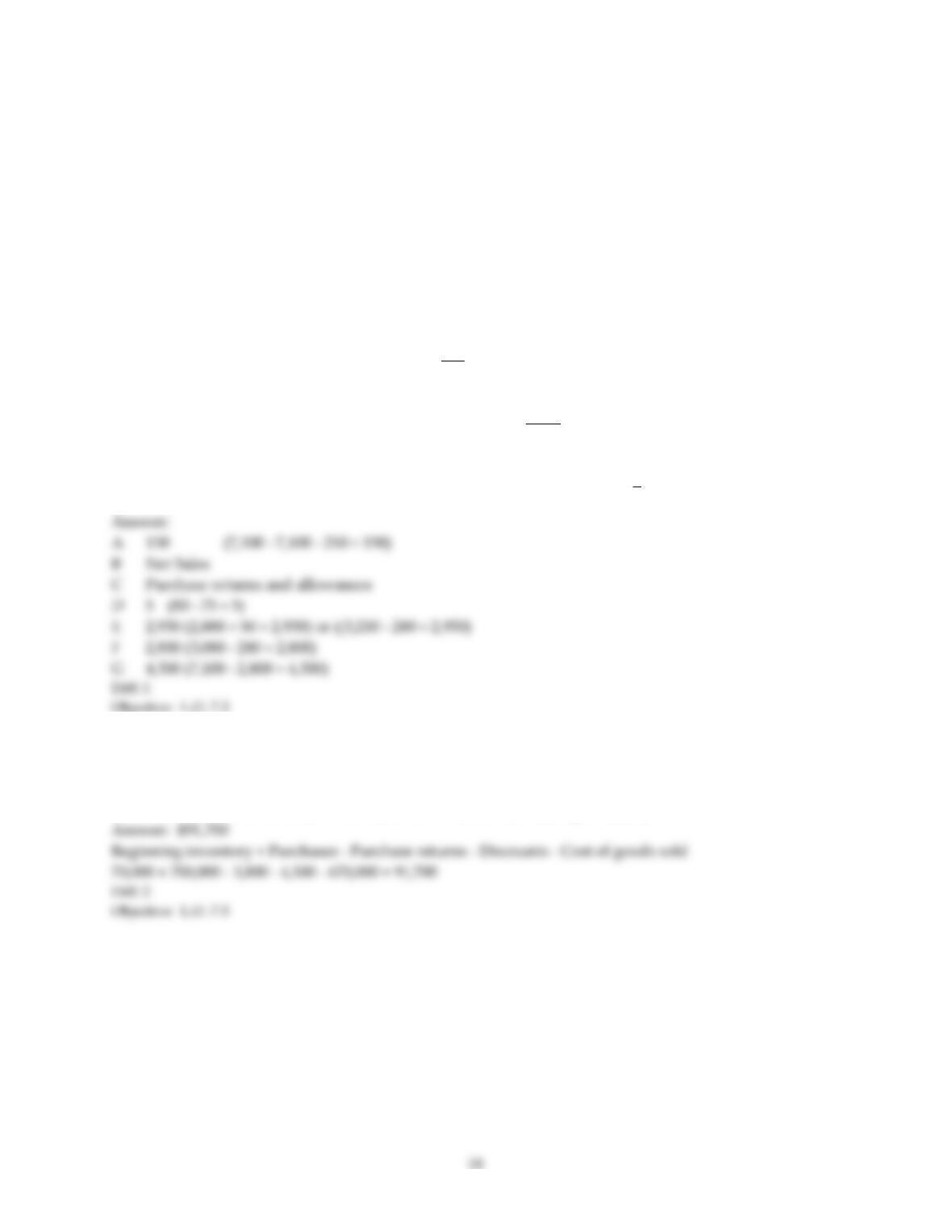
7.3-24) Fill in the appropriate blank figures in the detailed gross profit section of the income statement
below.
Gross sales $7,500
Sales returns and allowances A
Cash discounts on sales 250 ______
B _______________________ $7,100
Cost of goods sold
Inventory, January 1, 2X10 200
Purchases (gross) 3,210
C _______________________ 275
Cash discounts on purchases D 280
Net Purchases E
Freight In 50
Total cost of merchandise acquired 2,880
Cost of goods available for sale $3,080
Inventory, December 31, 2X10 280
Cost of goods sold F
Gross Profit $ G
7.3-25) Morris AutoParts had cost of goods sold for March, 20X9 totaling $670,000. Discounts used by
Morris AutoParts totaled $4,500 and discounts used by customers totaled $3,000. Sales returns were
$2,000 while purchase returns were $ 3,800. Total purchases amounted to $700,000. The inventory balance
on March 1, 20X9 was $ 70,000. Determine Morris AutoParts’ ending inventory.
Learning Objective 7.4 Questions
7.4-1) Using the LIFO method, the earliest purchases of inventory are assumed to be contained
A) on the balance sheet as part of ending inventory.
B) on the income statement as part of cost of goods sold.
C) equally split between the income statement and the balance sheet.
D) Impossible to determine from the given data
E) The earliest purchases of inventory under LIFO are not shown on any financial statement.
7.4-2) Using the FIFO method, the earliest purchases of inventory are assumed to be contained
A) on the balance sheet as part of ending inventory.
B) on the income statement as part of cost of goods sold.
C) equally split between the income statement and the balance sheet.
D) Impossible to determine from the given data
E) The earliest purchases of inventory under FIFO are not shown on any financial statement.
7.4-3) Which of the following inventory methods requires a company to keep track of the actual
movement of individual inventory items?
A) FIFO
B) LIFO
C) Weighted–average
D) Specific identification
E) FIFO and LIFO
7.4-4) When inventory prices are rising, all of the following are reasons for choosing the LIFO versus the
FIFO method except:
A) LIFO generally results in lower income taxes paid.
B) LIFO uses more current costs in calculating cost of goods sold.
C) LIFO avoids inventory profits.
D) LIFO reports the most up–to–date inventory values on the balance sheet.
E) None of the above is correct.
7.4-5) When inventory prices are rising, the ending inventory balance reported on a LIFO basis is
generally
A) lower than on a FIFO basis.
B) equal to a FIFO basis.
C) greater than on a FIFO basis.
D) equal to a weighted–average basis.
E) greater than a weighted–average basis.
7.4-6) When inventory prices are rising, the FIFO method will generally yield a gross profit that is
A) less than the LIFO method.
B) equal to the gross profit of the LIFO method.
C) FIFO does not generally cause a gross profit that is different from that of any other costing method.
D) higher than the LIFO method.
E) All of the above are correct.
7.4-7) Which inventory valuation method allows a company the greatest latitude in reporting results in
any given period?
A) FIFO
B) LIFO
C) Specific identification
D) Weighted–average
E) No method allows more latitude in reporting results than another.
7.4-8) Which inventory valuation method is capable of allowing different cost of goods sold and
inventory account balances within a given accounting period?
A) FIFO
B) LIFO
C) Specific identification
D) Weighted–average
E) Each method is capable of giving only one cost of goods sold and inventory balance for a given period.