7-1: Cost Allocation and Contingency Fees
A lawyer allocates overhead costs based on his hours working with different clients. The
lawyer expects to have $200,000 in overhead during the year and expects to work on clients’ cases
2,000 hours during the year. In addition he wants to pay himself $50 per hour for working with
clients. The lawyer, however, does not bill all of his clients based on covering overhead costs and
his own salary. Some clients pay her on contingency fees. If the lawyer works with a client on a
contingency fee basis, the lawyer receives half of any settlement for his client. During the year
the lawyer works 1,200 hours that are billable to clients. The remaining hours are worked on a
contingency basis. The lawyer wins $300,000 in settlements for his clients of which he receives
half. Actual overhead was $210,000,
What does the lawyer earn during the year after expenses?
7-2: 7-1: Solution to Cost Allocation and Contingency Fees (10 minutes)
Fixed Costs and Allocated Costs
The maintenance department’s costs are allocated to other departments based on the
number of hours of maintenance use by each department. The maintenance department has fixed
costs of $500,000 and variable costs of $30 per hour of maintenance provided. The variable costs
include the salaries of the maintenance workers. More maintenance workers can be added if
greater maintenance is demanded by the other departments without affecting the fixed costs of the
maintenance department. The maintenance department expects to provide 10,000 hours of
maintenance.
Required:
a. What is the application rate for the maintenance department?
b. What is the additional cost to the maintenance department of providing another hour of
maintenance?
c. What problem exists if the managers of other departments can choose how much
maintenance to be performed?
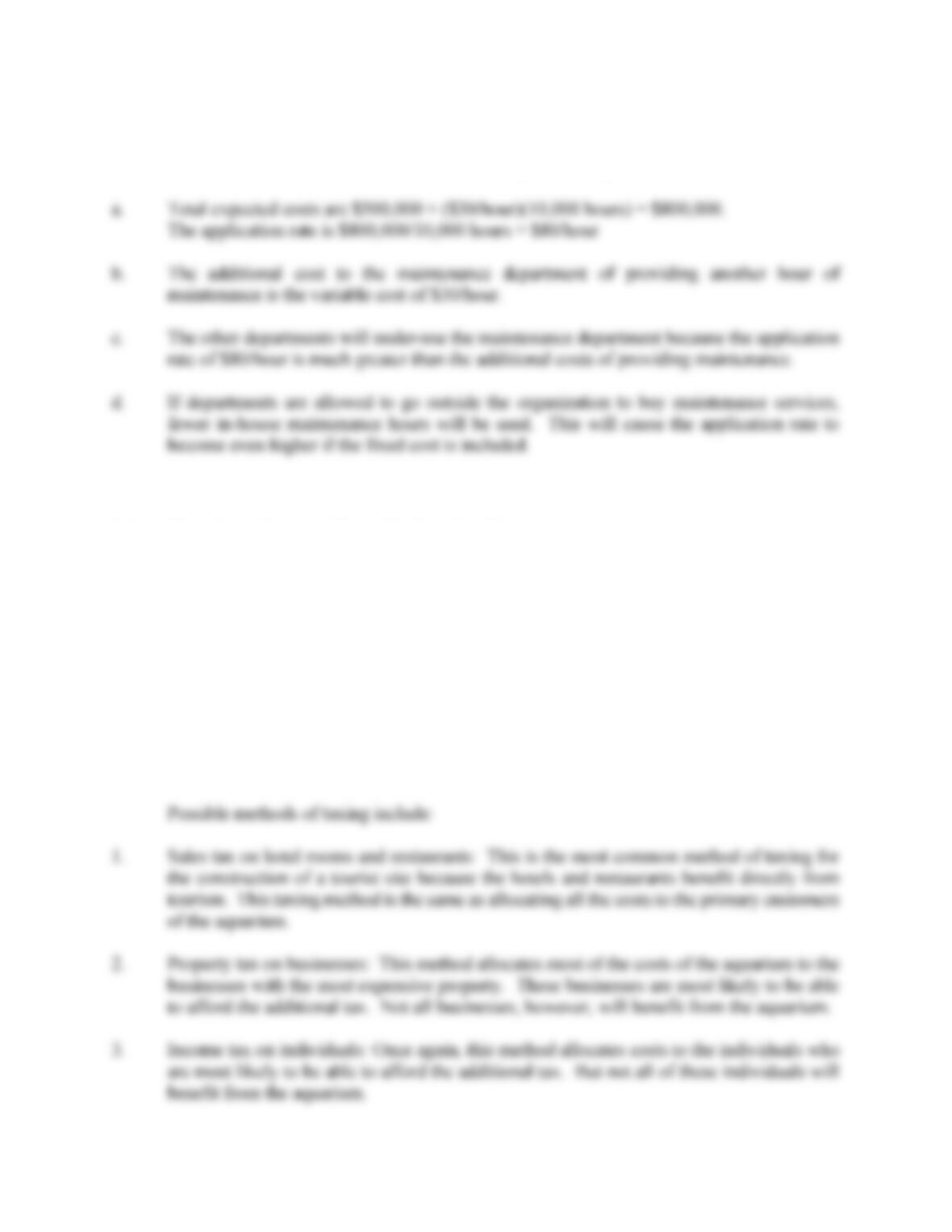
d. What problem exists if the other departments are allowed to go outside the organization to
buy maintenance services?
7-2: Solution to Fixed Costs and Allocated Costs (15 minutes)
7-3: Choosing Allocation Bases For Levying Taxes
The town of Seaside has decided to construct a new sea aquarium to attract tourist. The
cost of the measure is to be paid by a special tax. Although most of the townspeople believe the
sea aquarium is a good idea, there is disagreement about how the tax should be levied.
Required:
Suggest three different methods of levying the tax and the advantages and disadvantages
of each.
7-3: Solution to Choosing Allocation Bases for Levying Taxes (15 minutes)
7-4: Outsourcing and Overhead
Peluso Company, a manufacturer of snowmobiles, is operating at 70 percent of plant
capacity. Peluso’s plant manager is considering manufacturing headlights, which are now being
purchased for $11 each (a price that is not expected to change in the near future). The Peluso plant
has the equipment and labor force required to manufacture the headlights. The design engineer
estimates that each headlight requires $4 of direct materials and $3 of direct labor. Peluso’s plant
overhead rate is 200 percent of direct labor dollars, and 40 percent of the overhead is fixed cost.
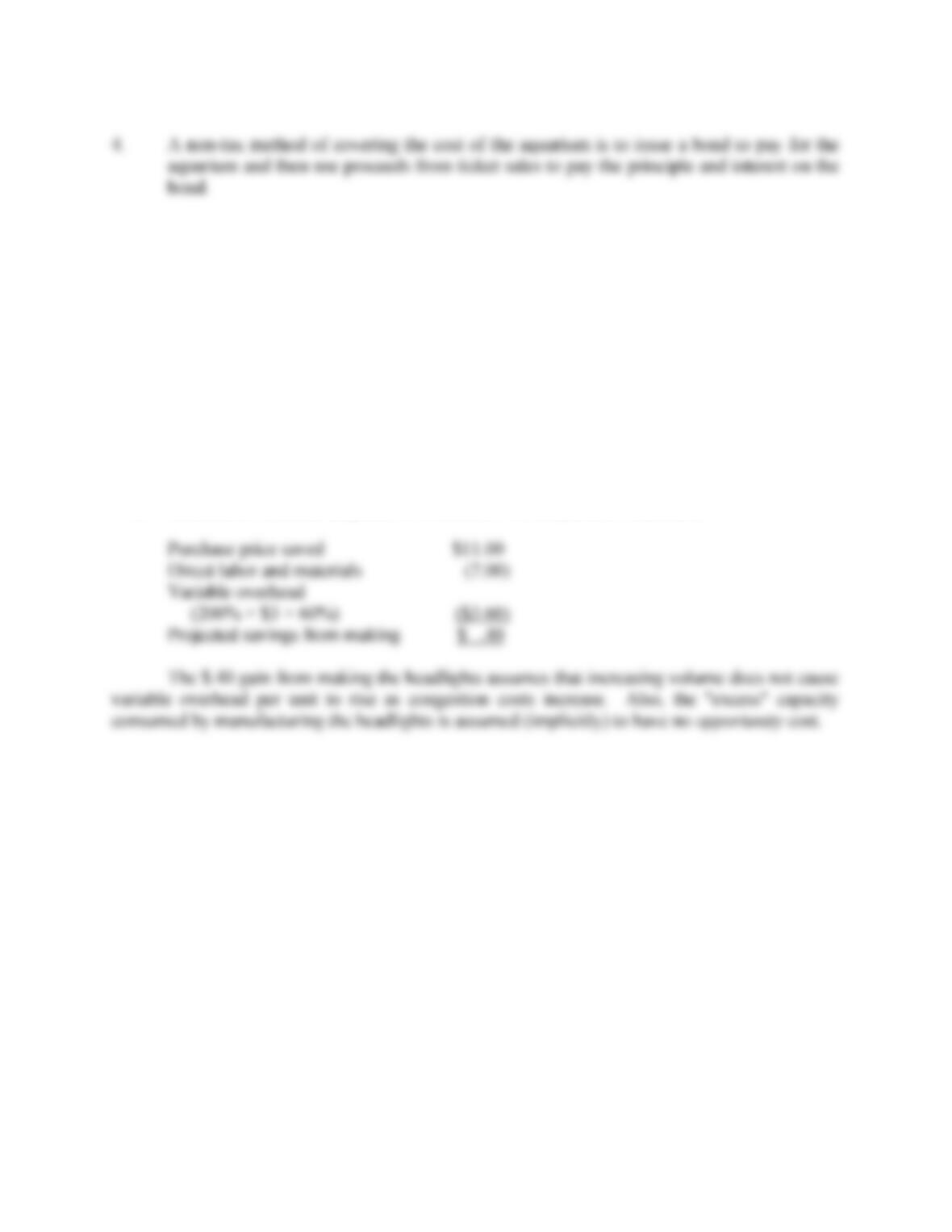
If Peluso Co. manufactures the headlights, how much of a gain (loss) for each headlight will result?
Source: CMA adapted
7–4: Solution to Outsourcing and Overhead (CMA adapted) (10 minutes)
7-5: Incentive Effects of Cost Allocations
Eastern University prides itself on providing faculty and staff a competitive compensation
package. One aspect of this package is a faculty and staff child tuition benefit of $4,000 per child
per year for up to four years to offset the cost of a college education. The faculty or staff member’s
child can attend any college or university, including Eastern University, and receive the tuition
benefit. If a staff member has three children in college one year, the staff member receives a
$12,000 tuition benefit. This money is not taxed to the individual staff or faculty member.
Eastern University pays the benefit directly to the university where the staff/faculty
member’s child is enrolled or if the student is attending Eastern, it reduces the amount of tuition
owed by the faculty/staff member. The university then charges this payment to a benefits account.
This benefits account is then allocated back to the various colleges and departments based on total
salaries in the college or department.
Evaluate the pros and cons of the present university accounting for tuition benefits. What

changes would you recommend making?
7–5: Solution to Incentive Effects of Cost Allocations (20 minutes)
7-6: Allocating Overhead versus Direct Tracing
Nixon & Ross, a law firm, is about to install a new accounting system that will allow the
firm to track more of the overhead costs to individual cases. Overheads are currently allocated to
individual client cases based on billable professional staff salaries. Attorneys working on client
cases charge their time to “billable professional staff salaries.” Attorney time spent in training,
law firm administrative meetings, and the like is charged to an overhead account titled “unbilled
staff salaries.”
The following is a summary of the costs for the current year:
Billable professional staff salaries
$ 4,000,000
Overhead
8,000,000
Total costs
$12,000,000
The overhead costs were as follows:

Secretarial costs
$1,500,000
Staff benefits
2,750,000
Office rent
1,250,000
Telephone and mailing costs
1,500,000
Unbilled staff salaries
1,000,000
Total costs
$8,000,000
Under the new accounting system, the firm will be able to trace secretarial costs, staff
benefits, and telephone and mailing costs to specific clients.
The following are the costs incurred on the Lawson Company case:
Billable professional staff salaries
$150,000
Secretarial costs
25,000
Staff benefits
13,500
Telephone and mailing costs
8,000
Total costs
$196,500
Required:
a. Calculate the current year’s overhead application rate under the old cost accounting system.
b. How would this application rate change if the secretarial costs, staff benefits, and telephone
and mailing costs were reclassified as direct costs instead of overhead, and overhead was
assigned based on direct costs (instead of staff salaries)? Direct costs are defined as billable
staff salaries plus secretarial costs, staff benefits, and telephone and mailing costs.
c. Use the overhead application rates from (a) and (b) to compute the cost of the Lawson case.
d. Nixon & Ross bills clients 150 percent of the total costs of the job. What will be the total
billings to the Lawson Co. if the old overhead application scheme is replaced with the new
overhead scheme?
e. Steve Nixon, managing partner, has commented that replacing the old allocation system
with the direct charge method of the new accounting system will result in more accurate
costing and pricing of cases. Evaluate the new system.
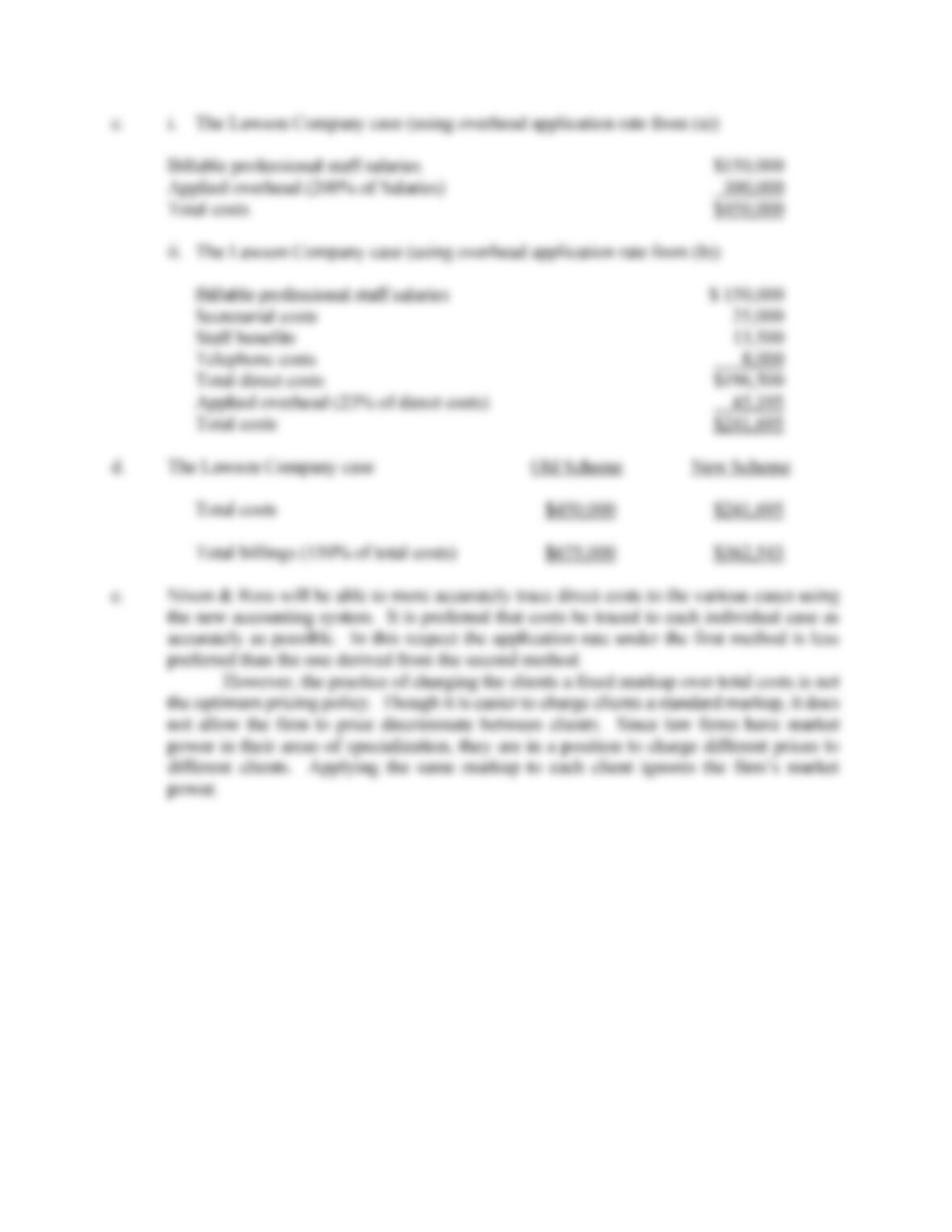
7–6: Solution to Allocating Overhead versus Direct Tracing (40 minutes)
7-7: Allocating Computer Costs
The Independent Underwriters Insurance Co. (IUI) established a systems department two
years ago to implement and operate its information technology system. IUI believed that its own
system would be more cost-effective than the service bureau it had been using.
IUI’s three departments −claims, records, and finance − have different requirements with
respect to hardware and other capacity-related resources and operating resources. The system was
designed to recognize these differing demands. It was also designed to meet IUI’s long-term
capacity. The excess capacity designed into the system is being sold to outside users until IUI
needs it. The estimated resource requirements used to design and implement the system are shown

in the following schedule.
Hardware and
Other Capacity-
Related Resources
Operating
Resources
Records
30%
60%
Claims
50
20
Finance
15
15
Expansion (outside use)
5
5
Total
100%
100%
IUI currently sells the equivalent of its expansion capacity to a few outside clients.
When the system became operational, management decided to redistribute total expenses
of the systems department to the user departments based upon actual computer time used. The
actual costs for the first quarter of the current fiscal year were distributed to the user departments
as follows:
Department
Percentage
Utilization
Amount
Records
60%
$330,000
Claims
20
110,00
Finance
15
82,500
Outside
5
27,500
Total
100%
$550,000
The three user departments have complained about the cost distribution since the systems
department was established. The records department’s monthly costs have been as much as three
times the costs experienced with the service bureau. The finance department is concerned about
the costs distributed to the outside user category, because these allocated costs form the basis for
the fees billed to outside clients.
James Dale, IUI‘s controller, decided to review the distribution method by which the
systems department’s costs have been allocated for the past two years. The additional information
he gathered for his review is reported in Tables 1, 2, and 3. Dale has concluded that the method
of cost distribution should be changed to reflect more directly the actual benefits received by the
departments. He believes that hardware and capacity-related costs should be allocated to the user
departments in proportion to their planned, long-term needs. Any difference between actual and
budgeted hardware costs should remain with the systems department.
The remaining costs for software development and operations would be charged to the user
departments based upon actual hours used. A predetermined hourly rate based upon the annual
budget data would be used. The hourly rates proposed for the current fiscal year are as follows:

Function
Hourly Rate
Software development
$30
Operations
Computer related
$200
Input/output related
$10
Dale plans to use first-quarter activity and cost data to illustrate his recommendations. The
recommendations will be presented to the systems department and the user departments for their
comments and reactions. He then expects to present his recommendations to management for
approval.
Required:
a. Prepare a schedule to show how the actual first-quarter costs of the systems department
will be charged to the users if James Dale’s recommended method is adopted.
b. Explain whether James Dale’s recommended system for charging costs to the user
departments will
(i) Improve cost control in the systems department.
(ii) Improve planning and cost control in the user departments.
(iii) Be a more equitable basis for charging costs to user departments.
Table 1
Systems Department Costs and Activity Levels
First Quarter
Annual Budget
Budget
Actual
Hours
Dollars
Hours
Dollars
Hours
Dollars
Hardware and other
capacity-related costs
−−
$600,000
−−
$150,000
−−
$155,000
Software development
18,750
562,500
4,725
141,750
4,250
130,000
Operations
Computer related
3,750
750,000
945
189,000
920
187,000
Input/output related
30,000
300,000
7,560
75,600
7,900
78,000
$2,212,500
$556,350
$550,000

Table 2
Historical Utilization by Users
Operations
Hardware
and Other
Software
Development
Computer
Input/Output
Capacity
Needs
Range
Average
Range
Average
Range
Average
Records
30%
0-30%
12%
55-65%
60%
10-30%
20%
Claims
50
15-60
35
10-25
20
60-80
70
Finance
15
25-75
45
10-25
15
3-10
6
Outside
5
0-25
8
3-8
5
3-10
4
100%
100%
100%
100%
Table 3
Utilization of Systems Department’s Services for First Quarter
(in Hours)
Operations
Software
Development
Computer
Related
Input/
Output
Records
425
552
1,580
Claims
1,700
184
5,530
Finance
1,700
138
395
Outside
425
46
395
Total
4,250
920
7,900
Source: CMA adapted.
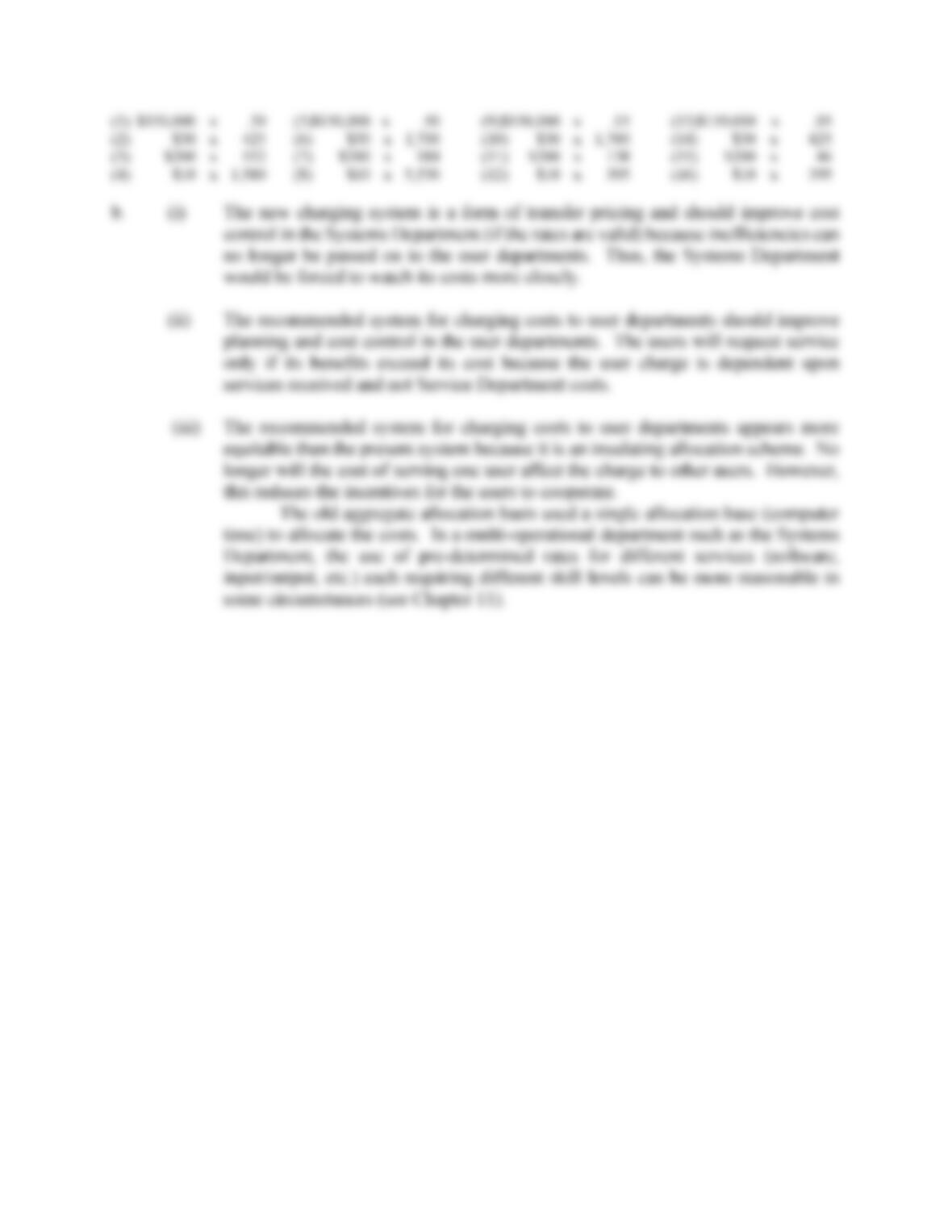
7–7: Solution to Allocating Computer Costs (CMA adapted) (45 minutes)
7–8: Cost Allocations Can Distort Pricing Decisions
Eastman Kodak used to sponsor a car in the NASCAR races. Like other major corporations
that sponsor sports events, Kodak believes that the public’s awareness of its products is enhanced
by sponsoring a NASCAR. For the right to have the car painted yellow with “Kodak” displayed
prominently over the automobile, Eastman Kodak pays the racing team an annual fee in the
millions of dollars.
Kodak is organized around about 25 business units that are profit centers. All Kodak
products are sold by the business units. Senior management at Kodak believes that since the
various business units at Kodak receive the benefits of the NASCAR exposure through greater
name recognition, and hence greater sales, the costs of the program should be allocated back to the
business units and ultimately to all Kodak products. The cost of the NASCAR program is allocated
back to the Kodak business units based on sales revenue. Suppose the allocation is 10 percent of
revenues. That is, for every $1 of revenue, the business unit is allocated $0.10 of cost from the
NASCAR car.
One of Kodak’s business units sells X-ray film in 100-sheet packages. The following table
summarizes possible pricing levels, packages sold at that price, and costs for the various number
of packages.

Price
Number of
Packages Sold
Total Cost
$564
218
$71,800
562
219
71,900
560
220
72,000
558
221
72,100
556
222
72,200
554
223
72,300
552
224
72,400
550
225
72,500
548
226
72,600
Required:
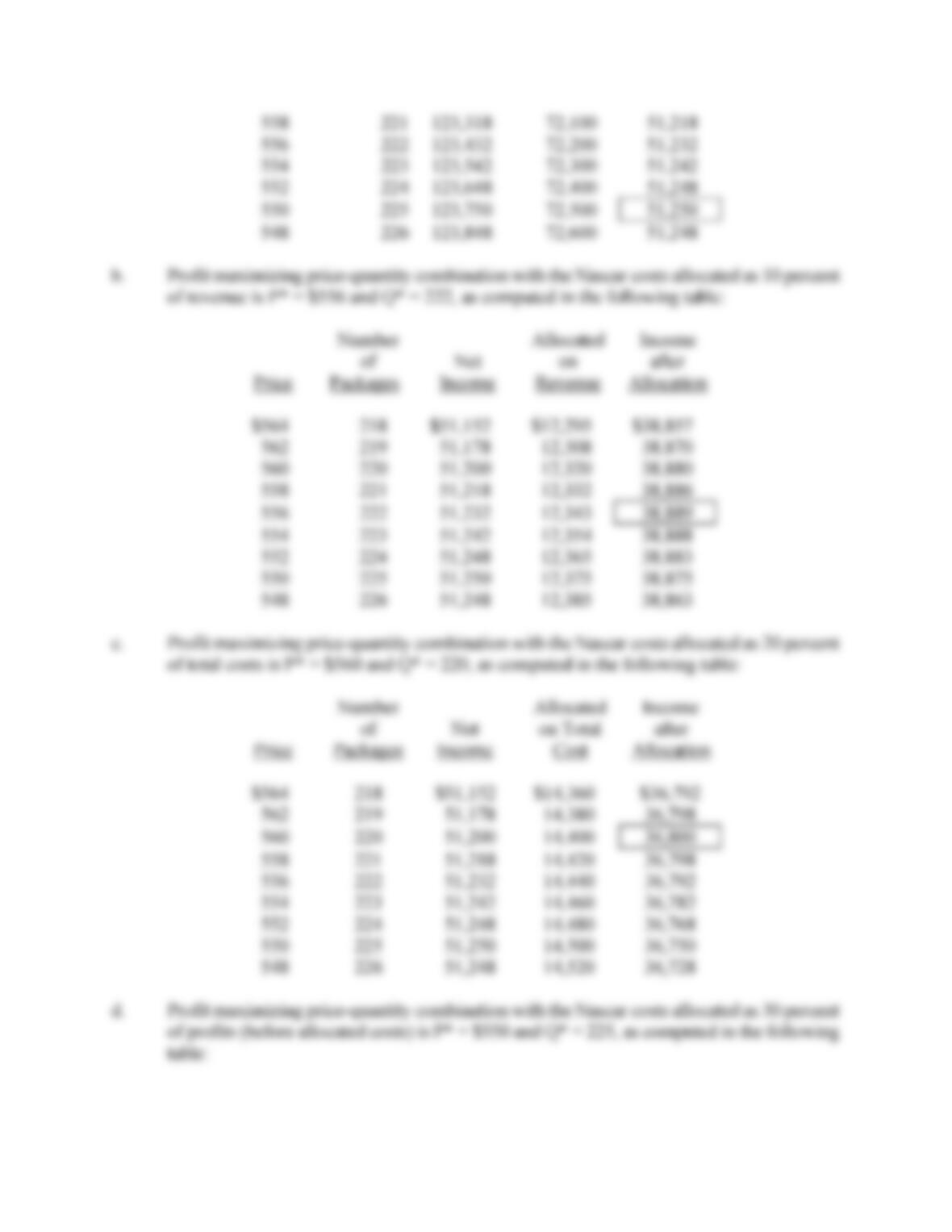
a. What price-quantity combination maximizes the profits of the X-ray film, ignoring the
allocation of NASCAR?
b. If $0.10 of the NASCAR is allocated for every dollar of X-ray revenue, what price-quantity
combination of X-ray film maximizes profits after allocating NASCAR costs?
c. What price-quantity combination of X-ray film maximizes profits after allocating
NASCAR costs using total costs (instead of revenues), where for every dollar of total costs,
$0.20 of NASCAR costs are allocated?
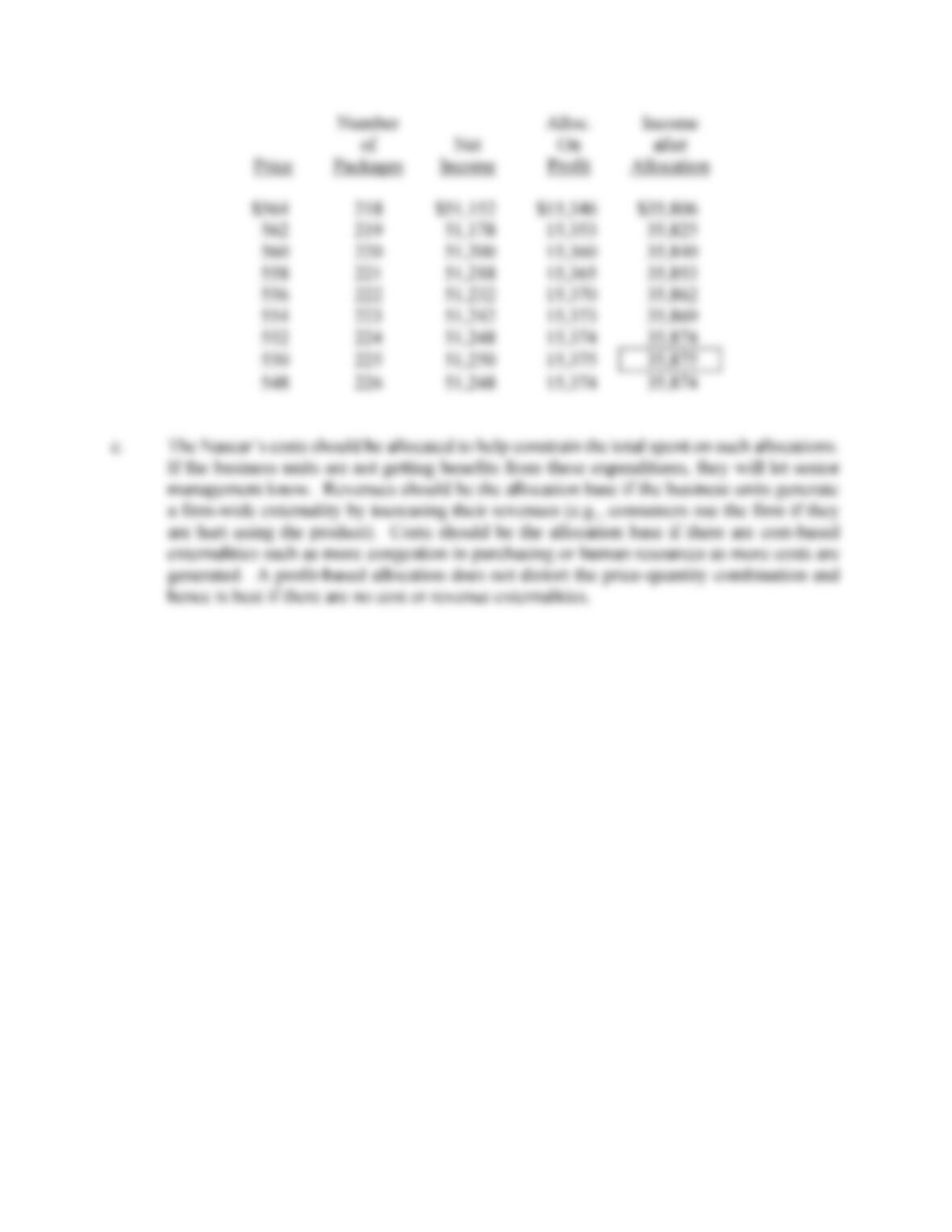
d. Instead of allocating the NASCAR based on revenues, it is allocated based on profits before
allocated costs. For every $1.00 of profits before allocated costs, $0.30 of NASCAR costs
are allocated. Now what price-quantity combination maximizes X-ray profits after
allocating NASCAR costs?
e. Should NASCAR costs be allocated to the business units, and if so, what allocation scheme
should be used (revenues, costs, or profits)?
7–8: Solution to Cost Allocations can Distort Pricing Decisions (45 minutes)