
Chapter 7: Introduction to Financial Statement Analysis Key
1. Financial statement ratios alone provide direct indicators of good or poor management.
2. The return from investing in the shares of common stock has two components: cash dividends and the change
in the market price of the common stock.
3. Theoretical and empirical research has shown that the expected return from investing in a firm relates, in part,
to the expected profitability of the firm.
4. Common shareholders have a residual claim on all income after creditors and preferred shareholders receive
amounts contractually owed them.
5. When a firm has securities outstanding that, if exchanged for shares of common stock, would decrease basic
earnings per share by 30% or more, generally accepted accounting principles require a dual presentation: basic
earnings per share and diluted earnings per share.
6. Three measures of profitability for a firm engaging in operations selling merchandise in its stores, to generate
net income are: (1) Rate of return on assets, (2) Rate of return on common shareholders’ equity, and (3)
Earnings per share of common stock.
7. ROA has particular relevance to the lenders, or creditors, of a firm.

8. The rate of return on common shareholders’ equity (ROCE) measures a firm’s performance in using and
financing assets to generate earnings.
9. The term financial leverage describes financing with debt and preferred stock to increase the potential return
to the residual common shareholders’ equity.
10. To study changes in ROA, the analyst can disaggregate ROA into the product of two other ratios: the profit
margin for ROA ratio and the total assets turnover ratio.
11. In theory, the numerator of the accounts receivable turnover ratio should include only sales made on account
if the objective is to measure how quickly a firm collects its accounts receivable.
12. The accounts receivable turnover ratio indicates how quickly a firm collects its accounts receivable.
13. If the firm offers terms of “net 45 days,” a days receivable outstanding of 45 days indicates that the firm
handles accounts receivable well.
14. Inventory turnover equals cost of goods sold divided by the average inventory during the period.
15. Some analysts calculate the inventory turnover ratio by dividing sales, rather than cost of goods sold, by the
average inventory. Using sales in the numerator will lead to correct measures of the inventory turnover ratio for
calculating the average number of days that inventory is on hand until sale.

16. Some analysts find the reciprocal of the fixed asset turnover ratio helpful in comparing the operating
characteristics of different firms, because it measures dollars of fixed assets required to generate one dollar of
sales.
17. Total assets turnover reflects the effects of turnover ratios for accounts receivable, inventory, and fixed
assets.
18. Four measures for assessing short-term liquidity risk are (1) Current ratio, (2) Quick ratio, (3) Cash flow
from operations to current liabilities ratio, and (4) Working capital turnover ratios.
19. A quick ratio approximately one-half of the current ratio is typical, although this varies by industry.
20. Most firms want to extend their payables as long as they can, but they also want to maintain their relations
with suppliers. Businesses, therefore, negotiate hard for favorable payment terms and then delay paying until
just before the last agreed moment.
21. Analysts use measures of long-term liquidity risk to evaluate a firm’s ability to meet interest and principal
payments on long-term debt and similar obligations as they come due. If a firm cannot make the payments on
time, it becomes insolvent and may have to reorganize or liquidate.
22. An analyst examines changes in a firm’s ratios over the three-year period—a so-called cross-section
analysis.
23. Many analysts use a common-size balance sheet, which expresses each balance sheet item as a percentage
of total assets.
24. As a practical matter, most firms report segment information by _____ indicating that most firms appear to
be organized on these same lines.
25. The typical first step in financial statement analysis and valuation (after selecting assumptions) is:
26. The typical last step in financial statement analysis and valuation (after selecting assumptions) is:
27. The typical steps in financial statement analysis and valuation include all of the following, except
28. The typical steps in financial statement analysis and valuation include(s):
29. The return from investing in the shares of common stock include(s):
30. The value of common stock investments will likely change between the time the shares are purchased and
the time in the future when they are sold. The difference between the eventual selling price and the purchase
price, is often called
31. What affect(s) the market price of common stock shares?
32. Most individuals prefer _____ to _____ and they will want a _____ expected return if they purchase
common stock shares than if they invest in a certificate of deposit.
33. Most financial statement analysis explores some aspect of a firm’s
34. Which of the following is/are limitations of ratio analysis?
35. Ratios provide little information unless the analyst places them in a context. After calculating the ratios, the
analyst must compare them with some standard. Which of the following is/are possible standard(s)?
36. Ratios provide little information unless the analyst places them in a context. After calculating the ratios, the
analyst must compare them with some standard. Which of the following is not a possible standard?
37. Measures of profitability for a firm engaging in operations selling merchandise in its stores to generate net
income do not include:
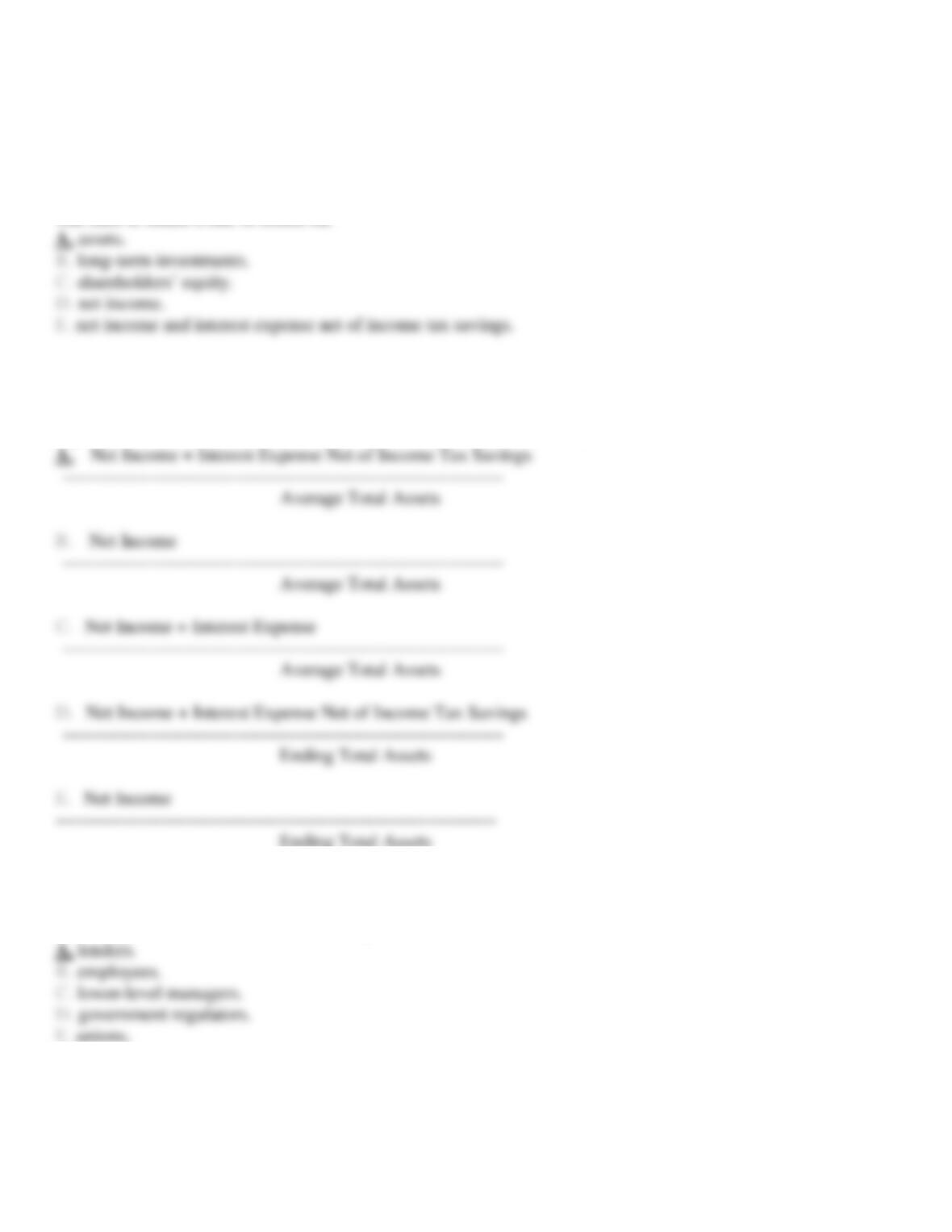
38. The following ratio relates the results of operating performance to the investments (assets) of a firm without
regard to how the firm financed those investments.
Net Income + Interest Expense Net of Income Tax Savings
———————————————————————–
Average Total Assets
The ratio is called a rate of return on:
39. The rate of return on assets relates the results of operating performance to the investments of a firm without
regard to how the firm financed those investments. The ratio is calculated as follows:
40. Analysis of the Return on Assets has particular relevance to the
41. A firm computes ROA, profit margin for ROA, and total assets turnover for each segment using the segment
disclosures. The amounts for these ratios computed at a segment level differ from those at a corporate level for
which of the following reason(s)?
42. The calculation of Rate of Return on Common Shareholders’ Equity (ROCE) is as follows:
Rate of Return on Common = Shareholders’ Equity
43. The capital provided by common shareholders during the period include(s):
44. The capital provided by common shareholders during the period used for calculating the return on common
equity equals
45. ROCE will exceed ROA whenever ROA exceeds the after-tax cost of borrowing plus any dividends
required for preferred shareholders. Which of the following is/are true?
46. ROCE disaggregates into the following components:
47. The term _____ describes financing with debt and preferred stock to increase the potential return to the
residual common shareholders’ equity.
48. The capital structure leverage ratio indicates
49. The higher the capital structure leverage ratio, the _____ is the proportion of financing that common
shareholders provide and the _____ is the proportion that creditors and preferred shareholders provide. Thus,
the _____ the capital structure leverage ratio, the _____ is financial leverage.
50. If the rate of return on assets for the year is 15%, a general interpretation of the ratio would be
51. Rate of return on common shareholders’ equity (ROCE)
52. A small leverage ratio may indicate that a company is
53. Which of the following ratios is not a measure of profitability?
54. Which ratio measures a firm’s performance in using assets to generate earnings independent of how the firm
financed acquisition of those assets?
55. The numerator of the rate of return on common shareholders’ equity
56. The rate of return on common shareholders’ equity
57. Using lower cost borrowed funds and earning a higher rate of return on those funds than their cost
58. Financial leverage
59. Financial leverage
60. The rate at which accounts receivable turnover
61. Igor Corporation’s accounts receivable, net of allowance for uncollectibles, were $250,000 at December 31,
Year 3, and $350,000 at December 31, Year 4. Net cash sales for Year 4 were $300,000. The accounts
receivable turnover was 6.0. Igor’s net sales for Year 4 were
62. The capital structure leverage ratio
63. To study changes in ROA, the analyst can disaggregate ROA into the product of two other ratios:
64. What is calculated as follows?
Profit Margin for ROA Total Assets
? = (before interest expense x Turnover
and related income Ratio
tax savings) Ratio
65. To calculate the amount of net income assignable to common shareholders’ equity, the analyst does not
66. The profit margin ratio for ROCE indicates
67. The total assets turnover ratio indicates
68. The rate which indicates how quickly a firm collects cash is the _____ turnover ratio.
69. The _____ turnover ratio equals sales revenue divided by average accounts receivable during the period.
70. The rate at which _____ turn(s) over measures how quickly a firm collects cash.
71. The accounts receivable turnover ratio equals
72. Most firms that sell to other businesses, as opposed to consumers, sell on account and collect within 30 to
90 days. Interpreting any particular firm’s accounts receivable turnover and days receivable outstanding
requires knowing the terms of sale. If a firm’s terms of sale are “net 30 days” and the firm collects its accounts
receivable in 45 days, then the
73. The _____ ratio indicates how fast firms sell their inventory items, measured in terms of the rate of
movement of goods into and out of the firm.
74. Managing inventory turnover involves balancing which of the following consideration(s) in setting the
optimum level of inventory and, thus, the rate of inventory turnover?
75. Some analysts calculate the inventory turnover ratio by dividing sales, rather than cost of goods sold, by the
average inventory. Which of the following regarding the inventory turnover ratio is/are not true?
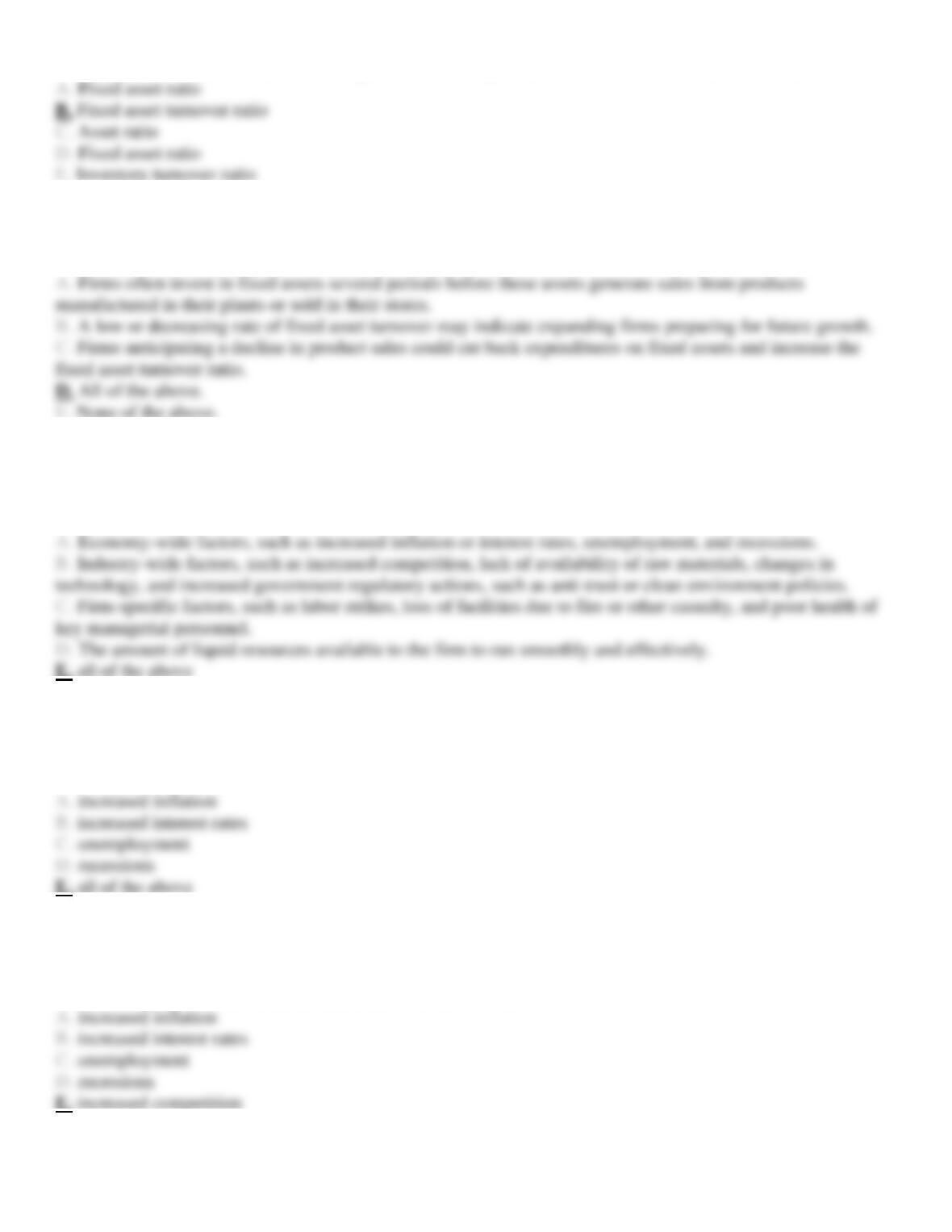
76. _____ measures the amount of sales generated from a particular level of investments in fixed assets.
77. Which of the following could affect(s) the fixed asset turnover ratio?
78. Analysts deciding between investments must consider the comparative risks. Which of the following factors
affect the risk of business firms?
79. Analysts deciding between investments must consider the comparative risks. Which of the following is/are
economy-wide factors that affect the risk of business firms?
80. Analysts deciding between investments must consider the comparative risks. Which of the following is/are
not economy-wide factors that affect the risk of business firms?
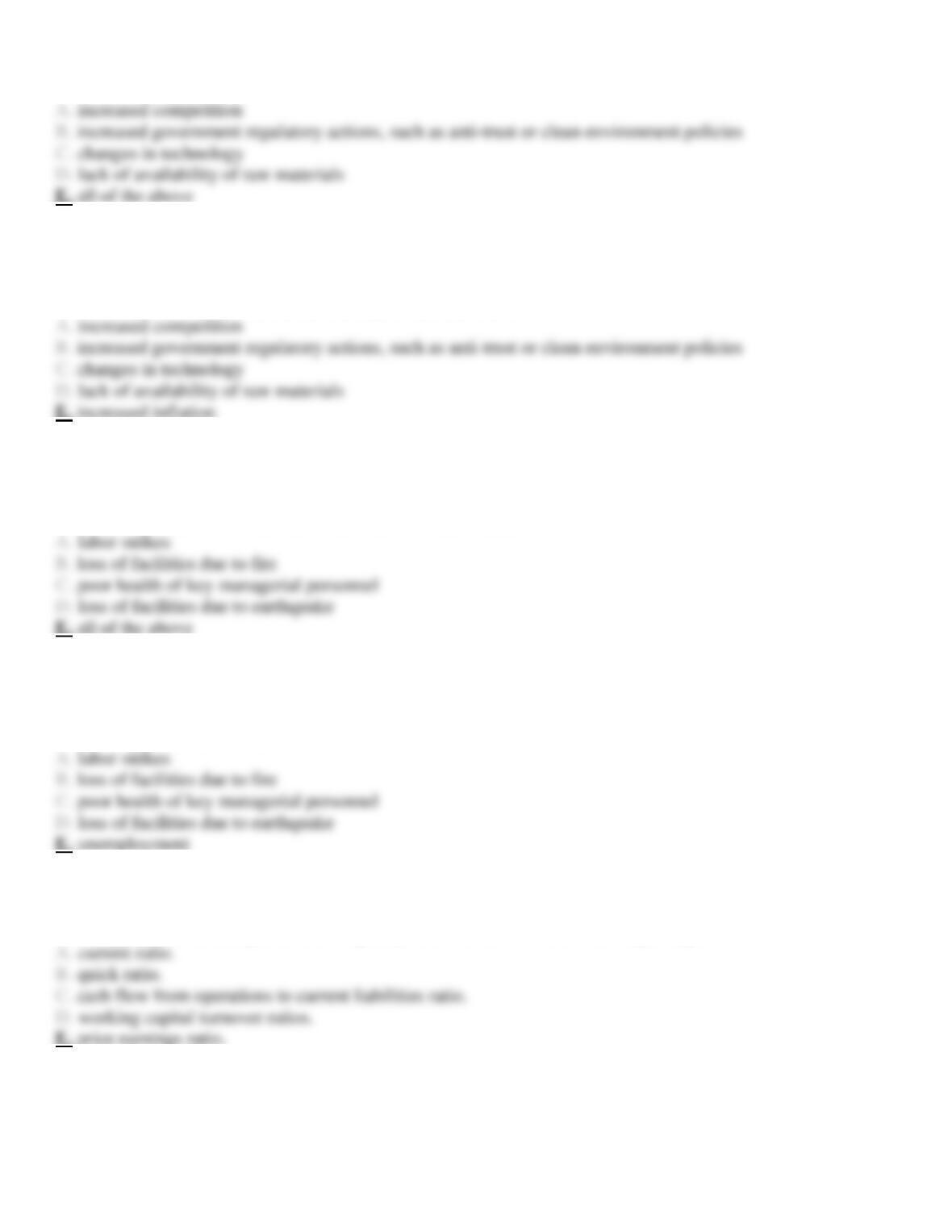
81. Analysts deciding between investments must consider the comparative risks. Which of the following
is/areindustry-wide factors that affect the risk of business firms?
82. Analysts deciding between investments must consider the comparative risks. Which of the following is/are
not industry-wide factors that affect the risk of business firms?
83. Analysts deciding between investments must consider the comparative risks. Which of the following
is/arefirm-specific factors that affect the risk of business firms?
84. Analysts deciding between investments must consider the comparative risks. Which of the following is/are
not firm-specific factors that affect the risk of business firms?
85. Measures for assessing short-term liquidity risk include all of the following except:
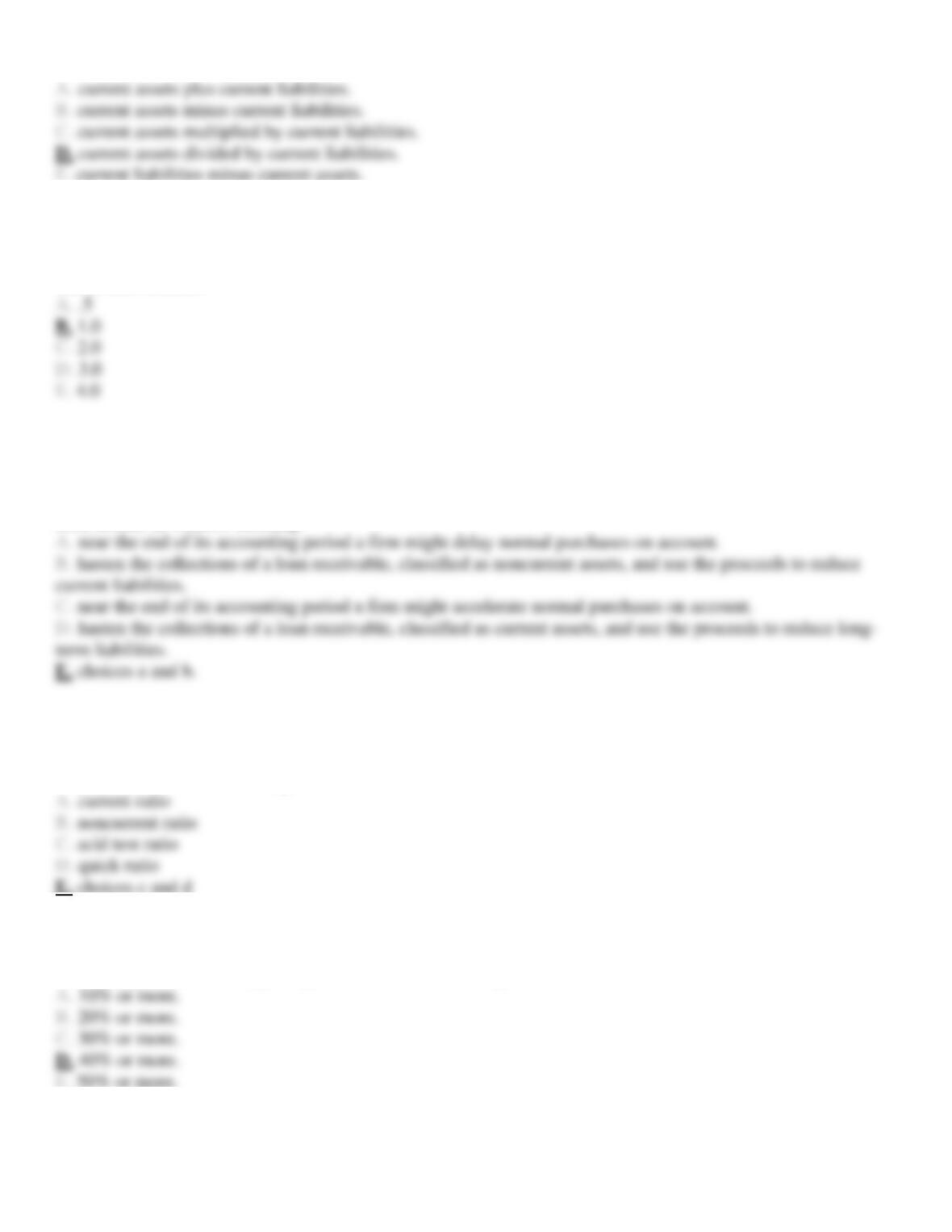
86. The current ratio equals
87. The current ratio indicates a firm’s ability to meet its short-term obligations. Analysts prefer a current ratio
that at least exceeds
88. Management can take deliberate steps to produce a financial statement that presents a better current ratio at
the balance sheet date than the average, or normal, current ratio during the rest of the year. Analysts refer to
such actions as window dressing:
89. What ratio(s) customarily include(s) in the numerator cash, marketable securities, and accounts receivable,
with the denominator including all current liabilities?
90. Healthy mature firms typically have a cash flow from operations to current liabilities ratio of:
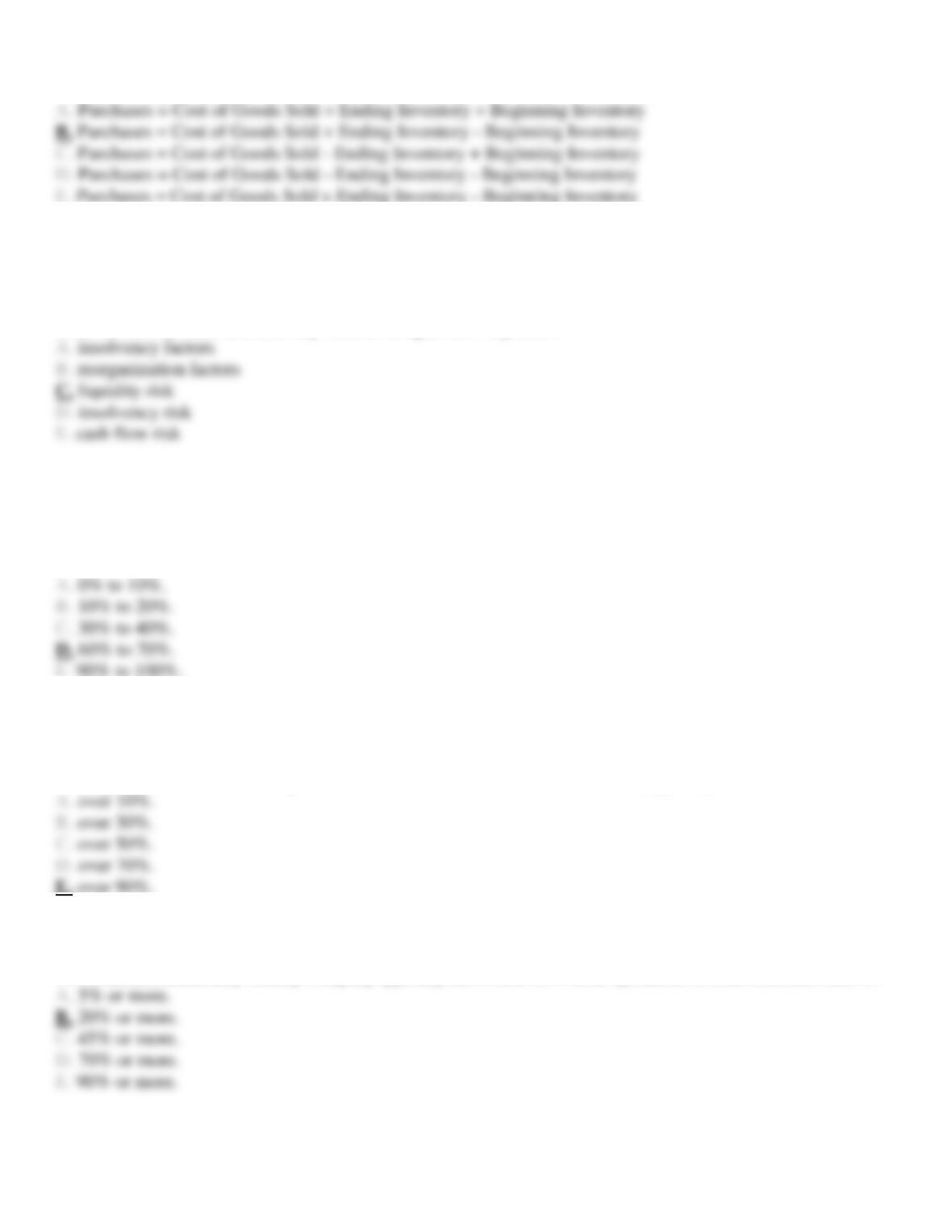
91. The accounts payable turnover ratio uses purchases on account in its computation. Although firms do not
disclose their purchases, the analyst can calculate the purchase amount as follows:
92. Analysts use measures of long-term _____ to evaluate a firm’s ability to meet interest and principal
payments on long-term debt and similar obligations as they come due. If a firm cannot make the payments on
time, it becomes insolvent and may have to reorganize or liquidate.
93. In assessing the debt ratios, analysts customarily vary the standard in relation to the stability of the firm’s
earnings and cash flows from operations. Public utilities have liabilities to assets ratios frequently on the order
of
94. In assessing the debt ratios, analysts customarily vary the standard in relation to the stability of the firm’s
earnings and cash flows from operations. Banks have liabilities to assets ratios, typically
95. A mature, financially healthy company typically has a cash flow from operations to total liabilities ratio of
96. The fixed asset turnover ratio
97. The accounts payable turnover ratio can reveal
98. During Year 2, Lamar Corporation purchased $600,000 of merchandise inventory. The cost of sales for year
2 was $660,000 and the ending merchandise inventory at December 31, Year 2 was $60,000. What was the
inventory turnover for Year 2?