
CHAPTER 7
Diagnostic and Formative Assessments
ITEMS
1. An assessment useful for diagnosis of learning deficits is likely to be useful also for purposes of
assigning letter grades.
(a) True
(b) False
2. Which of the following diagnostic approaches uses a norm-referencing framework to interpret
students’ needs?
(a) Analysis of knowledge structure
(b) Identifying students’ errors
(c) Content strengths and weaknesses
(d) Prerequisite knowledge and skills deficits
3. Which of the diagnostic approaches is implied when a teacher says, “I’m interested in finding out
why my students continue to say that wrapping a cold bottle of soft drink in a woolen sweater will
warm the soft drink?”
(a) Prerequisite deficits
(b) Identifying student’s errors
(c) Content strengths and weaknesses
(d) Analysis of knowledge structure
4. A teacher says, “John is skilled at the subtraction of two-digit numbers and is now ready to learn
subtraction of three-digit numbers when borrowing is not needed.” Which diagnostic approach is
implied?
(a) Profile of strengths and weaknesses
(b) Mastery of specific objectives
(c) Prerequisite hierarchy
(d) Both (b) and (c)
Questions 5, 6, 7, 8, and 9 refer to the information below
The table below shows the results (fraction of items correct) of a diagnostic test for five primary
school students.
Addition Subtraction Multiplication Division
Frank 15/15 9/10 12/13 11/18
Joe 12/15 8/10 12/13 16/18
Judy 14/15 8/10 13/13 10/18
Mary 13/15 9/10 8/13 9/18
5. According to the content profile of strengths and weaknesses diagnostic approach to diagnosis,
which student has a weakness in addition?
(a) Frank
(b) Joe
(c) Judy
(d) Mary
(e) None of the students
6. According to the mastery approach to diagnosis, which student has a weakness in addition?
(a) Frank
(b) Joe
(c) Judy
(d) Mary
(e) None of the students
7. According to the mastery approach to diagnosis, which student has a weakness in subtraction?
(a) Frank
(b) Joe
(c) Judy
(d) Mary
(e) None of the students
8. According to the mastery approach, what is Mary’s weak area?
(a) Addition
(b) Division
(c) Multiplication
(d) Subtraction
(e) She has no weak area.
9. According to the mastery approach, what is Joe’s weak area?
(a) Addition
(b) Division
(c) Multiplication
(d) Subtraction
(e) He has no weak area.
10. What is a major problem associated with the content area strengths and weaknesses approach in
diagnostic assessment?
(a) It cannot be used as a pretest.
(b) It gives faulty information on students’ weak areas.
(c) It does not give enough detail about a student’s difficulties.
(d) It must be administered individually.

11. For which diagnostic approach would concept maps be most useful?
(a) Mastery of specific objectives
(b) Identifying students’ errors
(c) Prerequisite deficits
(d) Knowledge structure analysis
12. Which of the following is a prerequisite to a student’s learning to add two-digit numbers with
carrying to the tens’ or hundreds’ place?
(a) Ability to borrow from tens’ and hundreds’ place
(b) Ability to do column addition with no carrying for three-digit numbers
(c) Ability to find missing addends for problems with single-digit addends
(d) Ability to do column addition with five single-digit addends
13. The analysis of knowledge structure approach to diagnosis requires the teacher to focus on
mistakes and errors a student makes.
(a) True
(b) False
14. Requiring a high score to pass a prerequisite skills tests is more important when teaching in a
linear, hierarchical sequence than when teaching in a spiral sequence.
(a) True
(b) False
15. Which of the following frameworks is inappropriate for prerequisite knowledge and skills
assessment?
(a) Criterion-referencing
(b) Domain-referencing
(c) Norm-referencing
16. What is a serious weakness of the prerequisite knowledge and skills approach to diagnosis?
(a) It does not identify enough skills to be useful.
(b) It requires that tree-like hierarchies be used.
(c) It does not provide information as to why students err.
17. The formative assessment cycle begins with
(a) A clear understanding of the learning objective
(b) A clear assessment plan for several, repeated assessments
(c) Student interest in charting their own progress

18. Ms. Bastien wanted to help her fourth-grade students understand what good reports should look
like, for her unit on United States geography. Which of the following is the most effective
strategy for her to do that?
(a) Show students the best report from the previous year, and tell them to use it as a model.
(b) Show students several good examples from the previous year.
(c) Ask students to deduce criteria from good examples from the previous year.
19. A good strategy for teaching students how to do self-assessment is to pass out a simple checklist
and ask them to use it on one of their assignments.
(a) True
(b) False
20. Which of the following is not a known benefit of good use of formative assessment strategies?
(a) Increased achievement of stated learning goals
(b) Increased compliance with classroom rules
(c) Increased motivation for learning
(d) Increased involvement in one’s own learning
21. A sixth-grade class was studying a certain kind of math problems, and they were going to have a
test on Tuesday. Which of the following is an example of student self-regulation of learning?
(a) Inez asked the teacher for extra practice problems to help her study for the test.
(b) Hermón decided not to do any problems Monday night because he was ready for the test.
(c) Both (a) and (b).
22. An eighth grade Social Studies class had to write an analysis of Lincoln’s Gettysburg Address. A
low achieving middle school student turned in an assignment that was not acceptable. Which of
the following feedback is most likely to help the student?
(a) Return the paper with one specific suggestion for improvement, and ask the student to
revise.
(b) Return the paper, unmarked, and ask the student to revise the assignment.
(c) Return the paper with an F, and ask the student to revise the assignment.
23. What is the key to a balanced assessment system?
(a) All assessments support the same learning objectives.
(b) Assessments start out easy and get progressively more difficult.
(c) Teachers design the district’s assessment system.
24. Which of the following would be an effective formative assessment technique for a class working
on group projects involving posters and presentations, to be graded with rubrics?
(a) Red light/green light teacher alerts
(b) Peer assessment, using the rubrics
(c) Students graphing their own progress
25. What action should a teacher take when, during seatwork, a primary student turns up the “sad
face” on her desk?
(a) Watch to see if she works out her difficulty.
(b) Stop at the desk and offer assistance.
(c) Deduct a point from her class participation grade.
26. One benefit to using student predicting and graphing their own progress during the memorization
of facts (math facts, spelling words, states and capitals, etc.) is that it aids metacognition in what
otherwise can be a rote activity.
(a) True
(b) False
27. Well-written rubrics are all students need for self-evaluation of projects and other performance
assessment.
(a) True
(b) False
28. After the day’s lesson, a science teacher asked students to write on a 3s5 card one question they
felt like they still needed to have answered in order to understand the water cycle. How might the
teacher best use the information on the cards?
(a) To plan the content for the next day’s lesson.
(b) To group students for discussion.
(c) To decide on the timing of the unit test.
(d) All of the above
29. Why is understanding typical learning progressions in a certain content area important for
formative assessment?
(a) Learning progressions help teachers interpret students’ work in relation to the intended
learning goal.
(b) Learning progressions help teachers grade student work in manner that is fair to all
the students in the class.
(c) Learning progressions help students see that their mistakes are all part of the process.
30. Which of the following is likely to be difficult for a teacher when she reviews student work?
(a) Identifying students’ errors and giving suggestions for fixing them.
(b) Suggesting next steps for students whose work has no errors.
(c) Giving feedback to students whose work is completely incorrect.
31. What is the main purpose for keeping records of the important results of your formative
assessment?
(a) To make sure your approach is systematic
(b) To make sure your students know you are serious
(c) To have the information available for grading
32. Formative evaluation of students is most appropriate when a teacher wants to grade the students.
(a) True
(b) False
33. Which of the following questions is open-ended?
(a) Why is there air?
(b) What is the chemical formula for carbon dioxide?
(c) What are some ways we can clean up our atmosphere?
34. Which of the following is a learning target for one lesson?
(a) I can do long division.
(b) I can set up a long division problem so it is easy to do.
(c) I can do 80% of my long division problems.
35. Which of the following is likely to be an appropriate student goal?
(a) I want to be able to graph linear equations.
(b) I want to pass my linear equations test.
(c) I want to get this problem right.
36. Class discussions can yield formative assessment information if they
(a) get all students involved.
(b) are about important topics.
(c) show what students are thinking.
37. What is the most important reason you should teach students to ask open-ended questions?
(a) They are more interesting than closed questions.
(b) They give evidence of student thinking.
(c) They help students teach each other.
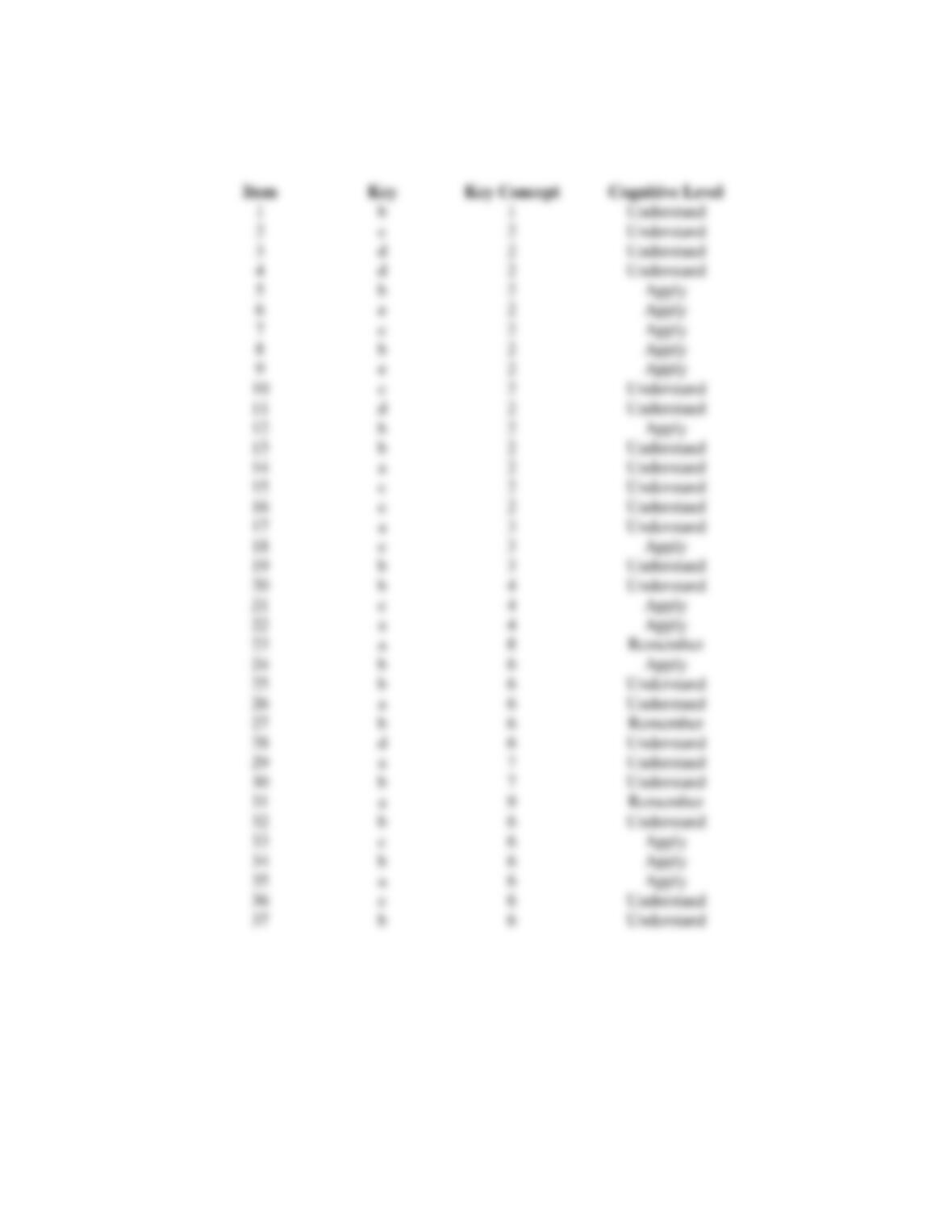
CHAPTER 7
Answers and Classification of Items