Chapter 7—Random variables and discrete probability distributions
MULTIPLE CHOICE
1. A statistical measure of the strength of the linear relationship between two random variables X and Y is
referred to as the:
A.
expected value.
B.
variance.
C.
covariance.
D.
standard deviation.
2. A table, formula, or graph that shows all possible values a random variable can assume, together with
their associated probabilities, is called a:
A.
discrete probability distribution.
B.
continuous probability distribution.
C.
bivariate probability distribution.
D.
probability tree.
3. If X and Y are random variables with E(X) =7 and E(Y) = 3, then E(2X + 3Y) is:
A.
10.
B.
23.
C.
27.
D.
21.
4. If X and Y are two independent random variables with V(X) = 6 and V(Y) = 5, then V(3X + 2Y) is:
A.
11.
B.
158.
C.
28.
D.
74.
5. If X and Y are any random variables with E(X)= 3, E(Y) = 2, E(XY) = 12, V(X) = 16 and V(Y) = 25, then
the relationship between X and Y is a:
Hint: corr(X,Y) =( E(xy) – E(x)E(y))/
A.
weak negative relationship.
B.
strong positive relationship.
C.
strong negative relationship.
D.
weak negative relationship.
6. Which of the following is not a characteristic of a binomial experiment?
A.
There is a sequence of identical trials.
B.
Each trial results in two or more outcomes.
C.
The trials are independent of each other.
D.
Probability of success p is the same from one trial to another.
7. The expected value, E(X), of a binomial probability distribution is:
A.
n + p.
B.
np(1 – p).
C.
np.
D.
n + p – 1.
8. The Poisson random variable is a:
A.
discrete random variable with infinitely many possible values.
B.
discrete random variable with a finite number of possible values.
C.
continuous random variable with infinitely many possible values.
D.
continuous random variable with a finite number of possible values.
9. Which probability distribution is appropriate when the events of interest occur randomly,
independently of one another, and rarely?
A.
Binomial distribution.
B.
Poisson distribution.
C.
Any discrete distribution.
D.
Any continuous distribution.
10. The expected number of heads in 90 tosses of an unbiased coin is:
A.
30.
B.
45.
C.
50.
D.
60.
11. Which of the following cannot generate a Poisson distribution?
A.
The number of children watching a movie.
B.
The number of telephone calls received by a switchboard in a specified time period.
C.
The number of customers arriving at a petrol station on Christmas day.
D.
The number of bacteria found in a cubic yard of soil.
12. A Poisson distribution with = .60 is a:
A.
symmetrical distribution.
B.
negatively skewed distribution (skewed to the left).
C.
positively skewed distribution (skewed to the right).
D.
binomial distribution.
13. A binomial distribution for which the number of trials n is large can well be approximated by a
Poisson distribution when the probability of success, p, is:
A.
larger than 0.95.
B.
larger than 0.50.
C.
between 0.25 and 0.50.
D.
smaller than 0.05.
14. The standard deviation of a binomial distribution for which n = 100 and p = .35 is:
A.
4.77.
B.
2.275.
C.
47.7.
D.
22.75.
15. The weighted average of the possible values that a random variable X can assume, where the weights
are the probabilities of occurrence of those values, is referred to as the:
A.
variance.
B.
standard deviation.
C.
expected value.
D.
covariance.
16. The number of accidents that occur annually on a busy stretch of highway is an example of:
A.
a discrete random variable.
B.
a continuous random variable.
C.
a discrete probability distribution.
D.
a continuous probability distribution.
17. Given that X is a binomial random variable, the binomial probability P(X
x) is approximated by the
area under a normal curve to the right of:
A.
x – 0.5.
B.
x + 0.5.
C.
x – 1.
D.
x + 1.
18. A function that assigns a numerical value to each simple event of an experiment is called:
A.
a sample space.
B.
a probability tree.
C.
a probability distribution.
D.
a random variable.
SHORT ANSWER
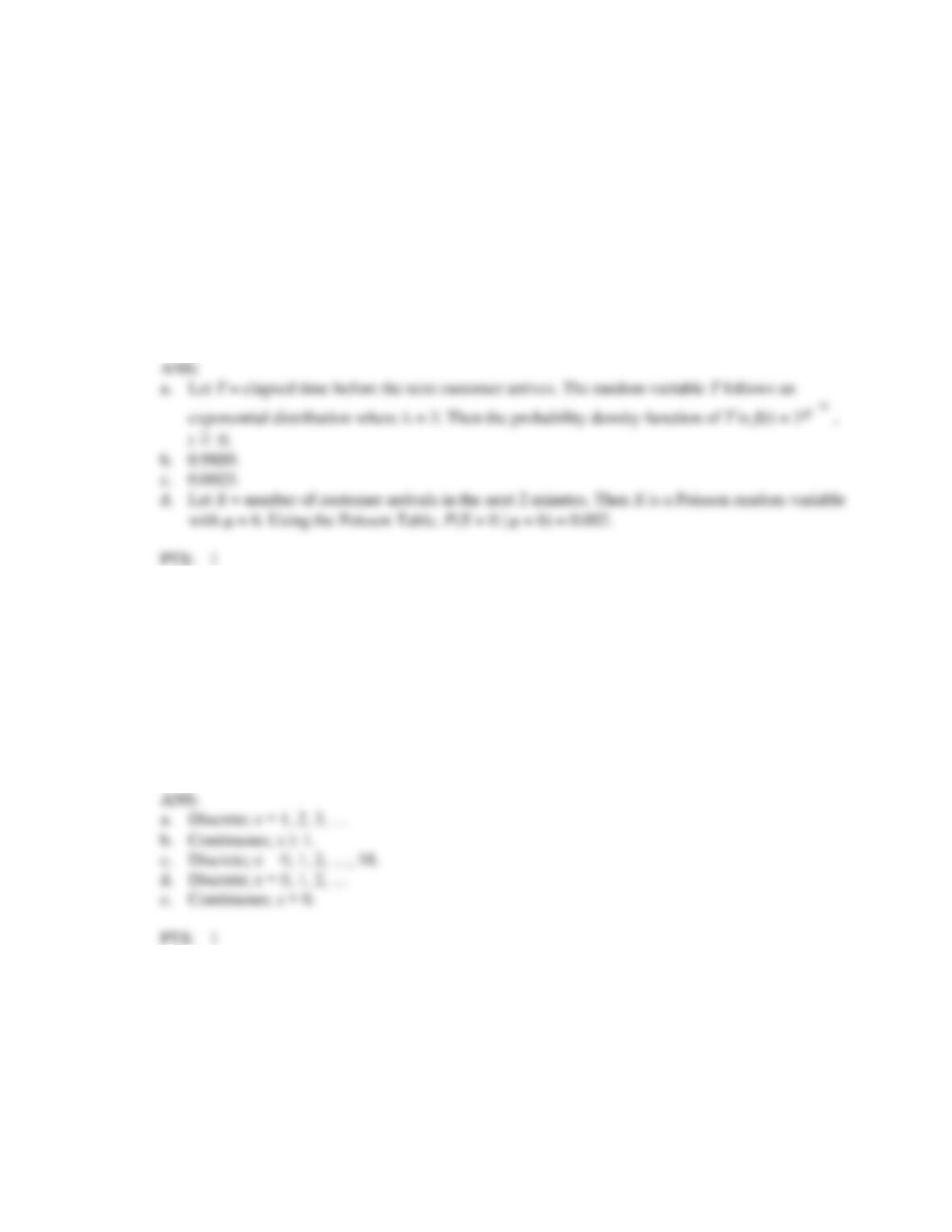
1. Suppose that customers arrive at a drive-through window at an average rate of three customers per
minute and that their arrival follows the Poisson model.
a. Write the probability density function of the distribution of the time that will elapse before the next
customer arrives.
b. Use the appropriate exponential distribution to find the probability that the next customer will
arrive within 1.5 minutes.
c. Use the appropriate exponential distribution to find the probability that the next customer will not
arrive within the next 2 minutes.
d. Use the appropriate Poisson distribution to answer part (c).
2. For each of the following random variables, indicate whether the variable is discrete or continuous,
and specify the possible values that it can assume.
a. X = the number of students in a tutorial class (assuming that there is at least one student in the
class)
b. X = the average number of students per tutorial class in a random sample of 10 tutorial classes
(assuming that there is at least one student in every class)
c. X = the number of students in a tutorial class of 18 who pass the mid-semester exam
d. X = the number of spectators on the next Australia v New Zealand cricket match
e. X = the weight of a newborn baby
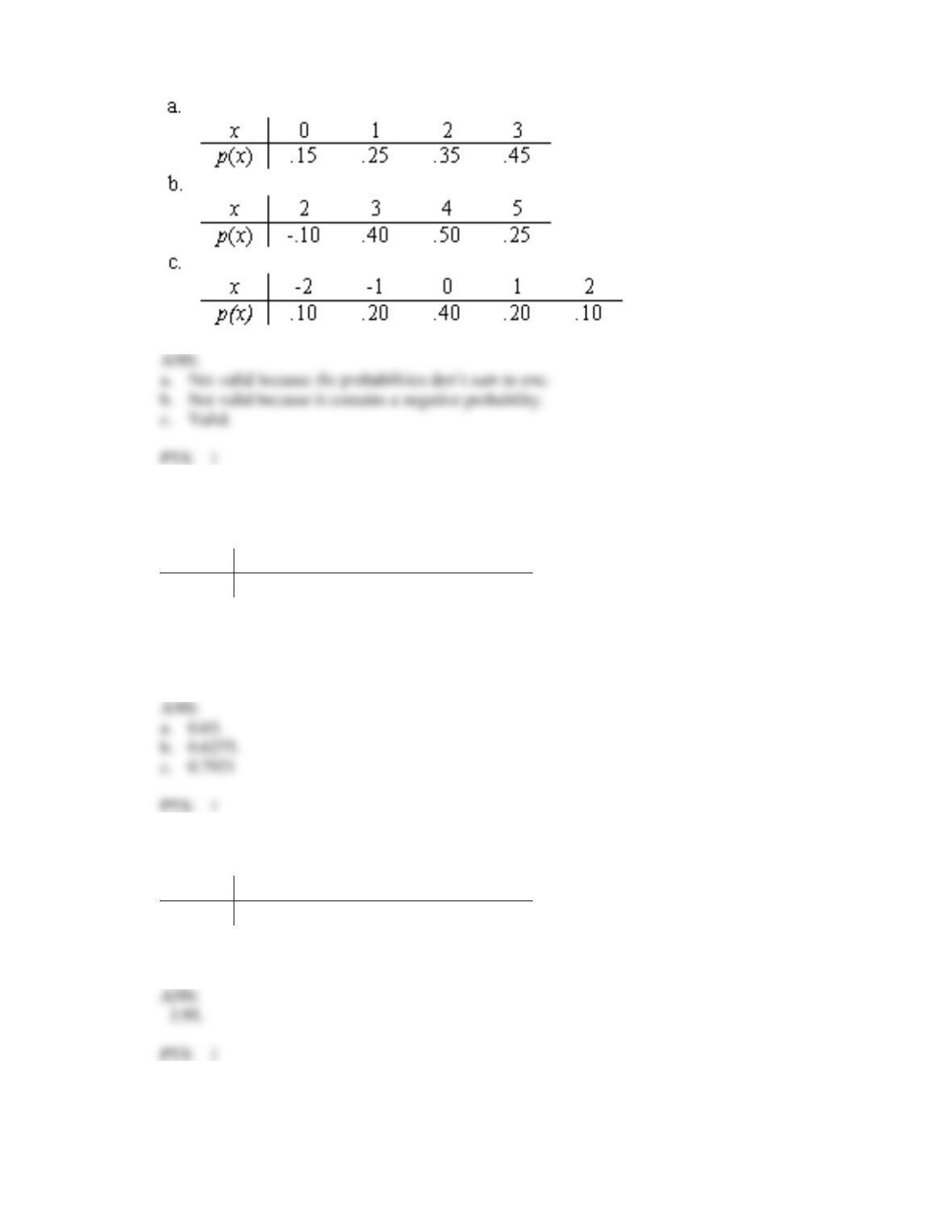
3. State whether or not each of the following are valid probability distributions, and if not, explain why
not.
4. The probability distribution for X is as follows:
x
–1
0
1
2
p(x)
0.1
0.25
0.55
0.1
a. Find E(X).
b. Find V(X).
c. Find
.
5. The probability distribution for X is as follows:
x
–1
0
1
2
p(x)
0.1
0.25
0.55
0.1
Find the expected value of Y = –3X – 2.
6. The probability distribution for X is as follows:
x
–1
0
1
2
p(x)
0.1
0.25
0.55
0.1
a. Find E(–2X + 1).
b. Find V(–2X + 1).
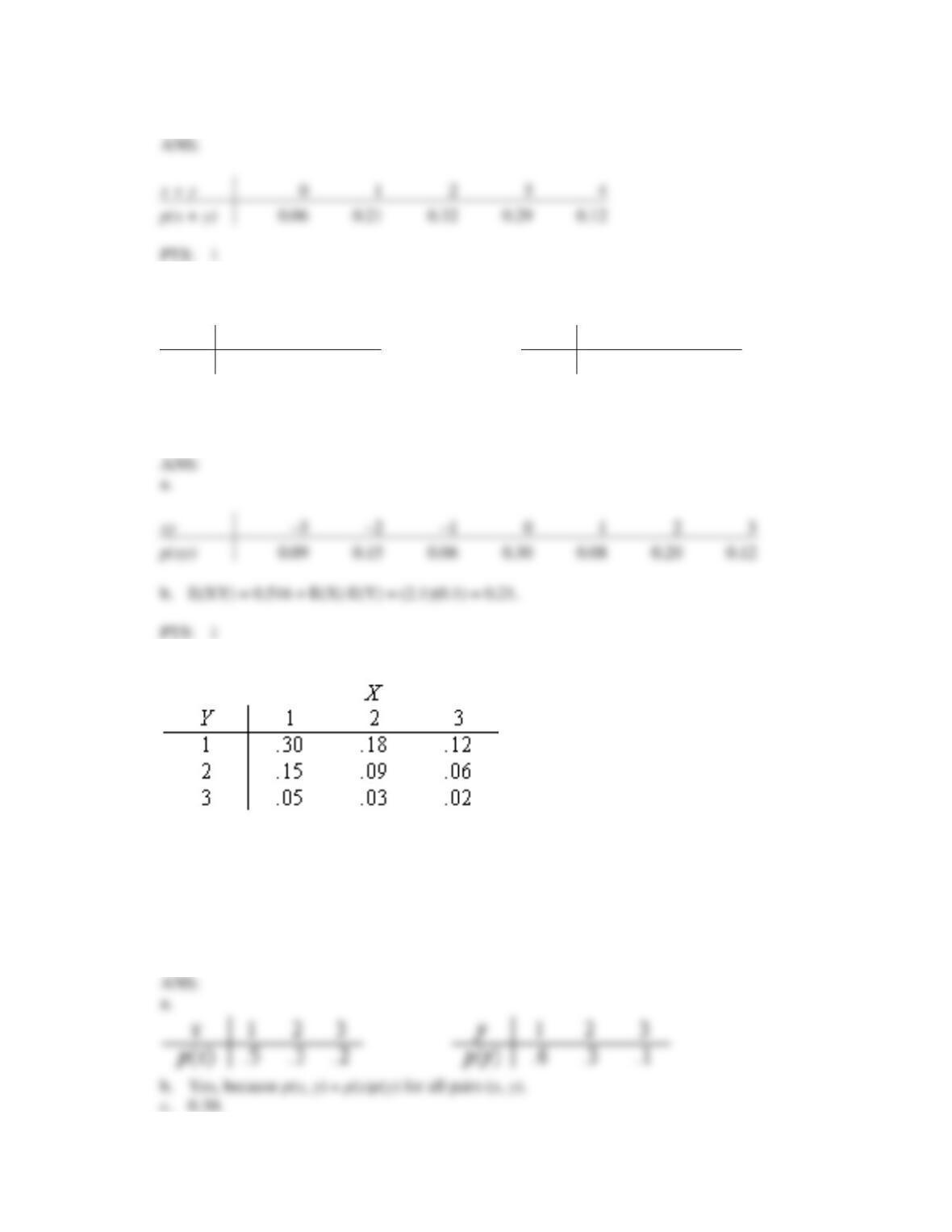
7. Let X represent the number of children in an Egyptian household. The probability distribution of X is
as follows:
What is the probability that a randomly selected Egyptian household will have:
a. more than 3 children?
b. between 3 and 5 children?
c. fewer than 4 children?
8. Let X represent the number of children in an Egyptian household. The probability distribution of X is
as follows:
a. Find the expected number of children in a randomly selected Egyptian household.
b. Find the standard deviation of the number of children in an Egyptian household.
9. Let X and Y be two independent random variables with the following probability distributions:
y
–1
0
1
p(y)
0.3
0.3
0.4
x
1
2
3
p(x)
0.2
0.5
0.3
Find the probability distribution of the random variable X + Y.
10. Let X and Y be two independent random variables with the following probability distributions:
y
–1
0
1
p(y)
0.3
0.3
0.4
p(xy)
a. Find the probability distribution of the random variable XY.
b. Check whether E(XY) = E(X) ´ E(Y) by separately evaluating each side of the equality.
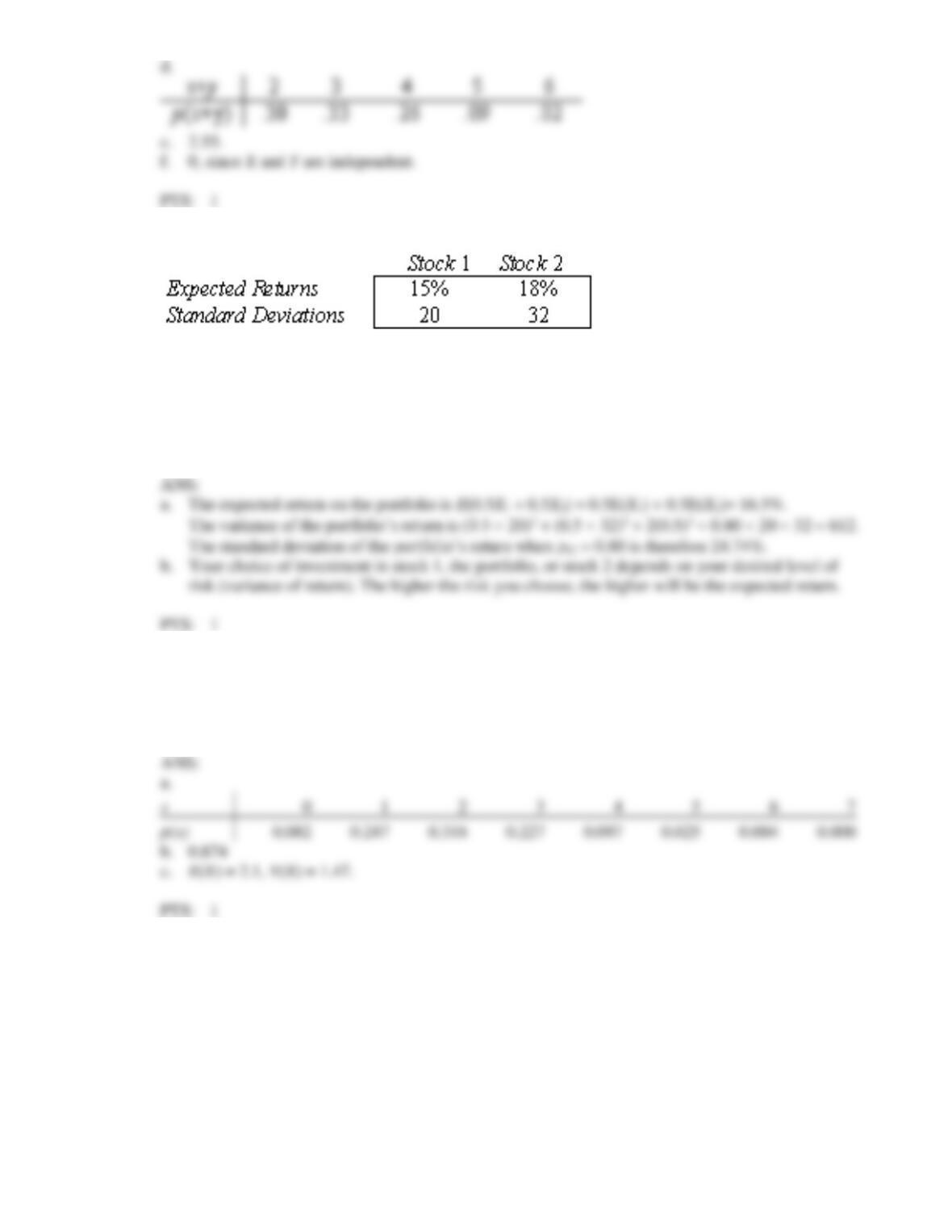
11. The joint probability distribution of X and Y is shown in the following table.
a. Determine the marginal probability distributions of X and Y.
b. Are X and Y independent? Explain.
c. Find P(Y = 2 | X = 1).
d. Find the probability distribution of the random variable X + Y.
e. Find E(XY).
f. Find COV(X, Y).
x
1
2
3
p(x)
0.2
0.5
0.3
x + y
p(x + y)
12. An analysis of the stock market produces the following information about the returns of two stocks:
Assume that the returns are positively correlated, with 12 = 0.80.
a. Find the mean and standard deviation of the return on a portfolio consisting of an equal investment
in each of the two stocks.
b. Suppose that you wish to invest $1 million. Discuss whether you should invest your money in
stock 1, stock 2, or a portfolio composed of an equal amount of investments on both stocks.
13. Consider a binomial random variable X with n = 7 and p = 0.3.
a. Find the probability distribution of X.
b. Find P(X < 3).
c. Find the mean and the variance of X.
14. Given a binomial random variable with n = 20 and p = 0.6, find the following probabilities using the
binomial table.
a. P(X 13).
b. P(X 15).
c. P(X = 17).
d. P(11 < X < 14).
15. A recent survey in Victoria revealed that 60% of the vehicles travelling on highways, where speed
limits are posted at 100 kilometres per hour, were exceeding the limit. Suppose you randomly record
the speeds of 10 vehicles travelling on the Hume Highway, where the speed limit is 100 kilometres per
hour. Let X denote the number of vehicles that were exceeding the limit. Find the following
probabilities.
a. P(X = 10).
b. P(4 < X < 9).
c. P(X = 2).
d. P(3 X 6).
16. An official from the Australian Securities and Investments Commission estimates that 75% of all
investment bankers have profited from the use of insider information. If 15 investment bankers are
selected at random from the Commission’s registry, find the probability that:
a. at most 10 have profited from insider information.
b. at least six have profited from insider information.
c. all 15 have profited from insider information.
17. A market researcher selects 20 students at random to participate in a wine-tasting test. Each student is
blindfolded and asked to take a drink out of each of two glasses, one containing an expensive wine and
the other containing a cheap wine. The students are then asked to identify the more expensive wine. If
the students have no ability whatsoever to discern the more expensive wine, what is the probability
that the more expensive wine will be correctly identified by:
a. more than half of the students?
b. none of the students?
c. all of the students?
d. eight of the students?
18. Let X be a Poisson random variable with = 6. Use the table of Poisson probabilities to find:
a. P(X 8)
b. P(X = 8)
c. P(X 5)
d. P(6 X 10)
19. Let X be a Poisson random variable with = 8. Use the table of Poisson probabilities to find:
a. P(X 6).
b. P(X = 4).
c. P(X 3).
d. P(9 X 14).
20. The proprietor of a small hardware store employs three men and three women. He will select three
employees at random to work on Christmas Eve. Let X represent the number of women selected.
a. Express the probability distribution of X in tabular form.
b. What is the probability that at least two women will work on Christmas Eve?
21. Phone calls arrive at the rate of 30 per hour at the reservation desk for a hotel.
a. Find the probability of receiving two calls in a five-minute interval of time.
b. Find the probability of receiving exactly eight calls in 15 minutes.
c. If no calls are currently being processed, what is the probability that the desk employee can take a
four-minute break without being interrupted?
22. An advertising executive receives an average of 10 telephone calls each afternoon between 2 and 4pm.
The calls occur randomly and independently of one another.
a. Find the probability that the executive will receive 13 calls between 2 and 4pm on a particular
afternoon.
b. Find the probability that the executive will receive seven calls between 2 and 3pm on a particular
afternoon.
c. Find the probability that the executive will receive at least five calls between 2 and 4pm on a
particular afternoon.
23. The number of arrivals at a local petrol station between 3:00 and 5:00pm has a Poisson distribution
with a mean of 12.
a. Find the probability that the number of arrivals between 3:00 and 5:00pm is at least 10.
b. Find the probability that the number of arrivals between 3:30 and 4:00pm is at least 10.
c. Find the probability that the number of arrivals between 4:00 and 5:00pm is exactly two.
24. Let X be a binomial random variable with n = 25 and p = 0.01.
a. Use the binomial table to find P(X = 0), P(X = 1), and P(X = 2).
b. Approximate the three probabilities in part (a) using the appropriate Poisson distribution.
c. Compare your approximations in part (b) with the exact probabilities found in part (a). What is
your conclusion?
25. Historical data collected at the Commonwealth Bank in Sydney revealed that 80% of all customers
applying for a loan are accepted. Suppose that 50 new loan applications are selected at random.
a. Find the expected value and the standard deviation of the number of loans that will be accepted by
the bank.
b. What is the probability that at least 42 loans will be accepted?
c. What is the probability that the number of loans rejected is between 10 and 15, inclusive?
26. Given a binomial random variable with n =15 and p = 0.40, find the exact probabilities of the
following events and their normal approximations.
a. X = 6.
b. X
9.
c. X
10.