
College Physics: A Strategic Approach, 3e (Knight)
Chapter 7 Rotational Motion
7.1 Conceptual Questions
1) There must be equal amounts of mass on both sides of the center of mass (or center of gravity)
of a system.
A) True
B) False
2) When a rigid object rotates about a fixed axis, what is true about all the points in the object?
(There could be more than one correct choice.)
A) They all have the same angular speed.
B) They all have the same tangential speed.
C) They all have the same angular acceleration.
D) They all have the same tangential acceleration.
E) They all have the same radial acceleration.
3) Two children, Ahmed and Jacques, ride on a merry-go-round. Ahmed is at a greater distance
from the axis of rotation than Jacques. Which of the following are true statements? (There could
be more than one correct choice.)
A) Jacques has a greater angular speed than Ahmed.
B) Jacques and Ahmed have the same angular speed.
C) Jacques has a smaller angular speed than Ahmed.
D) Ahmed has a greater tangential speed than Jacques.
E) Jacques and Ahmed have the same tangential speed.
4) A car is traveling along a freeway at 65 mph. What is the linear speed, relative to the highway,
of each of the following points on one of its tires?
(a) the highest point on the tire
(b) the lowest point on a tire
(c) the center of the tire
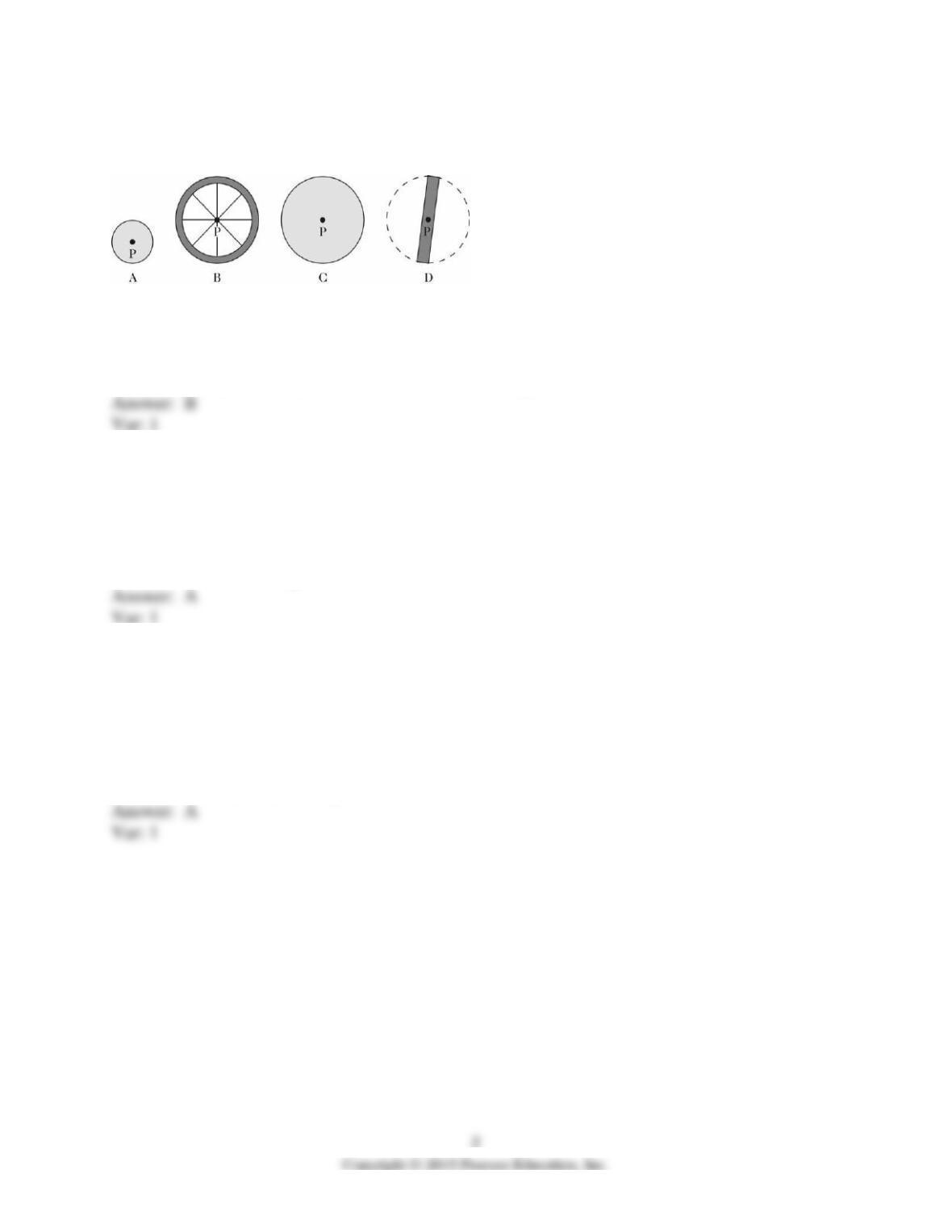
5) The figure shows scale drawings of four objects, each of the same mass and uniform
thickness, with the mass distributed uniformly. Which one has the greatest moment of inertia
when rotated about an axis perpendicular to the plane of the drawing at point P?
A) A
B) B
C) C
D) D
E) The moment of inertia is the same for all of these objects.
6) Two forces produce equal torques on a door about the door hinge. The first force is applied at
the midpoint of the door; the second force is applied at the doorknob. Both forces are applied
perpendicular to the door. Which force has a greater magnitude?
A) the first force (at the midpoint)
B) the second force (at the doorknob)
C) The two forces are equal.
7) Two equal-magnitude forces are applied to a door at the doorknob. The first force is applied
perpendicular to the door, and the second force is applied at 30° to the plane of the door. Which
force exerts the greater torque about the door hinge?
A) the first force (applied perpendicular to the door)
B) the second force (applied at an angle)
C) Both forces exert equal non-zero torques.
D) Both forces exert zero torque.
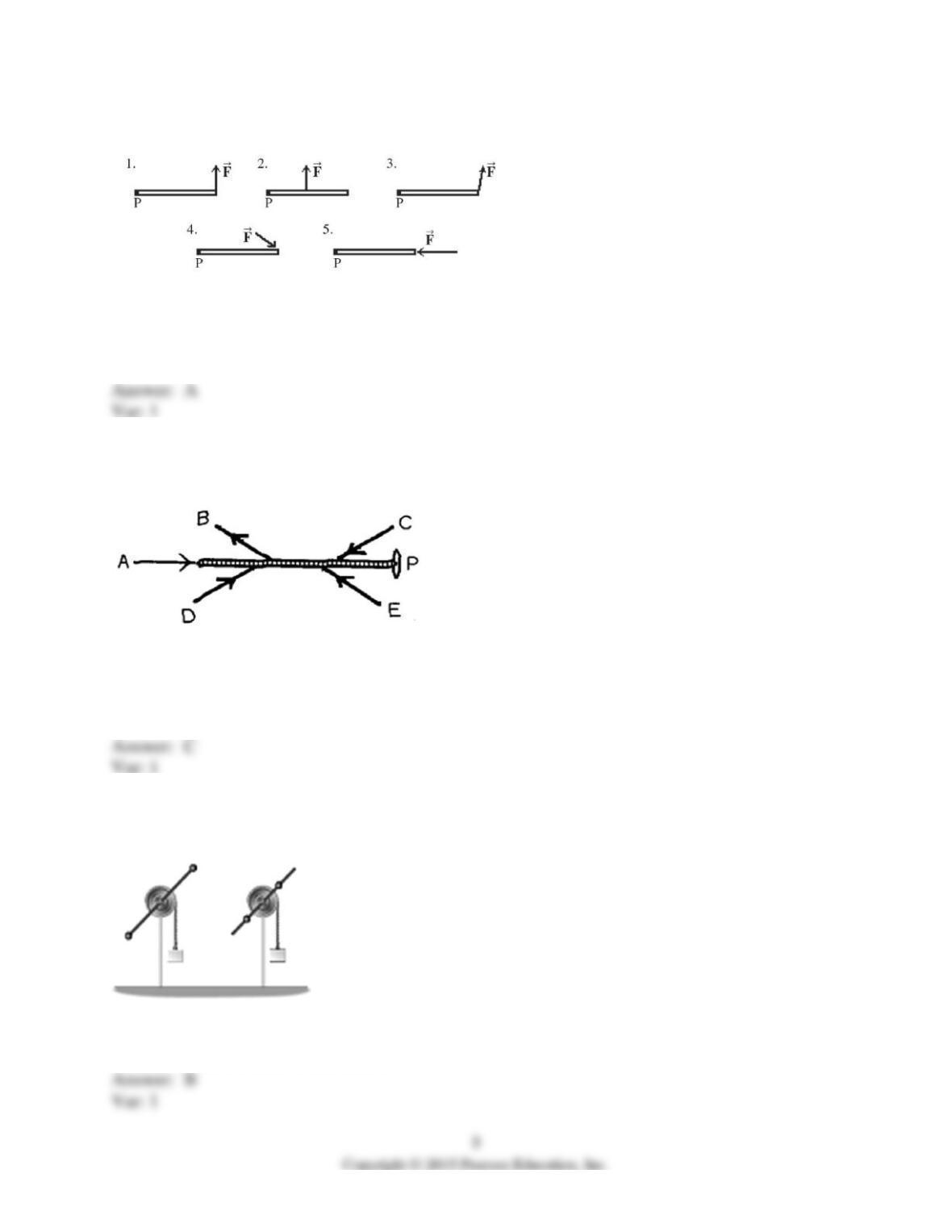
8) As shown in the figure, a given force is applied to a rod in several different ways. In which
case is the torque about the pivot P due to this force the greatest?
A) 1
B) 2
C) 3
D) 4
E) 5
9) Five forces act on a rod that is free to pivot at point P, as shown in the figure. Which of these
forces is producing a counter-clockwise torque about point P? (There could be more than one
correct choice.)
A) force A
B) force B
C) force C
D) force D
E) force E
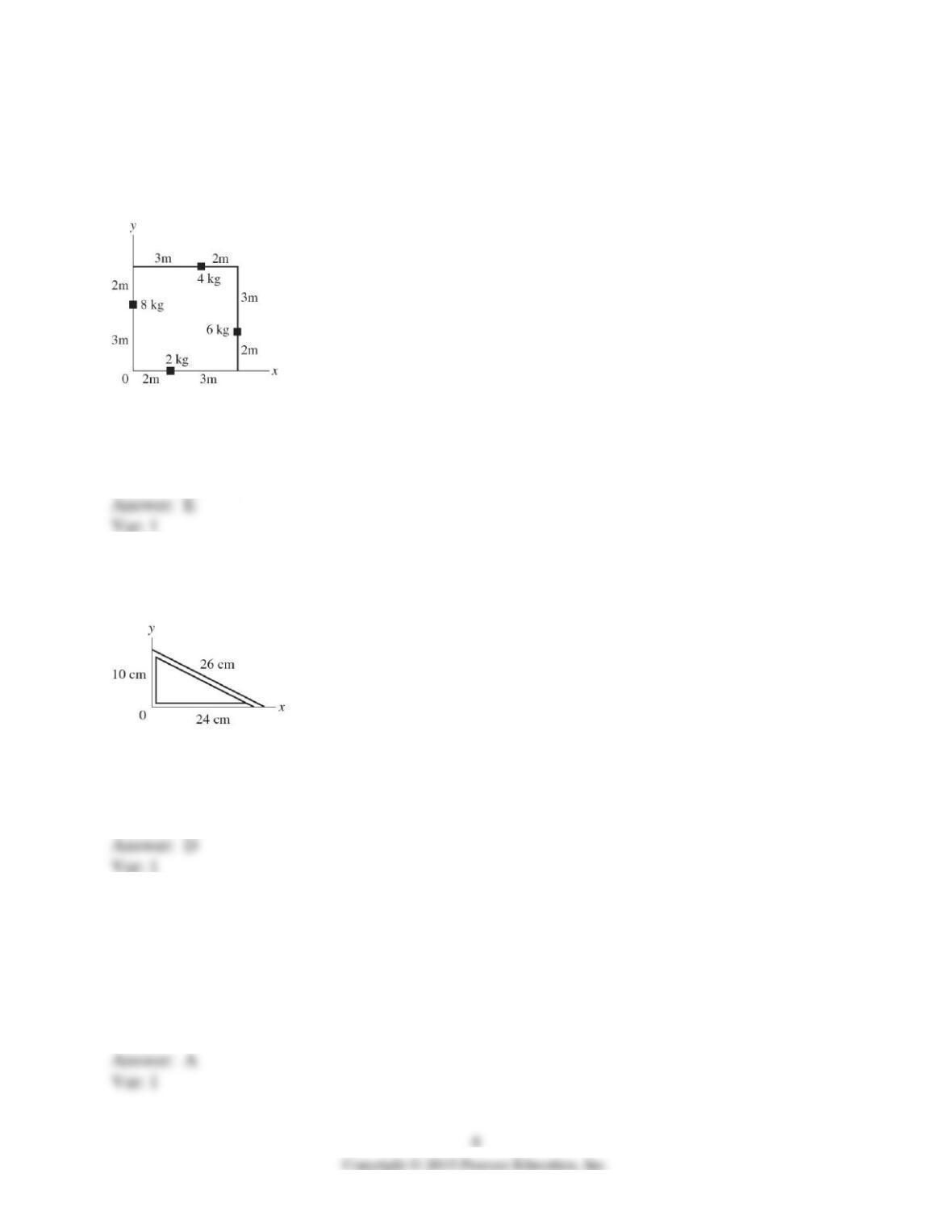
10) The rotating systems shown in the figure differ only in that the two identical movable masses
are positioned a distance r from the axis of rotation (left), or a distance r/2 from the axis of
rotation (right). If you release the hanging blocks simultaneously from rest,
A) the block at the left lands first.
B) the block at the right lands first.
C) both blocks land at the same time.
7.2 Problems
1) In the figure, four point masses are placed as shown. Assume that all the numbers in the figure
are accurate to two significant figures. What are the x and y coordinates of the center of mass (or
center of gravity) of this arrangement?
A) (2.2 m, 2.6 m)
B) (2.2 m, 2.7 m)
C) (2.3 m, 2.6 m)
D) (2.3 m, 2.7 m)
E) (2.3 m, 2.8 m)
2) As shown in the figure, a 60-cm length of uniform wire, of mass 60 g, is bent into a right
triangle. What are the x and y coordinates of the center of mass (or center of gravity) of this
triangle?
A) (8.0 cm, 3.0 cm)
B) (8.0 cm, 5.0 cm)
C) (9.0 cm, 4.0 cm)
D) (10 cm, 3.0 cm)
E) (10 cm, 5.0 cm)
3) A 60.0-kg man stands at one end of a 20.0-kg uniform 10.0-m long board. How far from the
man is the center of mass (or center of gravity) of the man-board system?
A) 1.25 m
B) 2.50 m
C) 5.00 m
D) 7.50 m
E) 9.00 m
4) A 2.0-m rope is lying on a table. You pick up one end and start raising it vertically. How high
above the table is the center of mass (or center of gravity) of the rope when half of the rope has
lifted off the table?
A) 0.25 m
B) 0.50 m
C) 0.75 m
D) 1.0 m
E) 1.5 m
5) Three masses are located in the x–y plane as follows: a mass of 6 kg is at (0 m, 0 m), a mass of
4 kg is at (3 m, 0 m), and a mass of 2 kg is at (0 m, 3 m). Where is the center of mass (or center
of gravity) of the system?
A) (1 m, 2 m)
B) (2 m, 1 m)
C) (1 m, 1 m)
D) (1 m, 0.5 m)
E) (0.5 m, 1 m)
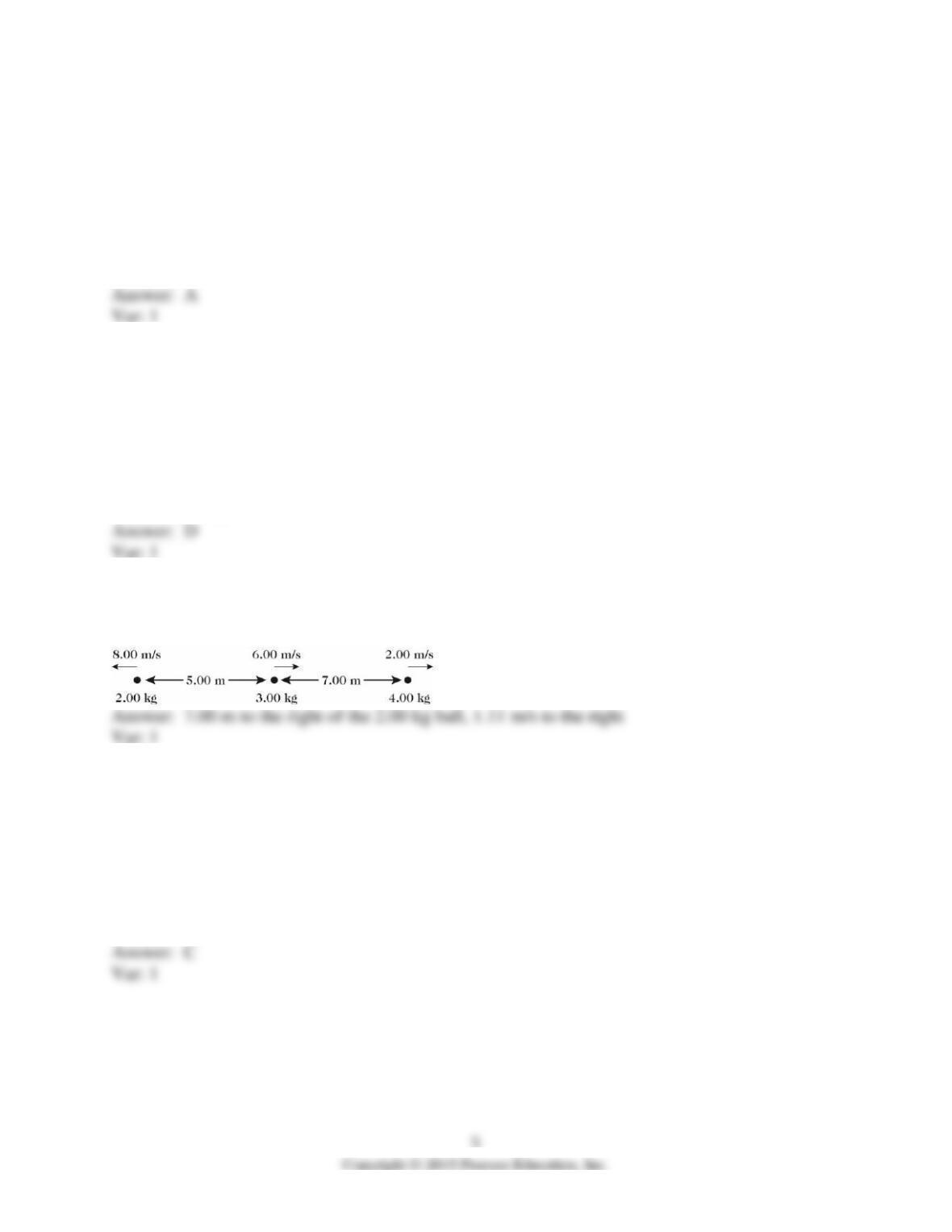
6) Three balls are moving along a straight line having the instantaneous positions shown in the
figure. At that instant, find the location and velocity of the center of mass (or center of gravity) of
this system.
7) A 30-kg child stands at one end of a floating 20-kg canoe that is 5.0-m long and initially at
rest in the water. The child then slowly walks to the other end of the canoe. How far does the
canoe move in the water, assuming water friction is negligible?
A) 1.0 m
B) 2.0 m
C) 3.0 m
D) 4.0 m
E) 5.0 m

8) The center of mass (or center of gravity) of a two-particle system is at the origin. One particle
is located at (3.0 m, 0.0 m) and has a mass of 2.0 kg. The other particle has a mass of 3.0 kg.
What is the location of the 3.0-kg particle?
A) (-3.0 m, 0.0 m)
B) (-2.0 m, 0.0 m)
C) (2.0 m, 0.0 m)
D) (3.0 m, 0.0 m)
9) Three small masses are positioned at the following coordinates: 3.0 kg at (3.0 m, 2.0 m); 4.0
kg at (0.0 m, -1.0 m); and 5.0 kg at (5.0 m, -7.0 m). What are the coordinates of the center of
mass (or center of gravity) of this system?
10) Three small masses are positioned as follows: 2.0 kg at (0.0 m, 0.0 m), 2.0 kg at (2.0 m, 0.0
m), and 4.0 kg at (2.0 m, 1.0 m). Determine the coordinates of the center of mass (or center of
gravity) of this system.
A) (0.50 m, 1.5 m)
B) (1.5 m, 0.50 m)
C) (2.5 m, 1.5 m)
D) (2.5 m, 0.50 m)
11) Three masses, 1.0 kg, 2.0 kg, and 3.0 kg, are located at (0.0 m, 0.0 m), (1.0 m, 1.0 m), and
(2.0 m, -2.0 m), respectively. What is the location of the center of mass (or center of gravity) of
this system?
A) (1.3 m, 0.67 m)
B) (1.3 m, -0.67 m)
C) (-1.3 m, 0.67 m)
D) (-1.3 m, -0.67 m)
12) A 3.0-kg mass is located at (0.0 m, 8.0 m), and a 1.0-kg mass is located at (12 m, 0.0 m).
You want to add a 4.0-kg mass so that the center of mass (or center of gravity) of the three-mass
system will be at the origin. What should be the coordinates of the 4.0-kg mass?
A) (-3.0 m, -6.0 m)
B) (-12 m, -8.0 m)
C) (3.0 m, 6.0 m)
D) (-6.0 m, -3.0 m)
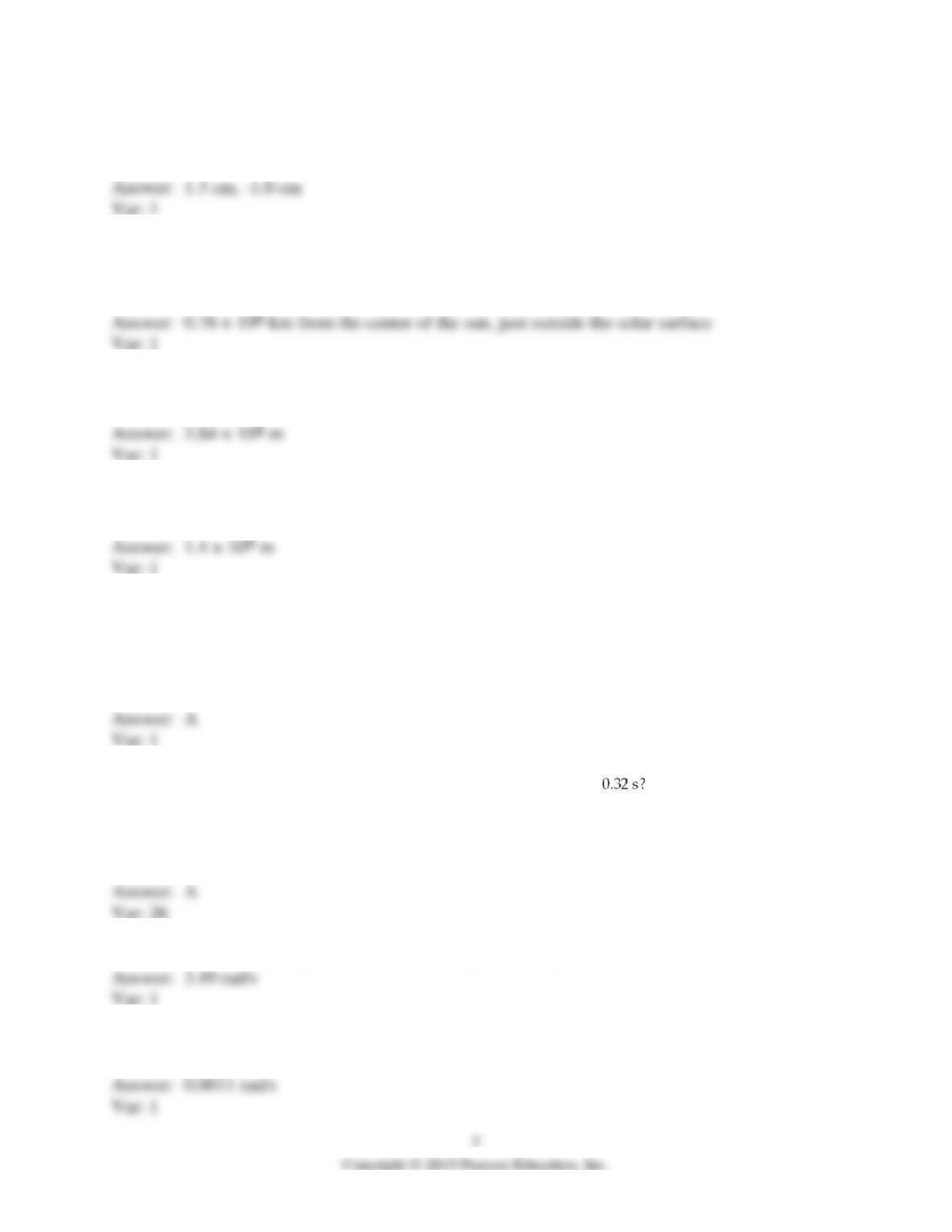
13) A 1.0-g bead is at (-2.0 cm, 2.0 cm), a 2.0-g bead is at (2.0 cm, -4.0 cm), and a 3.0-g bead is
at (2.0 cm, 0.0 cm). What are the coordinates of the center of mass (or center of gravity) of this
system of beads?
14) Consider the sun and its largest planet Jupiter. On the line joining them, how far from the
center of the sun is their center mass? Is it within or outside the sun? (Jupiter-sun distance is 778
× 106 km, diameter of the sun is 1.4 × 10⁶ km, the sun is 1000 times as massive as Jupiter)
15) The diameter of the Moon is 3.47 × 10⁶ m, and it subtends an angle of 0.00904 rad when
viewed from the surface of Earth. How far is the Moon from Earth?
16) The sun subtends an angle of 0.00928 rad when viewed from the surface of the earth, and its
distance from Earth is 1.5 × 10¹¹ m. What is the diameter of the sun?
17) What is the angular speed, in rad/s, of a flywheel turning at 813.0 rpm?
A) 85.14 rad/s
B) 13.53 rad/s
C) 63.84 rad/s
D) 95.33 rad/s
18) Through how many degrees does a 33 rpm turntable rotate in
A) 63°
B) 35°
C) 46°
D) 74°
19) Express the angular speed of an old 33 1/3 rpm LP in rad/s.
20) An artificial satellite in a low orbit circles the earth every 98 minutes. What is its angular
speed in rad/s?

21) A chicken is running in a circular path with an angular speed of 1.52 rad/s. How long does it
take the chicken to complete one revolution?
A) 4.13 s
B) 2.07 s
C) 118 s
D) 4.77 s
E) 8.26 s
22) At a certain instant, a compact disc is rotating at 210 rpm. What is its angular speed in rad/s?
A) 11 rad/s
B) 22 rad/s
C) 45 rad/s
D) 69 rad/s
E) 660 rad/s
23) When a fan is turned off, its angular speed decreases from 10 rad/s to 6.3 rad/s in 5.0 s. What
is the magnitude of the average angular acceleration of the fan?
A) 0.86 rad/s2
B) 0.74 rad/s2
C) 0.37 rad/s2
D) 11 rad/s2
E) 1.2 rad/s2
24) A bicycle wheel has an outside diameter of 66 cm. Through what distance does a point on
the rim move as the wheel rotates through an angle of 70°?
25) When Mary is 3.00 m from the center of a merry-go-round, her tangential speed is a constant
1.88 m/s.
(a) What is her angular speed in rad/s?
(b) What is the magnitude of her linear acceleration?
26) A cylinder of radius 8.0 cm rolls 20 cm in 5.0 s without slipping. Through how many degrees
does the cylinder turn during this time?

27) A wheel of diameter 0.70 m rolls on the floor without slipping. A point at the top of the
wheel moves with a speed 2.0 m/s relative to the floor.
(a) At what speed is the central axis of the wheel moving relative to the floor?
(b) What is the angular speed of the wheel?
28) A child is riding a merry-go-round that is turning at 7.18 rpm. If the child is standing 4.65 m
from the center of the merry-go-round, how fast is the child moving?
A) 5.64 m/s
B) 3.50 m/s
C) 0.556 m/s
D) 1.75 m/s
E) 1.80 m/s
29) An electrical motor spins at a constant If the rotor radius is what is the
linear acceleration of the edge of the rotor?
A) 5707 m/s2
B) 281.6 m/s2
C) 572,400 m/s2
D) 28.20 m/s2
30) A string is wound tightly around a fixed pulley having a radius of 5.0 cm. As the string is
pulled, the pulley rotates without any slipping of the string. What is the angular speed of the
pulley when the string is moving at 5.0 m/s?
A) 100 rad/s
B) 50 rad/s
C) 25 rad/s
D) 20 rad/s
E) 10 rad/s

31) A scooter has wheels with a diameter of 120 mm. What is the angular speed of the wheels
when the scooter is moving forward at 6.00 m/s?
A) 47.7 rpm
B) 955 rpm
C) 72.0 rpm
D) 50.0 rpm
E) 100 rpm
32) A bicycle has wheels that are 60 cm in diameter. What is the angular speed of these wheels
when it is moving at 4.0 m/s?
A) 1.2 rad/s
B) 4.8 rad/s
C) 0.36 rad/s
D) 13 rad/s
E) 7.6 rad/s
33) A bowling ball of mass 7.5 kg and diameter 18 cm rolls without slipping down a 10-m
bowling lane with a constant speed 4.3 m/s.
(a) Through what angle does the bowling ball turn as it travels the length of the lane?
(b) What is the angular speed of the bowling ball?
(c) Calculate the maximum radial acceleration that a point on the surface of the bowling ball
could have.
(d) Calculate the tangential acceleration of a point on the surface of the bowling ball.
34) A rolling wheel of diameter of 68 cm slows down uniformly from 8.4 m/s to rest over a
distance of 115 m. What is the magnitude of its angular acceleration if there was no slipping?
A) 1.8 rad/s2
B) 0.90 rad/s2
C) 5.7 rad/s2
D) 11 rad/s2
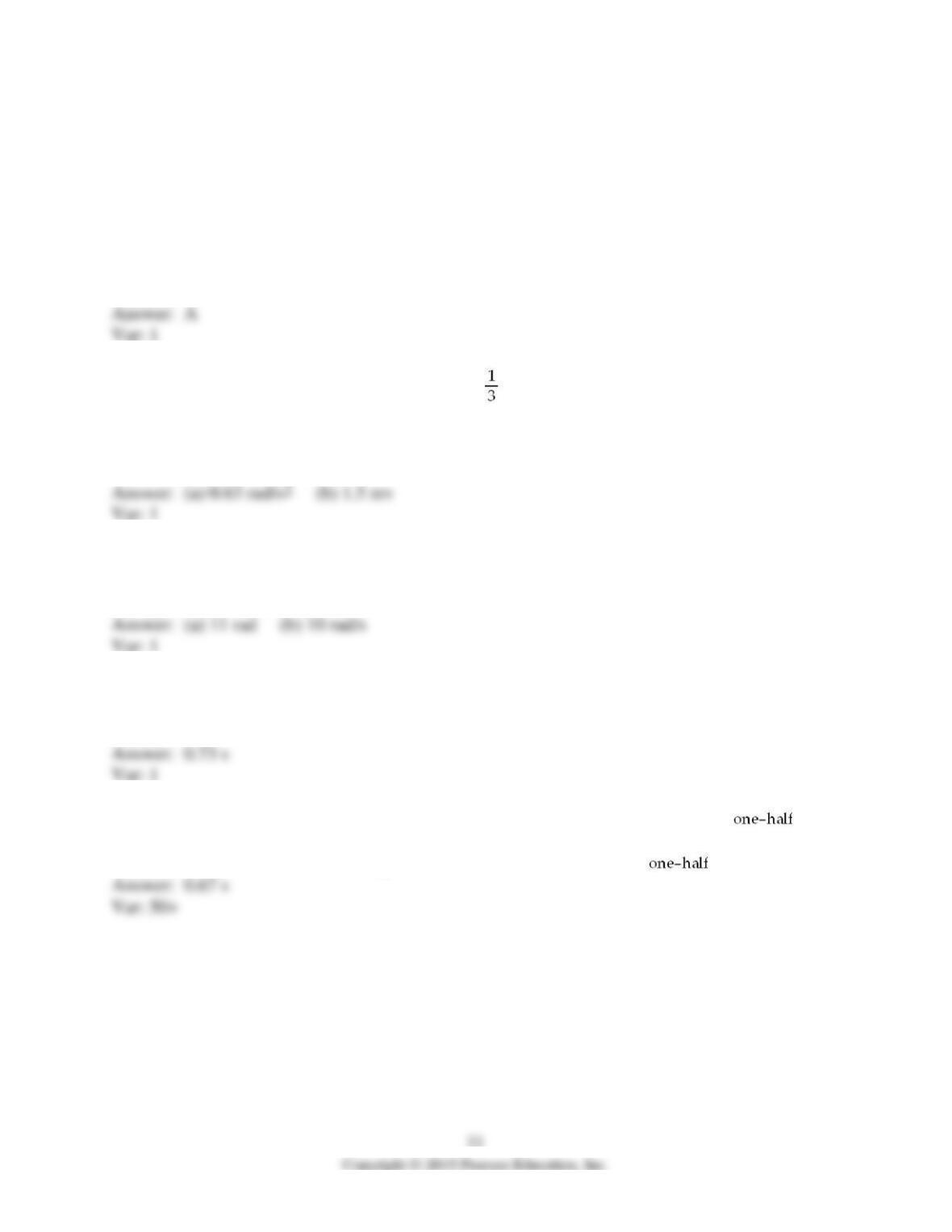
35) A child is riding a merry-go-round that has an instantaneous angular speed of 1.25 rad/s and
an angular acceleration of 0.745 rad/s2. The child is standing 4.65 m from the center of the
merry-go-round. What is the magnitude of the linear acceleration of the child?
A) 8.05 m/s2
B) 7.27 m/s2
C) 2.58 m/s2
D) 3.46 m/s2
E) 4.10 m/s2
36) When an old LP turntable was revolving at 33 rpm, it was shut off and uniformly slowed
down and stopped in 5.5 seconds.
(a) What was the magnitude of its angular acceleration (in rad/s2) as it slowed down?
(b) Through how many revolutions did it turn while stopping?
37) A wheel accelerates with a constant angular acceleration of 4.5 rad/s2 from an initial angular
speed of 1.0 rad/s. (a) Through what angle does the wheel turn in the first 2.0 s, and (b) what is
its angular speed at that time?
38) A wheel starts from rest and has a uniform angular acceleration of 4.0 rad/s2. After the
wheel completes its first revolution, how long does it take for it to make its second complete
revolution?
39) A bicycle wheel has an initial angular speed of 7.2 rad/s. After turning through of a
revolution, the angular speed is reduced to 2.2 rad/s. If the angular acceleration of the wheel was
constant during the motion, how long will it take the wheel to make the revolution?

40) How long does it take for a rotating object to speed up from 15.0 rad/s to 33.3 rad/s if it has a
uniform angular acceleration of 3.45 rad/s2?
A) 4.35 s
B) 5.30 s
C) 9.57 s
D) 10.6 s
E) 63.1 s
41) A wheel accelerates from rest to at a uniform rate of Through what angle (in
radians) did the wheel turn while accelerating?
A) 30 rad
B) 24 rad
C) 60 rad
D) 38 rad
42) A machinist turns on the power to a grinding wheel at time t = 0 s. The wheel accelerates
uniformly from rest for 10 s and reaches the operating angular speed of The wheel is run
at that angular speed for 30 s and then power is shut off. The wheel slows down uniformly at
until the wheel stops. In this situation, what is the angular acceleration of the wheel
between and
A) 3.8 rad/
B) 4.6 rad/
C) 5.3 rad/
D) 6.1 rad/
E) 6.8 rad/
43) A machinist turns on the power on to a grinding wheel at time t = 0 s. The wheel accelerates
uniformly from rest for 10 s and reaches the operating angular speed of The wheel is run
at that angular velocity for 30 s, and then power is shut off. The wheel slows down uniformly at
until the wheel stops. What is the total number of revolutions made by the wheel in this
situation?
A) 510
B) 280
C) 320
D) 470
E) 750
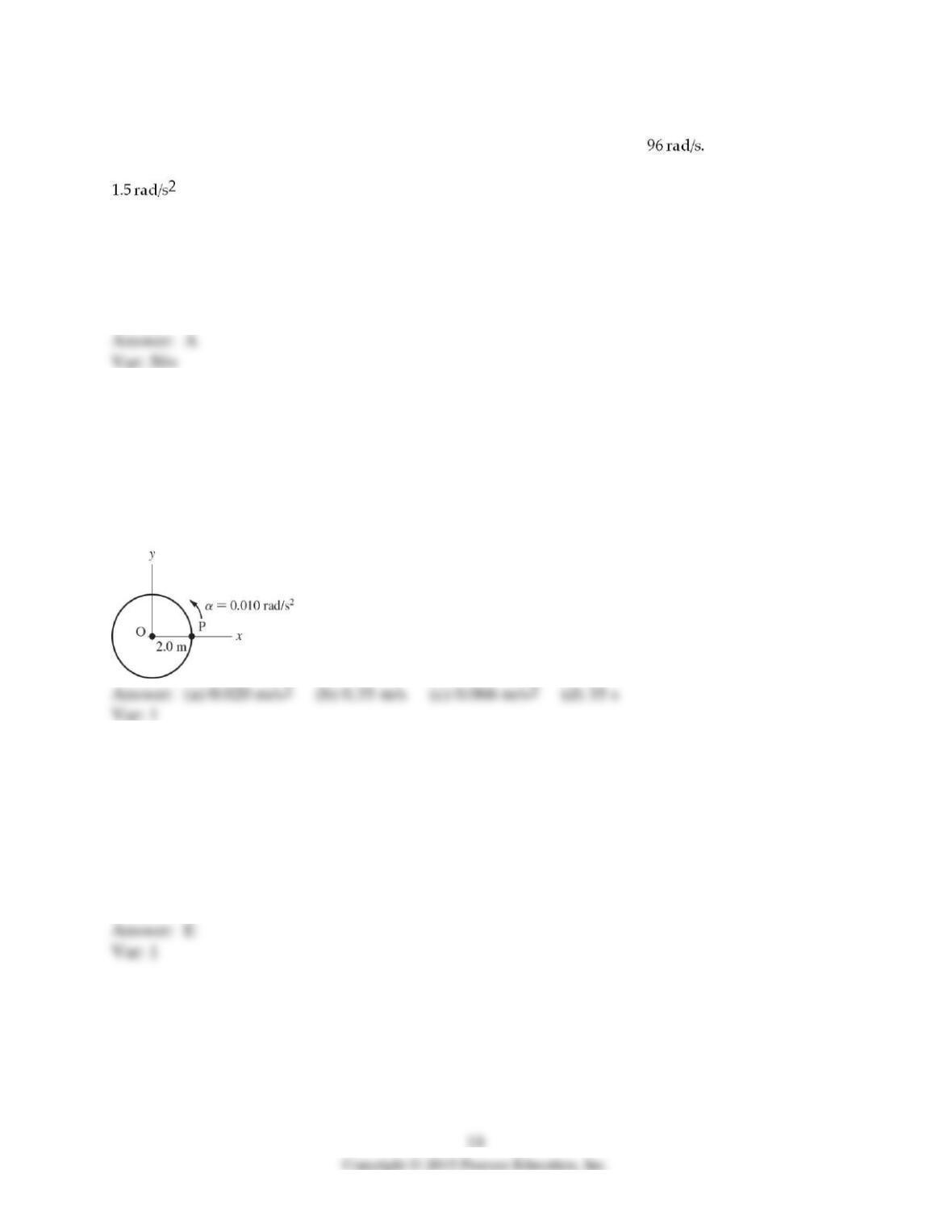
44) A machinist turns on the power on to a grinding wheel at time t = 0 s. The wheel accelerates
uniformly from rest for 10 s and reaches the operating angular speed of The wheel is run
at that angular velocity for 40 s and then power is shut off. The wheel slows down uniformly at
until the wheel stops. For how long a time after the power is shut off does it take the
wheel to stop?
A) 64 s
B) 62 s
C) 66 s
D) 68 s
E) 70 s
45) In the figure, point P is on the rim of a wheel of radius 2.0 m. At time t = 0, the wheel is at
rest, and P is on the x-axis. The wheel undergoes a uniform counterclockwise angular
acceleration of 0.010 rad/s2 about the center O.
(a) At time t = 0, what is the tangential acceleration of P?
(b) What is the linear speed of P when it reaches the y-axis?
(c) What is the magnitude of the net linear acceleration of P when it reaches the y-axis?
(d) How long after starting does it take for P to return to its original position on the x-axis?
46) An old LP record that is originally rotating at 33.3 rad/s is given a uniform angular
acceleration of 2.15 rad/s2. Through what angle has the record turned when its angular speed
reaches 72.0 rad/s?
A) 83.2 rad
B) 316 rad
C) 697 rad
D) 66.8 rad
E) 948 rad