Exam
Name___________________________________
MULTIPLE CHOICE. Choose the one alternative that best completes the statement or answers the question.
1)
Let f(x, y, z) be the amount of heat lost each day by a rectangular building x feet wide, y feet long,
and z feet high. Suppose that f
z(50, 80, 15) = 45. Which one of the following conclusions can be
drawn?
1)
A)
A building with dimensions 50 × 80 × 16 will lose about 45 more units of heat each day than a
building with dimensions 50 × 80 × 15 .
B)
A building with dimensions 51 × 81 × 16 will lose about 45 more units of heat each day than a
building with dimensions 50 × 80 × 15 .
C)
The marginal heat loss per day is 45 units of heat per square foot of surface area of the roof.
D)
A building with dimensions 50 × 80 × 15 loses about 45 units of heat each day.
E)
A building with dimensions 50 × 80 × 15 loses about 45 units of heat from the top of the
building each day
2)
Let f(x, y) =x2– xy +y2+ 2y – 4. The point –2
3, –4
3 is a
2)
A)
relative minimum
B)
absolute maximum
C)
not a relative extreme point
D)
relative maximum
3)
Let E =(2A + B – 3)2+(A + B + 2)2+ (4A + B – 1)2. What is E
A?
3)
A)
14A + 6B – 4
B)
42A + 24B – 9
C)
24A + 6B – 4
D)
42A + 14B – 9
E)
none of these
1
4)
Assume that a manufacturer has productivity function P(l, c) where l and c are the amounts of
labor and capital utilized. Which of the following indicates that a slight increase in the amount of
labor utilized will result in an increase in productivity of 3 units.
4)
A)
P(1, 75) = 3
B)
P
l(100, 75) = 3
C)
P
c(100, 75) = 3
D)
P(10, 75) = 3
E)
none of these
5)
The demand for a certain energy–efficient home is given by f(p1, p2), where p1 is the price of the
home and p2 is the price of electricity. Which of the following explains why f
p2
> 0?
5)
A)
As the price of electricity goes up, demand for the home goes down.
B)
As the price of electricity goes up, demand for the home goes up.
C)
Homes are too expensive during energy crises.
D)
The price of electricity keeps going up due to increased demand.
E)
As the price of electricity increases, demand for the home depends more on the price of the
home than on the price of electricity.
B
6)
Let f(x, y) = 5x2– 5y2+ 2xy + 34x + 38y + 12. At which point does f(x, y) have a possible maximum
or minimum value?
6)
A)
(4, –3)
B)
(–4, 3)
C)
(4, 3)
D)
(–4, –3)
B
2
B
7)
Suppose that a retailer sells f(p, a) units of an item, where p is the price per unit of the item and a is
the amount of money spent on advertising that item. Which of the following indicates that as the
amount spent on advertising is decreased, demand for the item also decreases?
7)
A)
f
p(50, 25) = – 1
B)
f
a(50, 25) = 10
C)
f
p(50, –1) = – 5
D)
f
a(50, 75) = – 10
8)
Let Q(x, y) =x2y +y3x4. The point (1, 0) is
8)
A)
a relative maximum point
B)
a relative minimum point
C)
absolute maximum
D)
not a relative extreme point
9)
Which straight line best fits the data points (0, 1), (1, 3), (2, 7)? Use partial derivatives.
9)
A)
y = 3Ax + B +2
3
B)
y = 3x +2
3
C)
y =2
3x + 3
D)
y = – 3x +2
3
E)
none of these
10)
Let f(x, y) =yex+ xy2. At which point does f(x, y) have a possible maximum or minimum value?
10)
A)
1
2, –e1/2
2
B)
1
2, –e1/2
C)
2
2, –2e 2/2
2
D)
(0, 0)
E)
none of these
11)
A closed rectangular box with square ends is to be designed so that the surface area of the box is
minimized. [Note: Surface area = 2x2+ 4xy.] It is required that the volume be 32 cubic inches.
Which of the following is the Lagrange function F(x, y, ) for this problem?
11)
A)
2x2+ 4xy +(32)
B)
x2y +(2x2+ 4xy – 32)
C)
2x2+ 4xy +(x2y – 32)
D)
(x2y – 32) +(2x2+ 4xy)
E)
none of these
12)
An artist produces two items for sale. Each unit of item I costs $50 to produce, while each unit of
item II costs $200. The revenue function is R(x, y) = 40x + 7xy + 80y2+ 10y, where x is units of item
I and y is units of item II. Suppose the artist has only $1000 to spend on production. Which of the
following is the Lagrange function the artist should use to determine what combination of
production amounts (x, y) will yield maximum profits subject to the constraint that his costs must
equal $1000.
12)
A)
40x + 7xy + 80y2+ 10y +(200x + 50y – 1000)
B)
40x + 7xy + 80y2+ 10y +(50x + 200y – 1000)
C)
–10x + 7xy + 80y2– 190y +(200x + 50y – 1000)
D)
–10x + 7xy + 80y2– 190y +(50x + 200y – 1000)
E)
none of these
13)
The function H(x, y) =x4– 9y2– 2x2y + 20y + 4 has
13)
A)
a relative maximum at the point (0, 1)
B)
a relative maximum at the point (–1, 1)
C)
neither a relative maximum nor minimum at (1, 4)
D)
a relative minimum at the point (0, 0)
E)
none of these
E
14)
Let f(x, y) =x2+ 2xy +5y2+ 2x + 10y – 3. At which point(s) does f(x, y) have possible
maximum/minimum values?
14)
A)
(1, 0)
B)
(–1, 17) and (0, 5)
C)
(0, –1)
D)
(–1, 0) and (0, 1)
E)
none of these
C
5
B
SHORT ANSWER. Write the word or phrase that best completes each statement or answers the question.
15)
Let f(x, y) = xy2+x2. Simplify f(x + h, y) – f(x, y)
h for h 0.
Enter your answer exactly in the form: ax +yn+ b.
15)
16)
Maximize f(x, y, z) = x + y + z subject to the constraint x2+y2+z2= 1, x, y, z > 0.
Enter your answer as just 3a where a is a reduced fraction of form b
c.
16)
17)
Calculate the iterated integral
2
1
1
0
1
xy + y dx dy.
Enter in the form (ln a)b.
17)
18)
Let R be the rectangle consisting of all points (x, y) such that 0 x 1, 0 y 2. Calculate
R
(ex – y) dx dy.
Enter your answer exactly in the form (e – a)(1 –eb).
18)
19)
Determine the maximum value of f(x, y) = 4 –x2–y2 subject to the constraint y = 3x – 4 .
Enter your answer as exactly just a, b where a is the maximum and b is the Lagrange
multiplier as either integers or reduced fractions of form c
d (no words or labels).
19)
20)
A business produces two products A and B. Let x and y denote, respectively, the quantity
of A and B to be produced. Limitations on the company resources require that 500x2+
100y be at most 100,000. Each unit of A yields a $5000 profit and each unit of B yields a
$500 profit. What should x and y be to yield a maximum profit?
Enter your answer exactly as just (a, b) an ordered pair of integers.
20)
21)
Calculate the iterated integral
2
–1
1/x2
0
x3ex3y dy dx.
Enter your answer exactly in the form ea± b –ec.
21)
22)
Let f(x, y) = xe2y + ye2x. Compute 2f
x2.
Enter your answer as just an unlabeled polynomial in e2x in standard form.
22)
23)
Let f(x, y, z) =exy2z3. Find f
z. Is 3xy2z2exy2z3 the correct answer?
Enter “yes” or “no”.
23)
24)
Let f(x, y) = (x2y3+x3)5. Find f
y. Is 5(x3+y3x2)4(3y2x2) the correct answer?
Enter “yes” or “no”.
24)
25)
Find all points (x, y) where f(x, y) =x3–y2– 3x + y + 5 has a possible relative maximum or
minimum.
Enter your answer exactly as just (a, b), (c, d) with a > c and where a, b, c, d are either
integers or reduced fractions of form e
f.
25)
26)
Find all points (x, y) where f(x, y) =x2+y3–6y2+ 6x – 15y has a possible relative
maximum or minimum.
Enter your answer exactly as just (a, b), (c, d) with b < d and where a, b, c, d are all integers.
26)
7
27)
Calculate the iterated integral
2
0
x
0
(x + 2y) dy dx.
Enter just a reduced fraction of form a
b.
27)
28)
Let f(x, y) =x
y + 1 . Find 2f
xy.
Enter just ±(P(y))a where P is a polynomial in standard form (do not label).
28)
29)
Let f(x, y) = (x2+ x)ey – x. Find f
x.
Enter your answer as just (P(x))ey – x where P is a polynomial in x in standard form.
29)
30)
Let f(x, y, z) =x2y +x
z. Find f
z.
Enter your answer as a polynomial in x in standard form (unlabeled).
30)
31)
Let f(x, y) =2y3+ 4x4+ 2xy. Find f
y.
Enter just a polynomial in y plus or minus a polynomial in x both in standard form (no
label, no parentheses).
31)
32)
Find all points (x, y) where f(x, y) = xy –2x2+ x – 4y + 1 has a possible relative maximum
or minimum.
Enter your answer exactly as just (a, b) where a, b are either reduced fractions of form c
d or
integers.
32)
33)
Let f(x, y) =x2+ y. Find f
y.
Enter just an integer.
33)
8
34)
Let f(x, y) =4x2+ 2y2/3 +ex4/3. Find f
y.
Enter just a power function in y in standard form (do not label).
34)
35)
Let f(x, y, z) = xyz. Find the point(s) where f(x, y, z) may have a possible relative
maximum or minimum, subject to the constraint x + 6y + 3z = 36 and where x > 0, y > 0, z
> 0. Use the method of Lagrange multipliers.
Enter your answer as just (a, b, c) where a, b, c are all integers.
35)
Answer:
Explanation:
36)
Let f(x, y,) = xy + 5. Compute f(1, 2 + k) – f(1, 2).
Enter a polynomial in k in standard form.
36)
Answer:
k
Explanation:
37)
Let f(x, y, z) =ex2+y2+ z2. Find f
z.
Enter your answer as a polynomial in ex2+y2+ z2 in standard form (unlabeled).
37)
Answer:
Explanation:
38)
Let f(x, y) =x2– 6xy + 10. Find the point(s) where f(x, y) may have a possible relative
maximum or minimum, subject to the constraint that 5x + 3y = 11. Use the method of
Lagrange multipliers.
Enter your answer as just (a, b) where a, b are both integers.
38)
Answer:
Explanation:
39)
Calculate the iterated integral
1
0
1
0(x3+y2+ xy) dy dx.
Enter just a reduced fraction of form a
b.
39)
Answer:
Explanation:
40)
Let f(x, y) = 8x – 2y. Find the point(s) where f(x, y) may have a possible relative maximum
or minimum, subject to the constraint x2+1
2y = 18. Use the method of Lagrange
multipliers.
Enter your answer as just (a, b) where a, b are integers.
40)
Answer:
Answer:
Explanation:
41)
Let f(x, y) =x
y– 2xy. Compute f 1 + h, 1
2.
Enter your answer as a polynomial in h in standard form.
41)
42)
Let f(x, y) =ln xy
y. Find f
x. Is (xy)–1 the correct answer?
Enter “yes” or “no”.
42)
43)
Let f(x, y) =x2+y2. Compute f
x at (3, 4).
Enter just a reduced fraction a
b.
43)
44)
Let f(x, y) =4x2+ 2y2+ 3xy. Find f
y.
Enter just a polynomial in y plus or minus a polynomial in x both in standard form (no
label, no parentheses).
44)
45)
Let f(x, y, z) = ( xyz + – 2z +x – z). Compute f(1, –2, –1).
Enter your answer as a b.
45)
46)
A company makes cylindrical cans of radius r and height h at a cost of a cents per unit area
for the top and bottom and b cents per unit area for the side. Express the cost of producing
a can as a function of the two variables r, and h.
Enter your answer in the form: r(cr ± dh).
46)
47)
Let f(x, y) =x2+y2. Compute f(3, 4).
Enter just an integer.
47)
10
48)
Let f(x, y) = y(x +ey – x). Compute f
x(2, 3).
Enter your answer exactly as just a(b ± e).
48)
49)
Use partial derivatives to obtain the formula for the best least–squares fit to the data points
(0, 3), (2, 5), (4, 5).
Enter your answer in standard point–intercept form with any fractions reduced of form a
b.
49)
50)
Find all points (x, y) where f(x, y) = 2x2+ 2y3– x – 6y + 14 has a possible relative
maximum or minimum.
Enter your answer exactly as just (a, b), (c, d) with b > d and where a, b, c, d are either
integers or reduced fractions of form e
50)
51)
Use the method of your choice to obtain the formula for the least–squares line to fit the
data (0, 0), (1, 2), (2, 3).
Enter your answer in standard point–intercept form with any fractions reduced of form a
b.
51)
52)
Calculate the iterated integral
1
0
x
0
(x – 2y – 7) dy dx.
Enter just a reduced fraction of form a
b.
52)
53)
Let f(x, y) =x2+ 2xy +ey. Find f
y.
Enter just a polynomial in x plus or minus a polynomial in ey both in standard form (do
not label, no parentheses).
53)
11
54)
Find all points (x, y) where f(x, y) = 3xy –x2–y2– 2x – y + 3 has a possible relative
maximum or minimum.
Enter your answer as just (a, b) where a, b are reduced fractions of form c
d.
54)
55)
Let f(x, y) = xy. Find f
x and f
y. Is y, x correct in the corresponding order?
Enter “yes” or “no”.
55)
56)
Design a cylindrical can of volume 100 cubic units that requires a minimum amount of
aluminum; that is, the can is to have a minimum surface area.
Enter your answer exactly as just r, h where r is exactly of form 3a
b representing radius,
and h is exactly of form c3d
e representing height (no labels, words, or units).
56)
57)
Minimize the function f(x, y, z) =x2+y2+z2 subject to the constraint x + y + z = 2.
Enter your answer an just a reduced fraction of form a
b.
57)
58)
Minimize the function f(x) = x + y, subject to the constraint xy = 100, x > 0, y > 0. Use the
method of Lagrange multipliers.
Enter your answer exactly as just (a, b), c where (a, b) gives the minimum and c is the
Lagrange multiplier as a reduced fraction of form d
e (no words or labels).
58)
59)
Maximize the function f(x, y) = 2x + y subject to the constraint x2+y2= 1.
Enter your answer exactly in the form ab
c, d
e , –hi
j, k
l.
59)
12
60)
Let f(x, y) =x2exy. Find f
x. Is (yx2– 2x)exy the correct answer?
Enter “yes” or “no”.
60)
61)
Find all points (x, y) where f(x, y) =x2– 2y2+ 4x – 6y + 8 has a possible relative maximum
or minimum.
Enter your answer as just (a, b) where a, b are either integers or reduced fractions of form
c
d.
61)
62)
Maximize the function f(x, y) =exy subject to the constraint x2+y2= 18, x, y > 0.
Enter your answer as just ea.
62)
63)
Let R be the rectangle consisting of all points (x, y) such that 0 x 3, 0 y 4. Calculate
R
xy dy dx.
Enter just an integer.
63)
64)
Find the greatest possible volume of a rectangular box that has length plus girth equal to 60
inches. Enter your answer as a single integer (no units).
64)
65)
Let f(x, y) =(x + y)2–(x + y)3. Find 2f
xy. Is –6(x + y) + 2 the correct answer?
Enter “yes” or “no”.
65)
66)
Find the pairs (x, y) that give the extreme values of 2x + 10y, subject to the constraint
4x2+ 5y2= 8400, using the method of Lagrange multipliers.
Enter your answer as exactly just (a, b), (c, d) where a > c (no words).
66)
13
67)
Let f(x, y, z) = ln(xy2z3). Find f
z.
Enter your answer in the unlabeled form azb.
67)
68)
Maximize the function f(x, y) =x2–y2 subject to the constraint y –x2= – 1
2, x, y >0.
Enter your answer as just a reduced fraction of form a
b.
68)
69)
Let f(x, y) =ex – y. Find 2f
xy. Is ex – y the correct answer?
Enter “yes” or “no”.
69)
70)
Calculate the iterated integral
2
1
3
2xy dy dx.
Enter just a reduced fraction of form a
b.
70)
71)
Determine the minimum of f(x, y) =x2+ 2y2 subject to the constraint x – 2y + 3 = 0.
Enter your answer exactly as just a, b where a is the minimum and b is the Lagrange
multiplier, both as integers (no labels).
71)
72)
Let f(x, y) =x2y – xy2. Find f
x. Is y2+ 2xy the correct answer?
Enter “yes” or “no”.
72)
73)
Find all points (x, y) where f(x, y) =x2+ xy +y2– x – y + 2 has a possible relative
maximum or minimum.
Enter your answer exactly as just (a, b) where a, b are reduced fractions of form c
d or
integers.
73)
74)
Let f(x, y) = 4y2– 2x3+ 5xy2. Find f
x.
Enter just a polynomial in x plus or minus a polynomial in y both in standard form (do not
label, no parentheses).
74)
75)
Let f (x, y, z) =xy
x + z . Compute f(1, –1, –2).
Enter just an integer.
75)
76)
Let f(x, y) =x2y2– 1. Compute f(–1, 1 + k) – f(–1, 1)
k for k 0.
Enter your answer as a polynomial in k in standard form.
76)
77)
Determine the minimum value of f(x, y) =x2– xy + 2y2+ 4 subject to the constraint
x – y – 1 = 0.
Enter your answer exactly as just a, b where a is the minimum and b is the Lagrange
multiplier, using integers or reduced fractions of form c
d (no words or units).
77)
78)
Let f(x, y) = 3x1/4y3/4. Compute f(4a, 4b).
Enter your answer as canbm.
78)
79)
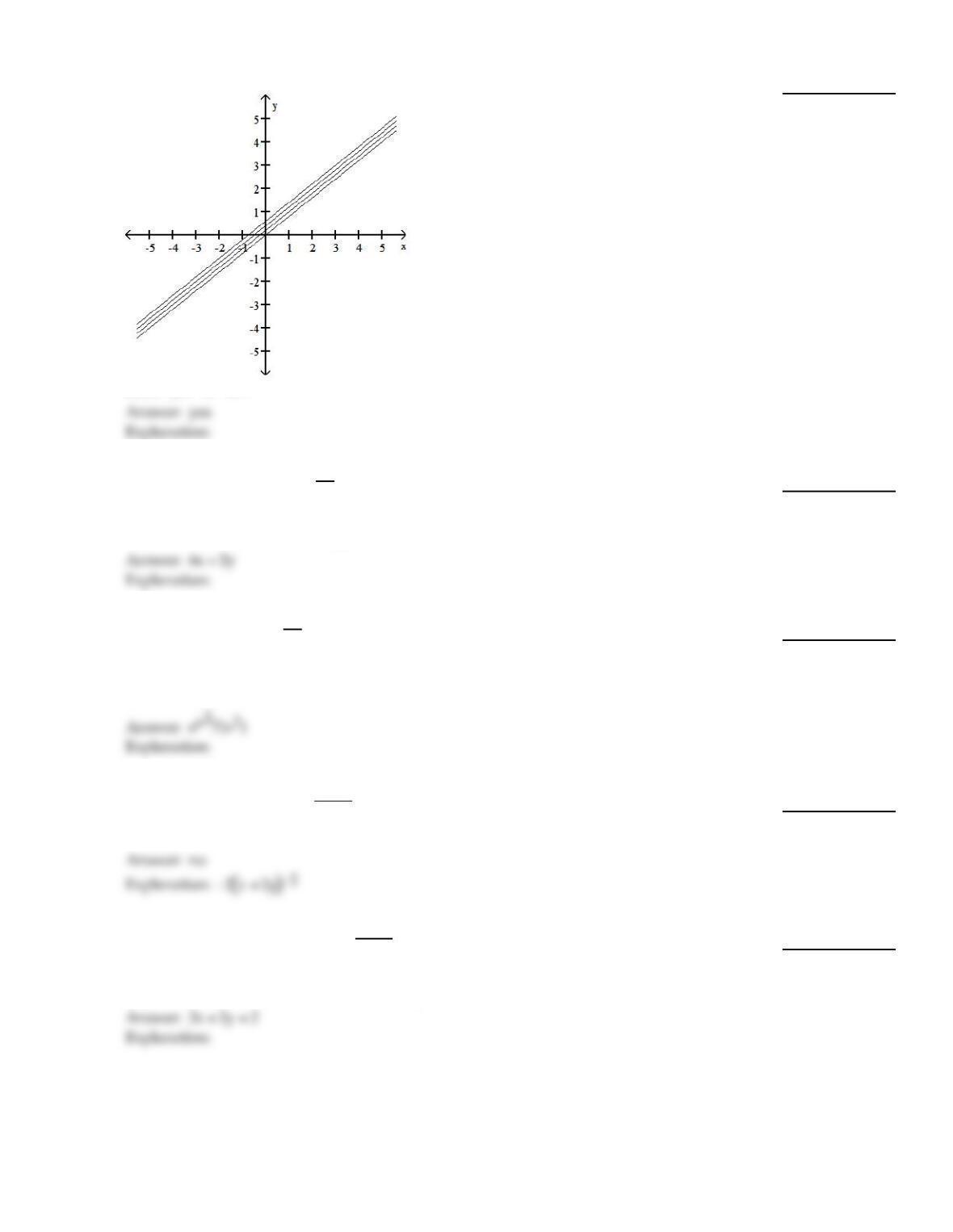
Are these the level curves of heights –1, 0, 1, and 2 for f(x, y) =4x –5y +2?
Enter “yes” or “no”.
79)
80)
Let f(x, y) = 3x2+ 2xy. Find f
x.
Enter your answer exactly as just a polynomial in x plus or minus a polynomial in y both in
standard form (do not label, no parentheses).
80)
81)
Let f(x, y) =ex2y. Find f
y.
Enter your answer exactly as just ex2y(P(x)) where P is a polynomial in x in standard form
(do not label).
81)
82)
Let f(x, y) = ln(x + 2y). Find 2f
xy . Is –(x + 2y)–2 the correct answer?
Enter “yes” or “no”.
82)
83)
Let f(x, y) =x2y +y2x + 2xy. Find 2f
xy.
Enter just a polynomial in x plus or minus a polynomial in y plus or minus two, both
polynomials in standard form (no label, no parentheses).
83)
16
84)
Use the method of your choice to obtain the formula for the least–squares line to fit the
data (0, 6), (1, 3), (2, 3).
Enter your answer in standard point–intercept form with any fractions reduced of form a
b.
84)
85)
Let R be the rectangle consisting of all points (x, y) such that 2 x 3, 0 y 2. Calculate
R
(x + y) dy dx.
Enter just an integer.
85)
7
MULTIPLE CHOICE. Choose the one alternative that best completes the statement or answers the question.
86)
Let g(x, t, z) =1
t(x –z2t). Find 2g
zt.
86)
A)
–2z
t+ 1
B)
0
C)
–2zt
D)
–2zt +t2
E)
none of these
B
Find the partial derivative.
87)
f(x, y) =e–2x + 3y. Find f
x.
87)
A)
fx(x, y) = – 2e–2x + 3y
B)
fx(x, y) =e–2x + 3
C)
fx(x, y) = – 2e–2x
D)
fx(x, y) =3e–2x + 3y
A
17
Solve the problem.
88)
Find three positive numbers whose sum is 72 and whose product is a maximum.
88)
A)
24, 24, and 24
B)
36, 18, and 18
C)
24, 18, and 18
D)
36, 36, and 36
89)
Let P(x, y, z) = xy + 2x3y2– 1. Compute P
z(2, 1, 3).
89)
A)
1
B)
0
C)
2
D)
3
E)
none of these
B
90)
Let f(x, y) =x3y +ex + 3y. Compute 2f
xy(1, 0).
90)
A)
6 + e
B)
3 + e
C)
3 + 3e
D)
6
E)
none of these
C
Find the partial derivative.
91)
f(x, y) = x ln (8x +7y). Find f
x.
91)
A)
fx(x, y) =8x
8x +7y + ln (8x +7y)
B)
fx(x, y) =8x
8x +7y
C)
fx(x, y) = ln (8x +7y) +8
8x +7y
D)
fx(x, y) = ln (8x +7y)
A
18
A
Find the double integral over the rectangular region R with the given boundaries.
92)
(2xy) dx dy
R
0 x 4, 0 y 3
92)
A)
288
B)
72
C)
144
D)
36
Find the partial derivative.
93)
Find f
x for f(x, y, z) =6x9y10 + 3x4z7+ 3y10.
93)
A)
54x8y10 + 12x3z7
B)
60x9y9+ 21x4z6
C)
54x8+ 12x3
D)
540x8y9+ 84x3z6
A
94)
Find all points (x, y) where f(x, y) =1
x+ xy –1
y has a possible relative maximum or minimum. Use
the second–derivative test to determine, if possible, the nature of f(x, y) at each of these points.
94)
A)
Neither a relative maximum nor a relative minimum at (–1, 1)
B)
(1, 1) gives a relative minimum point
C)
(–1, 1) gives a relative maximum point
D)
(–1, 1) gives a relative minimum point
C
Draw the level curve of the given function f(x, y) at the specified point.
19
B
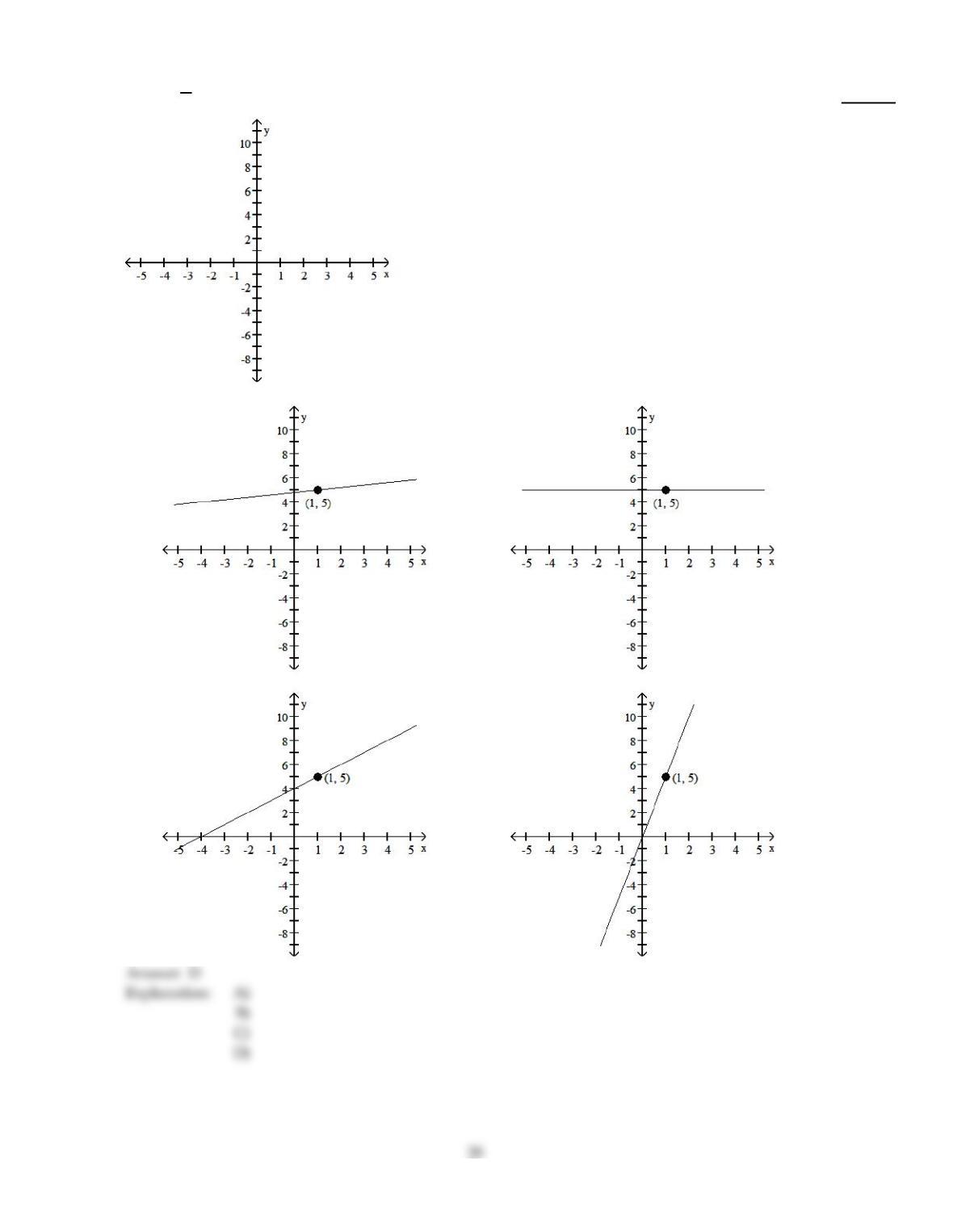
95)
f(x, y) =x
y; point (1, 5)
95)
A)
B)
C)
D)