Chemistry, 7e (McMurry/Fay)
Chapter 7 Covalent Bonding and Electron-Dot Structures
7.1 Multiple-Choice Questions
1) Covalent bonding is a
A) gain of electrons.
B) loss of electrons.
C) transfer of electrons.
D) sharing of electrons.
2) Which electrostatic forces hold atoms together in a molecule?
A) electron-electron forces
B) electron-nucleus forces
C) nucleus-nucleus forces
D) all three forces
3) At the equilibrium bond length
A) the attractive forces holding the atoms together are less than the repulsive forces.
B) the potential energy is a maximum.
C) the potential energy is a minimum.
D) the repulsive forces are greater than the attractive forces holding the atoms together.
4) Which is the longest bond?
A) N—N
B) N=N
C) N N
D) N—H
5) Which bond should have the highest bond dissociation energy?
A) N—N
B) N N
C) N N
D) N—H
6) Which molecule contains the most easily broken carbon-carbon bond?
A) H3C—CH3
B) H2C=CH2
C) F2C=CF2
D) HC CH
7) Which molecule has the weakest bonds?
A) CF4
B) CCl4
C) CBr4
D) CI4
8) What is the bond order of the O—O bond in O2?
A) 0
B) 1
C) 2
D) 3
9) Which of the following bonds is expected to be stronger?
A) C—C bond with a bond order of 0
B) C—C bond with a bond order of 1
C) C—C bond with a bond order of 2
D) C—C bond with a bond order of 3
10) What bond distance is expected to be longest?
A) A carbon-carbon bond with a bond order of 0
B) A carbon-carbon bond with a bond order of 1
C) A carbon-carbon bond with a bond order of 2
D) A carbon-carbon bond with a bond order of 3
11) Of the following elements, which has the highest electronegativity?
A) Si
B) N
C) Ga
D) Cd
12) Of the following elements, which has the lowest electronegativity?
A) Sn
B) As
C) S
D) Tl
13) The electronegativity is 2.1 for H and 3.0 for N. Based on these electronegativities, NH4+ would be
expected to
A) be ionic and contain H– ions.
B) be ionic and contain H+ ions.
C) have polar covalent bonds with a partial negative charges on the H atoms.
D) have polar covalent bonds with a partial positive charges on the H atoms.
14) A reactive element with a relatively high electronegativity would be expected to have a relatively
A) small negative electron affinity and a relatively low ionization energy.
B) small negative electron affinity and a relatively high ionization energy.
C) large negative electron affinity and a relatively low ionization energy.
D) large negative electron affinity and a relatively high ionization energy.
15) The compound CCl4 contains
A) ionic bonds.
B) nonpolar covalent bonds.
C) polar covalent bonds, with partial negative charges on the Cl atoms.
D) polar covalent bonds, with partial negative charges on the C atoms.
16) The greater the electronegativity difference between two bonded atoms, the
A) greater the bond order.
B) greater the covalent character of the bond.
C) greater the ionic character of the bond.
D) more unstable the bond.
17) The electronegativity for both sulfur and carbon is 2.5. Therefore the compound CS2 would be
expected to
A) be ionic with C as the anion.
B) be ionic with C as the cation.
C) have nonpolar covalent bonds between C and S.
D) have polar covalent bonds between C and S.
18) The phosphorus atom in PCl5 would be expected to have a
A) partial positive (δ+) charge.
B) partial negative (δ-) charge.
C) 3+ charge.
D) 3- charge.
19) A nitrogen atom in N2 should have a
A) charge of 1–.
B) partial charge δ-.
C) partial charge δ+.
D) charge of 0.
20) Element A has an electronegativity of 0.8 and element B has an electronegativity of 3.0. Which
statement best describes the bonding in A3B?
A) The AB bond is largely covalent with a δ– on A.
B) The AB bond is largely covalent with a δ+ on A.
C) The compound is largely ionic with A as the cation.
D) The compound is largely ionic with A as the anion.
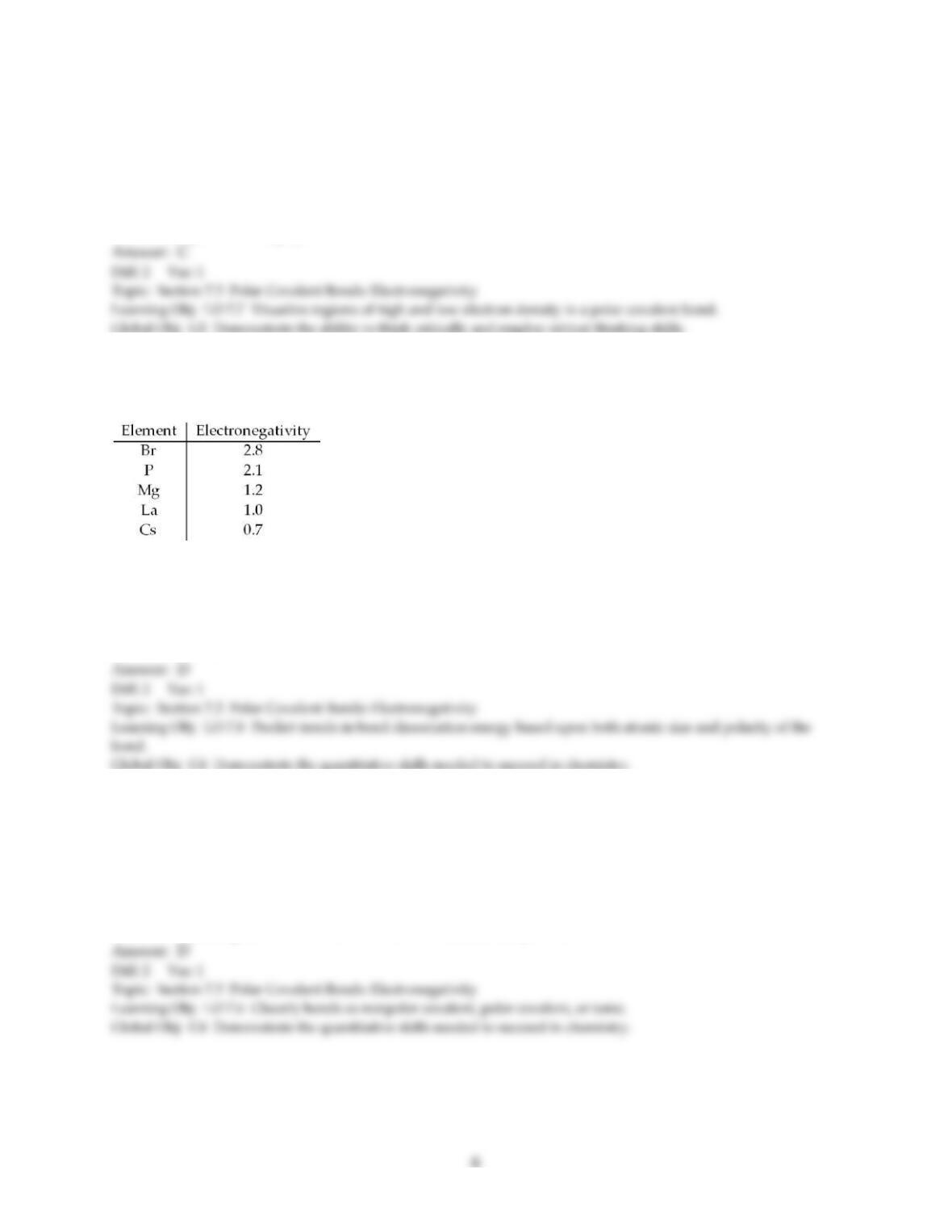
21) Based on the indicated electronegativities, arrange the following in order of increasing ionic character:
CsBr, LaBr3, PBr3, MgBr2.
A) CsBr, LaBr3, MgBr2, PBr3
B) CsBr, MgBr2, PBr3, LaBr3
C) PBr3, LaBr3, MgBr2, CsBr
D) PBr3, MgBr2, LaBr3, CsBr
22) The electronegativities for the elements vary from 0.7 for cesium to 4.0 for fluorine. The
electronegativity for iodine is 2.5. Based entirely on the general guidelines for electronegativities and
bond character,
A) binary compounds with iodine should all be polar covalent with a δ– on I.
B) binary compounds with iodine should all be polar covalent with a δ+ on I.
C) compounds with iodine may be ionic, polar covalent, or nonpolar covalent.
D) no binary compounds with iodine should be substantially ionic.
23) Arrange the following in order of increasing ionic character: Al2S3, MgS, Na2S, P4S3, S8.
A) MgS, Na2S, Al2S3, P4S3, S8
B) Na2S, MgS, Al2S3, P4S3, S8
C) S8, P4S3, Al2S3, MgS, Na2S
D) S8, P4S3, Al2S3, Na2S, MgS
24) In general, at room temperature
A) ionic compounds are all solids and covalent compounds are all gases.
B) ionic compounds are all solids, but covalent compounds may be solids, liquids, or gases.
C) ionic compounds are all solids, and covalent compounds are liquids or gases.
D) covalent compounds are all gases, but ionic compounds may be solids, liquids, or gases.
25) When melting S8, ________ forces must be overcome and S8 is expected to have a ________ melting
point than MgS.
A) covalent bonding, higher
B) covalent bonding, lower
C) intermolecular, higher
D) intermolecular, lower
26) Which of the following molecules is expected to have the highest melting point?
A) H2
B) Cl2
C) CCl4
D) NaCl
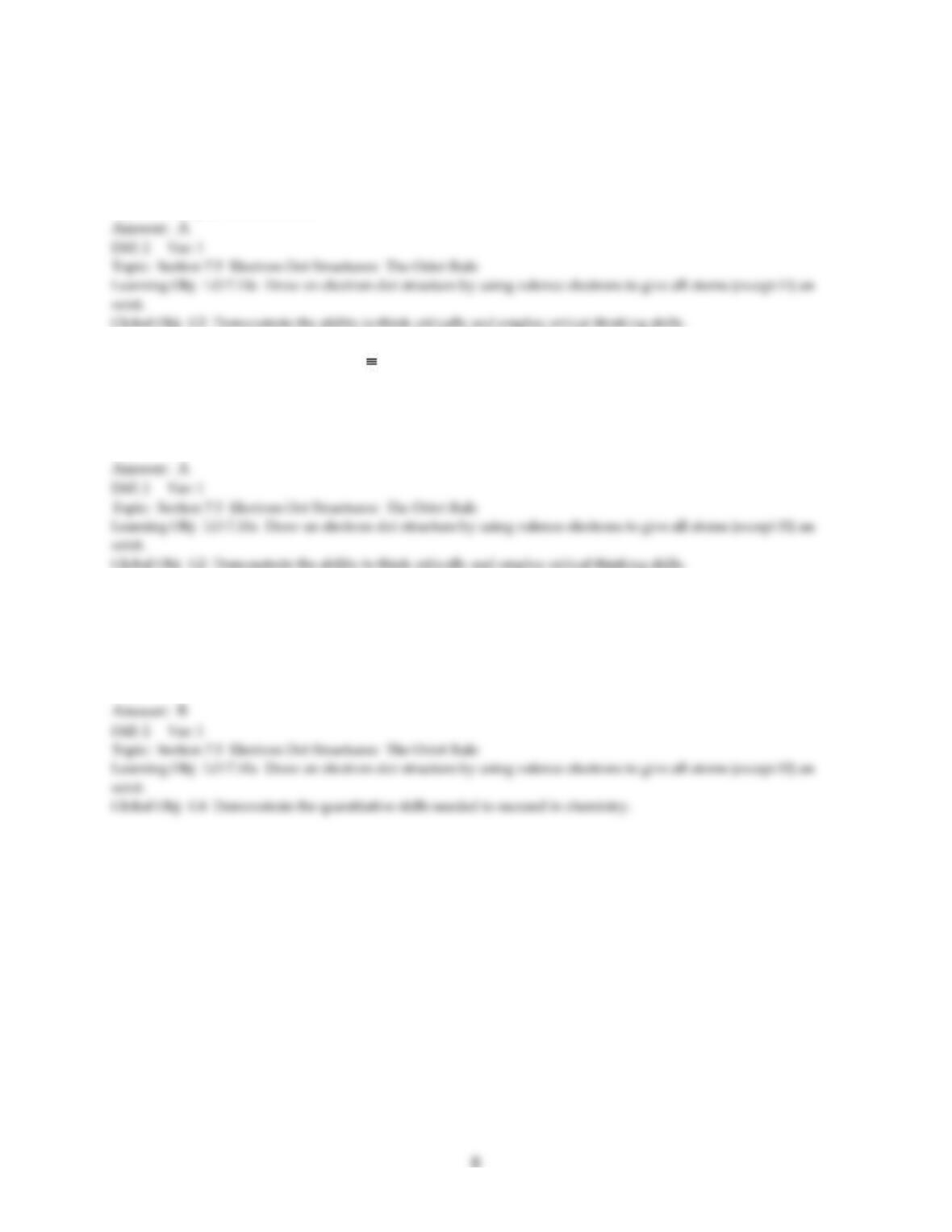
27) A::A represents
A) a double bond.
B) a quadruple bond.
C) one lone pair of electrons.
D) two lone pairs of electrons.
28) The nitrogen-nitrogen bond in :N N: has a bond order of
A) 3
B) 1
C) 2
D) 6
29) How many of the σ bonds in H2SO4 are coordinate covalent bonds?
A) 0
B) 2
C) 4
D) 6
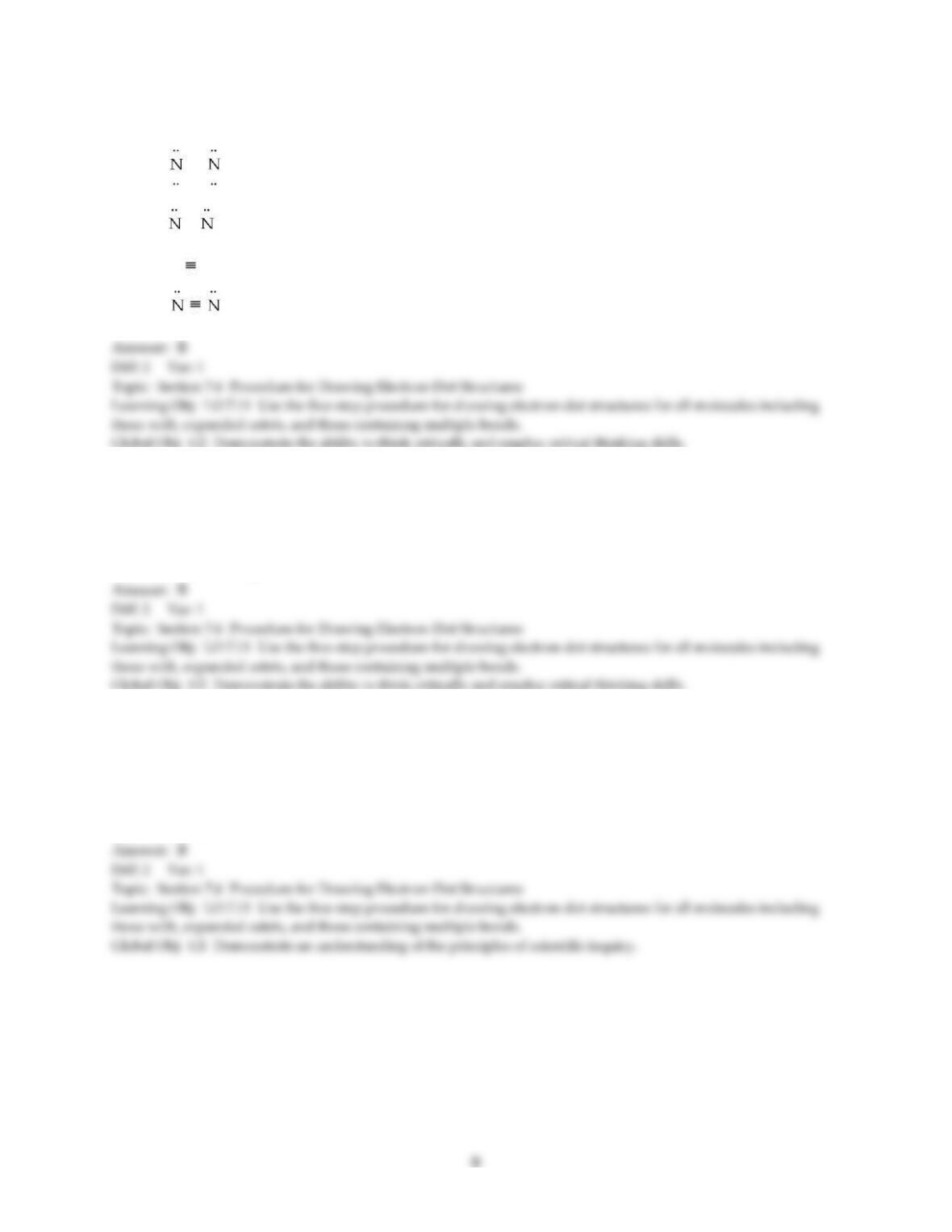
30) Which is the most acceptable electron dot structure for N2H2?
A) H — — — H
B) H —=— H
C) H — N N — H
D) H —— H
31) In the most acceptable electron-dot structure for carbonyl fluoride, COF2 the central atom is
A) C, which is singly-bonded to O.
B) C, which is doubly-bonded to O.
C) O, which is singly-bonded to C
D) O, which is doubly-bonded to C.
32) Elements that can accommodate more than eight electrons in their valence shell occur only in periodic
table row
A) 2 or lower.
B) 3 or lower.
C) 4 or lower.
D) 5 or lower.
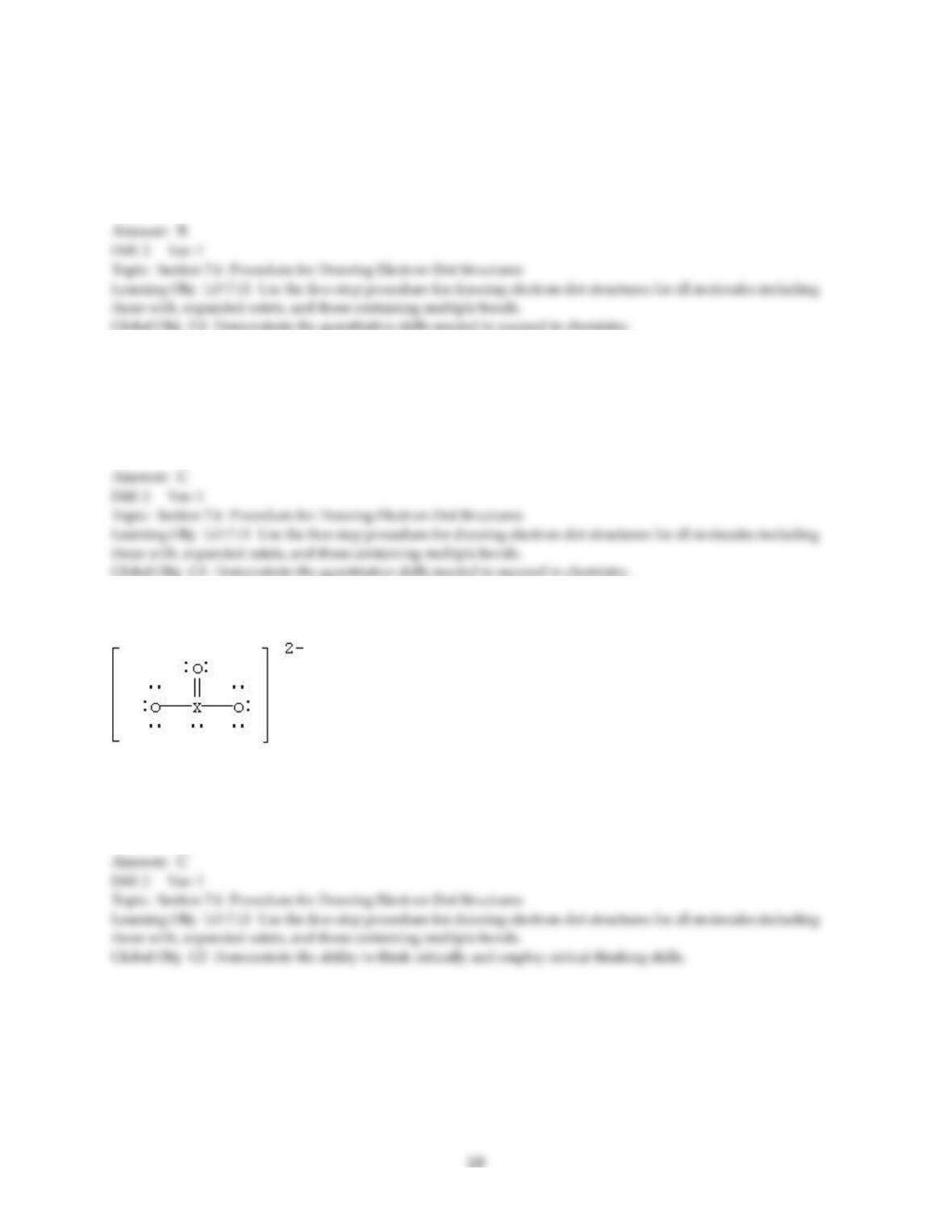
33) How many lone pairs of electrons are on the I atom in IF5?
A) 0
B) 1
C) 2
D) 3
34) How many electrons are in the valence shell of I in IF4–?
A) 8
B) 10
C) 12
D) 14
35) Identify the fourth-row element X that forms the ion.
A) Ge
B) As
C) Se
D) Kr
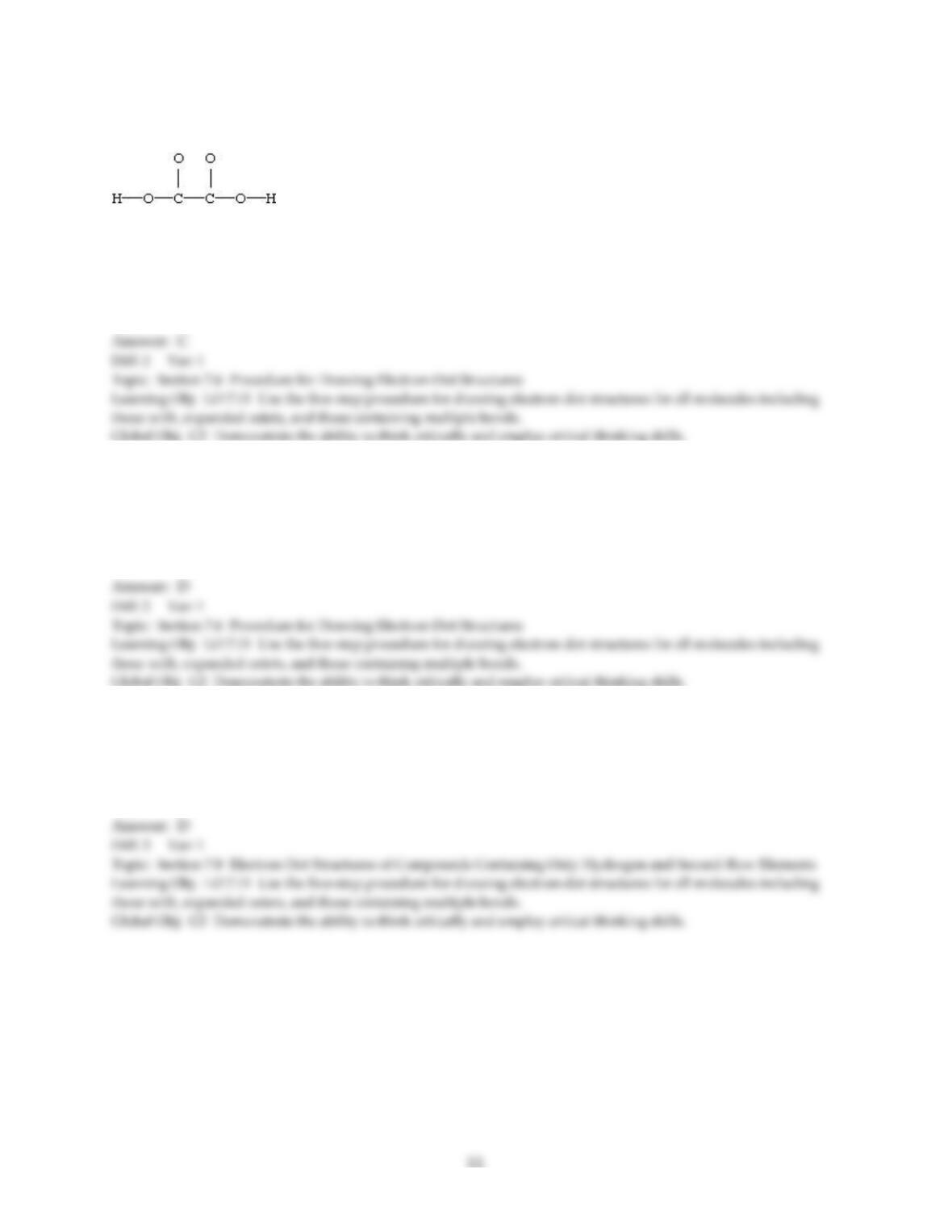
36) Consider a molecule with the following connections:
When a valid electron dot structure is written, how many double bonds will the molecule contain?
A) 0
B) 1
C) 2
D) 4
37) How many lone pairs are on the Br atom in BrI2–?
A) 0
B) 1
C) 2
D) 3
38) In the electron dot structure of HCN, the bond order of CN is
A) 0
B) 1
C) 2
D) 3
39) How many lone pairs in the correct electron dot structure of O3?
A) 2
B) 3
C) 4
D) 6
40) NO2– is be expected to have
A) two single bonds.
B) one single and one double bond.
C) two double bonds.
D) two identical bonds intermediate between a single and a double bond.
41) How many resonance structures are required in the electron-dot structure of CO32-?
A) two
B) three
C) four
D) five
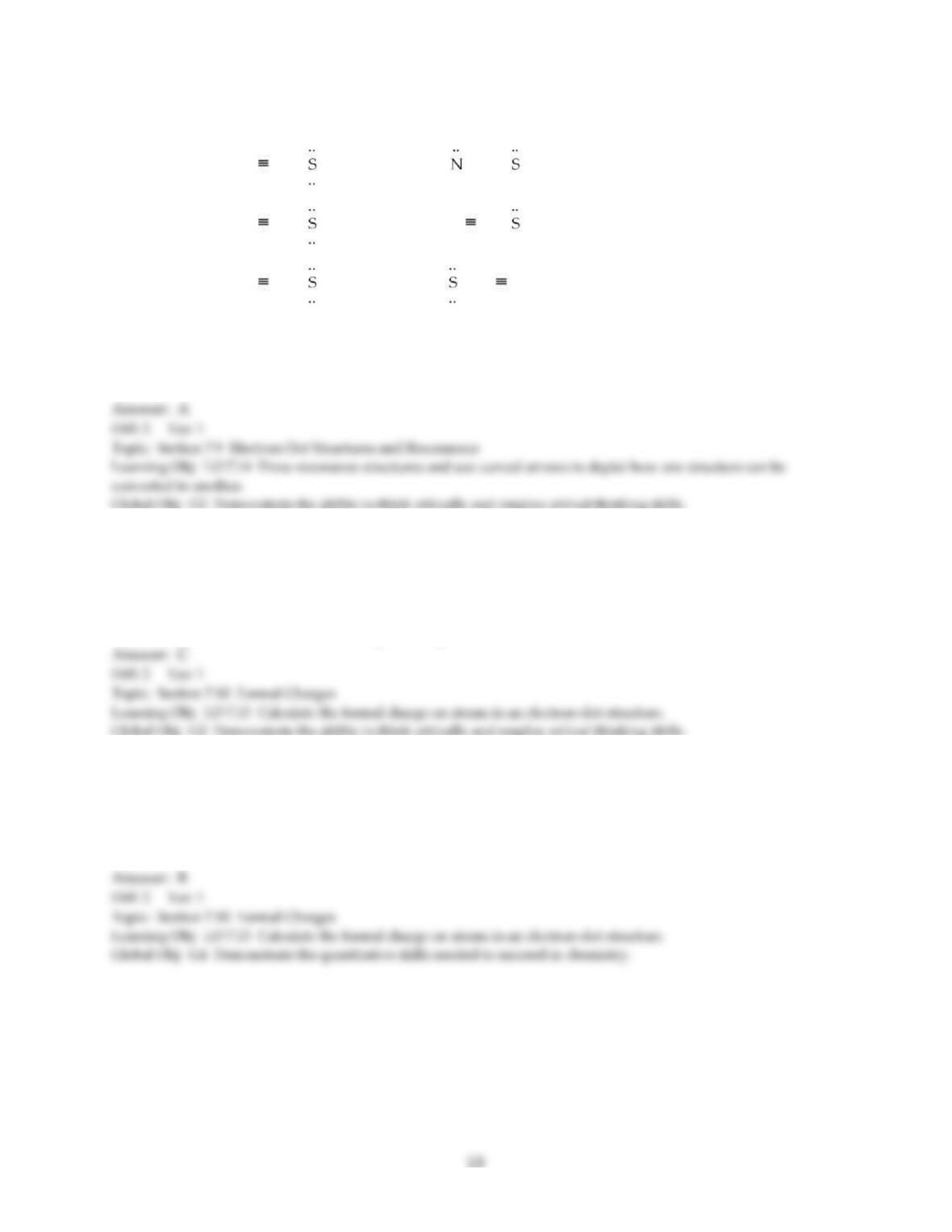
42) Which of the following are allowed resonance forms of NCS–?
I [: N C —:] – and [: = C = :] –
II [: N C —:] – and [: N C = :] –
III [: N C — :] – and [: — C N :] –
A) only I
B) only II
C) only III
D) I and III
43) Based on formal charge considerations, the electron-dot structure of CO32– ion has
A) two resonance structures involving two single bonds and one double bond.
B) two resonance structures involving one single bond and two double bonds.
C) three resonance structures involving two single bonds and one double bond.
D) three resonance structures involving one single bond and two double bonds.
44) In the best Lewis structure for CO2, what is the formal charge on the C atom?
A) -1
B) 0
C) +1
D) +2