15) The specifications for a manifold gasket that installs between two engine parts calls for a thickness of
2.500 mm ± .020 mm. The standard deviation of the process is estimated to be 0.004 mm. The process is
currently operating at a mean thickness of 2.50 mm. (a) What are the upper and lower specification limits
for this product? (b) What is the Cp for this process? (c) About what percent of all units of this gasket will
meet specifications? Does this meet the technical definition of Six Sigma?
16) The specifications for a manifold gasket that installs between two engine parts calls for a thickness of
2.500 mm ± .020 mm. The standard deviation of the process is estimated to be 0.004 mm. The process is
currently operating at a mean thickness of 2.50 mm. (a) What are the upper and lower specification limits
for this product? (b) What is the Cp for this process? (c) The purchaser of these parts requires a capability
index of 1.50. Is this process capable? Is this process good enough for the supplier? (d) If the process mean
were to drift from its setting of 2.500 mm to a new mean of 2.497, would the process still be good enough
for the supplier’s needs?
17) The specification for a plastic liner for concrete highway projects calls for a thickness of 6.0 mm ± 0.1
mm. The standard deviation of the process is estimated to be 0.02 mm. What are the upper and lower
specification limits for this product? The process is known to operate at a mean thickness of 6.03 mm.
What is the Cp and Cpk for this process? About what percent of all units of this liner will meet
specifications?
18) The specification for a plastic handle calls for a length of 6.0 inches ± .2 inches. The standard deviation
of the process is estimated to be 0.05 inches. What are the upper and lower specification limits for this
product? The process is known to operate at a mean thickness of 6.1 inches. What are the Cp and Cpk
values for this process? Is this process capable of producing the desired part?
19) A consultant has been brought in to a manufacturing plant to help apply Six Sigma principles. Her
first task is to work on the production of rubber balls. The upper and lower spec limits are 21 and 19 cm,
respectively. The consultant takes ten samples of size five and computes the sample standard deviation to
be .7 cm and the sample mean to be 19.89 cm. Compute Cp and Cpk for the process. Give the consultant
advice on what to do with the process based on your findings.
20) At your first job out of college you have been assigned to the production of bottled 20 oz. soda.
The process has upper and lower spec limits of 20.5 and 19.5 oz, respectively, with a mean of 19.8 oz
and standard deviation of .1 oz. Your manager has requested the process produce no more than 3.4
defects per 1 million bottles produced. Calculate Cpk and then determine if the process is capable
according to the manager’s standard.
Section 3 Acceptance Sampling
1) Acceptance sampling accepts or rejects an entire lot based on the information contained in the sample.
2) A lot that is accepted by acceptance sampling is certified to be free of defects.
3) In acceptance sampling, a manager can reach the wrong conclusion if the sample is not representative
of the population it was drawn from.
4) The probability of rejecting a good lot is known as consumer’s risk.
5) An acceptance sampling plan must define “good lots” and “bad lots” and specify the risk level
associated with each one.
6) The acceptable quality level (AQL) is the average level of quality we are willing to accept.
7) The steeper an OC curve, the better it discriminates between good and bad lots.
8) Consumer’s risk is the probability of:
A) accepting a good lot.
B) rejecting a good lot.
C) rejecting a bad lot.
D) accepting a bad lot.
E) none of the above
9) Acceptance sampling:
A) is the application of statistical techniques to the control of processes.
B) was developed by Walter Shewhart of Bell Laboratories.
C) is used to determine whether to accept or reject a lot of material based on the evaluation of a sample.
D) separates the natural and assignable causes of variation.
E) is another name for 100% inspection.
10) Acceptance sampling’s primary purpose is to:
A) estimate process quality.
B) identify processes that are out of control.
C) detect and eliminate defectives.
D) decide if a lot meets predetermined standards.
E) determine whether defective items found in sampling should be replaced.
11) An acceptance sampling plan’s ability to discriminate between low quality lots and high quality lots is
described by:
A) a Gantt chart.
B) the Central Limit Theorem.
C) a process control chart.
D) an operating characteristic curve.
E) a range chart.
12) Acceptance sampling:
A) may involve inspectors taking random samples (or batches) of finished products and measuring them
against predetermined standards.
B) may involve inspectors taking random samples (or batches) of incoming raw materials and measuring
them against predetermined standards.
C) is more economical than 100% inspection.
D) may be either of a variable or attribute type, although attribute inspection is more common in the
business environment.
E) All of the above are true.
13) Which of the following statements about acceptance sampling is true?
A) Acceptance sampling draws a sample from a population of items, tests the sample, accepts the entire
population if the sample is good enough, and rejects it if the sample is poor enough.
B) The sampling plan contains information about the sample size to be drawn and the critical acceptance
or rejection numbers for that sample size.
C) The steeper an operating characteristic curve, the better its ability to discriminate between good and
bad lots.
D) All of the above are true.
E) All of the above are false.
14) Acceptance sampling is usually used to control:
A) the number of units of output from one stage of a process that are then sent to the next stage.
B) the number of units delivered to the customer.
C) the quality of work–in-process inventory.
D) incoming lots of purchased products.
E) all of the above.
15) An operating characteristic (OC) curve describes:
A) how many defects per unit are permitted before rejection occurs.
B) the sample size necessary to distinguish between good and bad lots.
C) the most appropriate sampling plan for a given incoming product quality level.
D) how well an acceptance sampling plan discriminates between good and bad lots.
E) none of the above.
16) An operating characteristics curve shows:
A) upper and lower product specifications.
B) product quality under different manufacturing conditions.
C) how the probability of accepting a lot varies with the population percent defective.
D) when product specifications don’t match process control limits.
E) how operations affect certain characteristics of a product.
17) Producer’s risk is the probability of:
A) accepting a good lot.
B) rejecting a good lot.
C) rejecting a bad lot.
D) accepting a bad lot.
E) none of the above.
18) Which of the following is true regarding the relationship between AOQ and the true population
percent defective?
A) AOQ is greater than the true percent defective.
B) AOQ is the same as the true percent defective.
C) AOQ is less than the true percent defective.
D) There is no relationship between AOQ and the true percent defective.
E) The relationship between these two cannot be determined.
19) Under which of the following situations will the average outgoing quality (AOQ) decrease?
A) The true percentage defective of the lot increases.
B) The number of items in the sample decreases.
C) The number of items in the lot decreases.
D) The probability of accepting the lot for a given sample size and quantity defective increases.
E) The difference between the number of items in the lot and the number of items in the sample increases.
20) A Type I error occurs when:
A) a good lot is rejected.
B) a bad lot is accepted.
C) the number of defectives is very large.
D) the population is worse than the AQL.
E) none of the above
21) A Type II error occurs when:
A) a good lot is rejected.
B) a bad lot is accepted.
C) the population is worse than the LTPD.
D) the proportion of defectives is very small.
E) none of the above
22) In most acceptance sampling plans, when a lot is rejected, the entire lot is inspected and all defective
items are replaced. When using this technique the AOQ:
A) worsens (AOQ becomes a larger fraction).
B) improves (AOQ becomes a smaller fraction).
C) is not affected, but the AQL is improved.
D) is not affected.
E) falls to zero.
23) An acceptance sampling plan is to be designed to meet the organization’s targets for product quality
and risk levels. Which of the following is true?
A) n and c determine the AQL.
B) AQL, LTPD, α and β collectively determine n and c.
C) n and c are determined from the values of AQL and LTPD.
D) α and β are determined from the values of AQL and LTPD.
E) None of the above is true.
24) When a lot has been accepted by acceptance sampling, we know that:
A) it has more defects than existed before the sampling.
B) it has had all its defects removed by 100% inspection.
C) it will have the same defect percentage as the LTPD.
D) it has no defects present.
E) All of the above are false.
25) Which of the following statements about acceptance sampling is TRUE?
A) The steeper an OC curve, the better it discriminates between good and bad lots.
B) Acceptance sampling removes all defective items.
C) Acceptance sampling of incoming lots is replacing statistical process control at the supplier.
D) Acceptance sampling occurs continuously along the assembly line.
E) All of the above are true.
26) Which of the following is TRUE regarding the average outgoing quality level?
A) An AOQ value of 1 is ideal, because all defects have been removed.
B) AOQ is always greater than AQL but less than LTPD.
C) AOQ rises (worsens) following inspection of failed lots.
D) AOQ is very low (very good) for extremely poor quality lots.
E) None of the above is true.
27) ________ is a method of measuring samples of lots or batches of product against predetermined
standards.
28) A(n) ________ is a graph that describes how well an acceptance plan discriminates between good and
bad lots.
29) The ________ is the lowest level of quality that we are willing to accept.
30) The ________ is the percentage defective in an average lot of goods inspected through acceptance
sampling.
31) What is acceptance sampling?
32) What is the purpose of the Operating Characteristics curve?
33) What is the AOQ of an acceptance sampling plan?
34) Define consumer’s risk. Is it a Type I or Type II error? What is the symbol for its value?
35) What four elements determine the value of average outgoing quality?
36) What do the terms producer’s risk and consumer’s risk mean?
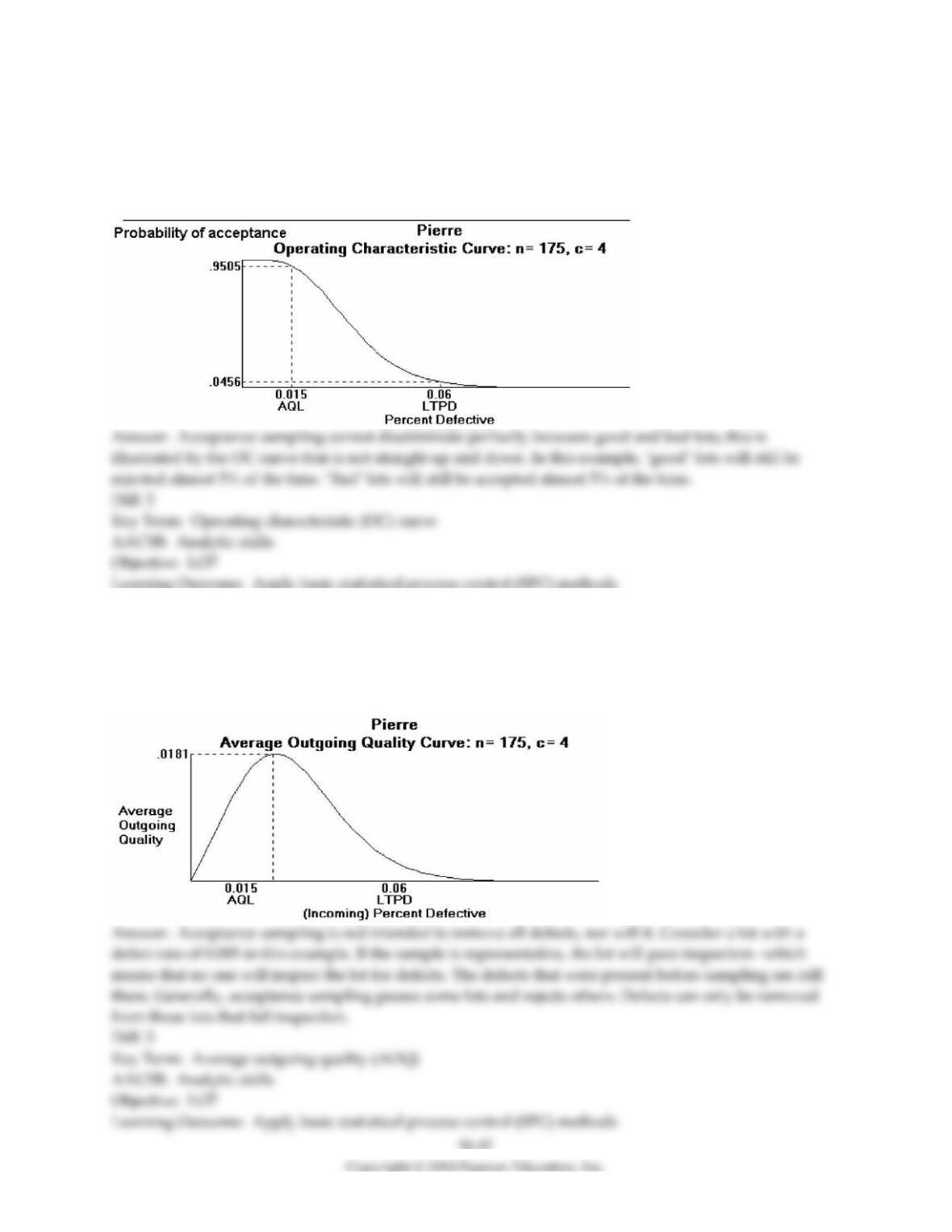
37) Pierre’s Motorized Pirogues and Mudboats is setting up an acceptance sampling plan for the special
air cleaners he manufactures for his boats. His specifications, and the resulting plan, are shown on the
POM for Windows output below. In relatively plain English (someone else will translate for Pierre),
explain exactly what he will do when performing the acceptance sampling procedure, and what actions
he might take based on the results.
38) Pierre’s Motorized Pirogues and Mudboats is setting up an acceptance sampling plan for the special
air cleaners he manufactures for his boats. His specifications, and the resulting plan, are shown on the
POM for Windows output below. Pierre is a bit confused. He mistakenly thinks that acceptance sampling
will reject all bad lots and accept all good lots. Explain why this will not happen.
39) Pierre’s Motorized Pirogues and Mudboats is setting up an acceptance sampling plan for the special
air cleaners he manufactures for his boats. His specifications, and the resulting plan, are shown on the
POM for Windows output below. Pierre wants acceptance sampling to remove ALL defects from his
production of air cleaners. Explain carefully why this won’t happen.