5) Assume that the price elasticity of demand for gasoline is -0.06. If the government tax causes
the price of gasoline to increase by 50 percent, what will be the decrease in the quantity of
gasoline demanded?
A) 0.5 percent
B) 3.0 percent
C) 8.33 percent
D) 50 percent
6) Assume that a 50 percent gasoline tax led to a large increase in its price and only a small
decrease in the quantity of gasoline demanded. Economic analysis would lead one to conclude
that
A) gasoline should be taxed because the benefits of the tax would exceed the costs.
B) gasoline should not be taxed because the benefits are uncertain.
C) gasoline should not be taxed on ethical grounds since ethical benefits and costs can’t be
measured.
D) the benefits of taxing gasoline is a normative issue. Economic analysis can be used to
contribute to discussion of this issue but cannot decide it.
7) Most food products have low income and price elasticities of demand.
8) The government of Bassaland is looking for new revenue sources. It is considering imposing
an excise tax on two goods: palm wine and diapers. If the price elasticity of demand for the
goods are -0.47 and -1.89 respectively, which good should it tax if the goal is to raise revenue? If
the government wants to tax only one good, which good should it tax if the goal is to discourage
consumption? Explain your answer.
9) Suppose the price elasticity of demand for methamphetamine is -0.35. If decriminalization
caused the price of methamphetamine to fall by 75 percent, what will be the percentage increase
in the quantity of methamphetamine demanded? If the price elasticity is –3.5, what will be the
percentage increase in quantity demanded?
6.6 The Price Elasticity of Supply and Its Measurement
1) The price elasticity of supply measures
A) the responsiveness of quantity supplied to changes in input prices.
B) the responsiveness of quantity supplied to changes in technology.
C) the responsiveness of quantity supplied to changes in price.
D) a supplier’s ability to produce a good in the face of scarcity.
2) To calculate the price elasticity of supply we divide
A) the percentage change in price by the percentage change in quantity supplied.
B) the percentage change in quantity supplied by the percentage change in price.
C) rise by the run.
D) the average price by the average quantity supplied.
3) Suppose the supply of bicycles is price elastic. This means that
A) consumers will respond significantly to an increase in the quantity supplied of bicycles.
B) suppliers will increase the quantity supplied of bicycles, but not immediately.
C) suppliers face many substitutes for bicycles.
D) suppliers will respond significantly to changes in the price of bicycles.
4) If the quantity supplied of walkie-talkies increases by 5 percent when prices increase by 12
percent, then
A) the supply of walkie-talkies is inelastic.
B) the supply of walkie-talkies is elastic.
C) the walkie-talkie supply curve will shift to the right.
D) the walkie-talkie supply curve will shift to the left.
5) Suppose when the price of jean-jackets increased by 10 percent, the quantity supplied
increased by 16 percent. Based on this information the price elasticity of supply of jean-jackets is
A) 0.625.
B) 6%.
C) 1.6.
D) 1.6%.
6) If an 8 percent decrease in the price of lobster leads to a 15 percent decrease in the quantity
supplied of lobster, then the supply of lobster is
A) unit-elastic.
B) unitarily elastic.
C) elastic.
D) perfectly inelastic.
7) Inelastic supply occurs whenever the elasticity of supply value is
A) negative and < -1.
B) any positive number.
C) positive and > 1.
D) positive and < 1.
8) If a supply curve is a horizontal line, supply is said to be
A) perfectly inelastic.
B) unit-elastic.
C) inelastic.
D) perfectly elastic.
9) A supply curve that is vertical
A) is perfectly elastic.
B) is perfectly inelastic.
C) is impossible.
D) has an elasticity equal to 1.
Table 6-5
Price
Quantity
Demanded
Quantity
Supplied
$6
5,000
2,000
7
4,000
2,000
8
3,000
2,000
9
2,000
2,000
10
1,000
2,000
The town of Bloomfield is well known for its basketball team. The price of basketball game
tickets is determined by market forces. Table 6-5 above shows the demand and supply schedules
for basketball games tickets.
10) Refer to Table 6-5. What is the most distinctive feature of the supply curve?
A) The supply curve is perfectly inelastic.
B) The supply curve is horizontal.
C) The supply curve is upward sloping.
D) The supply curve is perfectly elastic.
11) Refer to Table 6-5. What is the numerical value of the price elasticity of supply?
A) 1
B) greater than 0 but less than 1
C) 0
D) greater than 1
12) The price elasticity of supply is usually a positive number because
A) quantity supplied increases in response to income increases.
B) quantity supplied increases in response to price increases.
C) the quantity demanded usually rises when price falls and therefore suppliers would want to
capitalize on this increase in demand.
D) price rises when supply increases.
13) The price elasticity of supply of hot dog buns is estimated to be 1.5. Holding everything else
constant, this means that a 10 percent decrease in the price of hot dog buns will cause the
quantity of hot dog buns supplied to decrease by
A) 1.5 percent.
B) 15 percent.
C) approximately 25 percent.
D) approximately 5 percent.
14) Which of the following is a key determinant of the price elasticity of supply?
A) the slope of the supply curve
B) the availability of substitutes in production
C) the available technology
D) the time it takes to change output in response to a change in price
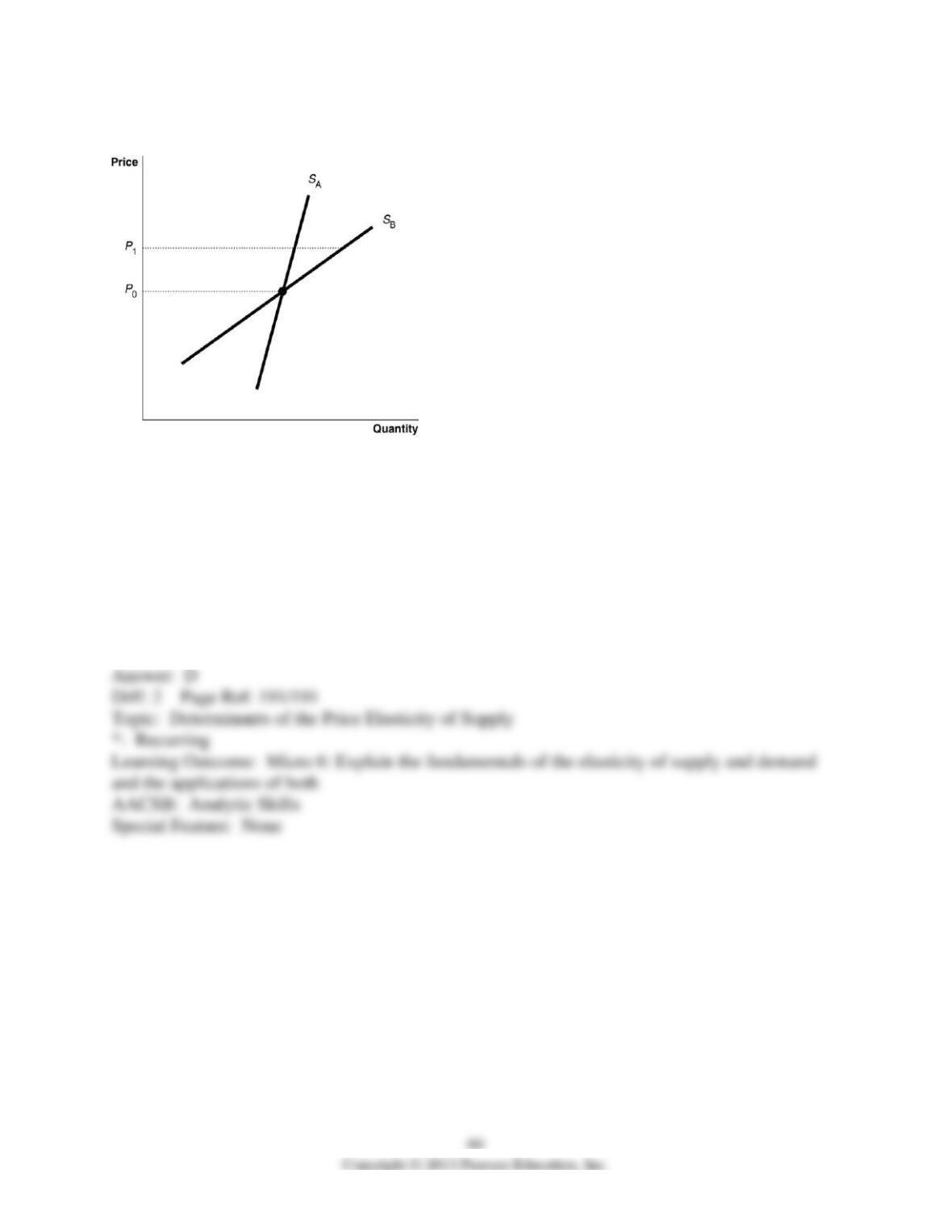
Figure 6-5
15) Refer to Figure 6-5. Suppose the diagram shows the supply curves for a product in the short
run and in the long run. Which supply curve represents supply in the short run and which curve
represents supply in the long run?
A) SB represents supply in the short run and SA represents supply in the long run.
B) Either SA or SB could represent supply in the short run; in the long run the supply curve must
be a vertical line.
C) Either SA or SB could represent supply in the long run; in the short run the supply curve must
be a horizontal line.
D) SA represents supply in the short run and SB represents supply in the long run.
16) Refer to Figure 6-5. The diagram shows two supply curves, SA and SB. As price rises from
P0 to P1, which supply curve is more elastic?
A) SA
B) SB
C) They are equally inelastic.
D) They are equally elastic.
17) Suppose the demand curve for a product is represented by a typical downward-sloping curve.
Now suppose the demand for this product increases. Which of the following statements
accurately predicts the resulting increase in price?
A) The more elastic the supply curve, the greater the price increase.
B) The more elastic the supply curve, the smaller the price increase.
C) The increase in price is not affected by the elasticity of the supply curve.
D) There will be no increase in price if the supply curve is perfectly inelastic.
18) Suppose the demand curve for hybrid cars shifts to the right. This will cause a relatively
small increase in the price of hybrid cars if
A) demand is elastic and supply is inelastic.
B) demand is inelastic and supply is elastic.
C) both demand and supply are inelastic.
D) both demand and supply are elastic.
19) The process involved in bringing oil to world markets can take years. Substitutes for oil-
based products such as gasoline are limited. As a result
A) the supply of oil is very elastic and the demand for oil is very elastic over short periods of
time.
B) the supply of oil is very inelastic and the demand for gasoline is inelastic over short periods of
time.
C) the supply of oil and the demand for oil shift to the right over short periods of time.
D) the supply of oil and the demand for oil are both perfectly elastic over short periods of time.
20) Shifts in the supply of oil have caused large changes in price since the 1970s because
A) the supply of oil is very inelastic while the demand for oil is very elastic over short periods of
time.
B) the supply of oil is very elastic while the demand for oil is inelastic over short periods of time.
C) both the supply of oil and the demand for oil are inelastic over short periods of time.
D) the supply of oil and the demand for oil are perfectly elastic over short periods of time.
21) Which of the following statements is true?
A) The supply of oil is very elastic over short time periods but becomes perfectly inelastic over
time. A given shift in supply results in a greater increase in the price of oil when the supply of oil
is perfectly inelastic.
B) The supply of oil is very inelastic over short time periods but becomes more elastic over time.
A given shift in supply results in a smaller increase in the price of oil when the supply is more
elastic.
C) The supply of oil is perfectly inelastic; therefore, as the demand for oil increases over time the
price of oil increases significantly.
D) Over short periods of time increases in the demand for oil are greater than increases in the
supply of oil. Over the long run increases in the demand and the supply of oil are about equal. As
a result, the price of oil increases greatly in the short run but is stable in the long run.
22) Supply is elastic whenever the elasticity value for supply is positive and greater than 1.
23) There are a limited number of original Picasso paintings. This means that the supply of
original Picasso paintings is perfectly inelastic.
24) Suppose the current price of copper is $3 per pound and the quantity supplied is 200 pounds
per day. If the price of copper falls to $2.50 per pound, the quantity supplied drops to 180 pounds
per day. Use the midpoint formula to calculate the price elasticity of supply for copper.
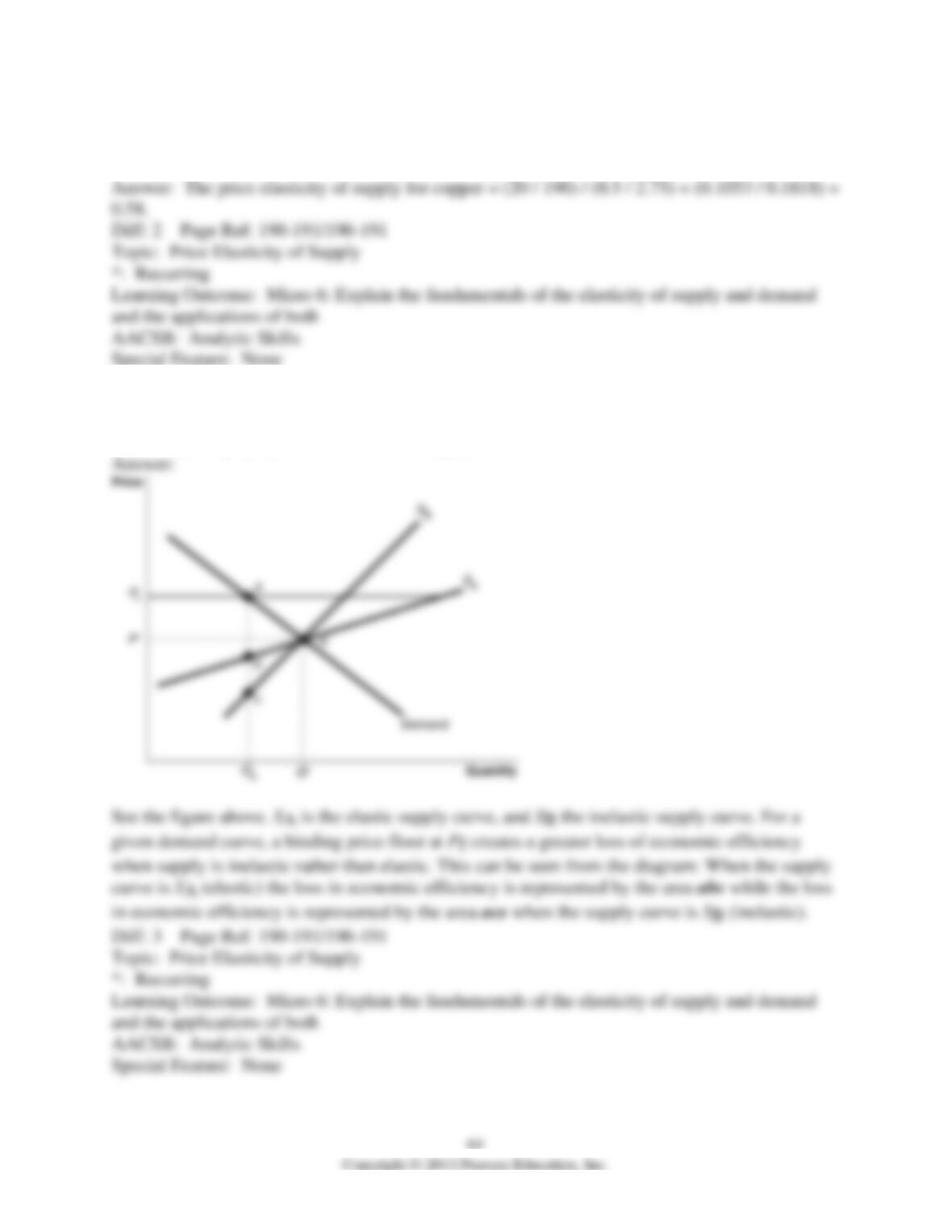
25) For a given demand curve, will there be a greater loss of economic efficiency from a binding
price floor when supply is elastic or inelastic? Illustrate your answer with a demand and supply
graph. In your graph you must show two supply curves, one elastic and the other inelastic.