Table 6-2
Estimated Price Elasticity of
Demand
Coca-Cola
-3.0
All carbonated soft drinks
-1.5
All soft drinks
-0.8
12) Refer to Table 6-2. Assume that an economist has estimated the price elasticity of demand
values in the table above. Use the data in the table to select the correct statement.
A) The demand for Coca-Cola is inelastic.
B) The elasticity for “All soft drinks” is less than the elasticity for Coca-Cola because Coca-Cola
is more of a luxury than a necessity; “All soft drinks” represent goods that are more necessity
than luxury.
C) The difference in elasticity values is explained by the fact that the more narrowly we define a
market the more elastic the demand will be.
D) There are fewer substitutes for “All carbonated soft drinks” than there are for “All soft
drinks.”
13) In general, a “big ticket item” such as a house or new car will
A) tend to have a more elastic demand than a lower priced good.
B) tend to have an inelastic demand because spending on the item takes up a large share of the
average consumer’s budget.
C) tend to have an inelastic demand because it has many substitutes.
D) tend to have a more inelastic demand the more time that passes.
14) Jill Borts believes that the price elasticity of demand for her economics textbook is relatively
inelastic. She argues “I was told I had to purchase a book written by Hubbard and O’Brien that is
required by my instructor. If I wanted to buy a mystery novel I would have many authors to
choose from. Therefore, the demand for mystery novels is more elastic than the demand for my
textbook.” Is Jill correct?
A) The demand for the textbook is more inelastic, but Jill’s reasoning is incorrect. The reason the
textbook has an inelastic demand is that it is more expensive than any novel.
B) She is correct.
C) She is confused. She should have concluded that the textbook has a more elastic demand than
a novel.
D) She is correct that the textbook has a more inelastic demand, but that is because most students
pay for their textbooks with credit or debit cards. Most people pay for novels and other books
with cash or by check.
15) As gasoline prices increased throughout 2010 and into 2011, consumers began to explore
alternatives to driving their cars and more people eventually ended up using public
transportation. This exemplifies that for a specific product, the longer the time period involved,
A) the larger (in absolute value) the price elasticity of demand.
B) the smaller (in absolute value) the price elasticity of demand.
C) the closer the price elasticity of demand is to reaching a value of zero.
D) the more people come to rely on that product.
16) The demand for The Federalist Papers is likely to be more elastic than the demand for a
best-selling mystery novel.
17) The demand for heating oil in the short run is more elastic than the long run demand for
heating oil.
18) The price elasticity of demand for Kellogg’s Raisin Bran is larger in absolute value than the
price elasticity for all breakfast cereals.
19) For each pair of items below determine which product would have the higher price elasticity
of demand (in absolute value).
a. Blood pressure medicine for someone who has high blood pressure and the purchase of
Clairol hair coloring product.
b. A new Ford Fusion or a tank of gas for your current car.
c. A Seiko watch or watches in general.
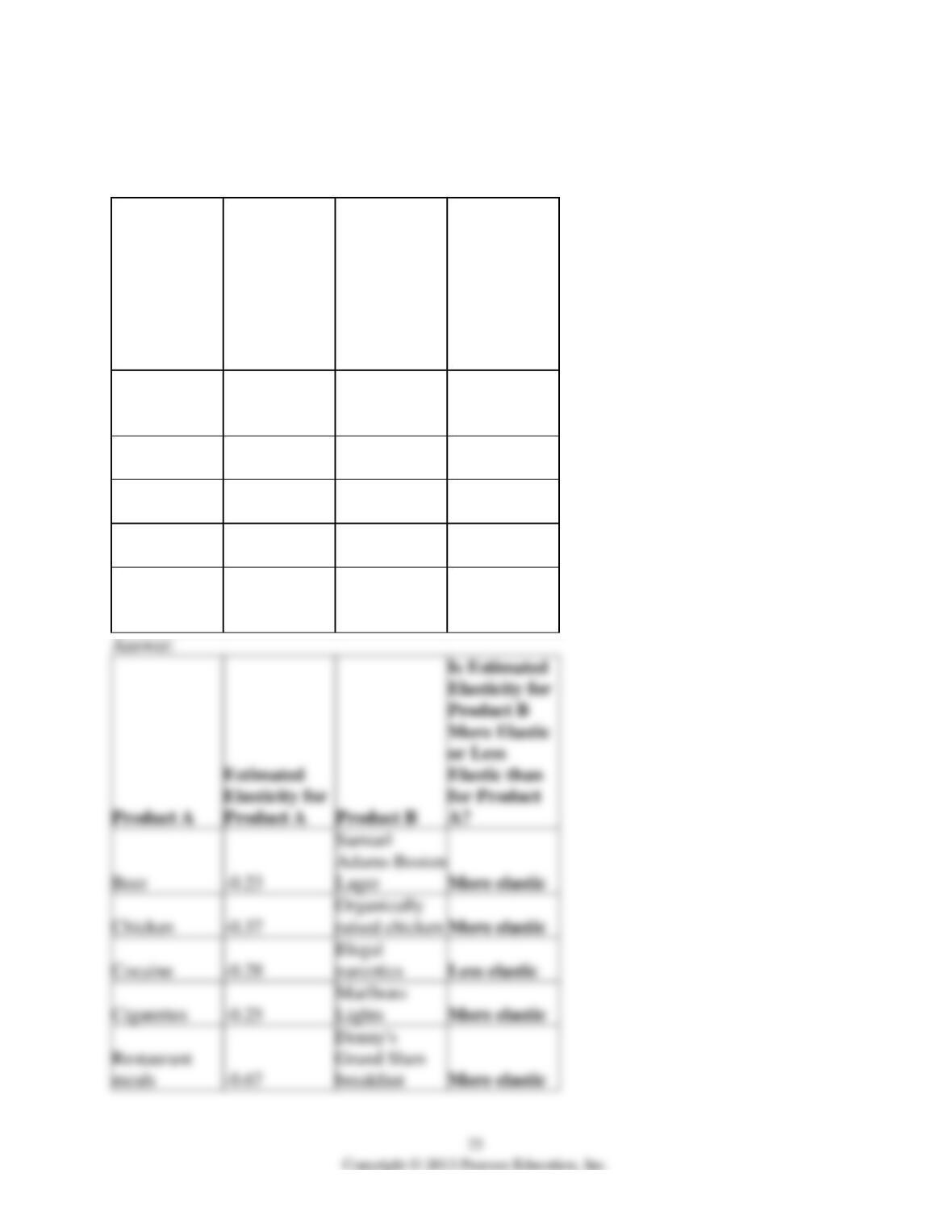
20) The estimated price elasticities of demand for the products listed in the table as “Product A”
are from Table 6-2 in the text. Indicate whether the products listed as “Product B” will have a
more elastic or less elastic demand than the corresponding Product A.
Product A
Estimated
Elasticity for
Product A
Product B
Is Estimated
Elasticity for
Product B
More Elastic
or Less
Elastic than
for Product
A?
Beer
-0.23
Samuel
Adams Boston
Lager
Chicken
-0.37
Organically
raised chicken
Cocaine
-0.28
Illegal
narcotics
Cigarettes
-0.25
Marlboro
Lights
Restaurant
meals
-0.67
Denny’s
Grand Slam
breakfast
Product A
Estimated
Elasticity for
Product A
Product B
Is Estimated
Elasticity for
Product B
More Elastic
or Less
Elastic than
for Product
A?
Beer
-0.23
Samuel
Adams Boston
Lager
Chicken
-0.37
Organically
raised chicken
Cocaine
-0.28
Illegal
narcotics
Cigarettes
-0.25
Marlboro
Lights
6.3 The Relationship between Price Elasticity of Demand and Total Revenue
1) Total revenue is equal to
A) the amount of funds earned by a firm minus its costs of production.
B) the total quantity sold of a product over a given period of time.
C) the price of a product multiplied by the number of units of the product sold.
D) the monetary value of the capital (for example, plant and equipment) a firm owns.
2) Which of the following statements is true?
A) Whenever a firm raises its price its total revenue will increase.
B) When a firm lowers its price its total revenue may either increase or decrease.
C) Whenever a firm increases its quantity sold its revenue will increase.
D) Total revenue will equal zero when the demand for a product is unit-elastic.
3) If demand is perfectly inelastic, the absolute value of the price elasticity coefficient is
A) infinity.
B) zero.
C) more than one.
D) equal to the absolute value of the slope of the demand curve.
4) If a firm raised its price and discovered that its total revenue fell, then the demand for its
product is
A) perfectly inelastic.
B) relatively inelastic.
C) perfectly elastic.
D) relatively elastic.
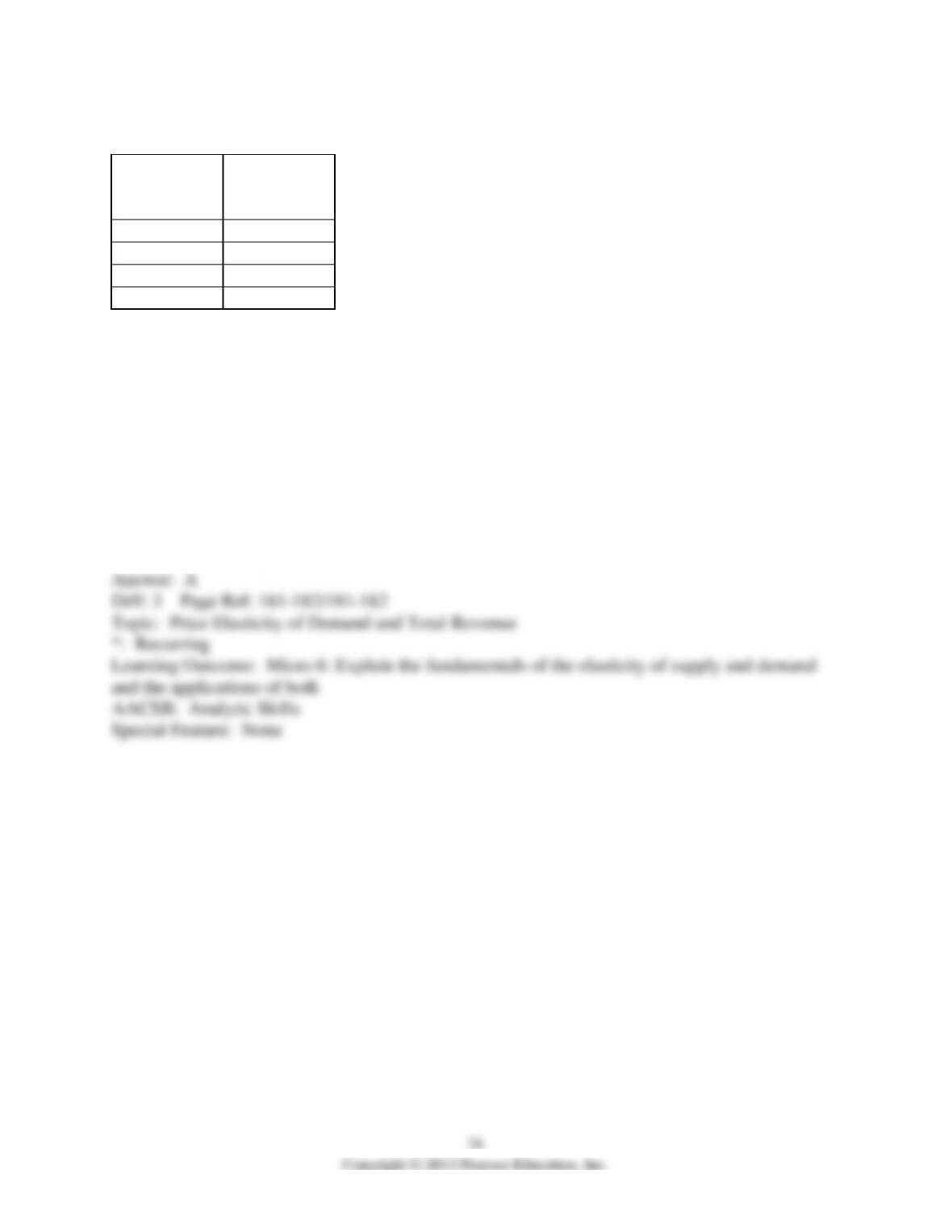
Table 6-3
Hourly
Rental Rate
(dollars)
Quantity
Demanded
(hours)
$60
40
75
32
80
30
100
24
5) Refer to Table 6-3. Katie Graham owns a kayak rental service in Santa Barbara. Table 6.3
below shows her estimated demand schedule for kayak rentals per week. She would like to
increase her sales revenue by changing the price she charges for rentals. At present she charges
$75. Based on the information in the table, Katie
A) is not able to increase her revenue by changing her price because the demand for kayak
rentals is unit-elastic.
B) should lower her price to $60 to increase her revenue because the demand for kayak rentals is
price elastic.
C) should raise her price to $80 to increase her revenue because the demand for kayak rentals is
price inelastic.
D) should raise her price to earn the most revenue.
6) Which of the following explains why a firm would be interested in the knowing the price
elasticity of demand for a good it sells?
A) The price elasticity of demand can be used to determine the impact of changes in income on
quantity sold.
B) Knowing the price elasticity of demand allows the firm to determine how the cost of
producing additional units of the good will change.
C) Knowing the price elasticity of demand allows the firm to calculate how changes in the price
of the good will affect the firm’s total profit.
D) The price elasticity of demand allows the firm to calculate how changes in the price of the
good will affect the firm’s total revenue.
7) Opera Estate Girls’ School is considering increasing its tuition to raise revenue. If the school
believes that raising tuition will increase revenue
A) it is assuming that the demand for attending the school is inelastic.
B) it is assuming that the demand for attending the school is elastic.
C) it is assuming that the demand for attending the school is unit-elastic.
D) it is assuming that the demand for attending the school is perfectly elastic.
8) Along a downward sloping, linear demand curve, total revenue is the greatest
A) where demand is normal.
B) where demand is the most inelastic.
C) where demand is the most elastic.
D) where demand is unit-elastic.
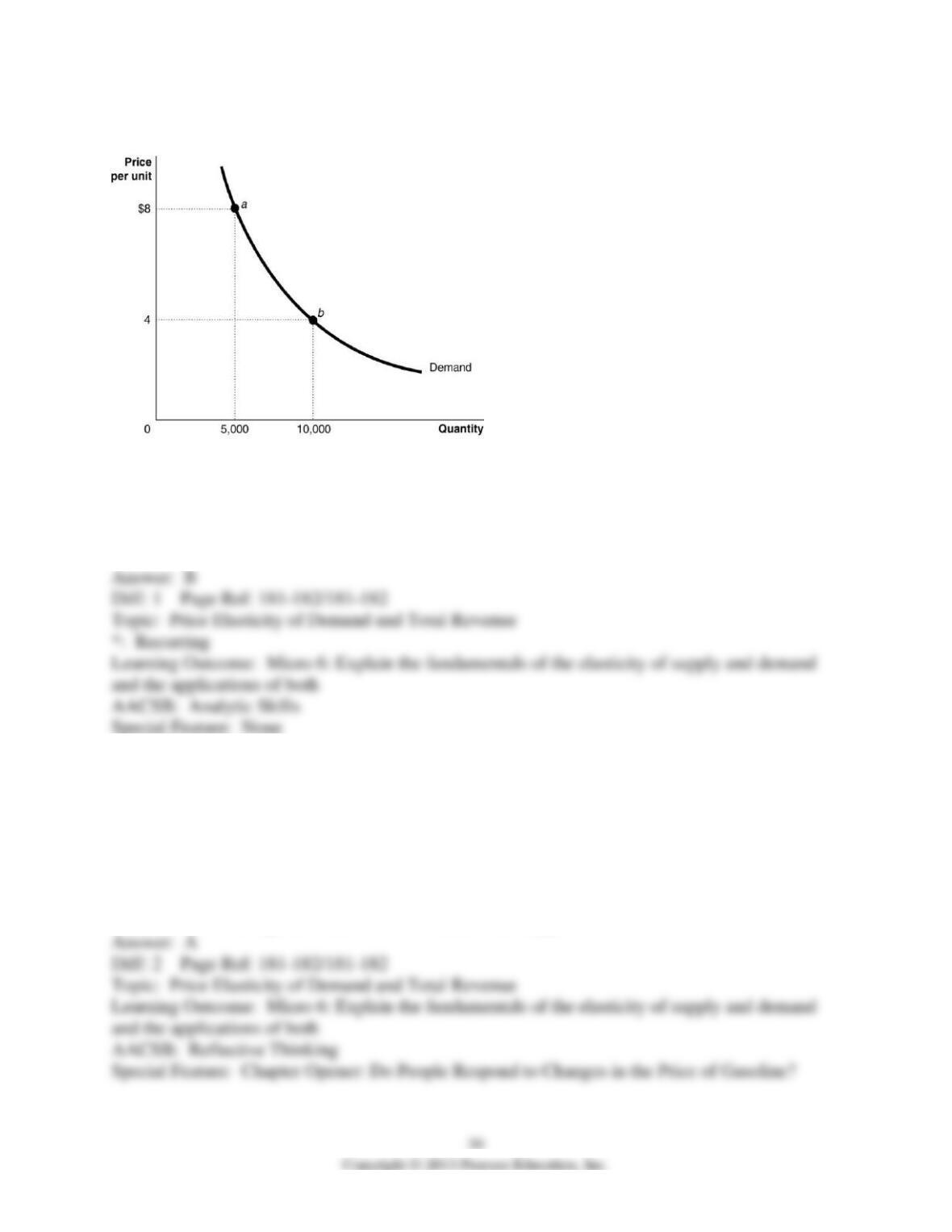
Figure 6-3
9) Refer to Figure 6-3. Between points a and b on the demand curve, demand is
A) perfectly inelastic.
B) unit-elastic.
C) perfectly elastic.
D) elastic.
10) In May 2011, the average price of gasoline in the United States was $3.76 per gallon, and
consumers purchased nearly 5 percent less gasoline than they had during May 2010, when the
average price of gasoline was $2.79 per gallon. Based on these figures, when the price of
gasoline rose from $2.79 per gallon to $3.76 per gallon, total revenue
A) increased.
B) decreased.
C) did not change.
D) There is not enough information to determine what happened to total revenue.
11) Assume that the market for barley is in equilibrium and the demand for barley is inelastic.
Predict what happens to the revenue of barley farmers if a prolonged drought reduces the supply
of barley. The drought will cause farm revenue to
A) rise because there will be a shortage of barley.
B) rise because the percentage decrease in quantity sold is less than the percentage increase in
price.
C) rise because the percentage increase in quantity sold is greater than the percentage increase in
price.
D) fall because of the decrease in the quantity of barley sold.
12) Assume that you own a small boutique hotel. In an attempt to raise revenue you reduce your
rates by 20 percent. However, your revenue falls. What does this indicate about the demand for
your boutique hotel rooms?
A) Boutique hotel rooms are inferior goods.
B) Demand is inelastic.
C) The demand curve for your hotel rooms is vertical.
D) Demand is elastic.
13) Suppose when Nablom’s Bakery raised the price of its breads by 10 percent, the quantity
demanded fell by 15 percent. What was the effect on sales revenue?
A) Sales revenue increased.
B) Sales revenue remained unchanged.
C) Sales revenue decreased.
D) It cannot be determined without information on prices.
14) Suppose at the current price, the demand for copper is estimated at -3.14. What happens to
sales revenue if the government imposes a price ceiling below the free market equilibrium price
in the copper market?
A) Sales revenue falls.
B) Sales revenue rises.
C) Sales revenue remains unchanged because copper is a necessity for most industries.
D) It cannot be determined without information on prices.
15) Suppose a decrease in the supply of paper results in an increase in revenue. This indicates
that
A) the demand for paper is inelastic.
B) the demand for paper is elastic.
C) the supply of paper is inelastic.
D) the supply of paper is elastic.
16) Which of the following statements is true?
A) If the price of a good is lowered and total revenue decreases, demand is elastic.
B) If the price of a good is raised and total revenue does not change, demand is perfectly elastic.
C) If the price of a good is raised and total revenue increases, demand is inelastic.
D) If the price of a good is lowered and total revenue increases, demand is inelastic.
17) Which of the following correctly comments on the following statement? “The only way to
increase the revenue from selling a product is to increase the product’s price.”
A) It is not true. Revenue will increase as the price of the product increases only if demand is
elastic.
B) This statement is not true. Revenue will increase as the price of the product increases only if
demand is inelastic.
C) The statement is true.
D) This statement is not true. Revenue will decrease as the price of the product increases because
quantity demanded will fall.
18) In 2001, the prices of VHS movie tapes were practically identical while DVD prices for
different movie titles varied considerably. What explanation can be given for this?
A) In 2001, VHS tapes were inferior goods while DVDs were luxuries.
B) In 2001, most VHS tapes were sold by discount retailers such as Wal-Mart; most DVDs were
sold online.
C) In 2001, the price elasticity demand for VHS tapes was inelastic; for DVDs the price
elasticity of demand was elastic.
D) In 2001, movie studies had determined their pricing strategies for VHS tapes but were unsure
of the price elasticities of DVDs.
19) If tolls on a toll road can be raised significantly before commuters will consider using a free
alternative, demand for using the toll road must be
A) inelastic.
B) elastic.
C) unit elastic.
D) perfectly elastic.
20) If tolls on a toll road can be raised significantly before commuters will consider using a free
alternative, then an increase in tolls will result in
A) a decrease in total revenue.
B) a decrease in non-toll road usage.
C) an increase in total revenue.
D) an increase in toll road usage.
21) If the price elasticity of demand is unit-elastic, a 10 percent increase in price will result in a
10 percent increase in revenue.
22) If demand for a product is perfectly inelastic a change in price will not change total revenue.
23) Suppose the absolute value of the price elasticity of demand for basketball game tickets on
your campus is greater than 1. Increasing ticket prices will increase the total revenue from ticket
sales.
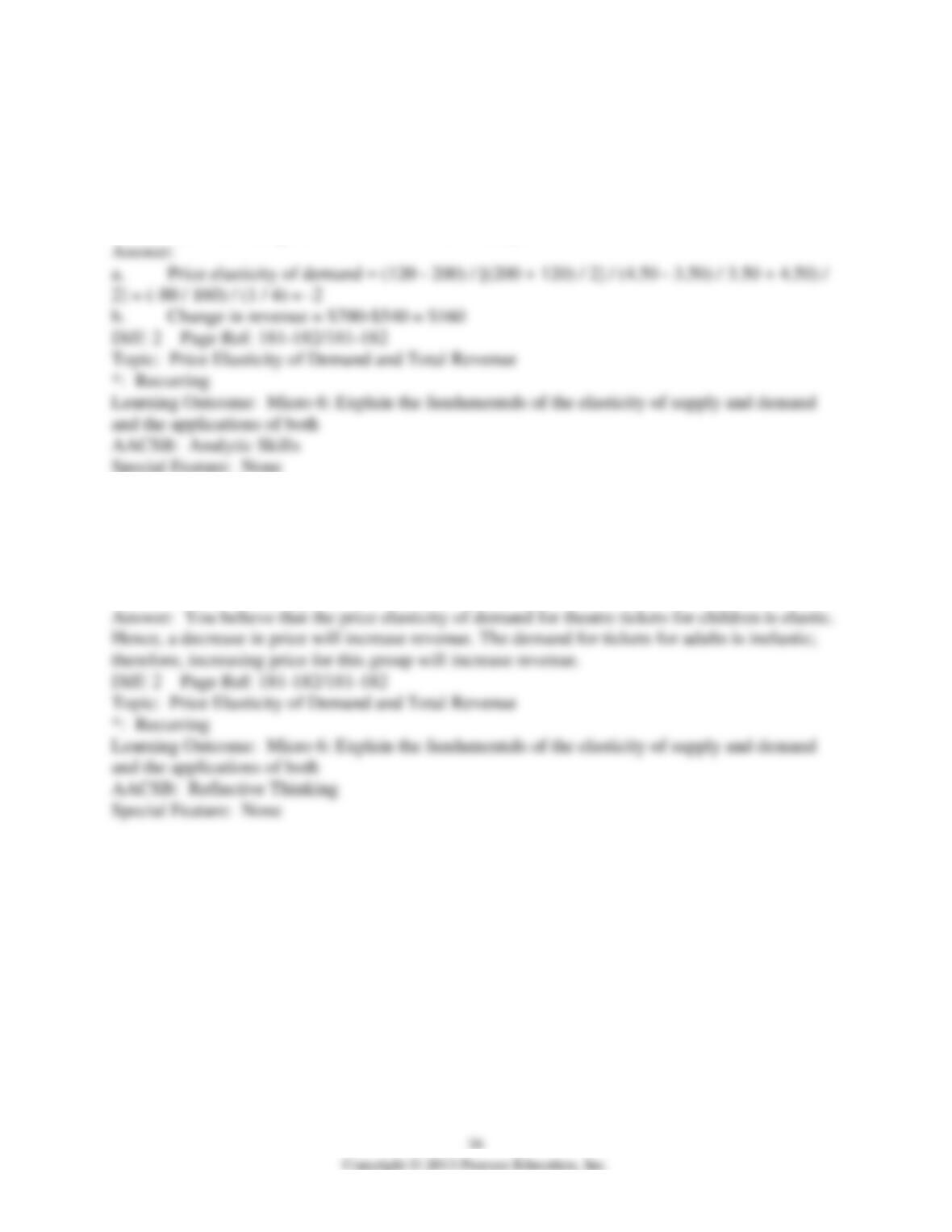
24) Ali’s Gyros operates near a college campus. Ali has been selling 120 gyros a day at $4.50
each and is considering a price cut. He estimates that he would be able to sell 200 gyros per day
at $3.50 each.
a. Calculate the price elasticity of demand using the midpoint formula.
b. Calculate the change in revenue as a result of the price cut.
25) You are the manager of a theater. At present the theater charges the same admission price of
$8 to all customers, regardless of age. You propose a two-tier pricing scheme: $5 for children
under the age of 12 and $10 for adults. You tell your supervisor that your proposal is likely to
increase revenues. What must be true about the price elasticity of demand if your proposal is to
achieve its goal of raising revenue? Explain your answer.
26) Suppose the governor of California has proposed increasing toll rates on California’s toll
roads, and has presented two possible scenarios to implement these increases. Following are
projected data for the two scenarios for the California toll roads:
Scenario 1: Toll rate in 2012: $10.00. Toll rate in 2016: $22.50
For every 100 cars using the toll roads in 2012, only 81.6 cars will use the toll roads in 2016.
Scenario 2: Toll rate in 2012: $10.00. Toll rate in 2016: $17.50
For every 100 cars using the toll roads in 2012, only 96.2 cars will use the toll roads in 2016.
a. Using the midpoint formula, calculate the price elasticity of demand for Scenario 1 and
Scenario 2.
b. Assume 10,000 cars use California toll roads every day in 2012. What would be the daily
total revenue received for each scenario in 2012 and in 2016?
c. Is demand under Scenario 1 and under Scenario 2 price elastic, inelastic, or unit elastic. Briefly
explain.
(For above questions, assume that nothing other than the toll change occurs during the time
frame listed that would affect consumer demand.)
6.4 Other Demand Elasticities
1) The income elasticity of demand measures
A) the responsiveness of quantity demanded to changes in income.
B) how a consumer’s purchasing power is affected by a change in the price of a product.
C) the percentage change in the price of a product divided by the percentage change in consumer
income.
D) the income effect of a change in price.
2) If a good has a negative income elasticity of demand, this indicates that the good is
A) a substitute with another good.
B) a complement with another good.
C) inferior.
D) normal.
3) If a 5 percent increase in income leads to a 10 percent increase in quantity demanded for
airline travel, then airline travel is
A) a necessity.
B) a substitute for another good.
C) a luxury.
D) an inferior good.
4) If a 6 percent increase in income leads to a 4 percent increase in quantity demanded for audio
books the income elasticity of demand is
A) -0.67.
B) 0.67.
C) 1.5.
D) 2.
5) If a 5 percent increase in income leads to a 10 percent decrease in quantity demanded for a
product this product is
A) an income elastic good.
B) an inferior good.
C) a necessity.
D) a luxury good.
6) If the quantity demanded for a good rises as income rises then the income elasticity of demand
for this good is ________ than 0, and the good is ________ good.
A) greater; an inferior
B) less; a normal
C) less; an inferior
D) greater; a normal
7) Demand for a luxury item, such as a yacht, is likely to be
A) both income and price inelastic.
B) both income elastic and price elastic.
C) income elastic and price inelastic.
D) income inelastic and price elastic.
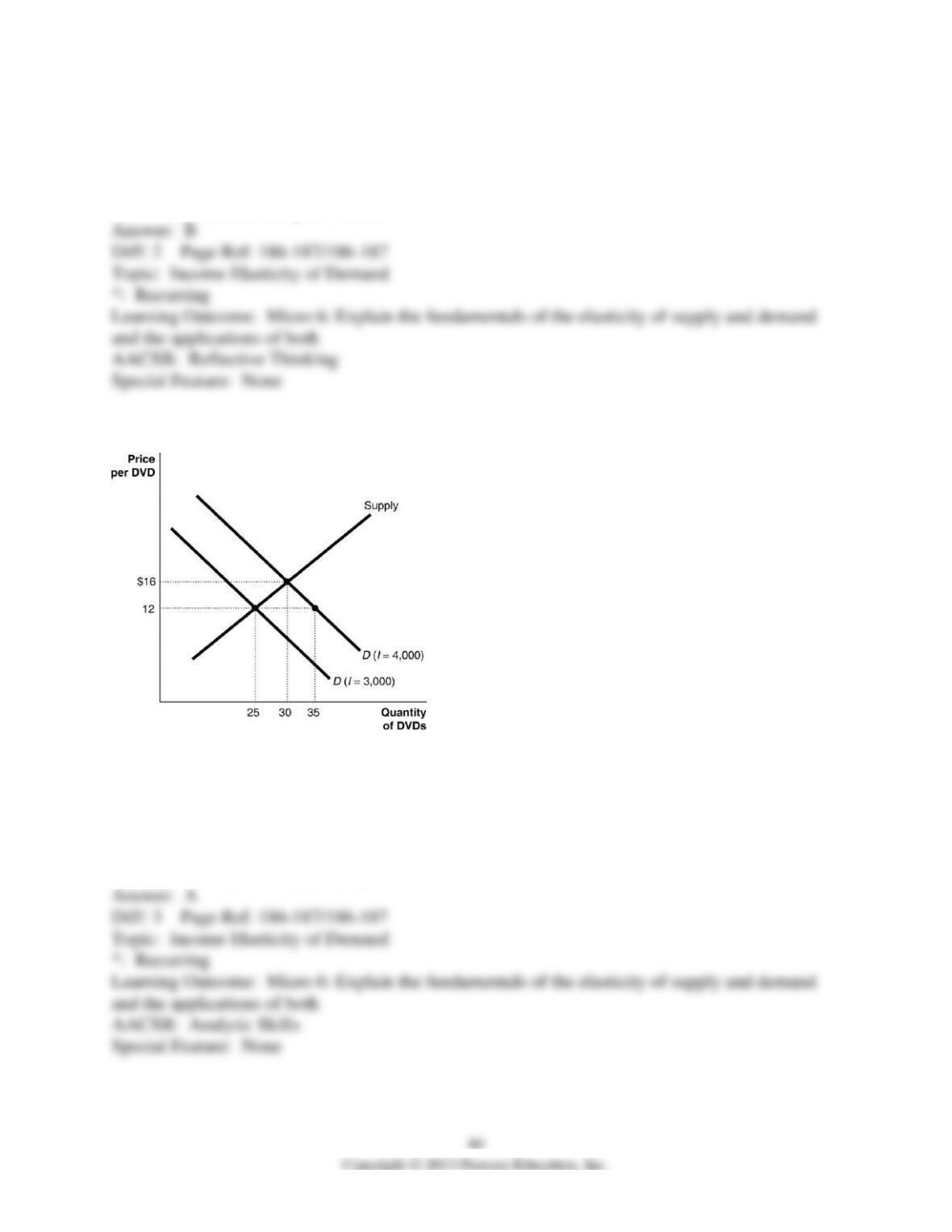
Figure 6-4
8) Refer to Figure 6-4. The data in the diagram indicates that DVDs are
A) luxury goods.
B) inelastic goods.
C) necessities.
D) both luxury goods and inelastic goods.
E) both necessities and inelastic goods.