Microeconomics, 4e – Testbank 2 (Hubbard)
Chapter 6 Elasticity: The Responsiveness of Demand and Supply
6.1 The Price Elasticity of Demand and Its Measurement
1) Economists use the concept of ________ to measure how one economic variable, such as
quantity, responds to a change in another economic variable, such as price.
A) slope
B) efficiency
C) relativity
D) elasticity
2) The price elasticity of demand is equal to
A) the value of the slope of the demand curve.
B) the change in quantity demanded divided by the change in price.
C) the percentage change in price divided by the percentage change in quantity demanded.
D) the percentage change in quantity demanded divided by the percentage change in price.
3) In May 2011, the average price of gasoline in the United States was $3.76 per gallon, and
consumers purchased nearly 5 percent less gasoline than they had during May 2010, when the
average price of gasoline was $2.79 per gallon. Based on these figures, from May 2010 to May
2011, the demand for gasoline was
A) elastic.
B) inelastic.
C) unit elastic.
D) perfectly elastic.
4) To calculate the price elasticity of demand we divide
A) the percentage change in quantity demanded by the percentage change in price.
B) the percentage change in price by the percentage change in quantity demanded.
C) rise by the run.
D) the average price by the average quantity demanded.
5) The slope of a demand curve is not used to measure the price elasticity of demand because
A) the slope of a linear demand curve is not constant.
B) the slope of a line cannot have a negative value.
C) the measurement of slope is sensitive to the units chosen for price and quantity.
D) the slope of the demand curve does not tell us how much quantity changes as price changes.
6) If the slope of a demand curve is equal to -0.1 then
A) demand is inelastic.
B) we don’t know whether the demand is elastic or inelastic.
C) the demand is elastic at low prices and inelastic at high prices.
D) as price increases by 10 percent quantity demanded decreases by 1 percent.
7) The price elasticity of demand for beef is estimated to be 0.60 (in absolute value). This means
that a 20 percent increase in the price of beef, holding every thing else constant, will cause the
quantity of beef demanded to
A) decrease by 12 percent.
B) decrease by 26 percent.
C) decrease by 32 percent.
D) decrease by 60 percent.
8) If the absolute value of the price elasticity of demand for aspirin equals 0.8 then
A) aspirin is a normal good.
B) the demand for aspirin is inelastic.
C) aspirin has few substitutes.
D) the demand for aspirin is elastic.
9) If demand is perfectly elastic, the absolute value of the price elasticity coefficient is
A) infinity.
B) zero.
C) more than one.
D) equal to the absolute value of the slope of the demand curve.
10) When the price of tortilla chips rose by 10 percent, the quantity of tortilla chips sold fell 4
percent. This indicates that the demand for tortilla chips is
A) inelastic.
B) elastic.
C) unit-elastic.
D) perfectly inelastic.
11) A linear downward sloping demand curve has price elasticities (in absolute values) that
A) increase as price decreases.
B) remain constant along the demand curve.
C) decrease as price decreases.
D) are greater than or equal to 1.
12) Carrie Bradshaw claims that when it comes to buying shoes, “price is no object.” If this is
true, then her demand for shoes is
A) perfectly elastic.
B) perfectly inelastic.
C) unit-elastic.
D) horizontal.
13) If the price elasticity of demand for insulin is equal to zero then the demand curve for insulin
is
A) horizontal.
B) downward sloping.
C) curvilinear.
D) vertical.
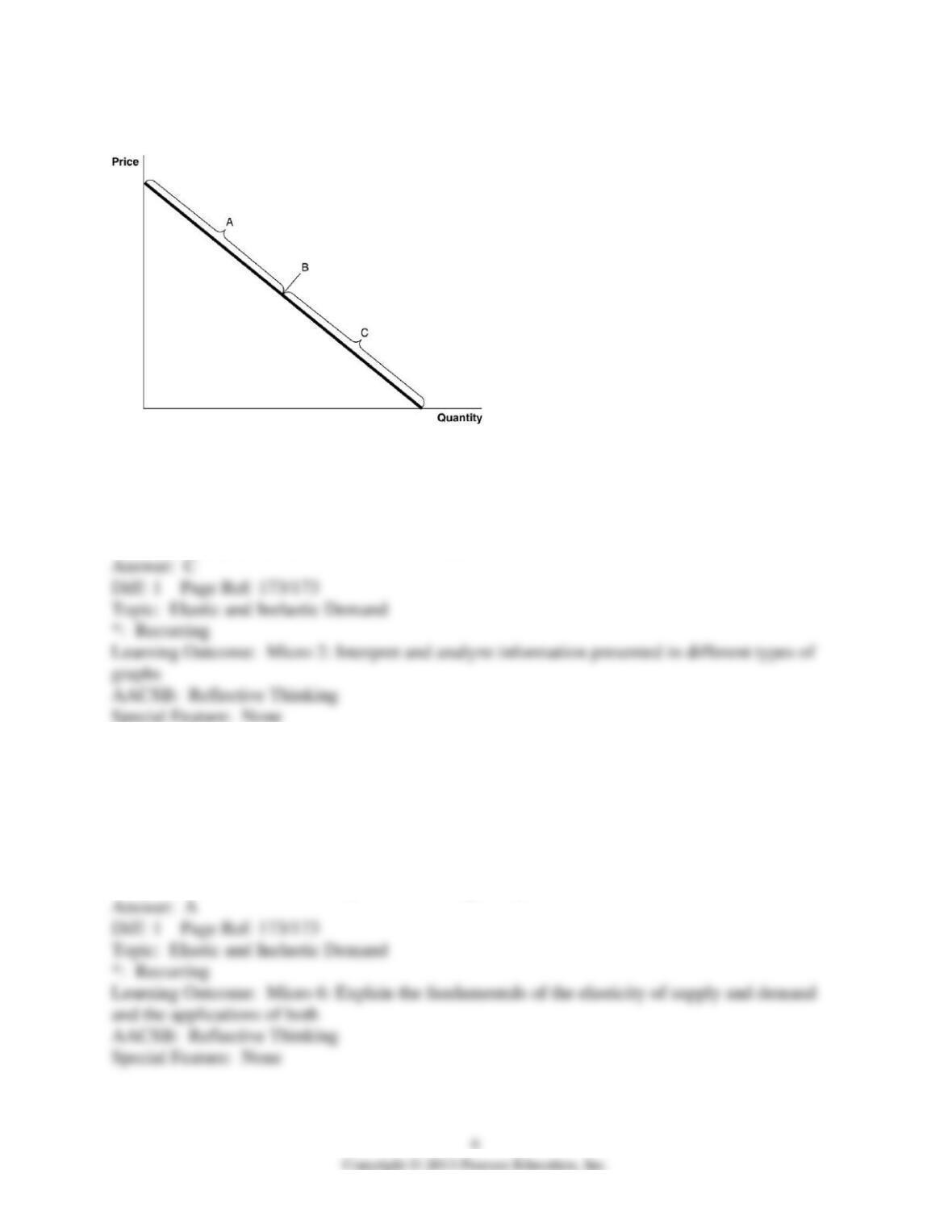
Figure 6-1
14) Refer to Figure 6-1. The section of the demand curve labeled “A” represents
A) the inelastic section of the demand curve.
B) the unit-elastic section of the demand curve.
C) the elastic section of the demand curve.
D) the perfectly elastic section of the demand curve.
15) If the demand for iPods is price elastic, then
A) the percentage change in quantity demanded is greater than the percentage change in price (in
absolute value).
B) the percentage change in quantity demanded is less than the percentage change in price (in
absolute value).
C) the percentage change in quantity demanded is equal to the percentage change in price.
D) quantity demanded is not responsive to changes in price.
16) If the demand for a steak is unit-elastic, then
A) the percentage change in quantity demanded is 1 percent greater than the percentage change
in price.
B) the percentage change in quantity demanded is equal to the percentage change in price.
C) the percentage change in quantity demanded is 100 percent greater than the percentage
change in price (in absolute value).
D) quantity demanded does not respond to changes in price.
17) If the demand for cell phone service is inelastic, then
A) the percentage change in quantity demanded is greater than the percentage change in price (in
absolute value).
B) the percentage change in quantity demanded is equal to the percentage change in price.
C) the quantity demanded does not change in response to changes in price.
D) the percentage change in quantity demanded is less than the percentage change in price (in
absolute value).
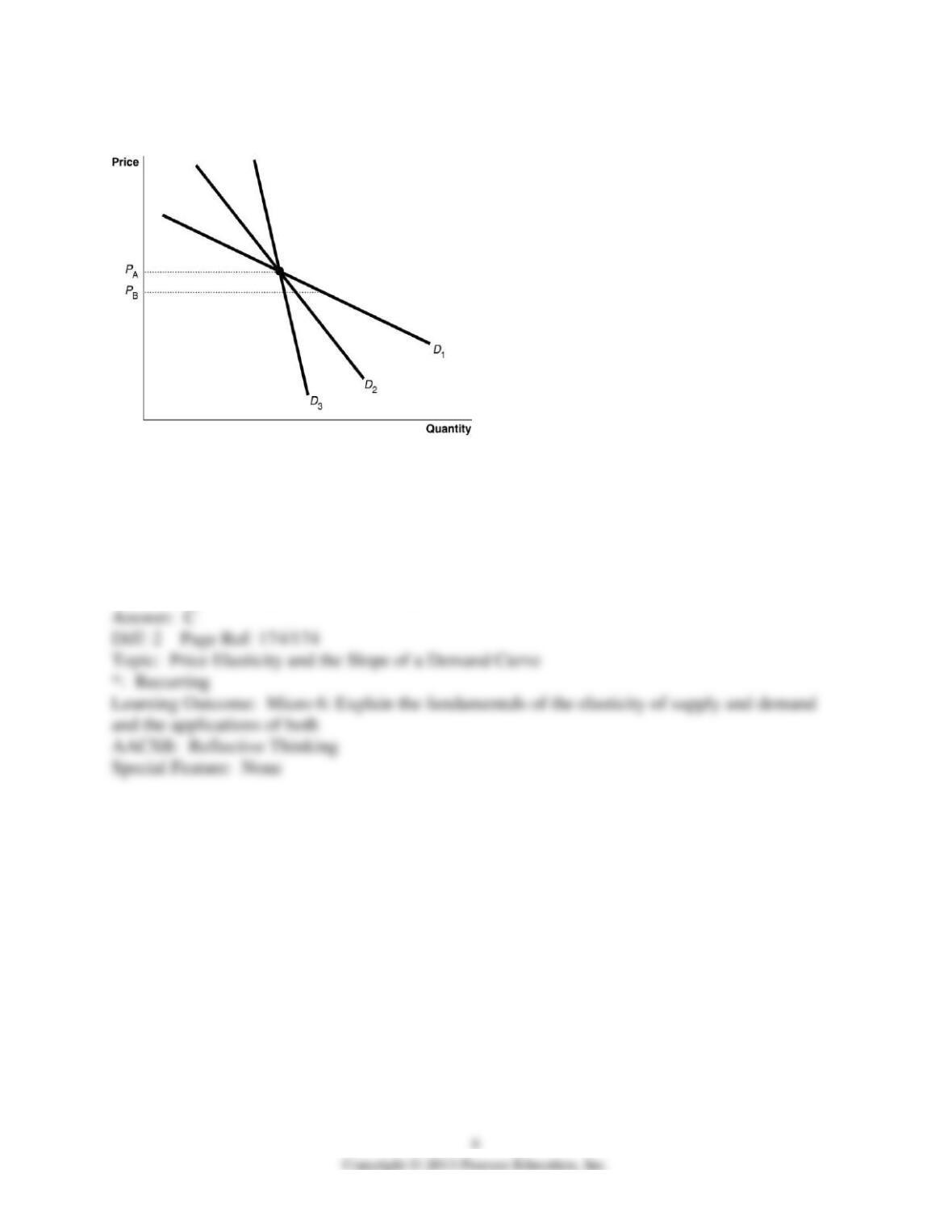
Figure 6-2
18) Refer to Figure 6-2. As price falls from PA to PB, the quantity demanded increases most
along D1; therefore,
A) D1 is unit elastic.
B) D1 is more inelastic than D2 or D3.
C) D1 is more elastic than D2 or D3
D) D1 is elastic at PA but inelastic at PB.
19) The midpoint formula is used to measure the elasticity of demand between two points on a
demand curve
A) when demand is elastic.
B) in special cases when the percentage change in the quantity demanded is equal to the
percentage change in price.
C) to ensure that the elasticity has a negative value.
D) to ensure that we have only one value of the price elasticity of demand between two points on
a demand curve.
20) When the price of pistachio nuts is $7.50 per lb. the quantity demanded is 48 lbs. When the
price of peaches is $9.00 per lb. the quantity demanded is 40 lbs. When the midpoint formula is
used to measure the price elasticity of demand we can say that the demand for pistachio nuts is
A) relatively, but not perfectly, elastic.
B) unit-elastic.
C) completely inelastic.
D) relatively, but not perfectly, inelastic.
21) Assume that when the price of cantaloupes is $2.50 the demand for cantaloupes is unit–
elastic, and that the demand curve for cantaloupes is linear and downward sloping. If firms lower
the price of cantaloupes to $2.00 which of the following statements can be made regarding the
price elasticity of demand for cantaloupes?
A) The demand for cantaloupes at $2.00 must be inelastic.
B) We cannot determine whether the demand for cantaloupes is elastic or inelastic without
knowing what the quantity demanded is at each price.
C) The demand for cantaloupes at $2.00 must be elastic.
D) The demand for cantaloupes at $2.00 must be unit-elastic.
22) Assume that the demand curve for sunblock is linear and downward sloping. Which of the
following statements about the slope of the demand curve for sunblock and the price elasticity of
demand for sunblock are true?
A) The slope and the price elasticity of demand are constant at all points along the demand curve
for sunblock.
B) The slope is constant, but the price elasticity of demand is not constant at all points along the
demand curve for sunblock.
C) The slope is not constant, but the price elasticity of demand is constant at all points along the
demand curve for sunblock.
D) The slope of the demand curve for sunblock is constant and equal to zero; demand is perfectly
inelastic.
23) If the percentage change in the quantity of teapots demanded is greater than the percentage
change in the price of teapots, then
A) the price elasticity of demand for teapots is greater than 1 in absolute value.
B) the demand for teapots is unit-elastic.
C) the price elasticity of demand for teapots is equal to zero.
D) the price elasticity of demand for teapots is less than 1 in absolute value.
24) We should never assume that an inelastic demand curve is a perfectly inelastic demand curve
because
A) there has never been evidence of a perfectly inelastic demand curve.
B) an inelastic demand curve may be perfectly inelastic at some times but not others.
C) perfectly inelastic demand curves are rare.
D) an inelastic demand curve may be elastic at high prices.
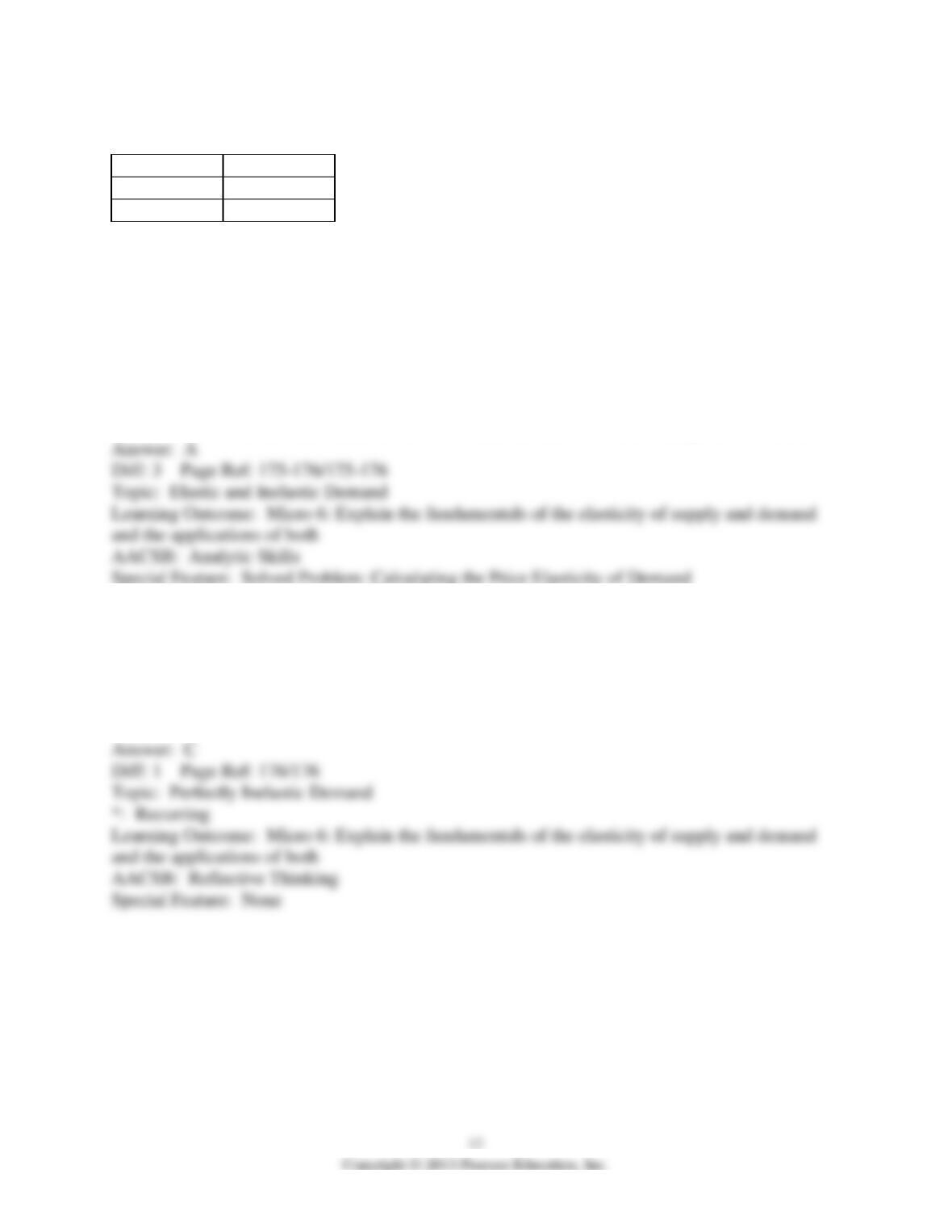
Table 6-1
Price
Quantity
$35
40
25
50
25) Refer to Table 6-1. Suppose you own a bookstore. You believe that you can sell 40 copies
per day of the latest John Grisham novel when the price is $35. You consider lowering the price
to $25 and believe this will increase the quantity sold to 50 books per day. Compute the price
elasticity of demand using the mid-point formula and these data. Select the correct implication
from your work.
A) The demand for the John Grisham book is inelastic. Revenue will fall if the price is lowered.
B) The demand for the John Grisham book is elastic. Revenue will rise if the price is lowered.
C) The demand for the John Grisham book is inelastic. Revenue will rise if the price is lowered.
D) The demand for the John Grisham book is elastic. Revenue will fall if the price is lowered.
26) Of the following, which is the best example of good with a perfectly inelastic demand?
A) the demand for tickets in New York City when the Mets or Yankees are in the World Series
B) the demand for gasoline
C) a diabetic’s demand for insulin
D) the demand for a college education by a student who has a full scholarship to an Ivy League
school
27) A perfectly elastic demand curve is
A) vertical.
B) horizontal.
C) curvilinear.
D) upward sloping.
28) A newspaper story on the effect of higher milk prices on the market for ice cream contained
the following:
“As a result [of the increase in milk prices], retail prices for ice cream are up 4 percent from last
year. . . . And ice cream consumption is down 3 percent.”
Source: John Curran, “Ice Cream, They Scream: Milk Fat Costs Drive Up Ice Cream Prices,”
Associated Press, July 23, 2001.
Based on the information given, what is the price elasticity of demand for ice cream?
A) 0.75 (in absolute value)
B) 1.33 (in absolute value)
C) 12%
D) We do not have enough information to calculate the elasticity.
29) Suppose that when the price per ream of recycled printer paper rises from $4 to $4.50, the
quantity demanded falls from 800 to 600 reams per day. Using the midpoint formula, what is the
price elasticity of demand (in absolute value) over this range?
A) 0.003
B) 0.41
C) 2.43
D) 4
30) If demand is inelastic, the absolute value of the price elasticity coefficient is greater than one.
31) If the demand for a product is elastic, the quantity demanded changes by a smaller
percentage than the percentage change in price.
32) If the absolute value of the price elasticity of demand for gasoline is 0.5, then a 10 percent
increase in the price of gasoline leads to a 0.5 percent decrease in the quantity demanded.
33) If at a price of $10, a vendor sells 5 units of a product and at a price of $8, 6 units are sold,
then, using the midpoint formula, the demand for this good is inelastic.
34) Briefly explain the economic concept of elasticity.
35) The current price of canvas messenger bags is $36 each and sales of the bags equal 400 per
week. If the price elasticity of demand is -2.5 and the price changes to $44, how many messenger
bags will be sold per week? Use the midpoint formula.
36) The U.S. government’s focus on supply reduction efforts in its “war on drugs” has been
relatively unsuccessful at addressing illegal drug use. Some economists believe that a successful
anti-drug program must concentrate on reducing demand; for example, through drug education
and voluntary treatment programs for addicts.
a. Suppose the price elasticity of demand for cocaine is -0.5. What will happen to the
equilibrium price, quantity and total revenue from cocaine sales if the government succeeds in its
efforts to reduce demand? What is likely to happen to the incentive to sell cocaine?
b. Suppose the government continues to concentrate its efforts on supply reduction and is able to
reduce the supply of cocaine. As a result of the reduction in supply the price of cocaine increases
by 25 percent. If the price elasticity of demand is -0.5, what is likely to happen to the incentive to
sell cocaine?
c. Based on your answers, explain why one approach might be preferred over the other.
6.2 The Determinants of the Price Elasticity of Demand
1) The larger the share of a good in a consumer’s budget, holding everything else constant, the
A) more price elastic is a consumer’s demand.
B) more vertical is a consumer’s demand curve.
C) more price inelastic is a consumer’s demand.
D) more unit-elastic is a consumer’s demand.
2) The most important determinant of the price elasticity of demand for a good is
A) the definition of the market for a good.
B) the availability of substitutes for the good.
C) the share of the good in the consumer’s budget.
D) whether the good is a necessity or a luxury.
3) Which of the following statements is true?
A) In general, if a product has few substitutes it will have an elastic demand.
B) The more time that passes the more inelastic the demand for a product becomes.
C) The demand curve for a necessity is more elastic than the demand curve for a luxury.
D) The more narrowly we define a market, the more elastic the demand for a product will be.
4) Which of the following is not a determinant of a good’s price elasticity of demand?
A) the slope of the demand curve
B) the share of the good in the consumer’s total budget
C) whether the good is a luxury or a necessity
D) the passage of time
5) If the absolute value of the price elasticity of demand for DVD movies is 0.8 then the
elasticity of demand for the DVD for the movie The Hangover should be
A) less then 0.8 in absolute value.
B) greater than 0.8 in absolute value.
C) equal to 1 in absolute value.
D) equal to zero because the DVD of this movie has been out for several years.
6) Holding everything else constant, the demand for a good tends to be more elastic
A) the more substitutes there are for the good.
B) the shorter the time period involved.
C) the more consumers perceive the good to be a necessity.
D) the less important the product is in consumers’ budgets.
7) Holding everything else constant, the absolute value of the price elasticity of demand for
Saucony tennis shoes is ________ the price elasticity of demand for tennis shoes.
A) less than
B) equal to
C) twice as great as
D) greater than
8) Which of the following could explain why the demand for table salt is inelastic?
A) Salt is a luxury good.
B) Salt is a rare commodity.
C) Households devote a very small portion of their income to salt purchases.
D) Salt is a luxury for high income consumers but a necessity for low income consumers.
9) Economist Jerry Hausman estimated the price elasticity of demand for breakfast cereal. He
found that
A) the price elasticity for a particular brand of raisin bran was the same as the elasticity of
demand for all family cereals.
B) the price elasticity of demand for Post Raisin Bran is less than the price elasticity of demand
for Kellogg’s Raisin Bran.
C) the price elasticity of all family breakfast cereals is greater than the price elasticity of demand
for Post Raisin Bran or Kellogg’s Raisin Bran.
D) the price elasticity of demand for a particular brand of raisin bran was larger in absolute value
than the elasticity for all family cereals.
10) Economist Jerry Hausman estimated the price elasticity of demand for “Post Raisin Bran”
and “All types of breakfast cereals.” He found that the price elasticity of demand for Post Raisin
Bran was -2.5 and the price elasticity of demand for “All types of breakfast cereals” was -0.9.
Which of the following can be implied from Hausman’s estimates?
A) The demand for “All types of breakfast cereals” is elastic.
B) A 1 percent increase in the price of Post Raisin Bran will lead to a 25 percent decrease in the
quantity demanded of Post Raisin Bran.
C) The demand for Post Raisin Bran is more elastic than the demand for “All types of breakfast
cereals.”
D) A 1 percent decrease in the price of breakfast cereals will lead to a 2.5 percent increase in the
quantity demanded of Post Raisin Bran.
11) Most people buy salt infrequently and in small quantities. Even a doubling of the price of salt
is likely to result in a small decline in the quantity of salt demanded. Therefore,
A) the demand for salt will be perfectly inelastic.
B) salt is a normal good.
C) the demand for salt is relatively inelastic.
D) the price elasticity of demand for salt is greater than 1 (in absolute value).