
Hall: Guyton and Hall Textbook of Medical Physiology, 12th Edition
Chapter 67: Metabolism of Carbohydrates, and Formation of Adenosine Triphosphate
Test Bank
1. A high NAD+/NADH ratio in a cell would most likely facilitate which of the following?
A. Fatty acid oxidation
B. Lactate formation
C. Glucose oxidation
D. Pyruvic acid formation
2. Which of the following best describes the fate of lactate produced in exercising skeletal
muscle?
A. Converted to pyruvate in liver
B. Converted to pyruvate in skeletal muscle
C. Used as energy by liver
D. Used as energy by skeletal muscle
3. Which of the following enzymes enable the liver to export glucose?
A. Glucokinase
B. Glucose-6-phosphatase
C. Glycogen phosphatase
D. Hexokinase
4. Which of the following most likely contributes energy during anaerobic work in skeletal
muscle?
A. Gluconeogenesis
B. Fatty acid oxidation
C. Phosphocreatine
D. Oxidation of lactate to pyruvate
5. Which of the following best describes the substance that becomes the final common
pathway for the transport of nearly all carbohydrates to cells in the body?
A. ATP
B. Fructose
C. Galactose
D. Glucose
Test Bank
67-2
E. NADPH
6. Which of the following mechanisms best describes how glucose is transported from the
extracellular space to the interior of a muscle fiber?
A. Facilitated diffusion
B. Primary active transport
C. Secondary active transport
D. Simple diffusion
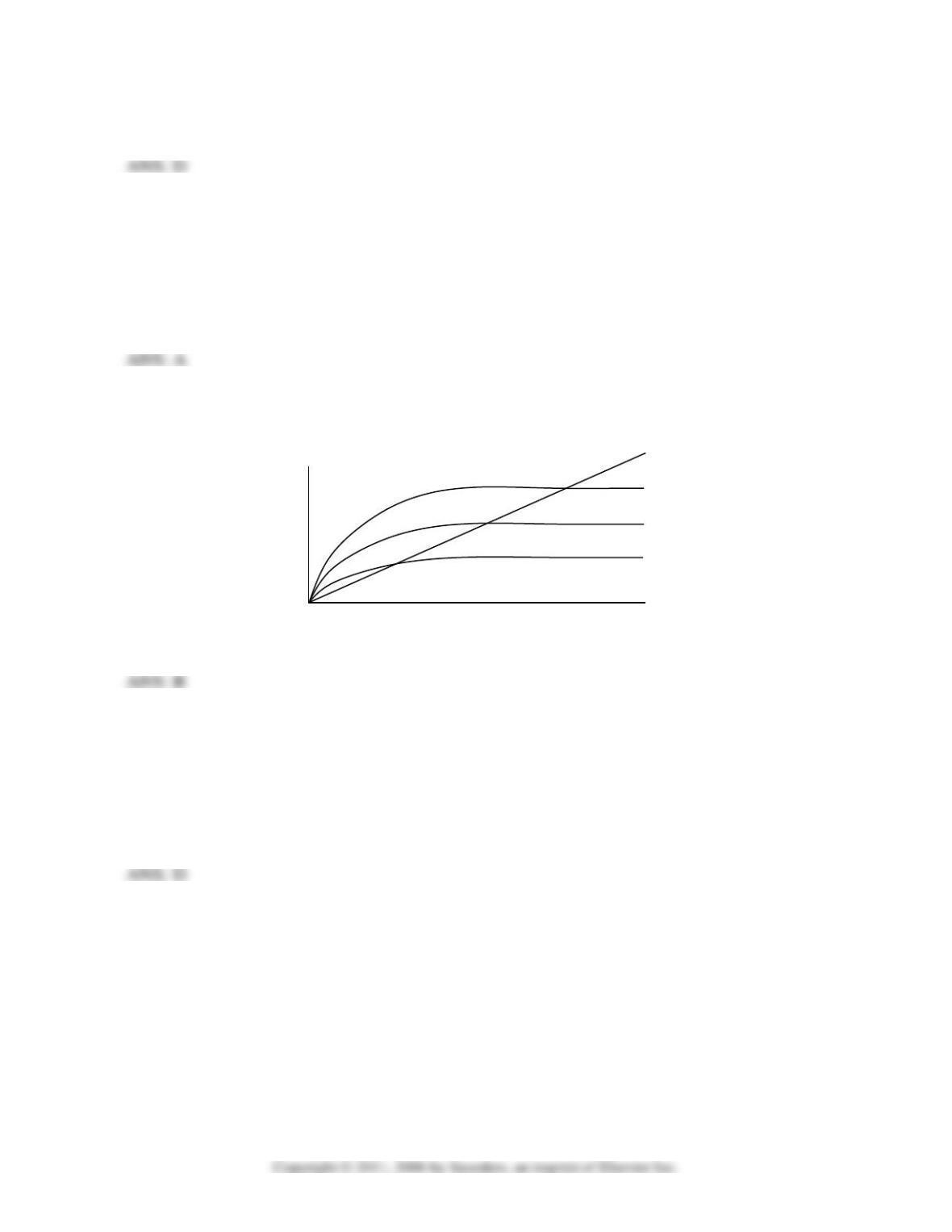
7. If “C” represents the movement of glucose into skeletal muscle under control conditions,
which curve would represent glucose transport after adding additional insulin?
8. Which of the following transporters facilitate insulin-sensitive, postprandial uptake of
excess glucose from the bloodstream?
A. GLUT1
B. GLUT2
C. GLUT3
D. GLUT4
9. Glucose transporter type 4 (GLUT4) is found mainly in which of the following tissues?
A. Adipose tissues only
B. Adipose tissues, heart, liver, and skeletal muscle
C. Heart only
D. Heart, liver, and adipose tissues
E. Liver only
F. Skeletal muscle only
G. Skeletal muscle, heart, and adipose tissues
H. Skeletal muscle, heart, and liver
Flux Into
Cell
Extracellular
Concentration
B
C
D
A

Test Bank
67-3
10. Which of the following enzymes plays a critical role in capturing glucose intracellularly?
A. Citrate synthase
B. Fumarase
C. Glucokinase
D. Glucose phosphatase
E. Lactic dehydrogenase
F. Succinic dehydrogenase
11. Which of the following best describes the process of glycogen formation?
A. Citric acid cycle
B. Gluconeogenesis
C. Glycogenesis
D. Glycogenolysis
12. Which of the following best describes the process by which stored glycogen is converted
to glucose?
A. Citric acid cycle
B. Gluconeogenesis
C. Glycogenesis
D. Glycogenolysis
13. Which of the following substances can activate phosphorylase and thereby promote
glycogenolysis?
A. Epinephrine and glucagon
B. Epinephrine and insulin
C. Epinephrine only
D. Glucagon only
E. Glucagon, insulin, and epinephrine
F. Insulin only
14. In glycolysis, one molecule of glucose is split to form two molecules of which of the
following substances?
A. Fumaric acid
B. Isocitric acid
C. Lactic acid

Test Bank
67-4
D. Pyruvic acid
E. Succinic acid
15. Which of the following best describes the amount of ATP produced from one mole of
glucose by the glycolytic process (in moles)?
A. 0
B. 1
C. 2
D. 38
E. 4
16. Which of the following best describes the amount of ATP produced during the
conversion of pyruvic acid to acetyl coenzyme A (in moles)?
A. 0
B. 1
C. 2
D. 38
E. 4
17. The sequence of chemical reactions in the citric acid cycle occurs in which part of a cell?
A. Cytosol
B. Golgi apparatus
C. Lysosome
D. Mitochondrion
E. Vesicle
18. The citric acid cycle begins and ends with which of the following substances?
A. Acetyl coenzyme A
B. Citric acid
C. Isocitric acid
D. Oxaloacetic acid
E. Oxalosuccinic acid
F. Succinic acid