The Cultural Landscape, 11e (Rubenstein)
Chapter 6 Religions
1) With respect to the relationship between culture, religion, and the physical environment,
A) few religions derive meaningful events from the physical environment.
B) religious ideas may be responsible for some of the changes people make in the physical
environment.
C) religion is no longer an important source of identification for a distinct cultural group.
D) all religions appeal primarily to people living in their land of origin.
E) religious ideas nearly all arise from changes in the physical environment.
2) Religion is a good example of the tension between globalization and local diversity because
A) migrants leave their religion behind when they migrate to a new area.
B) religion always represents the most traditional worldviews of a population.
C) many people follow more than one religion.
D) all religions are in competition to convert as many people as possible.
E) religion represents core cultural values and beliefs that may conflict with others.
3) Mahayanists, in contrast to Theravadists, emphasize Buddha’s
A) life of self-help.
B) compassion.
C) renouncing of worldly goods.
D) wisdom.
E) practice of meditation.
4) Animists believe that
A) people should complete God’s creation of the Earth.
B) inanimate objects and natural events have spirits.
C) people should make complete use of the Earth’s resources.
D) natural disasters are preventable.
E) enlightenment can be achieved by all people.
5) Especially important in Confucianism is to
A) perform public service.
B) reflect on the mystical and magical aspects of life.
C) respect forces of nature as divine.
D) believe in one all-powerful God.
E) read the holy texts daily.
6) Especially important in Daoism is to
A) perform public service.
B) reflect on the mystical and magical aspects of life.
C) respect forces of nature as divine.
D) believe in one all-powerful God.
E) read the holy texts daily.
7) The belief in the existence of only one god is
A) animism.
B) cosmogony.
C) monotheism.
D) polytheism.
E) pagan.
8) Beliefs concerning the origin of the universe are
A) animism.
B) cosmogony.
C) monotheism.
D) astronomy.
E) polytheism.
9) When geographers study the sites where religions originated as well as the processes by which
those religions diffused to other locations, they are focusing on the
A) spatial connections in religion.
B) geo-religious linkages of culture.
C) role of history in the social sciences.
D) lack of spatial connections in religion.
E) loss of historical processes in the formations of religions.
10) A geographer researching the practices of Tibetan Buddhists as well as the world travels of
the Dalai Lama is studying
A) spatial connections in religion.
B) theological connections in religion.
C) monetary connections in religion.
D) connections between Christianity and Buddhism.
E) connections between ethnic and universalizing religions.
11) A person attempting to detect ________ within forests and streams would likely be an
animist.
A) physical markings
B) voices or personalities
C) inspiration for beautiful art
D) evidence of past missionary activities
E) inspiration for religious texts
12) The world’s largest ethnic religion is
A) Confucianism.
B) Daoism.
C) Hinduism.
D) Shintoism.
E) Islam.
13) Which characteristic distinguishes religion in Latin America from North America?
A) having a Roman Catholic majority
B) having a Protestant majority
C) location relative to the Equator
D) Ethnic religions make up the majority in one but not the other.
E) Latin America has more Protestants, Jews, and Muslims.
14) Given Daoism’s classification as either a universalizing or an ethnic religion, which of the
following would you be more likely to categorize as pertaining to Daoism?
A) Most shrines are located in major cities and towns around the world.
B) Most of the religious texts concern the stories and letters of missionaries who traveled to
different countries.
C) Most shrines are located at major physical features or sites of longstanding cultural
significance.
D) Most of the religious texts are directly related to warfare.
E) People of numerous ethnic groups attend the great majority of religious services.
15) The maps and diagrams in this chapter help us surmise that a person from northern Germany
is more likely to be an adherent of
A) Protestantism.
B) Roman Catholicism.
C) Judaism.
D) Eastern Orthodoxy.
E) a fundamentalist Christian sect.
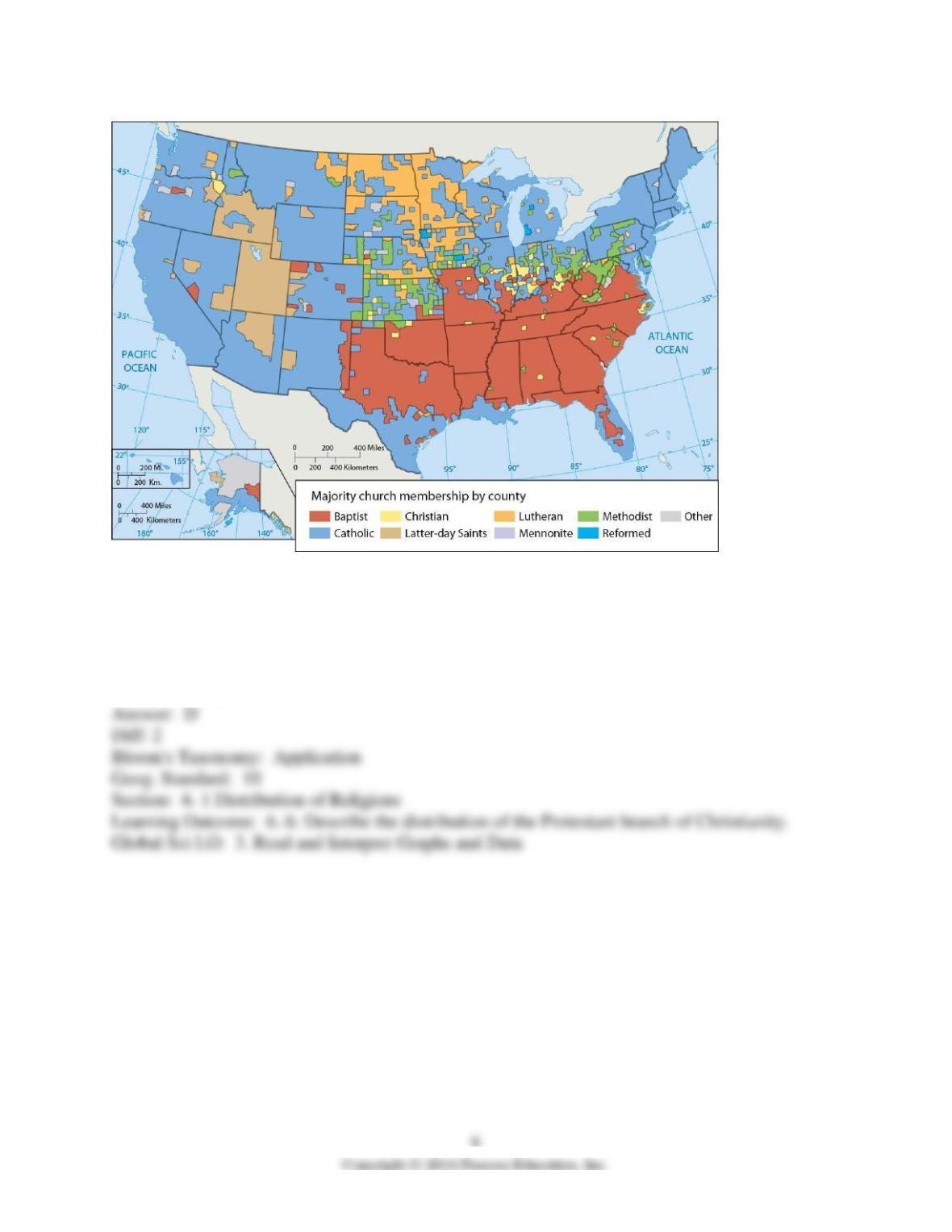
16) This map indicates that Lutherans are clustered in the ________ United States.
A) northeastern
B) southern
C) southwestern
D) upper midwestern
E) northwestern
17) The maps in this chapter indicate that Eastern Orthodoxy is a branch of Christianity
prevalent in
A) Russia.
B) Italy.
C) Spain.
D) Russia and Spain but not Greece.
E) Greece and Germany but not Russia.
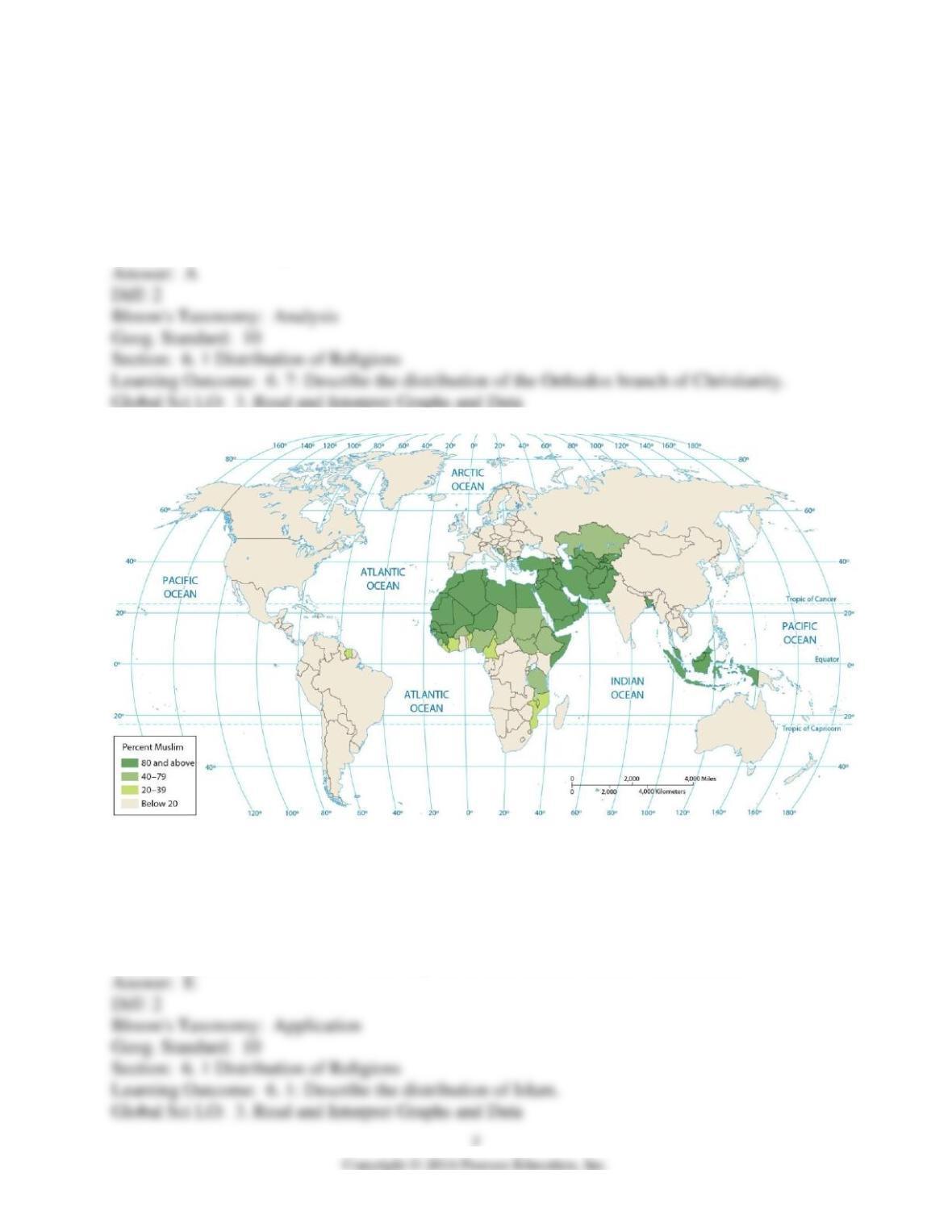
18) This map shows that Muslims are clustered in
A) Southwestern Asia, Sub-Saharan Africa, and parts of South Asia.
B) Southwestern Asia, North Africa, South America, and parts of North America.
C) Eastern Europe, North America, South Asia, and parts of Russia, China, and Japan.
D) East Asia, South Asia, and North Africa.
E) Southwestern Asia, North Africa, and parts of South Asia and Southeastern Asia.
19) A review of the world maps in this chapter indicates that in South America,
A) nearly all of the people are Catholic.
B) the great majority of the people are Catholic.
C) nearly all of the people are Protestant.
D) the population is almost equally divided between Catholics and Protestants.
E) about one-fourth of the people are Protestant, one-fourth Catholic, and the remainder practice
traditional religions.
20) A review of the maps in this chapter indicates that in northeastern Canada,
A) nearly all of the people are Catholic.
B) the great majority of the people are Catholic.
C) nearly all of the people are Protestant.
D) the population is almost equally divided between Catholics and Protestants.
E) about three-fourths of the people are Protestant and one-fourth are Catholic.
21) The maps in this chapter indicate that in Sub-Saharan Africa,
A) about half of the people are Protestant.
B) about one-fourth of the people are Protestant.
C) about half of the people are Catholic.
D) about one-fourth of the people are animists.
E) about one-fourth of the people are Orthodox Christian.
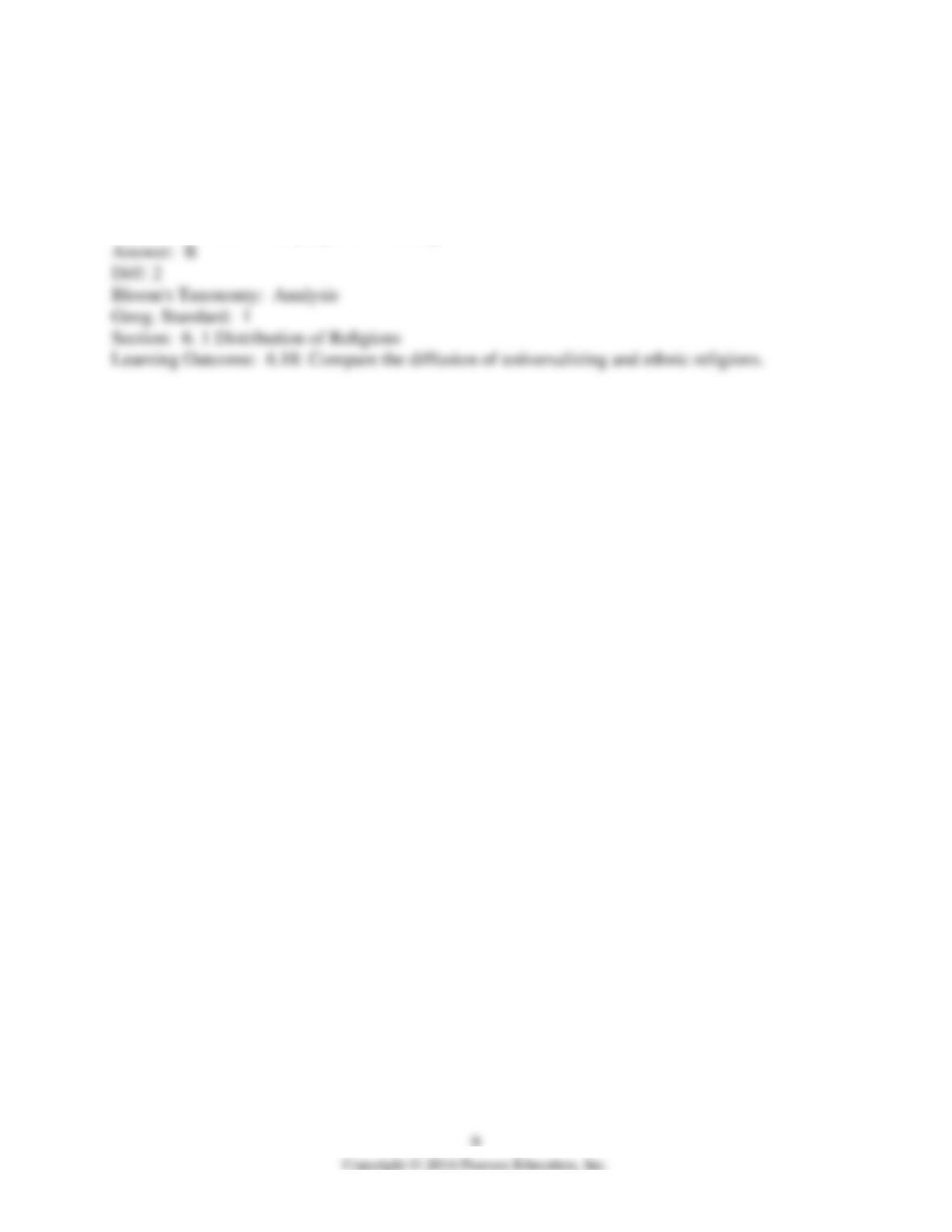
22) The maps in this chapter indicate that in Australia and the South Pacific,
A) more than half of the people are Protestant.
B) less than half of the people are Protestant.
C) about half of the people are Catholic.
D) about one-fourth of the people are animists.
E) more than half of the people are nonreligious.
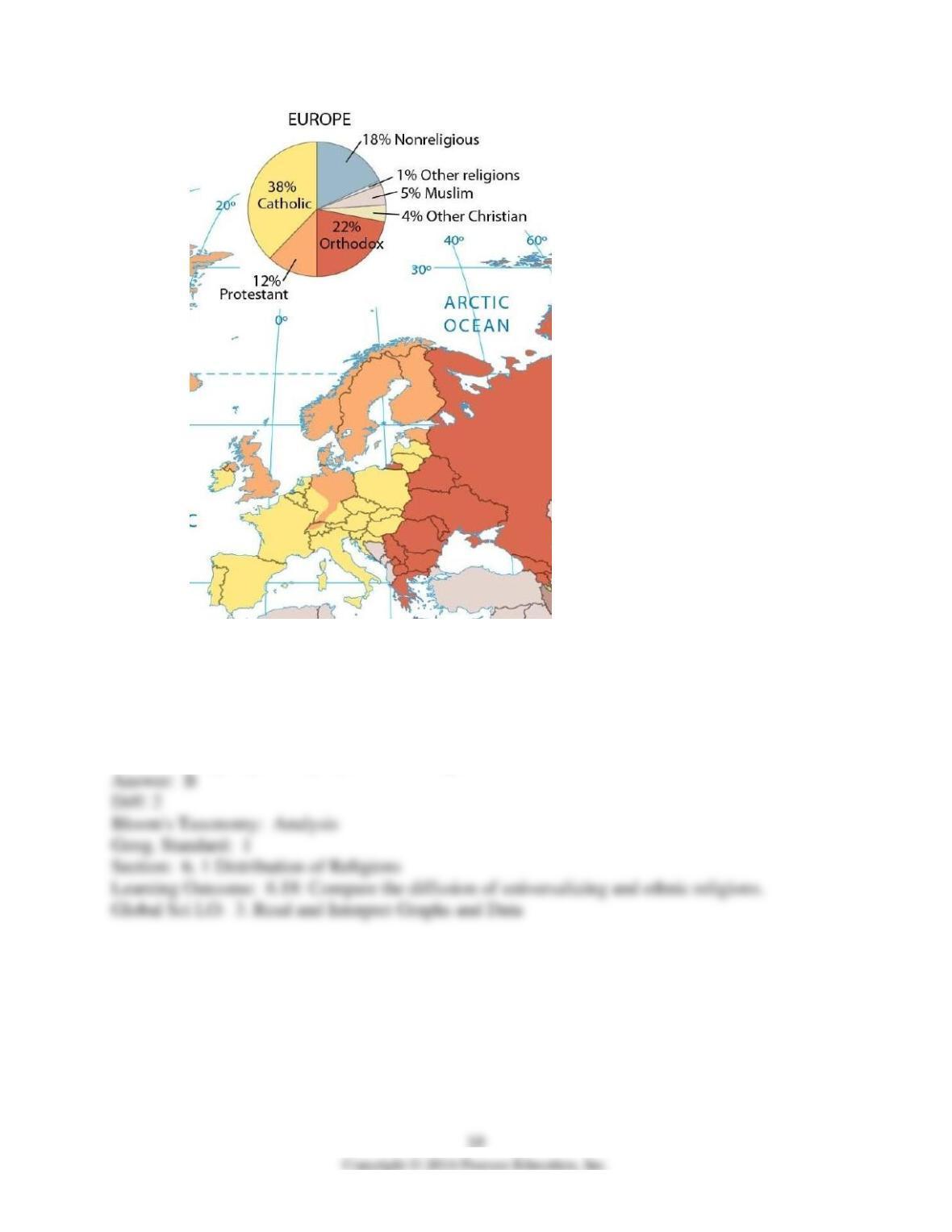
23) When analyzing the maps in this chapter, we can infer that in France,
A) most of the people are Protestant.
B) most of the people are Catholic.
C) about half of the people are Catholic and half are Protestant.
D) about one-fourth of the people are animists.
E) the vast majority of the people are nonreligious.
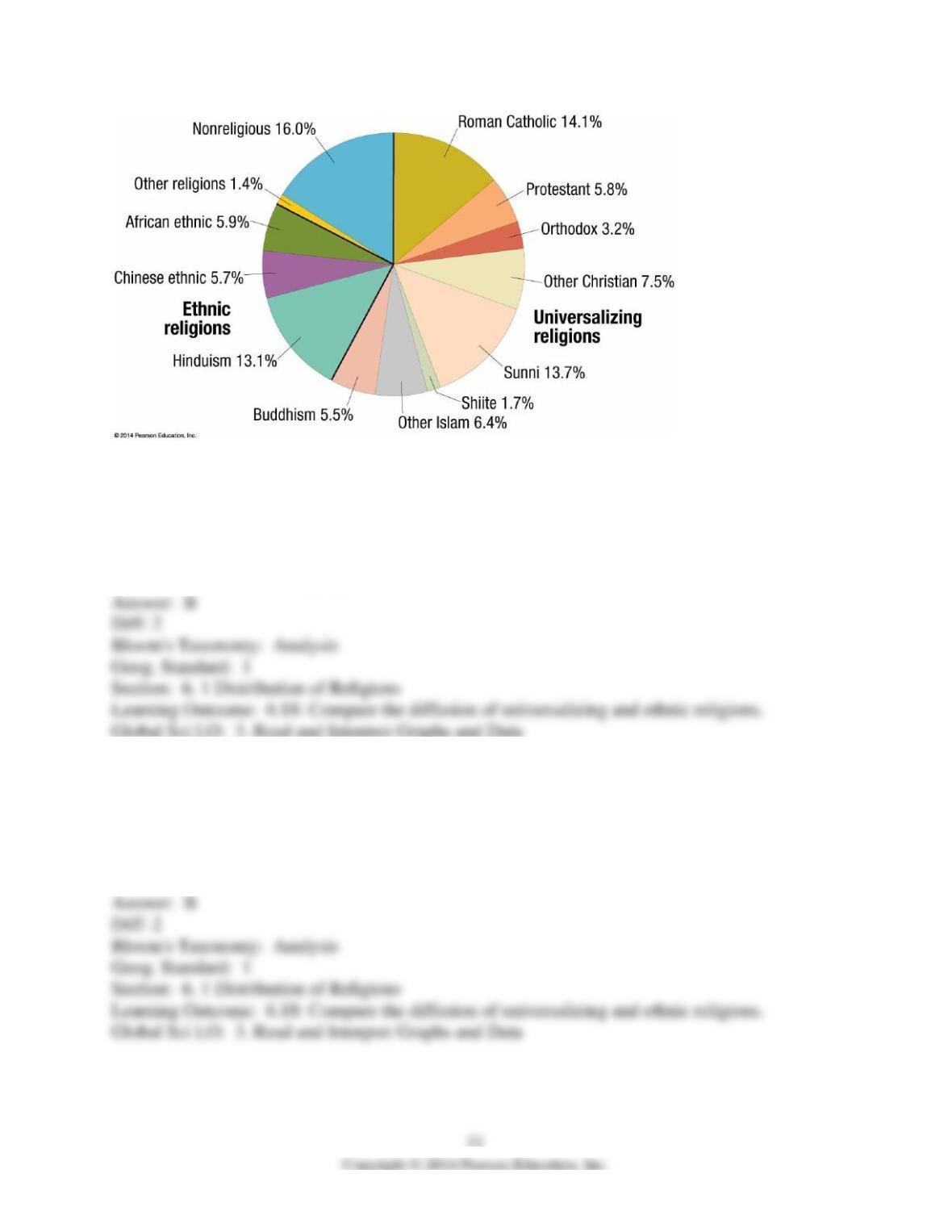
24) Analysis of the charts in this chapter indicates that in the world population,
A) more than half of the people are nonreligious.
B) less than one-fifth of the people are non-religious.
C) more than half of the people are Christian.
D) about half of the people are Muslim.
E) about two-thirds of the people are Christian.
25) The charts in this chapter indicate that in the world population,
A) about half of the people are nonreligious.
B) there are more Muslims than Hindus.
C) there are more Catholics than Muslims.
D) there are more Muslims than Christians.
E) there are more Buddhists than Hindus.
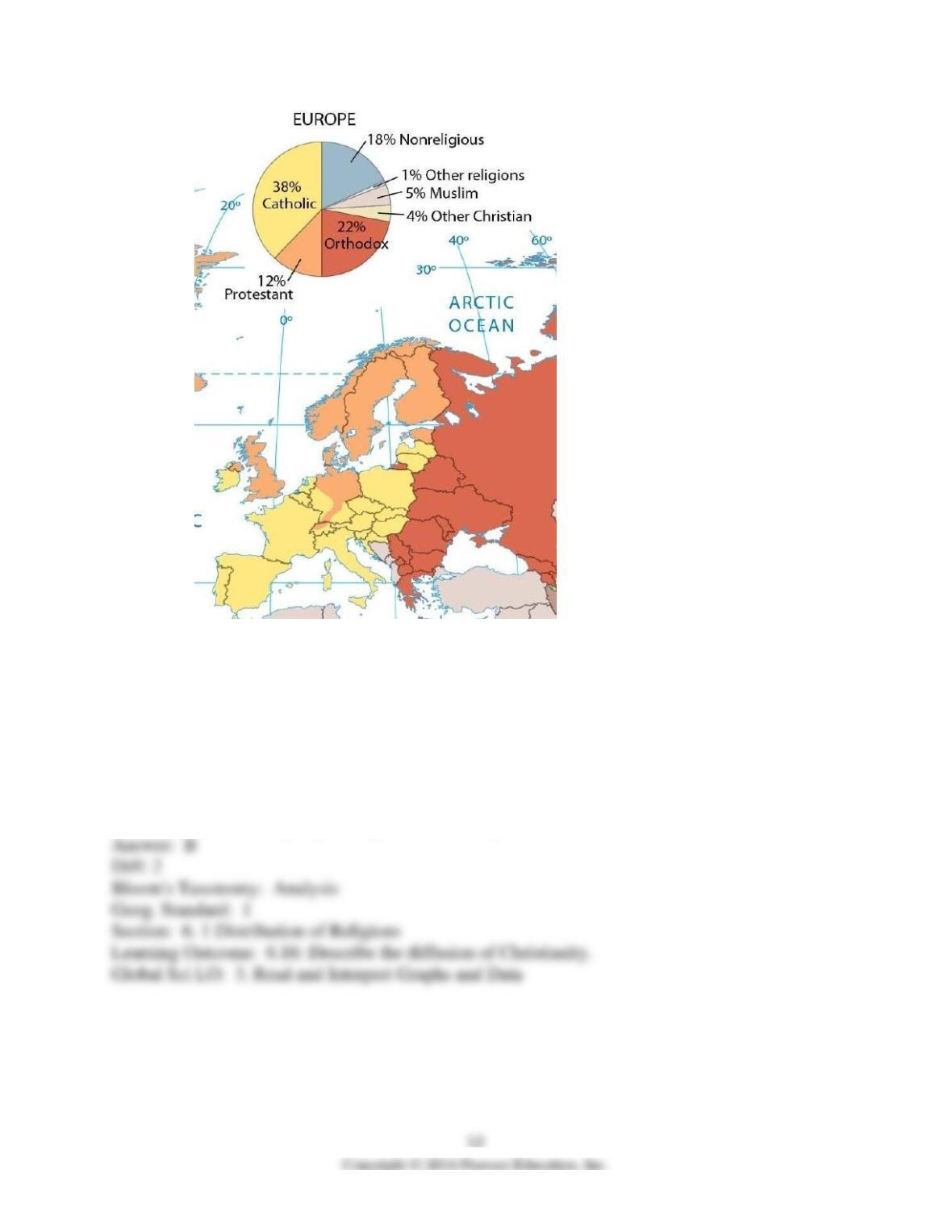
26) Analysis of this map indicates that in Germany,
A) Catholics are the majority in the north, while Protestants are the majority in the west and
southeast.
B) Catholics are the majority in the west and southeast, while Protestants are the majority in the
north.
C) The majority are nonreligious in the center and north, while Catholics are the majority in the
south.
D) Protestants account for the majority in every region of the country.
E) Catholics are the majority throughout the country.
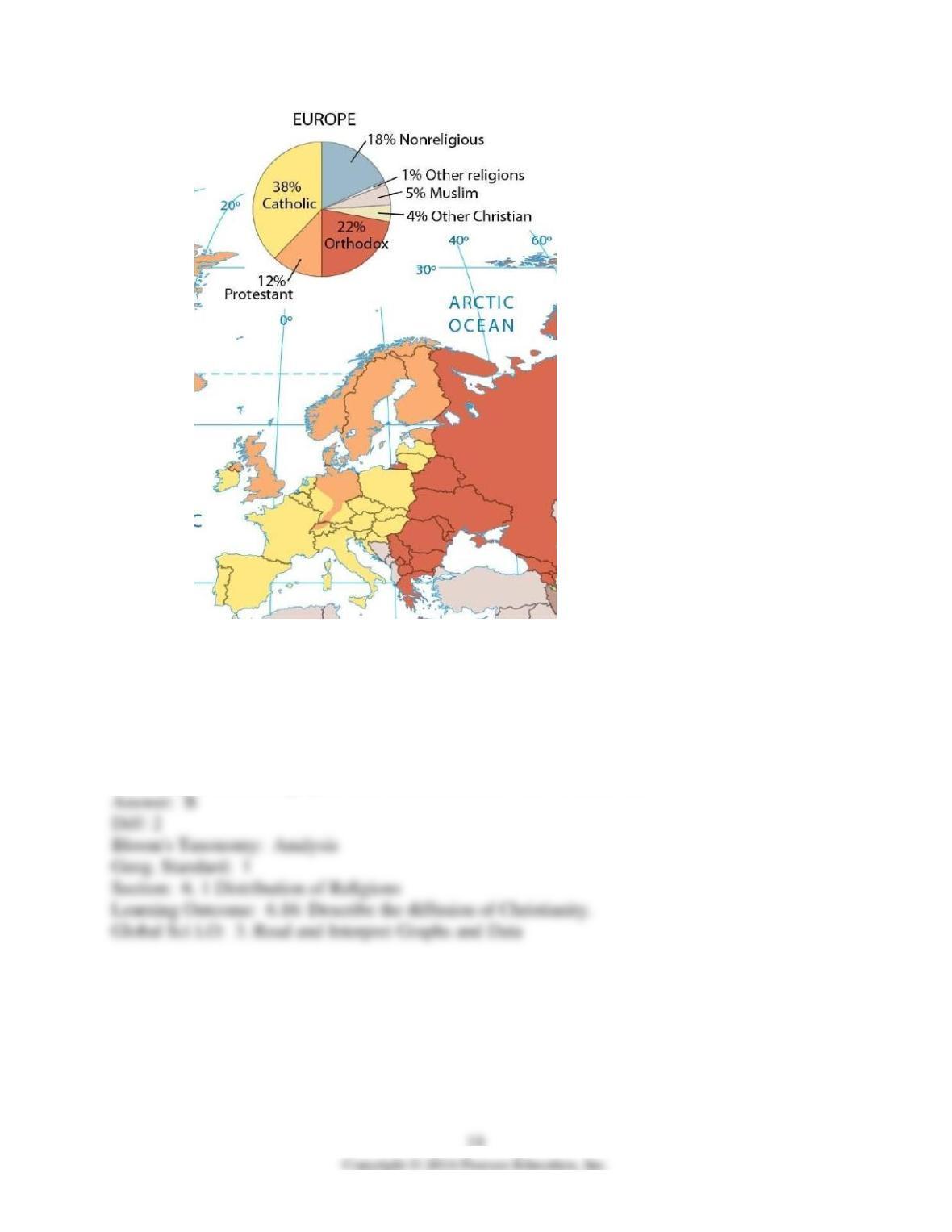
27) Analysis of this map indicates that in Scotland,
A) Catholics are the majority in the north, while Protestants are the majority in the south.
B) Protestants are the majority.
C) the majority of the people are nonreligious.
D) Protestants account for the majority in the south, while Catholics are the majority in the north
and west.
E) the population is roughly divided between Protestants and Catholics.
28) A relatively small group that has broken away from an established church is a
A) branch.
B) denomination.
C) sect.
D) dialect.
E) family.
29) The world’s largest universalizing religion is
A) Buddhism.
B) Christianity.
C) Hinduism.
D) Islam.
E) Shintoism.
30) Which is a branch of Christianity?
A) Druze
B) Eastern Orthodox
C) Shiite
D) Theravadist
E) Judaism
31) Almost 90 percent of people in the Western Hemisphere claim adherence to
A) Christianity.
B) Roman Catholicism.
C) Protestantism.
D) Eastern Orthodoxy.
E) fundamentalist and nondenominational Christian churches.
32) Lutheranism is an example of a Christian
A) branch.
B) denomination.
C) religion.
D) sect.
E) family.
33) The dominant branch of Islam is
A) Druze.
B) Eastern Orthodoxy.
C) Sikh.
D) Sunni.
E) Shiite.
34) The dominant branch of Islam in Iran is
A) Medina.
B) Eastern Orthodoxy.
C) Mecca.
D) Sunni.
E) Shiite.
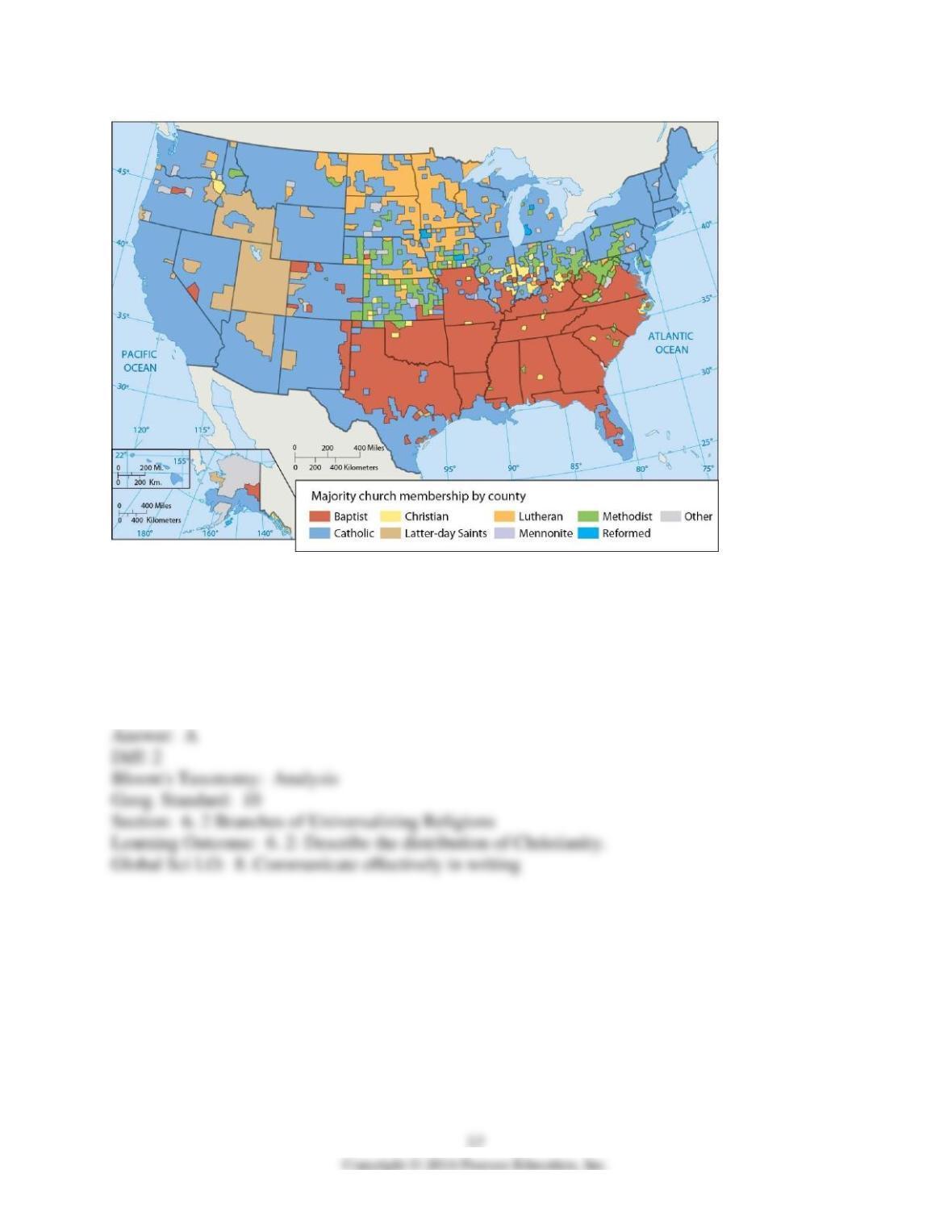
35) Based on the map above, we can surmise that a person from Alabama is more likely to be an
adherent of
A) a Baptist church.
B) the Roman Catholic church.
C) an Eastern Orthodox church.
D) Judaism.
E) Islam.
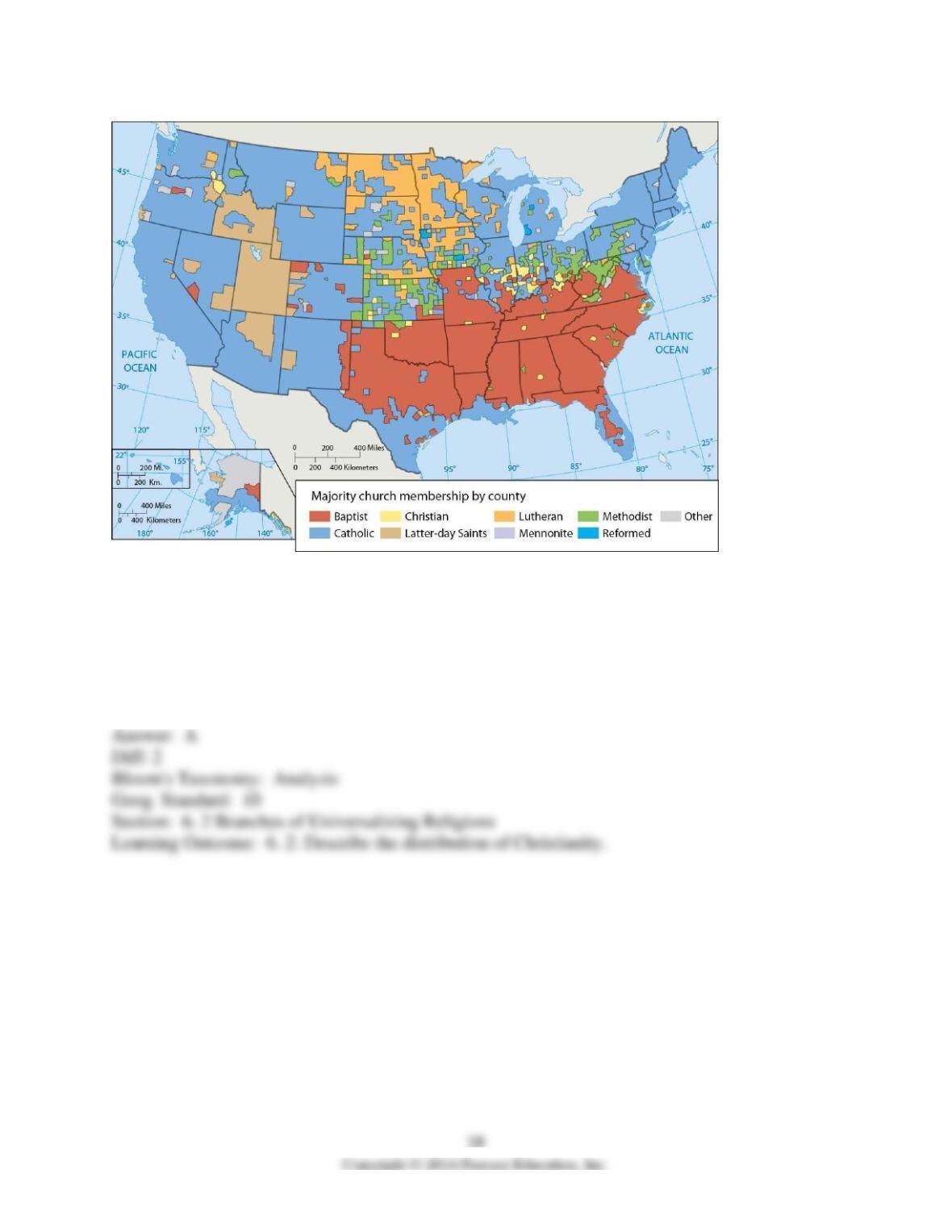
36) The maps and diagrams in this chapter help us surmise that a person from Minnesota is more
likely to be an adherent of
A) the Lutheran church.
B) the Roman Catholic church.
C) a Baptist church.
D) an Eastern Orthodox church.
E) a Methodist church.
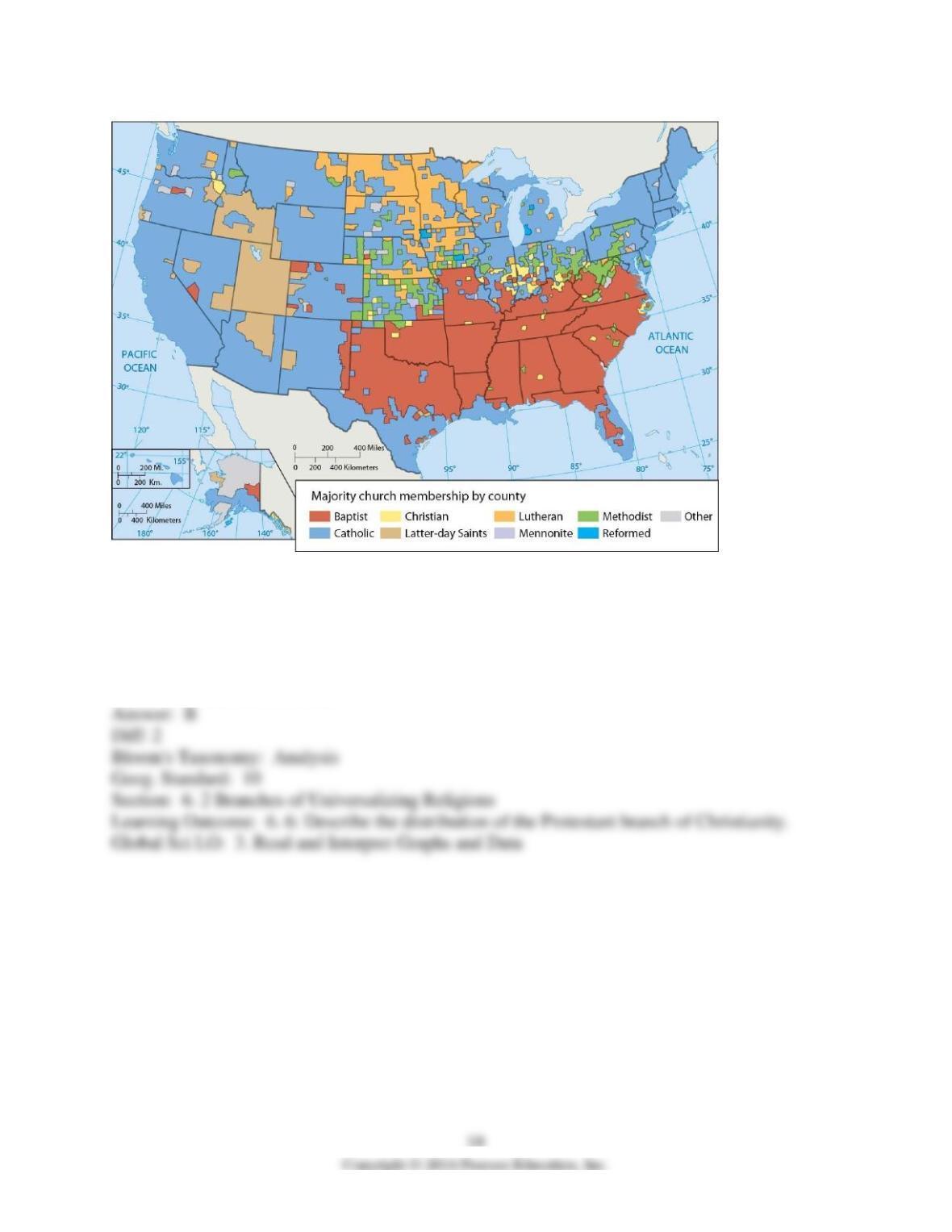
37) This map indicates that Baptists are clustered in the ________ United States.
A) northeastern
B) southern
C) southwestern
D) upper midwestern
E) northwestern and southern
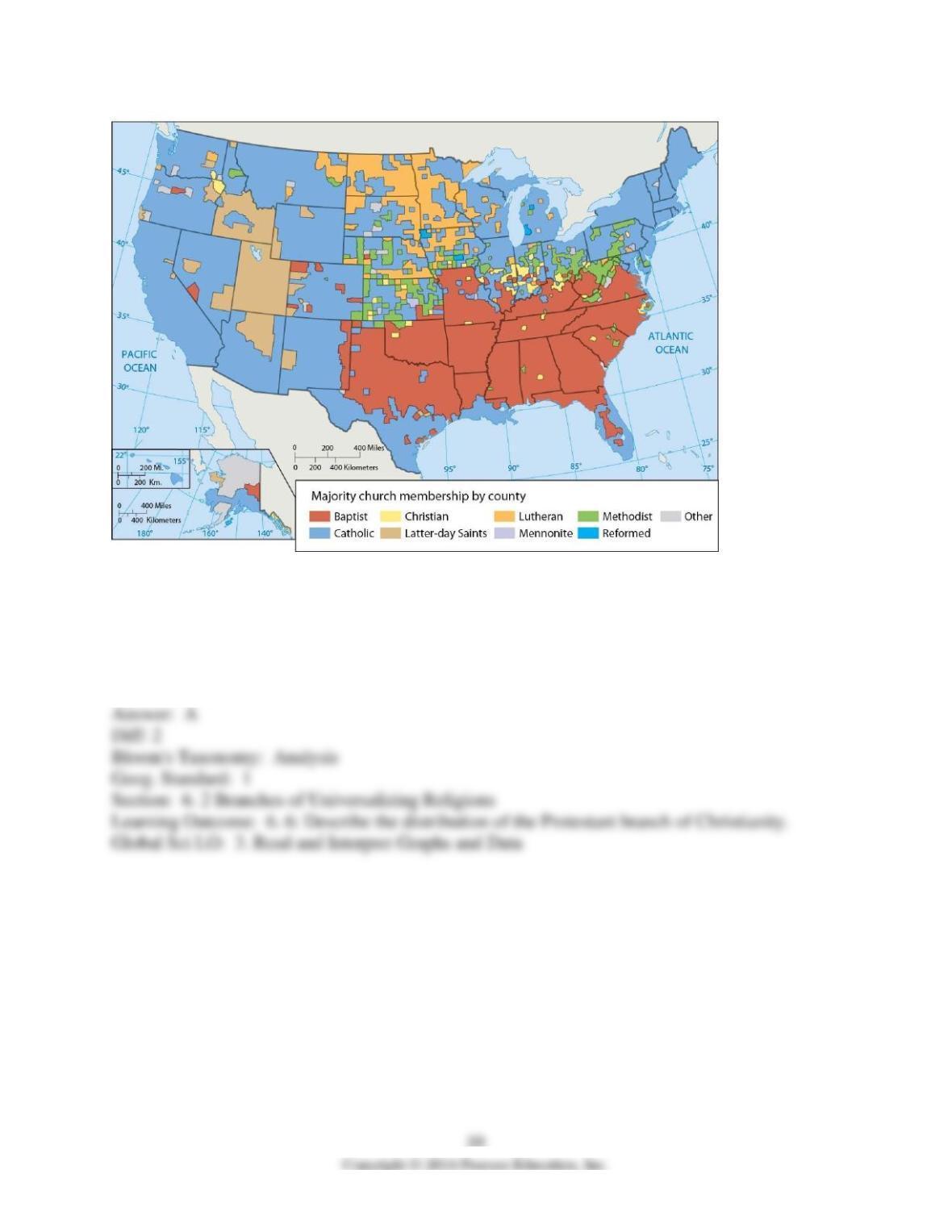
38) According to this map, the largest group of religious adherents in the U.S. Southwest are
A) Catholics.
B) Baptists.
C) Latter-day Saints.
D) Methodists.
E) Lutherans.