Exam
Name___________________________________
MULTIPLE CHOICE. Choose the one alternative that best completes the statement or answers the question.
1)
Which of the following best describes the process of eluviation?
1)
A)
feldspar decomposition and leaching of the soluble products from the C soil horizon
B)
removal of very fine–sized silt and clay particles from the E soil horizon
C)
removal of soluble chemical constituents from the A and B soil horizons
D)
buildup of calcite in the B horizon of pedocal soils
2)
Which of the following is/are most susceptible to chemical weathering by dissolution?
2)
A)
iron oxides
B)
clay minerals
C)
quartz
D)
calcite
3)
Which of the following best describes sets of fractures in relatively fresh bedrock, such as granite,
which are roughly parallel to the land surface?
3)
A)
columnar joints
B)
thermal expansion cracks
C)
sheeting fractures
D)
hydrolytic failures
4)
In which area would weathering by frost wedging probably be most effective?
4)
A)
in a moist, tropical forest
B)
where the subsoil is permanently frozen
C)
in moist, temperate climates
D)
in cool high desert areas
5)
Which one of the following statements concerning soil erosion is NOT true?
5)
A)
Soils form naturally by weathering; if protected from erosion, sound management can
maintain or enhance their nutrient levels and textural characteristics.
B)
Rates of soil erosion exceed rates of soil formation in some parts of the world.
C)
Sheet erosion, rills, and gullies develop mainly during prolonged droughts.
D)
Grasses and other vegetation, windbreaks, and contour cropping will help reduce losses of
soil from cultivated lands.
6)
The finely divided, red, brown, and yellow soil–coloring minerals originate by what process?
6)
A)
mechanical weathering of the feldspars and micas in granite and rhyolite
B)
mechanical weathering of very fine–grained, blue–gray clays
C)
chemical weathering of quartz and feldspars
D)
precipitation of iron oxides during the chemical weathering process
7)
Which of the following best describes the “Dust Bowl”?
7)
A)
areas of severe wind erosion on the Great Plains, 1930s
B)
the area covered by volcanic ash around Mt. Pinatubo, 1991
C)
a New Year’s Day invitational soccer match in Tripoli, Libya
D)
the long drought preceding the Irish potato famine of the 1840s
8)
Which term describes a soil formed by weathering of the underlying bedrock?
8)
A)
transported
B)
transformational
C)
residual
D)
relict
9)
In the Rocky Mountain region of the United States, north–facing slopes (downhill direction is
toward the north) are typically more moist and heavily forested than south–facing slopes. Why?
9)
A)
South–facing slopes receive less moisture, yet rock weathering is faster.
B)
South–facing slopes receive more moisture and sunlight; rock weathering is slower.
C)
North–facing slopes receive more sunlight in the summer; snow melts faster and more soil
moisture is available for the trees.
D)
North–facing slopes receive about the same amount of precipitation as south–facing slopes;
less moisture evaporates from north–facing slopes.
10)
Which of the following statements about oxisols in tropical rainforests is TRUE?
10)
A)
Oxisols, with proper management, are very suitable for commercial agriculture.
B)
Oxisol soils are very rich in nutrients required for vigorous plant growth.
C)
Oxisol soils readily compact and harden when dried and exposed to sunlight.
D)
Rainforests regenerate quickly following clear cutting or clearing for agriculture.
Explanation:
11)
What two factors speed up rates of chemical reaction and weathering in rocks and soils?
11)
A)
high temperatures; very dry
B)
low temperatures; very dry
C)
warm temperatures; very moist
D)
low temperatures; very moist
Explanation:
12)
Which one of the following statements concerning mechanical weathering is NOT true?
12)
A)
It allows for faster rates of chemical weathering.
B)
It is important in the formation of talus slopes.
C)
It involves a major change in the mineral composition of the weathered material.
D)
It reduces grain sizes of rock particles.
Explanation:
Explanation:
13)
Clay minerals formed from gabbro or diorite bedrock illustrate which kind of weathering?
13)
A)
chemical
B)
proactive
C)
mechanical
D)
syntropical
14)
Under similar warm, moist climatic conditions, why would basalt and gabbro generally have
higher chemical weathering rates than rhyolite and granite?
14)
A)
The plagioclase feldspars in the granite and rhyolite decompose readily to clay minerals and
iron oxides.
B)
The potassium feldspars and quartz in the rhyolite and granite are more susceptible to
cracking by frost wedging.
C)
The ferromagnesian minerals in the gabbro and basalt are subject to oxidation and chemical
breakdown.
D)
The quartz in the gabbro and basalt decomposes very quickly.
15)
Clay minerals, silica (SiO2), and dissolved potassium bicarbonate in the soil water are products of
which process?
15)
A)
chemical weathering of orthoclase feldspar
B)
differential mechanical weathering of micas
C)
chemical weathering of olivine and plagioclase feldspar
D)
mechanical weathering of granite and rhyolite
16)
From the land surface downward to the unweathered bedrock, which of the following is the correct
order of the different soil horizons?
16)
A)
O, A, E, B, C, bedrock
B)
E, A, B, C, O, bedrock
C)
D, E, C, B, A, bedrock
D)
A, B, C, D, E, bedrock
17)
Oxisol soils form under what climatic conditions?
17)
A)
moist and temperate as in the northeastern United States
B)
cool and relatively dry as in the northern Great Plains of the United States
C)
hot and dry as in the desert regions of North Africa and Arabia
D)
warm and moist as in a wet, tropical forest
18)
Which one of the following statements best describes erosion?
18)
A)
Erosion is the movement of weathered rock and regolith toward the base of a slope.
B)
Erosion is the process by which weathered rock and mineral particles are removed from one
area and transported elsewhere.
C)
Erosion is the combined processes of leaching, eluviation, and mass wasting.
D)
Erosion is the disintegration and decomposition of rocks and minerals at the surface.
19)
Which of the following best describes the E soil horizon?
19)
A)
erosion zone
B)
residual zone
C)
leaching zone
D)
regolith zone
20)
What portion of an angular, fracture–bounded granitic block shows the highest rate of weathering?
20)
A)
the crack surfaces not including edges and corners
B)
the edges and corners
C)
the unfractured interior
D)
All of the above show equal rates.
21)
What two chemical constituents cannot form by chemical weathering of the feldspar minerals?
21)
A)
soluble sodium and potassium bicarbonates
B)
silica and insoluble clay minerals
C)
silica and soluble calcium bicarbonate
D)
insoluble iron oxides and soluble magnesium bicarbonates
22)
Assume that water filling a crack in a rock undergoes cycles of freezing and melting. Which of the
following statement is TRUE?
22)
A)
Water shrinks as it melts, causing the crack walls to be pulled closer together.
B)
Water shrinks as it freezes, causing the crack walls to be drawn closer together.
C)
Water expands as it freezes, causing the crack walls to be pushed apart.
D)
Water expands as it melts, causing the crack walls to be pushed apart.
23)
Which of the following statements concerning oxisol soils is generally NOT true?
23)
A)
They consist of only the most insoluble, soil–forming minerals.
B)
They remain highly productive agriculturally without additions of fertilizers.
C)
They form in warm, moist, tropical climates.
D)
They are mainly red in color.
24)
Which of the following statements concerning humus is NOT true?
24)
A)
Humus is typically found above the B soil horizon.
B)
Humus is less abundant in wet, tropical, forested areas than in temperate, forested areas.
C)
Humus consists of decaying and partly decayed leaves and other plant materials.
D)
Humus is readily leached from the B horizon in weakly acidic, soil solutions.
25)
Which term best describes an accumulation of angular rock fragments at the base of a steep,
bedrock slope or cliff?
25)
A)
talus slope
B)
trellis slope
C)
taliche slope
D)
tellus slope
26)
Which one of the following is an important, mechanical weathering process for enlarging fractures
and extending them deeper into large boulders and bedrock?
26)
A)
oxidation
B)
eluviation
C)
frost wedging
D)
hydrologic cycling
27)
Frost wedging is the major weathering process contributing to the formation of which regolith
material?
27)
A)
soil horizons
B)
talus slopes
C)
tropical laterites
D)
mature pedalfers
28)
What mineral particles are the dominant coloring agents in reddish, brownish, and yellowish soils?
28)
A)
soluble potassium and sodium bicarbonates
B)
dust–sized grains of iron oxides
C)
humus and calcium carbonate
D)
very fine–sized, silica and calcite particles
SHORT ANSWER. Write the word or phrase that best completes each statement or answers the question.
Word Analysis. Examine the words and/or phrases for each question below and determine the relationship among the
majority of words/phrases. Choose the option that does not fit the pattern.
29)
a. surface area b. rock characteristics c. latitude d. climate
29)
30)
What is the most abundant, naturally produced, weak acid involved in chemical
weathering and soil formation?
30)
31)
What term refers to removal of soluble constituents from soils?
31)
Word Analysis. Examine the words and/or phrases for each question below and determine the relationship among the
majority of words/phrases. Choose the option that does not fit the pattern.
32)
a. C horizon b. A horizon c. E horizon d. B horizon
32)
33)
What term describes the layer of partly decayed plant matter at the top of the soil profile in
most forested areas?
33)
34)
Half Dome in Yosemite National Park, California, and Stone Mountain in Georgia, are
shaped mainly by what mechanical weathering process?
34)
35)
Would you call the loose, unconsolidated, surface material on Mars regolith or soil?
35)
36)
The very fine–sized, clay mineral particles move downward from the A to the B horizon of
some soils. What is this process called?
36)
Word Analysis. Examine the words and/or phrases for each question below and determine the relationship among the
majority of words/phrases. Choose the option that does not fit the pattern.
37)
a. frost wedging b. mass wasting c. sheeting d. dissolution
37)
38)
Which term denotes the true soil above the zone of partly weathered bedrock?
38)
39)
Under most weathering conditions, which mineral component of granites and rhyolites
would be most resistant to decomposition?
39)
40)
What kind of weathering involves only a reduction in the sizes of bedrock, regolith, and
mineral particles?
40)
Word Analysis. Examine the words and/or phrases for each question below and determine the relationship among the
majority of words/phrases. Choose the option that does not fit the pattern.
41)
a. carbonic acid b. clay minerals c. dissolved silica d. sheeting
41)
42)
a. topography b. time c. parent material d. elevation
42)
TRUE/FALSE. Write ‘T’ if the statement is true and ‘F’ if the statement is false.
43)
Removal of soluble chemical constituents from a soil is termed leaching.
43)
44)
Like most other liquids, water decreases in volume when it freezes.
44)
45)
Feldspars commonly decompose during weathering to clay minerals, silica, and soluble
constituents.
45)
46)
Abundant moisture and warm temperatures result in high rates of chemical weathering.
46)
47)
Chemical weathering in bedrock below the land surface often begins along joints and sheeting
fractures.
47)
48)
Sheeting fractures and exfoliation domes commonly develop in areas with soft, highly fractured
bedrock.
48)
49)
Very fine–grained, iron oxide particles account for nearly all red, yellow, and brown soil colors.
49)
50)
The solum or true soil includes all horizons above the C horizon.
50)
51)
Ferromagnesian minerals (like olivine and pyroxene) that crystallize at high temperatures in
Bowen’s reaction series are generally much less susceptible to chemical weathering than quartz.
51)
52)
Quartz is quite resistant to weathering and is an important component of sands in riverbeds and on
beaches.
52)
53)
Calcite, a major component of some monumental and building stones, slowly dissolves in weakly
acidic waters.
53)
54)
Humus is a concentration of decaying, organic matter in the B horizons of Oxisol soils.
54)
55)
Quartz weathers readily to aluminum–rich clay minerals.
55)
56)
Oxidation of iron is an important chemical weathering process for ferromagnesian silicate minerals
like olivine and biotite.
56)
57)
Decomposition of pyrite is an important factor in generating acidic mine drainage.
57)
58)
Sheeting is mainly a process of mechanical weathering.
58)
ESSAY. Write your answer in the space provided or on a separate sheet of paper.
Critical thinking and discussion questions. Use complete sentences, correct spelling, and the information presented in
chapter 6 to answer the questions below.
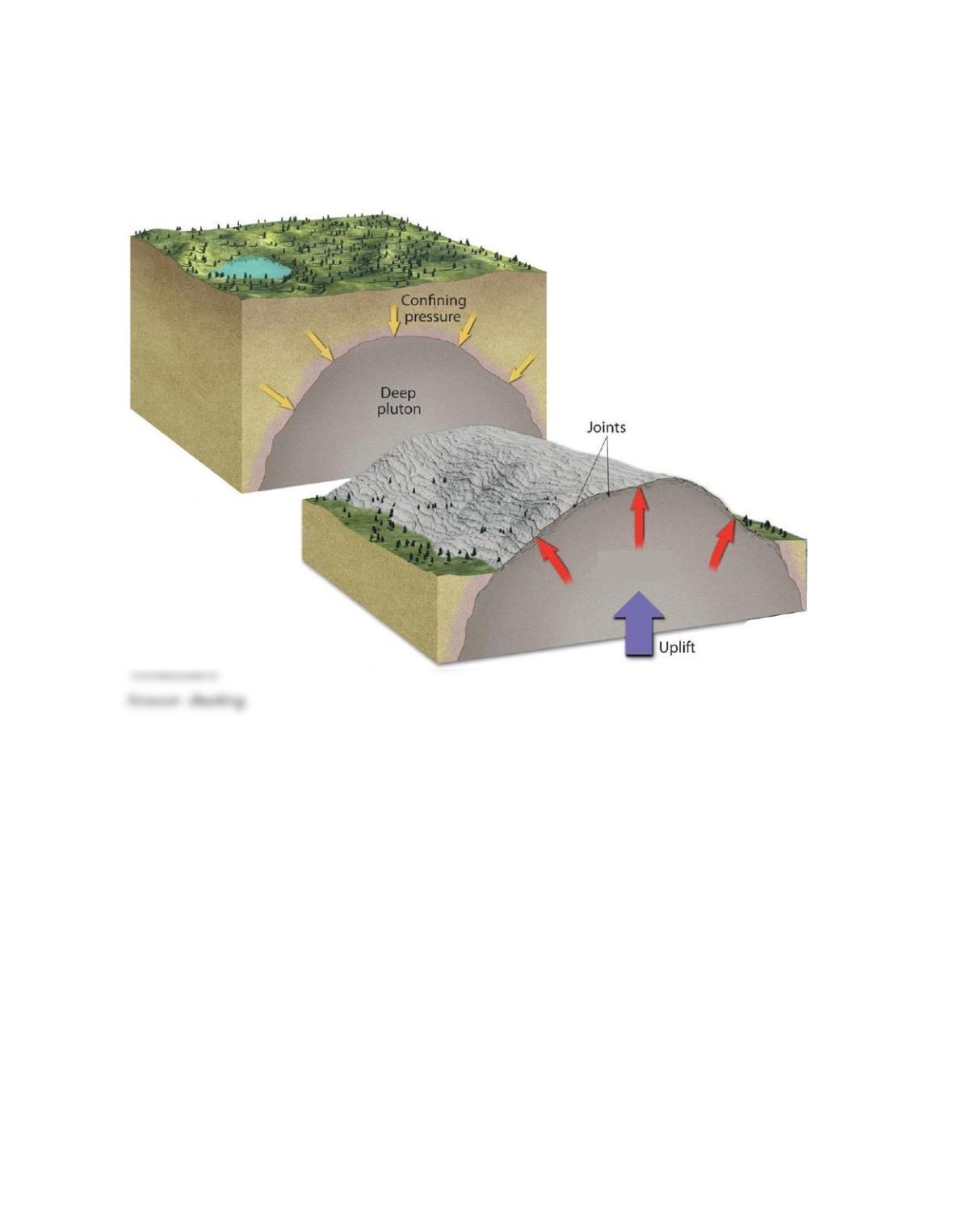
59)
What process does the diagram below illustrate?
11
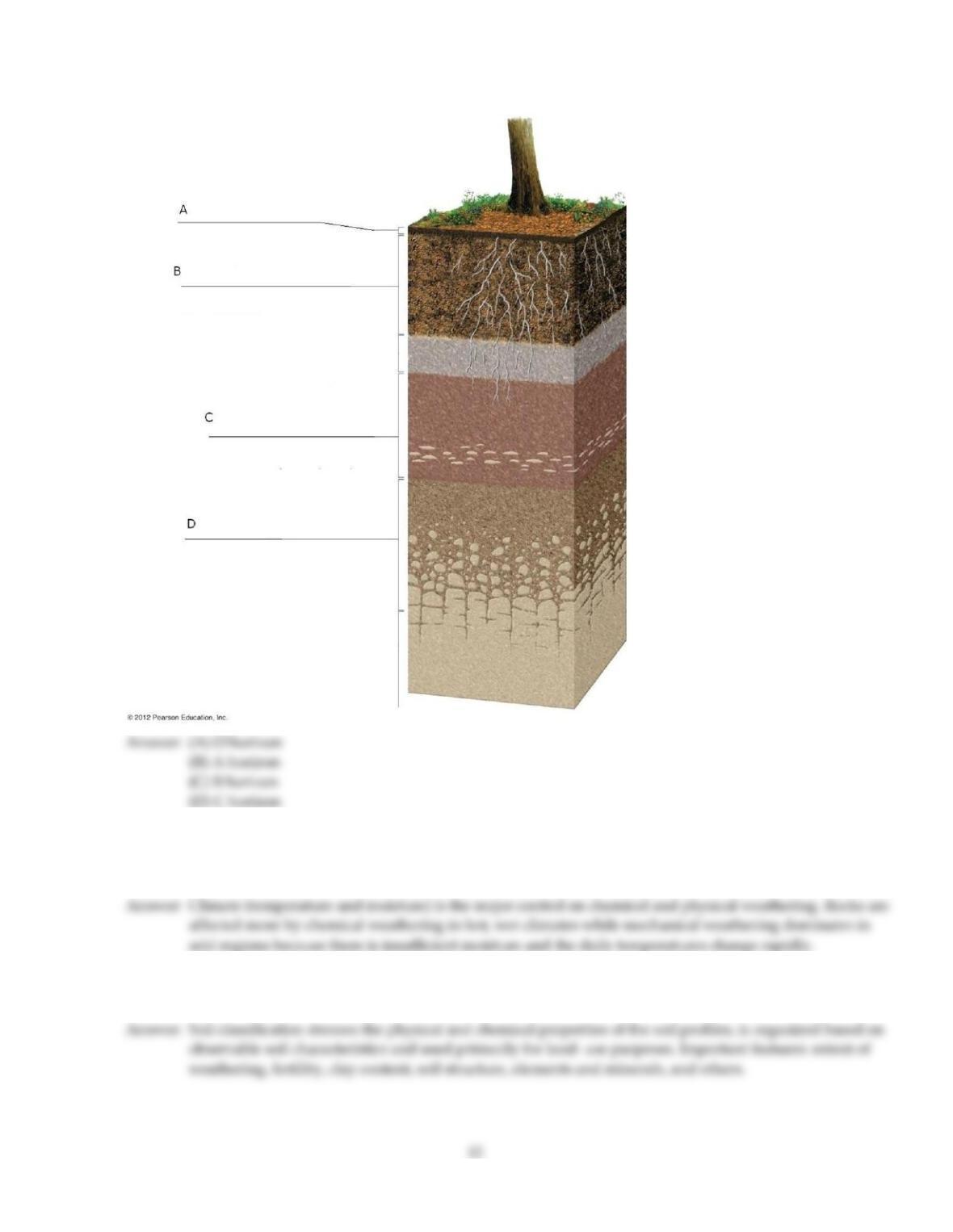
60)
Fill in the blanks on the diagram below with the names of the soil “layers” that are labeled.
61)
Based on the examples and discussion in chapter 6, what is the relationship of climate to weathering, both
chemical and mechanical? Also, are certain climates more susceptible to certain types of weathering? Why or
why not?
62)
Briefly discuss the classification of soils. What parameters are important? What characteristics or features are
evaluated for distinguishing between different types of soils?
63)
How do weathering and the development of soils influence the topography and landforms in a given region?
Are certain landforms indicative of the particular bedrock geology of a region or is that determined more by
weathering?
Answer Key
Testname: C6
Answer Key
Testname: C6
15