Managerial Decision Modeling w/ Spreadsheets, 3e (Balakrishnan/Render/Stair)
Chapter 6 Integer, Goal, and Nonlinear Programming Models
6.1 Chapter Questions
1) These are problems in which some, but not all, the decision variables must have integer solutions:
A) mixed IP problems
B) pure IP problems
C) pure binary problems
D) mixed binary IP problems
E) goal programming problems
2) These are problems in which all decision variables must have integer solutions:
A) mixed binary IP problems
B) pure binary IP problems
C) mixed IP problems
D) pure IP problems
E) goal programming problems
3) Rounding off the solution to an LP relaxed problem may yield:
A) an infeasible solution
B) a non-optimal solution
C) a higher objective function value
D) an unbounded solution
E) A or B
4) A company wants to select 2 products from a set of four possible products. Which of the following
constraints ensures that no more than 3 will be selected?
A) XA + XB + XC + XD = 3
B) XA + XB + XC + XD ≥ 0
C) XA + XB + XC + XD ≤ 3
D) XA + XB + XC + XD ≥ 3
E) XA + XB + XC + XD ≠ 3
5) A company wants to select one product from a set of 3 possible products. Which of the following
ensures that only one product will be selected?
A) XA + XB + XC = 1
B) XA + XB + XC ≤ 1
C) XA + XB + XC ≥ 1
D) XA + XB + XC ≥ 0
E) XA – XB – XC = 1
6) If a company produces product A then it must also produce either product B or product C. Which of
the following constraints enforces this condition?
A) XA – XB – XC ≥ 0
B) XA + XB + XC ≤ 2
C) XA + (XB – XC) ≤ 0
D) XA + XB + XC ≥ 2
E) XA – XB – XC ≤ 0
7) Which type of cost is independent of the volume of production?
A) inventory cost
B) marginal cost
C) sunk cost
D) variable cost
E) fixed charge
8) A company incurs a cost that is directly proportional to the magnitude of the decision variable. This
is an example of a:
A) fixed charge
B) sunk cost
C) variable cost
D) marginal cost
E) inventory cost
9) Consider a model with 3 ranked goals. Solving this model requires us to solve:
A) a single LP problem
B) 3 separate LP problems
C) 2 separate LP problems
D) a single quadratic programming problem
E) 3 quadratic programming problems
10) If a company produces Product A, then it must produce at least 200 units of Product A. Which of
the following constraints model this condition?
A) X1Y1 ≤ 200
B) X1 ≥ 200 + Y1
C) X1 ≤ 200Y1
D) X1 – 200Y1 ≥ 0
E) X1 > 200
11) An investment strategy restricts the portfolio to a mix of two stocks A and B with the following
price/share and annual returns:
Stock Price/Share Annual Return
A $35 5%
B $45 7%
Assume that the maximum amount available for investment is $100,000 with the following 2 prioritized
investment goals:
Rank R1: Obtain an annual return of at least 6%.
Rank R2: Limit the investment in stock B to no more than 55% of the total investment.
Assume X1 = dollar amount allocated to stock A, and X2 = dollar amount allocated to stock B.
What is the objective function?
A) Min d1+ + d2–
B) Min R2(d1+) + R1(d2–)
C) Min R1(d1–) – R2(d2+)
D) Min R1(d1+) + R2(d2–)
E) Min R1(d1–) + R2(d2+)
12) Problems which can be stated as an assortment of desired objectives are known as:
A) quadratic programming
B) integer programming
C) goal programming
D) linear programming
E) binary programming
13) Suppose that XA equals 10. What are the values for d1+ and d1– in the following constraint?
XA + d1–– d1+ = 7
A) d1– = 0, d1+ = 3
B) d1–= 3, d1+ = 0
C) d1– = 7, d1+ = 0
D) d1– = 0, d1+ = 7
E) d1– = 10, d1+ = 3
14) Consider the following constraint that needs to be expressed as a goal:
3X1 + 4X2 ≤ 11.
The correct format is:
A) 3X1 + 4X2 – d1– + d1+ = 11
B) 3X1 + 4X2 + d1– – d1+ = 11
C) 3X1 + 4X2 + d1– – d1+ ≥ 11
D) 3X1 + 4X2 + d1– – d1+ ≤ 11
E) 3X1 + 4X2 + d1– – d1+ ≠ 11
15) The deviational variable di‾ indicates the amount by which a certain goal is:
A) overachieved
B) over attained
C) binding
D) underachieved
E) non-binding
16) Which of the following statements about nonlinear programming is FALSE?
A) Either the objective function or at least one constraint is nonlinear.
B) The optimal solution must be a corner point solution.
C) There can be both local and global optimal solutions.
D) There is no precise way to know where to start the solution search process.
17) Nonlinear programming models can be approximated by linear or almost linear models through a
procedure known as ________.
A) separable programming
B) goal programming
C) integer programming
D) quadratic programming
E) mixed integer programming
18) The “bin” option is used in Solver to specify general integer variables.
19) Consider the following constraint and its associated binary decision variables:
XA + XB + XC ≥ 2.
This constraint is an example of a mutually exclusive constraint.
20) Consider the following constraint and its associated binary variables: XA + XB = 1.
21) In mixed IP problems, some, but not all, of the decision variables have integer solutions.
22) The optimal solution to an IP model must be at a corner point of the feasible region.
23) In goal programming, the objective is typically to maximize the sum of the deviational variables.
24) Deviational variables assume the value zero if a goal is completely attained.
25) The deviational variable di– typically denotes underachievement.
26) If overachievement is acceptable, the appropriate di+ variable can be dropped from the objective
27) Consider the following objective function with prioritized goals: Min: R1(d1–) + R2(d1–).
This implies that goal 2 is of higher rank than goal 1.
28) A goal programming problem assumes that its objective function and constraints are linear.
29) When an objective function contains squared terms, and the problem’s constraints are linear, it is
referred to as a quadratic programming problem.
30) The IP solution can sometimes produce a better objective function value than its LP relaxed
problem.
8
31) Rounding off the solution to an LP relaxation problem may sometimes yield an infeasible solution to
an IP problem.
32) An integer programming problem assumes that its objective function and its constraints are linear.
33) The optimal solution of to an NLP model must be a corner point of the feasible region.
34) An NLP model can have both local and global optimal solutions.
35) There is no precise way to know where to start the solution search process for an NLP model.
6.2 Excel Problems
1) Mr. Smith, an avid reader, must decide on which books to take with him during a long flight. Mr.
Smith will use his carry-on bag, which can hold a maximum of 20 pounds. Mr. Smith has attached a
satisfaction index for each book, based on a 5-point scale (1 = low satisfaction, 5 =high satisfaction), as
shown below.
Book Satisfaction Index Weight (lbs.)
Marketing 4 4
History 5 3
Statistics 1 3
Management 3 5
Finance 3 4
Economics 2 3
Excel 5 4
Access 4 5
Which books should Mr. Smith take with him on the flight to maximize his satisfaction index?
Use this information for the following questions.
Six products are currently waiting processing on a single machine. The machine is available today for a
maximum of 25 hours. The processing time per hour for each product along with the profit contribution
per product is show below.
Product Profit Contribution Processing Time (Hours)
A $55 5
B $70 4
C $45 6
D $60 5
E $50 3
F $65 6
2) Refer to the information above. Which products should be processed to maximize the total profit
contribution?
3) Refer to the information above. Assume that the following conditions must be met:
a) We want to ensure that exactly one of these products: A, B, or C must be processed.
b) We want to ensure that if product E is processed then product F must be processed.
Which products should be processed to maximize the total profit contribution?
Use this information to answer the following questions.
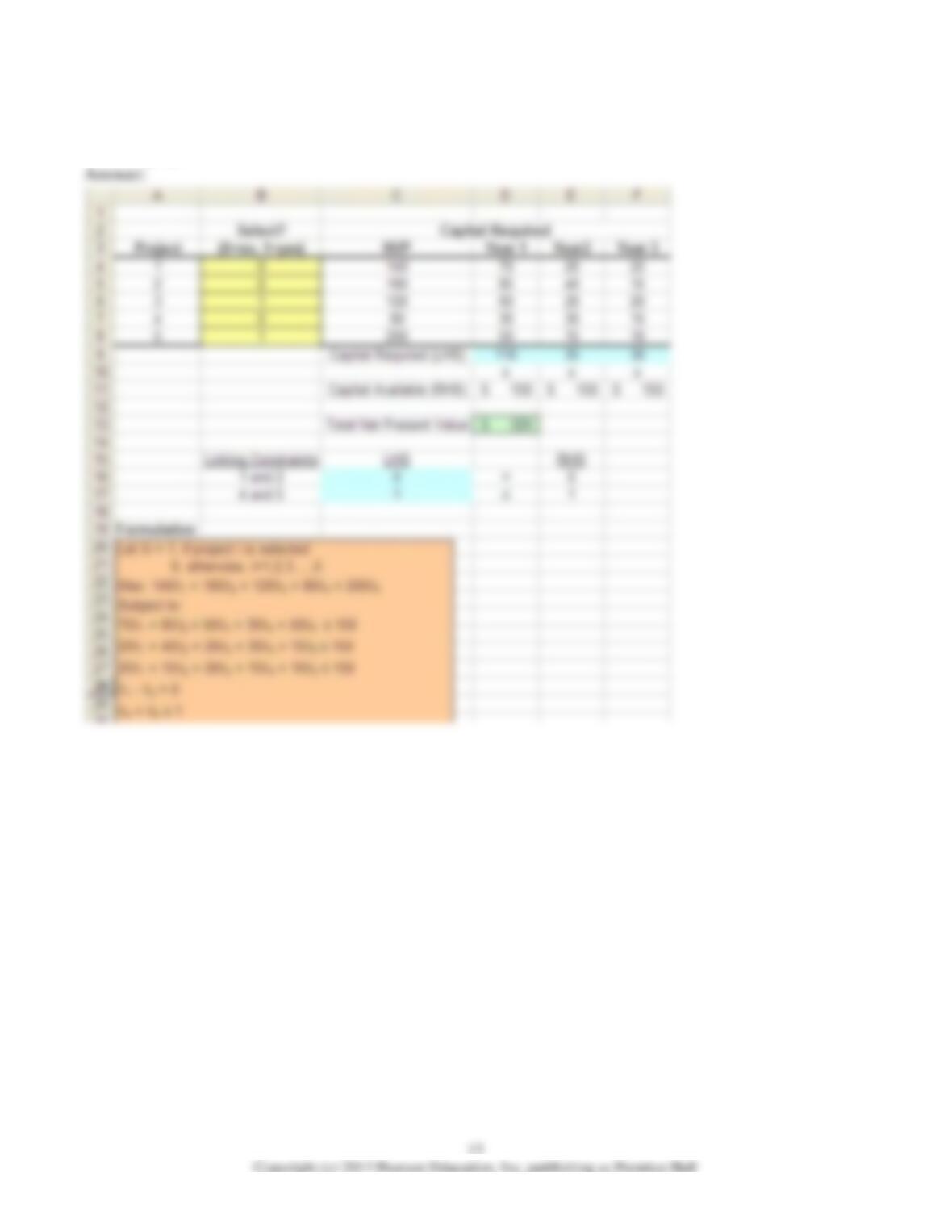
A decision maker is provided with 5 different potential projects and must determine which projects to
choose. The projects require different amounts of capital and different expected net present values
(NPV) over the next three years.
NVP Capital Required (in $000s)
Project (in $000s) Year 1 Year 2 Year 3
1 140 70 20 25
2 180 85 40 15
3 120 60 20 20
4 80 30 30 15
5 200 50 15 10
4) Determine which set of projects should be selected in order to achieve the maximum net present value
if the decision maker has $150,000 available for investment each year.
5) Refer to the information above. Determine which set of projects should be selected in order to
achieve the maximum net present value if the following two conditions must also be met:
a) If project 1 is selected, then project 2 must be selected, and vice versa.
b) Since projects 4 and 5 require outsourcing various operations, the decision maker wants at most one
of these projects to be included in the solution and not both.
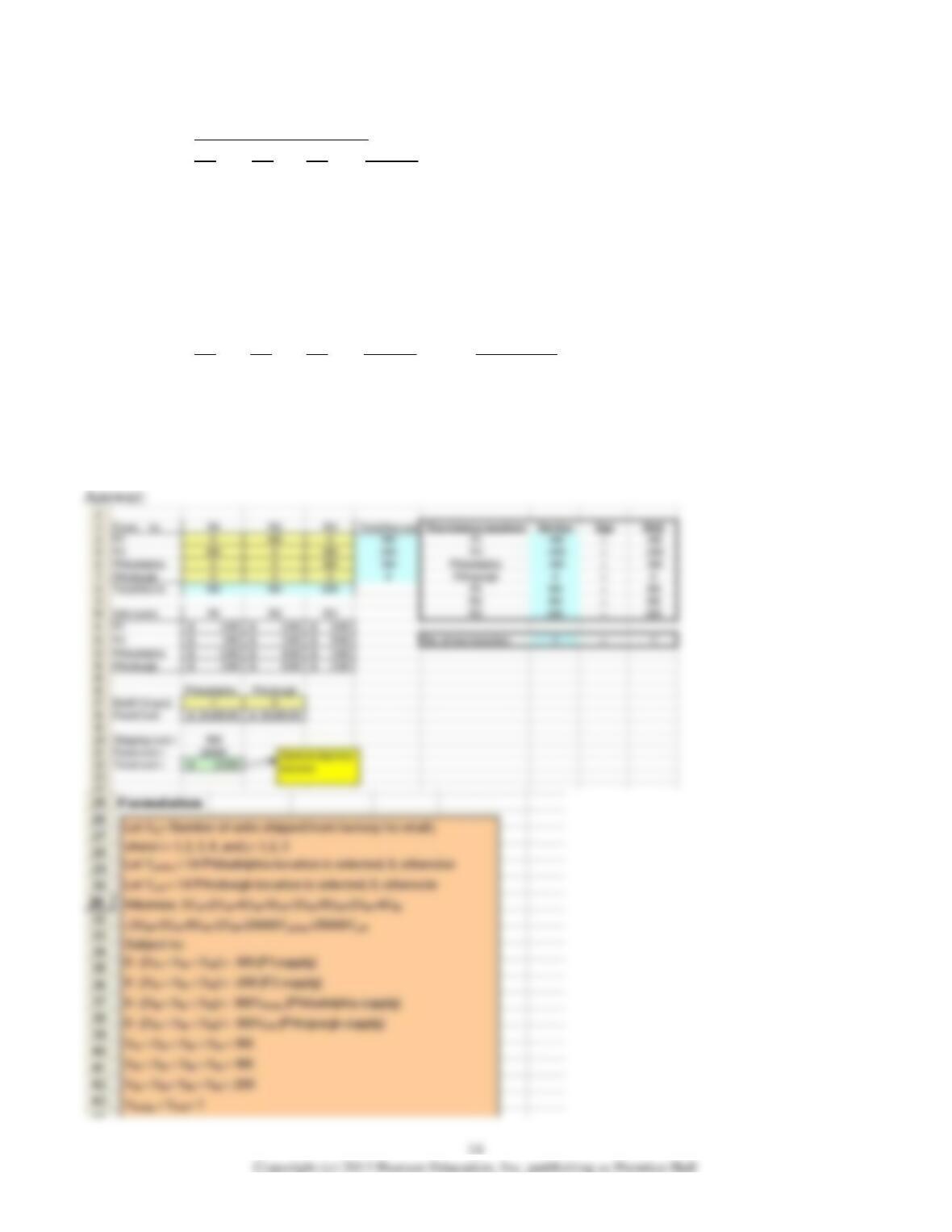
6) A company currently has two factories: F1 and F2, and three retail outlets: R1, R2, and R3. The
shipping costs per unit along with the monthly capacity and demand requirements are summarized
below:
Shipping Cost Per Unit
R1 R2 R3 Supply
F1 $3 $2 $4 100
F2 $1 $3 $5 200
Demand 100 100 200
The firm has decided to build a new factory to expand its productive capacity. The two sites being
considered are Philadelphia and Pittsburgh. The estimated shipping costs for the new factories along
with their estimated fixed cost and production capacity are summarized below:
R1 R2 R3 Supply Fixed Cost
Philadelphia $2 $4 $3 100 $20,000
Pittsburgh $3 $5 $2 100 $25,000
Which of the new locations will yield the lowest cost in combination with the existing factories and
retail outlets?