39) Examples of ethnic religions include
A) Daoism and Christianity.
B) Daoism, Confucianism, and Judaism.
C) Confucianism, Islam, and Buddhism.
D) Buddhism, Judaism, and Hinduism.
E) Hinduism and Buddhism.
40) Which of the following is not a universalizing religion?
A) Buddhism
B) Sikhism
C) Islam
D) Judaism
E) Christianity
41) Which is not an ethnic Asian religion?
A) Buddhism
B) Confucianism
C) Shintoism
D) Daoism
E) Hinduism
42) Hinduism’s caste system
A) assigns everyone to a distinct class.
B) decrees the pilgrimages which should be taken.
C) is a substitute for the lack of a holy book.
D) identifies a family’s important deities.
E) is the basis for seasonal celebrations.
43) Both universalizing and ethnic religions
A) appeal primarily to one group of people living in one place.
B) can diffuse to different populations around the world.
C) attempt to be global and appeal to all people.
D) can be expressed as Christianity and Islam.
E) arose from changes in the physical environment.
44) An ethnic religion is
A) based on only one language.
B) appealing mostly to one group of people in one place.
C) based on belief in one particular spiritual leader.
D) younger than a universalizing religion.
E) more peaceful than a universalizing religion.
45) Followers of which religious branch do not trace their origin to Abraham?
A) Eastern Orthodox
B) Mahayana
C) Shiite
D) Sunni
E) Judaism
46) Which of the following is currently the most important religion in the homeland of the man
who founded it?
A) Buddhism
B) Christianity
C) Hinduism
D) Islam
E) Shintoism
47) Unlike other universalizing religions, Buddhism
A) remained primarily concentrated in one region of the world.
B) was not begun by an individual founder and then diffused elsewhere.
C) was founded in China.
D) worships more than one god.
E) diffused primarily by colonization.
48) Which of the following would be more characteristic of a universalizing religion?
A) Several priests build temples at the tops of the world’s highest volcanoes.
B) Several priests travel across the world to establish missions on remote islands.
C) A religious leader proclaims that you cannot join her church unless your mother was
previously a member of that church.
D) Priests follow a calendar of religious services based largely on seasonal changes.
E) Priests and adherents of a particular church pledge that they will not support warfare in any
form.
49) Which of the following would we be more likely to classify as a characteristic of an ethnic
religion?
A) Priests build temples in cities around the world.
B) Priests travel across the world to establish missions on remote islands.
C) A religious leader proclaims that you cannot join her church as a full member unless you
bring two or three people with you, as converts to her religion.
D) The religious calendar is based largely on seasonal changes in a particular region.
E) The adherents of a church pledge that they will not support warfare in any form.
50) Christianity first diffused from its hearth through
A) contagious diffusion.
B) hierarchical diffusion.
C) relocation diffusion.
D) expansion diffusion.
E) military conquest.
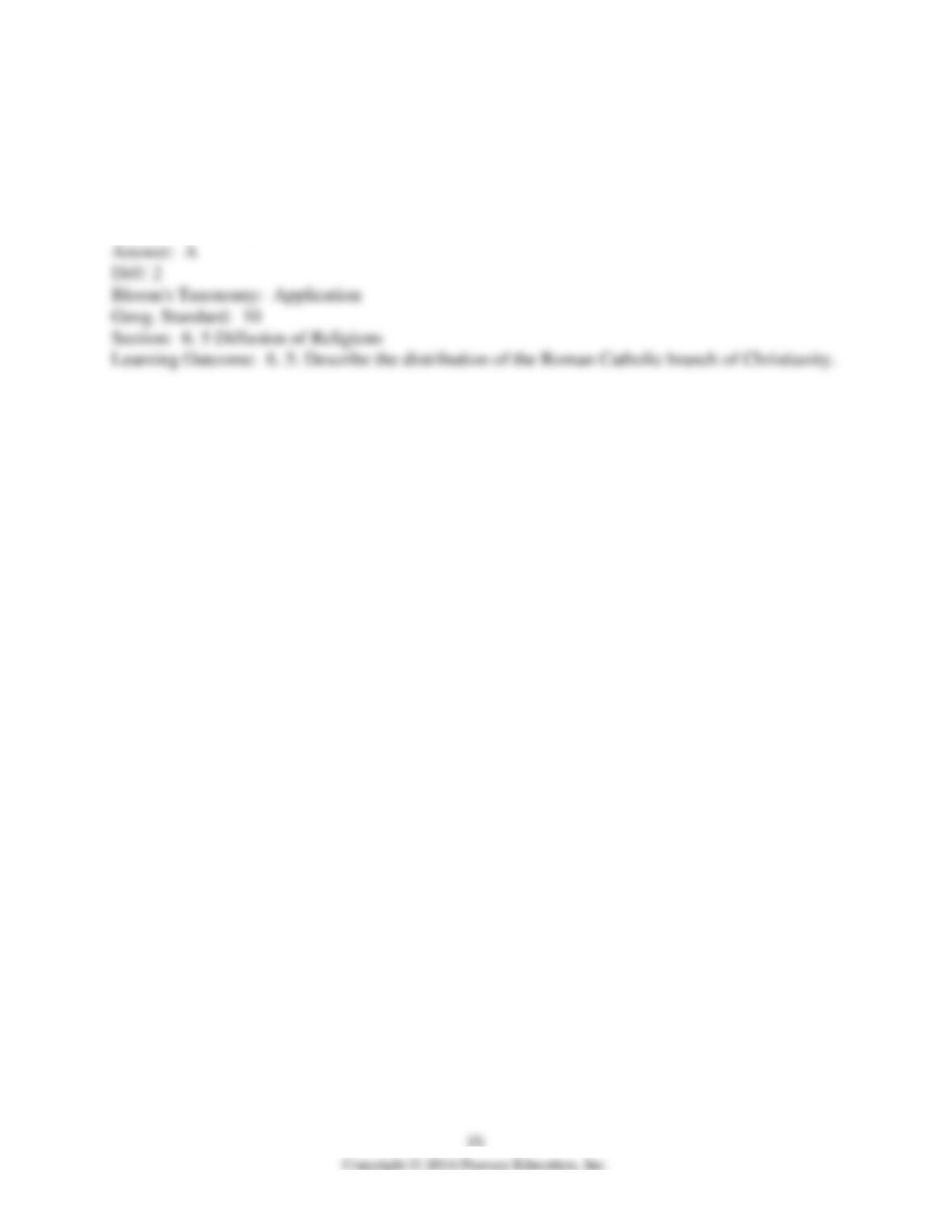
51) Roman Catholics are clustered in the U.S. southwest primarily because of migration of
A) Roman Catholics from Latin America.
B) Roman Catholics from the northeastern United States.
C) Roman Catholics from Ireland.
D) Protestants to the north.
E) Protestants to the east.
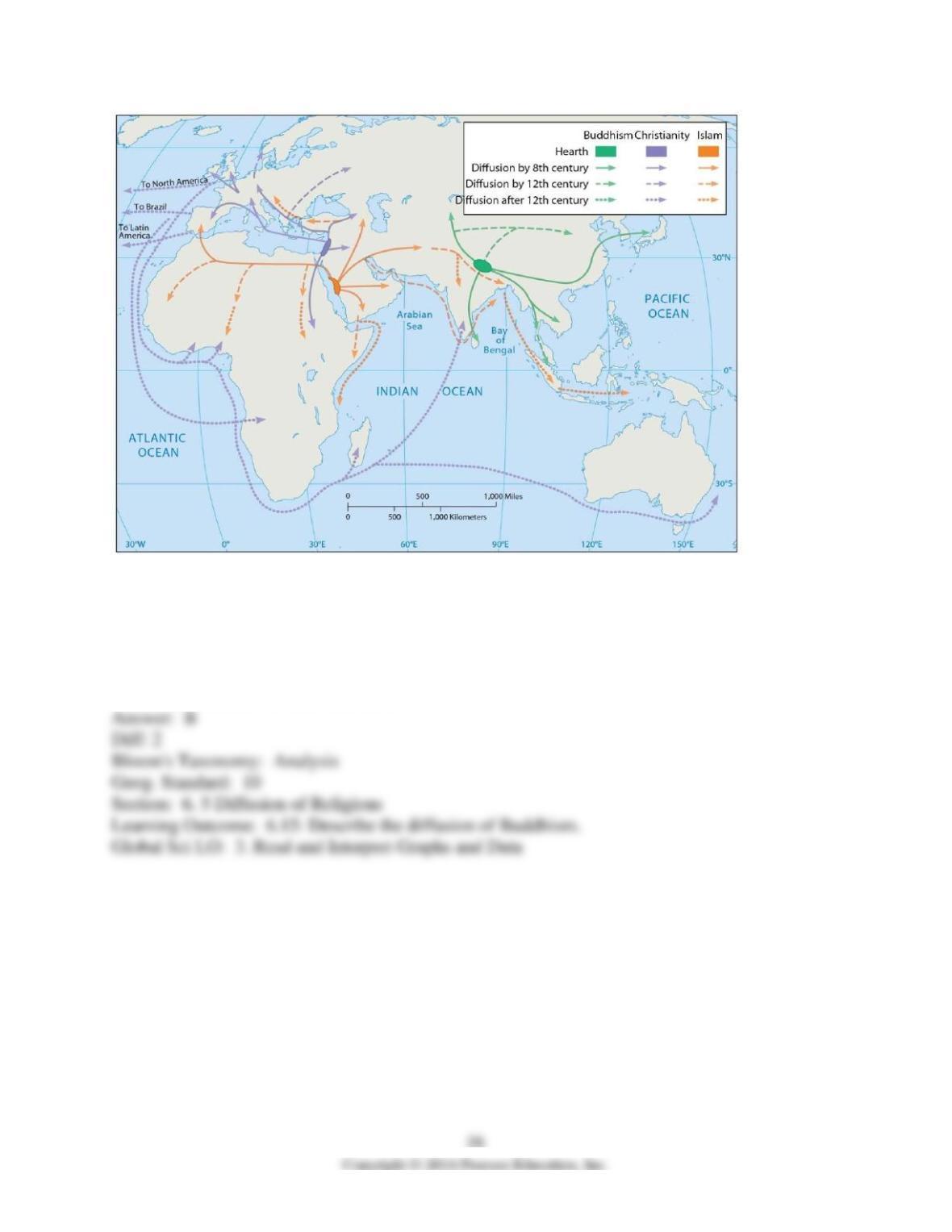
52) According to this map, Buddhism diffused initially to
A) Southwest Asia, Northeast Asia, and South Asia.
B) South Asia, East Asia, and Southeast Asia.
C) Africa, Southwest Asia, and Europe.
D) Africa, Europe, and Southeast Asia.
E) Southeast Asia and Northeast Asia.
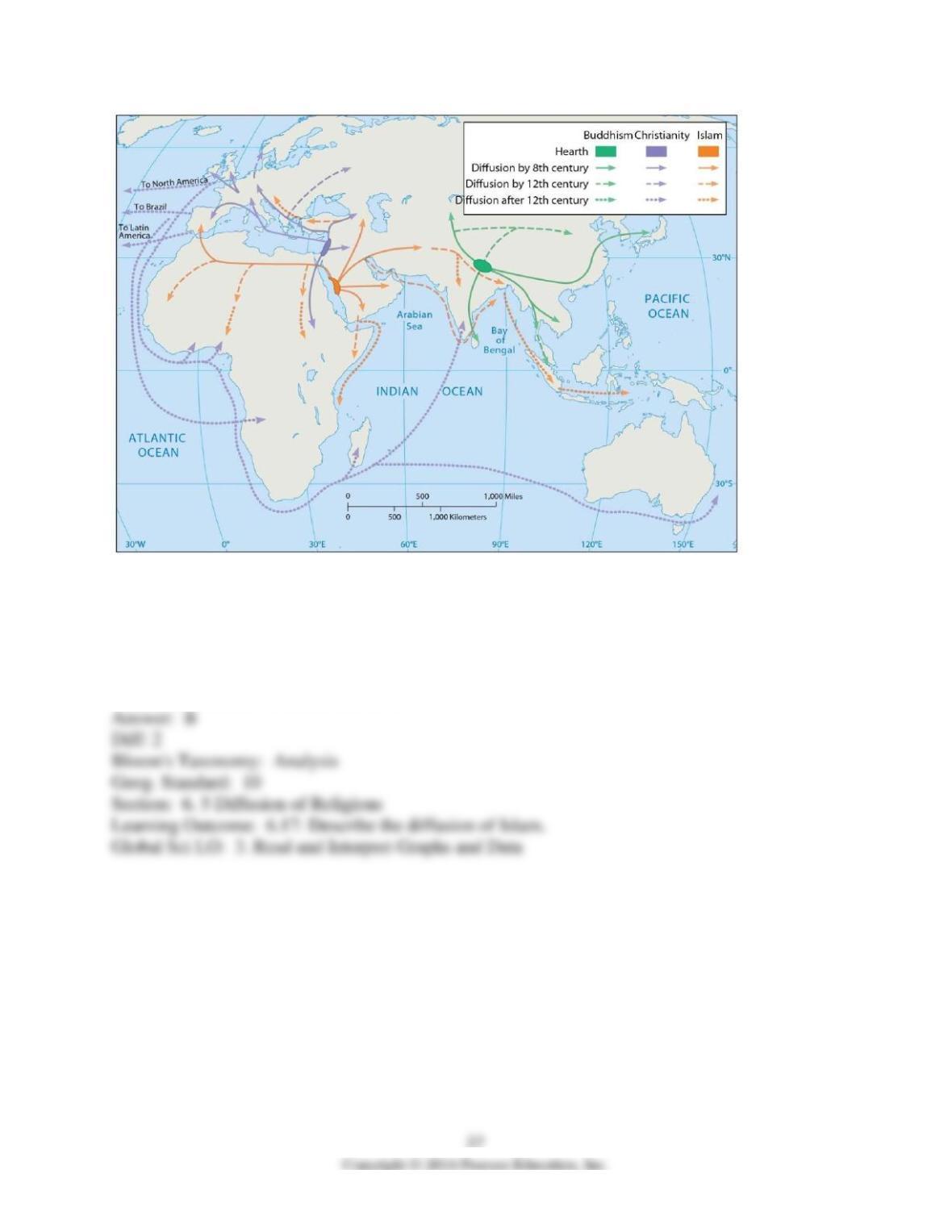
53) According to this map, Islam diffused initially to
A) Southwest Asia, Northeast Asia, and South Asia.
B) Southwest Asia and North Africa.
C) West Africa, Southwest Asia, and Europe.
D) North Africa, Europe, and Southeast Asia.
E) Southeast Asia and Southwest Asia.
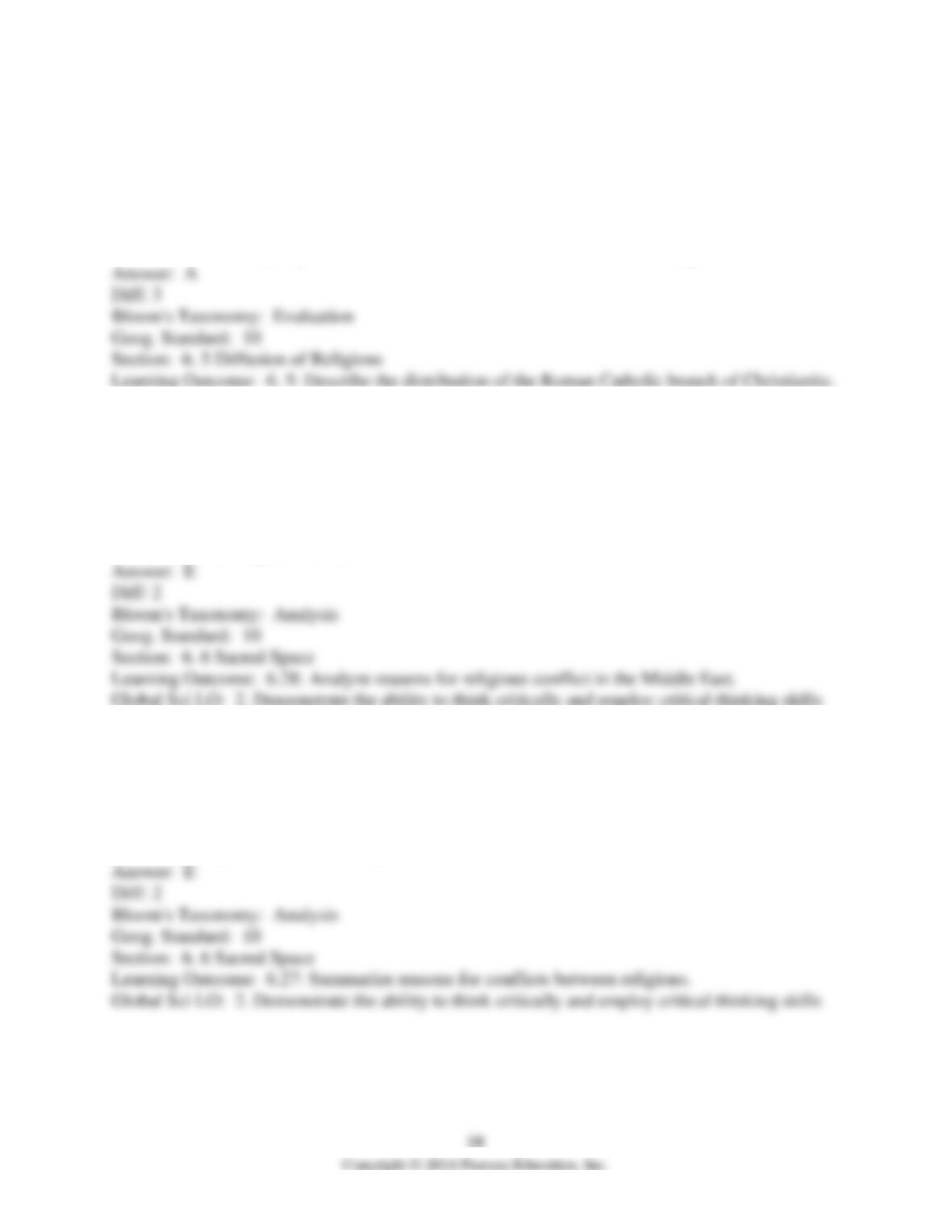
54) It is reasonable to surmise that historically, when signs were posted in store windows
warning “No Irish Need Apply,” the store owner may also have been
A) a Protestant discriminating against Roman Catholic immigrants.
B) a Roman Catholic discriminating against Jewish and Protestant immigrants.
C) a Roman Catholic from Ireland.
D) a nonreligious entrepreneur discriminating against all religious adherents.
E) a Protestant attempting to welcome Roman Catholics but not Jewish immigrants.
55) Given Muslim perspectives on sacred spaces in the Middle East, politicians in the region
have been wary of inviting further religious-fueled conflict by proclaiming
A) the West Bank a Palestinian-controlled area.
B) Jerusalem to be a holy city for three major religions.
C) that groups of Christians and Jews will not start touring Mecca and Medina.
D) that groups of Christians and Jews will tour Jerusalem.
E) Jerusalem the capital of Israel.
56) Some of the violence linked to religion in Israel and Palestine is also linked to
A) the immigration of Tibetan Buddhists into the area.
B) the ordination of women as leaders in some Protestant Christian denominations.
C) the existence of Mecca and Medina.
D) a belief in the equitable sharing of resources regardless of religious affiliation.
E) ethnic groups, resources, and disputes over the control of land.
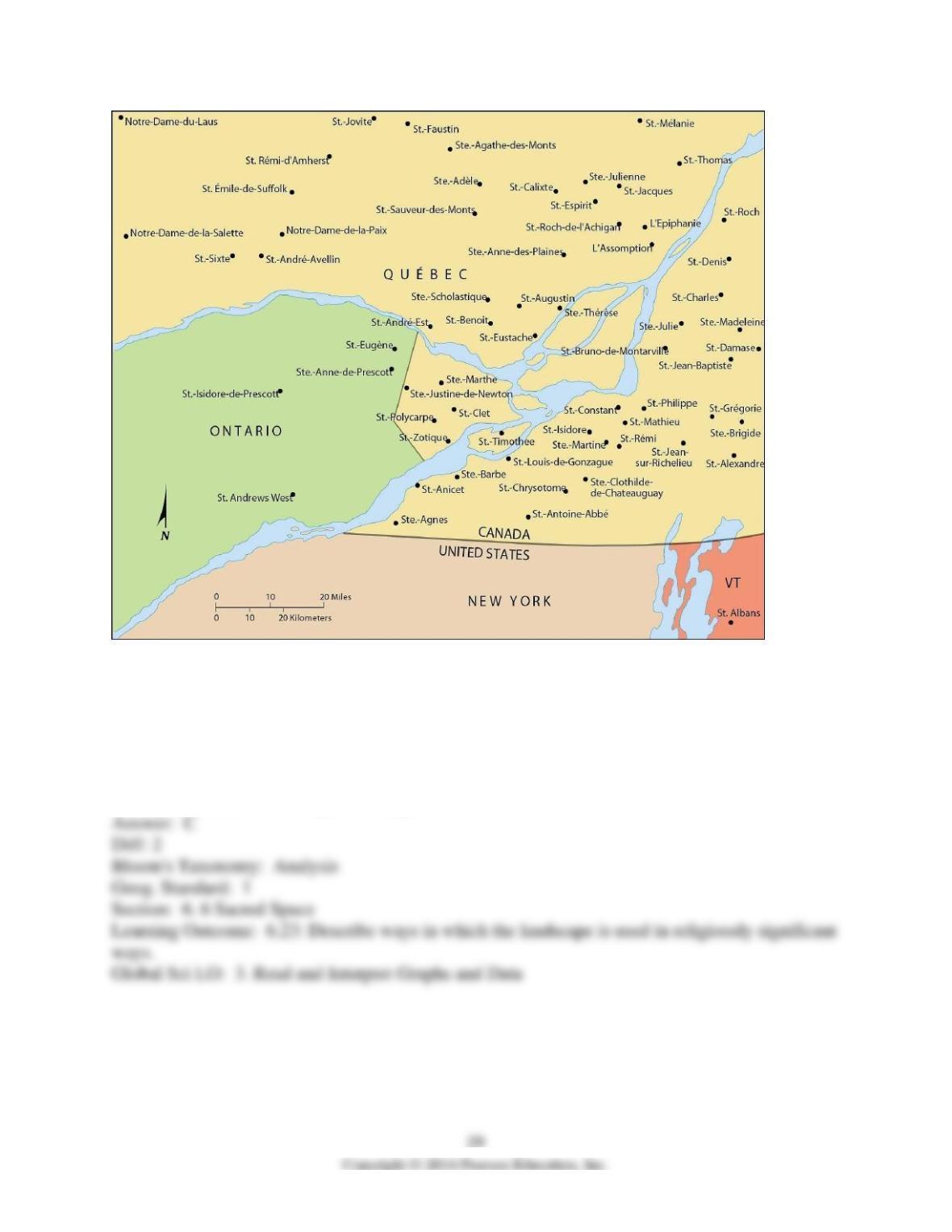
57) According to this map, the landscape of Quebec is distinguished from neighboring Canadian
provinces and the United States partly because it
A) has toponyms from non Indo-European languages.
B) is not predominantly Christian.
C) has numerous religious toponyms.
D) may become part of France again.
E) displays numerous examples of religious tolerance.
58) Judaism is classified as an ethnic rather than a universalizing religion, partly because
A) its main holidays relate to events in the life of its founder, Abraham.
B) it uses a standard solar calendar rather than a lunar calendar.
C) its rituals derive from the agricultural cycle in Israel.
D) it commemorates the Exodus from Egypt.
E) the holy text is the foundation of the religion.
59) The agricultural calendar is relatively unimportant to which type of religions?
A) animist
B) ethnic
C) traditional
D) universalizing
E) Judaism, Shintoism, and Daoism
60) The Julian and Gregorian calendars are
A) designed to celebrate religiously notable events in East Asia.
B) lunar calendars.
C) Christian calendars that are now used as standard calendars in much of the world.
D) Christian calendars that have been replaced by scientific, nonreligious calendars.
E) pre-Christian calendars.
61) Which of the following best describes the situation of religion in Tibet?
A) Only a few practice Buddhism; the majority observe Confucianism.
B) Tibetan leaders have a high degree of local control over the policies of their province.
C) The population has become almost entirely atheist since the Chinese invasion.
D) Its spiritual leader is in exile and the government discourages observance.
E) Freedom of religion is protected by provincial law.
62) Which is NOT a characteristic of a hierarchical religion?
A) It has a well-defined hierarchical structure.
B) It encourages each congregation to be self-sufficient.
C) It organizes territory into local administrative units.
D) It fosters interaction among different congregations.
E) Regional administration is located in large cities.
63) Protestants in Ireland are
A) dispersed throughout the island.
B) recent immigrants from Great Britain.
C) highly clustered in one part of the island.
D) highly integrated with the Roman Catholic population.
E) ethnically English and not ethnically Irish.
64) Jerusalem’s geography represents a particularly difficult religious conflict to resolve because
A) sacred sites to Jews and Muslims are literally built on top of one another.
B) the population of Jerusalem is majority Christian but surrounded by majority Jewish and
Muslim populations on either side.
C) the Israeli government has separated the most sacred sites with a massive concrete wall.
D) Israel captured the Sinai peninsula from Egypt.
E) few Muslims and Jews are allowed within the city.
65) The barrier between Israel and the West Bank
A) has been ruled as illegal by both Israeli and international courts but is supported by other
elements of the Israeli government.
B) is welcomed by both sides within the Palestinian and Israeli governments, regardless of their
political affiliations.
C) represents the natural landscape feature of the Jordan River as described in early religious
texts.
D) follows the previous border between Israel and Jordan.
E) has established peace in the Middle East.
66) The concept of a ghetto originally referred to the area of a city
A) inside the walls.
B) inhabited by the lowest-income people.
C) where Jews were forced to live.
D) where most blacks lived.
E) where the untouchable caste lived.
67) The example of Jerusalem indicates that in regards to the geographic landscape,
A) sacred sites may be equally important to universalizing and ethnic religions.
B) the population of Jerusalem is majority Christian but surrounded by majority Jewish and
Muslim populations on either side.
C) the sacred sites for universalizing religions do not overlap with the sacred sites of ethnic
religions.
D) there is almost always a clear distinction between the uses of sacred spaces by both ethnic and
universalizing religions.
E) Islam and Christianity are not good examples of universalizing religions.
68) The exiled spiritual leader of Tibet is the
A) Dalai Buddha.
B) Kublai Khan.
C) Panchen Buddha.
D) Dalai Lama.
E) Buddha.
69) For most of the past 2,000 years, most Jews have been
A) highly clustered in present-day Israel.
B) dispersed around the world.
C) concentrated in the United States.
D) forced to live in ghettos.
E) nomads herding sheep.
70) Cremation is more important than burial in which religion?
A) Buddhism
B) Christianity
C) Hinduism
D) Islam
E) Judaism
71) The goal of the majority of people living in Northern Ireland is to
A) remain part of the United Kingdom.
B) migrate to the Republic of Ireland.
C) become part of the Republic of Ireland.
D) join the Irish Republican Army.
E) establish an independent republic.
72) The United Nations partition plan dividing Palestine placed Jerusalem under
A) a British Mandate.
B) Palestinian administration.
C) Israeli administration.
D) divided administration.
E) United Nations administration.