
Understanding Stress, Immunity, and Disease
130
c. both a and b are necessary to produce illness.
d. neither a nor b is necessary to produce illness.
38. Stress is a factor in
a. tension but not vascular headaches.
b. vascular but not tension headaches.
c. both vascular and tension headaches.
d. neither tension nor vascular headaches.
39. The type of stress that is most closely associated with headaches is
a. major life events, such as loss of a loved one.
b. daily hassles.
c. persistent fears and anxiety.
d. depression.
40. When Sheldon Cohen and his colleagues intentionally exposed healthy volunteers to
common cold viruses, they found that their previous level of stress was
a. unrelated to subsequent number of colds.
b. related in a dose-response manner to subsequent number of colds.
c. positively related to subsequent number of colds but not in a dose-response
manner.
d. inversely related to subsequent number of colds.
41. Sheldon Cohen and his colleagues found that development of colds
a. was more strongly related to the duration of stress than its severity.
b. was not reliably related to the severity of the stress but was related to the presence
of stress.
c. occurred only with both long-term stress and severe stress.
d. showed no relationship between previous stress and the subsequent development
of colds.
42. Evidence now suggests that most colds are caused by an interaction of exposure to the
virus and
a. diet.
b. lack of sleep.
c. white blood count.
d. stress.
43. Evidence is strongest for the hypothesis that
a. there is little relationship between stress and heart disease.
b. stressful experiences increase the risk of heart attack.
c. stressful experiences can buffer people against cardiovascular disease.
d. most heart attacks among middle-age men are related to marital stress.

Understanding Stress, Immunity, and Disease
131
44. The notion that some people respond more strongly to stress than do others is called
a. Type A behavior pattern.
b. Type B behavior pattern.
c. reactivity.
d. responsively.
45. In what way does reactivity relate to ethnic background?
a. African American men show more reactivity to stress than do European American
men.
b. European American children show more reactivity than do African American
children.
c. Children with the highest rate of reactivity are European American children with a
family history of heart disease.
d. Both b and c are correct.
46. Robert, a middle-aged African American man believes that he has just been called a
derogatory name. According to research, Robert is most likely to
a. react by insulting the other person.
b. react by moving away from the other person.
c. react with increased blood pressure.
d. realize that he may have misinterpreted the other person’s words.
47. Research on the 2006 World Cup soccer championship indicated that
a. the stress of watching matches raised the risk of cardiac events for people with
cardiac problems.
b. the excitement of watching matches provided relief from reactivity.
c. men’s but not women’s risk of heart attack increased as a result of watching
matches.
d. soccer fans were more likely to experience an initial cardiac event, but individuals
with a history of heart disease actually experienced a lowered risk of cardiac
events during and after matches.
48. Stress probably plays some role in the development of
a. Type 1 diabetes.
b. Type 2 diabetes.

Understanding Stress, Immunity, and Disease
c. both Type 1 and Type 2 diabetes.
d. neither type of diabetes.
49. The most solid research evidence suggests that
a. stress can trigger an asthma attack.
b. stress is the strongest risk factor for cardiovascular disease.
c. stress is the chief cause of depression.
d. stress is unrelated to both depression and anxiety.
50. The connection between the immune system and asthma may occur through
a. the stress that comes from treatment for the disorder.
b. inflammation.
c. triggers such as smoke or dust.
d. the ethnic background of the person with the disease.
51. Evidence regarding the effects of stress on depression indicates that
a. stress seems to be a necessary condition for depression.
b. stress is a sufficient condition for depression.
c. stress is involved in more than half of all depressive episodes.
d. vulnerability and coping ability mediate the effects of stress on depression.
52. People with a negative outlook and a tendency to ruminate over problems
a. are less likely than others to complain about being sick.
b. are at higher risk for depression than those with a more positive attitude.
c. express more satisfaction with life than do other people.
d. all of these.
53. Austin suffers from recurrent intrusive memories of his experiences as a fire fighter at the
time of the World Trade Center attacks. He also has unpleasant dreams that replay some
of these experiences. Austin is most likely suffering from
a. clinical depression.
b. schizophrenia.
c. posttraumatic stress disorder.
d. transcendent psychosis.
54. Personality may also play a role in who develops a cold. In one study, people who were
______ developed fewer colds than others.
a. neurotic
b. extraverted
c. agreeable
d. conscientious

Understanding Stress, Immunity, and Disease
133
55. Vaccinations may be less effective in protecting against stress among people who
experience ________.
a. stress
b. many daily hassles
c. few daily hassles
d. exposure to cigarette smoke.
56. In a study of women with the sexually transmitted form of herpes simplex virus, women
experiencing psychosocial distress were more likely to
a. transfer the virus to someone else.
b. show the onset of genital lesions a few days later.
c. contract other herpes viruses.
d. all of the above.
57. Which of the following ethnic groups has been shown to have lowest reactivity in
response to a laboratory stressor?
a. Asian American
b. African American
c. European American
d. Caribbean Americans
58. Though stress may not directly cause ulcers, there may be an indirect link between stress
and ulcers, as stress may increase all of the following EXCEPT:
a. heavy drinking
b. smoking
c. caffeine consumption
d. exercise
59. Stress may contribute to diabetes through its possible effects on _______.
a. smoking
b. heavy drinking
c. obesity
d. exercise
60. In regards to the effects of stress on pregnancy, research indicates that __________
a. acute stress is the riskiest for pregnancy complications.

Understanding Stress, Immunity, and Disease
134
b. stress early in the pregnancy is riskier than stress later in the pregnancy.
c. stress late in the pregnancy is riskier than stress early in the pregnancy.
d. both a and c.
61. ________ children show the greatest asthma symptoms following an acute stress task.
a. Overweight
b. Underweight
c. Low socioeconomic status
d. High socioeconomic status
62. There is evidence that stress contributes to the development of __________.
a. depressive symptoms
b. anxiety symptoms
c. both anxiety and depressive symptoms.
d. neither anxiety nor depressive symptoms.
63. One explanation as to why some individuals are more vulnerable to depression is that
these individuals
a. have a small, but active, social support network.
b. have ineffective coping strategies.
c. have too many stressful experiences.
d. all of the above
64. Which of the following is not an adequate explanation for why some individuals are more
vulnerable to depression than others?
a. Ineffective coping strategies may increase vulnerability to depression.
b. Rumination may increase vulnerability to depression.
c. Major life stress may provide a “kindling” experience that increases vulnerability
to depression.
d. Certain genes have been implicated in vulnerability to depression, regardless of
environmental factors.
65. _______ may help explain why stress can lead to depression.
a. Increased cytokine production
b. Decreased cytokine production
c. Increased T-cell production
d. Increased activity of natural killer cells
66. The ethnic group that is most vulnerable to developing PTSD is
a. Asian Americans
Understanding Stress, Immunity, and Disease
b. Hispanic Americans
c. European Americans
d. African Americans
True/False Questions
1. The immune system protects the body against bacteria but not viruses.
2. T-cells are a type of nonspecific immune system response.
3. Psychoneuroimmunology is a multidisciplinary field that focuses on the interactions among
behavior, the nervous system, the endocrine system, and the immune system.
4. The functioning of the immune system occurs only in the lymph nodes.
5. The diathesis-stress model suggests that recent stress predisposes people to illness.
6. Most tension headaches are the result of traumatic life events.
7. Evidence from research by Sheldon Cohen and his colleagues demonstrated that stress has
no relationship to catching the common cold.
8. Most heart attacks are caused by sudden traumatic experiences.
9. Compared with people who have little reaction to stressful events, those who react with strong
emotions are more likely to have cardiovascular disease.
10. Almost all ulcers are caused by stress.
11. The immune system has one way to fight invading foreign substances: specific immune
system responses.
12. Chronic stress is more damaging to the immune system than short-term stress.
Understanding Stress, Immunity, and Disease
136
13. Stress may “get under the skin” by altering health-related behaviors, such as people drinking
more alcohol to cope with stressful life events.
14. The higher a person’s level of stress, the more likely that person will become ill.
15. A recent study on over 55,000 Japanese adults showed greater perceived stress increased the
risk for Type 2 diabetes.
Essay Questions
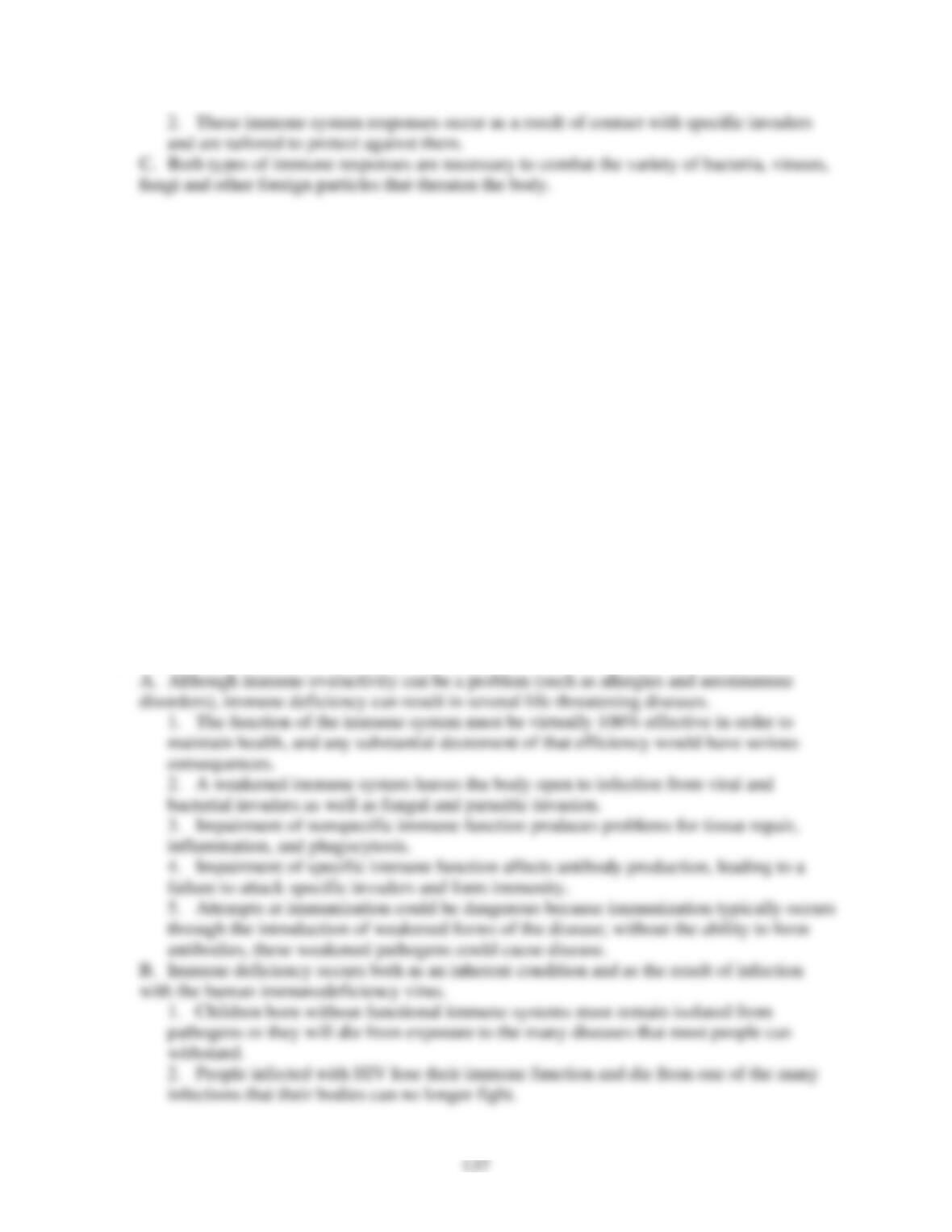
1. What functions do nonspecific and specific immunity serve, and why are both necessary?
Understanding Stress, Immunity, and Disease
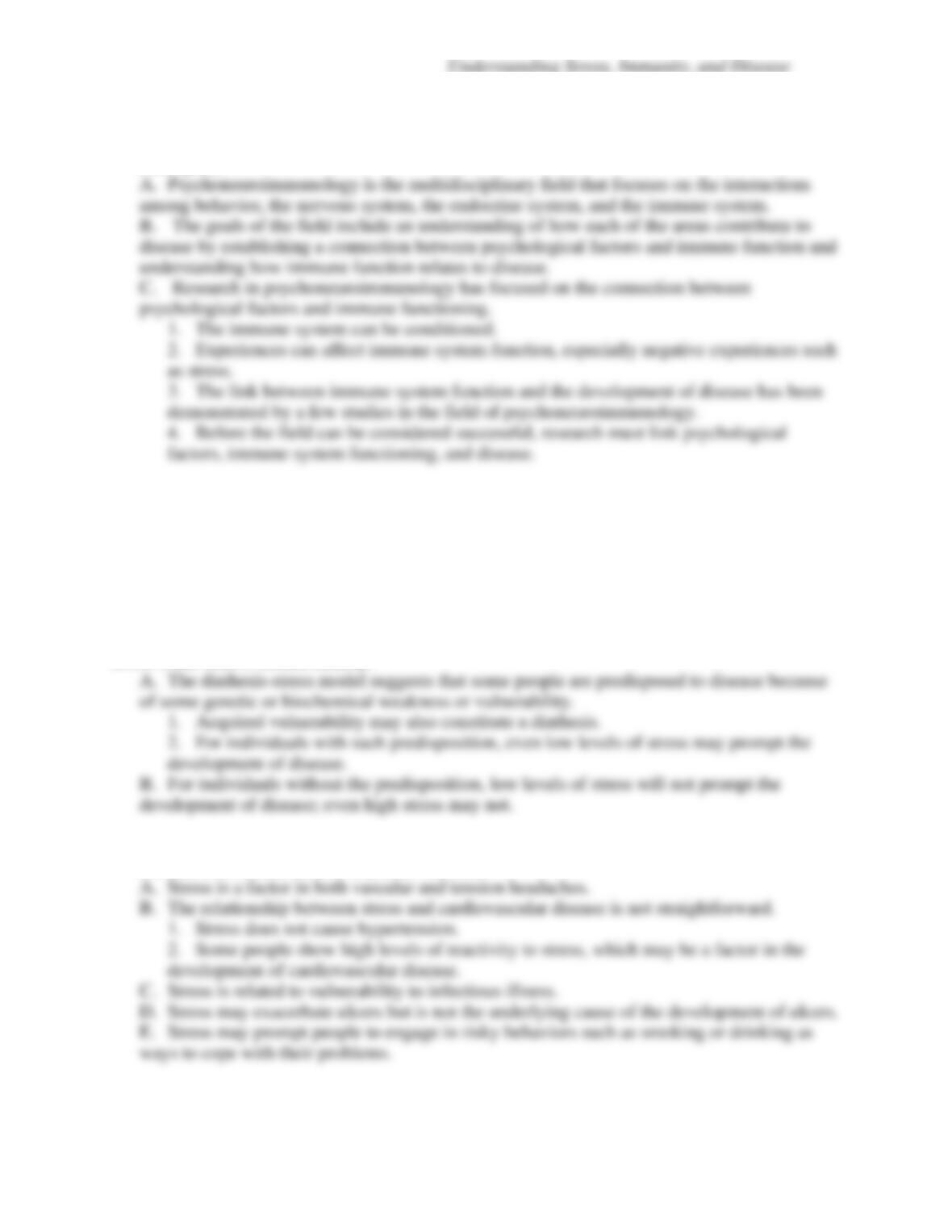
2. Discuss the implications of immune deficiency.
138
3. Explain the goals of the field of psychoneuroimmunology and evaluate its progress toward
these goals.
4. How does the diathesis-stress model explain how some people get sick when exposed to
stress while others remain healthy?
5. How strong is the relationship between stress and headache, heart disease, infectious
disease, ulcers, diabetes, or any other disease?
Understanding Stress, Immunity, and Disease
6. Evaluate the evidence for stress as a factor in psychological disorders.