
Chapter 6
Equity: Concepts and Techniques
Note: In the sixth edition of Global Investments, the exchange rate quotation symbols differ from previous
editions. We adopted the convention that the first currency is the quoted currency in terms of units
of the second currency.
For example, €:$ = 1.4 indicates that one euro is priced at 1.4 dollars. In previous editions we used
the reversed convention $/€ = 1.4, meaning 1.4 dollars per euro.
All problems in this test bank still use the old convention and have not been adapted to reflect the
new quotation symbols used in the 6th edition.
◼ Questions and Problems
1. In studying the impact of consolidation on Price/Earnings (P/E) ratios, there are four basic methods
of consolidating the account of a subsidiary into the parent company:
• Full consolidation. Assets, liabilities, and earnings of the subsidiaries are fully incorporated,
line-by-line, into the parent’s accounts, with special care to avoid double counting.
• Proportional consolidation. Assets, liabilities, and earnings are consolidated line-by-line,
proportionate to the percentage of ownership in the subsidiary.
• Equity consolidation. A share of the subsidiary profits is consolidated on a one-line basis,
proportionate to the share of equity owned by the parent. The value of the investment in the
subsidiary is adjusted to reflect the change in the subsidiary’s equity.
• No consolidation. This is sometimes referred to as the cost method, whereby only dividends
received from the subsidiary affect earnings of the parent. The value of the investment in the
subsidiary is carried at cost in the parent’s book and is not revalued.
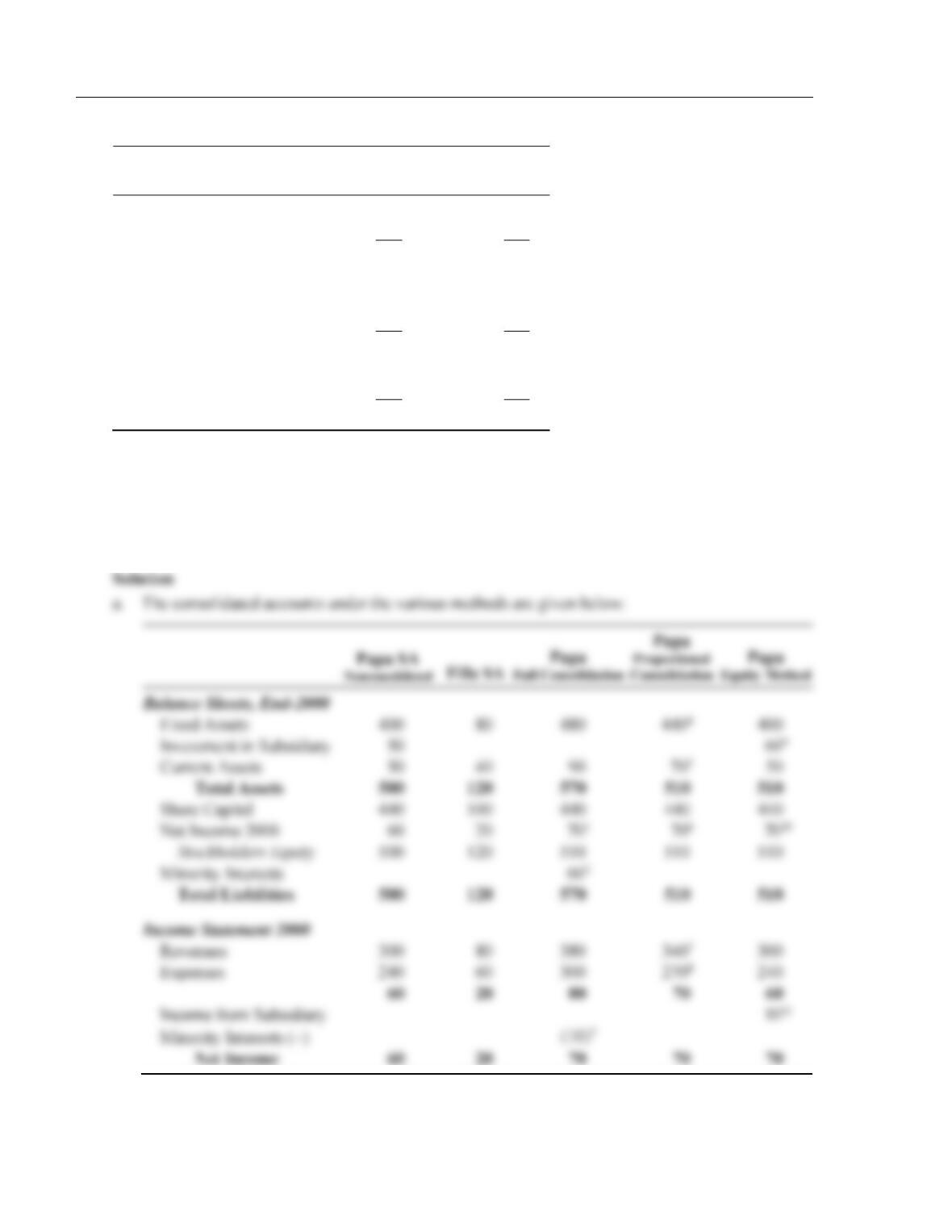
Here are the simplified 2000 accounts of Papa SA and Fille SA, two French firms. Papa SA owns
50% of Fille SA, a company created the previous year. Fille SA has not paid any dividend. The
nonconsolidated accounts follow:
Papa SA
€ million
Fille SA
€ million
Balance Sheets, End-2000
Fixed Assets
400
80
Investment in Subsidiary
50
Current Assets
50
40
Total Assets
500
120
Share Capital
440
100
Net Income 2000
60
20
Continued
44 Solnik/McLeavey • Global Investments, Sixth Edition
Papa SA
€ million
Fille SA
€ million
Stockholders Equity
500
120
Minority Interests
Total Liabilities
500
120
Income Statement 2000
Revenues
300
80
Expenses
240
60
60
20
Income from Subsidiary
Minority Interests (−)
Net Income
60
20
The nonconsolidated accounts for Papa SA use the cost method, whereby the investment in the
subsidiary is carried at historical cost in the balance sheet of the parent.
a. Establish the consolidated accounts, using the other three methods outlined above.
b. Which method provides the highest reported net income for Papa SA?
c. Which method provides the highest P/E ratio, based on book value, for Papa SA?
Fixed Assets
Investment in Subsidiary
Current Assets
Total Assets
Share Capital
Net Income 2000
Minority Interests
Revenues
Expenses
Income from Subsidiary
Minority Interests (−)

Chapter 6 Equity: Concepts and Techniques 45
2. Japanese companies tend to belong to groups (“keiretsu”) and to hold shares of one another. Because
these cross-holdings are minority interests, they tend not to be consolidated in published financial
statements. To study the impact of this tradition on published earnings, take the following simplified
example:
Company A owns 20% of Company B; the initial investment was 20 billion yen.
Company B owns 30% of Company A; the initial investment was 20 billion yen.
Both companies value their minority interests at historical cost. The year-end nonconsolidated
balance sheets of the two companies follow:
Balance Sheet
Company A
Yen Billion
Company B
Yen Billion
Current Assets
70
120
Fixed Assets
70
150
Minority Investments
10
10
Total Assets
150
280
Debt
50
80
Shareholders Equity
100
200
Total Liabilities
150
280
The annual net income of Company A was 15 billion yen. The annual net income of Company B was
40 billion yen. Assume that the two companies do not pay any dividends. The current stock market
values are 250 billion yen for Company A and 550 billion yen for Company B.
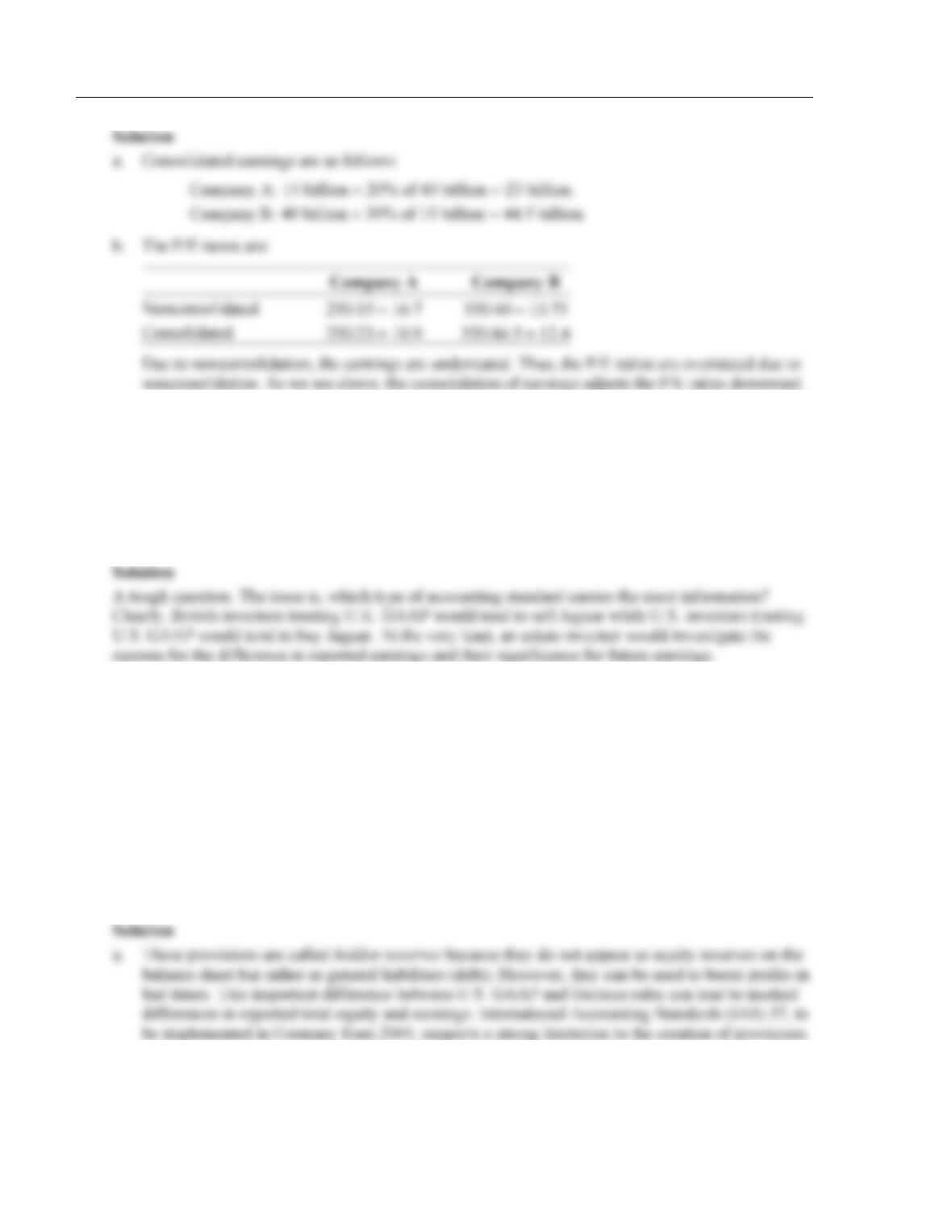
a. Restate the earnings of the two companies, using the equity method of consolidation. Remember
that the share of the minority-interest profits is consolidated on a one-line basis, proportionate to
the share of the equity owned by the parent. The value of the investment in the subsidiary is
adjusted to reflect the change in the subsidiary’s equity.
b. Calculate the P/E ratios based on nonconsolidated and consolidated earnings. Are they similar?
46 Solnik/McLeavey • Global Investments, Sixth Edition
3. In 1989, Jaguar Plc, an English company, was listed on the London SEAQ and on NASDAQ. At the
time, one-fourth of Jaguar common stock was held in the form of American Deposit Receipts (ADRs)
quoted on NASDAQ. Under U.K. accounting principles, Jaguar reported a 1988 net income (before
extraordinary items) of £61 million, a decrease of 27% from 1987 net income. Under U.S. generally
accepted accounting principles (GAAP), Jaguar reported a 1988 net income (before extraordinary
items) of £113 million, an increase of 89% over the comparable figure for 1987. What would your
reaction be as an investor?
4. In 1993 Daimler-Benz became the first German company to be listed on the New York Stock
Exchange (NYSE). This forced Daimler-Benz to file a reconciliation statement with U.S. GAAP
(Form 20-F). Because Daimler-Benz drew on hidden reserves during the recession of 1993, its
German-reported profit (in Deutsche mark or DM) was a small, but positive, DM615 million. It
translated into a DM1.84 billion loss according to U.S. GAAP. Daimler’s 1993 net worth translates
from DM18.15 billion under German rules to DM26.28 billion under U.S. GAAP.
a. Explain what happened on earnings.
b. Explain what happened on book value (net worth).
c. In a profitable year, Daimler-Benz decides to increase its hidden reserves. How would this
decision affect earnings calculated according to U.S. and German GAAP?
d. Same question for book value.

Chapter 6 Equity: Concepts and Techniques 47
5. A company has 500,000 shares outstanding at $20 per share. To its management, the company grants
employee stock options on 10,000 shares. Five thousand of these options can be exercised at a price
of $21 any time during the next five years. For five years, the employees thus have the right but not
the obligation to purchase shares at the $21 price, regardless of the prevailing market price of the
stock. Another 5,000 of these options can be exercised at a price of $25 any time during the next
five years. For five years, the employees thus have the right but not the obligation to purchase shares
at the $25 price, regardless of the prevailing market price of the stock. The company’s auditor can
provide an estimate of the options’ value. Using price volatility estimates for the stock, a standard
Black−Scholes’ valuation model gives an estimated value of $12 per share option with an exercise
price of $21 and of $7 per share option with an exercise price of $25. Without expensing the options,
the company’s pretax earnings are reported as $10 million.
a. What are the pretax earnings per share without expensing the share options granted?
b. What are the pretax earnings per share with expensing the share options granted?
6. A company can generate an return on equity (ROE) of 12% and has an earnings retention ratio of
0.80. Next year’s earnings are projected at $100 million. If the required rate of return for the company
is 10%, what is the company’s tangible P/E value, franchise factor, growth factor, and franchise
P/E value?

48 Solnik/McLeavey • Global Investments, Sixth Edition

Chapter 6 Equity: Concepts and Techniques 49
7. Consider two companies based in a country with an inflation rate of 2%. There is no real growth in
earnings. The real rate of return required by global investors for this type of stock investment is 5%.
a. Assume that the Company A can only pass 60% of inflation through its earnings. What should be
its P/E using prospective earnings?
b. Assume that the Company B can pass the full inflation through its earnings. What should be its
P/E using prospective earnings?
8. Consider Company A with a zero earnings retention ratio and a real growth rate in earnings of
%. In an inflationary environment, the company can only pass inflation through its earnings
at a flow-through rate of
. So if I is the inflation rate, its earnings will grow at a rate of
g
=
+
I. The real rate of return required for this company is
, so the nominal rate of return
required is r =
+ I.
Use a simple dividend discount model (DDM) assuming that dividends will grow indefinitely at a
constant compounded annual growth rate (CAGR), g =
+
I.
a. Derive formulas equivalent of Equations (6.7) and (6.8), which assumed no real growth in
earnings. Discuss the results.
b. Use these formulas to calculate P/E ratio on prospective earnings with the following data on
Company A:
= 2%, I = 4%,
= 4%,
= 100%.
c. Same question for a Company B, whose inflation pass-through rate is only 80%.

50 Solnik/McLeavey • Global Investments, Sixth Edition
9. The U.S. Department of Justice (DoJ) uses the Herfindahl Index to evaluate the impact of a proposed
horizontal merger between firms on the degree of market concentration. The following text is an
extract of the official document found in 2003 on the DoJ Web site:
Market concentration is a function of the number of firms in a market and their respective market
shares. As an aid to the interpretation of market data, the Agency will use the Herfindahl–
Hirschman Index (“HHI”) of market concentration. The HHI is calculated by summing the
squares of the individual market shares of all the participants […].

1.51 General Standards
In evaluating horizontal mergers, the Agency will consider both the post-merger market
concentration and the increase in concentration resulting from the merger. Market concentration
is a useful indicator of the likely potential competitive effect of a merger. The general standards
for horizontal mergers are as follows:
a. Post-Merger HHI below 0.10. The Agency regards markets in this region to be
unconcentrated. Mergers resulting in unconcentrated markets are unlikely to have adverse
competitive effects and ordinarily require no further analysis.
b. Post-Merger HHI between 0.10 and 0.18. The Agency regards markets in this region to be
moderately concentrated. Mergers producing an increase in the HHI of less than 0.01 points
in moderately concentrated markets, post-mergers are unlikely to have adverse competitive
consequences and ordinarily require no further analysis. Mergers producing an increase in
the HHI of more than 0.01 points in moderately concentrated markets, post-mergers
potentially raise significant competitive concerns depending on the factors set forth in
Section 2-5 of the Guidelines.
c. Post-Merger HHI above 0.18. The Agency regards markets in this region to be highly
concentrated. Mergers producing an increase in the HHI of less than 0.005 points, even in
highly concentrated markets, post-mergers are unlikely to have adverse competitive
consequences and ordinarily require no further analysis. Mergers producing an increase in
the HHI of more than 0.005 points in highly concentrated markets, post-mergers potentially
raise significant competitive concerns, depending on the factors set forth in Section 2-5 of
the Guidelines. Where the post-merger HHI exceeds 0.18, it will be presumed that mergers
producing an increase in the HHI of more than 0.01 points are likely to create or enhance
market power or facilitate its exercise. The presumption may be overcome by a showing that
factors set forth in Section 2-5 of the Guidelines make it unlikely that the merger will create
or enhance market power or facilitate its exercise, in light of market concentration and
market shares.
Source: http://www.usdoj.gov/atr/public/guidelines/horiz_book/hmg1.html, June 2003.
Note: The appellations Herfindahl–Hirschman Index (“HHI”) or Herfindahl Index (“H”) are used
interchangeably. The DoJ expresses the Index in squared percent, for example (10%)2 = 100,
rather than (10%)2 = (0.10)2 = 0.01. With their units, the index is equal to 100 100 = 10,000
times the same index calculated in International Investments. To be consistent, we took the
liberty to transform their units into ours.
a. You consider an industry with numerous very small firms and five large firms. Their market
shares are as follows:
Company
Market Share
A
30%
B
15%
C
15%
D
5%
E
1%
Companies A and B merge, what should the reaction of the DoJ be according to the Agency’s
standards?
b. Consider now that the merger is between companies A and D. What should the reaction of the
DoJ be according to the Agency’s standards?

52 Solnik/McLeavey • Global Investments, Sixth Edition
c. Consider now that the merger is between Companies A and E. What should the reaction of the
DoJ be according to the Agency’s standards?
10. You are an active British stock portfolio manager. Your performance is measured against the FTSE
index, a broadly based British stock index. It has been repeatedly observed that small-capitalization
stocks outperform large-capitalization stocks over prolonged periods of time (“small–firm effect”)
but that there have been periods when the reverse was true. It has also been repeatedly observed that
value stocks (firms with low price-to-book ratios) outperform growth stocks over prolonged periods
of time (“value/growth effect”) but that there have been periods when the reverse was true.
How would an attribute factor model be useful in estimating the risks that your performance deviates
from that of the assigned benchmark?

Chapter 6 Equity: Concepts and Techniques 53
11. You invest in a country named Papaf. You observe the stock returns on a list of stocks during
three periods.
Stock
Period 1
Period 2
Period 3
A
14.5%
−10.5%
14%
B
11%
−6.5%
10.5%
C
7.5%
−3%
8%
D
5.5%
−1%
5%
E
2%
2%
2.5%
F
−1.5%
5%
−1%
You consider explaining differences in returns by common factors, with a linear model as represented
in Equation (6.9). You have two candidates for factors: movements in interest rates and changes in
the local temperature measured at noon-time from the previous day. The various values of these
factors are given below:
Factor
Period 1
Period 2
Period 3
Change in Interest Rate
−3%
+3%
−3%
Change in Temperature
−5%
−3%
+5%
a. Try to assess whether each factor has an influence on stock returns.
b. Try to estimate the intercept and the factor exposures of each asset.

54 Solnik/McLeavey • Global Investments, Sixth Edition
12. You invest in a country named Paf. You consider explaining the difference in returns by two common
factors, with a linear factor model as given in Equation (6.9). Your candidate for factors are movements
in interest rates and changes in the popularity of the president of Paf, as measured by polls. The
various values of the factor returns and of the returns on four stocks (A, B, C, and D) for the ten past
periods are given below:
Period
Interest Rate
Popularity
A
B
C
D
1
−3%
2%
−2.57
−4.43
−2.16
−5.02
2
2%
7%
1.90
2.53
2.01
3.81
3
5%
6%
5.46
7.42
4.10
9.17
4
−2%
4%
−1.62
−4.70
−0.59
−3.24
5
4%
−3%
4.51
6.43
3.01
8.79
6
2%
4%
2.16
1.56
1.36
4.66
7
−5%
−7%
−5.54
−4.73
−4.08
−8.68
8
−6%
0%
−5.83
−8.12
−5.41
−11.47
9
3%
2%
3.04
4.71
2.42
6.43
10
1%
−2%
1.18
2.44
0.00
2.50
You will try to assess whether the two factors have an influence on stock returns. To do so:
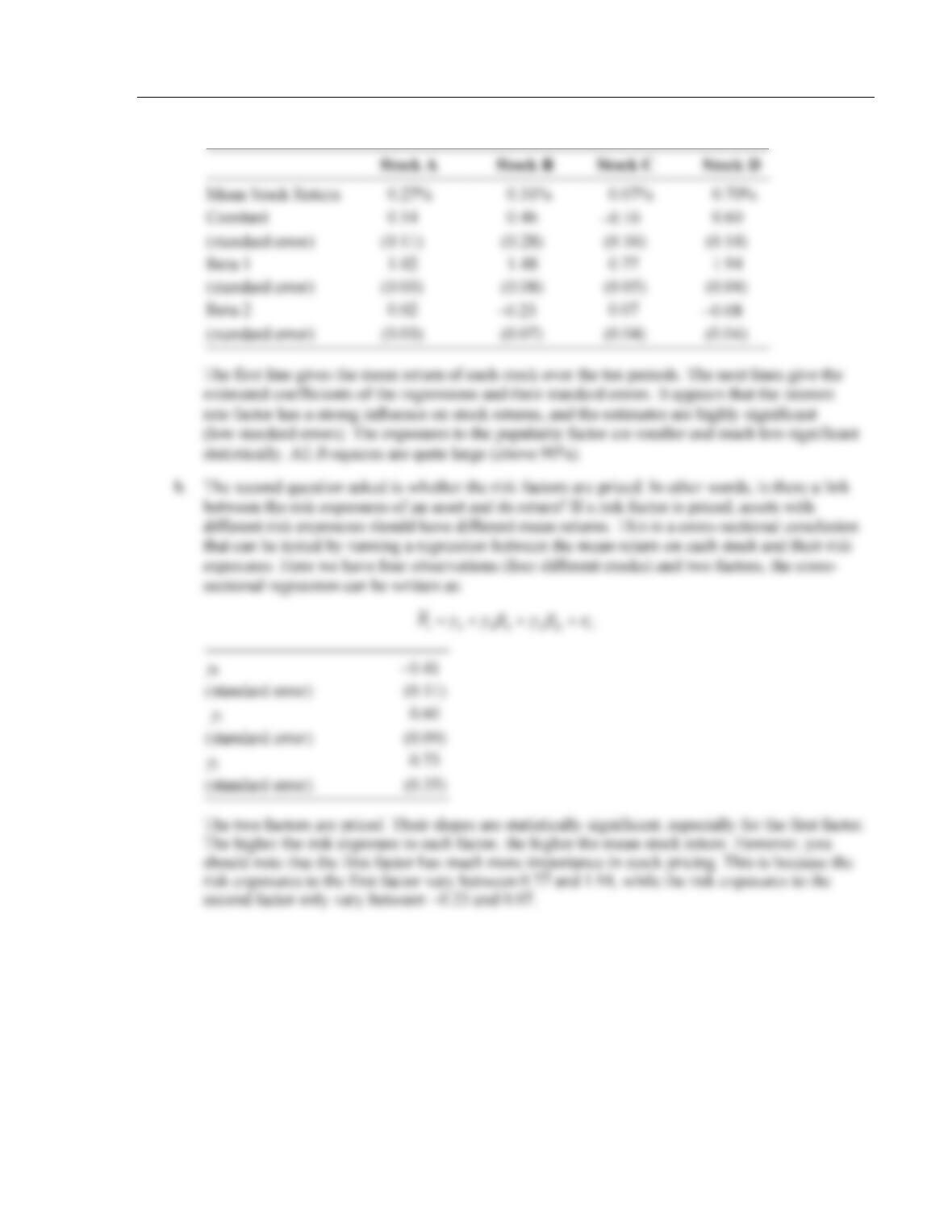
a. Estimate the factor exposures for each of the four assets. (You can do a times-series regression
for each asset against the two factors.)
b. Are the factors «priced», that is, is there a relation between mean returns on the assets and their
factor exposures? (You can do a cross-sectional regression between the mean return on the asset
and its exposures, that is, you have one observation for each asset.)
Chapter 6 Equity: Concepts and Techniques 55