Chapter 6: Accounting for Merchandising Businesses
212.
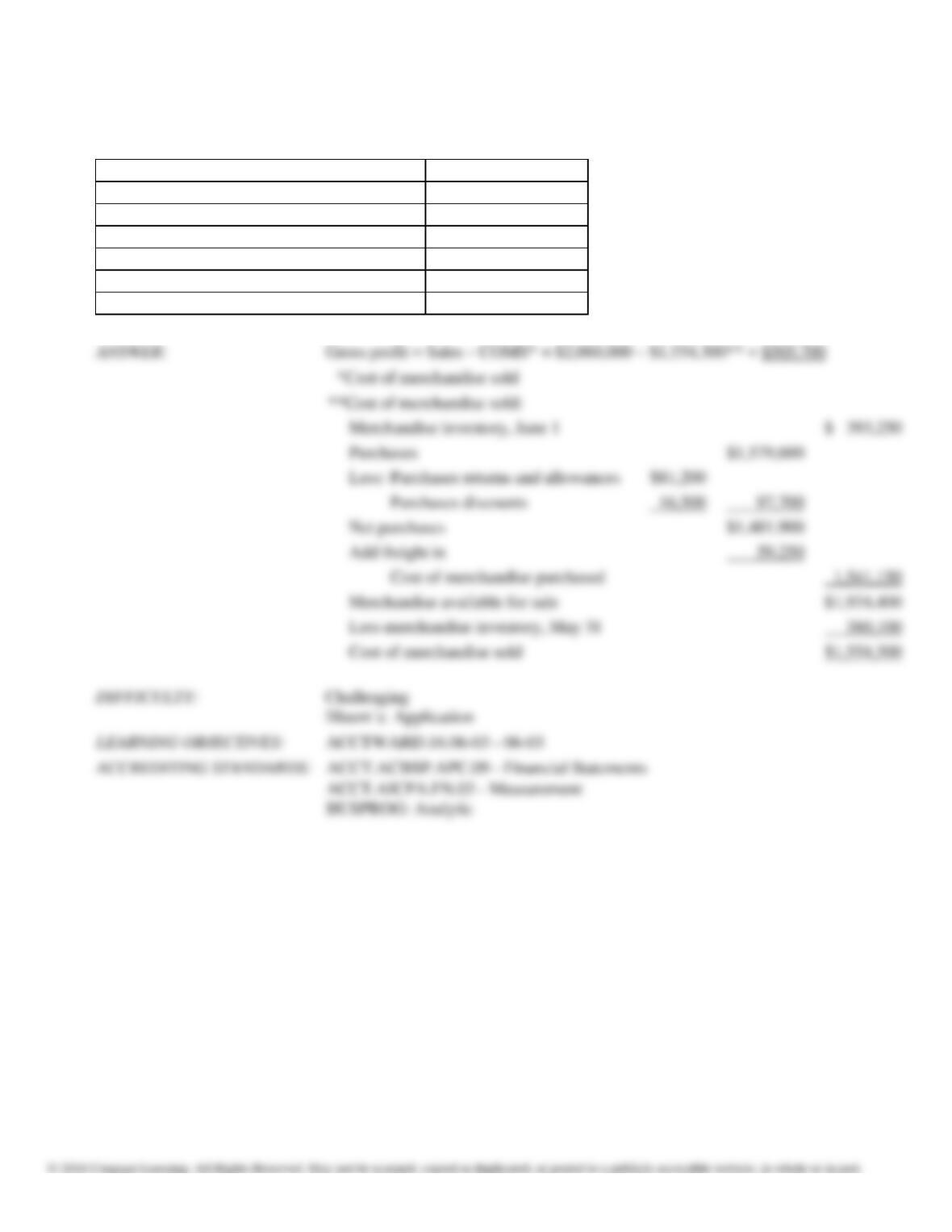
Using the following data taken from Connor Inc., determine the gross profit to be reported on the income
statement
for the year ended May 31.
Merchandise inventory, June 1
$ 393,250
Merchandise inventory, May 31
380,100
Purchases
1,579,600
Purchases returns and allowances
81,200
Purchases discounts
16,500
Sales
2,060,000
Freight in
59,250
Chapter 6: Accounting for Merchandising Businesses
213.
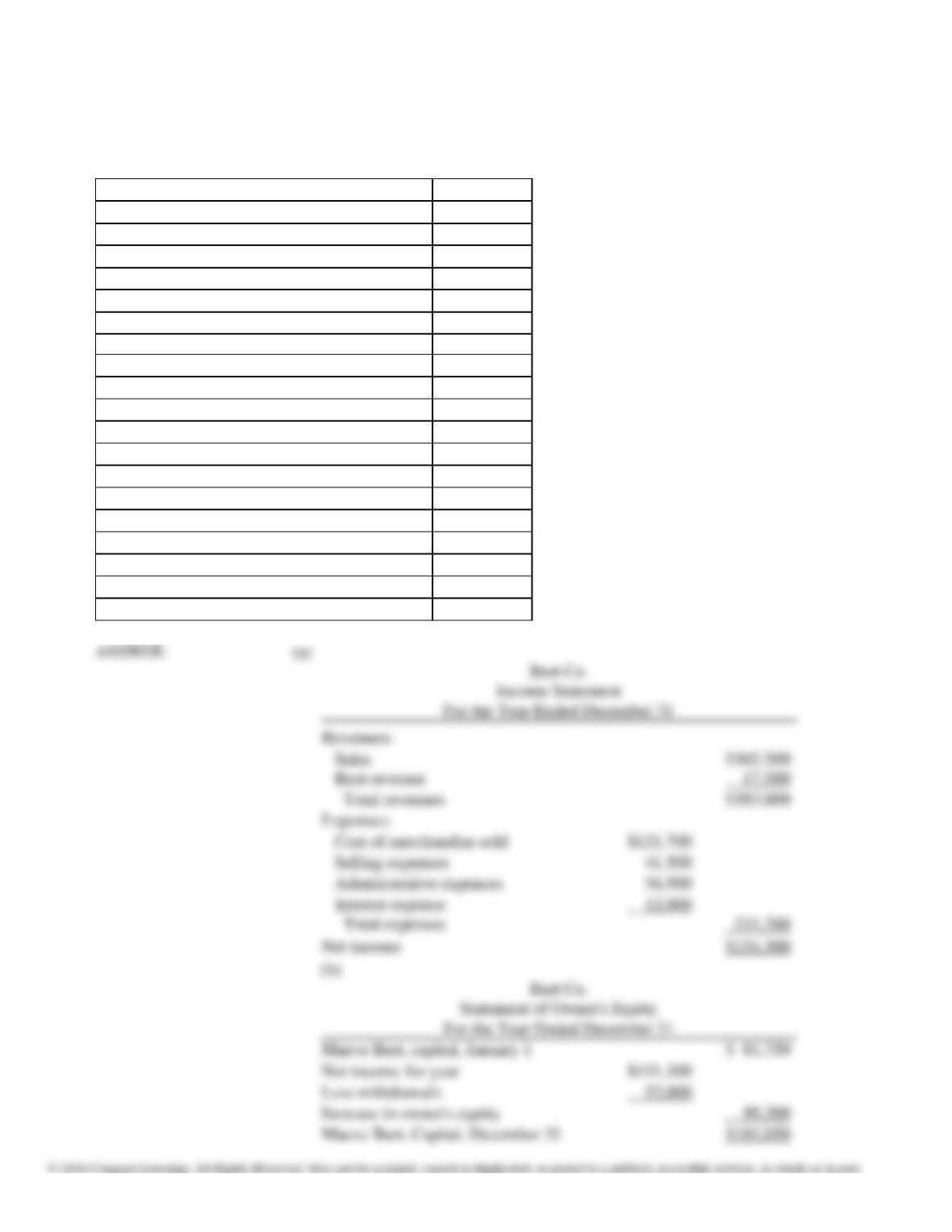
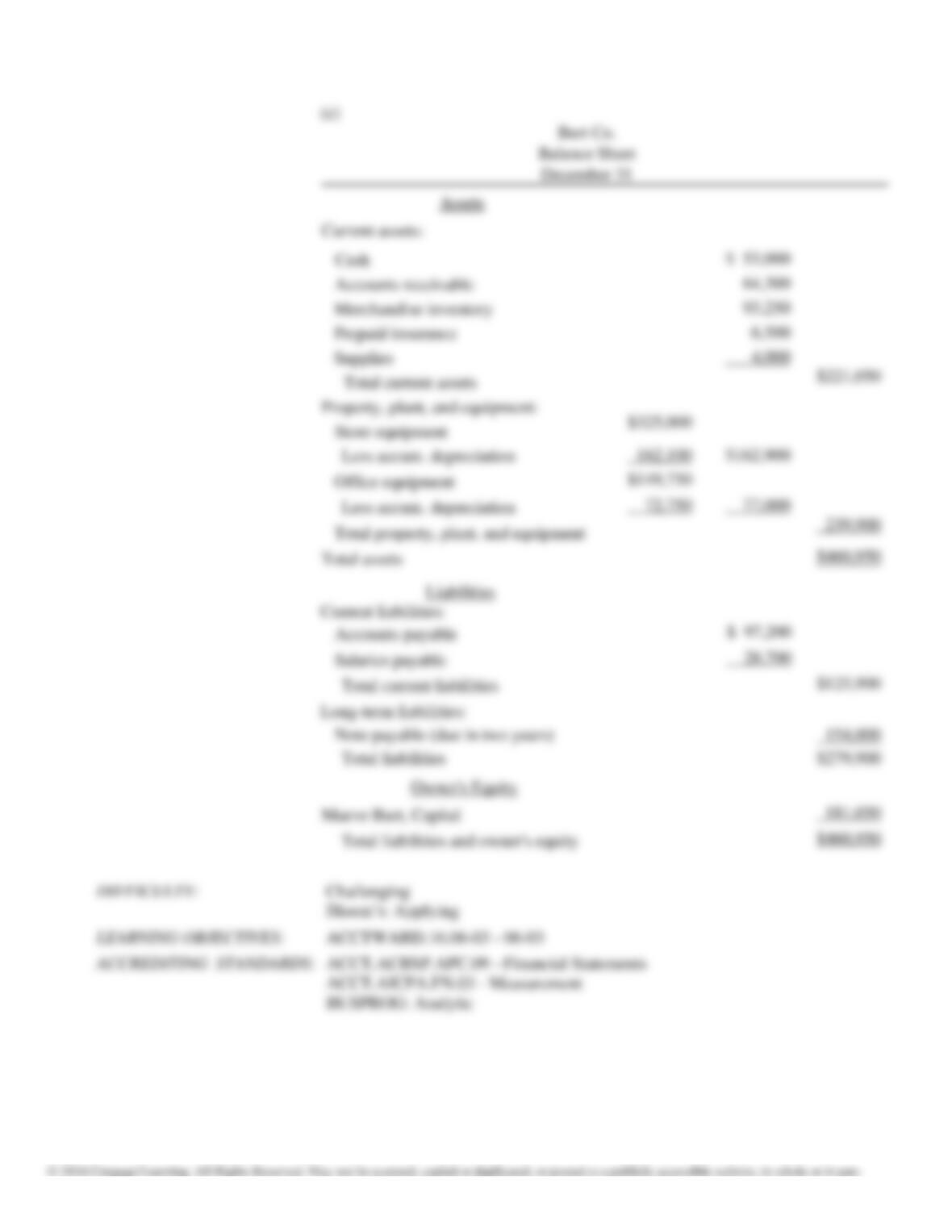
Prepare (a) a single-step income statement, (b) a statement of owner’s equity, and (c) a balance sheet in report
form from the following data for Burt Co., taken from the ledger after adjustments on December 31, the end of the
fiscal year.
Accounts Payable
$ 97,200
Accounts Receivable
64,300
Accumulated Depreciation—Office Equipment
72,750
Accumulated Depreciation—Store Equipment
162,100
Administrative Expenses
56,500
Maeve Burt, Capital
81,750
Cash
53,000
Cost of Merchandise Sold
121,700
Maeve Burt, Drawing
52,000
Interest Expense
12,000
Merchandise Inventory
93,250
Note Payable, Due in two years
154,000
Office Equipment
149,750
Prepaid Insurance
6,500
Rent Revenue
17,500
Salaries Payable
28,700
Sales
365,500
Selling Expenses
41,500
Store Equipment
325,000
Supplies
4,000
Chapter 6: Accounting for Merchandising Businesses
Chapter 6: Accounting for Merchandising Businesses
214.
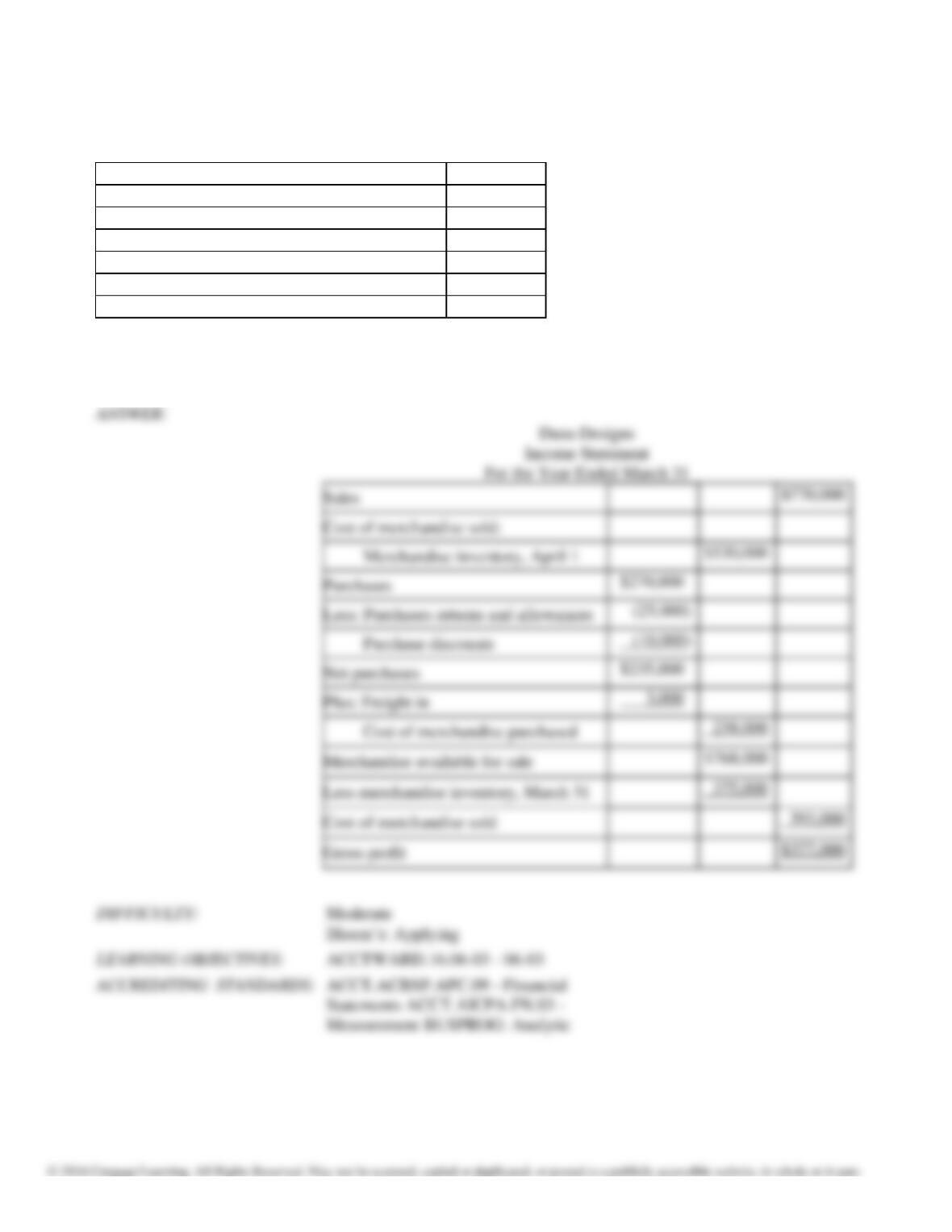
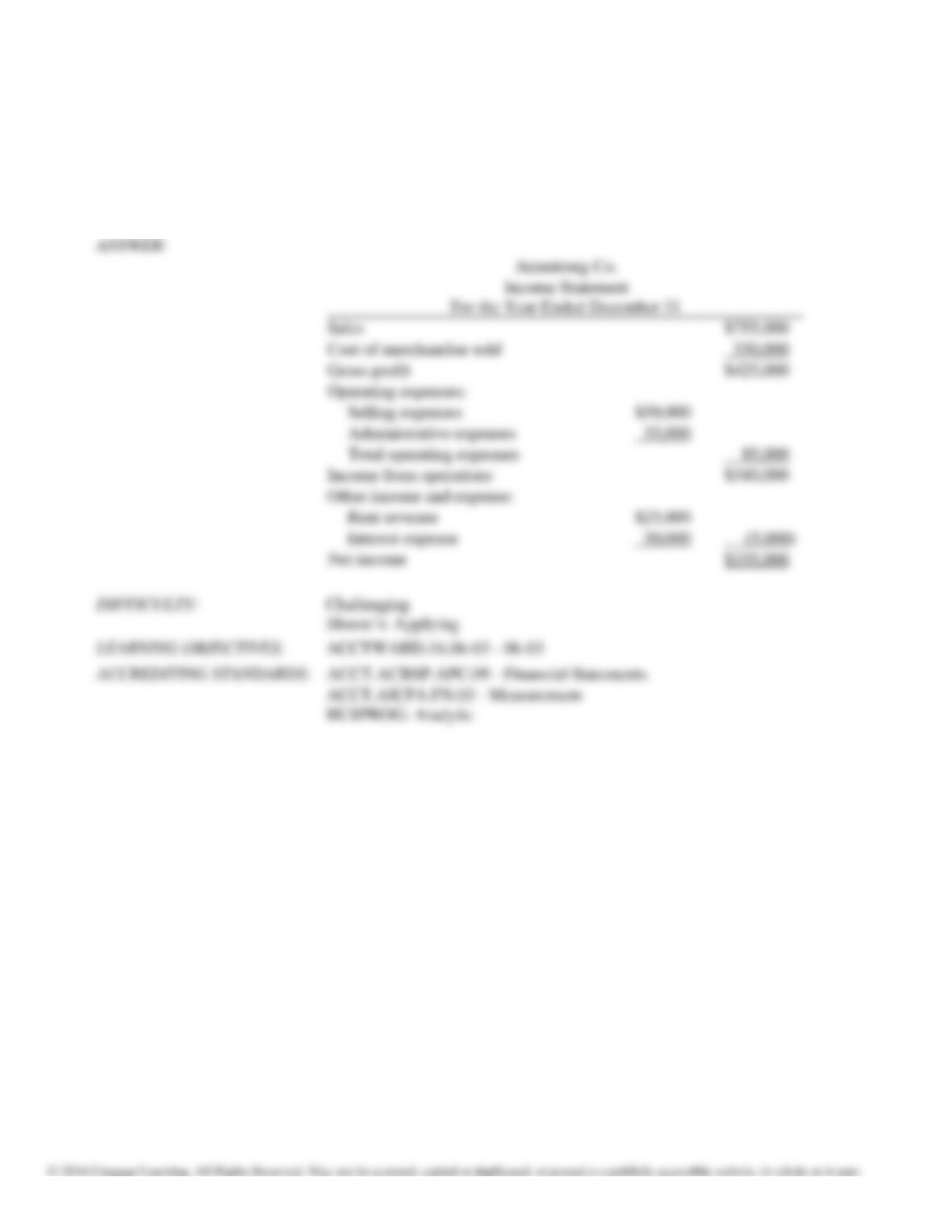
The following data were extracted from the accounting records of Dana Designs for the year ended March 31.
Merchandise inventory, April 1
$530,000
Merchandise inventory, March 31
375,000
Purchases
270,000
Purchase returns and allowances
25,000
Purchase discounts
10,000
Sales
770,000
Freight in
3,000
Prepare the cost of merchandise sold section of the income statement for the year ended March 31, using the
periodic method.
Chapter 6: Accounting for Merchandising Businesses
215.
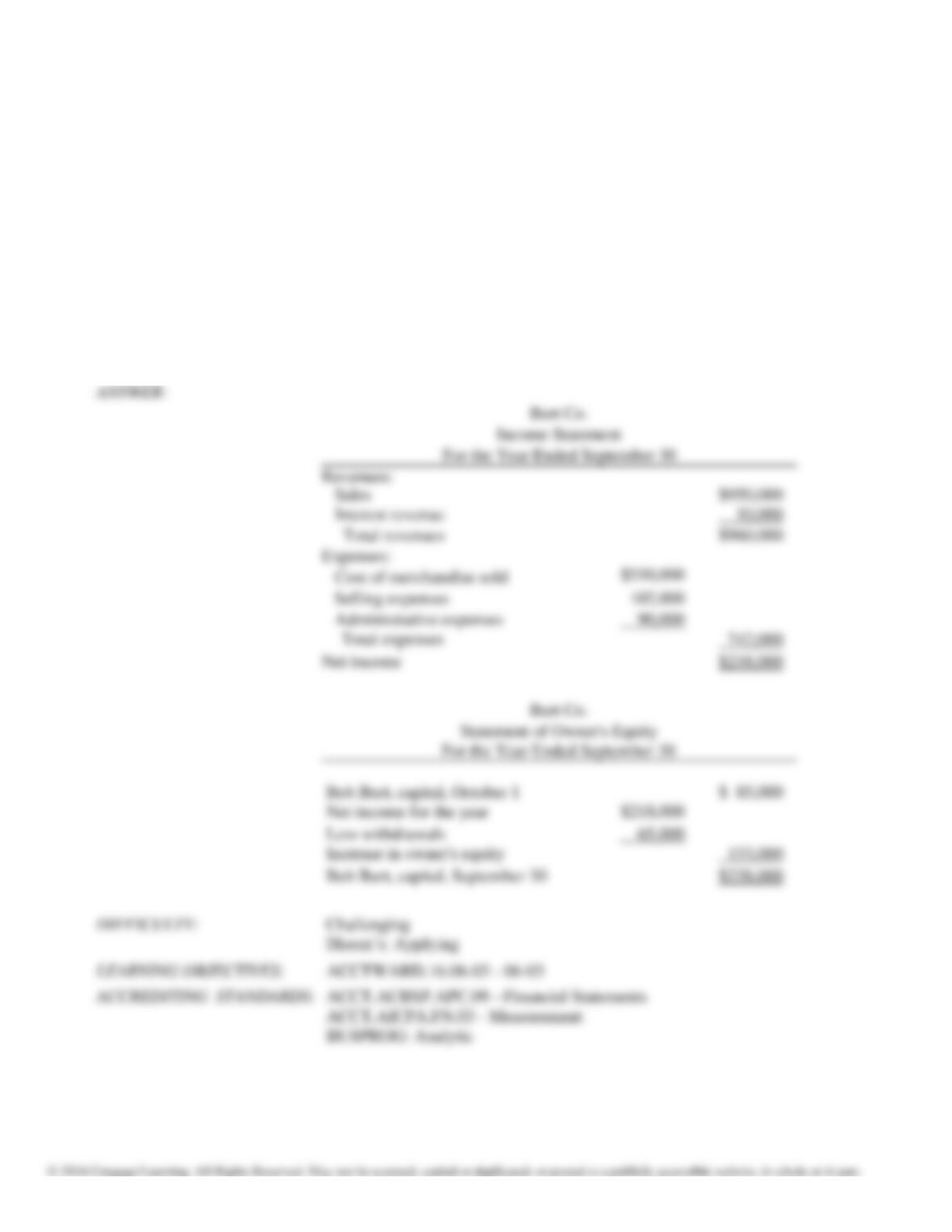
Prepare a multiple-step income statement for Armstrong Co. from the following data for the year ended December
31.
Sales, $755,000; cost of merchandise sold, $330,000; administrative expenses, $35,000; interest expense,
$30,000;
rent revenue, $25,000; selling expenses, $50,000.
Chapter 6: Accounting for Merchandising Businesses
216.
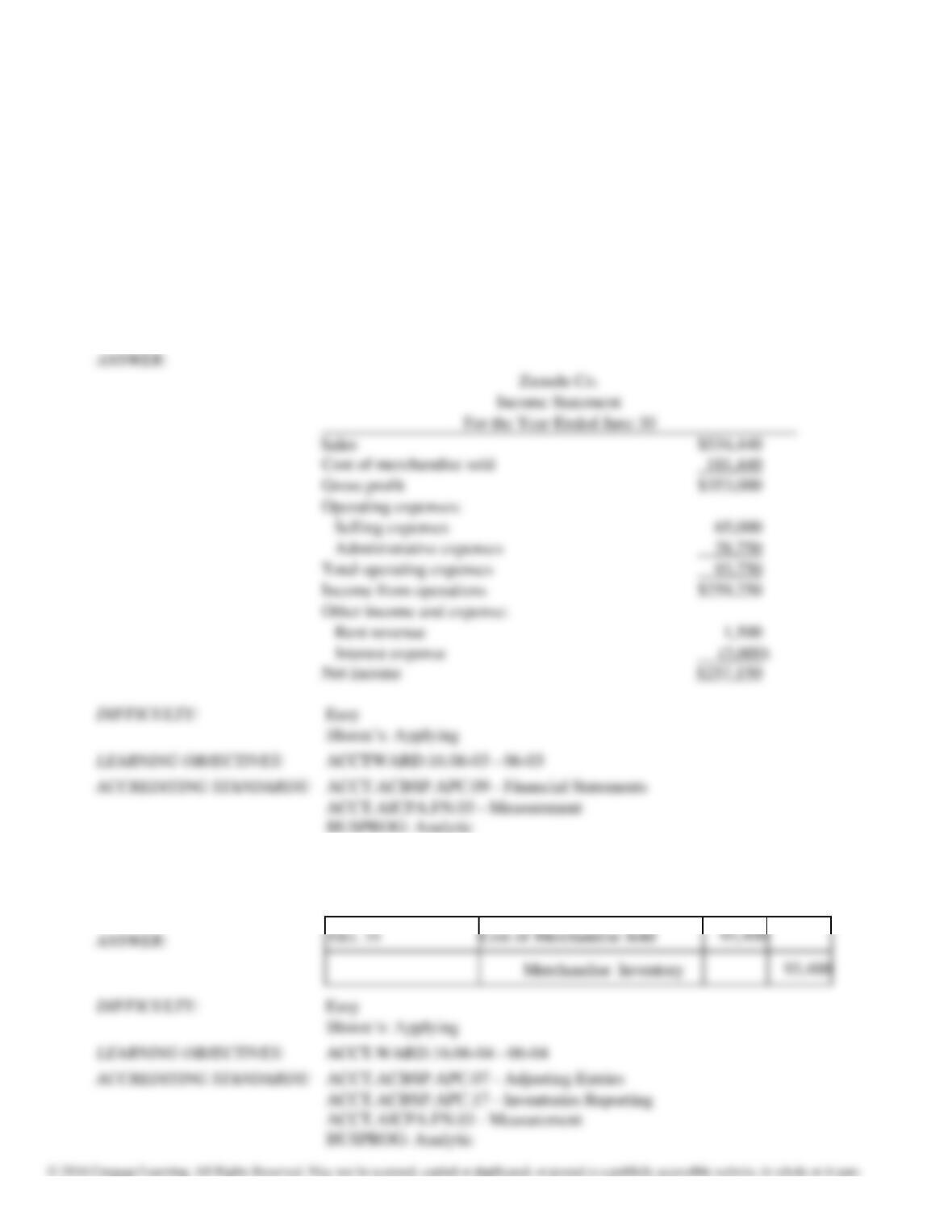
Selected data from the ledger of Burt Co., after adjustments, on September 30, the end of the fiscal year, are listed
as follows:
Accounts Receivable
$ 39,120
Office Equipment
$ 82,700
Accumulated Depreciation
60,540
Prepaid Insurance
4,680
Administrative Expenses
90,000
Note Payable
77,750
Bob Burt, Capital
85,000
Salaries Payable
3,060
Cost of Merchandise Sold
550,000
Sales
950,000
Bob Burt, Drawing
65,000
Selling Expenses
102,000
Interest Revenue
10,000
Supplies
3,125
Prepare a single-step income statement and a statement of owner’s equity.
Chapter 6: Accounting for Merchandising Businesses
217.
The following data for the current year ended June 30 are from the accounting records of Zanadu Co.:
Administrative expenses
$ 28,750
Cost of merchandise sold
181,440
Interest expense
3,600
Rent revenue
1,500
Sales
534,440
Selling expenses
65,000
Prepare a multiple-step income statement for the year ended June 30.
218.
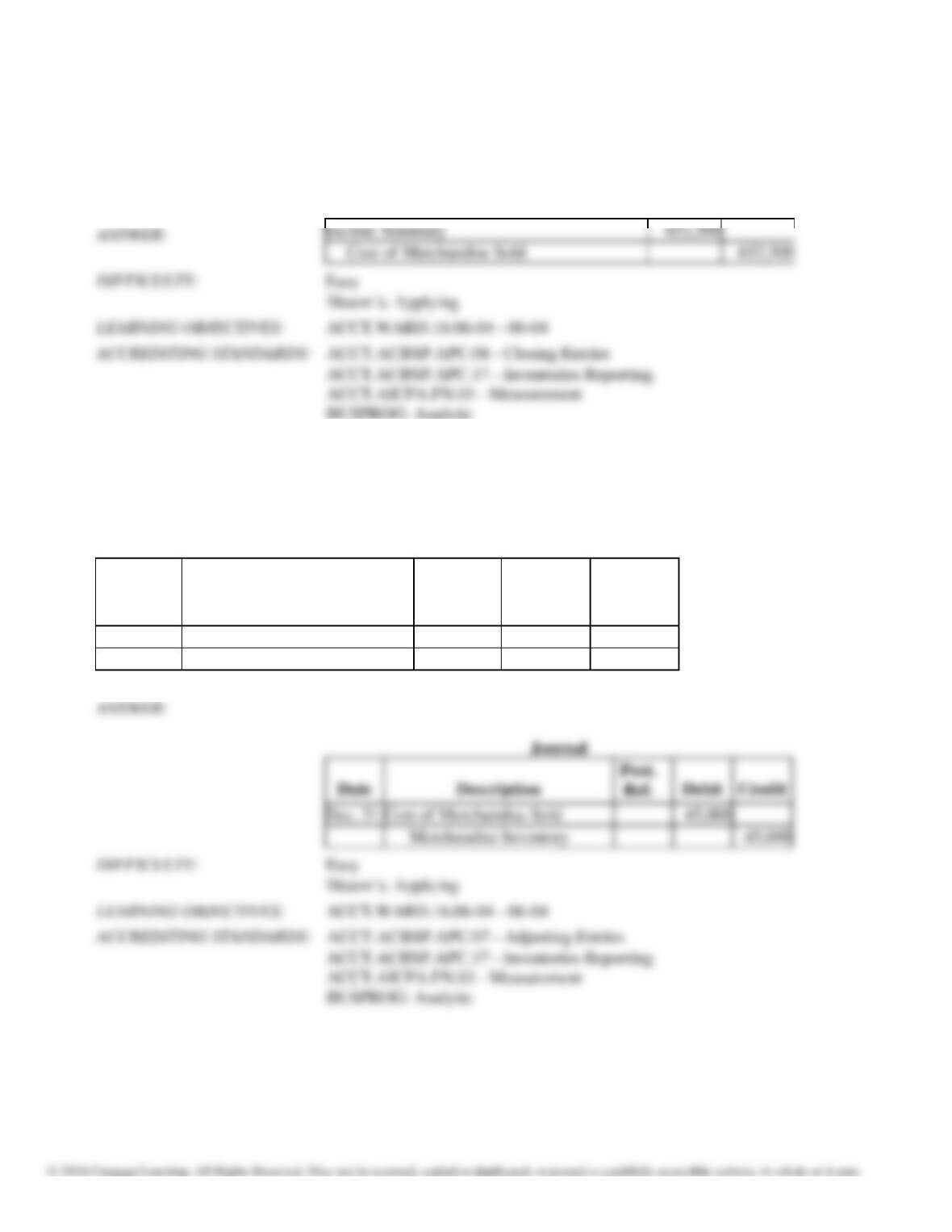
Madison Company’s perpetual inventory records indicate that $875,300 of merchandise should be on hand on
October 31. The physical inventory indicates that $781,900 is actually on hand. Journalize the adjusting entry
for
the inventory shrinkage for Madison Company for the year ended October 31.
Chapter 6: Accounting for Merchandising Businesses
219.
Selected accounts and amounts appear below. Journalize the closing entry, assuming a perpetual inventory system.
Merchandise Inventory $ 45,500
Cost of Merchandise Sold 652,500
220.
The records of Penny Co. indicated that $415,000 of merchandise should be on hand on December 31. The
physical inventory indicates that $370,000 of merchandise is actually on hand. Journalize the adjusting entry for
the
inventory shrinkage for the year ended December 31.
Journal
Date
Description
Post.
Ref.
Debit
Credit
Chapter 6: Accounting for Merchandising Businesses
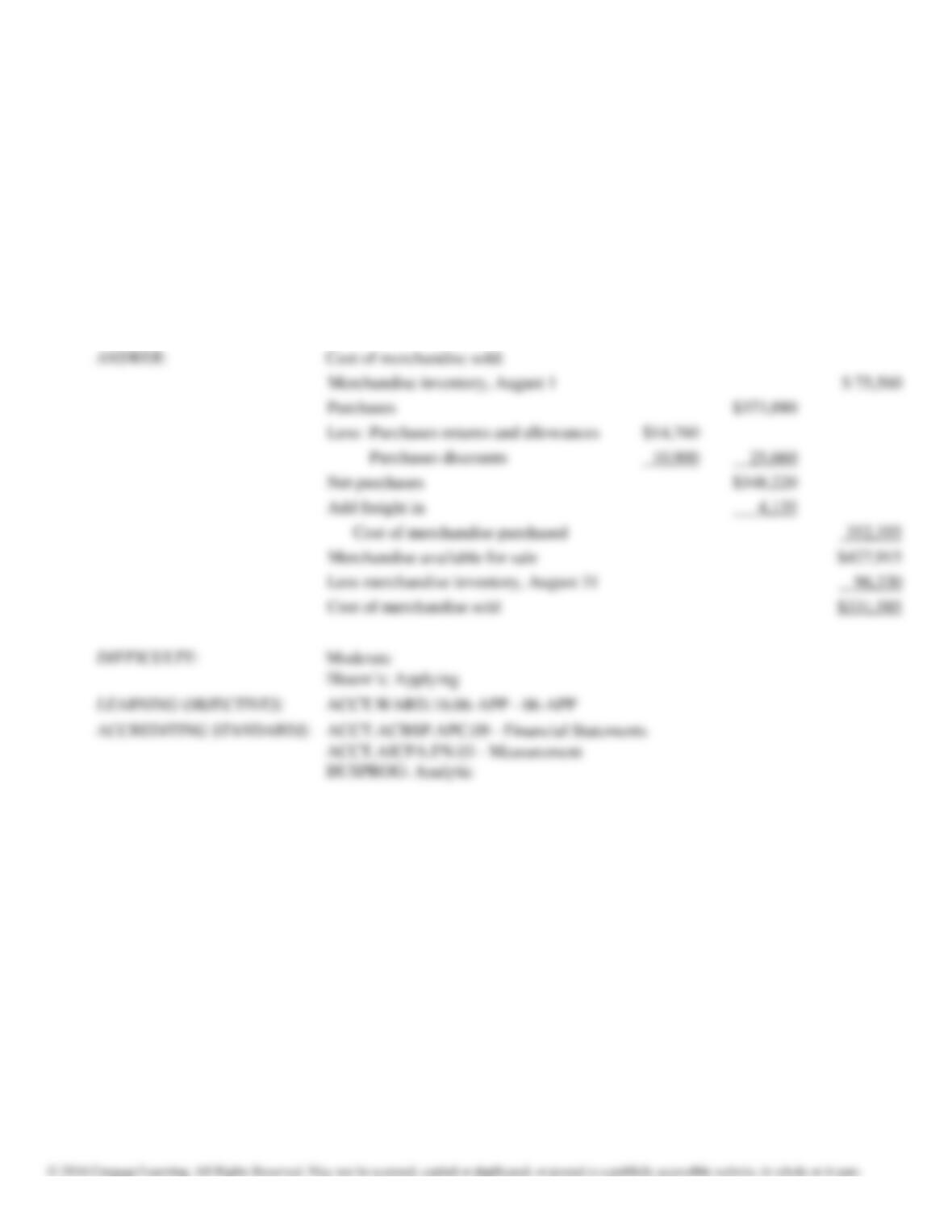
221.
Based upon the following data for a business with a periodic inventory system, determine the cost of
merchandise
sold for August.
Merchandise inventory, August 1
$ 75,560
Merchandise inventory, August 31
96,330
Purchases
373,880
Purchases returns & allowances
14,760
Purchases discounts
10,900
Freight in
4,135

Chapter 6: Accounting for Merchandising Businesses
Match each of the following items (a–h) with the appropriate definition below.
a.
Freight
b.
Delivery Expense
c.
Merchandise Inventory
d.
Sales discount
e.
Purchase Returns and Allowances
f.
Debit memo
g.
Purchase discount
h.
Trade discount
DIFFICULTY: Easy
Bloom’s: Remembering
LEARNING OBJECTIVES: ACCT.WARD.16.06-02 – 06–02
ACCT.WARD.16.06-APP – 06-APP
ACCREDITING STANDARDS: ACCT.ACBSP.APC.04 – Cash vs. Accrual
ACCT.ACBSP.APC.06 – Recording Transactions
ACCT.ACBSP.APC.07 – Adjusting Entries
ACCT.ACBSP.APC.17 – Inventories Reporting
ACCT.AICPA.FN.03 – Measurement
BUSPROG:
Analytic
222.
Discount taken by the buyer for early payment of invoice.
223.
Account used to record merchandise on hand under a perpetual inventory system.
224.
Early payment discount offered to customers by the seller.
225.
Expense account for recording shipping costs paid by the seller.
226.
Discount to government agencies or customers who purchase large quantities of merchandise.
227.
Account where returned merchandise or price adjustments are recorded by the buyer under the periodic inventory
system.
Chapter 6: Accounting for Merchandising Businesses
228.
The cost associated with delivery of merchandise to the customer.
229.
Informs the seller of the reasons for the return of merchandise or the request for a price allowance.
Match each of the following terms (a–h) with the correct definition below.
a.
Credit terms
b.
FOB destination
c.
FOB shipping point
d.
Periodic inventory system
e.
Perpetual inventory system
f.
Inventory shrinkage
g.
Single-step income statement
h.
Multiple-step income statement
DIFFICULTY: Easy
Bloom’s: Remembering
LEARNING OBJECTIVES: ACCT.WARD.16.06-02 – 06–02
ACCT.WARD.16.06-04 – 06–04
ACCT.WARD.16.06-APP – 06-APP
ACCTWARD.16.06–03 – 06–03
ACCREDITING STANDARDS: ACCT.ACBSP.APC.04 – Cash vs. Accrual
ACCT.ACBSP.APC.09 – Financial Statements
ACCT.ACBSP.APC.17 – Inventories Reporting
ACCT.AICPA.FN.03 – Measurement
BUSPROG: Analytic
230.
Shipping terms where the ownership of merchandise passes to the buyer when the buyer receives the merchandise.
231.
Losses of inventory due to theft, damage, spoilage, etc. that cause the actual inventory on hand to be less than that
on record.
232.
Statement where net income is determined by deducting all expenses from all revenues.

Chapter 6: Accounting for Merchandising Businesses
233.
Payment arrangements determined by the seller as to when invoices are due and whether early payment discount is
offered.
234.
Inventory system that updates the merchandise inventory account for every purchase and sale transaction.
235.
Inventory system that updates the merchandise inventory account only at the end of the accounting period based
on
a physical count of merchandise on hand.
236.
Statement that includes subtotals for net sales, gross profit, and net operating income in determining net income.
237.
Shipping terms where the ownership of merchandise passes to the buyer when the seller delivers the
merchandise
to the freight carrier.