60. The most important determinants of sanctions include
a.
Cultural factors including nationalistic attitudes
b.
Strength of political opposition in the targeting nation
c.
The number of nations imposing sanctions
d.
All of the above
United States – BPROG: Reflective Thinking – BPROG: Analysis
Economic Sanctions
BLOOM’S: Comprehension
61. Industrial policies
a.
Require formal explicit efforts by governments
b.
May be implicit
c.
Have never been used by the U.S. government
d.
Both a and b
United States – BPROG: Reflective Thinking – BPROG: Analysis
Industrial Policies of the United States
BLOOM’S: Comprehension
62. Trade adjustment assistance policies
a.
Can resolve all workers’ challenges to free trade
b.
Attempt to share gains from free trade with disadvantaged workers
c.
Have never been used to sustain a losing business concern
d.
Are financed by state and local tax revenues
United States – BPROG: Reflective Thinking – BPROG: Analysis
United States – PA – DESC: International Trade and Fi – DESC: International Trade and
United States – BPROG: Reflective Thinking – BPROG: Analysis
General Agreement on Tariffs and Trade
63. The United States
a.
Has been a heavy user of antidumping laws to protect domestic producers
b.
Has rarely used antidumping laws to protect domestic producers
c.
Has targeted antidumping action against China, Japan, Canada, Italy, and Germany
d.
Both a and c
United States – BPROG: Reflective Thinking – BPROG: Analysis
Antidumping Duties: Protection Against Foreign Dumping
BLOOM’S: Knowledge
Figure 6.4 Japanese Market for Jetliners
64. Consider the Japanese market for jetliners as depicted in Figure 6.4. Suppose lone producer of jetliners in the world is
Boeing and Boeing faces a constant marginal cost of $20 million per jetliner. What price will Boeing charge for jetliners
in the Japanese market and how many will they sell?
a.
$20 million, 23
b.
$20 million, 46
c.
$30 million, 46
d.
$30 million, 23
Trade Promotion Authority (Fast Track Authority)
BLOOM’S: Knowledge
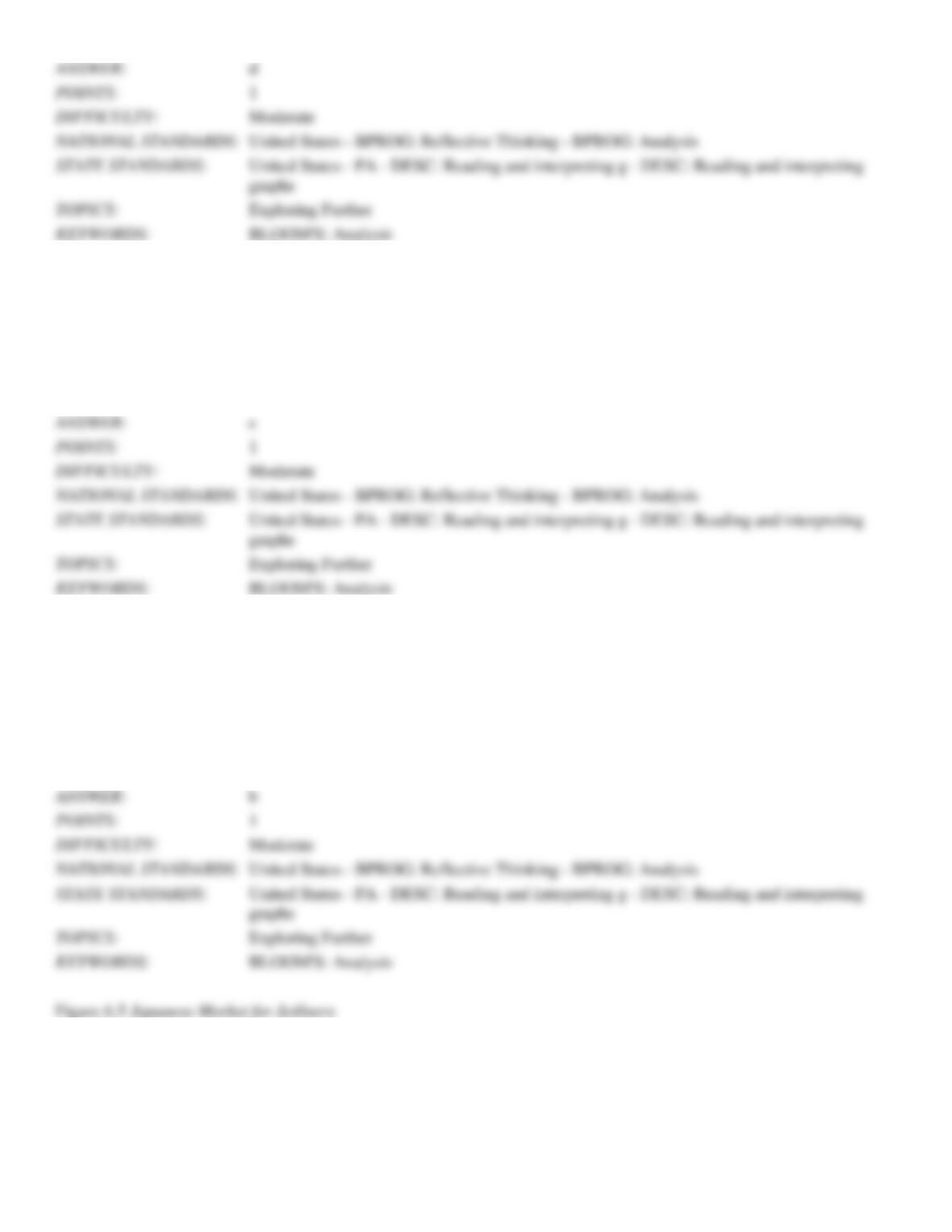
65. Consider the Japanese market for jetliners as depicted in Figure 6.4. Suppose lone producer of jetliners in the world is
Boeing and Boeing faces a constant marginal cost of $20 million per jetliner. How much profit will boeing make?
a.
0
b.
$150 million
c.
$230 million
d.
$250 million
1
NATIONAL STANDARDS:
66. Consider the Japanese market for jetliners as depicted in Figure 6.4. Suppose lone producer of jetliners in the world is
Boeing and Boeing faces a constant marginal cost of $20 million per jetliner. How much consumer surplus will the
Japanese airlines who purchase the jetliners earn from their transactions with Boeing?
a.
0
b.
$115 million
c.
$230 million
d.
$250 million
b
1
NATIONAL STANDARDS:
d
1
NATIONAL STANDARDS:
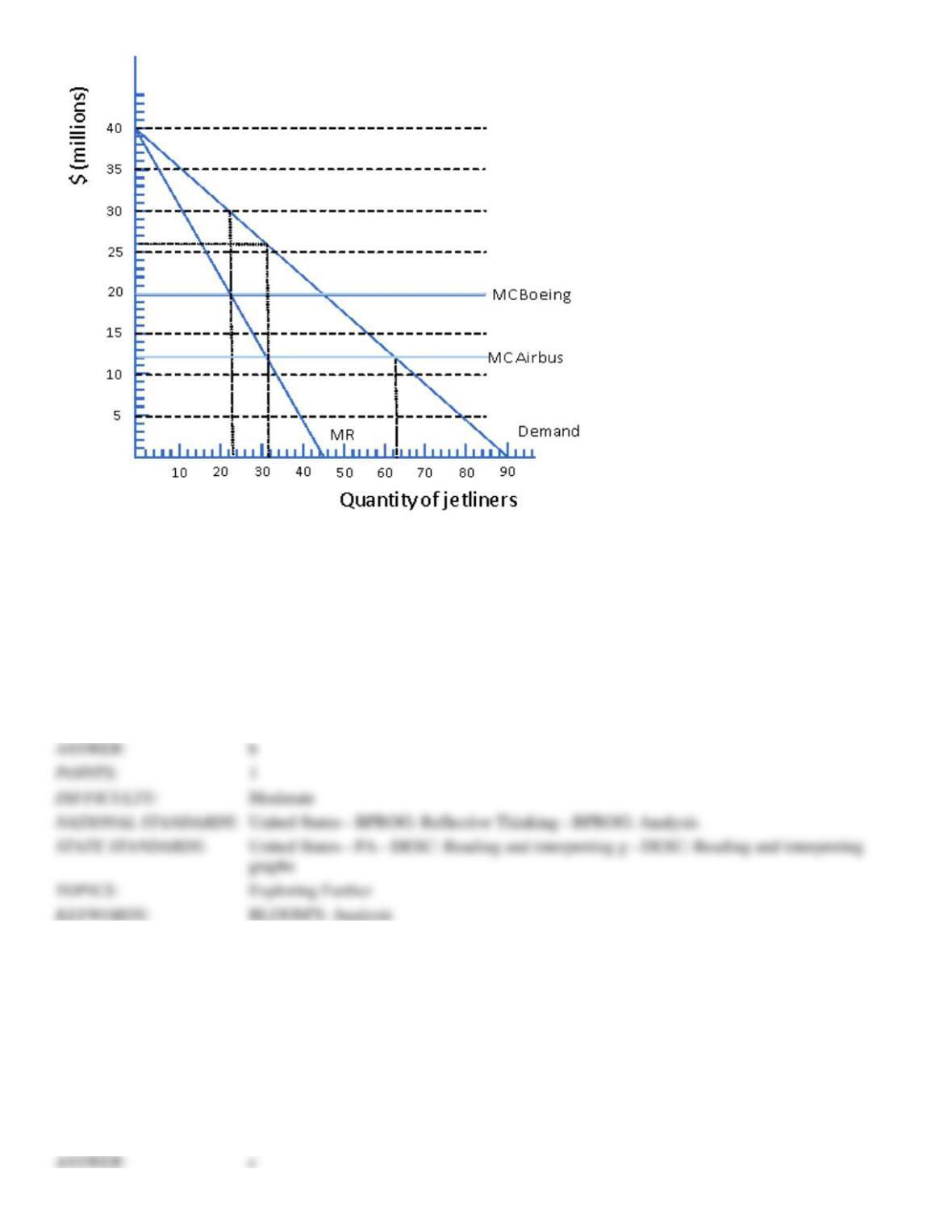
67. Consider the Japanese market for jetliners as depicted in Figure 6.5. Suppose lone producer of jetliners in the world is
Boeing and Boeing faces a constant marginal cost of $20 million per jetliner but now a European manufacturer, Airbus,
begins production. Airbus faces the same marginal cost as Boeing but the European government provides Airbus with a
subsidy of $8 million per jetliner produced. As a result of the competition, Boeing leaves the Japanese market leaving
Airbus as a monopoly. How many jetlines will airbus produce and what price will they sell them for?
a.
23, $30 million
b.
32, $26 million
c.
23, $26 million
d.
32, $30 million
68. Consider the Japanese market for jetliners as depicted in Figure 6.5. Suppose lone producer of jetliners in the world is
Boeing and Boeing faces a constant marginal cost of $20 million per jetliner but now a European manufacturer, Airbus,
begins production. Airbus faces the same marginal cost as Boeing but the European government provides Airbus with a
subsidy of $8 million per jetliner produced. As a result of the competition, Boeing leaves the Japanese market leaving
Airbus as a monopoly. How much profit will Airbus earn?
a.
$230 million
b.
$350 million
c.
$416 million
d.
$450 million
69. Consider the Japanese market for jetliners as depicted in Figure 6.5. Suppose lone producer of jetliners in the world is
Boeing and Boeing faces a constant marginal cost of $20 million per jetliner but now a European manufacturer, Airbus,
begins production. Airbus faces the same marginal cost as Boeing but the European government provides Airbus with a
subsidy of $8 million per jetliner produced. As a result of the competition, Boeing leaves the Japanese market leaving
Airbus as a monopoly. As a result of the entery of the subsidized producer what will happen to the consumer surplus
gained by Japanese airlines from buying jetliners?
a.
decrease by $109 million
b.
nothing
c.
increase by $50 million
d.
increase by $109 million
c
Moderate
United States – BPROG: Reflective Thinking – BPROG: Analysis
Exploring Further
70. The high point of U.S. protectionism occurred with the passage of the Kennedy Act in the 1960s.
a.
True
b.
False
False
Easy
United States – BPROG: Reflective Thinking – BPROG: Analysis
Smoot-Hawley Act
BLOOM’S: Knowledge
71. With the passage of the Smoot-Hawley Act in 1930, U.S. average tariffs were raised to over 50 percent on protected
imports.
a.
True
b.
False
True
Moderate
United States – BPROG: Reflective Thinking – BPROG: Analysis
Moderate
United States – BPROG: Reflective Thinking – BPROG: Analysis
Exploring Further
72. Proponents of the Smoot-Hawley Act of 1930 viewed it as a means of combating domestic unemployment.
a.
True
b.
False
True
Moderate
73. It is generally agreed that the Smoot-Hawley Act of 1930 led to improvements in U.S. exports and an overall increase
in U.S. output and employment.
a.
True
b.
False
False
Moderate
Finance
74. According to the Reciprocal Trade Agreements Act of 1934, the President could lower tariffs by up to 10 percent of
the existing level without congressional approval.
a.
True
b.
False
True
Moderate
75. Under the normal-trade-relations (most-favored-nation) principle, two nations agree to apply tariffs to each other at
rates as low as those applied to any other nation.
a.
True
b.
False
76. According to the normal-trade-relations (most-favored-nation) principle, if the United States extends MFN treatment
to China and then grants a low tariff on imports of shirts from South Korea, the United States is obligated to provide the
identical low-tariff on imports of shirts from China.
a.
True
b.
False
True
Moderate
77. U.S. tariffs on imports from countries issued normal-trade-relations (most-favored-nation) status are often three or
four times as high as those on comparable imports from nations not receiving that status.
a.
True
b.
False
True
Moderate
78. According to the General Agreement on Tariffs and Trade and its successor, the World Trade Organization, only
bilateral trade negotiations can take place between a country and its trading partners.
a.
True
b.
False
False
Moderate
True
Moderate
79. Members of the General Agreement on Tariffs and Trade and its successor, the World Trade Organization, agree to
the principle of nondiscrimination in trade and the reduction of trade barriers by multilateral negotiations.
a.
True
b.
False
Moderate
Finance
80. The Uruguay Round of trade negotiations resulted in the General Agreement on Tariffs and Trade being succeeded by
the World Trade Organization.
a.
True
b.
False
True
Moderate
81. The only members of the General Agreement on Tariffs and Trade and its successor, the World Trade Organization,
are developing countries rather than developed countries.
a.
True
b.
False
False
Moderate
82. According to the fast-track provision of U.S. trade law, once the President has completed trade negotiations, their
outcome is subject to a vote (without amendment) in Congress within 90 legislative days of submission.
a.
True
b.
False
True
83. The fast-track provision of U.S. trade law has the affect of speeding up the timetable during which the President
negotiates trade agreements with foreign governments.
a.
True
b.
False
True
Moderate
84. The main focus of the Uruguay Round of multilateral trade negotiations was on tariff barriers rather than nontariff
trade barriers.
a.
True
b.
False
False
Moderate
85. Although the Uruguay Round of multilateral trade negotiations succeeded in reducing nontariff trade barriers, it could
not achieve reductions in tariff trade barriers.
a.
True
b.
False
False
Moderate
86. Among the codes of conduct addressed at the Tokyo Round of multilateral trade negotiations were customs valuation,
Moderate
product standards, subsidies and countervailing duties, government procurement policies, and import licensing
procedures.
a.
True
b.
False
87. Under the government procurement policy of the World Trade Organization, federal-state-local governments are
prevented from discriminating in favor of the products of domestic suppliers on contracts valued at $1 million and more.
a.
True
b.
False
False
Moderate
Finance
88. Unlike the Tokyo Round of multilateral trade negotiations, the Uruguay Round addressed the issues of intellectual
property protection, trade barriers in services, and agricultural subsidies.
a.
True
b.
False
True
Moderate
89. The U.S. trade-remedy laws attempt to redress hardships for U.S. firms resulting from actions and policies of foreign
firms and governments.
a.
True
b.
False
True
Moderate
True
Moderate
90. According to U.S. trade law, the escape clause provides relief to U.S. firms due to unfair foreign competition.
a.
True
b.
False
False
Moderate
91. According to the escape clause, temporary trade restrictions may be imposed in industries where domestic producers
are substantially being harmed by surging imports.
a.
True
b.
False
True
Moderate
Finance
92. The purpose of “countervailing duties,” as levied by the domestic government, is to neutralize import tariffs imposed
by foreign governments.
a.
True
b.
False
False
Moderate
93. Under the provisions of the World Trade Organization, Canada would have the right to impose countervailing duties
on imports of South Korean steel when the South Korean government provides export subsidies to its steelmakers.
a.
True
b.
False