
Name:
Class:
Date:
chapter 6
Indicate whether the statement is true or false.
1. Bayes’ is useful in determining the value of perfect information (EVPI).
a.
True
b.
False
2. In decision trees, an end node (a triangle) indicates that the problem is completed; that is, all decisions have been
made, all uncertainty has been resolved, and all payoffs/costs have been incurred.
a.
True
b.
False
3. In decision trees, a decision node (a square) is a time when the result of an uncertain event becomes known.
a.
True
b.
False
4. In decision trees, a probability node (a circle) is a time when the decision maker makes a decision.
a.
True
b.
False
5. In general, the expected monetary values (EMV) represent possible payoffs.
a.
True
b.
False
6. In a multistage decision problem, decisions and outcomes alternate. That is, a decision maker makes a decision, then
some uncertainty is resolved, then the decision maker makes a second decision, then some further uncertainty is
resolved, and so on.
a.
True
b.
False
7. Tornado charts and spider charts can be used to determine which input variables have the most impact on the
expected value in a decision problem
a.
True
b.
False
8. In making decisions, we choose the decision with the largest expected monetary value.
a.
True
b.
False
9. A risk profile lists all possible monetary values and their corresponding probabilities.
a.
True
b.
False
10. In a single-stage decision problem, a single decision is made first, and then all uncertainty is resolved.
a.
True
b.
False
11. The expected value of perfect information (EVPI) is the most the decision maker would be willing to pay for the sample
information.
Name:
Class:
Date:
chapter 6
a.
True
b.
False
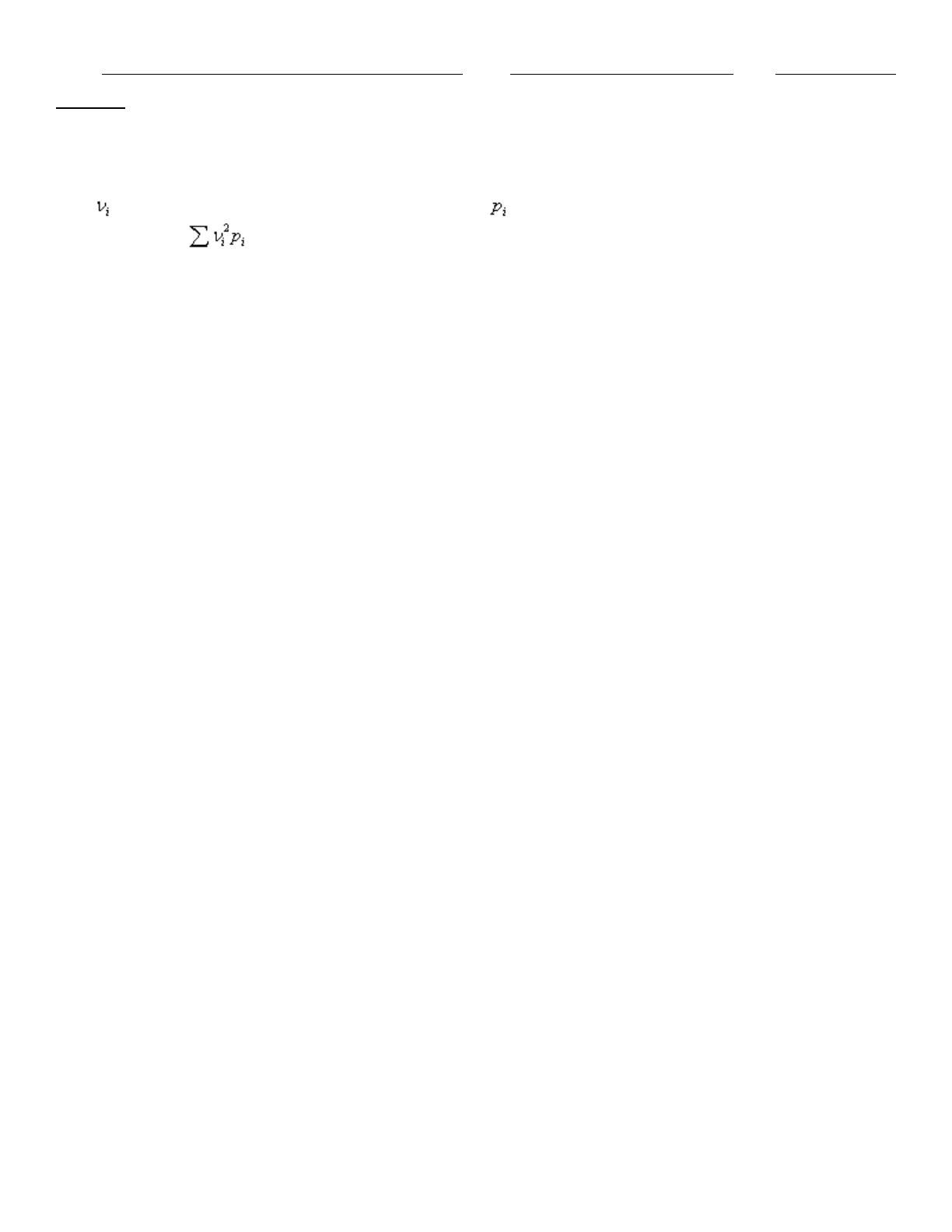
12. If is the monetary value corresponding to outcome i and is its probability, then the expected monetary value is
defined as: EMV = .
a.
True
b.
False
13. The expected value of perfect information (EVPI) is the difference between the EMV with perfect information and the
EMV with no additional information.
a.
True
b.
False
14. Utility function is a function that encodes a person’s or company’s feelings toward risk.
a.
True
b.
False
15. Prior probabilities are sometimes called likelihoods, the probabilities that are influenced by information about the
outcome of an earlier uncertainty.
a.
True
b.
False
16. Decision trees are composed of nodes (circles, squares, and triangles) and branches (lines).
a.
True
b.
False
17. For each possible decision and each possible outcome, the payoff table lists the monetary value earned by an
organization, where a positive value represents a profit and a negative value represents a loss.
a.
True
b.
False
18. The expected value of sample information (EVSI) is the difference between the EMV we can obtain with sample
information and the EMV we can obtain without information.
a.
True
b.
False
19. A spider chart shows both the range (as a percentage) of the variability of the input variables as well as the resulting
changes in the expected value
a.
True
b.
False
20. The certainty equivalent is the certain dollar amount a risk-averse decision maker would accept in order to avoid a
gamble altogether.
a.
True
b.
False
21. When you use the expected monetary value (EMV) criterion, you are not using all of the information that is shown in

Name:
Class:
Date:
chapter 6
the risk profiles of alternatives, since you are only comparing the means.
a.
True
b.
False
22. Rational decision makers are never willing to violate the expected monetary value (EMV) maximization criterion when
large amounts of money are at stake.
a.
True
b.
False
23. The expected monetary value (EMV) criterion is sometimes referred to as “playing the averages” and for that reason
should only be used for recurring decisions.
a.
True
b.
False
24. The expected value of perfect information (EVPI) is irrelevant concept since perfect information is almost never
available at any price.
a.
True
b.
False
25. For a risk averse decision maker, the certainty equivalent is less than the expected monetary value (EMV).
a.
True
b.
False
26. The slope of the lines for the input variables on a tornado chart indicates their relative impact on the expected value
a.
True
b.
False
27. A strategy region chart is useful for seeing whether the decision changes over the range of the input variable.
a.
True
b.
False
28. Bayes’ rule can be used for updating the probability of an uncertain outcome after observing the results of a test or
study.
a.
True
b.
False
Indicate the answer choice that best completes the statement or answers the question.
29. If all monetary values in a decision problem are costs, then it is customary to list them as __________ values in a cost
table.
a.
positive
b.
negative
c.
either positive or negative
d.
All of these options
30. If x is a monetary value (a payoff if positive, a cost if negative), U(x) the utility of this value, and R > 0 is an adjustable
parameter called the risk tolerance, then the function U(x) = 1 – is called
a.
Poisson utility
b.
exponential utility
c.
binomial utility
d.
normal utility

Name:
Class:
Date:
chapter 6
31. One class of “ready–made” utility functions is called exponential utility. Exponential utility has an adjustable parameter
called risk tolerance. The risk tolerance parameter measures:
a.
how much money the decision maker has to spend
b.
the decision maker’s attitude toward risk
c.
how much risk there is in a given decision
d.
the probability of an unfavorable outcome
e.
None of these options
32. The sensitivity of the expected value to changes in the input variables can be inferred from a spider chart by
observing:
a.
The height of the line above the horizontal axis for each variable
b.
The length of the line for each variable
c.
The slope of the line for each variable
d.
The color of the line for each variable
e.
None of these options
33. In decision trees, probabilities are listed on probability branches. These probabilities may be events that have already
been observed.
a.
marginal due to
b.
conditional on
c.
averaged with
d.
increased by
e.
the same as
34. Mathematically, the utility function for risk adverse individuals is said to be _____________ and/or _______________.
a.
decreasing, linear
b.
decreasing, convex
c.
increasing, linear
d.
increasing, concave
e.
increasing, decreasing
35. The preferred criterion in decision making is.
a.
maximin
b.
maximax
c.
EMV
d.
None of these options
36. The expected value of sample information (EVSI) is equal to:
a.
EMV with posterior information – EMV with prior information
b.
EMV with free perfect information – EMV free information
c.
EMV with perfect information – EMV without information
d.
EMV with free information – EMV without information
e.
None of these options
37. With regard to decision making, most individuals are __________________.
a.
risk averse
b.
risk seekers

Name:
Class:
Date:
chapter 6
c.
risk maximizers
d.
EMV maximizers
e.
None of these options
38. Which of the following can be obtained with a tornado chart?
a.
The absolute change in expected value resulting from the change in each input variable
b.
The percent change in expected value resulting from the change in each input variable
c.
A ranking of the relative sensitivity of expected value to each input variable
d.
None of these options
e.
All of these options
39. All problems related to decision making under uncertainty have three common elements:
a.
the mean, median, and mode
b.
the set of decisions, the cost of each decision and the profit that can be made from each decision
c.
the set of possible outcomes, the set of decision variables and the constraints
d.
the set of decisions, the set of possible outcomes, and a value model that prescribes results
e.
None of these options
40. Bayes’ Rule is useful for?
a.
Value of Sample Information
b.
Value of Perfect Information
c.
Sensitivity Analysis
d.
All of these options
e.
None of these options
41. Which of the following is true with regard to a good decision?
a.
It ensures that good outcomes will be obtained
b.
It accounts for unlucky outcomes
c.
It should be independent of the sequencing of uncertainties and decisions
d.
It should incorporate all information about uncertainties and alternatives
e.
All of these options
42. A risk profile lists:
a.
all possible monetary values and their corresponding probabilities
b.
all possible outcomes and their corresponding utility
c.
all options and their possible outcomes
d.
the nodes and branches for each possible outcome
e.
None of these options
43. Expected monetary value (EMV) is:
a.
the average or expected value of the decision if you knew what would happen ahead of time
b.
the weighted average of possible monetary values, weighted by their probabilities
c.
the average or expected value of the information if it was completely accurate
d.
the amount that you would lose by not picking the best alternative

Name:
Class:
Date:
chapter 6
e.
a decision criterion that places an equal amount on all states of nature
44. Which of the following statements are true?
a.
Sensitivity analysis is a process of seeing how optimal decision and EMV vary when one or more inputs vary.
b.
Multistage decision problem is one where decisions and observations of uncertain outcomes alternate.
c.
Contingency plan is a strategy in a multistage decision problem that specifies which decision to make for each
possible outcome.
d.
All of the above
e.
None of the above
45. There are three types of nodes that are used with the decision trees. They are the:
a.
mean nodes, variance nodes, and the standard deviation nodes
b.
probability nodes, risk nodes, and the expected value nodes
c.
supply nodes, demand nodes, and the expected value nodes
d.
decision nodes, probability nodes, and end nodes.
e.
horizontal nodes, vertical nodes, and the diagonal nodes
46. In a single-stage decision tree problem, all ___________ are made first and then all ___________ is (are) resolved.
a.
decisions; uncertainty
b.
calculations; probabilities
c.
EMV calculations; posterior probabilities
d.
likelihoods; posterior probabilities
e.
prior probabilities; joint probabilities
47. Which of these sensitivity analysis charts is most useful in determining whether the optimal decision changes over the
range of the input variable?
a.
Strategy region chart
b.
Tornado chart
c.
Spider chart
d.
All of these options
e.
None of these options
48. The solution procedure that was introduced in the book for decision trees is called the:
a.
folding diagram
b.
single-stage method
c.
risk profile method
d.
precision tree method
e.
folding back on the tree
49. In the nomenclature of Bayes’ Rule, which of the following are probabilities that are conditioned on information that is
obtained?
a.
Prior probabilities
b.
Posterior probabilities
c.
Marginal probabilities
d.
Objective probabilities

Name:
Class:
Date:
chapter 6
e.
Subjective probabilities
50. Utility functions are mathematical functions that transform monetary values – payoffs and costs – into
________________.
a.
expected values
b.
utility values
c.
EMV values
d.
anchor values
e.
None of the above
51. In decision trees, time:
a.
is constant
b.
proceeds from bottom to top
c.
proceeds from top to bottom
d.
proceeds from right to left
e.
proceeds from left to right
52. The expected value of perfect information (EVPI) is equal to:
a.
EMV with posterior information – EMV with prior information
b.
EMV with free perfect information – EMV with information
c.
EMV with free perfect information – EMV with no information
d.
EMV with perfect information – EMV with less than perfect information
53. A payoff table lists the monetary values (profit or loss) for each possible and each possible _______________.
a.
mean and standard deviation
b.
decision and utility
c.
decision and outcome
d.
risk profile and outcome
e.
None of these options
54. When the lines for two alternatives cross on a strategy region chart, this shows:
a.
A change in which decision alternative is optimal
b.
The point at which a decision was made
c.
The point where the rate of change in expected value is zero
d.
Resolution of the uncertainty about the input variable
e.
None of these options
An investor has $25,000 in assets and faces a difficult choice between two investments. If he invests in the first
opportunity there is a 70% chance that he will increase his assets by $75,000 and a 30% chance that he will increase his
assets by $20,000. If he invests in the second option there is a 40% chance that he will increase his assets by $150,000
and a 60% chance that he will increase his assets by $5,000.
55. (A) Construct a decision tree to help the investor make his decision. Make sure to label all decision and chance nodes
and include appropriate costs, payoffs and probabilities.

Name:
Class:
Date:
chapter 6
(B) What is the best choice for the investor? Why?
(C) Suppose that investor has an exponential utility function for final assets with a risk tolerance parameter equal to
$60,000. Which investment opportunity will he prefer in this case? What is his certainty equivalent?
Suppose that a decision maker’s risk attitude toward monetary gains or losses x given by the utility function U(x) =
56. If there is a 10% chance that one of the decision maker’s family heirlooms, valued at $5,000, will be stolen during the
next year, what is the most that she would be willing to pay each year for an insurance policy that completely covers the
potential loss of her cherished items?
The following is a payoff table giving profits for various situations:
States of Nature
A
B
C
Alternative 1
160
120
140
Alternative 2
150
140
90
Alternative 3
120
160
80
Do Nothing
0
0
0
The probabilities for states of nature A, B, and C are 0.3, 0.5, and 0.2 respectively.
57. What are the expected payoffs for the three alternatives?
Suppose that a decision maker’s risk attitude toward monetary gains or losses x given by the utility function U(x) =
58. Show that this decision maker is indifferent between gaining nothing and entering a risky situation with a gain of
$80,000 (probability 1/3) and a loss of $10,000 (probability 2/3).
The owner of a radio station in a rapidly growing community in central Texas is about to begin operations and must decide
what type of program format to offer. She is considering three formats; rock, country, and rap. The number of listeners for
a particular format will depend on the type of potential audience that is available. Income from advertising depends on the
number of listeners the station has. Three broad categories of audience type can be described as A1, A2, and A3. The
rock music format draws mainly for the A1 listener, the country music format draws mainly from the A2 listener and the
rap music format draws mainly from the A3 listener. The station owner does not know which type of audience will
dominate the community once its growth has stabilized. Probabilities have been assigned to the potential dominant
audience, based on the community growth that has already occurred in this area. Since she wants to begin building an
image now, the decision as to which format to adopt must be made in an environment of uncertainty. The station owner
has been able to construct the following payoff table, in which the entries are average monthly revenue in thousands of
dollars.
Audience
Format
A1
A2
A3
Rock
$ 110
$ 80
$ 70
Country
$ 90
$ 120
$ 50
Rap
$ 70
$ 60
$ 140
Probability
0.3
0.5
0.2
Name:
Class:
Date:
chapter 6
59. The station is most uncertain about the average monthly revenue associated with the rock format and an A1 audience.
Construct a strategy region chart for this input variable with a possible range from $85,000 to $200,000. Does the optimal
decision to select the country format change at any point in this range?
Suppose that a decision maker’s utility as a function of her wealth, x, is given by U(x) = ln x (the natural logarithm of x).
60. Is this decision maker risk averse? Explain why or why not.
Mrs. Rich has just bought a new $30,000 car. As a reasonably safe driver, she believes that there is only a 5% chance of
being in an accident in the forthcoming year. If she is involved in an accident, the damage to her new car depends on the
severity of the accident. The probability distribution for the range of possible accidents and the corresponding damage
amounts (in dollars) are shown in the table below. Mrs. Rich is trying to decide whether she is willing to pay $170 each
year for collision insurance with a $300 deductible. Note that with this type of insurance, she pays the first $300 in
damages if she causes an accident, and the insurance company pays the remainder.
Distribution of Accident Types and Corresponding Damage Amounts
Type of Accident
Conditional Probability
Damage to Car
Minor
0.60
$200
Moderate
0.20
$1,000
Serious
0.10
$4,000
Catastrophic
0.10
$30,000
61. What impact, if any, does the insurance premium cost have on her decision? Briefly explain your answer
The owner of a radio station in a rapidly growing community in central Texas is about to begin operations and must decide
what type of program format to offer. She is considering three formats; rock, country, and rap. The number of listeners for
a particular format will depend on the type of potential audience that is available. Income from advertising depends on the

Name:
Class:
Date:
chapter 6
number of listeners the station has. Three broad categories of audience type can be described as A1, A2, and A3. The
rock music format draws mainly for the A1 listener, the country music format draws mainly from the A2 listener and the
rap music format draws mainly from the A3 listener. The station owner does not know which type of audience will
dominate the community once its growth has stabilized. Probabilities have been assigned to the potential dominant
audience, based on the community growth that has already occurred in this area. Since she wants to begin building an
image now, the decision as to which format to adopt must be made in an environment of uncertainty. The station owner
has been able to construct the following payoff table, in which the entries are average monthly revenue in thousands of
dollars.
Audience
Format
A1
A2
A3
Rock
$ 110
$ 80
$ 70
Country
$ 90
$ 120
$ 50
Rap
$ 70
$ 60
$ 140
Probability
0.3
0.5
0.2
62. As the average monthly revenue associated with the rock format and an A1 audience varies between about $142,500
and $200,000, what happens to the maximum expected revenue? Briefly explain why.
A television network earns an average of $1.6 million each season from a hit program and loses an average of $400,000
each season on a program that turns out to be a flop, and of all programs picked up by this network in recent years, 25%
turn out to be hits and 75% turn out to be flops.
63. Construct a decision tree to help the television network identify the strategy that maximizes its expected profit in
responding to a newly proposed television program. Make sure to label all decision and chance nodes and include
appropriate costs, payoffs and probabilities.
The Waco Tire Company (WTC) is considering expanding production to meet possible increases in demand. WTC’s
alternatives are to construct a new plant, expand the existing plant, or do nothing in the short run. It will cost them $1
million to build a new facility and $600,000 to expand their existing facility. The market for this particular product may
expand, remain stable, or contract. ETC’s marketing department estimates the probabilities of these market outcomes as
0.30, 0.45, and 0.25, respectively. The expected revenue for each alternative is presented in the table below.
MKT expands
MKT stable
MKT contracts
Build new plant
$1,650,000
$1,000,000
$450,000
Expand plant
$1,000,000
$850,000
$450,000
Do nothing
$0
$0
$0
64. Construct a decision tree to identify the course of action that maximizes WTC’s expected profit. Make sure to label all
decision and chance nodes and include appropriate costs, payoffs and probabilities.
A television network earns an average of $1.6 million each season from a hit program and loses an average of $400,000
each season on a program that turns out to be a flop, and of all programs picked up by this network in recent years, 25%
turn out to be hits and 75% turn out to be flops.
65. What should the network do? What is their expected profit?
Southport Mining Corporation is considering a new mining venture in Indonesia. There are two uncertainties associated
with this prospect; the metallurgical properties of the ore and the net price (market price minus mining and transportation

Name:
Class:
Date:
chapter 6
costs) of the ore in the future.
The metallurgical properties of the ore would be classified as either “high grade” or “low grade”. Southport’s geologists
have estimated that there is a 70% chance that the ore will be “high grade”, and otherwise, it will be “low grade”.
Depending on the net price, both ore classifications could be commercially successful.
The anticipated net prices depended on market conditions, and also on the metallurgical properties of the ore. Southport’s
economists have simplified the continuous distribution of possible prices into a two-outcome discrete distribution (“high” or
“low” net price) for the investment analysis. The probabilities of these net prices, and the associated outcomes (in millions
of dollars), are summarized below.
High Grade metallurgy (p=0.7)
Low Grade metallurgy (p=0.3)
Prices
Probability
Outcome
Probability
Outcome
High
0.8
40
0.6
$20
Low
0.2
–$20
0.4
–$40
66. Since the core test can only sample a small part of the mine, Southport’s geologists believe it is somewhat unrealistic
to view it as a perfectly reliable test. Based on similar tests they have conducted in the past, they believe that if the
metallurgical properties of the ore are actually High Grade, then the probability that this test will return “favorable” results
is 0.95. If the metallurgical properties are Low Grade, the probability that this test will return “favorable” results is only
0.25. Otherwise, the test results will be considered “unfavorable”. Given this information, what are the posterior
probabilities that the ore will be a High Grade and Low Grade, given the core test report?
67. Should the network purchase the report if it costs $160,000?
A customer has approached a local credit union for a $20,000 1-year loan at a 10% interest rate. If the credit union does
not approve the loan application, the $20,000 will be invested in bonds that earn a 6% annual return. Without additional
information, the credit union believes that there is a 5% chance that this customer will default on the loan, assuming that
the loan is approved. If the customer defaults on the loan, the credit union will lose the $20,000.
68. Construct a decision tree to help the credit union decide whether or not to make the loan. Make sure to label all
decision and chance nodes and include appropriate costs, payoffs and probabilities.
A buyer for a large sporting goods store chain must place orders for professional footballs with the football manufacturer
six months prior to the time the footballs will be sold in the stores. The buyer must decide in November how many
footballs to order for sale during the upcoming late summer and fall months. Assume that each football costs the chain
$45. Furthermore, assume that each pair can be sold for a retail price of $90. If the footballs are still on the shelves after
next Christmas, they can be discounted and sold for $35 each. The probability distribution of consumer demand for these
footballs (in hundreds) during the upcoming season has been assessed by the market research specialists and is
presented below. Finally, assume that the sporting goods store chain must purchase the footballs in lots of 100 units.
Demand (in hundreds)
Probability
4
0.30
5
0.50
6
0.20
69. Construct a decision tree to identify the buyer’s course of action that maximizes the expected profit earned by the
chain from the purchase and subsequent sale of footballs in the coming year.
Mrs. Rich has just bought a new $30,000 car. As a reasonably safe driver, she believes that there is only a 5% chance of
being in an accident in the forthcoming year. If she is involved in an accident, the damage to her new car depends on the

Name:
Class:
Date:
chapter 6
severity of the accident. The probability distribution for the range of possible accidents and the corresponding damage
amounts (in dollars) are shown in the table below. Mrs. Rich is trying to decide whether she is willing to pay $170 each
year for collision insurance with a $300 deductible. Note that with this type of insurance, she pays the first $300 in
damages if she causes an accident, and the insurance company pays the remainder.
Distribution of Accident Types and Corresponding Damage Amounts
Type of Accident
Conditional Probability
Damage to Car
Minor
0.60
$200
Moderate
0.20
$1,000
Serious
0.10
$4,000
Catastrophic
0.10
$30,000
70. What should Mrs. Rich do? What is her expected cost in that case?
71. Formulate a payoff table that specifies the cost (in dollars) associated with each possible decision and type of
accident.
The following is a payoff table giving profits for various situations:
States of Nature
A
B
C
Alternative 1
160
120
140
Alternative 2
150
140
90
Alternative 3
120
160
80
Do Nothing
0
0
0
The probabilities for states of nature A, B, and C are 0.3, 0.5, and 0.2 respectively.
72. What else might one consider in choosing from among these alternatives?
Mrs. Rich has just bought a new $30,000 car. As a reasonably safe driver, she believes that there is only a 5% chance of
being in an accident in the forthcoming year. If she is involved in an accident, the damage to her new car depends on the
severity of the accident. The probability distribution for the range of possible accidents and the corresponding damage
amounts (in dollars) are shown in the table below. Mrs. Rich is trying to decide whether she is willing to pay $170 each
year for collision insurance with a $300 deductible. Note that with this type of insurance, she pays the first $300 in
damages if she causes an accident, and the insurance company pays the remainder.
Distribution of Accident Types and Corresponding Damage Amounts
Type of Accident
Conditional Probability
Damage to Car
Minor
0.60
$200
Moderate
0.20
$1,000
Serious
0.10
$4,000
Catastrophic
0.10
$30,000
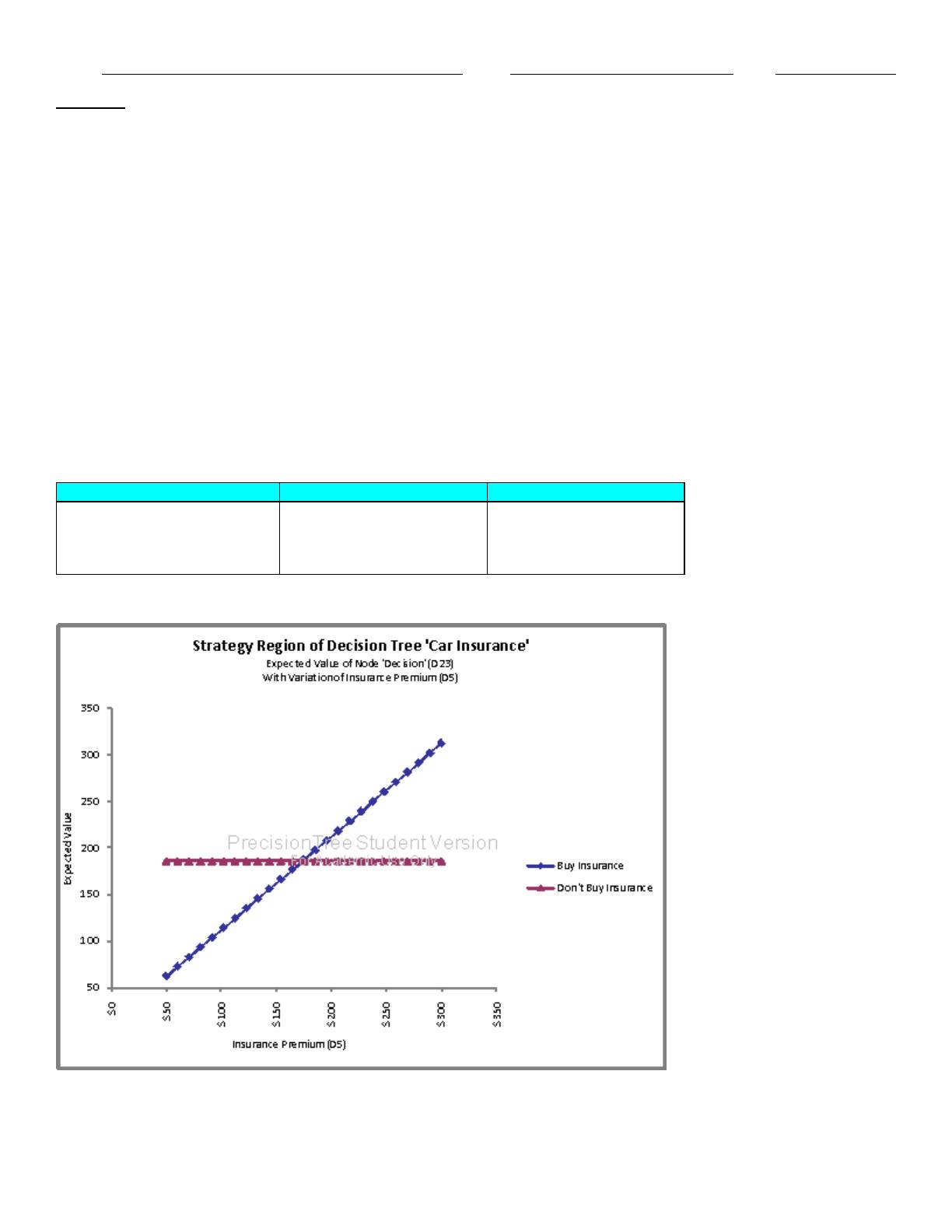
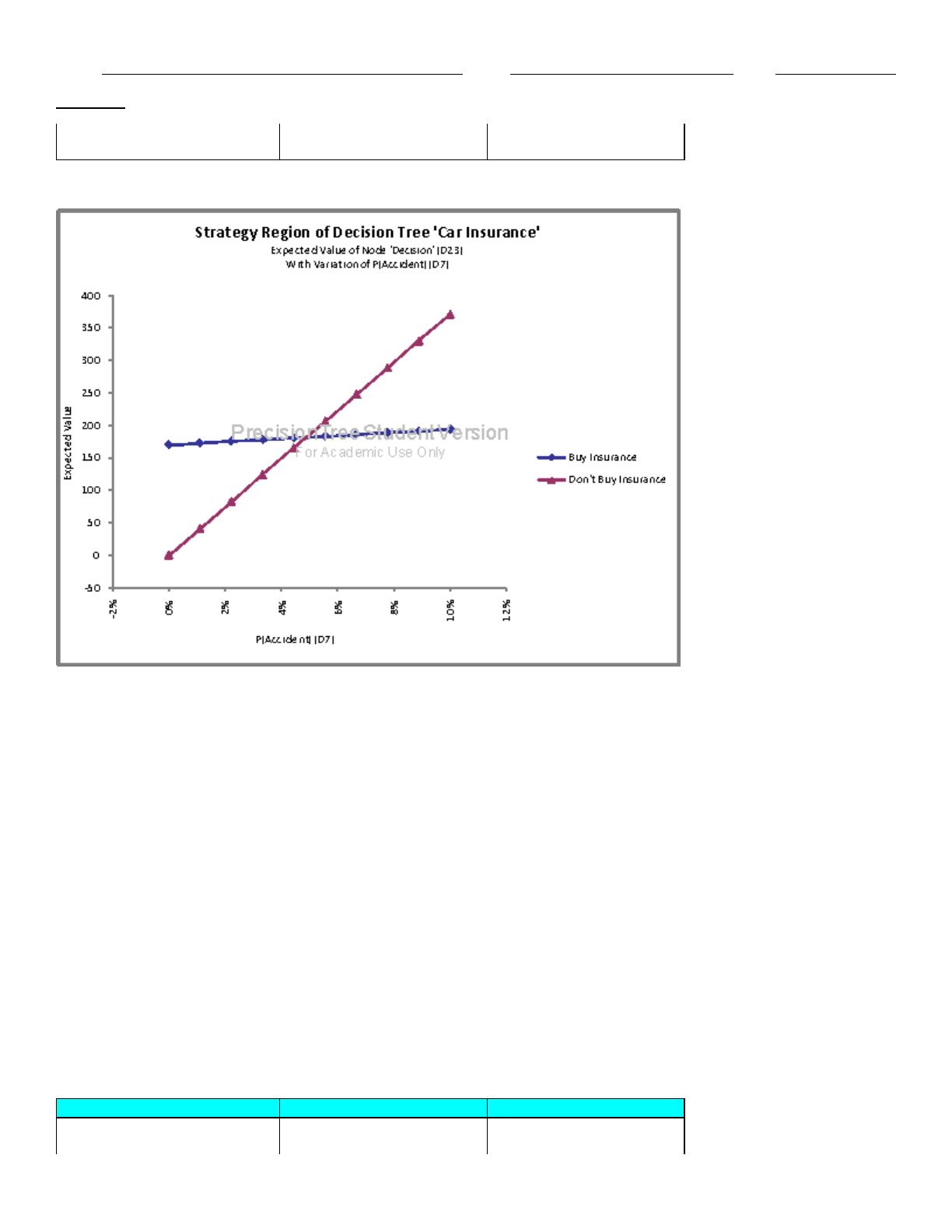
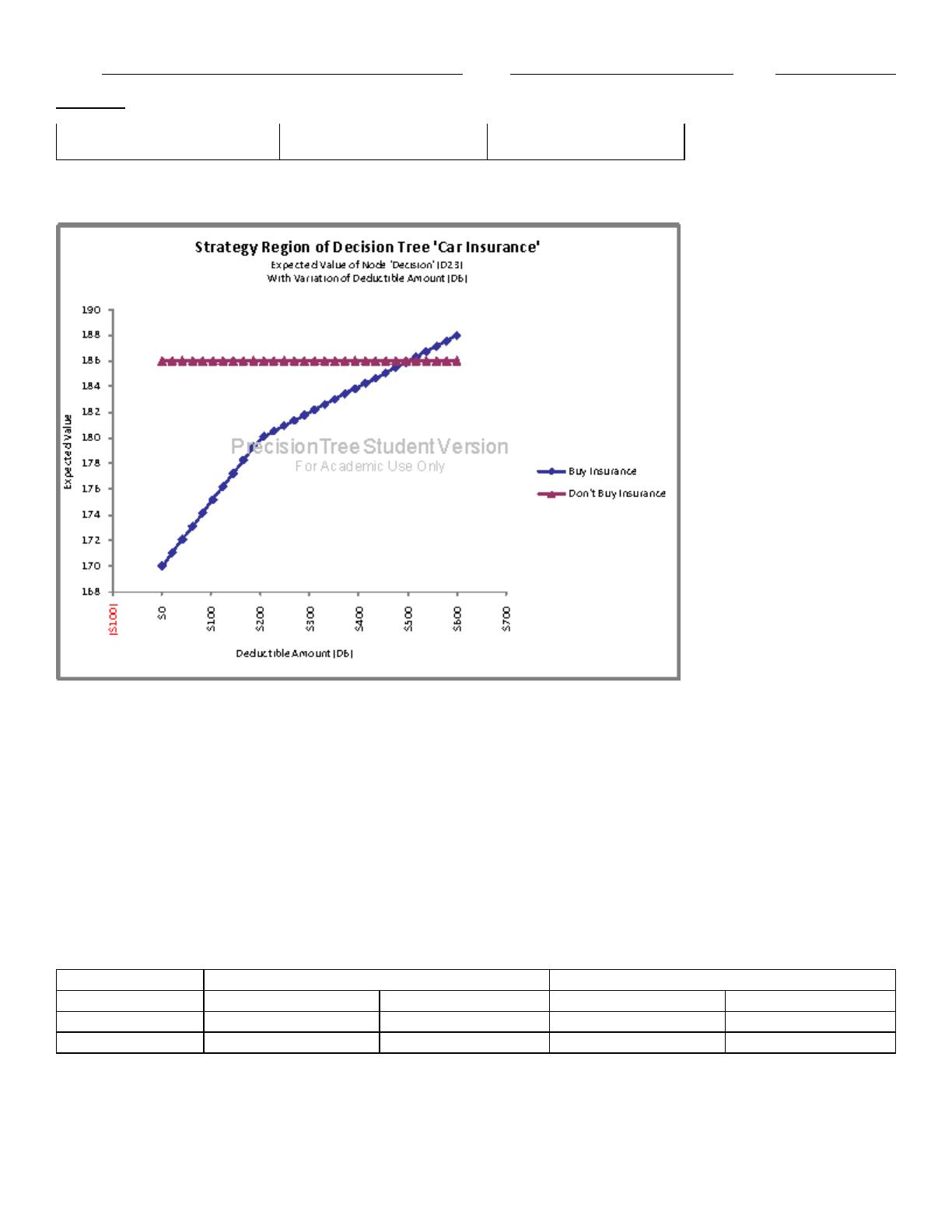
73. Perform a sensitivity analysis on the optimal decision and summarize your findings. Vary the probability of being in an
accident from 0% to 10%, the insurance premium from $50 to $300, and the deductible amount from $0 to $600. In
response to which model inputs is the expected total cost value most sensitive?

Name:
Class:
Date:
chapter 6
A customer has approached a local credit union for a $20,000 1-year loan at a 10% interest rate. If the credit union does
not approve the loan application, the $20,000 will be invested in bonds that earn a 6% annual return. Without additional
information, the credit union believes that there is a 5% chance that this customer will default on the loan, assuming that
the loan is approved. If the customer defaults on the loan, the credit union will lose the $20,000.
74. What should the credit union do? What is their expected profit?
A buyer for a large sporting goods store chain must place orders for professional footballs with the football manufacturer
six months prior to the time the footballs will be sold in the stores. The buyer must decide in November how many
footballs to order for sale during the upcoming late summer and fall months. Assume that each football costs the chain
$45. Furthermore, assume that each pair can be sold for a retail price of $90. If the footballs are still on the shelves after
next Christmas, they can be discounted and sold for $35 each. The probability distribution of consumer demand for these
footballs (in hundreds) during the upcoming season has been assessed by the market research specialists and is
presented below. Finally, assume that the sporting goods store chain must purchase the footballs in lots of 100 units.
Demand (in hundreds)
Probability
4
0.30
5
0.50
6
0.20
75. Generate a risk profile for each possible decision in this problem. Would this have any impact on your decision?
A nuclear power company is deciding whether to build a nuclear plant at Chico Canyon or at Pleasantville. The cost of
building the power plant is $14 million at Chico and $20 million at Pleasantville. If the company builds at Chico, however,
and an earthquake occurs at Chico during the next 5 years, construction will be terminated and the company will lose $14
million (and will still have to build a power plant at Pleasantville). Without further information, the company believes there
is a 20% chance that an earthquake will occur at Chico during the next 5 years.
76. (A) Construct a decision tree to help the power company decide what to do. Make sure to label all decision and
chance nodes and include appropriate costs, payoffs and probabilities.
(B) Where should the power company build the plant? What is the expected cost?
(C) Suppose that a geologist (and his team) can be hired to analyze the fault structure at Chico Canyon. He will either
predict whether an earthquake will occur or not. If the geologist is perfectly reliable, what is the most the company should
be willing to pay for his services?
(D) Suppose that an actual (not perfectly reliable) geologist can be hired to analyze the earthquake risk. The geologist’s
past record indicates that he will predict an earthquake on 90% of the occasions for which an earthquake will occur and
no earthquake on 85% of the occasions for which an earthquake will not occur. Given this information, what are the
posterior probabilities that an earthquake will and will not occur, given the geologists predictions?
(E) Should the company hire the geologist if his fee is $1.5M?
A customer has approached a local credit union for a $20,000 1-year loan at a 10% interest rate. If the credit union does
not approve the loan application, the $20,000 will be invested in bonds that earn a 6% annual return. Without additional
information, the credit union believes that there is a 5% chance that this customer will default on the loan, assuming that
the loan is approved. If the customer defaults on the loan, the credit union will lose the $20,000.
77. The bank can thoroughly investigate the customer’s credit record and obtain a favorable or unfavorable
recommendation. If the credit report is perfectly reliable, what is the most the credit union should be willing to pay for the
report?
The Waco Tire Company (WTC) is considering expanding production to meet possible increases in demand. WTC’s

Name:
Class:
Date:
chapter 6
alternatives are to construct a new plant, expand the existing plant, or do nothing in the short run. It will cost them $1
million to build a new facility and $600,000 to expand their existing facility. The market for this particular product may
expand, remain stable, or contract. ETC’s marketing department estimates the probabilities of these market outcomes as
0.30, 0.45, and 0.25, respectively. The expected revenue for each alternative is presented in the table below.
MKT expands
MKT stable
MKT contracts
Build new plant
$1,650,000
$1,000,000
$450,000
Expand plant
$1,000,000
$850,000
$450,000
Do nothing
$0
$0
$0
78. Formulate a payoff table that specifies WTC’s payoff (in dollars) associated with each possible decision and each
market condition in the future.
The owner of a radio station in a rapidly growing community in central Texas is about to begin operations and must decide
what type of program format to offer. She is considering three formats; rock, country, and rap. The number of listeners for
a particular format will depend on the type of potential audience that is available. Income from advertising depends on the
number of listeners the station has. Three broad categories of audience type can be described as A1, A2, and A3. The
rock music format draws mainly for the A1 listener, the country music format draws mainly from the A2 listener and the
rap music format draws mainly from the A3 listener. The station owner does not know which type of audience will
dominate the community once its growth has stabilized. Probabilities have been assigned to the potential dominant
audience, based on the community growth that has already occurred in this area. Since she wants to begin building an
image now, the decision as to which format to adopt must be made in an environment of uncertainty. The station owner
has been able to construct the following payoff table, in which the entries are average monthly revenue in thousands of
dollars.
Audience
Format
A1
A2
A3
Rock
$ 110
$ 80
$ 70
Country
$ 90
$ 120
$ 50
Rap
$ 70
$ 60
$ 140
Probability
0.3
0.5
0.2
79. Construct a decision tree to help the station identify its optimal format. Make sure to label all decision and chance
nodes and include appropriate costs, payoffs and probabilities.
Mrs. Rich has just bought a new $30,000 car. As a reasonably safe driver, she believes that there is only a 5% chance of
being in an accident in the forthcoming year. If she is involved in an accident, the damage to her new car depends on the
severity of the accident. The probability distribution for the range of possible accidents and the corresponding damage
amounts (in dollars) are shown in the table below. Mrs. Rich is trying to decide whether she is willing to pay $170 each
year for collision insurance with a $300 deductible. Note that with this type of insurance, she pays the first $300 in
damages if she causes an accident, and the insurance company pays the remainder.
Distribution of Accident Types and Corresponding Damage Amounts
Type of Accident
Conditional Probability
Damage to Car
Minor
0.60
$200
Moderate
0.20
$1,000
Name:
Class:
Date:
chapter 6
Serious
0.10
$4,000
Catastrophic
0.10
$30,000
80. What impact, if any, does the probability of being in an accident have on her decision? Briefly explain your answer
A customer has approached a local credit union for a $20,000 1-year loan at a 10% interest rate. If the credit union does
not approve the loan application, the $20,000 will be invested in bonds that earn a 6% annual return. Without additional
information, the credit union believes that there is a 5% chance that this customer will default on the loan, assuming that
the loan is approved. If the customer defaults on the loan, the credit union will lose the $20,000.
81. Suppose that an actual (not perfectly reliable) credit report has the following characteristics based on historical data; in
cases where the customer did not default on the approved loan, the probability of receiving a favorable recommendation
on the basis of the credit investigation was 80%, while in cases where the customer defaulted on the approved loan, the
probability of receiving a favorable recommendation on the basis of the credit investigation was 25%. Given this
information, what are the posterior probabilities that an earthquake will and will not occur, given the geologists
predictions?
Mrs. Rich has just bought a new $30,000 car. As a reasonably safe driver, she believes that there is only a 5% chance of
being in an accident in the forthcoming year. If she is involved in an accident, the damage to her new car depends on the
severity of the accident. The probability distribution for the range of possible accidents and the corresponding damage
amounts (in dollars) are shown in the table below. Mrs. Rich is trying to decide whether she is willing to pay $170 each
year for collision insurance with a $300 deductible. Note that with this type of insurance, she pays the first $300 in
damages if she causes an accident, and the insurance company pays the remainder.
Distribution of Accident Types and Corresponding Damage Amounts
Type of Accident
Conditional Probability
Damage to Car
Minor
0.60
$200
Moderate
0.20
$1,000
Name:
Class:
Date:
chapter 6
Serious
0.10
$4,000
Catastrophic
0.10
$30,000
82. What impact, if any, does the insurance deductible amount have on her decision? Briefly explain your answer
Southport Mining Corporation is considering a new mining venture in Indonesia. There are two uncertainties associated
with this prospect; the metallurgical properties of the ore and the net price (market price minus mining and transportation
costs) of the ore in the future.
The metallurgical properties of the ore would be classified as either “high grade” or “low grade”. Southport’s geologists
have estimated that there is a 70% chance that the ore will be “high grade”, and otherwise, it will be “low grade”.
Depending on the net price, both ore classifications could be commercially successful.
The anticipated net prices depended on market conditions, and also on the metallurgical properties of the ore. Southport’s
economists have simplified the continuous distribution of possible prices into a two-outcome discrete distribution (“high” or
“low” net price) for the investment analysis. The probabilities of these net prices, and the associated outcomes (in millions
of dollars), are summarized below.
High Grade metallurgy (p=0.7)
Low Grade metallurgy (p=0.3)
Prices
Probability
Outcome
Probability
Outcome
High
0.8
40
0.6
$20
Low
0.2
–$20
0.4
–$40
83. Suppose that Southport could consider another alternative – postponing the go/no-go decision on the new venture and
drilling for a core sample of the ore to determine with complete certainty its metallurgical property. How much should
Southport be willing to pay for the core sample?
A department store in a small town is in the process of budget planning and will be building a decision tree to select the

Name:
Class:
Date:
chapter 6
best option among its available marketing channels. To estimate the probabilities it will need, it considers a customer base
of 1500 individuals, 700 of which are women. Data shows that 240 of the women in this population earn at least $50,000
per year and 300 of the men earn at least $50,000 per year.
84. If a randomly selected individual is observed to earn at least $50,000 per year, what is the probability that this person
is a man?
Mrs. Rich has just bought a new $30,000 car. As a reasonably safe driver, she believes that there is only a 5% chance of
being in an accident in the forthcoming year. If she is involved in an accident, the damage to her new car depends on the
severity of the accident. The probability distribution for the range of possible accidents and the corresponding damage
amounts (in dollars) are shown in the table below. Mrs. Rich is trying to decide whether she is willing to pay $170 each
year for collision insurance with a $300 deductible. Note that with this type of insurance, she pays the first $300 in
damages if she causes an accident, and the insurance company pays the remainder.
Distribution of Accident Types and Corresponding Damage Amounts
Type of Accident
Conditional Probability
Damage to Car
Minor
0.60
$200
Moderate
0.20
$1,000
Serious
0.10
$4,000
Catastrophic
0.10
$30,000
85. Generate a statistical summary and risk profile for each of Mrs. Rich’s possible decisions. Does this information
impact her decision?
The Waco Tire Company (WTC) is considering expanding production to meet possible increases in demand. WTC’s
alternatives are to construct a new plant, expand the existing plant, or do nothing in the short run. It will cost them $1
million to build a new facility and $600,000 to expand their existing facility. The market for this particular product may
expand, remain stable, or contract. ETC’s marketing department estimates the probabilities of these market outcomes as
0.30, 0.45, and 0.25, respectively. The expected revenue for each alternative is presented in the table below.
MKT expands
MKT stable
MKT contracts
Build new plant
$1,650,000
$1,000,000
$450,000
Expand plant
$1,000,000
$850,000
$450,000
Do nothing
$0
$0
$0
86. Generate a risk profile for each of WTC’s possible decisions in this problem. Characterize the differences in risk for
the different options.
Mrs. Rich has just bought a new $30,000 car. As a reasonably safe driver, she believes that there is only a 5% chance of
being in an accident in the forthcoming year. If she is involved in an accident, the damage to her new car depends on the
severity of the accident. The probability distribution for the range of possible accidents and the corresponding damage
amounts (in dollars) are shown in the table below. Mrs. Rich is trying to decide whether she is willing to pay $170 each
year for collision insurance with a $300 deductible. Note that with this type of insurance, she pays the first $300 in
damages if she causes an accident, and the insurance company pays the remainder.
Distribution of Accident Types and Corresponding Damage Amounts

Name:
Class:
Date:
chapter 6
Type of Accident
Conditional Probability
Damage to Car
Minor
0.60
$200
Moderate
0.20
$1,000
Serious
0.10
$4,000
Catastrophic
0.10
$30,000
87. Construct a decision tree to help Mrs. Rich decide whether or not to purchase insurance. Note that the tree should
minimize Mrs. Rich’s annual expected total cost, including the possible insurance premium, deductible payment, and
damage payment. In your tree, make sure to label all decision and chance nodes and include appropriate costs, payoffs
and probabilities.
A recent MBA graduate is considering an offer of employment at a biotech company, where she has been offered stock
options as part of her compensation package. The options give her the right, but not the obligation, to buy 2500 shares of
stock either one year from now or two years from now at a price of $50, which is the current market price of the stock. If
the price of the stock has risen above $50 at either time, she can buy 2500 shares at $50 and then immediately sell at the
current price, thereby making a risk-free profit. On the other hand, if the price of the stock has dropped below $50, she will
not exercise the option because it is “out of the money” and she would lose money. Based on historical market
information, she estimates that the stock price in the first year will either go up by 25% from its current price, with
probability of 0.55, or it will go down by 15%, with probability of 0.45. In either case, she can exercise the options or wait
to see what will happen in the second year. If she decides to wait, the in the second year, the stock price will again go up
or down by the same amounts and with the same probabilities, starting from either the “up” or “down” price at the end of
the first year.
88. (A) Construct a decision tree to help her model her option decision making. Make sure to label all decision and chance
nodes and include appropriate costs, payoffs and probabilities.
(B) What is the optimal decision making policy regarding the options in all possible scenarios over the next two years?
(C) What is the expected value of the stock options? Ignore the time value of money (assume no discounting of future
payoffs)
(D) If her estimates of the increases/decreases or probabilities are inaccurate, could the options have a negative EMV?
Mrs. Rich has just bought a new $30,000 car. As a reasonably safe driver, she believes that there is only a 5% chance of
being in an accident in the forthcoming year. If she is involved in an accident, the damage to her new car depends on the
severity of the accident. The probability distribution for the range of possible accidents and the corresponding damage
amounts (in dollars) are shown in the table below. Mrs. Rich is trying to decide whether she is willing to pay $170 each
year for collision insurance with a $300 deductible. Note that with this type of insurance, she pays the first $300 in
damages if she causes an accident, and the insurance company pays the remainder.
Distribution of Accident Types and Corresponding Damage Amounts
Type of Accident
Conditional Probability
Damage to Car
Minor
0.60
$200
Moderate
0.20
$1,000
Serious
0.10
$4,000
Catastrophic
0.10
$30,000
89. Why is there a kink in the line for the “Buy Insurance” line in the above strategy region chart?
A construction company has obtained a contract for a highway project and will need to lease an additional road grader for
a month to fill out its equipment fleet. The company is trying to decide between two different lease options for the grader:
1) lease an older grader for $8,500, or 2) lease a newer grader for $10,000. The newer grader is still under warranty, so
the lease cost covers all repair expenses. However, the company would be responsible for any repair expenses if it leases
the older grader. The construction company’s maintenance foreman believes there is a 30% chance that there will be no

Name:
Class:
Date:
chapter 6
need for repairs with the older grader, but also thinks there is a 45% chance that some repairs ($2,000) could be needed,
and a 25% chance that significant repairs ($5,000) might be required.
90. (A) Construct a decision tree to help the company make its decision. Make sure to label all decision and chance nodes
and include appropriate costs, payoffs and probabilities.
(B) What is the best lease option? Why?
(C) Suppose the company could hire an experienced mechanic to inspect the old grader to determine the repair cost
before the company makes its final decision. If the mechanic is always correct in his assessments, what is the most the
company would pay for the inspection?
Suppose that a decision maker’s utility as a function of her wealth, x, is given by U(x) = ln x (the natural logarithm of x).
91. The decision maker now has $10,000 and two possible decisions. For Alternative 1, she loses $500 for certain
(x=$9,500). For Alternative 2, she loses $0 (x=$10,000) with probability 0.9 and loses $5,000 (x=$5,000) with probability
0.10. Which alternative maximizes the expected utility of her net wealth?
Southport Mining Corporation is considering a new mining venture in Indonesia. There are two uncertainties associated
with this prospect; the metallurgical properties of the ore and the net price (market price minus mining and transportation
costs) of the ore in the future.
The metallurgical properties of the ore would be classified as either “high grade” or “low grade”. Southport’s geologists
have estimated that there is a 70% chance that the ore will be “high grade”, and otherwise, it will be “low grade”.
Depending on the net price, both ore classifications could be commercially successful.
The anticipated net prices depended on market conditions, and also on the metallurgical properties of the ore. Southport’s
economists have simplified the continuous distribution of possible prices into a two-outcome discrete distribution (“high” or
“low” net price) for the investment analysis. The probabilities of these net prices, and the associated outcomes (in millions
of dollars), are summarized below.
High Grade metallurgy (p=0.7)
Low Grade metallurgy (p=0.3)
Prices
Probability
Outcome
Probability
Outcome
High
0.8
40
0.6
$20
Low
0.2
–$20
0.4
–$40
92. What should the Southport do? What is their expected profit?
A buyer for a large sporting goods store chain must place orders for professional footballs with the football manufacturer
six months prior to the time the footballs will be sold in the stores. The buyer must decide in November how many
footballs to order for sale during the upcoming late summer and fall months. Assume that each football costs the chain
$45. Furthermore, assume that each pair can be sold for a retail price of $90. If the footballs are still on the shelves after
next Christmas, they can be discounted and sold for $35 each. The probability distribution of consumer demand for these
footballs (in hundreds) during the upcoming season has been assessed by the market research specialists and is
presented below. Finally, assume that the sporting goods store chain must purchase the footballs in lots of 100 units.
Demand (in hundreds)
Probability
4
0.30
5
0.50
6
0.20
93. What is the optimal strategy for order quantity, and what is the expected profit in that case?

Name:
Class:
Date:
chapter 6
A customer has approached a local credit union for a $20,000 1-year loan at a 10% interest rate. If the credit union does
not approve the loan application, the $20,000 will be invested in bonds that earn a 6% annual return. Without additional
information, the credit union believes that there is a 5% chance that this customer will default on the loan, assuming that
the loan is approved. If the customer defaults on the loan, the credit union will lose the $20,000.
94. Should the credit union purchase the report if it costs $150?
The owner of a radio station in a rapidly growing community in central Texas is about to begin operations and must decide
what type of program format to offer. She is considering three formats; rock, country, and rap. The number of listeners for
a particular format will depend on the type of potential audience that is available. Income from advertising depends on the
number of listeners the station has. Three broad categories of audience type can be described as A1, A2, and A3. The
rock music format draws mainly for the A1 listener, the country music format draws mainly from the A2 listener and the
rap music format draws mainly from the A3 listener. The station owner does not know which type of audience will
dominate the community once its growth has stabilized. Probabilities have been assigned to the potential dominant
audience, based on the community growth that has already occurred in this area. Since she wants to begin building an
image now, the decision as to which format to adopt must be made in an environment of uncertainty. The station owner
has been able to construct the following payoff table, in which the entries are average monthly revenue in thousands of
dollars.
Audience
Format
A1
A2
A3
Rock
$ 110
$ 80
$ 70
Country
$ 90
$ 120
$ 50
Rap
$ 70
$ 60
$ 140
Probability
0.3
0.5
0.2
95. What format is optimal? What is the expected profit in that case?
Southport Mining Corporation is considering a new mining venture in Indonesia. There are two uncertainties associated
with this prospect; the metallurgical properties of the ore and the net price (market price minus mining and transportation
costs) of the ore in the future.
The metallurgical properties of the ore would be classified as either “high grade” or “low grade”. Southport’s geologists
have estimated that there is a 70% chance that the ore will be “high grade”, and otherwise, it will be “low grade”.
Depending on the net price, both ore classifications could be commercially successful.
The anticipated net prices depended on market conditions, and also on the metallurgical properties of the ore. Southport’s
economists have simplified the continuous distribution of possible prices into a two-outcome discrete distribution (“high” or
“low” net price) for the investment analysis. The probabilities of these net prices, and the associated outcomes (in millions
of dollars), are summarized below.
High Grade metallurgy (p=0.7)
Low Grade metallurgy (p=0.3)
Prices
Probability
Outcome
Probability
Outcome
High
0.8
40
0.6
$20
Low
0.2
–$20
0.4
–$40
96. Construct a decision tree to help Southport identify the strategy that maximizes its expected profit for this investment.
Make sure to label all decision and chance nodes and include appropriate costs, payoffs and probabilities.

Name:
Class:
Date:
chapter 6
97. Should Southport conduct the imperfect core test if it costs $250,000?
A department store in a small town is in the process of budget planning and will be building a decision tree to select the
best option among its available marketing channels. To estimate the probabilities it will need, it considers a customer base
of 1500 individuals, 700 of which are women. Data shows that 240 of the women in this population earn at least $50,000
per year and 300 of the men earn at least $50,000 per year.
98. What is the probability that a randomly selected individual from this population earns less than $50,000 per year?
A television network earns an average of $1.6 million each season from a hit program and loses an average of $400,000
each season on a program that turns out to be a flop, and of all programs picked up by this network in recent years, 25%
turn out to be hits and 75% turn out to be flops.
99. Suppose that an actual (not perfectly reliable) market research report has the following characteristics based on
historical data: if the program is actually going to be a hit, there is a 90% chance that the market researchers will predict
the program to be a hit, and if the program is actually going to be a flop, there is a 20% chance that the market
researchers will predict the program to be a hit. Given this information, what are the posterior probabilities that a show will
be a hit or a flop, given the market research report?
A department store in a small town is in the process of budget planning and will be building a decision tree to select the
best option among its available marketing channels. To estimate the probabilities it will need, it considers a customer base
of 1500 individuals, 700 of which are women. Data shows that 240 of the women in this population earn at least $50,000
per year and 300 of the men earn at least $50,000 per year.
100. If a randomly selected individual is observed to earn less than $50,000 per year, what is the probability that this
person is a woman?
The Waco Tire Company (WTC) is considering expanding production to meet possible increases in demand. WTC’s
alternatives are to construct a new plant, expand the existing plant, or do nothing in the short run. It will cost them $1
million to build a new facility and $600,000 to expand their existing facility. The market for this particular product may
expand, remain stable, or contract. ETC’s marketing department estimates the probabilities of these market outcomes as
0.30, 0.45, and 0.25, respectively. The expected revenue for each alternative is presented in the table below.
MKT expands
MKT stable
MKT contracts
Build new plant
$1,650,000
$1,000,000
$450,000
Expand plant
$1,000,000
$850,000
$450,000
Do nothing
$0
$0
$0
101. What course of action is optimal for WTC? What is the expected profit in that case?
A buyer for a large sporting goods store chain must place orders for professional footballs with the football manufacturer
six months prior to the time the footballs will be sold in the stores. The buyer must decide in November how many
footballs to order for sale during the upcoming late summer and fall months. Assume that each football costs the chain
$45. Furthermore, assume that each pair can be sold for a retail price of $90. If the footballs are still on the shelves after
next Christmas, they can be discounted and sold for $35 each. The probability distribution of consumer demand for these
footballs (in hundreds) during the upcoming season has been assessed by the market research specialists and is
presented below. Finally, assume that the sporting goods store chain must purchase the footballs in lots of 100 units.
Demand (in hundreds)
Probability

Name:
Class:
Date:
chapter 6
4
0.30
5
0.50
6
0.20
102. Formulate a payoff table that specifies the contribution to profit (in dollars) from the sales of footballs by this chain for
each possible purchase decision (in hundreds of pairs) and each outcome with respect to consumer demand.
The owner of a radio station in a rapidly growing community in central Texas is about to begin operations and must decide
what type of program format to offer. She is considering three formats; rock, country, and rap. The number of listeners for
a particular format will depend on the type of potential audience that is available. Income from advertising depends on the
number of listeners the station has. Three broad categories of audience type can be described as A1, A2, and A3. The
rock music format draws mainly for the A1 listener, the country music format draws mainly from the A2 listener and the
rap music format draws mainly from the A3 listener. The station owner does not know which type of audience will
dominate the community once its growth has stabilized. Probabilities have been assigned to the potential dominant
audience, based on the community growth that has already occurred in this area. Since she wants to begin building an
image now, the decision as to which format to adopt must be made in an environment of uncertainty. The station owner
has been able to construct the following payoff table, in which the entries are average monthly revenue in thousands of
dollars.
Audience
Format
A1
A2
A3
Rock
$ 110
$ 80
$ 70
Country
$ 90
$ 120
$ 50
Rap
$ 70
$ 60
$ 140
Probability
0.3
0.5
0.2
103. As the average monthly revenue associated with the rock format and an A1 audience varies between $85,000 to
about $140,000, what happens to the maximum expected revenue? Briefly explain why.
104. Tyson Manufacturing (a maker of industrial products) is interested in marketing a new product. The company must
decide whether to manufacture this product essentially on its own or employ a subcontractor to manufacture it. Below are
two tables that represent the information related to the estimated probability distribution of the cost of one unit of this
product under each alternative.
Cost under “Make” alternative. Cost under “Buy” alternative.
Cost per unit
Probability
Cost per unit
Probability
$40
0.20
$40
0.15
$45
0.25
$45
0.30
$50
0.35
$50
0.40
$55
0.20
$55
0.15
Assuming that Tyson seeks to minimize the expected unit cost of manufacturing of buying the new product, should the
company make the new product or buy it from a subcontractor? Show your work.
A television network earns an average of $1.6 million each season from a hit program and loses an average of $400,000
each season on a program that turns out to be a flop, and of all programs picked up by this network in recent years, 25%
turn out to be hits and 75% turn out to be flops.

Name:
Class:
Date:
chapter 6
105. The network can conduct market research to determine whether a program will be a hit or a flop. If the market
research report is perfectly reliable, what is the most the network should be willing to pay for it?
A landowner in Texas is offered $200,000 for the exploration rights to oil on her land, along with a 25% royalty on the
future profits if oil is discovered. The landowner is also tempted to develop the field herself, believing that the interest in
her land is a good indication that oil is present. In that case, she will have to contract a local drilling company to drill an
exploratory well on her own. The cost for such a well is $750,000, which is lost forever if no oil is found. If oil is
discovered, however, the landowner expects to earn future profits of $7,500,000. Finally, the landowner estimates (with
the help of her geologist friend) the probability of finding oil on this site to be 60%.
106. (A) Construct a decision tree to help the landowner make her decision. Make sure to label all decision and chance
nodes and include appropriate costs, payoffs and probabilities.
(B) What should the landowner do? Why?
(C) Suppose the landowner is uncertain about the reliability of her geologist friend’s estimate of the probability that oil will
be found on her land. If she thinks the probability could be anywhere between 40% and 80%, would that change her
decision?
(D) Suppose that, in addition to the uncertainty about the probability of finding oil, the landowner is also uncertain about
the cost of the exploratory well (could vary +/– 25%) and the future profits (could vary +/– 50%). To which of these
variables is the expected value most sensitive?
(E) What does the risk profile show about the relative risk levels for the landowner’s two options?
(F) Suppose the landowner suspects that she may be a somewhat risk-averse decision maker, because the she doesn’t
feel there is as much of a difference between the two options as their expected values would indicate. She consults with a
decision analysis expert who asks her to decide between two hypothetical alternatives: 1) a gamble with equal
probabilities of winning an amount $X and losing an amount –$X/2, and 2) doing nothing, with a payoff of $0. The point at
which she cannot decide between 1) and 2) is when X=$1,500,000. What is her risk tolerance if she uses an exponential
utility function to model her preferences?
(G) Apply the risk tolerance given in your answer to the previous question to the landowner’s decision tree in (A). What is
the optimal decision in this case? What is the resulting certainty equivalent?
(H) If the landowner could hire an expert geologist prepare a report to help her make her decision, what is the most that
information could be worth? Assume the geologist’s information is perfectly reliable.
Suppose that a decision maker’s utility as a function of her wealth, x, is given by U(x) = ln x (the natural logarithm of x).
107. The decision maker now has $15,000 and two possible decisions. For decision 1, she loses $1,000 for certain. For
decision 2, she loses $0 with probability 0.9 and loses $4,000 with probability 0.10. Which decision maximizes the
expected utility of her net wealth?

Name:
Class:
Date:
chapter 6
Answer Key

Name:
Class:
Date:
chapter 6
Name:
Class:
Date:
chapter 6
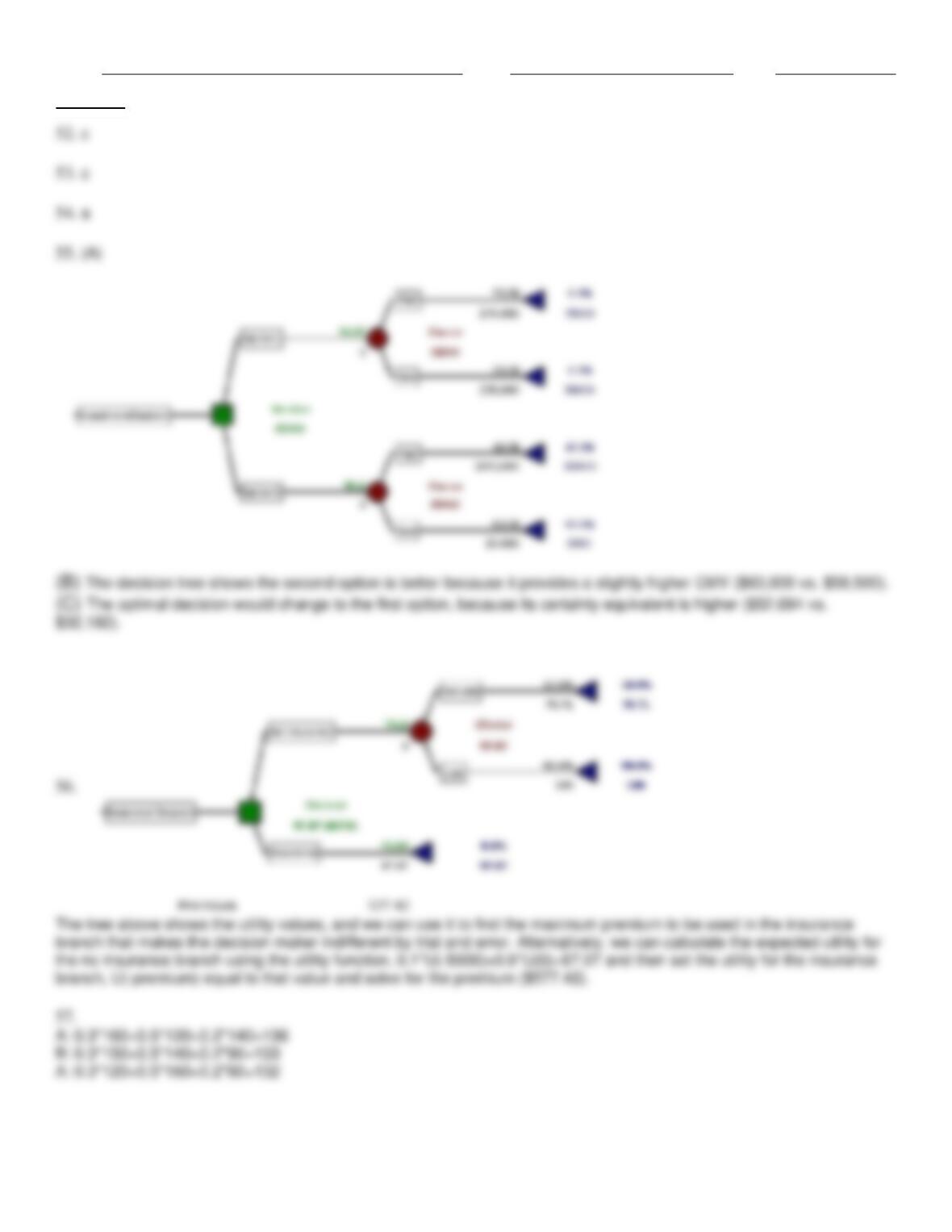
$32,182).
branch, U(-premium) equal to that value and solve for the premium ($577.42).
Name:
Class:
Date:
chapter 6
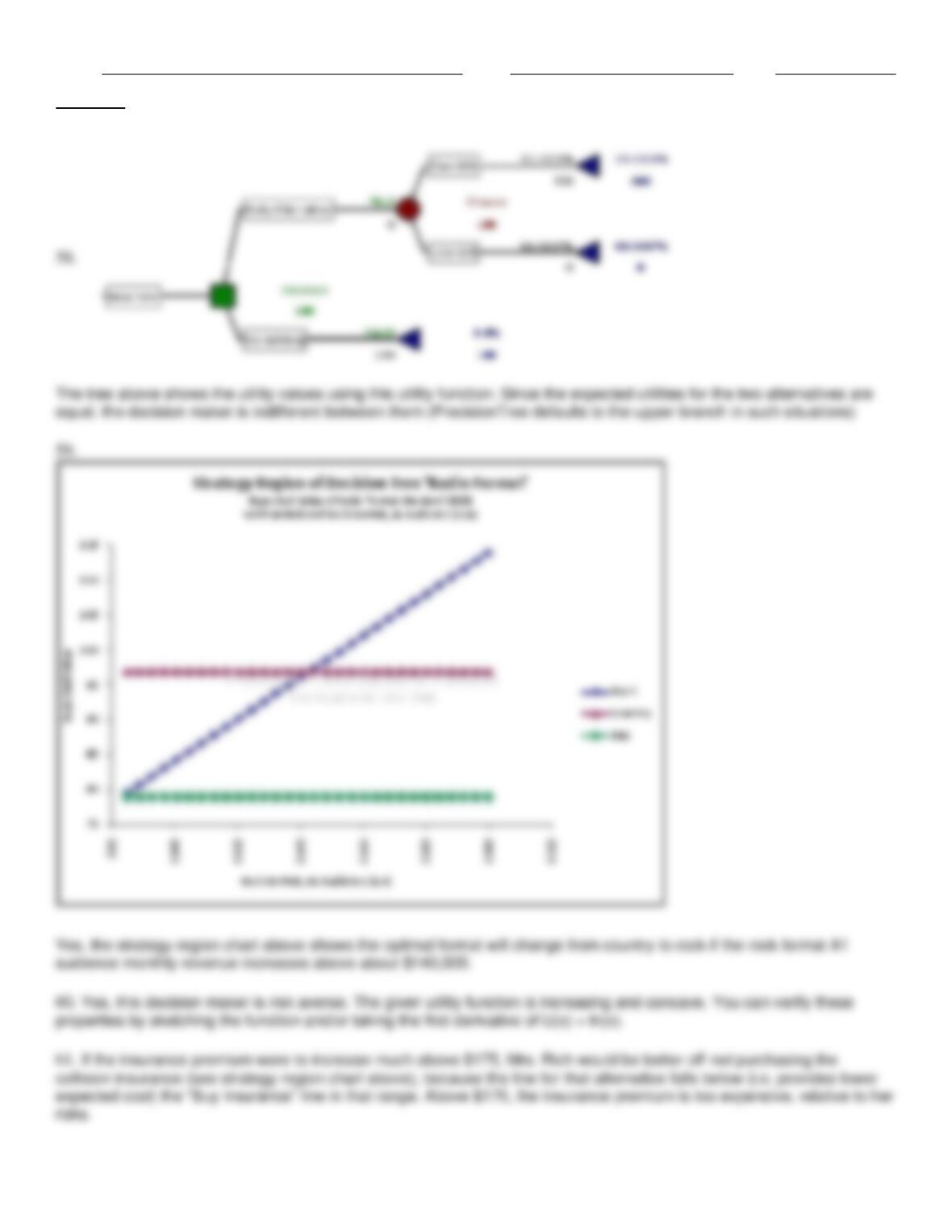
equal, the decision maker is indifferent between them (PrecisionTree defaults to the upper branch in such situations)
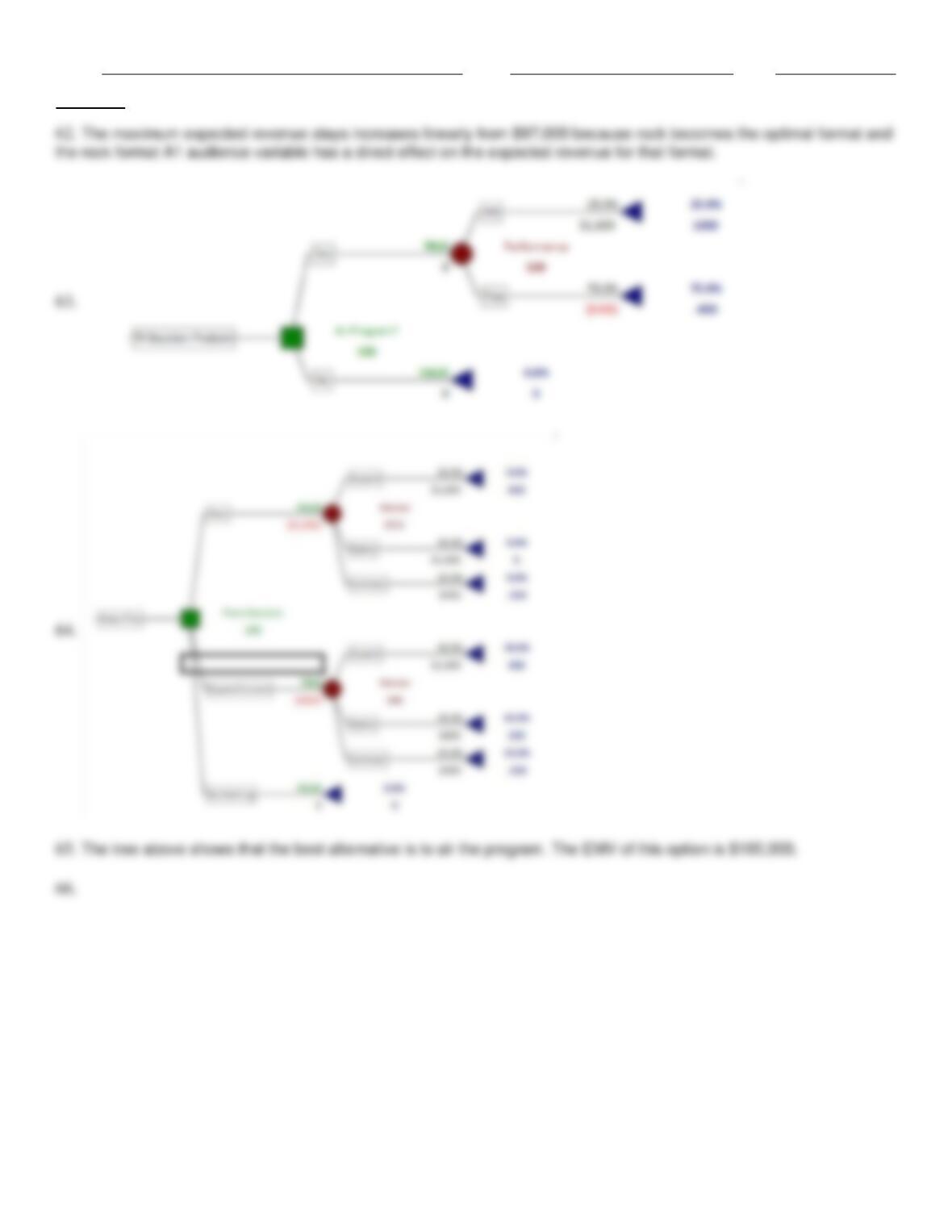
audience monthly revenue increases above about $140,000.
properties by sketching the function and/or taking the first derivative of U(x) = ln(x).
risks.
Name:
Class:
Date:
chapter 6
Name:
Class:
Date:
chapter 6
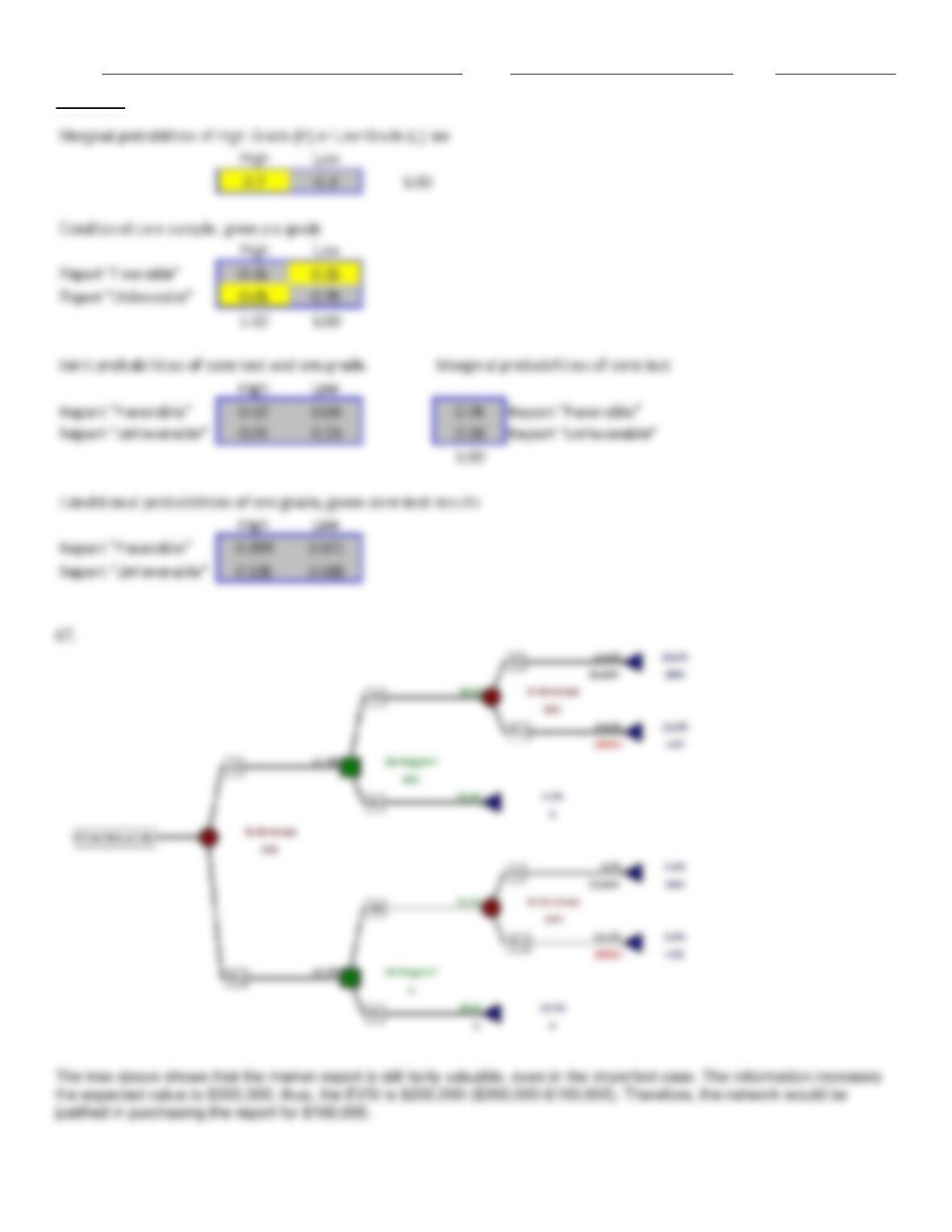
justified in purchasing the report for $160,000.
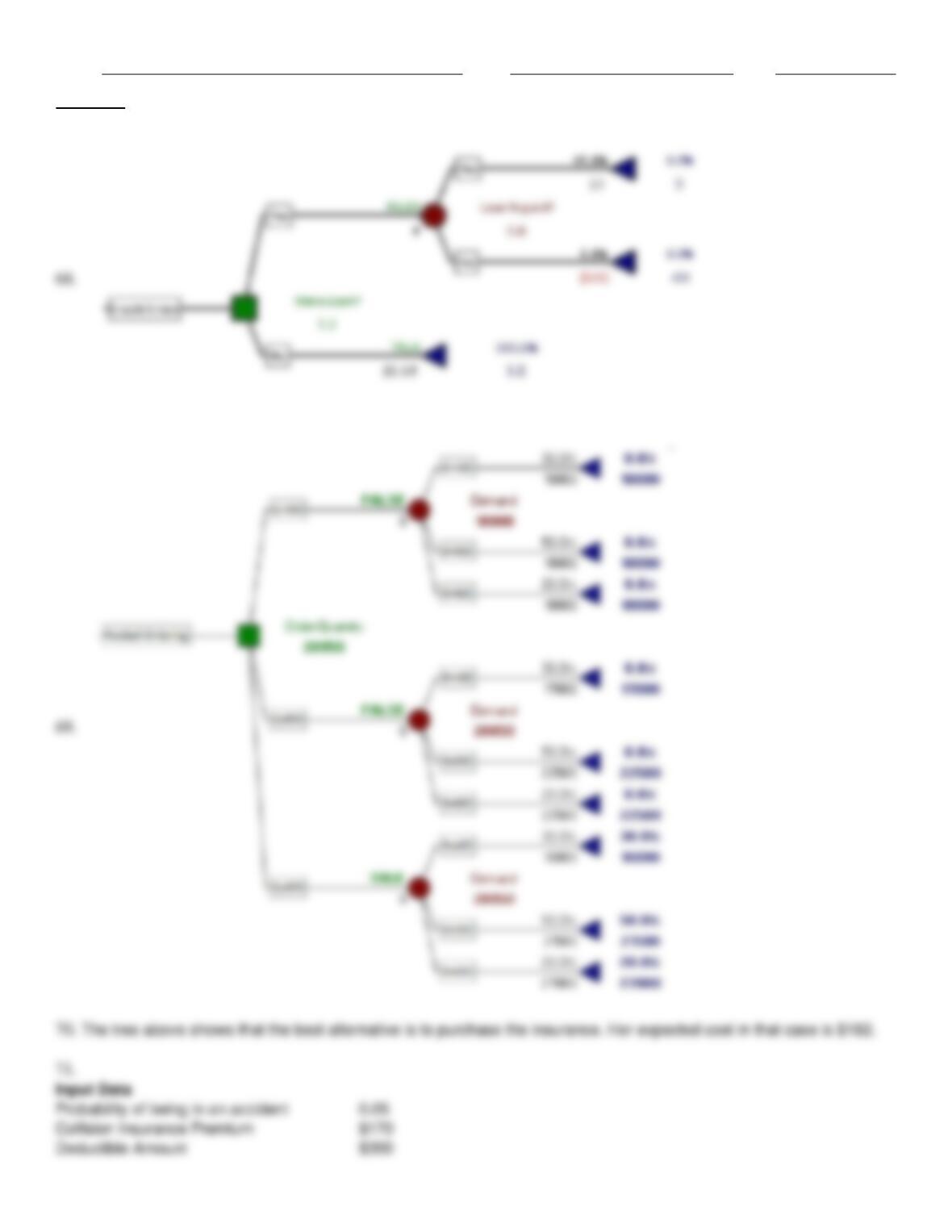
Name:
Class:
Date:
chapter 6
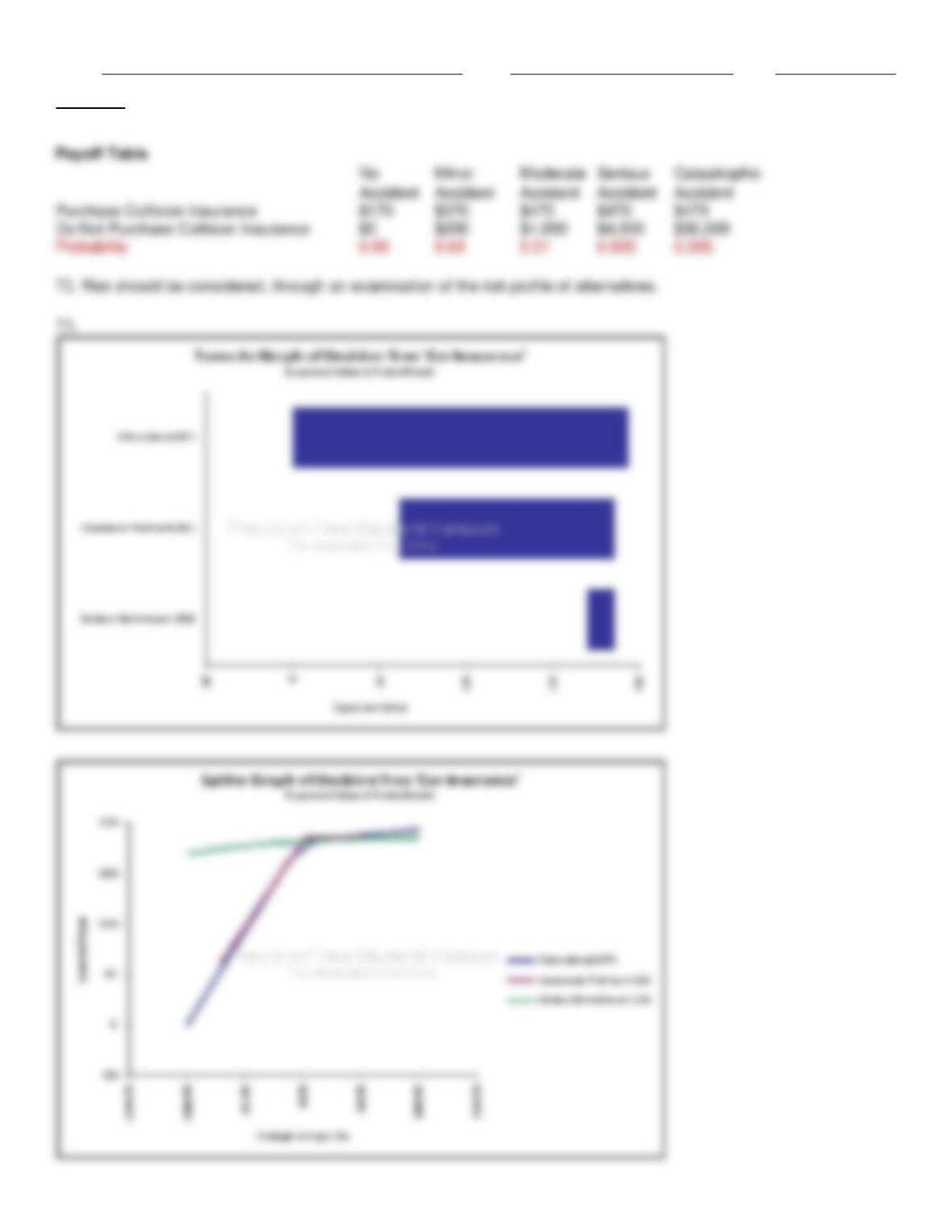
Probability of being in an accident
Collision Insurance Premium
Deductible Amount
Name:
Class:
Date:
chapter 6
Minor
Moderate
Serious
Catastrophic
Accident
Accident
Accident
Accident
Accident
Purchase Collision Insurance
$1,000
$4,000
$30,000
Name:
Class:
Date:
chapter 6
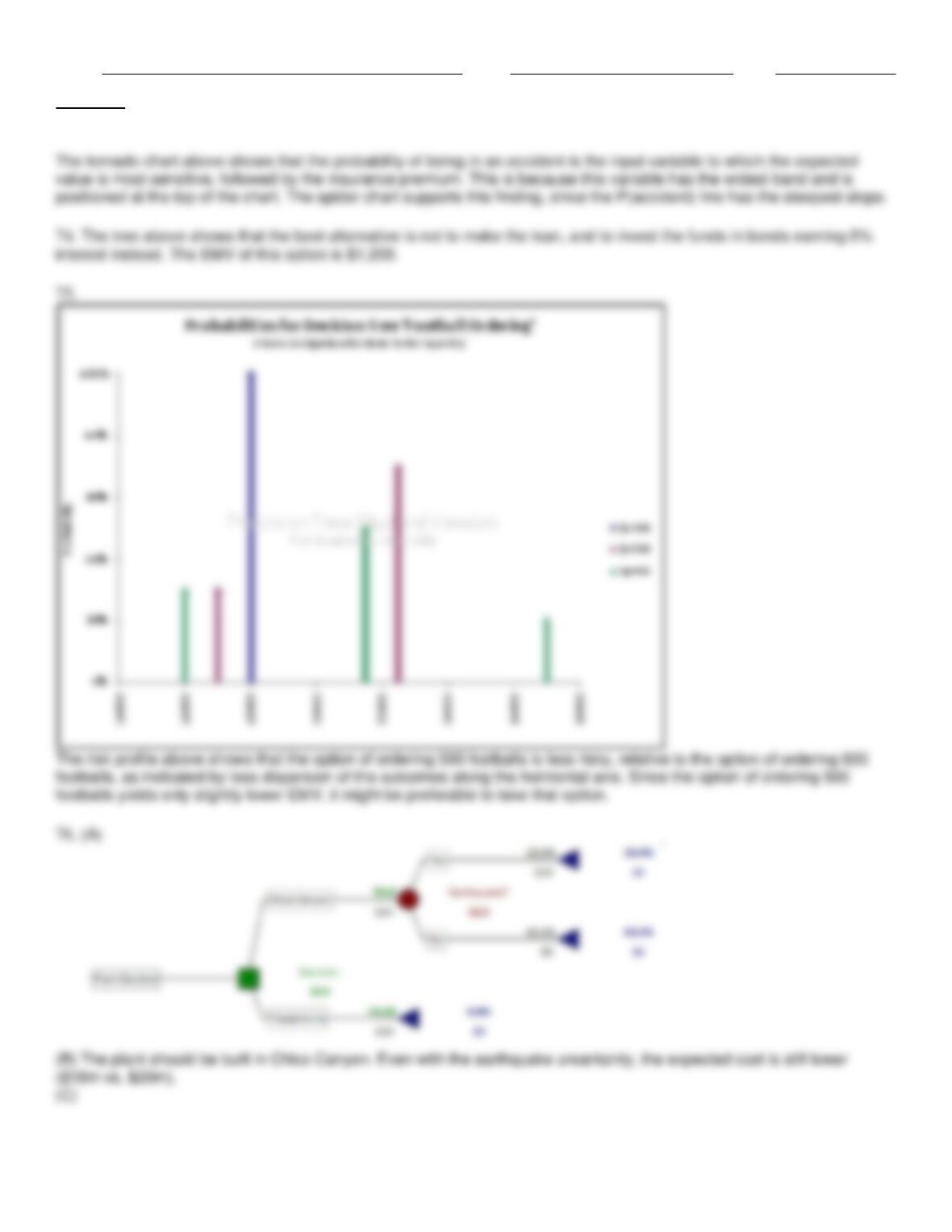
positioned at the top of the chart. The spider chart supports this finding, since the P(accident) line has the steepest slope.
interest instead. The EMV of this option is $1,200.
footballs yields only slightly lower EMV, it might be preferable to take that option.
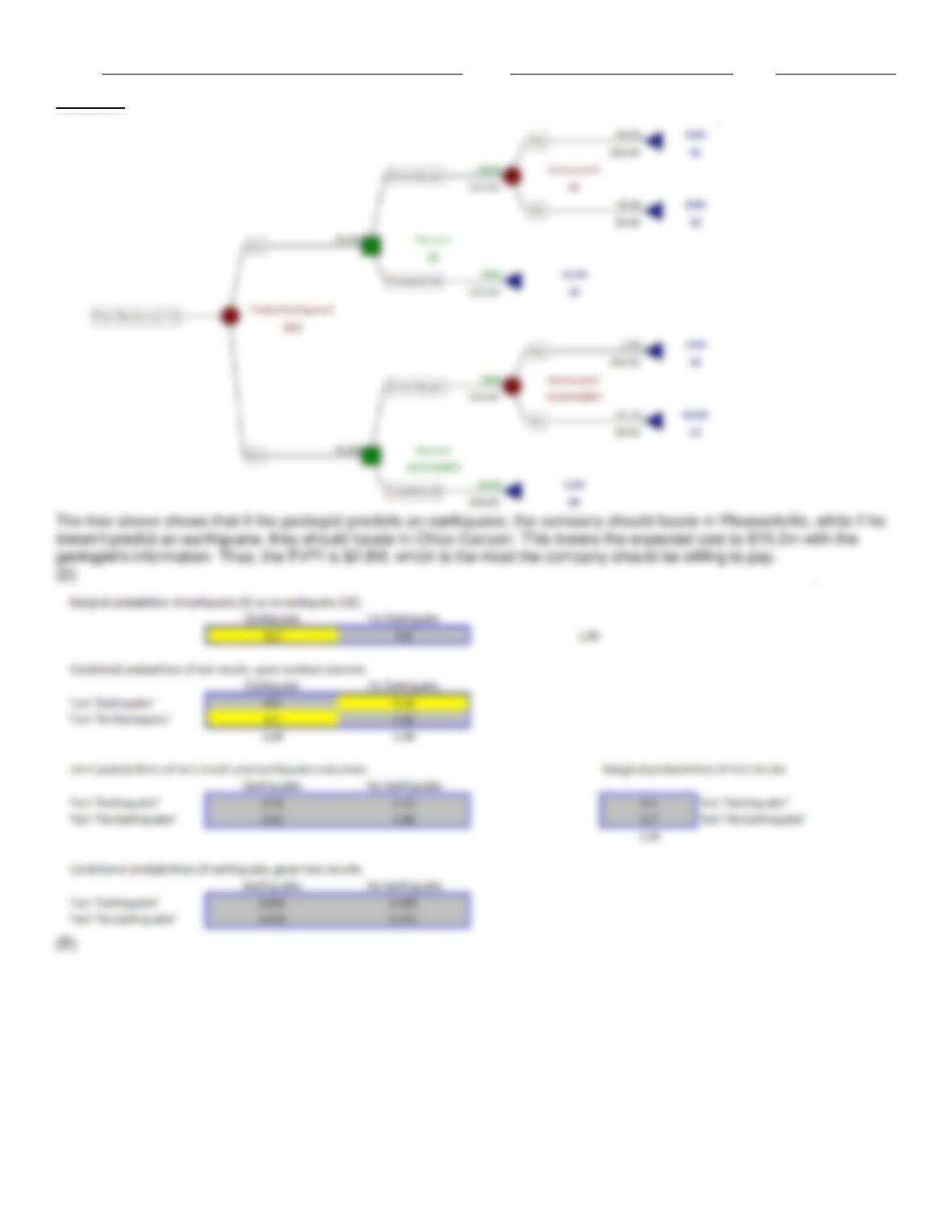
(C)
Name:
Class:
Date:
chapter 6
(E)
Name:
Class:
Date:
chapter 6
Name:
Class:
Date:
chapter 6
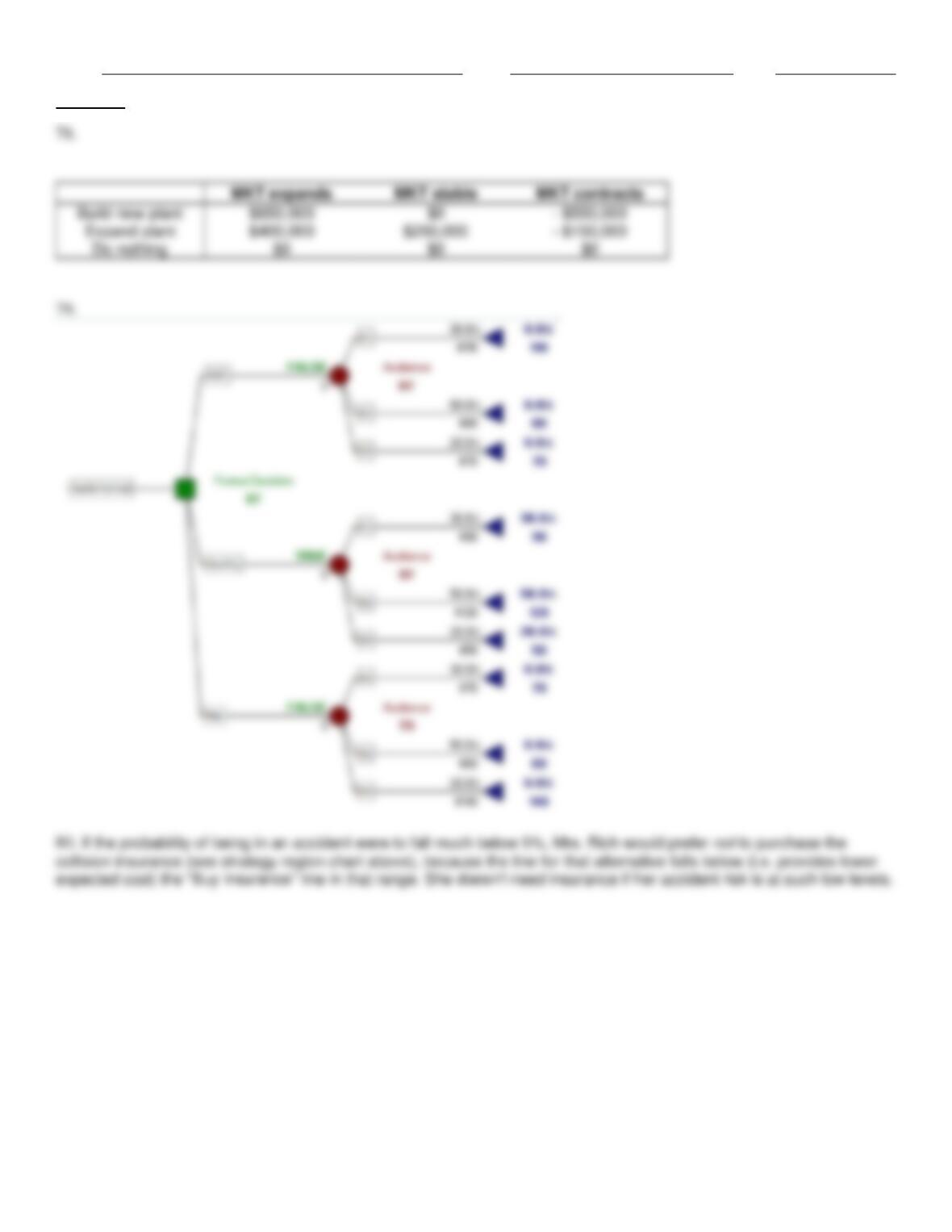
expected cost) the “Buy Insurance” line in that range. She doesn’t need insurance if her accident risk is at such low levels.
Name:
Class:
Date:
chapter 6
Name:
Class:
Date:
chapter 6
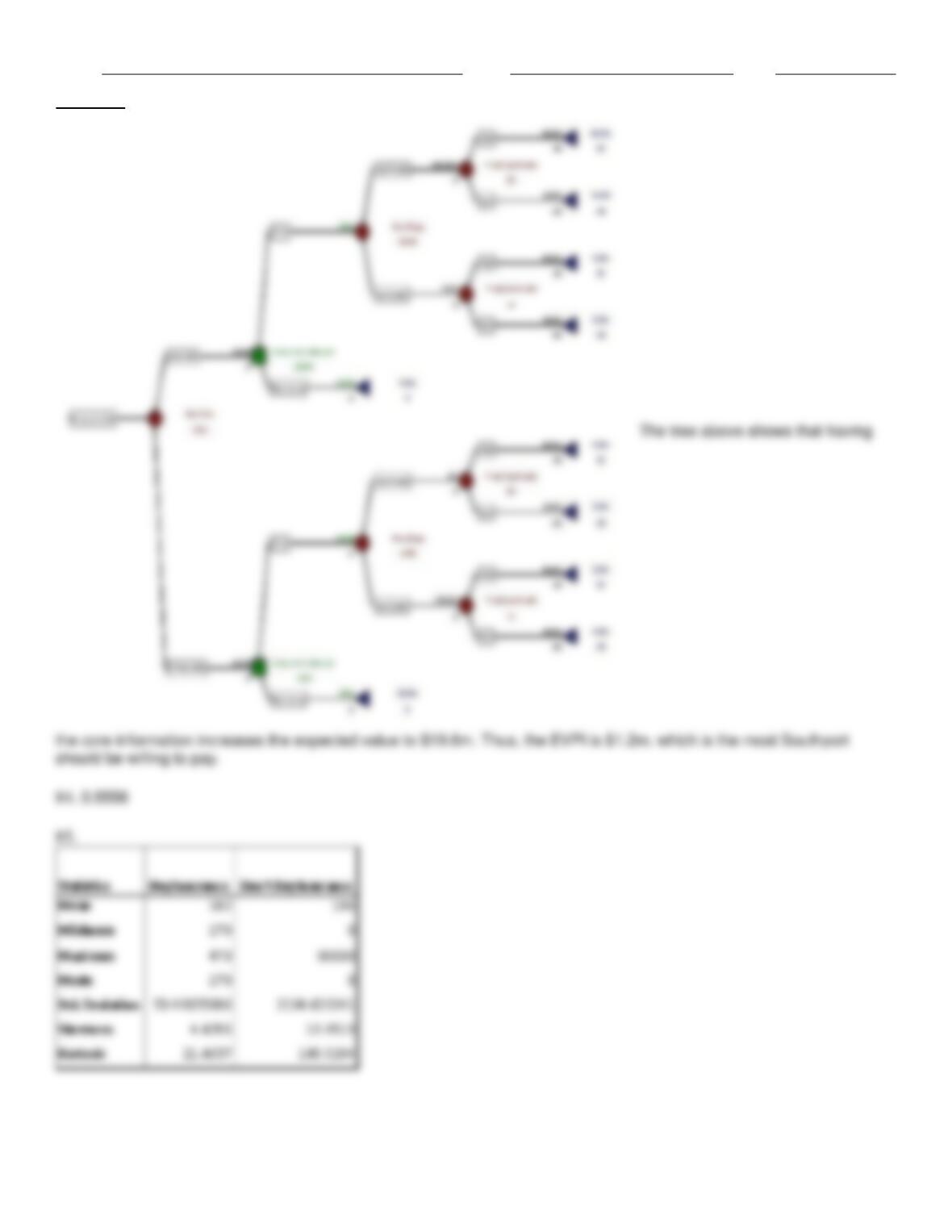
should be willing to pay.
Name:
Class:
Date:
chapter 6
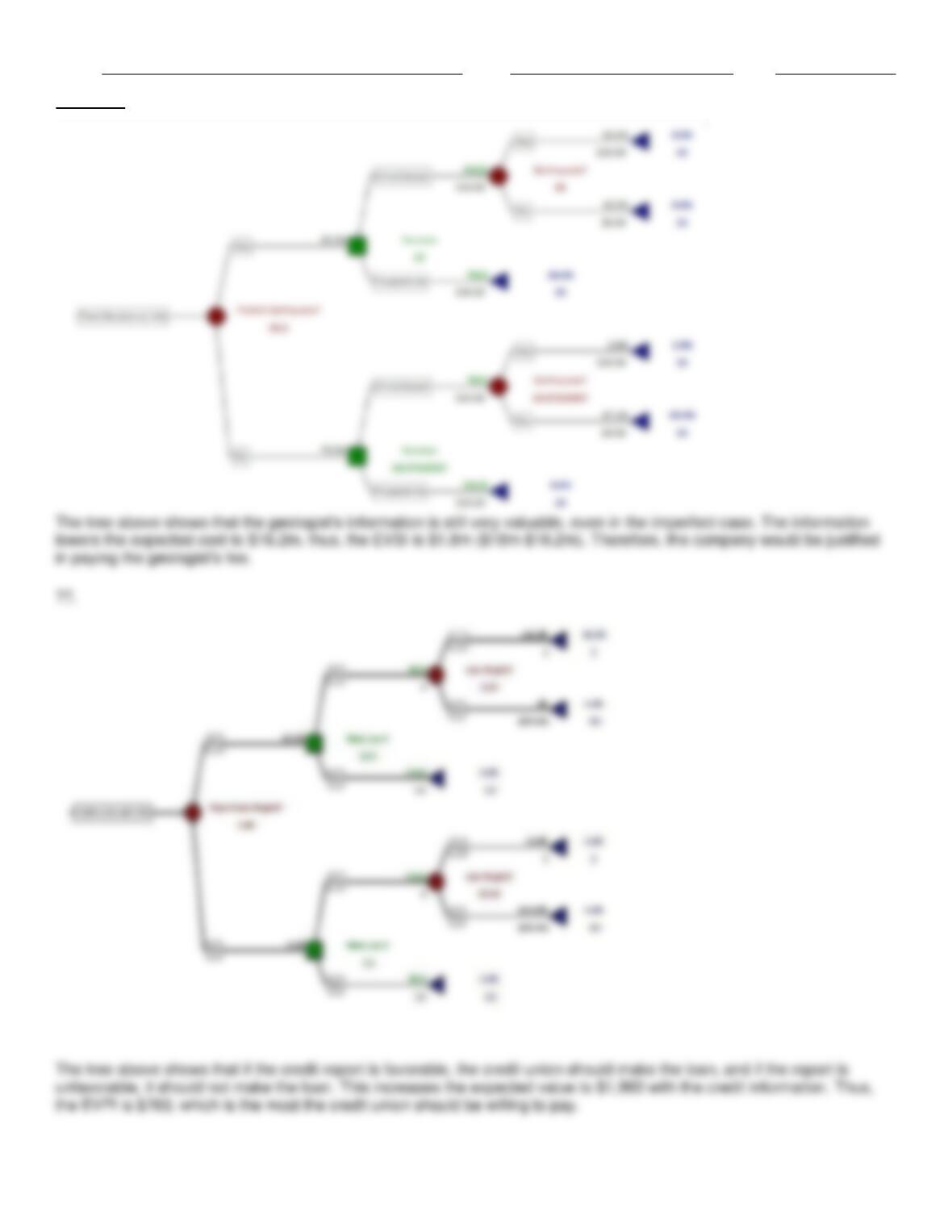
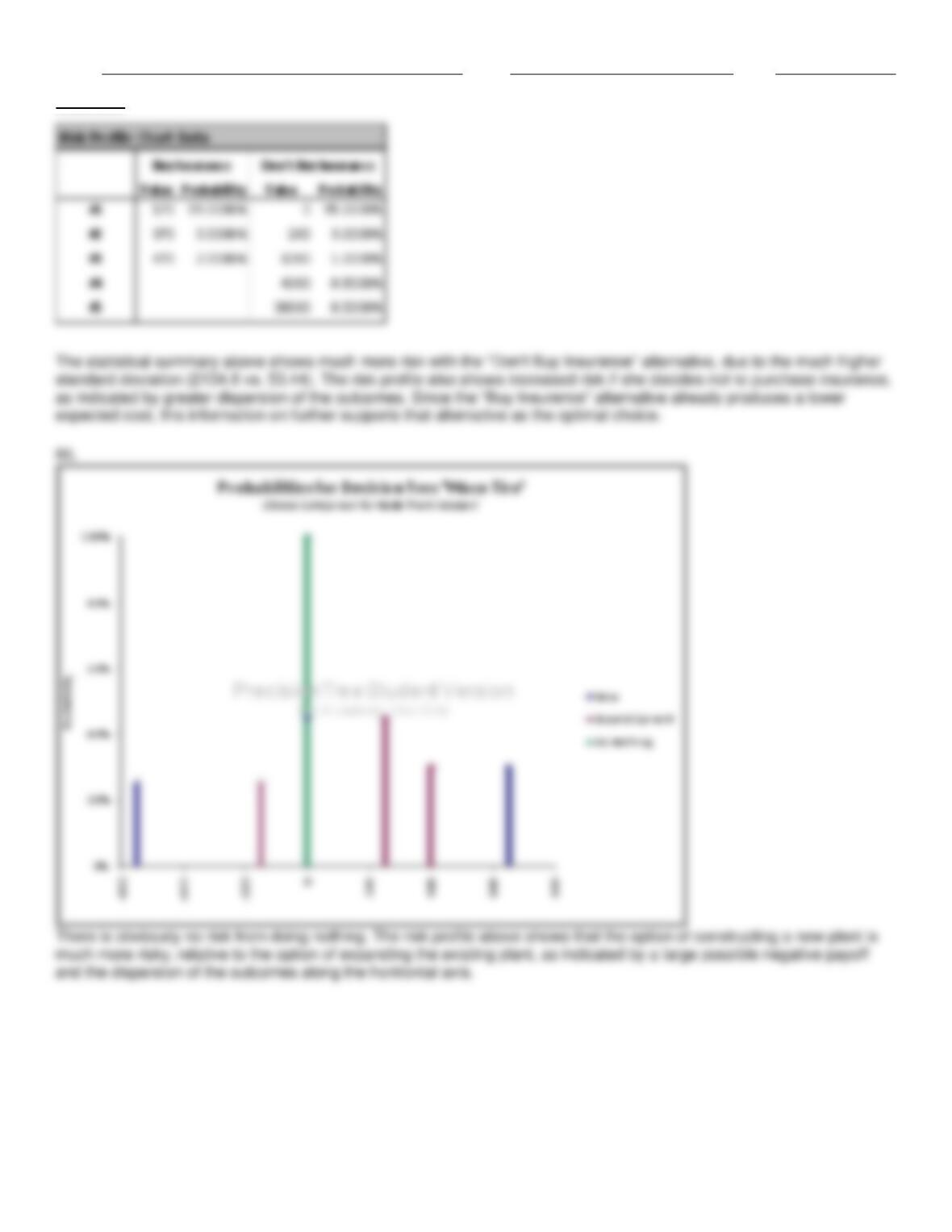
expected cost, this information on further supports that alternative as the optimal choice.
Name:
Class:
Date:
chapter 6
Name:
Class:
Date:
chapter 6
Name:
Class:
Date:
chapter 6
Name:
Class:
Date:
chapter 6
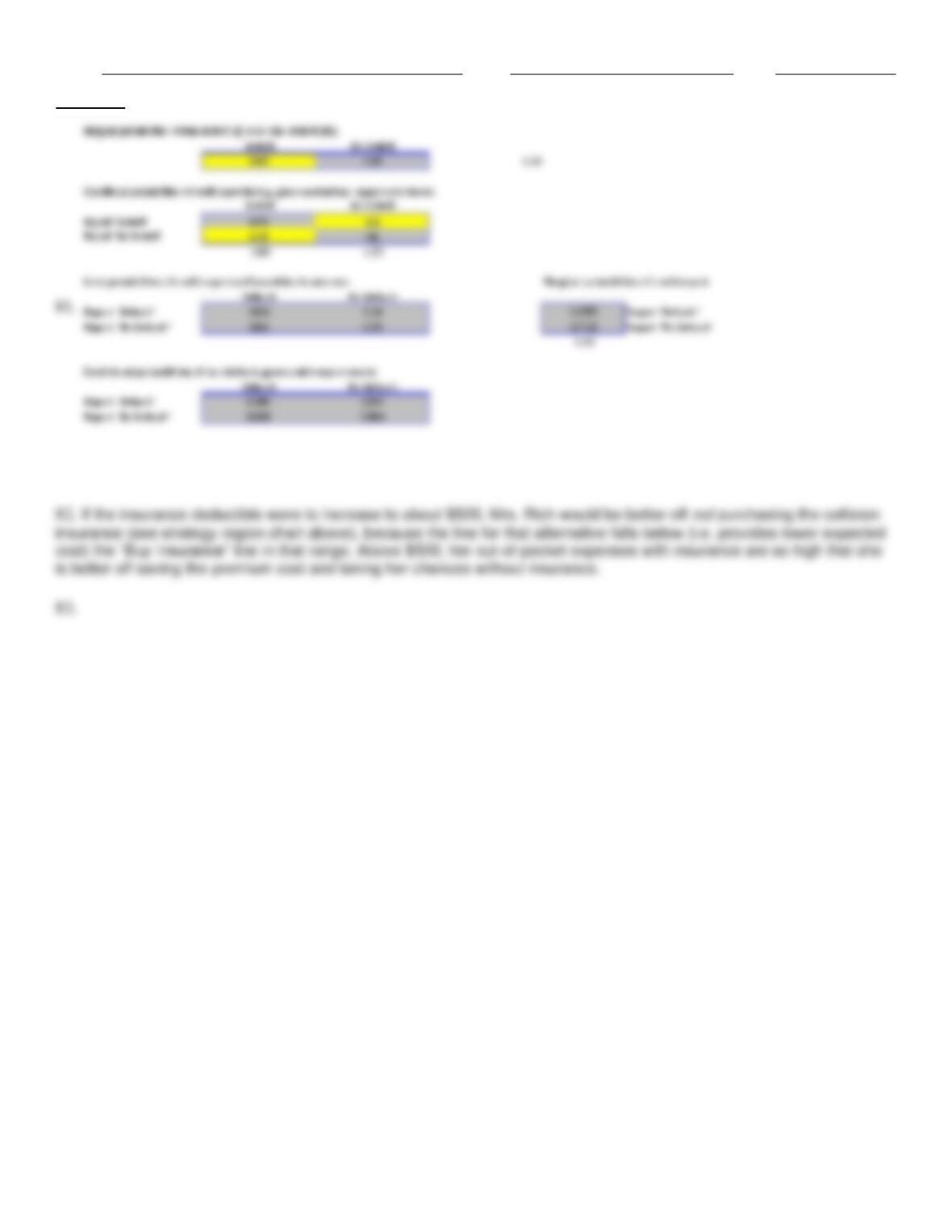
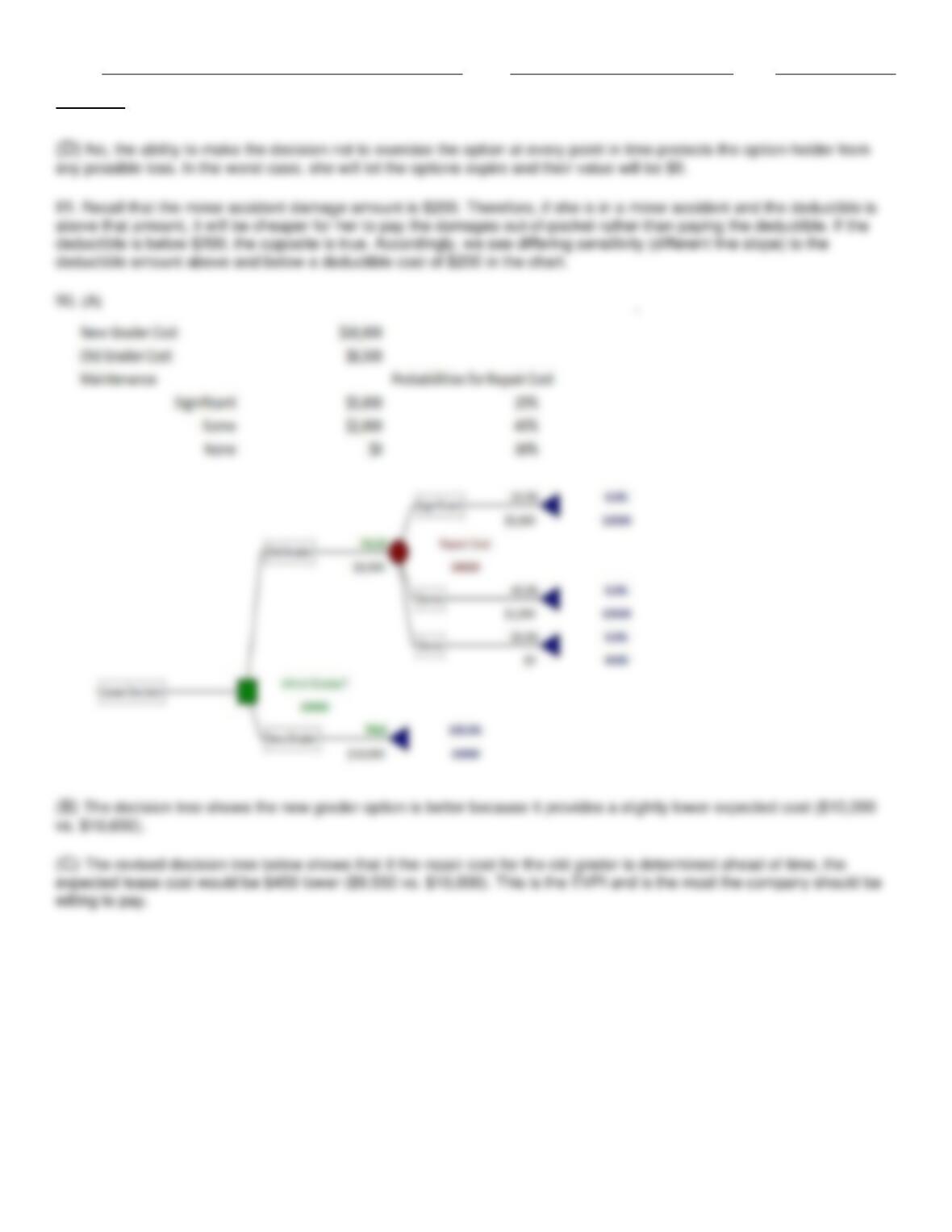
deductible amount above and below a deductible cost of $200 in the chart.
willing to pay.
Name:
Class:
Date:
chapter 6
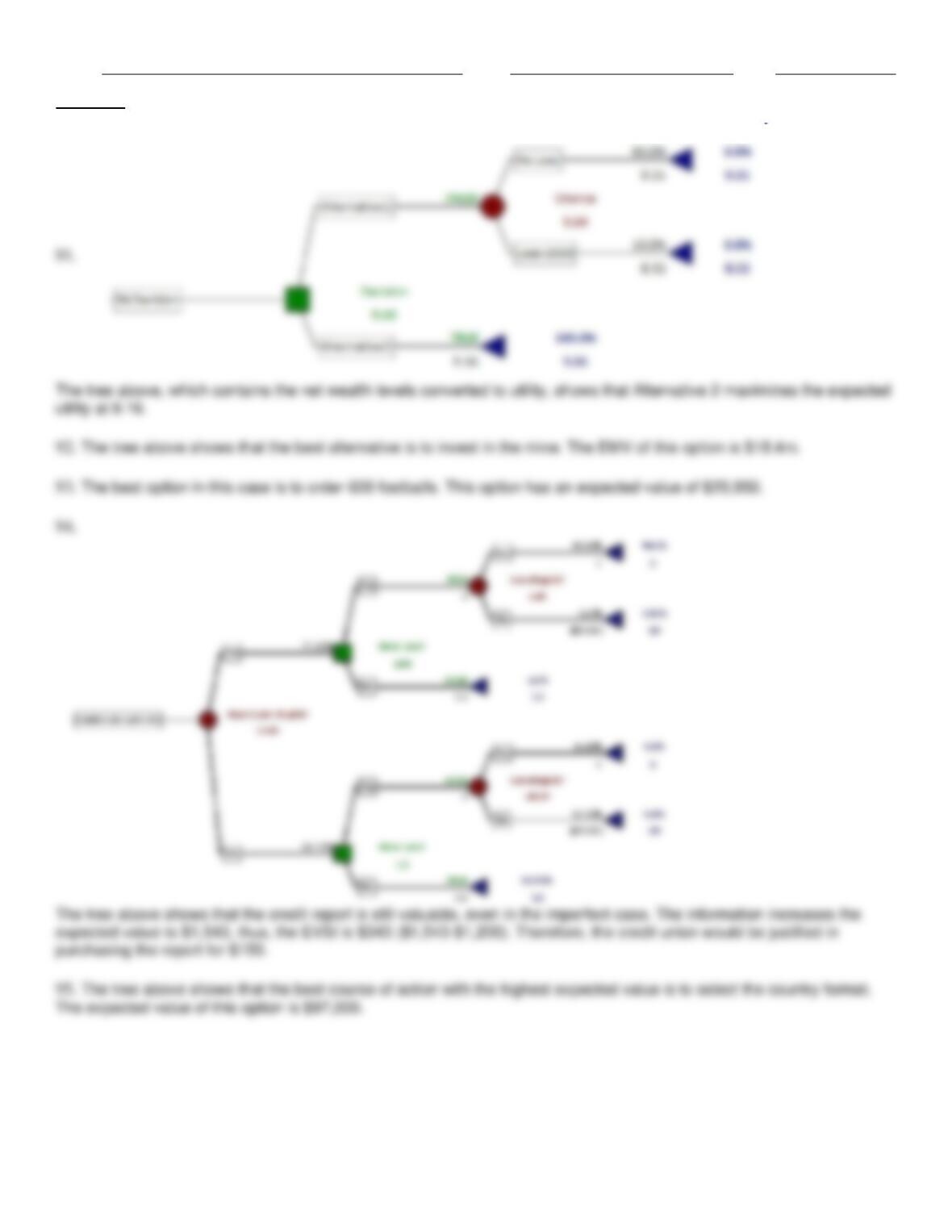
utility at 9.16.
purchasing the report for $150.
The expected value of this option is $97,000.
Name:
Class:
Date:
chapter 6
Name:
Class:
Date:
chapter 6
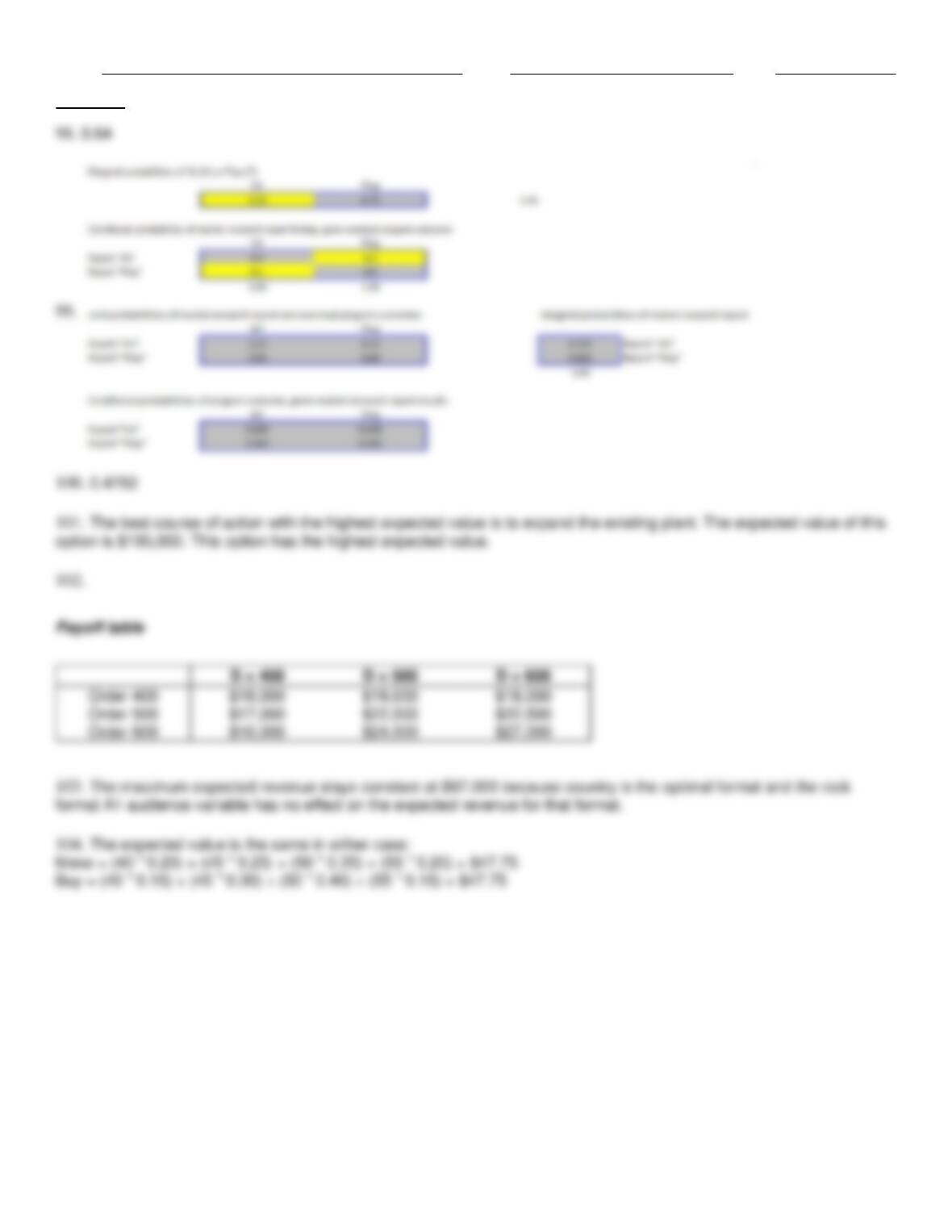
option is $195,000. This option has the highest expected value.
format A1 audience variable has no effect on the expected revenue for that format.
Buy = (40 0.15) + (45 0.30) + (50 0.40) + (55 0.15) = $47.75
Name:
Class:
Date:
chapter 6
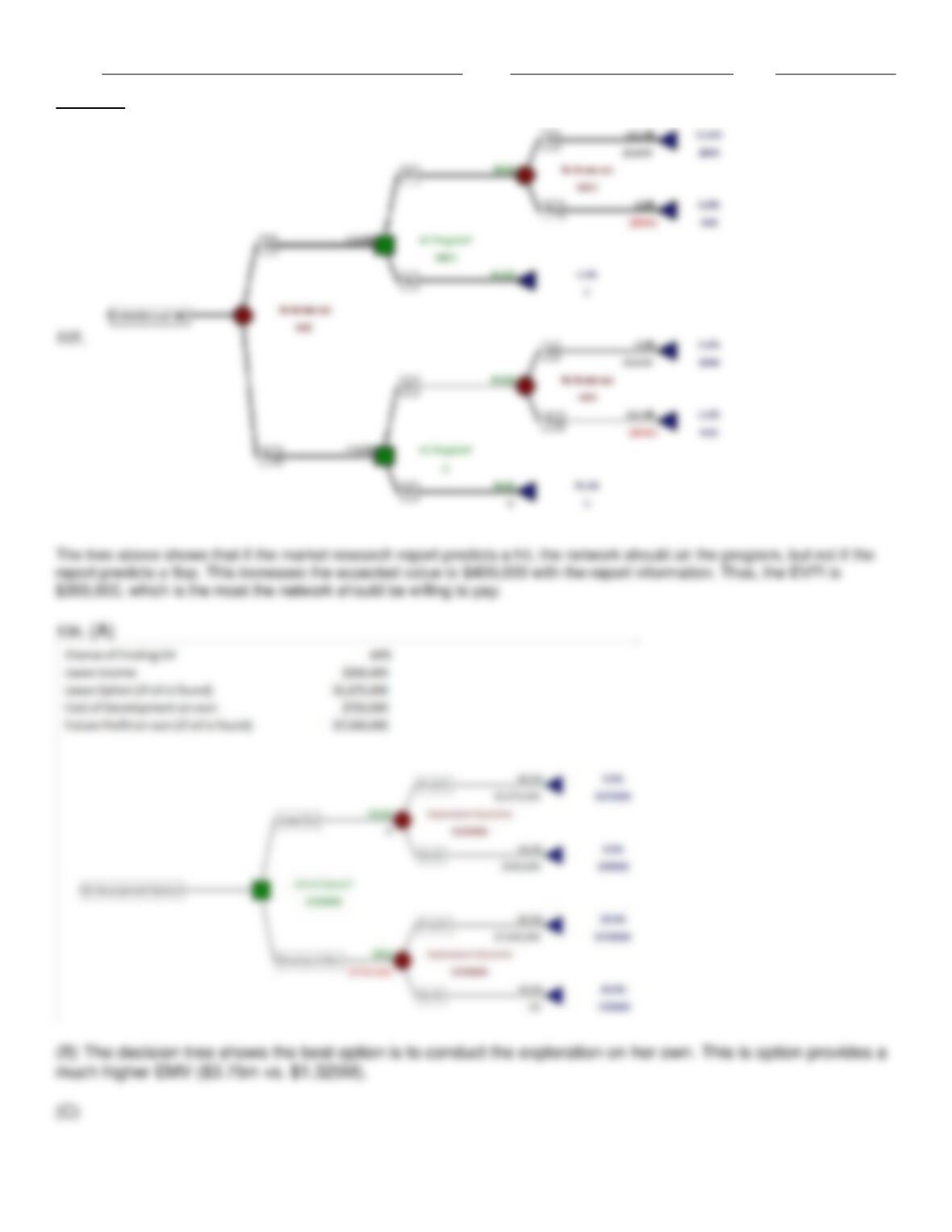
$300,000, which is the most the network should be willing to pay.
Name:
Class:
Date:
chapter 6
Name:
Class:
Date:
chapter 6
Name:
Class:
Date:
chapter 6
Name:
Class:
Date:
chapter 6
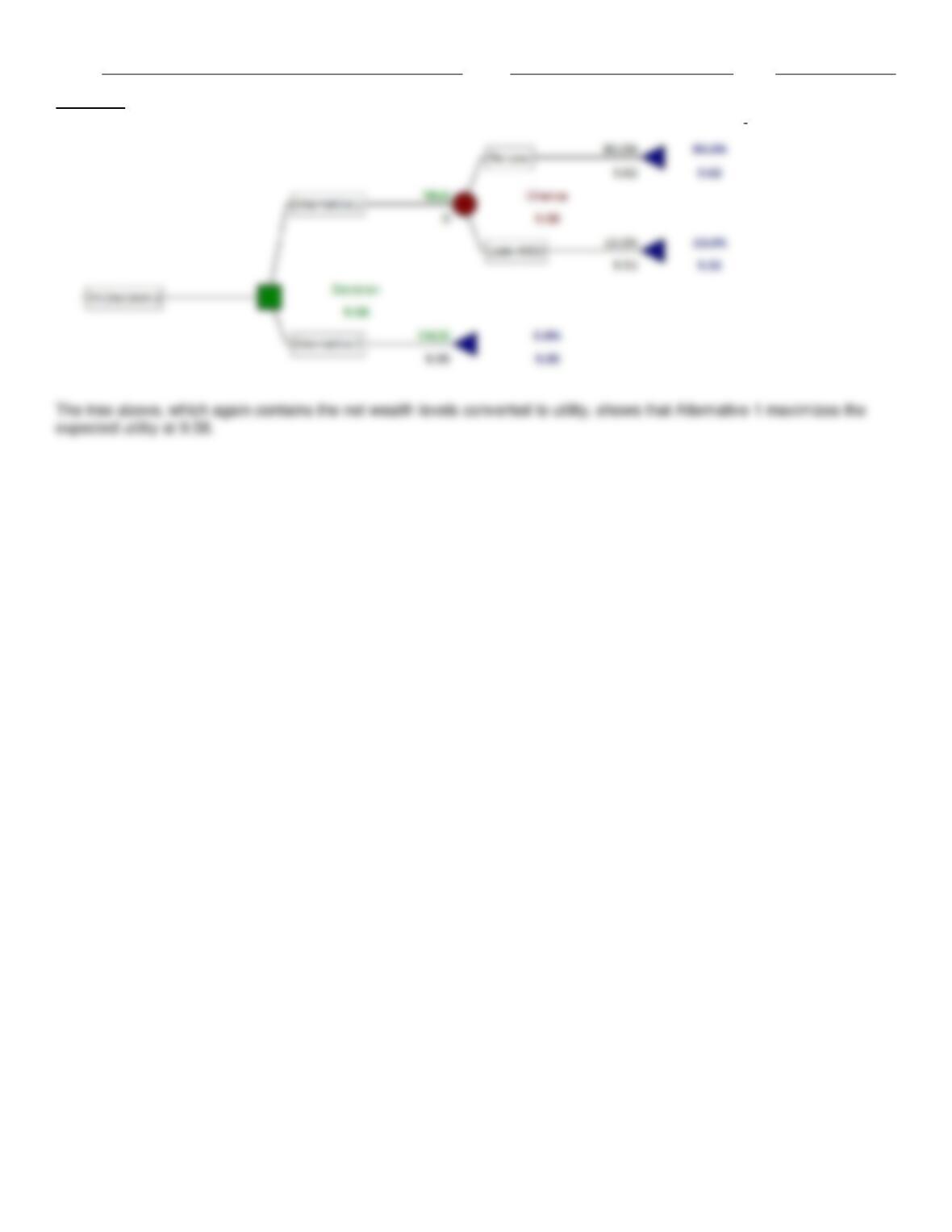
expected utility at 9.58.