Chapter 6: Accounting for Merchandising Businesses
119.
To encourage a buyer to pay before the end of the credit period, the seller may offer a
a.
purchases discount
b.
sales discount
c.
trade discount
d.
payment discount
120.
Taking advantage of a 2/10, n/30 purchases discount is equal to a savings yearly rate of approximately
a.
2%
b. 24%
c. 20%
d. 36%
121.
Who is responsible for the freight costs when the terms are FOB shipping point?
a.
the ultimate customer
b.
the buyer
c.
the seller
d.
either the seller or the buyer
Chapter 6: Accounting for Merchandising Businesses
122.
Who is responsible for the freight cost when the terms are FOB destination?
a.
the seller
b.
the buyer
c.
the customer
d.
either the buyer or the seller
123.
A retailer purchases merchandise with a catalog list price of $30,000. The retailer receives a 15% trade discount
and credit terms of 2/10, n/30. How much cash will be needed to pay this invoice within the discount period?
a. $30,000
b. $24,900
c. $29,400
d. $24,990
124.
What type of company would normally offer trade discounts to its customers?
a.
service companies
b.
retailers
c.
wholesalers
d.
online retailers
Chapter 6: Accounting for Merchandising Businesses
125.
Which of the following accounts will only be found in the chart of accounts of a merchandising company?
a.
Sales
b.
Accounts Receivable
c.
Merchandise Inventory
d.
Accounts Payable
126.
Which of the following items would not affect the cost of merchandise inventory acquired during the period?
a.
quantity discounts
b.
sales discounts
c.
freight-in
d.
sales commissions
127.
If title to merchandise purchases passes to the buyer when the goods are delivered to the buyer, the terms are
a.
consigned
b.
n/30
c.
FOB shipping point
d.
FOB destination
Chapter 6: Accounting for Merchandising Businesses
128.
If title to merchandise purchases passes to the buyer when the goods are shipped from the seller, the terms are
a.
n/30
b.
FOB shipping point
c.
FOB destination
d.
consigned
129.
If merchandise sells for $3,500, with terms of 3/15, n/45 and the cost of the inventory sold is $2,100, the
amount
charged to sales is
a. $3,395
b. $3,500
c. $2,037
d. $2,100
130.
Under the perpetual inventory system, all purchases of merchandise are debited to the account
a.
Merchandise Inventory
b.
Cost of Merchandise Sold
c.
Cost of Merchandise Available for Sale
d.
Purchases
Chapter 6: Accounting for Merchandising Businesses
131.
When the perpetual inventory system is used, the inventory sold is debited to
a.
Supplies Expense
b.
Cost of Merchandise Sold
c.
Merchandise Inventory
d.
Sales
132.
Under a perpetual inventory system
a.
accounting records continuously disclose the amount of inventory
b.
increases in inventory resulting from purchases are debited to Purchases
c.
there is no need for a year-end physical count
d.
the purchase returns and allowances account is credited when goods are returned to vendors
133.
The journal entry to record the receipt of inventory purchased for cash in a perpetual inventory system would be
a. Jan. 1 Merchandise Inventory
Cash
1,500
1,500
b. Jan. 1 Office Supplies
Cash
1,500
1,500
c. Jan. 1 Purchases
Accounts Payable
1,500
1,500
d. Jan. 1 Cash
Accounts Receivable
1,500
1,500
Chapter 6: Accounting for Merchandising Businesses
134.
Which of the following items should not be included in the cost of ending merchandise inventory?
a.
purchased units in transit, shipped FOB shipping point
b.
purchased units in transit, shipped FOB destination
c.
units on hand in the warehouse
d.
sold units in transit, not invoiced, and shipped FOB destination
135.
The Corbit Corp. sold merchandise for $10,000 cash. The cost of the merchandise sold was $7,590. The
journal
entries to record this transaction under the perpetual inventory system would be
a.
Cash 10,000
Merchandise Inventory 10,000
Cost of Merchandise Sold
Sales
7,590
7,590
b. Cash
Sales
10,000
10,000
Cost of Merchandise Sold
Merchandise Inventory
7,590
7,590
c. Cash
Sales
10,000
10,000
Cost of Merchandise Sold
Merchandise Inventory
10,000
10,000
d. Cash
Sales
7,590
7,590
Cost of Merchandise Sold 7,590
Merchandise Inventory 7,590
Chapter 6: Accounting for Merchandising Businesses
136.
Abbey Co. sold merchandise to Gomez Co. on account, $35,000, terms 2/15, net 45. The cost of the
merchandise
sold is $24,500. Abbey Co. issued a credit memo for $3,600 for merchandise returned that
originally cost $1,700. Gomez Co. paid the invoice within the discount period. What is the amount of gross
profit earned by
Abbey Co. on the above transactions?
a. $10,500
b. $30,772
c. $7,972
d. $31,400
137.
What is the major difference between a periodic and perpetual inventory system?
a.
Under the periodic inventory system, the purchase of inventory will be debited to the Purchases account.
b.
Under the periodic inventory system, no journal entry is recorded at the time of the sale of inventory for
the
cost of the inventory.
c.
Under the periodic inventory system, all adjustments such as purchases returns and allowances and
discounts
are reconciled at the end of the month.
d.
All of the answers are correct.
Chapter 6: Accounting for Merchandising Businesses
138.
When comparing a retail business to a service business, the financial statement that changes the least is the
a.
balance sheet
b.
income statement
c.
statement of owner’s equity
d.
statement of cash flows
139.
Generally, the revenue account for a merchandising business is entitled
a.
Sales
b.
Fees Earned
c.
Gross Sales
d.
Gross Profit
140.
Which account is not classified as a selling expense?
a.
Sales Salaries
b.
Delivery Expense
c.
Cost of Goods Sold
d.
Advertising Expense
Chapter 6: Accounting for Merchandising Businesses
141.
President’s salaries, depreciation of office furniture, and office supplies are
a.
selling expenses
b.
miscellaneous expenses
c.
administrative expenses
d.
inventory expenses
142.
Expenses that are incurred directly or entirely in connection with the sale of merchandise are classified as
a.
selling expenses
b.
general expenses
c.
other expenses
d.
administrative expenses
143.
When the perpetual inventory system is used, the inventory sold is shown on the income statement as
a.
cost of merchandise sold
b.
purchases
c.
purchases returns and allowances
d.
net purchases
Chapter 6: Accounting for Merchandising Businesses
144.
The statement of owner’s equity shows
a.
only net income, beginning and ending capital
b.
only total assets, beginning and ending capital
c.
only net income, beginning capital, and withdrawals
d.
beginning and ending capital and all the changes in the owner’s capital as a result of net income (loss),
and
withdrawals
145.
Merchandise with an invoice price of $6,000 is purchased on September 2 subject to terms of 2/10, n/30, FOB
destination. Freight costs paid by the seller totaled $200. What is the cost of the merchandise if paid on
September
12, assuming the discount is taken?
a. $6,120
b. $5,940
c. $6,090
d. $5,880
146.
When the three sections of a balance sheet are presented on a page in a downward sequence, it is called the
a.
account form
b.
comparative form
c.
horizontal form
d.
report form
Chapter 6: Accounting for Merchandising Businesses
147.
Multiple-step income statements show
a.
gross profit but not income from operations
b.
neither gross profit nor income from operations
c.
both gross profit and income from operations
d.
income from operations but not gross profit
148.
The form of income statement that derives its name from the fact that the total of all expenses is deducted from the
total of all revenues is called a
a.
multiple-step statement
b.
revenue statement
c.
report-form statement
d.
single-step statement
149.
Under the periodic inventory system, the journal entry to record the purchase of merchandise inventory will
include
a debit to
a.
Merchandise Inventory
b.
Purchases
c.
Accounts Payable
d.
Cost of Merchandise Purchased
Chapter 6: Accounting for Merchandising Businesses
150.
Using the following information, what is the amount of net income?
Purchases
$32,000
Selling expense
$ 960
Merchandise inventory,
September 1
5,700
Merchandise inventory,
September 30
6,370
Administrative expense
910
Sales
63,000
Rent revenue
1,200
Interest expense
1,040
a. $29,510
b. $27,560
c. $28,310
d. $29,350
151.
Using the following information, what is the amount of gross profit?
Purchases
$32,000
Selling expense
$ 960
Merchandise inventory,
September 1
5,700
Merchandise inventory,
September 30
6,370
Administrative expense
910
Sales
63,000
Rent revenue
1,200
Interest expense
1,040
a. $25,300
b. $31,670
c. $30,600
d. $62,840
Chapter 6: Accounting for Merchandising Businesses
152.
Using the following information, what is the amount of income from operations?
Purchases
$32,000
Selling expense
$ 960
Merchandise inventory,
September 1
5,700
Merchandise inventory,
September 30
6,370
Administrative expense
910
Sales
63,000
Rent revenue
1,200
Interest expense
1,040
a. $32,870
b. $31,910
c. $30,710
d. $29,800
153.
Which of the following accounts should be closed to Income Summary at the end of the fiscal year?
a.
Merchandise Inventory
b.
Accumulated Depreciation
c.
Drawing
d.
Cost of Merchandise Sold
Chapter 6: Accounting for Merchandising Businesses
154.
Which account will be included in both service and merchandising companies, closing entries?
a.
Sales
b.
Cost of Merchandise Sold
c.
Purchase Discounts
d.
Sales Returns and Allowances
155.
If the physical count of the inventory revealed $158,000 of merchandise on hand and the inventory records reported
$163,000, what would be the necessary adjusting entry to record inventory shrinkage?
a.
debit Merchandise Inventory, $158,000; credit Cost of Merchandise Sold, $158,000
b.
debit Merchandise Inventory, $5,000; credit Cost of Merchandise Sold, $5,000
c.
debit Cost of Merchandise Sold, $163,000; credit Merchandise Inventory, $158,000
d.
debit Cost of Merchandise Sold, $5,000; credit Merchandise Inventory, $5,000
156.
Inventory shrinkage is recorded when
a.
merchandise is returned by a buyer
b.
merchandise purchased from a seller is incomplete or short
c.
merchandise is returned to a seller
d.
there is a difference between a physical count of inventory and inventory records
Chapter 6: Accounting for Merchandising Businesses
157.
Bradford Company had $700,000 in sales for the year. The total assets at the beginning of the year were
$240,000
and total assets at the end of the year were $280,000. The ratio of sales to total assets is (round answer
to 2
decimal places)
a. 2.69
b. 0.40
c. 2.92
d. 0.34
158.
Bountiful Company had sales of $650,000 and cost of merchandise sold of $200,000 during the year. The total
assets balance at the beginning of the year was $175,000 and at the end of the year was $167,000. Calculate the
ratio of sales to total assets.
a. 3.00
b. 3.80
c. 0.29
d. 0.26
Chapter 6: Accounting for Merchandising Businesses
159.
A company using the periodic inventory system has the following account balances: Merchandise Inventory at
the
beginning of the year, $3,600; Freight In, $650; Purchases, $10,700; Purchases Returns and Allowances,
$1,950; Purchases Discounts, $330. The cost of merchandise purchased is equal to
a. $12,670
b. $9,070
c. $8,420
d. $17,230
160.
Which of the following accounts will not be found in the Cost of Merchandise Sold section of the income
statement
for a company using the periodic inventory method?
a.
Purchases
b.
Freight In
c.
Selling Expense
d.
Merchandise Inventory
161.
A company, using the periodic inventory system, has merchandise inventory costing $210 on hand at the
beginning
of the period. During the period, merchandise costing $635 is purchased. At year-end, merchandise
inventory
costing $160 is on hand. The cost of merchandise sold for the year is
a. $795
b. $685
c. $265
d. $635
Chapter 6: Accounting for Merchandising Businesses
162.
Where are selling and administrative expenses found on the multiple-step income statement?
a.
before gross profit
b.
after sales and before gross profit
c.
after net income and before expenses
d.
after gross profit
163.
Under the periodic inventory system, the journal entry to record the cost of merchandise sold at the point of
sale
will include which of the following?
a.
none of these
b.
Cost of Merchandise Sold
c.
Inventory
d.
Purchases
164.
Under a periodic inventory system, closing entries will include
a.
debits to Sales, Purchases Returns and Allowances, and Purchases Discounts
b.
credits to Purchases and Sales Discounts
c.
adjustments to Merchandise Inventory account to match physical inventory
d.
all of these
Chapter 6: Accounting for Merchandising Businesses
165.
The proper journal entry to record the receipt of inventory purchased on account in a periodic inventory
system
would be
a. Jan. 1 Merchandise Inventory
1,600
Accounts Payable
1,600
b. Jan. 1 Office Supplies
1,600
Accounts Payable
1,600
c. Jan. 1 Purchases
1,600
Accounts Payable
1,600
d. Jan. 1 Purchases
1,600
Accounts Receivable
1,600
166.
Using the following information, what is the amount of cost of merchandise sold?
Purchases
$32,000
Selling expense
$ 960
Merchandise inventory,
September 1
5,700
Merchandise inventory,
September 30
6,370
Administrative expense
910
Sales
63,000
Rent revenue
1,200
Interest expense
1,040
a. $32,400
b. $32,670
c. $31,330
d. $38,370
Chapter 6: Accounting for Merchandising Businesses
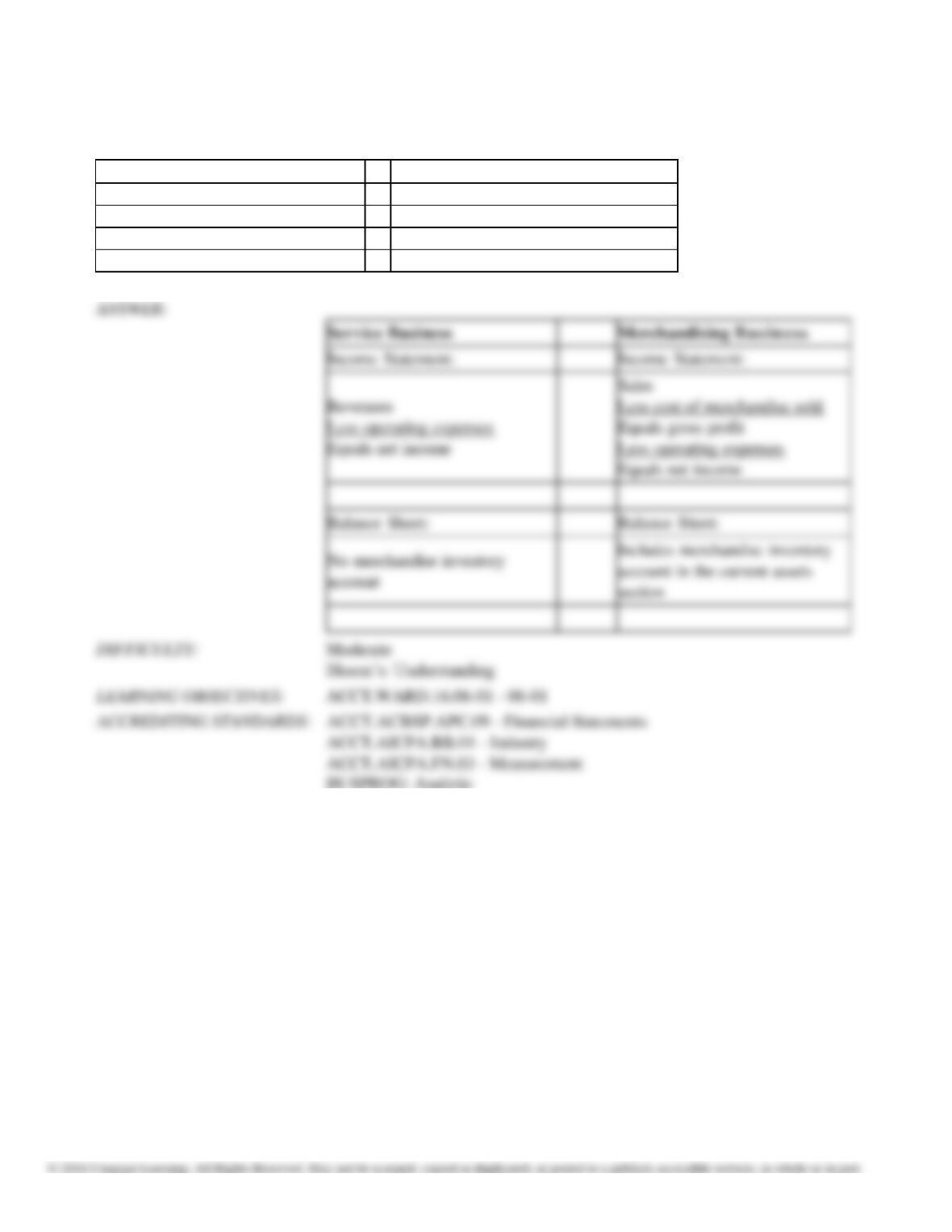
167.
Discuss the following statement:
“Operating cycles for all merchandising businesses are the same, with similar profit margins.”
Include an example(s) to illustrate your explanation.
Chapter 6: Accounting for Merchandising Businesses
168.
Describe the major differences in preparing the financial statements for a service business and a
merchandising
business.
Service Business
Merchandising Business
Income Statement:
Income Statement:
Balance Sheet:
Balance Sheet: