
CHAPTER 6: PROCESS COSTING
1. A process is a series of activities or operations, which are linked to perform a specific objective.
a. True
b. False
2. The cost flows for a process-costing system are totally different from those of a job order costing system.
a. True
b. False
3. Process systems are characterized by a larger number of homogeneous products passing through a
series of processes.
a. True
b. False
4. The production report is the document that summarizes the manufacturing activity that takes place in a
work–in– process department.
a. True
b. False
5. Many service organizations and just–in–time (JIT) manufacturing firms operate in an environment without
work–in– process inventories.
a. True
b. False
6. Services that are basically homogeneous and repetitive cannot take advantage of a process-costing
approach.
a. True
b. False
7. In JIT manufacturing, work cells are created that produce a product from start to finish.
a. True
b. False

Chapter 6: Process Costing
8. In firms with ending work–in–process inventories, output is measured using equivalent units.
a. True
b. False
9. Equivalent units are the incomplete units that could have been produced given the total amount of effort
expended.
a. True
b. False
10. In a process–costing system, work–in–process inventory, materials are added uniformly so that multiple
calculations of equivalent units are needed for each type of input.
a. True
b. False
11. The FIFO costing method recognizes that the work and costs carried over from the prior period
legitimately belong to that period.
a. True
b. False
12. FIFO follows the job–order costing principle.
a. True
b. False
13. The FIFO method unit costs are used to value output that is related to future periods.
a. True
b. False
14. The weighted average method treats the equivalent output and costs in beginning work-in-process
inventories as if they belong to the current period when calculating unit cost.
a. True
b. False

Chapter 6: Process Costing
15. In a process-costing system, the costing of goods transferred out in BWIP inventory is difficult
because there are multiple categories of completed units.
a. True
b. False
16. The major benefit of the weighted average method is simplicity. The major disadvantage is that
accuracy and performance measurements are impaired.
a. True
b. False
17. Transferred-in goods, must be converted to the units of measure used by the current department.
a. True
b. False
18. For the receiving department of a process-costing manufacturer, transferred-in goods are materials that
are added at the end of the process.
a. True
b. False
19. In calculating equivalent units of production using the weighted average method, the transferred-in
goods are treated as materials added at the beginning of the process.
a. True
b. False
20. When manufacturing companies exhibit characteristics of both job and process environments, they
use batch production processes.
a. True
b. False
21. Operation costing uses a blend of job–order and process-costing procedures whenever batches of
dissimilar products are produced.
a. True
b. False
Chapter 6: Process Costing
22. In operation costing, job-order procedures are used to assign direct materials costs and process
procedures are used to assign conversion costs.
a. True
b. False
23. When spoilage is assumed to be normal, it is not tracked separately, it is simply included in the total
cost of good units.
a. True
b. False
24. Spoilage in a process costing process means that more units enter the process than leave it.
a. True
b. False
25. Abnormal spoilage costs are treated the same as normal spoilage for process costing.
a. True
b. False
26. The accounting system which accumulates production costs by process and uses a work–in-process
account for each process is called .
27. The basic characteristics of process costing include: cost flows, journal
entries, and the __________ report.
28. A key input to the cost of production report is costs.
29. Companies using JIT manufacturing do not use inventories for their process costing.
30. In a __________ costing system, production costs are accumulated by process.
Chapter 6: Process Costing
31. In process costing, costing can be used to assign shared overhead to processes.
32. The units that could have been produced in a period given the amount of manufacturing inputs used are
called
__________ .
33. The process that determines the equality of the costs in beginning work in process and the costs incurred
during the period is called .
34. When materials are not added uniformly using a work–in–process system, of
equivalent units are needed, one for each type of input.
35. The unit–costing method that excludes prior–period work and costs in computing current–period unit work
and costs is called the costing method.
36. FIFO follows the principle.
37. For beginning work-in–process category using FIFO, the manufacturing cost is the sum of the current-
period
__________ and the current __________ to complete the BWIP.
38. The method is a unit-costing method that merges prior-period work and costs with
current period work and costs.
39. The weighted average costing method picks up inventory costs and outputs and treats
them as if they belong in the current period.
40. Using the weighted average costing method, the costing of goods transferred out is since
there is only one category of completed units.
Chapter 6: Process Costing
41. The cost assigned to goods from a prior process is called the cost.
42. For the receiving department, transferred in goods are added at the of the process.
43. The usual approach in process manufacturing is to treat transferred-in goods as a separate material
category when calculating .
44. The costing system that uses job-order procedures to assign direct material costs to batches
and process procedures to assign conversion costs is called costing.
45. In operation costing, the process which produces batches of different products which are identical in
many ways but differ in others is called process
46. The documents used to collect production costs for each batch in operation costing are called .
47. Manufacturing firms that have characteristics of both job and process environments often use processes.
48. is a costing system that blends job-order and process-costing procedures applied to
batches of homogeneous products.
49. When spoilage is assumed to be it is embedded in the total cost of good units.
50. When spoilage is due to the exacting nature of a particular job it is called spoilage.

Chapter 6: Process Costing
51. What system would a manufacturer of unique special orders or batch processes most likely use to
accumulate costs?
a. contract costing
b. variable costing
c. process costing
d. job–order costing
52. In process costing, costs are accounted for by
a. job.
b. batch.
c. process.
d. year.
53. The appropriate cost accounting system to use when inventory items are produced on an assembly line is
a. weighted average.
b. job–order costing.
c. process costing.
d. perpetual method.
54. The process that accumulates production costs by process and uses a work-in-process account for each
process is called:
a. Process costing
b. Joint costing
c. Variable costing
d. Job–order costing
Chapter 6: Process Costing
Figure 6-1
The Allen Company has the following information for the Assembly Department for October 2016:
Materials purchased
$45,000
Materials used
49,000
Direct labor
30,000
Actual manufacturing overhead
56,000
Cost of goods completed and transferred to the Finishing Dept.
Overhead rate is 200 percent of direct labor costs.
Allen Company uses a process costing system for the Assembly Department.
125,000
55. Refer to Figure 6-1. The journal entry to record materials purchased would include a
a. debit to Materials Inventory for $45,000.
b. debit to Materials Inventory for $49,000.
c. credit to Accounts Payable for $49,000.
d. both b and c.
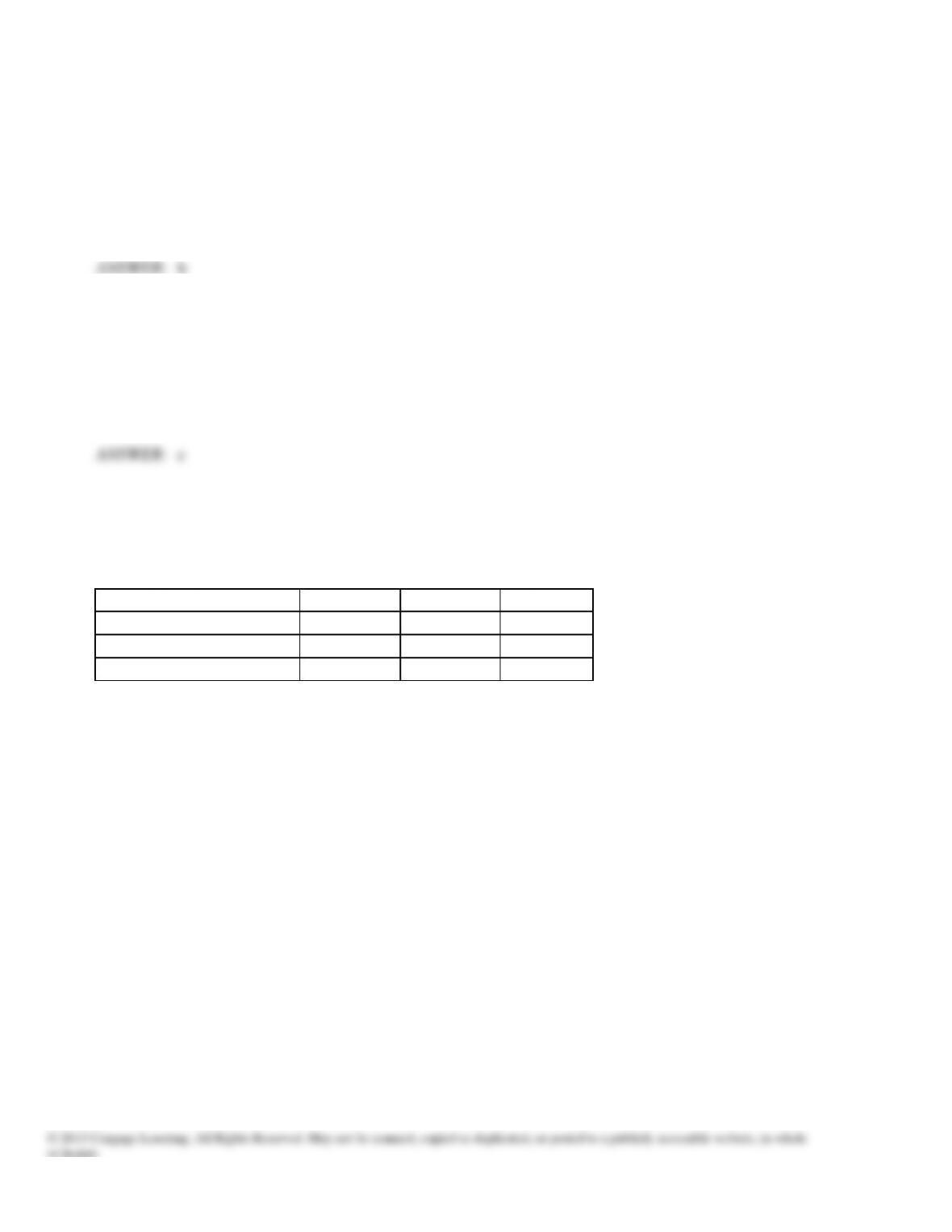
56. Refer to Figure 6-1. What is the total amount of debits to Work in Process-Assembly Department for
October?
a. $125,000
b. $131,000
c. $139,000
d. $109,000
57. Refer to Figure 6-1. The journal entry to record goods completed and transferred out of the Assembly
Department would include a
a. debit to Finished Goods Inventory for $125,000.
b. credit to Materials Inventory for $125,000.
c. debit to Work in Process-Assembly Department for $125,000.
d. debit to Work in Process–Finishing Department for $125,000.
Chapter 6: Process Costing
58. When products and their costs are moved from one process to the next process, these costs are referred
to as
a. unit costs.
b. transferred-in costs.
c. WIP inventory costs.
d. equivalent unit costs.
59. Which is NOT a difference between the job-order costing system and the process costing system?
a. They accumulate their costs to different cost objectives.
b. The number of work–in-process accounts is different.
c. One does not use the finished goods account.
d. all of the above.
Figure 6-2
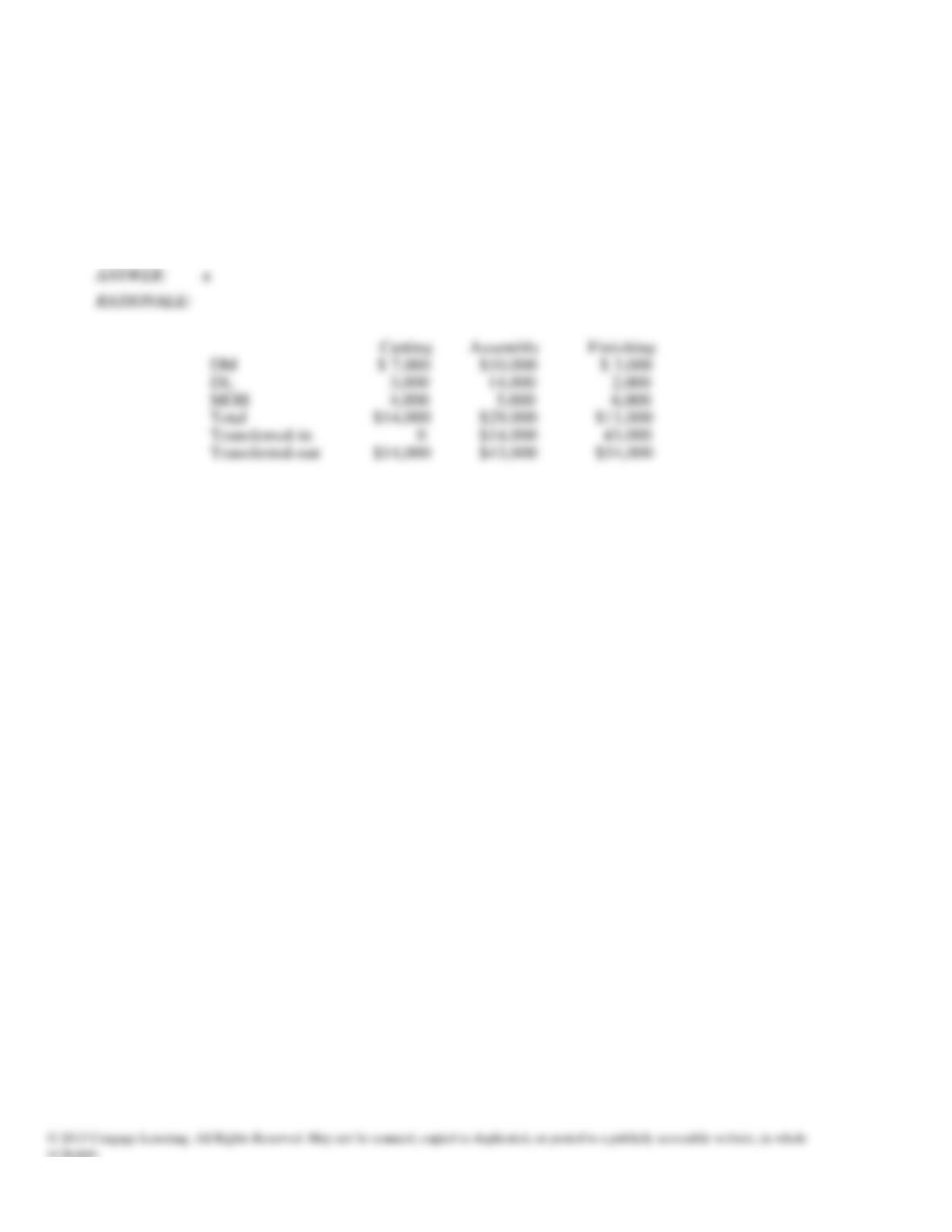
Leandro Corp. manufactures wooden desks. Production consists of three processes: cutting, assembly,
and finishing. The following costs are given for April:
Cutting
Assembly
Finishing
direct materials
$7,000
$10,000
$3,000
direct labor
3,000
14,000
2,000
applied overhead
4,000
5,000
6,000
There were no work in process inventories and 1,000 podiums were
produced.
Chapter 6: Process Costing
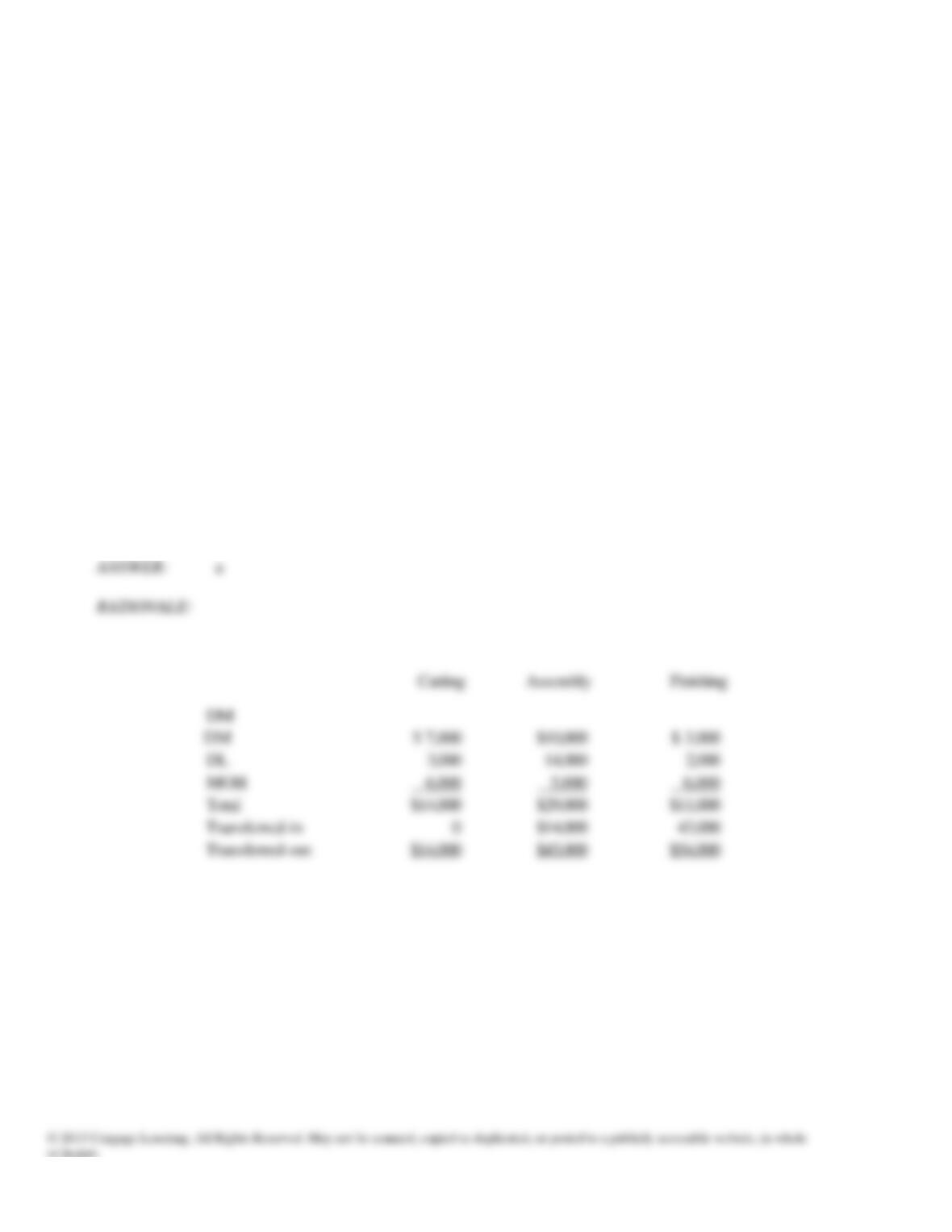
60. Refer to Figure 6-2. What is the cost transferred out of the assembly
department.
a. $43,000
b. $54,000
c. $29,000
d. $14,000
e. none of the above
Chapter 6: Process Costing
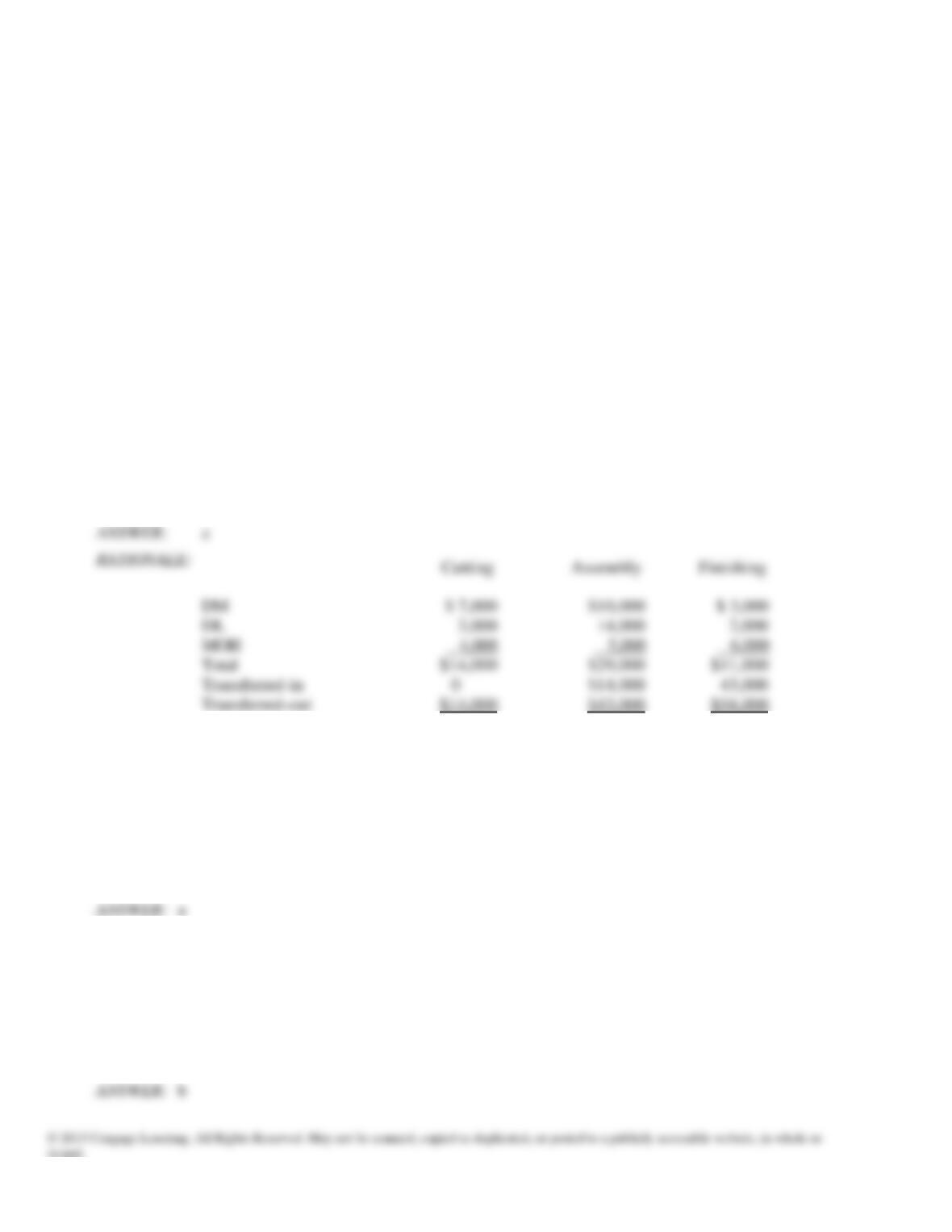
61. Refer to Figure 6-2. Record the journal entries to record the transfer of goods from process to process.
a. Work in Process – Assembly 14,000
Work in Process – Cutting 14,000
Work in Process – Finishing 43,000
Work in Process – Assembly 43,000
Finished Goods 54,000
Work in Process – Finishing 54,000
b. Work in Process – Assembly 29,000
Work in Process – Cutting 29,000
Work in Process – Finishing 11,000
Work in Process – Assembly 11,000
Finished Goods 54,000
Work in Process – Finishing 54,000
c. Work in Process – Cutting 14,000
Raw Materials 14,000
Work in Process – Assembly 29,000
Raw materials 29,000
Work in Process – Finishing 11,000
Raw Materials 11,000
d. none of the above
Chapter 6: Process Costing
62. Refer to Figure 6-2. The journal entry to assign costs to the Assembly process would be
a. Raw Materials 10,000
Payroll 14,000
Overhead Control 5,000
Work in Process – Assembly 29,000
b. Raw Materials 20,000
Payroll 19,000
Overhead Control 15,000
Work in Process – Assembly 54,000
c. Work in Process – Assembly 29,000
Raw Materials 10,000
Payroll 14,000
Overhead Control 5,000
d. Work in Process – Assembly 54,000
Raw Materials 20,000
Payroll 19,000
Overhead Control 15,000
e. none of the above
63. In a process costing system, which of the following would be TRUE?
a. There is no need to use time tickets to assign costs to processes.
b. There is no need to track materials to processes.
c. A process costing system is more expensive to maintain because it has more work–in-process accounts.
d. all of the above are true.
64. As production occurs, materials, direct labor, and applied manufacturing overhead are recorded in
a. cost of goods sold.
b. work in process.
c. materials.
d. finished goods.
Chapter 6: Process Costing
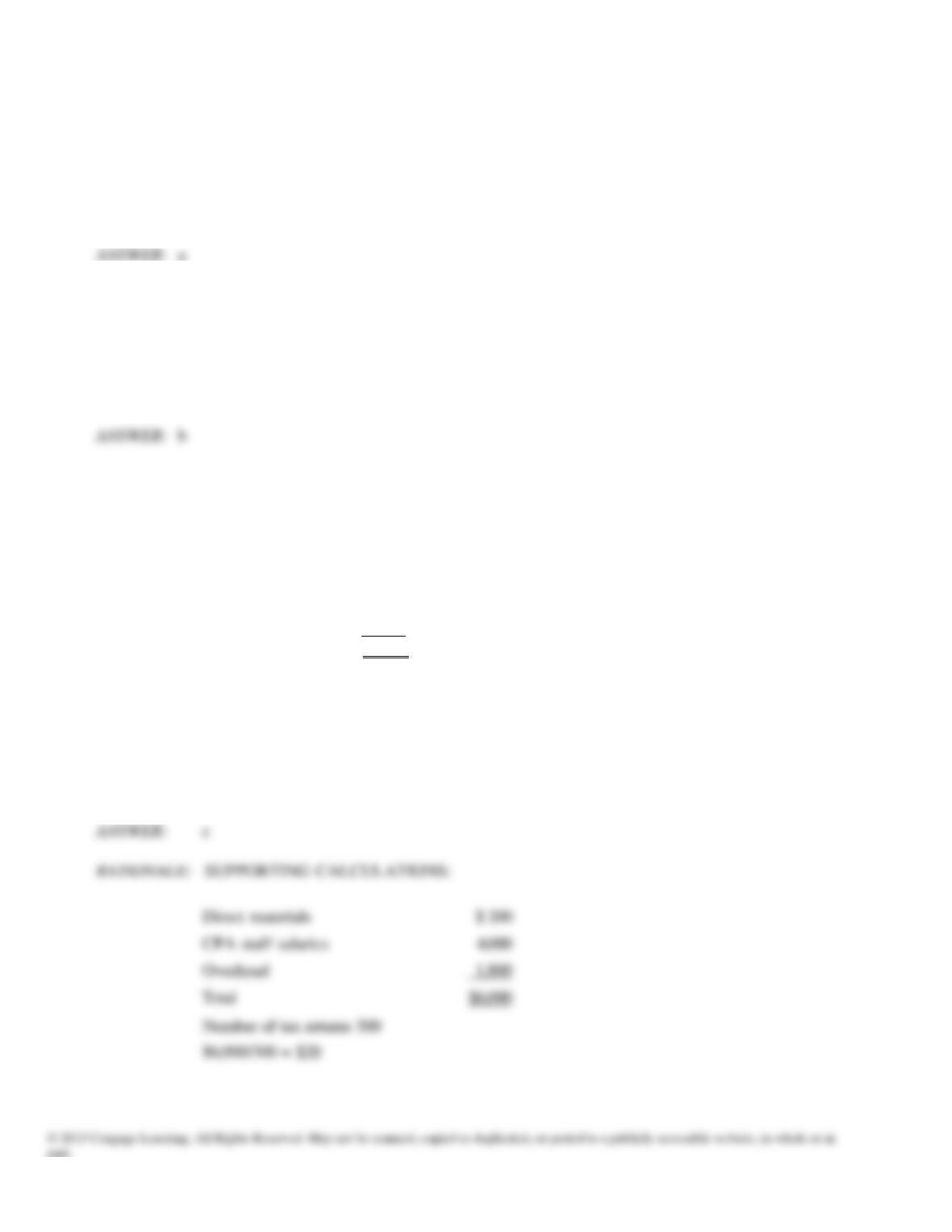
65. Which is TRUE about services?
a. Some services may require that a sequence of uniform processes be performed.
b. Services can never be homogeneous and repetitively produced.
c. Services cannot have work-in-process inventories.
d. All services require job-order costing.
66. Which is NOT a feature of a process costing system?
a. Standardized products pass through standardized processes.
b. Each unit is treated uniquely in receiving a process.
c. Manufacturing costs are accumulated by a process for a given time period.
d. Unit costs are calculated for each department.
Figure 6-3
Jamie Hopen, CPA, prepares tax returns. The production costs and the number of tax returns prepared for the
month of September are as follows:
Direct materials
$ 200
CPA staff salaries
4,000
Overhead
1,800
Total
$6,000
Number of tax returns 300
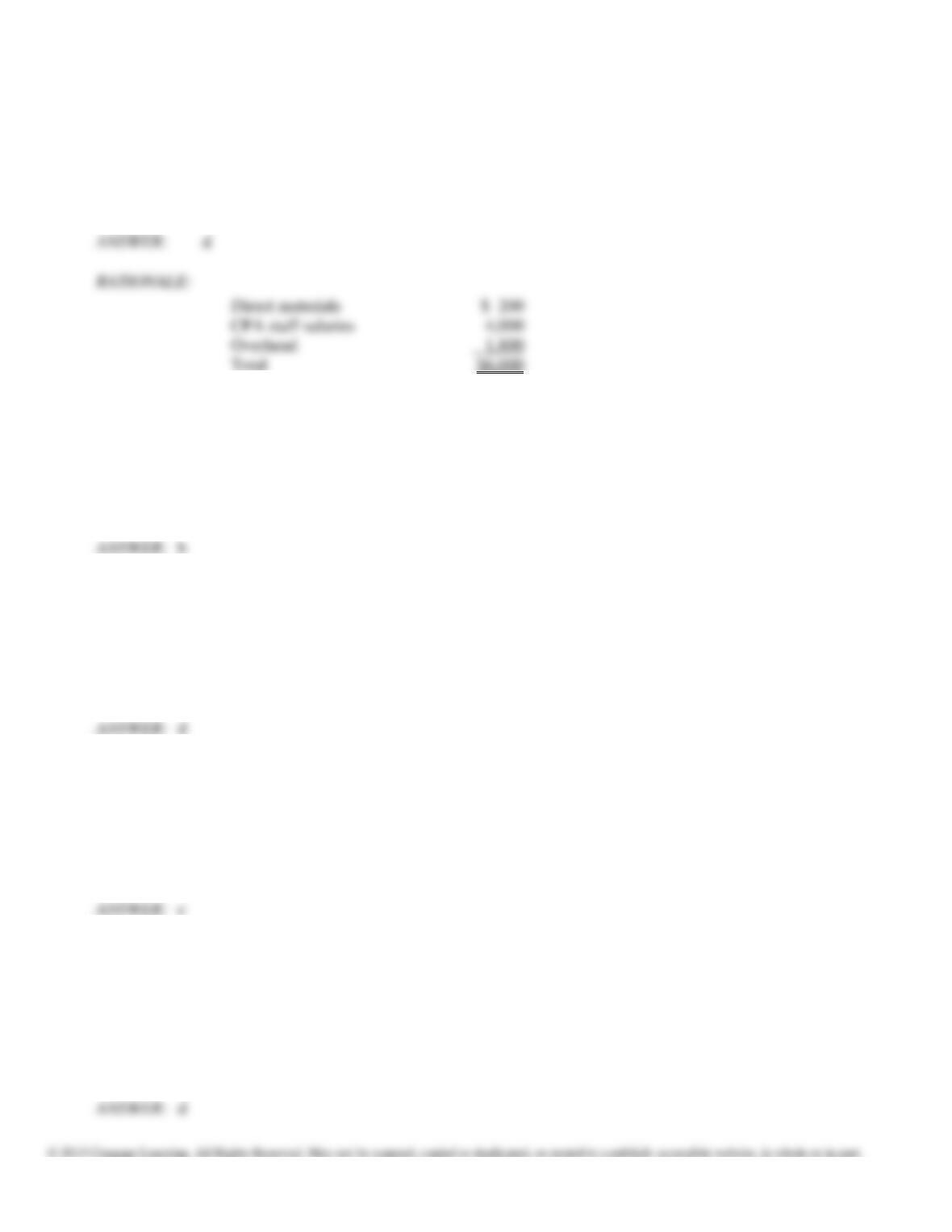
67. What is the unit cost per tax return?
a. $0.67
b. $15.00
c. $20.00
d. $3.33
Chapter 6: Process Costing
68. Refer to Figure 6-3. What is the cost of services sold?
a. $1,800
b. $4,000
c. $200
d. $6,000
69. In order to determine product costs, JIT firms are usually structured so they can use:
a. job–order costing
b. process costing
c. joint costing
d. variable costing
70. JIT manufacturing emphasizes
a. continuous improvement.
b. elimination of waste.
c. reduction of work–in–process inventories.
d. all of the above.
71. Activity–based costing might have a role in process costing settings under what conditions?
a. under no conditions
b. when there are products produced with homogeneous processes and little diversity
c. when multiple products are being produced.
d. when only one product is being produced
72. The whole units that could have been produced in a period given the amount of manufacturing inputs used is(are)
called:
a. FIFO costing
b. Transferred–in cost
c. Weighted average cost
d. Equivalent units of output
Chapter 6: Process Costing
73. That which determine(s) whether the costs assigned to units transferred out and to units in ending work
in process are equal to the costs in beginning work in process, plus the manufacturing costs incurred in
the current period is(are) called:
a. Equivalent unit of output
b. Cost reconciliation
c. Batch production process
d. Transferred–in costs
74. Equivalent units expresses all activity of the period in terms of
a. direct labor hours.
b. partially completed units.
c. fully completed units.
d. units of input.
75. The term given to units that represents the number of completed units that is equal, in terms of
production inputs, to a given number of partially completed units is:
a. Units completed
b. Equivalent units
c. Units started and completed
d. Total units in production
Figure 6-4
The following information is available from the records of Diamond Cut, Inc.:
Direct Materials-Assembly Department
$10,000
Direct Materials–Finishing Department
15,000
Direct Labor-Assembly Department
11,000
Direct Labor-Finishing Department
20,000
Applied Overhead-Assembly Department
11,000
Applied Overhead-Finishing Department
20,000
Actual Overhead-Assembly Department
12,500
Actual Overhead-Finishing Department
17,500
Chapter 6: Process Costing
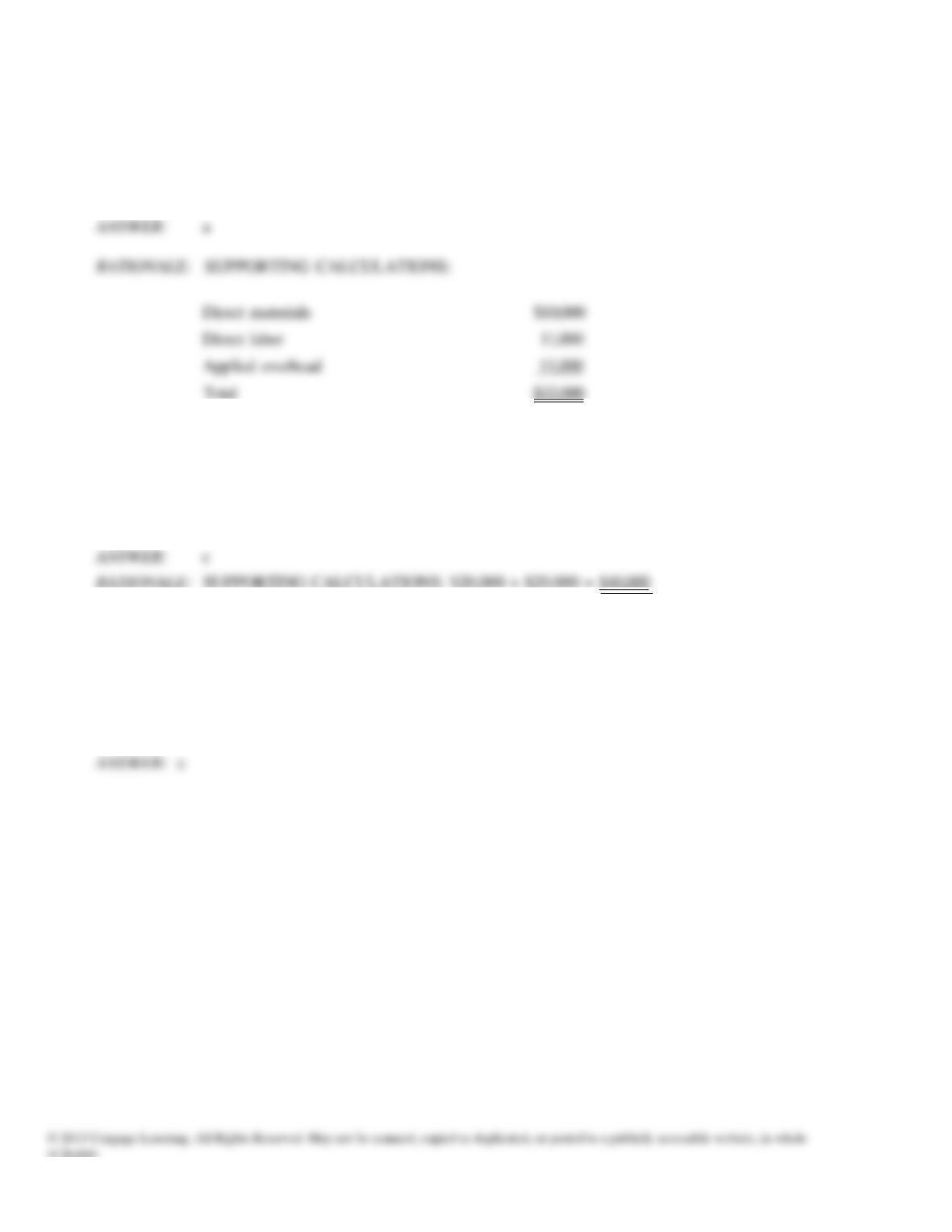
76. Refer to Figure 6-4. What are the “total costs to account for” in the Assembly Department?
a. $32,000
b. $44,500
c. $21,000
d. $10,000
77. Refer to Figure 6-4. What are the conversion costs in the Finishing Department?
a. $35,000
b. $37,500
c. $40,000
d. $57,500
78. When conversion costs are uniform,
a. materials, labor, and overhead are applied at different rates throughout the process.
b. materials, labor, and overhead are added throughout the process at the same rate.
c. labor and overhead are added at the same rate but different materials are added at a different point.
d. materials and labor are added at the same rate but overhead is applied uniformly.
Chapter 6: Process Costing
Figure 6-5
Maynard Inc. manufactures desks. The following data was given for production in February:
units, beginning work in process 0
units started 200
units completed ?
units, ending work in process (40% complete) 50
79. Refer to figure 6-5. What were the total number of units to account for?
a. 50
b. 150
c. 200
d. 400
e. none of the above
80. Refer to Figure 6-5. How many units were completed?
a. 400
b. 200
c. 150
d. 50
e. none of the above
Chapter 6: Process Costing
81. Refer to Figure 6-5. What are the equivalent units?
a. 200
b. 170
c. 180
d. 150
e. none of the above
82. Refer to Figure 6-5. If a total of $11,050 in production costs were incurred, what is the unit cost in February?
a. $65
b. $55.25
c. $73.67
d. $221
e. none of the above
Chapter 6: Process Costing
83. Refer to Figure 6-5. If a total of $11,050 in production costs were incurred, how much cost is assigned to the units
completed?
a. $11,050
b. $3.250
c. $8,287.50
d. $9,750
e. none of the above
84. “Total costs to account for” does NOT include which of the following costs?
a. direct materials requisitioned for the department
b. prior department costs transferred in
c. ending work–in–process balance
d. beginning work-in–process balance
Chapter 6: Process Costing
Figure 6-6
Mannassass Company manufactures chairs. The following information was given for the company:
units, beginning work in process
0
units started
20,000
units completed
?
units, ending work in process
5,000
cost of direct materials
$440,000
cost of conversion
$64,000
Materials in the ending inventory were 100 percent complete and conversion in the ending inventory was 20 percent
complete.
85. Refer to Figure 6-6. What are the units started and completed?
a. 20,000
b. 10,000
c. 15,000
d. 40,000
e. none of the above