46) People with high cholesterol levels often take drugs in an attempt to lower their cholesterol
levels. One such drug is Lipitor. How does this drug work?
A) It enhances the activity of enzymes that help break down cholesterol in the body.
B) It prevents cholesterol from the diet from being absorbed in the small intestine.
C) It acts as a competitive inhibitor by binding to the active site of enzymes that normally
produce cholesterol.
D) It increases the activation energy of enzymes needed to produce cholesterol.
47) What mechanism is used to finely tune enzyme activity according to the needs of the cell?
A) competitive inhibition
B) coupled reactions
C) enzyme specificity
D) allosteric regulation
48) Which of the following is true of allosteric enzymes?
A) Their activity can be reduced when the product binds the enzyme.
B) Their activity can be reduced when the substrate binds the enzyme.
C) Their coenzyme is removed when the product binds the enzyme.
D) Their activity can be increased by competitive inhibitors.
49) Why is allosteric regulation important to a cell?
A) It allows the cell to control how much of a metabolic product is produced.
B) It allows the cell to switch to other sources of energy besides ATP.
C) It reduces the cell’s need for coenzymes.
D) It allows the cell to control how much activation energy is required for enzymatic reactions.
50) In allosteric enzyme regulation, which of the following is false about the molecules that can
inhibit enzyme activity?
A) They can cause the active site to have a poor shape for binding substrate.
B) They can increase substrate binding.
C) They cause a change in the enzyme’s shape.
D) They can bind to a site other than the active site.
51) When a product binds to an allosteric enzyme to slow its reaction, it does which of the
following?
A) binds to the active site, blocking the binding of substrate
B) binds to a site other than the active site, changing the shape of the active site and decreasing
the binding of substrate
C) binds to the substrate, blocking its binding of the active site
D) binds to the product production site, stopping the production of product
52) It is possible for a cell to harvest 100 percent of the energy from a chemical reaction to
produce movement.
53) Endergonic reactions release energy.
54) Cells can harvest the energy released during exergonic reactions to drive endergonic
reactions.
55) Only eukaryotic cells depend on ATP.
56) Given enough time, sucrose can spontaneously break down into fructose and glucose in a
glass of water.
57) Enzymes themselves are altered in the process of catalyzing chemical transformations.
58) Enzymes increase the activation energy needed for a particular reaction.
59) Allosteric regulation depends on inhibitors binding to the active site of enzymes.

Match the following.
A) thermodynamics
B) coupled reaction
C) endergonic reaction
D) exergonic reaction
E) bioenergetics
F) activation energy
G) ATP
60) Links the study of energy to life
Topic: Section 6.2
Skill: Knowledge/Comprehension
61) The study of energy
Topic: Section 6.2
Skill: Knowledge/Comprehension
62) The breakdown of large molecules into smaller ones, with the release of energy
Topic: Section 6.3
Skill: Knowledge/Comprehension
63) The building of larger molecules, requiring energy
Topic: Section 6.3
Skill: Knowledge/Comprehension
64) Using the energy from the breakdown of molecules to fuel the construction of new molecules
Topic: Section 6.3
Skill: Knowledge/Comprehension
65) A source of chemical energy for metabolic processes
Topic: Section 6.4
Skill: Knowledge/Comprehension
66) The energy required to initiate a chemical reaction
Topic: Section 6.6
Skill: Knowledge/Comprehension
67) The study of the thermodynamics of biology is known as ________.
68) A reaction that requires the input of energy to move forward is ________.
69) A ________ is a set of enzymatically controlled steps that results in the completion of a
product or process in an organism.
70) Molecules that facilitate the work of enzymes by binding with them are ________.
71) The regulation of an enzyme’s activity by means of a molecule binding to a site on the
enzyme other than its active site is called ________.
72) It has been hypothesized that, if the sun disappeared, all life would end. Other than the
obvious drop in temperature, why would humans probably die if the sun suddenly stopped
shining?
73) You have been asked to explain to a high school class the first law of thermodynamics and
how this law affects the students’ lives. Using your own words, describe the first law of
thermodynamics, and give an example (other than the examples described in the chapter).
74) You have been asked to explain to a high school class the second law of thermodynamics
and how this law affects the students’ lives. Using your own words, describe the second law of
thermodynamics, and give an example (other than the examples described in the chapter).
75) A ripped piece of paper will never spontaneously repair itself. Explain the law of
thermodynamics that explains why this is so.
76) Explain why it takes energy to create starch from glucose, but it does not take energy to
create glucose from starch. In your explanation, describe the law of thermodynamics that
explains this, and describe how.
77) Would ATP be the energy currency of the cell if the phosphate groups the cell contains were
not charged? Why or why not?
78) Explain why enzymes are involved in exergonic reactions, such as lactose breaking down
into glucose and galactose, and whether these reactions can occur spontaneously.
79) Individuals with the genetic disease phenylketonuria (PKU) lack a single enzyme called
phenylalanine hydroxylase, which converts the amino acid phenylalanine to the amino acid
tyrosine. If this conversion does not happen, phenylalanine builds up and becomes toxic to the
central nervous system, causing serious problems for the individual. The management of this
disease is to avoid phenylalanine by severely limiting the amount of protein in the diet. How
would this help?
80) Explain how vitamins play a role in cellular metabolism.
81) Phosphofructokinase is an enzyme involved in glycolysis, which is a metabolic pathway
involved in ATP production. It can be allosterically regulated by both ATP and ADP. Why is
regulating the activity of this enzyme important? Predict what will happen to the rate of reaction
when ATP levels in the cell are high, and predict what will happen when the levels of ADP in the
cell are high.
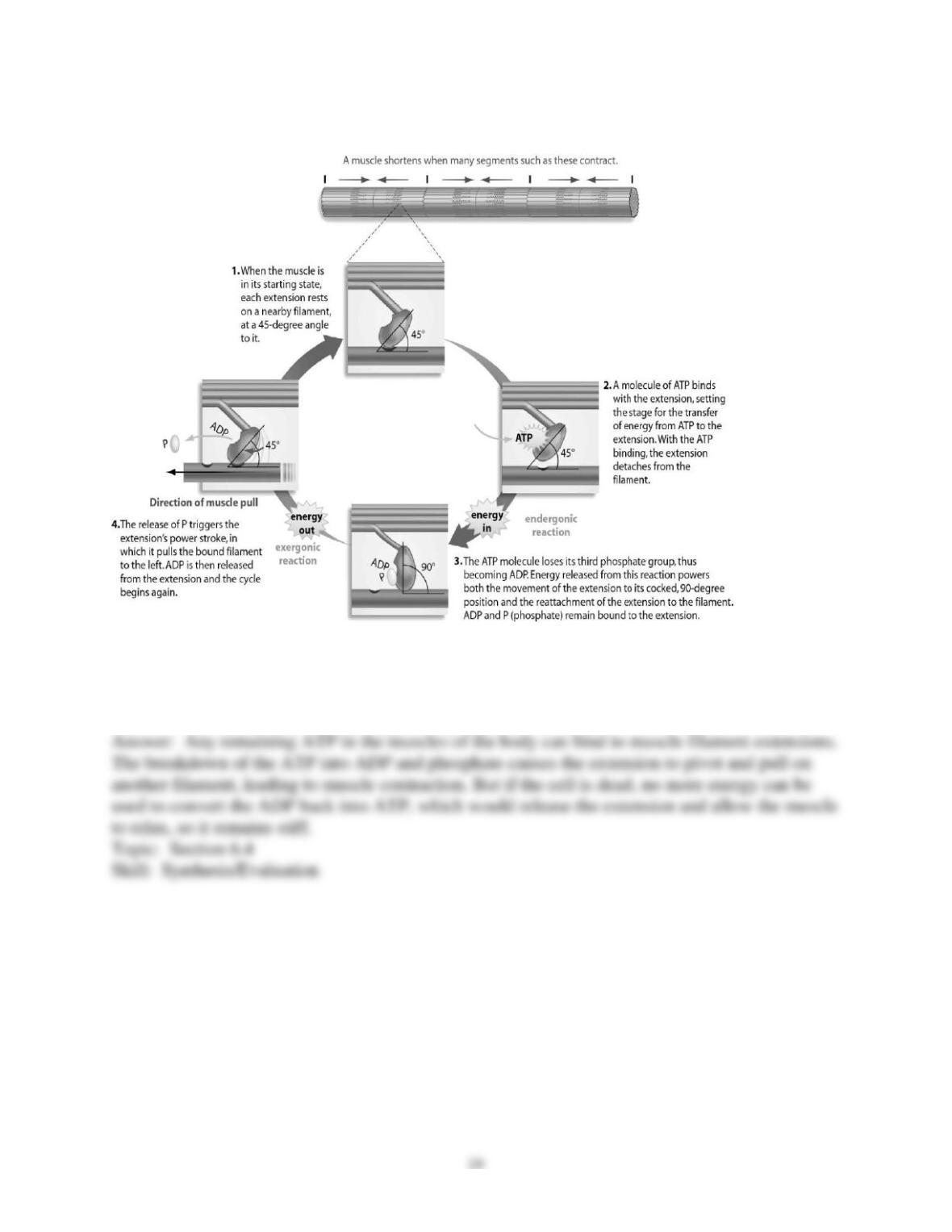
Refer to the figure below, and then answer the question that follows.
82) You have a job as an assistant in a morgue. You are startled (almost to death) when a corpse
that recently came in suddenly sits up and remains very stiff. This muscle contraction and
stiffness in a dead body is known as rigor mortis. Using your knowledge of the ADP/ATP cycle
and its role in muscle contraction, explain why rigor mortis occurs.
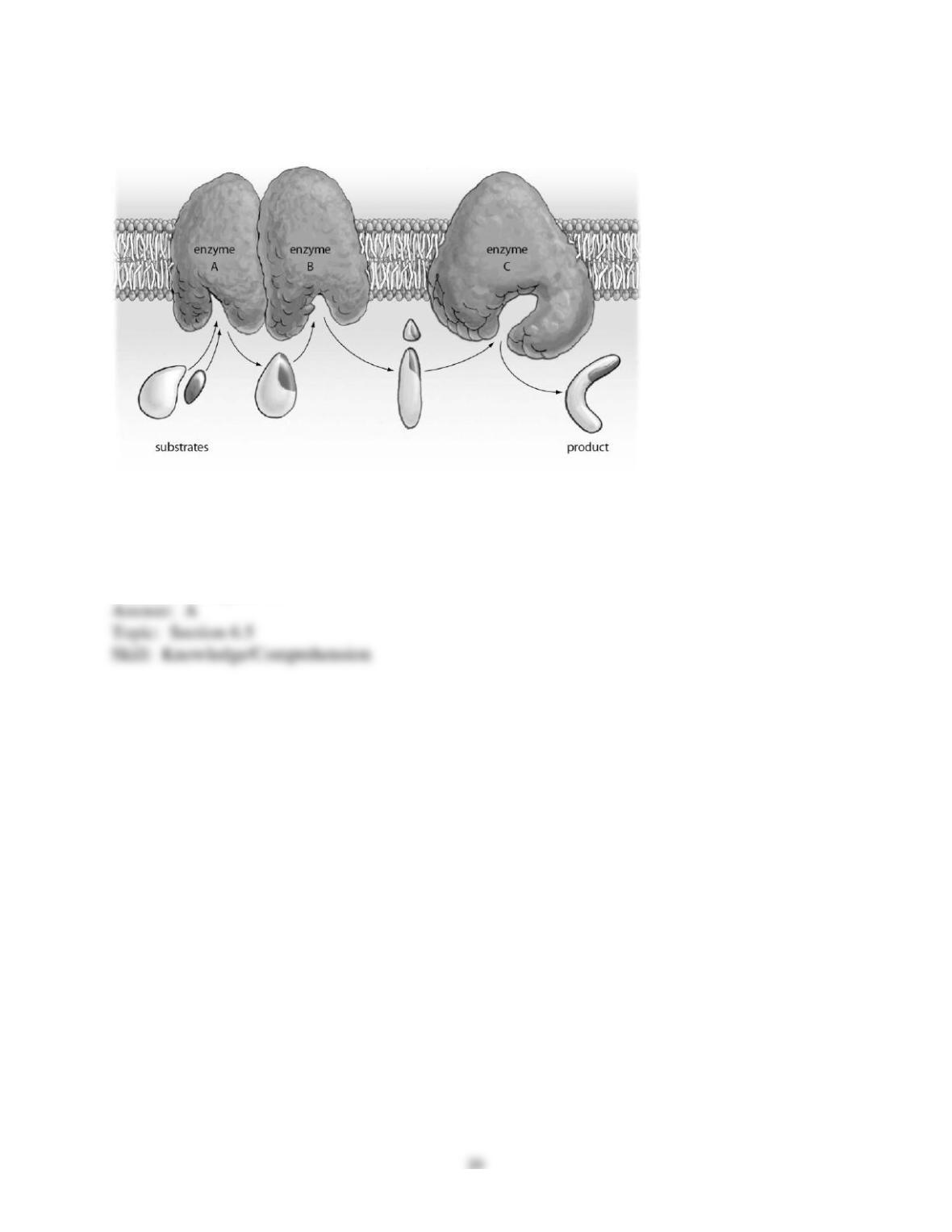
Refer to the figure below, and then answer the question that follows.
83) The figure above represents:
A) a metabolic pathway.
B) lowering activation energy.
C) competitive inhibition.
D) allosteric regulation.
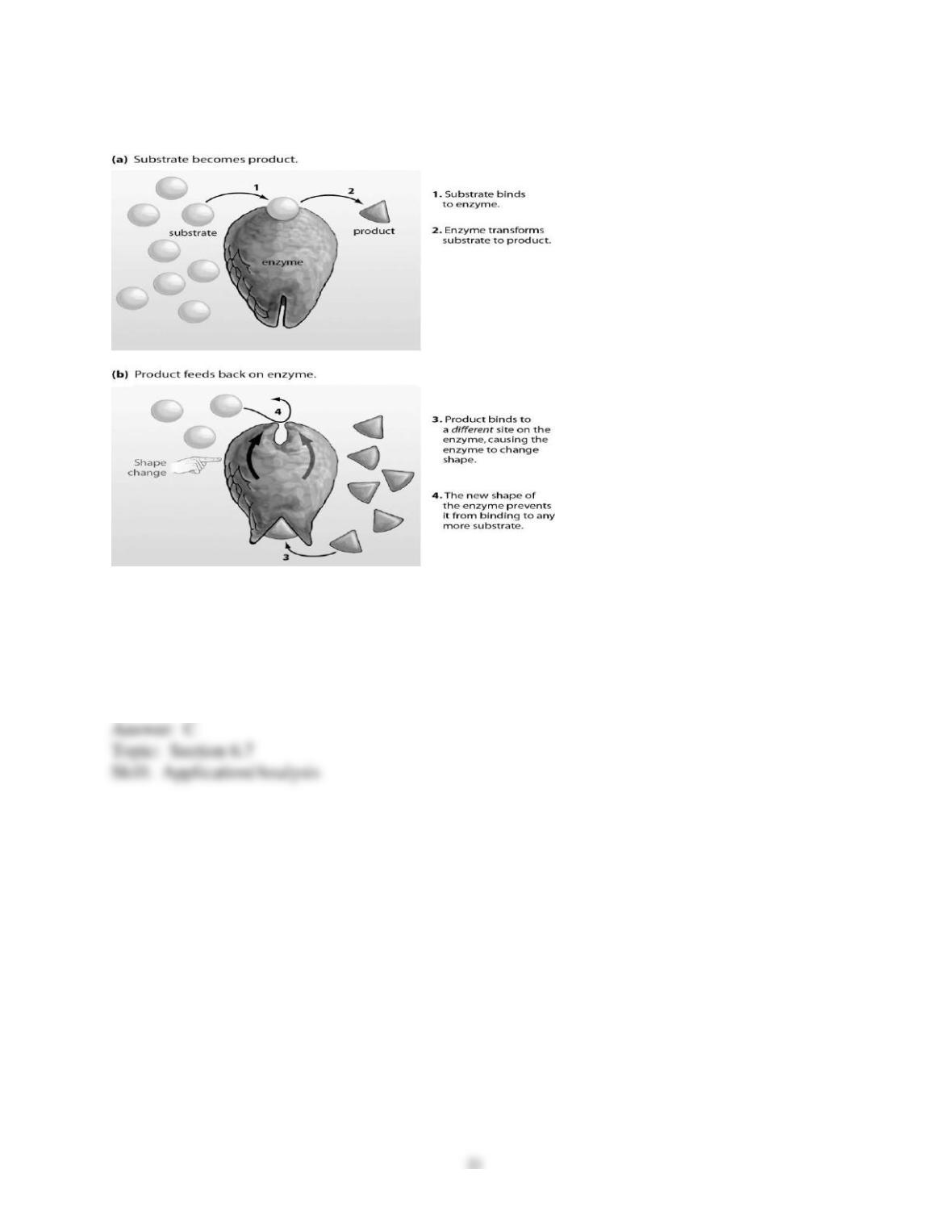
Refer to the figure below, and then answer the question that follows.
84) The figure above represents allosteric inhibition. Based on the figure, what could be done to
allow the enzyme to function again?
A) add more enzyme
B) add more substrate
C) remove some of the product
D) remove some of the substrate