Larson_Calculus_10e ch06sec02
MULTIPLE CHOICE
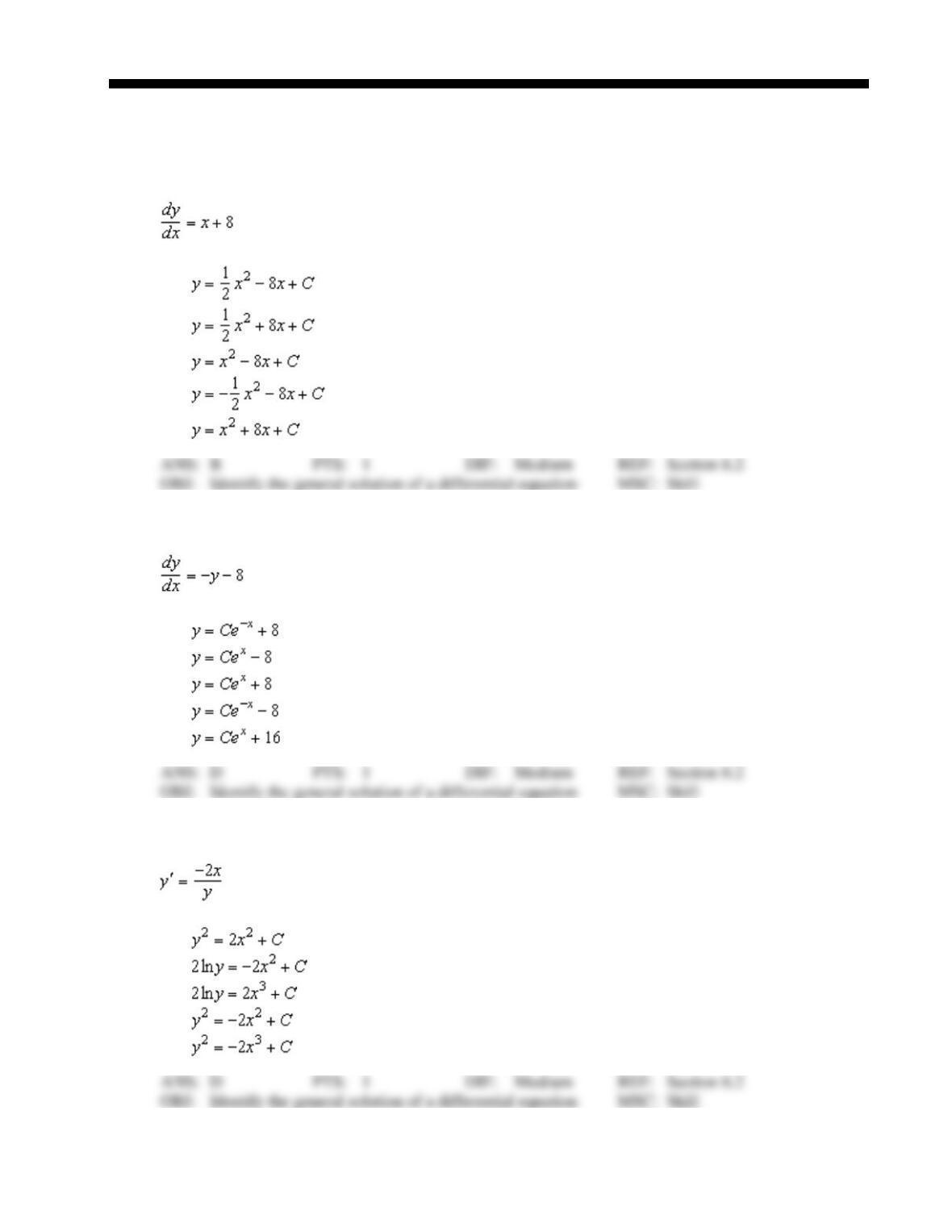
1. Solve the differential equation.
a.
b.
c.
d.
e.
2. Solve the differential equation.
a.
b.
c.
d.
e.
3. Solve the differential equation.
a.
b.
c.
d.
e.
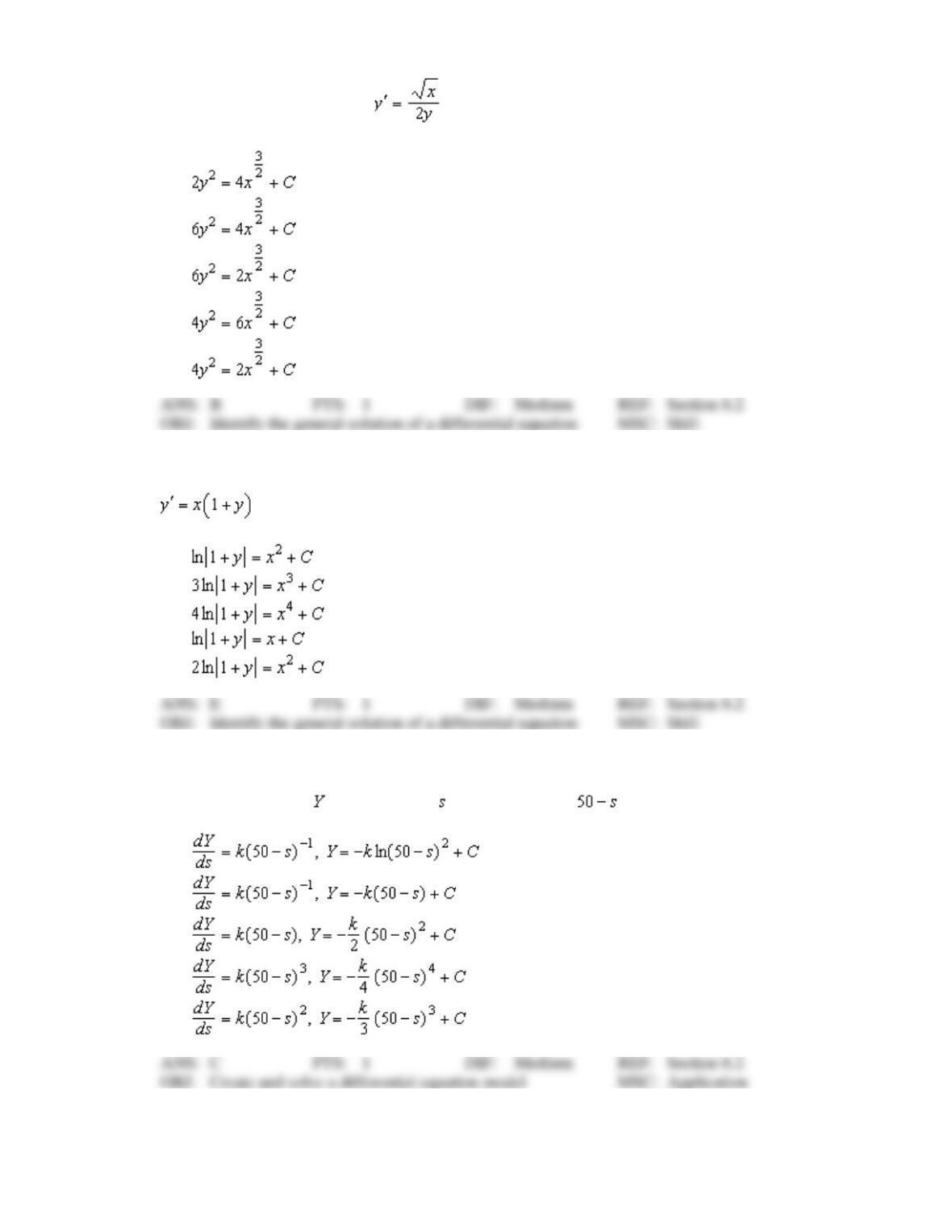
4. Solve the differential equation .
a.
b.
c.
d.
e.
5. Solve the differential equation.
a.
b.
c.
d.
e.
6. Write and solve the differential equation that models the following verbal statement:
The rate of change of with respect to is proportional to .
a.
b.
c.
d.
e.
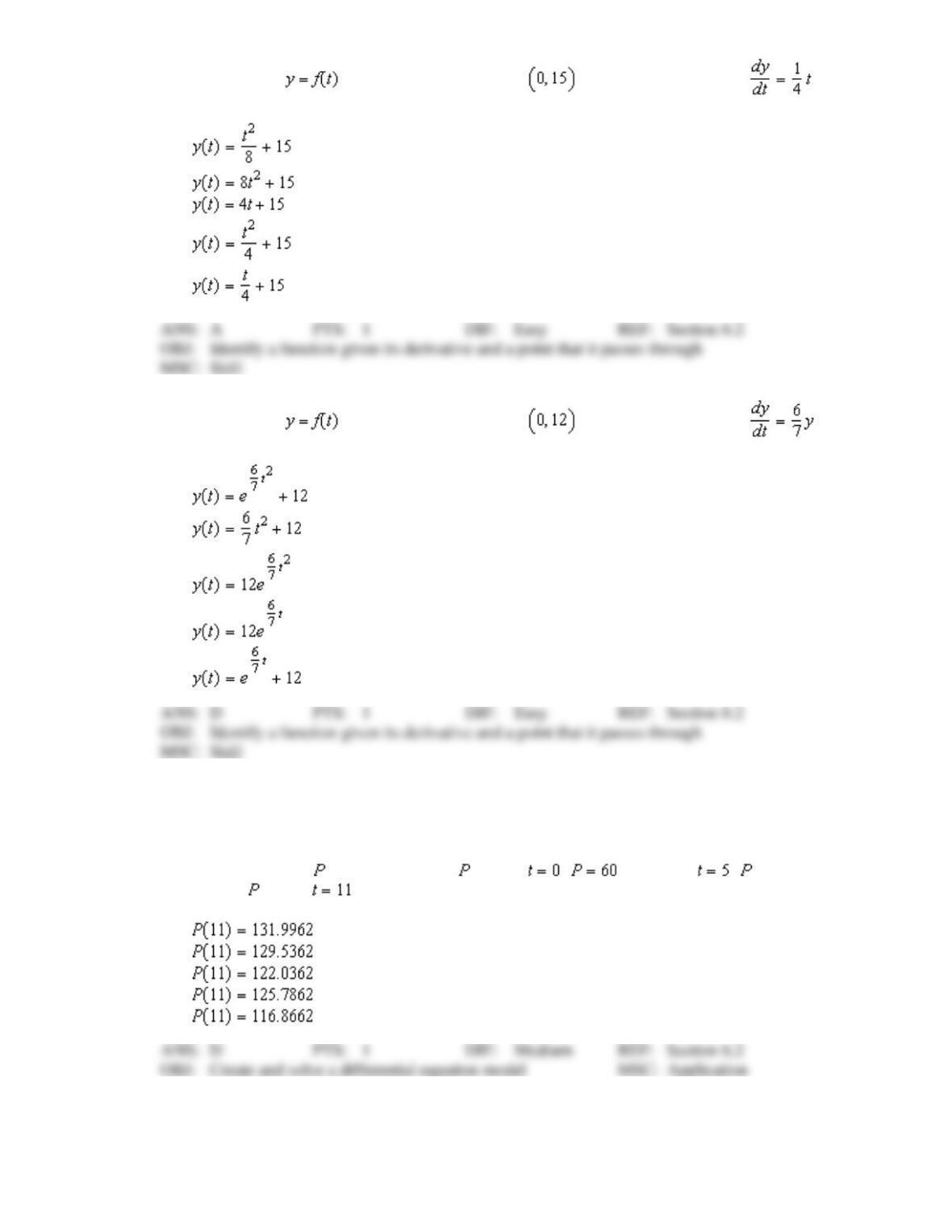
7. Find the function passing through the point with the first derivative .
a.
b.
c.
d.
e.
8. Find the function passing through the point with the first derivative .
a.
b.
c.
d.
e.
9. Write and solve the differential equation that models the following verbal statement. Evaluate the
solution at the specified value of the independent variable, rounding your answer to four decimal
places:
The rate of change of is proportional to . When , and when , = 84. What is
the value of when ?
a.
b.
c.
d.
e.
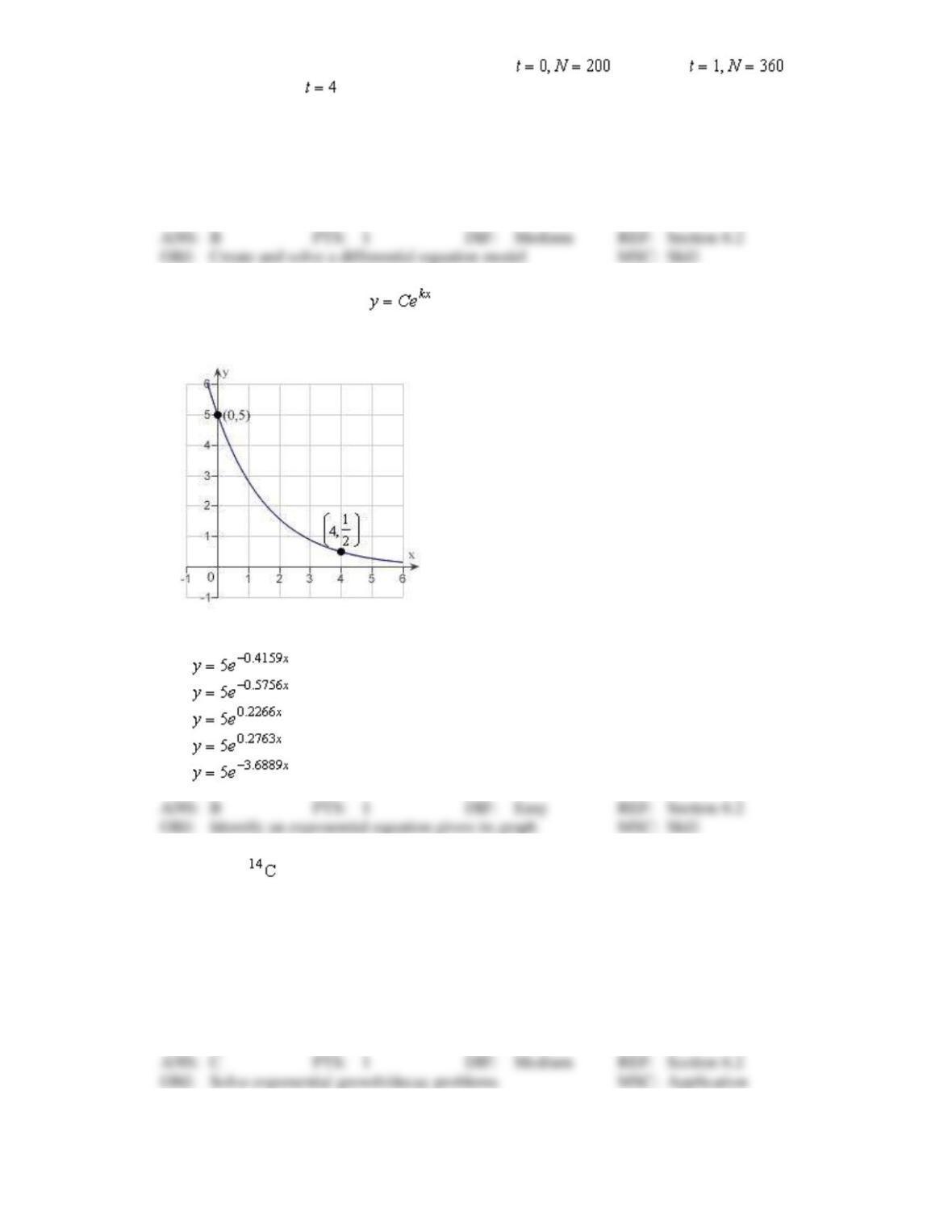
10. The rate of change of N is proportional to N. When and when . What is
the value of N when ? Round your answer to three decimal places.
a.
2,129.520
b.
2,099.520
c.
2,049.520
d.
491.383
e.
262,440.000
11. Find the exponential function that passes through the two given points. Round your values
of C and k to four decimal places.
a.
b.
c.
d.
e.
12. The isotope has a half-life of 5,715 years. Given an initial amount of 11 grams of the isotope,
how many grams will remain after 500 years? After 5,000 years? Round your answers to four decimal
places.
a.
7.2469 gm, 4.1988 gm
b.
6.2117 gm, 3.5989 gm
c.
10.3528 gm, 5.9982 gm
d.
4.1411 gm, 2.3993 gm
e.
12.4233 gm, 7.1979 gm
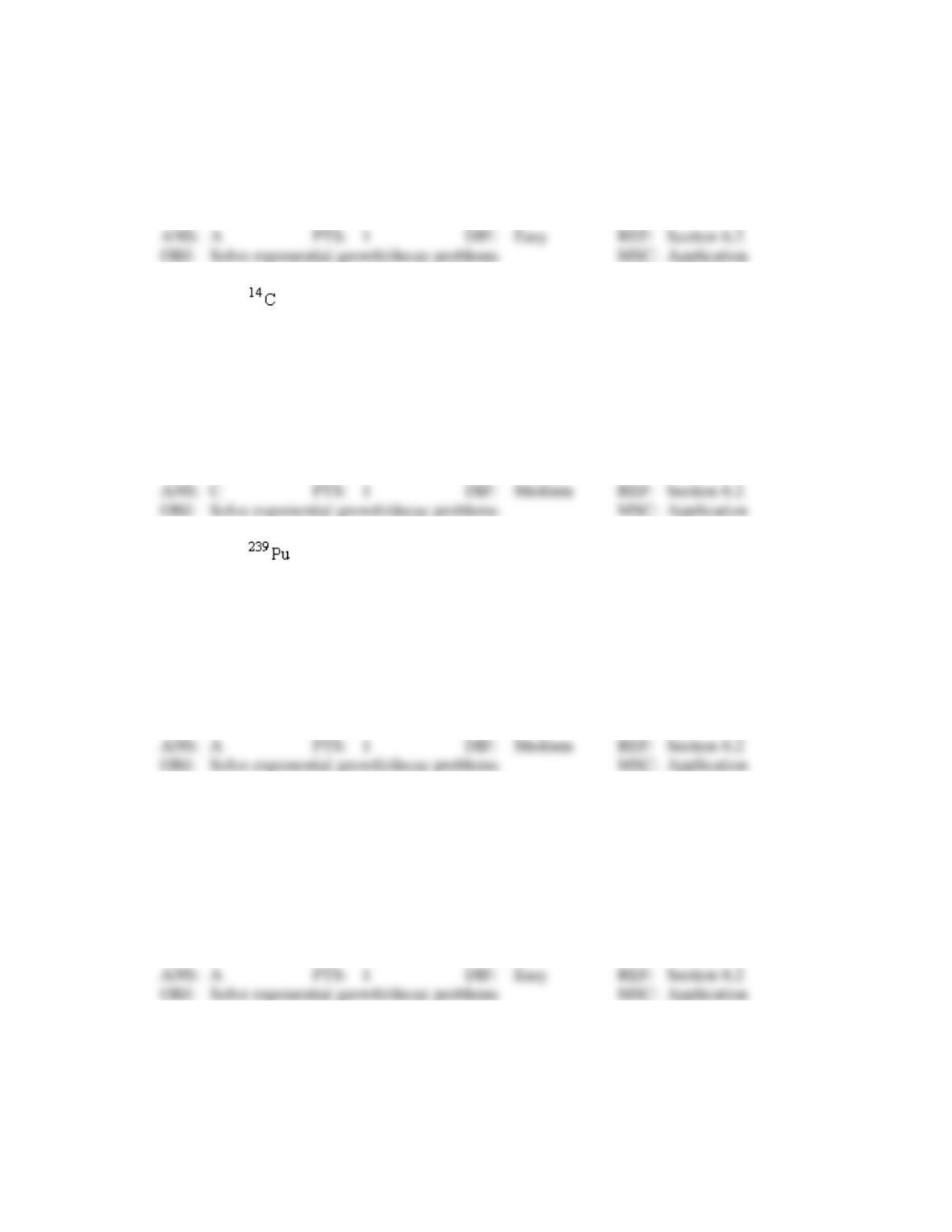
13. The half-life of the radium isotope Ra-226 is approximately 1,599 years. If the initial quantity of the
isotope is 38 g, what is the amount left after 1,000 years? Round your answer to two decimal places.
a.
24.63 g
b.
30.60 g
c.
25.13 g
d.
11.88 g
e.
12.32 g
14. The isotope has a half-life of 5,715 years. After 2,000 years, a sample of the isotope is reduced to
1.2 grams. What was the initial size of the sample (in grams)? How much will remain after 20,000
years (i.e., after another 18000 years)? Round your answers to four decimal places.
a.
1.0706 , 0.0947
b.
2.4471 , 0.2164
c.
1.5294 , 0.1352
d.
2.1412 , 0.1893
e.
1.9883 , 0.1758
15. The isotope has a half-life of 24,100 years. After 10,000 years, a sample of the isotope is
reduced 1.6 grams. What was the initial size of the sample (in grams)? How large was the sample after
the first 1,000 years? Round your answers to four decimal places.
a.
2.1332 , 2.0727
b.
2.7731 , 2.6945
c.
1.2799 , 1.2436
d.
1.7065 , 1.6582
e.
1.0666 , 1.0364
16. The half life of the radium isotope Ra-226 is approximately 1,599 years. If the amount left after 1,000
years is 1.8 g, what is the amount after 2000 years? Round your answer to three decimal places.
a.
1.167 g
b.
0.939 g
c.
1.800 g
d.
0.490 g
e.
2.334 g
17. The half-life of the radium isotope Ra-226 is approximately 1,599 years. What percent of a given
amount remains after 800 years? Round your answer to two decimal places.
a.
70.70 %
b.
5.71 %
c.
72.70 %
d.
25.02 %
e.
0.71 %
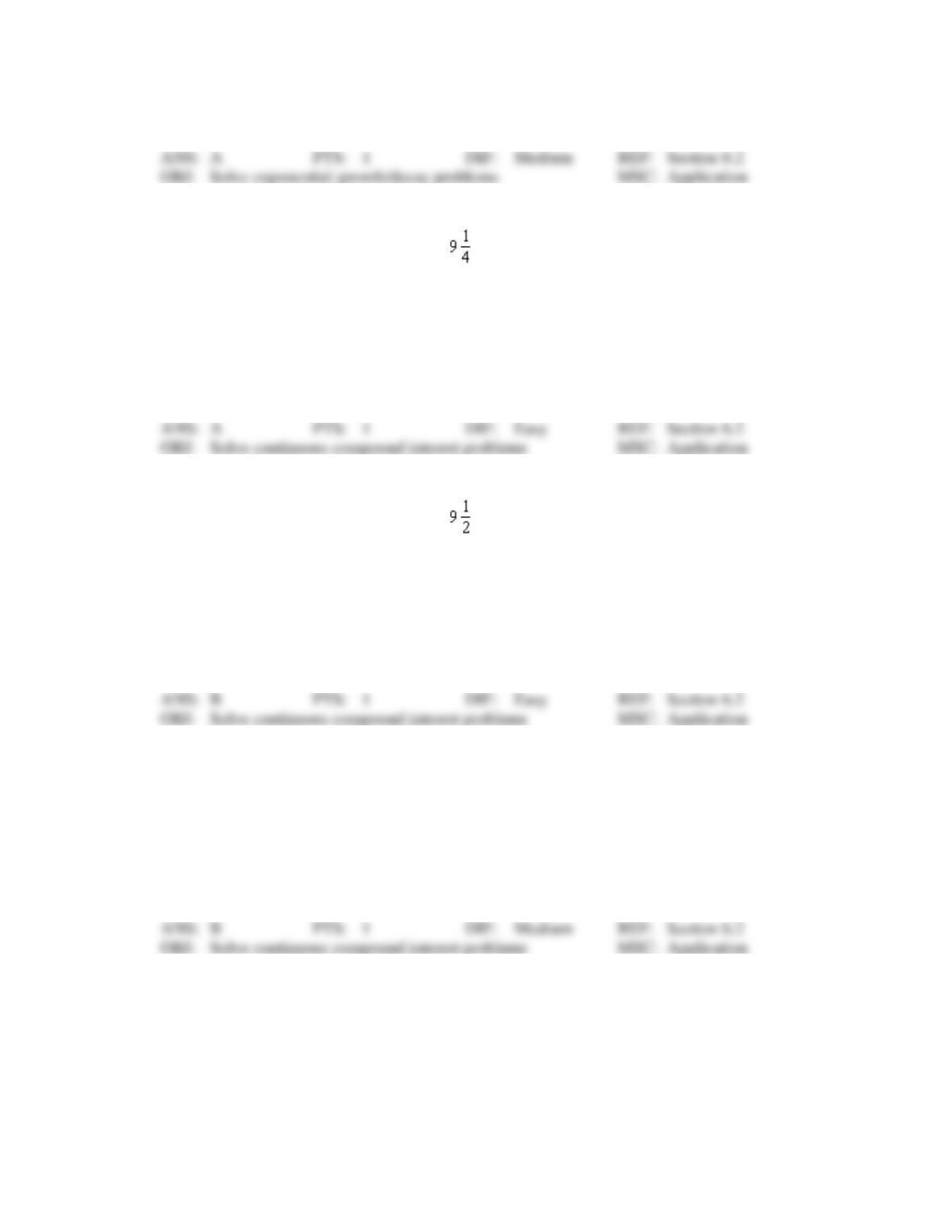
18. The initial investment in a savings account in which interest is compounded continuously is $813. If
the time required to double the amount is years, what is the annual rate? Round your answer to
two decimal places.
a.
7.49 %
b.
7.70 %
c.
13.34 %
d.
6.29 %
e.
8.89 %
19. The initial investment in a savings account in which interest is compounded continuously is $604. If
the time required to double the amount is years, what is the amount after 15 years? Round your
answer to the nearest cent.
a.
$1,917.58
b.
$1,804.46
c.
$1,907.37
d.
$1,404.46
e.
$8,278.18
20. Find the principal that must be invested at the rate 8%, compounded monthly, so that $1,000,000 will
be available for retirement in 50 years. Round your answer to the nearest cent.
a.
$250,000.00
b.
$18,560.39
c.
$717,324.37
d.
$333,333.33
e.
$21,321.23
21. Find the time (in years) necessary for 1,000 to double if it is invested at a rate 6% compounded
continuously. Round your answer to two decimal places.
a.
1.16 years
b.
11.55 years
c.
1.39 years
d.
11.90 years
e.
11.58 years
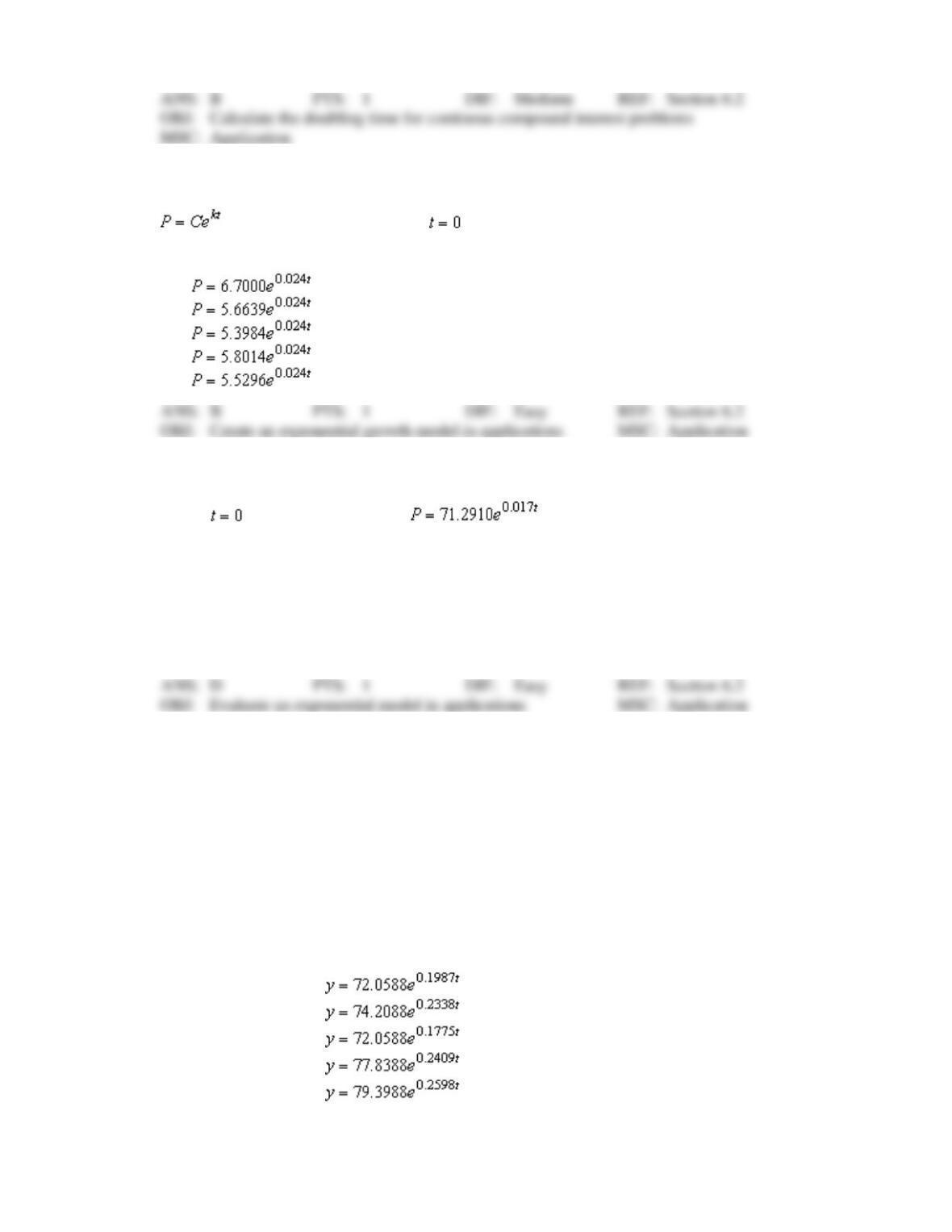
22. Suppose that the population (in millions) of Paraguay in 2007 was 6.7 and that the expected
continuous annual rate of change of the population is 0.024. Find the exponential growth model
for the population by letting correspond to 2000. Round your answer to four decimal
places.
a.
b.
c.
d.
e.
23. Suppose that the population (in millions) of a Egypt in 2007 is 80.3 and that expected continuous
annual rate of change of the population is 0.017. The exponential growth model for the population by
letting corresponds to 2000 is . Use the model to predict the population of the
country in 2013. Round your answer to two decimal places.
a.
83.08 million
b.
87.42 million
c.
90.45 million
d.
88.92 million
e.
81.68 million
24. The number of bacteria in a culture is increasing according to the law of exponential growth. After 5
hours there are 175 bacteria in the culture and after 10 hours there are 425 bacteria in the culture.
Answer the following questions, rounding numerical answers to four decimal places.
(i) Find the initial population.
(ii) Write an exponential growth model for the bacteria population. Let t represent time in hours.
(iii) Use the model to determine the number of bacteria after 20 hours.
(iv) After how many hours will the bacteria count be 15,000?
a.
(i) 72.0588 ; (ii) ; (iii) 3,819.3668 ; (iv) 32.4162 hr
b.
(i) 74.2088 ; (ii) ; (iii) 5,194.0840 ; (iv) 34.6442 hr
c.
(i) 72.0588 ; (ii) ; (iii) 2,506.6327 ; (iv) 30.0817 hr
d.
(i) 77.8388 ; (ii) ; (iii) 7,945.5374 ; (iv) 36.7554 hr
e.
(i) 79.3988 ; (ii) ; (iii) 10,598.0009 ; (iv) 38.5348 hr
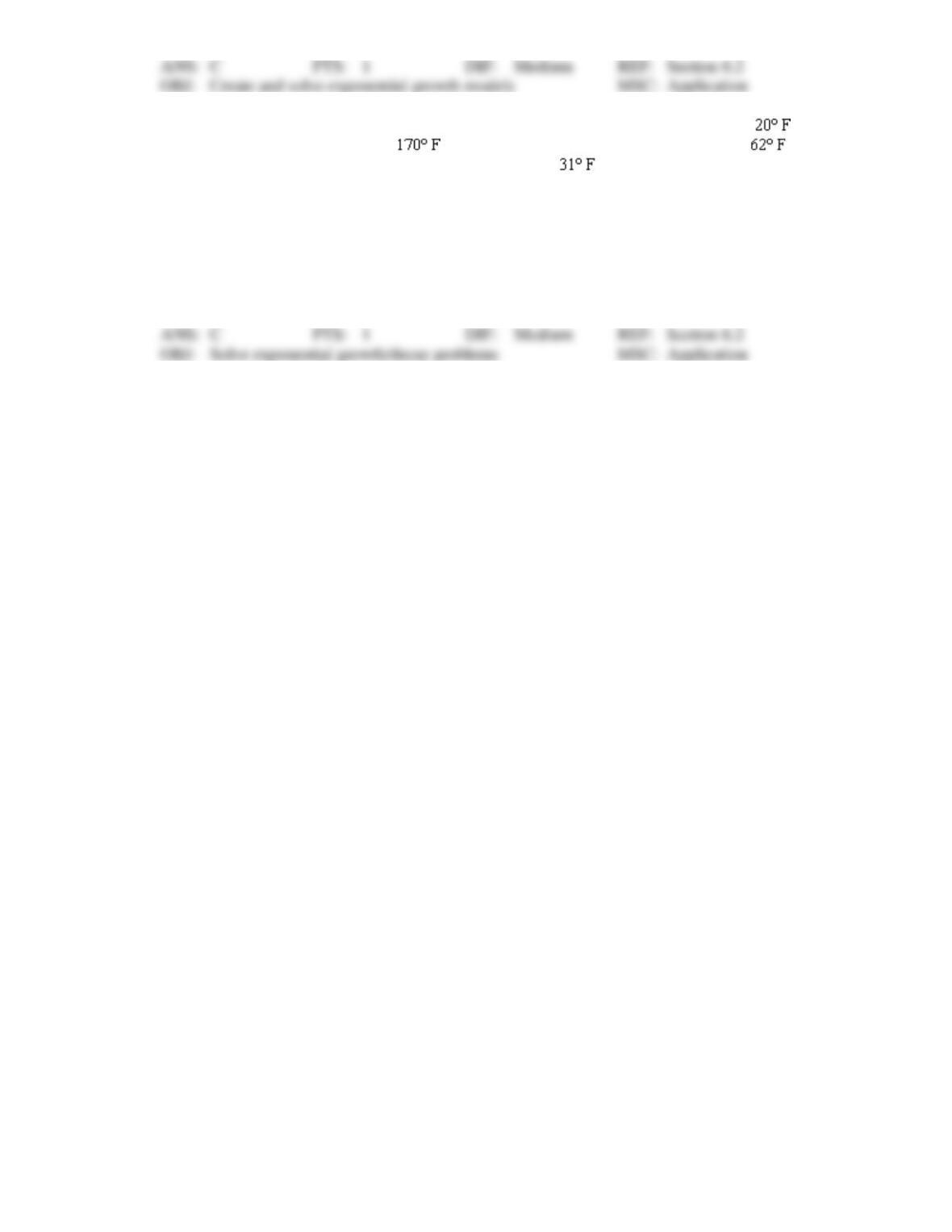
25. A container of hot liquid is placed in a freezer that is kept at a constant temperature of . The
initial temperature of the liquid is . After 3 minutes, the liquid’s temperature is . How
much longer will it take for its temperature to decrease to ? Round your answer to two decimal
places.
a.
1.89 minutes
b.
2.84 minutes
c.
3.16 minutes
d.
1.26 minutes
e.
3.47 minutes