
Chapter 6: Waves and Sound
TRUE/FALSE
1. The flash from a camera is an example of a continuous wave.
2. The number of cycles of a wave passing a point per unit time is the wave’s period.
3. The distance between two successive ‘like’ points on a wave is the wave’s wavelength.
4. The maximum displacement of points on a wave from the equilibrium position is the wave’s
wavelength.
5. The wavelength of a wave divided by the frequency of the wave is the wave’s speed.
6. When the frequency of the source of a water wave increases, the distance between
successive peaks in the wave increases.
7. When the frequency of the source of a water wave increases, the speed of the waves
traveling in the water increases.
8. A water wave is an example of a transverse wave.
9. A sound wave in a metal bar is an example of a longitudinal wave.
10. Sound in a vacuum is impossible.
11. Regions of a longitudinal wave where the particles of the medium are squeezed together are
called compressions.
12. Waves carry energy.
13. The speed of a wave is the same as the speed of the particles displaced by the wave.
14. You have two ropes of the same length. The mass of the second rope is twice the mass of
the first rope. The velocity of a wave in the second rope is times the velocity of a
wave in the first rope.
15. You pull on a rope with a certain force, and a wave travels in the rope with a certain
velocity. If you double your force, the velocity of a wave in the rope is now times the
original velocity.
16. You have two identical ropes stretched with the same force between two different sets of
posts. The second rope is twice as long as the first rope. The velocity of a wave in the
second rope is half the velocity of a wave in the first rope.
17. A wave moves in a rope with a certain wavelength. A second wave is made to move in the
same rope with twice the wavelength of the first wave. The frequency of the second wave is
half the frequency of the first wave.

18. If the source moves away from you, the frequency you hear is lower than f.
19. If you run towards the source, the frequency you hear is lower than f.
20. If the source moves away from you, and at the same time you run away from the source, the
frequency you hear is the same as f.
21. If the temperature of the air rises, the frequency you hear is higher than f.
22. If the source moves away from you faster than the speed of sound in air, you do not hear any
frequency but instead a ‘sonic boom.’
23. Sound cannot travel through solid steel.
24. If the source moves, the wavelength of the sound in front of the direction of motion is
smaller than the wavelength behind the direction of motion.
25. You can hear sound through an open window from sources that are not in your line of sight
because of diffraction.
26. When two identical waves arrive at the same place in phase, there is destructive
interference.
27. Two speakers in a stereo emit identical pure tones. As you move around in front of the
speakers, you hear the sound alternating between loud and zero. This occurs because of
diffraction.
28. In order for two waves to interfere completely destructively, they must have the same
amplitude.

29. As you move farther away from a source emitting a pure tone, the frequency of the sound
you hear decreases.
30. Reverberation can both inhibit conversation and enhance music.
31. Reverberation time of a room can be increased by covering the walls with better reflectors
of sound.
32. In ultrasound the wavelength of the sound is much smaller than in normal sound.
33. Two uses of ultrasound are navigation by bats and controlling insects.
34. A sound level of 80 dB has twenty times the amplitude of a 60 dB sound.
35. A zero decibel sound level has zero amplitude.
36. Combining two sounds of equal intensity will give a sound level 3 dB higher than the sound
level due to just one of them.
37. A sound with ten times the amplitude of another sound is judged to be ten times as loud.
38. Two identical sound producers will sound twice as loud as just one.
39. Your vocal cords are used to produce all the sounds you make while speaking.

40. Telephones don’t transmit frequencies above 3,400 Hz. Musical notes should sound normal
over the telephone as long as they are below 3,400 Hz.
41. If you increase the linear mass density of a rope, the speed of a wave on the rope also
increases.
42. In the troposphere segment of the Earth’s atmosphere, as you increase in altitude the
temperature decreases. This means the speed of sound decreases as you increase in altitude.
43. For waves moving through the atmosphere at a constant velocity, higher frequency waves
must have proportionally longer wavelengths.
44. Sound waves propagate in two dimensions.
MULTIPLE CHOICE
1. What is meant by a wave medium?
a.
a wave of moderate amplitude
b.
water
c.
air
d.
any material through which a wave travels
2. The number of cycles of a wave passing a point per unit time is the wave’s
a.
speed
b.
frequency
c.
wavelength
d.
amplitude
e.
loudness
3. The distance between two successive ‘like’ points on a wave is the wave’s
a.
speed
b.
frequency
c.
wavelength
d.
amplitude

e.
loudness
4. What is the symbol traditionally used to represent wavelength?
a.
wl
c.
m
b.
y
d.
l
5. The maximum displacement of points on a wave from the equilibrium position is the wave’s
a.
speed
b.
frequency
c.
wavelength
d.
amplitude
e.
loudness
6. The distance between peaks on a wave divided by the time for the wave to travel this
distance is the wave’s
a.
speed
b.
frequency
c.
wavelength
d.
amplitude
e.
loudness
7. The wavelength of a wave multiplied by the frequency of the wave is the wave’s
a.
speed
b.
frequency
c.
wavelength
d.
amplitude
e.
loudness
8. When the frequency of the source of a water wave increases, the distance between
successive peaks in the wave
a.
remains unchanged
b.
increases
c.
decreases
d.
cannot be determined
9. When the frequency of the source of a water wave increases, the speed of the waves
traveling in the water
a.
remains unchanged
b.
increases
c.
decreases
d.
cannot be determined
10. You drop a rock in a pond, and the water waves travel away from the rock with a certain
speed. You drop a heavier rock in the water. The speed of the waves in the water from the
heavier rock
a.
remains unchanged
b.
increases
c.
decreases
d.
cannot be determined
11. If a source of sound is traveling toward you, the speed of the sound waves reaching you is
_______________ the speed the sound waves would have had if the source were stationary.
a.
faster than
b.
slower than
c.
the same as
12. Two sound waves traveling through the air have different frequencies. Consequently, they
must also have different
a.
amplitudes
b.
speeds
c.
wavelengths
d.
all of the above
13. Which of the following can change the frequency of a wave?
a.
interference
b.
the Doppler effect
c.
diffraction
d.
all of the above
14. You pull on a rope with a certain force, and a wave travels in the rope with a certain
velocity. If you double your force, the velocity of a wave in the rope is now ____________
the original velocity.
a.
1/2
b.
times
c.
the same as
d.
times
e.
2 times
15. You have two ropes of the same length. The mass of the second rope is twice the mass of
the first rope. The velocity of a wave in the second rope is ___________ the velocity of a
wave in the first rope.
a.
1/2
b.
times
c.
the same as
d.
times
e.
2 times
16. You have two identical ropes stretched with the same force between two different sets of
posts. The second rope is twice as long as the first rope. The velocity of a wave in the
second rope is ____________ the velocity of a wave in the first rope.
a.
1/2
b.
times
c.
the same as
d.
times
e.
2 times
NARREND
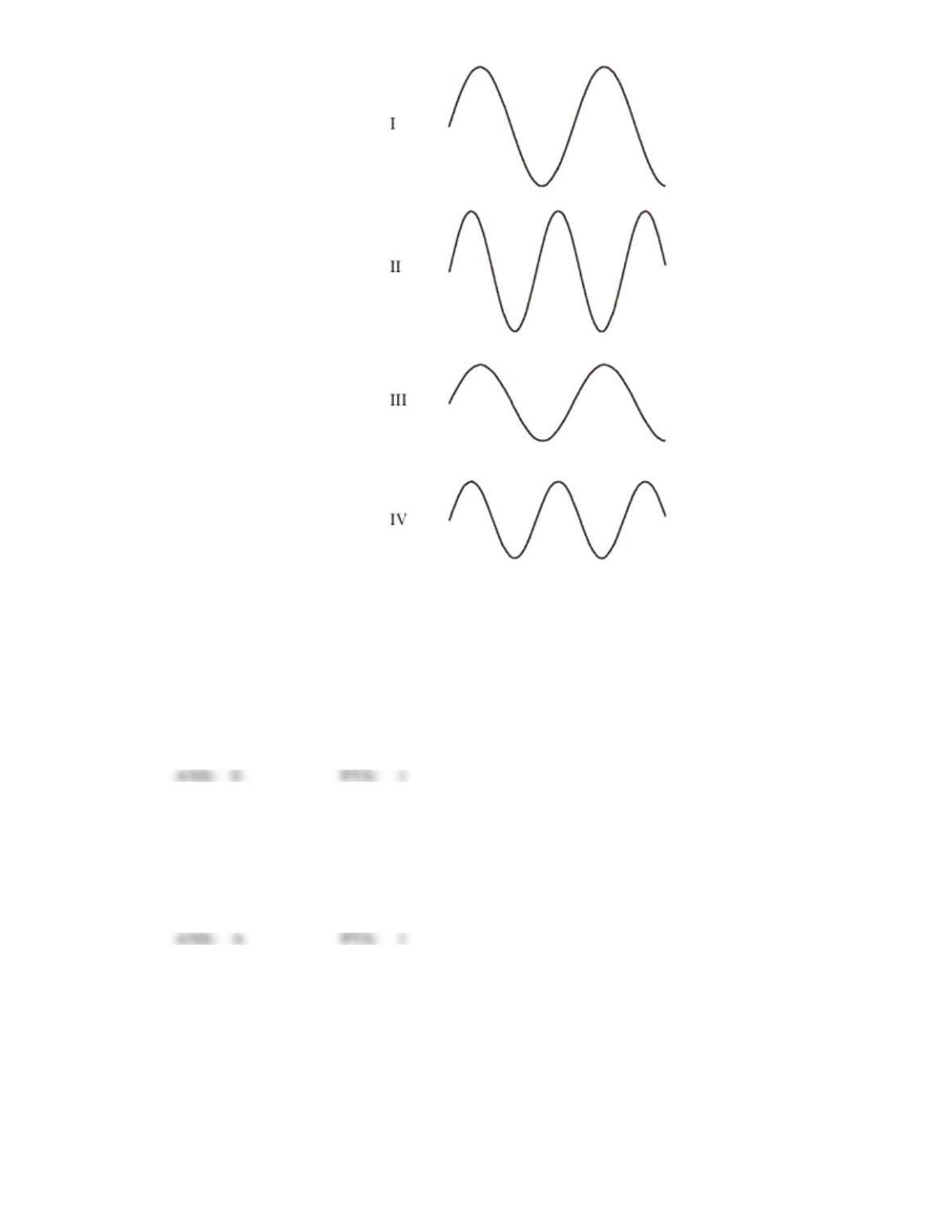
17. The wave where the speed is greatest is
a.
I
b.
II
c.
III
d.
IV
e.
all of the above
18. A wave moves in a rope with a certain wavelength. A second wave is made to move in the
same rope with twice the wavelength of the first wave. The frequency of the second wave is
_______________ the frequency of the first wave.
a.
1/2
c.
2 times
b.
the same as
d.
unrelated to
19. You shout at a cliff, and hear your echo in 2 seconds. If the speed of sound in the air is 340
m/s, the distance of the cliff from you is
a.
85 m
b.
170 m
c.
340 m
d.
680 m

e.
none of the above
20. If the source moves away from you, the frequency you hear is
a.
the same as f
c.
lower than f
b.
higher than f
d.
unrelated to f
21. If you run towards the source, the frequency you hear is
a.
the same as f
c.
lower than f
b.
higher than f
d.
unrelated to f
22. If the source moves away from you, and at the same time you run away from the source, the
frequency you hear is
a.
the same as f
c.
lower than f
b.
higher than f
d.
unrelated to f
23. If the temperature of the air rises, the frequency you hear is
a.
the same as f
c.
lower than f
b.
higher than f
d.
unrelated to f
24. If the source moves away from you faster than the speed of sound in air, the frequency that
you hear is
a.
the same as f
c.
lower than f
b.
higher than f
d.
unrelated to f
25. If the source moves, the wavelength of the sound in front of the direction of motion is
____________ the wavelength behind the direction of motion.
a.
the same as
c.
smaller than
b.
larger than
d.
unrelated to
26. You can hear sound through an open window from sources that are not in your line of sight
because of
a.
interference
b.
diffraction
c.
the sound level

d.
the Doppler effect
e.
none of the above
27. Which of these waves will diffract the most when passing through a 20 cm wide opening in
a barrier?
a.
a wave with a wavelength of 25 cm
b.
a wave with a wavelength of 2 cm
c.
a wave with a wavelength of 0.05 cm
d.
none of these waves will diffract at all
28. When two identical waves arrive at the same place in phase, there is
a.
constructive interference
b.
destructive interference
c.
diffraction
d.
a Doppler effect
e.
a shock wave
29. Two speakers in a stereo emit identical pure tones. As you move around in front of the
speakers, you hear the sound alternating between loud and zero. This occurs because of
a.
interference
b.
changing sound level
c.
diffraction
d.
the Doppler effect
e.
shock waves
30. As you move farther away from a source emitting a pure tone, the ___________ of the
sound you hear decreases.
a.
frequency
b.
period
c.
wavelength
d.
amplitude
e.
none of the above
31. Choose the correct statement.
a.
The perceived pitch of a sound usually doesn’t depend on the sound’s frequency.
b.
The frequency of each musical note is 10 Hz higher than that of the next lower
note.
c.
The decibel is the standard measure of tone quality.
d.
The perceived loudness of a sound depends somewhat on frequency.

32. Which of the following is not one of the ways sound can be used?
a.
to circulate the refrigerant in a refrigerator
b.
to relay information to orbiting satellites
c.
to form images of internal organs
d.
to measure the air temperature aloft
e.
to make a bubble in water produce light
33. In ultrasound the _____________ of the sound is much greater than in normal sound.
a.
frequency
b.
period
c.
wavelength
d.
amplitude
e.
speed
34. Ultrasound is used
a.
to form images of internal organs
b.
by bats to navigate
c.
in automatic focus cameras
d.
to control insects
e.
all of the above
35. The wavelength of ultrasound at 1 million Hz in air where the speed of sound is 340 m/s is
a.
0.00000034 m
b.
0.0000034 m
c.
0.00034 m
d.
0.34 m
e.
340,000,000 m
36. You listen to a live orchestra concert from a cheap seat far away, high up in the balcony.
The music seems to be a little out of sync with the conductor’s beat. Why?
a.
The musicians are paying no attention to the conductor.
b.
You are noticing a time lag due to the finite speed of sound.
c.
The orchestra is not very good.
d.
The viola section is dragging.
37. Doppler radar can
a.
catch speeders
b.
measure the speed of a pitcher’s fastball
c.
detect tornadoes
d.
do all of the above
38. You see a lightning flash and half a second later hear a loud blast of thunder. How far away
did the lightning hit?
a.
about a mile
c.
a tenth of a mile
b.
half a mile
d.
none of the above
39. An echo is a sound wave that has been
a.
diffracted
b.
refracted
c.
reflected
d.
reverberated
e.
amplified
40. The wavelength of the wave shown in this figure is about
a.
2 m
b.
1.75 m
c.
0.33 m
d.
not defined
e.
slightly over 5 m
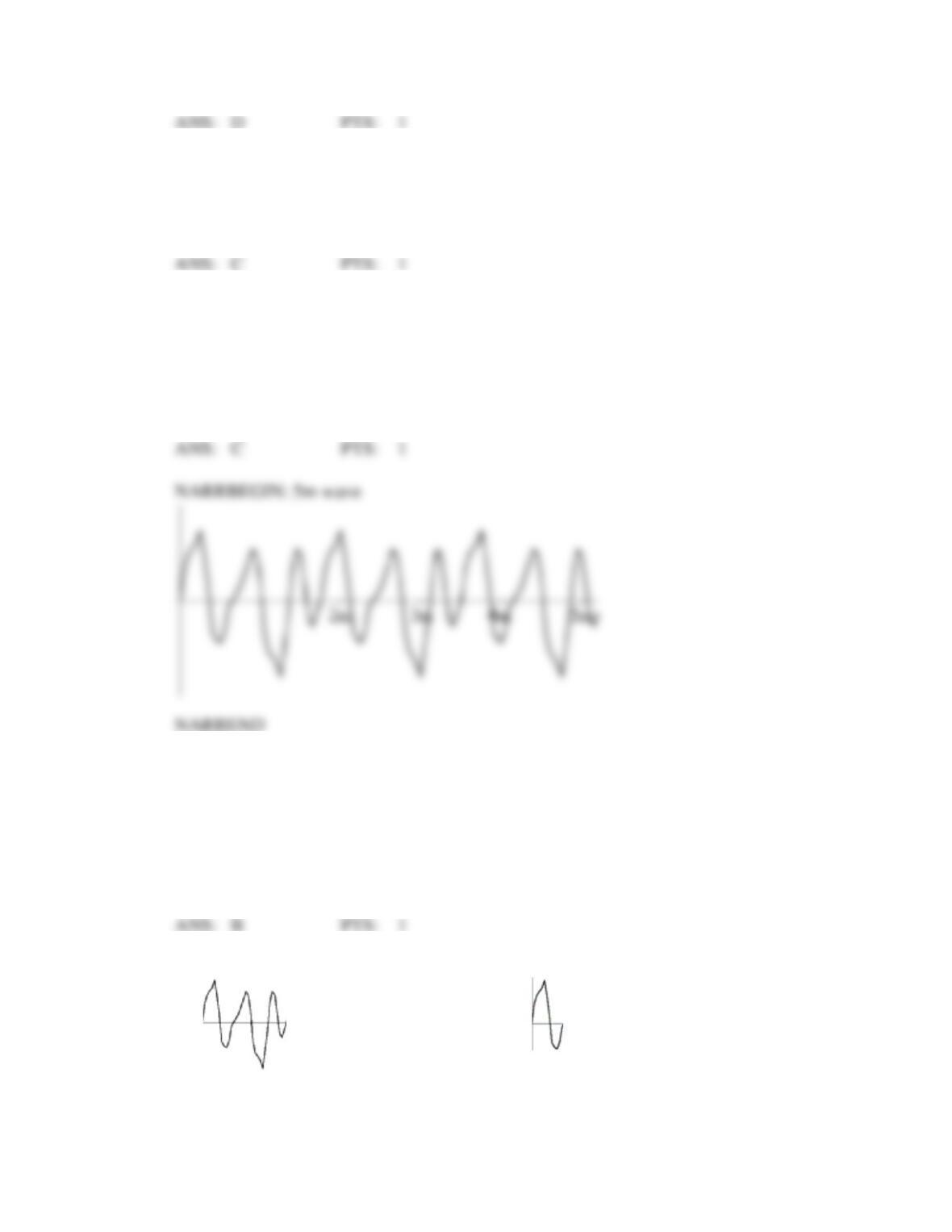
41. Which of these shows one cycle of the wave?
a.
c.