Ch.6 ExponentialandLogarithmicFunctions
6.1 CompositeFunctions
1 FormaCompositeFunction
MULTIPLECHOICE.Choosetheonealternativethatbestcompletesthestatementoranswersthequestion.
Evaluatetheexpressionusingthevaluesgiveninthetable.
1) (f∘g)(3)
x14812
f(x) –38014
x–5–313
g(x) 1–748
A) 0 B) 8 C) 4 D) Undefined
2) (g∘f)(1)
x1610 12
f(x) –110 213
x–5–113
g(x) 1–7610
A) –7B)6 C)
–1D)10
Evaluatetheexpressionusingthegraphsofy=f(x)andy=g(x).
3) Evaluate(fg)(1).
A) 6 B) –5 C) 3 D) 0
Forthegivenfunctionsfandg,findtherequestedcompositefunctionvalue.
4) f(x)=x+2,g(x)=2x; Find(f∘g)(1).
A) 2 B) 2 3 C) 6 D) 2 6
5) f(x)=4x+4,g(x)=4x2+3; Find(f∘f)(2).
A) 52 B) 1447 C) 80 D) 579
Page1

6) f(x)=4x+6,g(x)=4x2+1; Find(f∘g)(4).
A) 266 B) 1937 C) 94 D) 16,901
7) f(x)=7x2–7x ,g(x)=17x–10; Find(f∘g)(12).
A) 262,094 B) 15,698 C) 246,396 D) 179,256
8) f(x)=5x+5
,
g(x)=–1
/
x; Find(g∘f)(3).
A) –1
20 B) 10
3C) –20
3D) 59
3
9) f(x)=x–6
x,g(x)=x2+9; Find(g∘f)(–2).
A) 25 B) 13 C) 145
16 D) 7
13
10) f(x)=2x+4,g(x)=4x2+1; Find(g∘f)(4).
A) 577 B) 28 C) 16,901 D) 134
11) f(x)=15x2–6x,g(x)=18x–9; Find(f∘g)(5).
A) 97,929 B) 6201 C) 91,728 D) 27,945
12) f(t)=t4+30t2+225,g(t)=t+3
3; Find(f∘g)(15).
A) 51 B) 81 C) 2601 D) 1440
Forthegivenfunctionsfandg,findtherequestedcompositefunction.
13) f(x)=5x+11
,
g(x)=3x–1; Find(f∘g)(x).
A) 15x+6 B) 15x+16 C) 15x+10 D) 15x+32
14) f(x)=–6x+9
,
g(x)=2x+8; Find(g∘f)(x).
A) –12x+26 B) –12x+57 C) 12x+26 D) –12x–10
15) f(x)=2
x+5,g(x)=7
5x; Find(f∘g)(x).
A) 10x
7+25x B) 7x+35
10x C) 10x
7–25x D) 2x
7+25x
16) f(x)=x–6
8,g(x)=8x+6; Find(g∘f)(x).
A) x B) 8x+42 C) x+12 D) x–3
4
17) f(x)=5
x–8,g(x)=4
7x; Find(f∘g)(x).
A) 35x
4–56x B) 4x–32
35x C) 35x
4+56x D) 5x
4–56x
Page2
18) f(x)=x–5
4,g(x)=4x+5; Find(g∘f)(x).
A) x B) 4x+15 C) x+10 D) x–5
4
19) f(x)=x+10,g(x)=8x–14; Find(f∘g)(x).
A) 2 2x–1B) 2 2x+1 C) 8 x+10–14 D) 8 x–4
20) f(x)=4x2+5x+8,g(x)=5x–6; Find(g∘f)(x).
A) 20x2+25x+34 B) 20x2+25x+46 C) 4x2+25x+34 D) 4x2+5x+2
21) f(x)=x2+9,g(x)=x2+5; Find(f∘g)(x).
A) x4+10x2+34 B) x4+18x2+86 C) x4+34 D) x4+86
Decidewhetherthecompositefunctions,f∘gandg∘f,areequaltox.
22) f(x)=5x–4,g(x)=x5+4
A) Yes,yes B) No,no C) No,yes D) Yes,no
23) f(x)=x2+2,g(x)=x–2
A) No,no B) No,yes C) Yes,no D) Yes,yes
24) f(x)=x,g(x)=x2
A) Yes,yes B) No,no C) No,yes D) Yes,no
25) f(x)=x–7
3,g(x)=3x+7
A) Yes,yes B) No,no C) Yes,no D) No,yes
26) f(x)=3x,g(x)=x
3
A) Yes,yes B) No,no C) Yes,no D) No,yes
27) f(x)=1
x,g(x)=x
A) No,no B) No,yes C) Yes,no D) Yes,yes
28) f(x)=x+1,g(x)=x2
A) No,no B) No,yes C) Yes,no D) Yes,yes
29) f(x)=x3+2,g(x)=3x–2
A) Yes,yes B) No,no C) No,yes D) Yes,no
Findfunctionsfandgsothatf∘g=H.
30) H(x)=3x+1
A) f(x)=3x;g(x)=x+1 B) f(x)=x+1;g(x)=3x
C) f(x)=3x;g(x)=1 D) f(x)=x;g(x)=x+1
Page3
31) H(x)= 1
x2–7
A) f(x)=1
x,g(x)=x2–7 B) f(x)=x2–7;g(x)=1
x
C) f(x)=1
x2
–9;g(x)=1
xD) f(x)=1
x;g(x)=1
x2
–9
32) H(x)=∣2x+10∣
A) f(x)=∣x∣;g(x)=2x+10 B) f(x)= –∣x∣;g(x)=2x+10
C) f(x)=∣–x∣;g(x)=2x–10 D) f(x)=x;g(x)=2x+10
33) H(x)=(5–2x3)2
A) f(x)=x2;g(x)=5–2x3B) f(x)=5–2x3;g(x)=x2
C) f(x)=(5–2x)3;g(x)=x2D) f(x)=x3;g(x)=(5–2x)2
34) H(x)=1
x2–7
A) f(x)=1
x;g(x)=x2–7 B) f(x)=x2–7;g(x)=1
x
C) f(x)=1
x2;g(x)=–1/7 D) f(x)=1
x2;g(x)=x–7
35) H(x)=5
2x+2
A) f(x)=5
x;g(x)=2x+2 B) f(x)=5
x;g(x)=2x+2
C) f(x)=2x+2;g(x)=5 D) f(x)=5;g(x)=2+2
36) H(x)=|4–3x2|
A) f(x)=|x|;g(x)=4–3x2B) f(x)=4–3x2;g(x)=|x|
C) f(x)=4–3|x|;g(x)=x2D) f(x)=x2;g(x)=4–3|x|
37) H(x)=∣5x+3∣
A) f(x)=∣x∣;g(x)=5x+3 B) f(x)= –∣x∣;g(x)=5x+3
C) f(x)=∣–x∣;g(x)=5x–3 D) f(x)=x;g(x)=5x+3
38) H(x)= 1
x–2
A) f(x)=1
x–2;g(x)=x B) g(x)=x;f(x)=1
x–2
C) f(x)=x–2;g(x)=1
xD) f(x)=1
x–2;g(x)=1
x
Page4
Solvetheproblem.
39) ThepopulationPofapredatormammaldependsuponthenumberxofasmalleranimalthatisits
primaryfoodsource.Thepopulationsofthesmalleranimaldependsupontheamountaofacertainplant
thatisitsprimaryfoodsource.IfP(x)=2x2+7ands(a)=2a+2,whatistherelationshipbetweenthe
predatormammalandtheplantfoodsource?
A) P(s(a))=8a2+16a+15 B) P(s(a))=4a2+8a+11
C) P(s(a))=8a2+8a+15 D) P(s(a))=4a+9
40) AnoilwellofftheGulfCoastisleaking,withtheleakspreadingoiloverthesurfaceofthegulfasacircle.
Atanytimet,inminutes,afterthebeginningoftheleak,theradiusoftheoilslickonthesurfaceis
r(t)=5tft.FindtheareaAoftheoilslickasafunctionoftime.
A) A(r(t))=25πt2B) A(r(t))=5πt2C) A(r(t))=25t2D) A(r(t))=25πt
41) Anairlinecharterservicechargesafareperpersonof$450 plus$20 foreachunsoldseat.Theairplane
holds75passengers.Letxrepresentthenumberofunsoldseatsandwriteanexpressionforthetotal
revenueRforacharterflight.
A) R(x)=(75–x)(450+20x)or33,750+1050x–20x2
B) R(x)=75(450+20x)or33,750+1500x
C) R(x)=(75–x)(450+20x)or33,750+1500x–20x2
D) R(x)=x(450+20x)or450x+20x2
42) ThesurfaceareaofaballoonisgivenbyS(r)=4πr2,whereristheradiusoftheballoon.Iftheradiusis
increasingwithtimet,astheballoonisbeingblownup,accordingtotheformular(t)=2
3t3,t≥0,findthe
surfaceareaSasafunctionofthetimet.
A) S(r(t))=16
9
πt6B) S(r(t))=4
9
πt6C) S(r(t))=16
9
πt3D) S(r(t))=16
9
πt9
SHORTANSWER.Writethewordorphrasethatbestcompleteseachstatementoranswersthequestion.
43) ThesurfaceareaS(insquareinches)ofacylindricalpipewithlength12inchesisgivenbyS(r)=2πr2+24
πr,whereristheradiusofthepiston(ininches).Iftheradiusisincreasingwithtimet(inminutes)
accordingtotheformular(t)=1
6t2,t≥0,findthesurfaceareaSofthepipeasafunctionofthetimet.
44) ThevolumeV(incubicinches)ofacylindricalpipewithlength12inchesisgivenbyV(r)=12πr2,wherer
istheradiusofthepiston(ininches).Iftheradiusisincreasingwithtimet(inminutes)accordingtothe
formular(t)=1
6t2,t≥0,findthevolumeVofthepipeasafunctionofthetimet.
45) Thepricepofacertainproductandthequantitysoldxobeythedemandequationp=–2
3x+200,0≤x≤
300.SupposethatthecostCofproducingxunitsisC=x
20
+800.Assumingthatallitemsproducedare
sold,findthecostCasafunctionofthepricep.
46) Iff(x)=1
2x2+4andg(x)=2x–a,findasothatthegraphoff∘gcrossesthey–axisat36.
Page5
2 FindtheDomainofaCompositeFunction
MULTIPLECHOICE.Choosetheonealternativethatbestcompletesthestatementoranswersthequestion.
Findthedomainofthecompositefunctionf∘g.
1) f(x)=9x+72;g(x)=x+6
A) {xxisanyrealnumber} B) {xx≠–14}
C) {xx≠14} D) {xx≠–6
,
x≠–8}
2) f(x)=5
x+1;g(x)=x+10
A) {xx≠–11} B) {xx≠–1}
C) {xx≠–1
,
x≠–10} D) {xxisanyrealnumber}
3) f(x)=x+4;g(x)=5
x+6
A) {xx≠–6} B) {xx≠–10}
C) {xx≠–6
,
x≠–4} D) {xxisanyrealnumber}
4) f(x)=10
x–2;g(x)=20
x
A) {xx≠0,x≠10} B) {xx≠0,x≠2}
C) {xx≠0,x≠2
,
x≠10} D) {xxisanyrealnumber}
5) f(x)=–40
x;g(x)=3
x+4
A) {xx≠–4}B){xx≠–4
,
x≠0}
C) {xx≠0,x≠–4
,
x≠10} D) {xxisanyrealnumber}
6) f(x)=x
x+1;g(x)=3
x+5
A) {xx≠–5
,
x≠–8} B) {xx≠–5
,
x≠–1}
C) {xx≠0,x≠–5
,
x≠–8} D) {xxisanyrealnumber}
7) f(x)=x;g(x)=4x+8
A) {xx≥–2} B) {xx≥0}
C) {xx≤–2orx≥0} D) {xxisanyrealnumber}
8) f(x)=5x+15;g(x)=x
A) {xx≥0} B) {xx≥–3}
C) {xx≤–3orx≥0} D) {xxisanyrealnumber}
9) f(x)=x–1;g(x)=1
x–9
A) {x9
<
x≤10} B) {xx≥1
,
x≠9}
C) {xx≠9
,
x≠1} D) {xxisanyrealnumber}
10) f(x)=2
x–9;g(x)=x–2
A) {xx≥2
,
x≠83} B) {xx≥2
,
x≠9}
C) {xx≥2
,
x≠9
,
x≠83} D) {xxisanyrealnumber}
Page6
11) f(x)=2–x;g(x)=2x–1
A) x|–1
2
≤x≤3
2B) allrealnumbers C) {x|x≥2} D) {x|x≤2}
SHORTANSWER.Writethewordorphrasethatbestcompleteseachstatementoranswersthequestion.
Solvetheproblem.
12) Iff(x)=x2andg(x)=–1+5x,find(f∘g)(x)andfindthedomainof(f∘g)(x).
6.2 One–to–OneFunctions;InverseFunctions
1 DetermineWhetheraFunctionIsOne–to–One
MULTIPLECHOICE.Choosetheonealternativethatbestcompletesthestatementoranswersthequestion.
Indicatewhetherthefunctionisone–to–one.
1) {(15
,
–19),(14
,
10),(–8
,
12)}
A) Yes B) No
2) {(11
,
9),(–15
,
9),(–20
,
17)}
A) Yes B) No
3) {(–6
,
–6),(–5
,
–6),(–4
,
–4),(–3
,
–9)}
A) Yes B) No
4) {(6
,
–12),(–4
,
–11),(–6
,
–10),(–8
,
–9)}
A) Yes B) No
5) {(–4
,
1),(–1
,
4),(2
,
–7),(–2
,
7)}
A) Yes B) No
Usethehorizontallinetesttodeterminewhetherthefunctionisone–to–one.
6)
x
y
x
y
A) Yes B) No
Page7
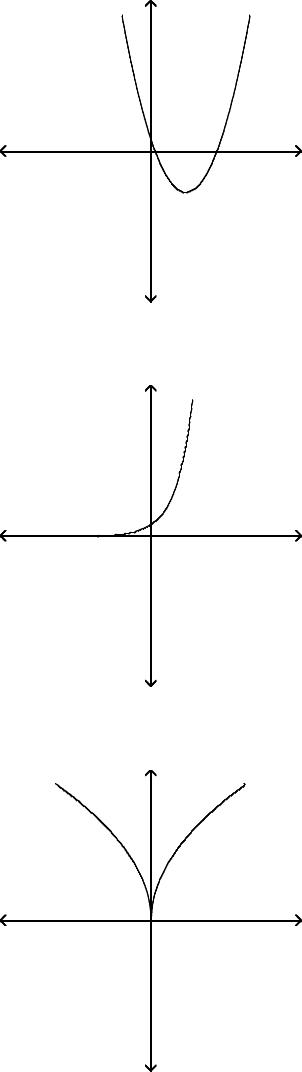
7)
x
y
x
y
A) Yes B) No
8)
x
y
x
y
A) Yes B) No
9)
x
y
x
y
A) Yes B) No
Page8
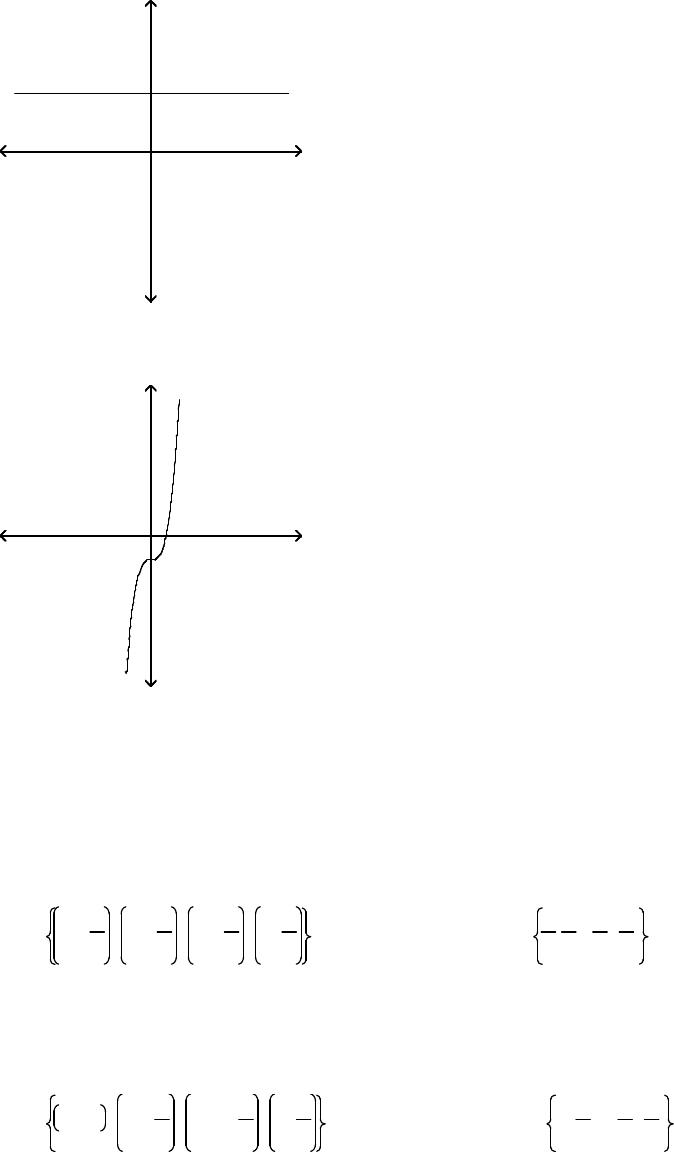
10)
x
y
x
y
A) Yes B) No
11)
x
y
x
y
A) Yes B) No
2 DeterminetheInverseofaFunctionDefinedbyaMaporaSetofOrderedPairs
MULTIPLECHOICE.Choosetheonealternativethatbestcompletesthestatementoranswersthequestion.
Findtheinverseofthefunctionandstateitsdomainandrange.
1) {(14
,
3),(12
,
4),(10
,
5),(8
,
6)}
A) {(3
,
14),(4
,
12),(5
,
10),(6
,
8)};D={3
,
4
,
5
,
6 };R={14
,
12
,
10
,
8}
B) 14,1
3,12,1
4,10,1
5,8,1
6;D={14,12,10,8},R=1
3,1
4, 1
5,1
6
C) {(4
,
3),(3
,
10),(14
,
12),(4
,
5)};D={(4
,
3
,
14};R={(3
,
10 12
,
5}
D) {(4
,
3),(6
,
10),(14
,
10),(4
,
5)};D={4
,
6
,
14};R={3
,
10
,
5}
2) {(–6
,
1),(–1
,
6),(–5
,
–3),(5
,
3)}
A) {(1
,
–6),(6
,
–1),(–3
,
–5),(3
,
5)}D={1
,
6
,
–3
,
3};R={–6
,
–1
,
–5
,
5}
B) –6,1,–1,1
6,–5,–1
3,5,1
3
D={–6,–1,–5,5},R=1,1
6,–1
3,1
3
C) {(3
,
–5),(–5
,
–1),(1
,
–6),(–3
,
5)};D={3
,
–5
,
1
,
–3};R={–5
,
–1
,
–6
,
5}
D) {(3
,
–5),(6
,
–1),(1
,
–1),(–3
,
5)};D={(3
,
6
,
1
,
–3};R={–5
,
–1
,
5}
Page9
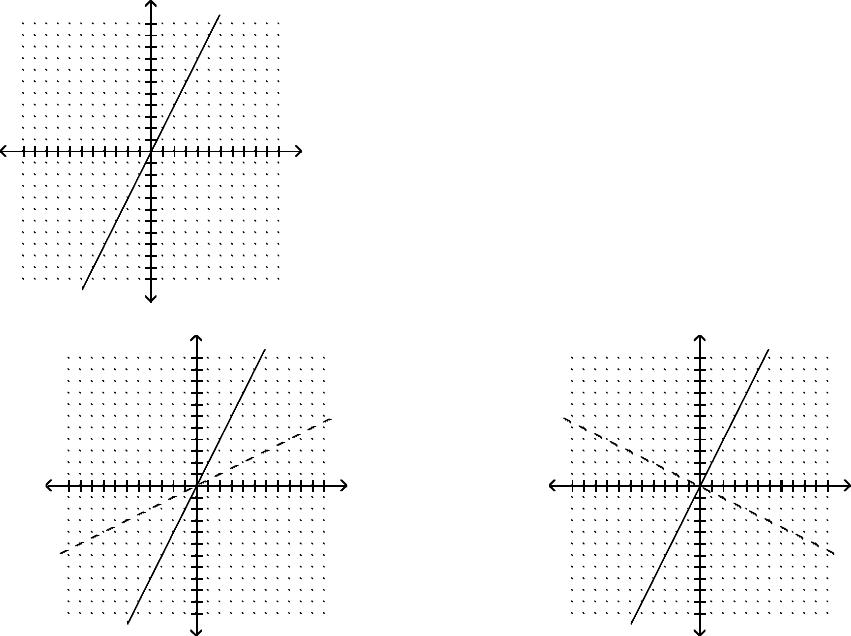
3) {(–3,4),(–1,5),(0,2),(2,6),(5,7)}
A) {(4,–3),(5,–1),(2,0),(6,2),(7,5)}D={2,4,5,6,7};R={–3,–1,0,2,5}
B) {(3,4),(1,5),(0,2),(–2,6),(–5,7)};D={3,1,0,–2,–5};R={2,4,5,6,7}
C) {(–3,–4),(–1,–5),(0,–2),(2,–6),(5,–7)};D={–3,–1,0,2,5};R={–7,–6,–5,–4,–2}
D) {(3,–4),(1,–5),(0,–2),(–2,–6),(–5,–7)};D={3,1,0,–2,–5};R={–7,–6,–5,–4,–2}
Findtheinverse.Determinewhethertheinverserepresentsafunction.
4) {(6
,
–10),(5
,
–9),(3
,
–8),(1
,
–7)}
A) {(–10
,
6),(–9
,
5),(–8
,
3),(–7
,
1)};afunction
B) {(–10
,
6),(–9
,
5),(–8
,
3),(–7
,
1)};notafunction
C) {(–9
,
–10),(–10
,
3),(6
,
5),(–9
,
–8)};notafunction
D) {(–9
,
–10),(–7
,
3),(6
,
3),(–9
,
–8)};afunction
3 ObtaintheGraphoftheInverseFunctionfromtheGraphoftheFunction
MULTIPLECHOICE.Choosetheonealternativethatbestcompletesthestatementoranswersthequestion.
Thegraphofaone–to–onefunctionfisgiven.Drawthegraphoftheinversefunctionf–1asadashedlineorcurve.
1) f(x)=2x
x
-10 -5 5 10
y
10
5
-5
-10
x
-10 -5 5 10
y
10
5
-5
-10
A)
x
-10 -5 5 10
y
10
5
-5
-10
x
-10 -5 5 10
y
10
5
-5
-10
B)
x
-10 -5 5 10
y
10
5
-5
-10
x
-10 -5 5 10
y
10
5
-5
-10
Page10
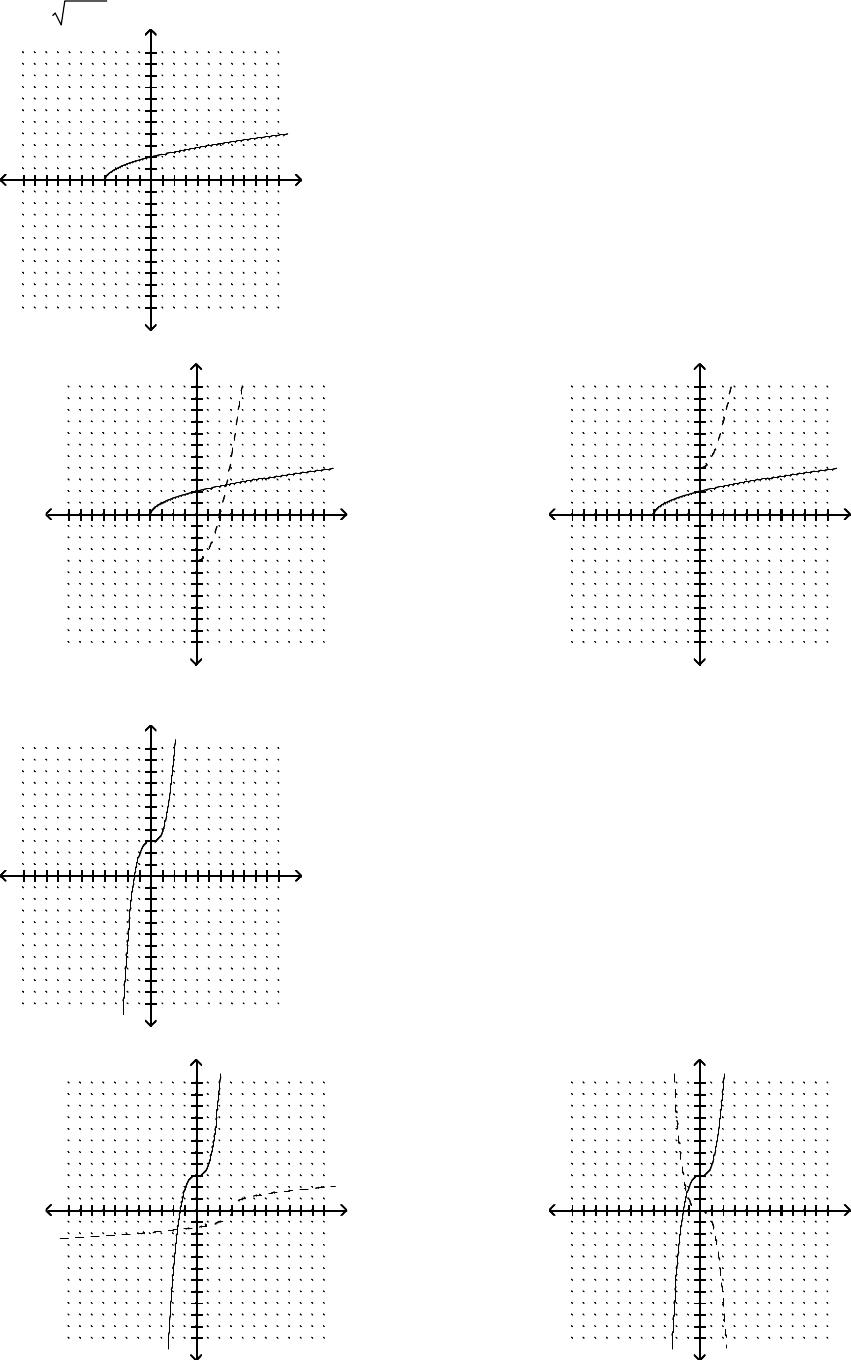
2) f(x)=x+4
x
-10 -5 5 10
y
10
5
-5
-10
x
-10 -5 5 10
y
10
5
-5
-10
A)
x
-10 -5 5 10
y
10
5
-5
-10
x
-10 -5 5 10
y
10
5
-5
-10
B)
x
-10 -5 5 10
y
10
5
-5
-10
x
-10 -5 5 10
y
10
5
-5
-10
3) f(x)=x3+3
x
-10 -5 5 10
y
10
5
-5
-10
x
-10 -5 5 10
y
10
5
-5
-10
A)
x
-10 -5 5 10
y
10
5
-5
-10
x
-10 -5 5 10
y
10
5
-5
-10
B)
x
-10 -5 5 10
y
10
5
-5
-10
x
-10 -5 5 10
y
10
5
-5
-10
Page11
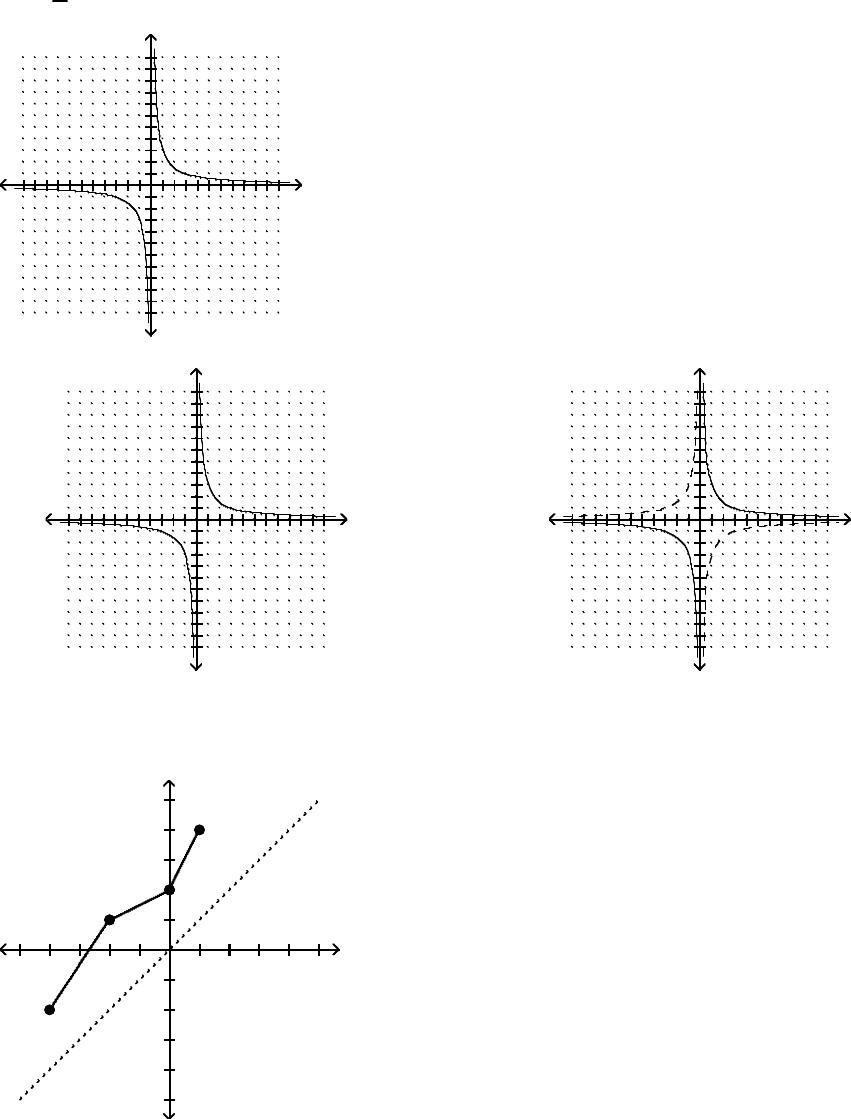
4) f(x)=3
x
x
-10 -5 5 10
y
10
5
-5
-10
x
-10 -5 5 10
y
10
5
-5
-10
A) Functionisitsowninverse
x
-10 -5 5 10
y
10
5
-5
-10
x
-10 -5 5 10
y
10
5
-5
-10
B)
x
-10 -5 5 10
y
10
5
-5
-10
x
-10 -5 5 10
y
10
5
-5
-10
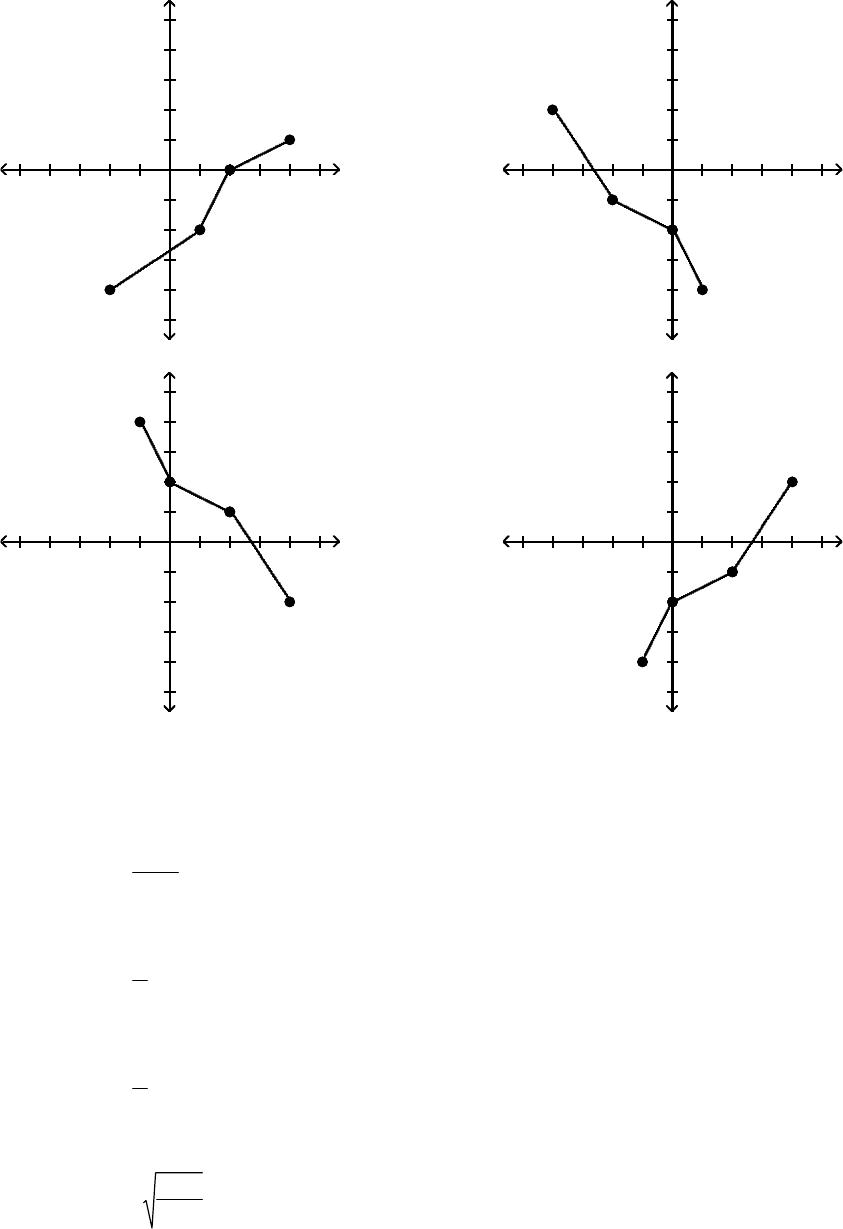
Usethegraphofthegivenone–to–onefunctiontosketchthegraphoftheinversefunction.Forconvenience,the
graphofy=xisalsogiven.
5)
x
–5–4–3–2–1 12345
y
5
4
3
2
1
-1
-2
-3
-4
-5
(-4, –2)
(-2, 1) (0, 2)
(1, 4)
x
–5–4–3–2–1 12345
y
5
4
3
2
1
-1
-2
-3
-4
-5
(-4, –2)
(-2, 1) (0, 2)
(1, 4)
Page12
A)
x
-5 -4 -3 -2 -1 1 2 3 4 5
y
5
4
3
2
1
-1
-2
-3
-4
-5
(-2, –4)
(1, –2)
(2, 0)
(4, 1)
x
-5 -4 -3 -2 -1 1 2 3 4 5
y
5
4
3
2
1
-1
-2
-3
-4
-5
(-2, –4)
(1, –2)
(2, 0)
(4, 1)
B)
x
-5 -4 -3 -2 -1 1 2 3 4 5
y
5
4
3
2
1
-1
-2
-3
-4
-5
(-4, 2)
(-2, –1) (0, –2)
(1, –4)
x
-5 -4 -3 -2 -1 1 2 3 4 5
y
5
4
3
2
1
-1
-2
-3
-4
-5
(-4, 2)
(-2, –1) (0, –2)
(1, –4)
C)
x
-5 -4 -3 -2 -1 1 2 3 4 5
y
5
4
3
2
1
-1
-2
-3
-4
-5
(4, –2)
(2, 1)
(0, 2)
(-1, 4)
x
-5 -4 -3 -2 -1 1 2 3 4 5
y
5
4
3
2
1
-1
-2
-3
-4
-5
(4, –2)
(2, 1)
(0, 2)
(-1, 4)
D)
x
-5 -4 -3 -2 -1 1 2 3 4 5
y
5
4
3
2
1
-1
-2
-3
-4
-5
(4, 2)
(2, –1)
(0, –2)
(-1, –4)
x
-5 -4 -3 -2 -1 1 2 3 4 5
y
5
4
3
2
1
-1
-2
-3
-4
-5
(4, 2)
(2, –1)
(0, –2)
(-1, –4)
4 FindtheInverseofaFunctionDefinedbyanEquation
MULTIPLECHOICE.Choosetheonealternativethatbestcompletesthestatementoranswersthequestion.
Decidewhetherornotthefunctionsareinversesofeachother.
1) f(x)=4x–5,g(x)=x+4
5
A) No B) Yes
2) f(x)=3x+9,g(x)=1
3x–3
A) Yes B) No
3) f(x)=4x–4,g(x)=1
4x+1
A) Yes B) No
4) f(x)=8x2+9,g(x)=x–9
8
A) Yes;Excludetheinterval(–∞
,
9) B) Yes;Novaluesneedtobeexcluded.
C) Yes;Excludetheinterval(–∞
,
8) D) No
Page13
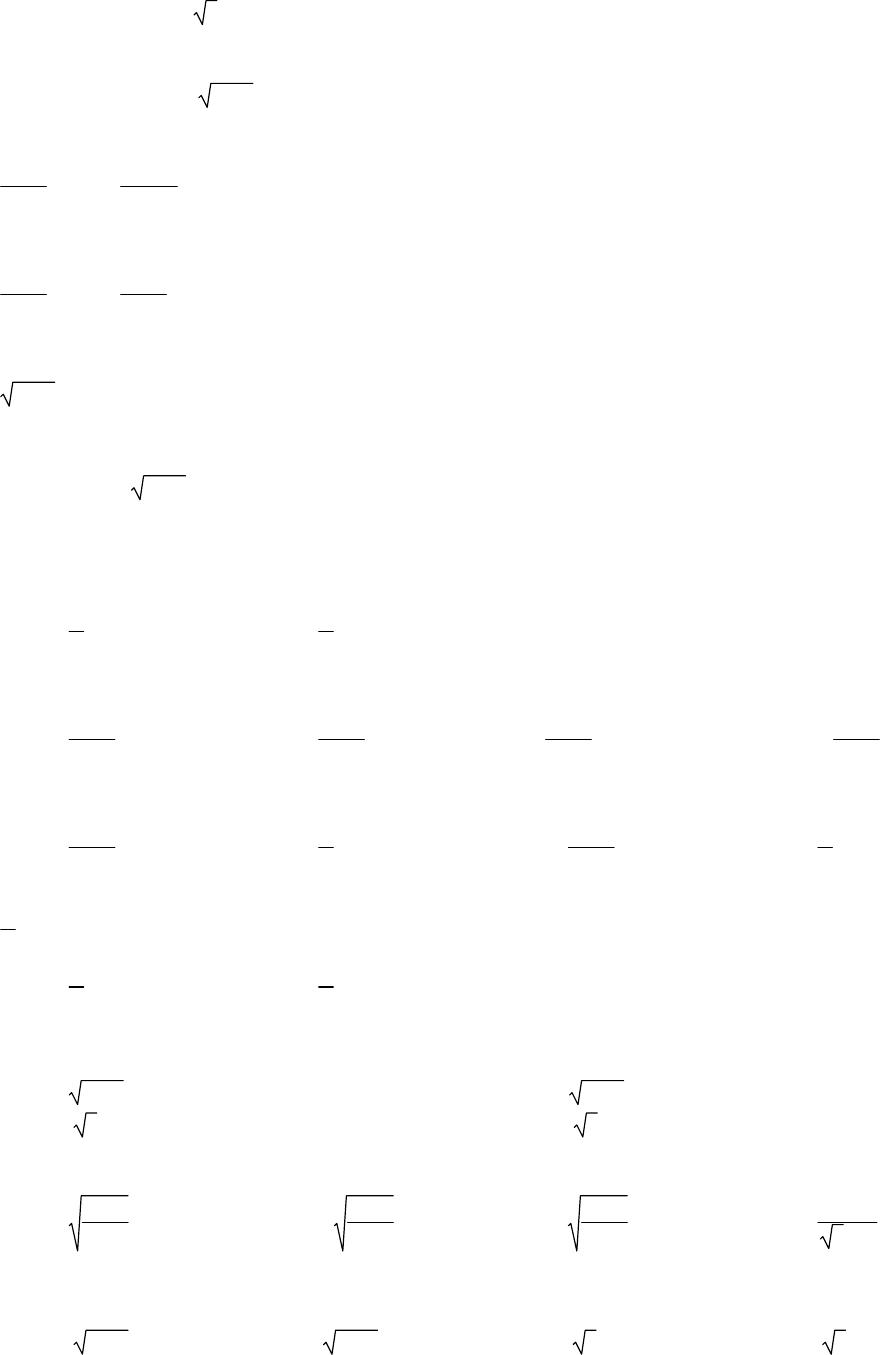
5) f(x)=(x–2)2,x≥2;g(x)=x+2
A) Yes B) No
6) f(x)=(x–2)2,x≥2;g(x)=x+2
A) No B) Yes
7) f(x)=1
x+2,g(x)=2x+1
x
A) No B) Yes C) Yes;Excludethevalue{–2}
8) f(x)=1+x
x,g(x)=1
x–1
A) Yes B) No
9) f(x)=x+9,domain[–9,∞);g(x)=x2+9,domain(–∞,∞)
A) No B) Yes
10) f(x)=x3–3,g(x)=3x+3
A) Yes B) No
Thefunctionfisone–to–one.Finditsinverse.
11) f(x)=8x
A) f–1(x)=x
8B) f–1(x)=8
xC) f–1(x)=–8x D) f–1(x)=8x
12) f(x)=2x+5
A) f–1(x)=x–5
2B) f–1(x)=x+5
2C) f(x)=x–5
2D) f–1(x)=–x+2
5
13) f(x)=3x–7
A) f–1(x)=x+7
3B) f–1(x)=x
3
–7C)f
–1(x)=x–7
3D) f–1(x)=x
3
+7
14) f(x)=2
x
A) f–1(x)=2
xB) f–1(x)=x
2C) f–1(x)=–2x D) f–1(x)=2x
15) f(x)=x2+4,x≥0
A) f–1(x)=x–4,x≥4B)f
–1(x)=x+4,x≥–4
C) f–1(x)=x–4,x≥0D)f–1(x)=x–4,x<0
16) f(x)=5x2–7,x≥0
A) f–1(x)=x+7
5B) f–1(x)=–x+7
5C) f–1(x)=5
x+7D) f–1(x)=5
x+7
17) f(x)=x3–3
A) f–1(x)=3x+3B) f–1(x)=3x–3C) f–1(x)=3x+3D)f
–1(x)=3x–3
Page14
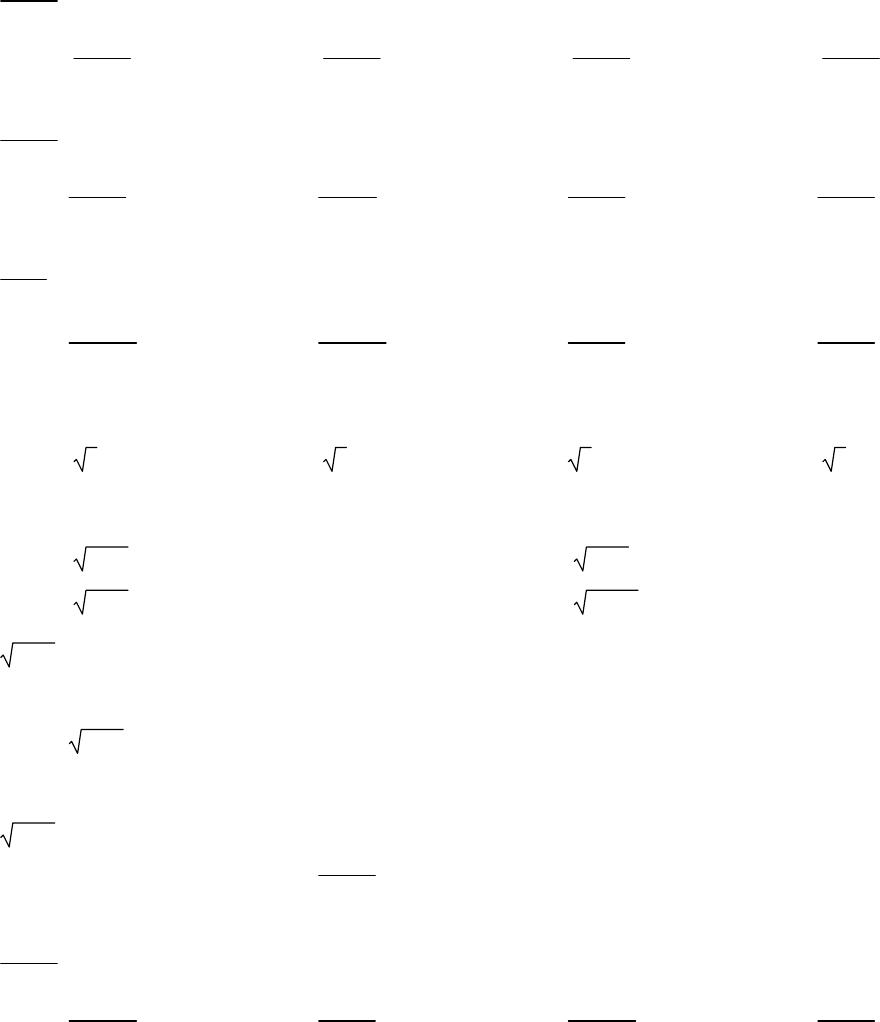
18) f(x)=7x+5
8
A) f–1(x)=8x–5
7B) f–1(x)=8x+5
7C) f–1(x)=8
7x–5D) f–1(x)=8
7x+5
19) f(x)=4
7x+3
A) f–1(x)=4–3x
7x B) f–1(x)=4–3y
7y C) f–1(x)=7x+3
4D) f–1(x)=3x–4
7x
20) f(x)=7
x+7
A) f–1(x)=–7x+7
xB) f–1(x)=7+7x2
xC) f–1(x)=7+7x
xD) f–1(x)=x
7+7x
21) f(x)=(x–5)3
A) f–1(x)=3x+5B)f
–1(x)=3x–5C)f
–1(x)=x+5D)f
–1(x)=3x+125
22) f(x)=(x+2)3–8.
A) f–1(x)=3x+8–2B)f
–1(x)=3x–2+8
C) f–1(x)=3x+6D) f–1(x)=3x+10
23) f(x)=x–7
A) f–1(x)=x2+7,x≥0B)f
–1(x)=x2–7,x≥0
C) f–1(x)=x+7D) f–1(x)=(x–7)2
24) f(x)=3x–4
A) f–1(x)=x3+4B)f
–1(x)=1
x3+4
C) f–1(x)=x+4D)f
–1(x)=x3+16
25) f(x)=3x–7
8x+4
A) f–1(x)=–4x–7
8x–3B) f–1(x)=3x+3
8x+4C) f–1(x)=8x–3
–4x–7D) f–1(x)=3x–7
8x+4
Page15
Findtheinversefunctionoff.Statethedomainandrangeoff.
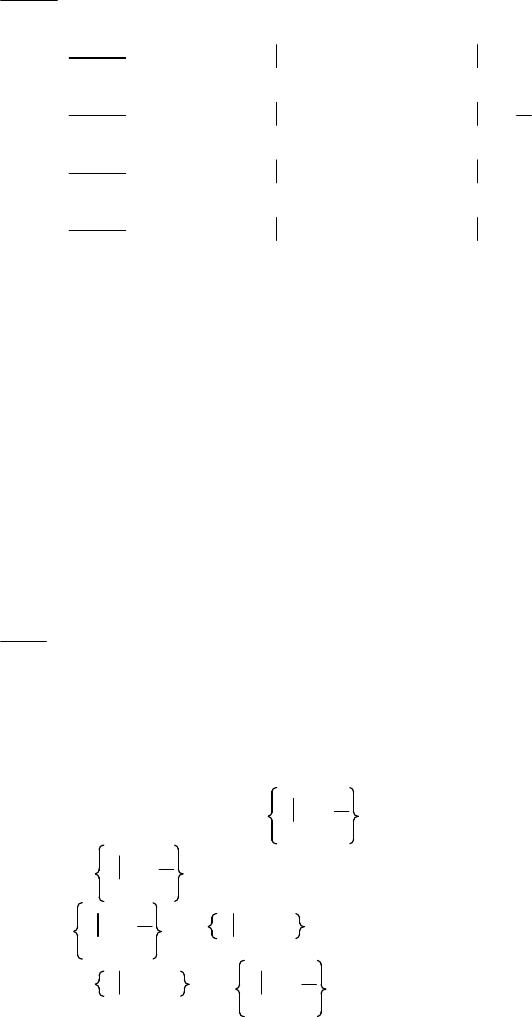
26) f(x)=3x–2
x+5
A) f–1(x)=5x+2
3–x;domainoff:{x x≠–5};rangeoff:{y y≠3}
B) f–1(x)=x+5
3x–2;domainoff:{x x≠–5};rangeoff:{y y≠2
3}
C) f–1(x)=5x+2
3+x;domainoff:{x x≠–5};rangeoff:{y y≠–3}
D) f–1(x)=3x+2
x–5;domainoff:{x x≠–5};rangeoff:{y y≠5}
Determinei)thedomainofthefunction,ii)therangeofthefunction,iii)thedomainoftheinverse,andiv)the
rangeoftheinverse.
27) f(x)=–6x–6
A) f(x):Disallrealnumbers
,
Risallrealnumbers;
f–1(x):Disallrealnumbers,Risallrealnumbers
B) f(x):Disallrealnumbers
,
R={y|y> –6};
f–1(x):Disallrealnumbers,R={y|y<–6}
C) f(x):D={x|x>–6}
,
Risallrealnumbers;
f–1(x):D={x|x<–6},Risallrealnumbers
D) f(x):D={x|x>–6}
,
R={y|y>–6};
f–1(x):D={x|x<–6},R={y|y<–6}
28) f(x)=3
x+4
A) f(x):D={x|x≠–4}
,
R={y≠0};
f–1(x):D={x|x≠0},R={y|y≠–4}
B) f(x):Disallrealnumbers
,
Risallrealnumbers;
f–1(x):Disallrealnumbers,Risallrealnumbers
C) f(x):Disallrealnumbers,R=yy≠3
4;
f–1(x):D=xx≠3
4,Risallrealnumbers
D) f(x):D=xx≠3
4,R=yy≠–4 ;
f–1(x):D=xx≠–4 ,R=yy≠3
4
Page16
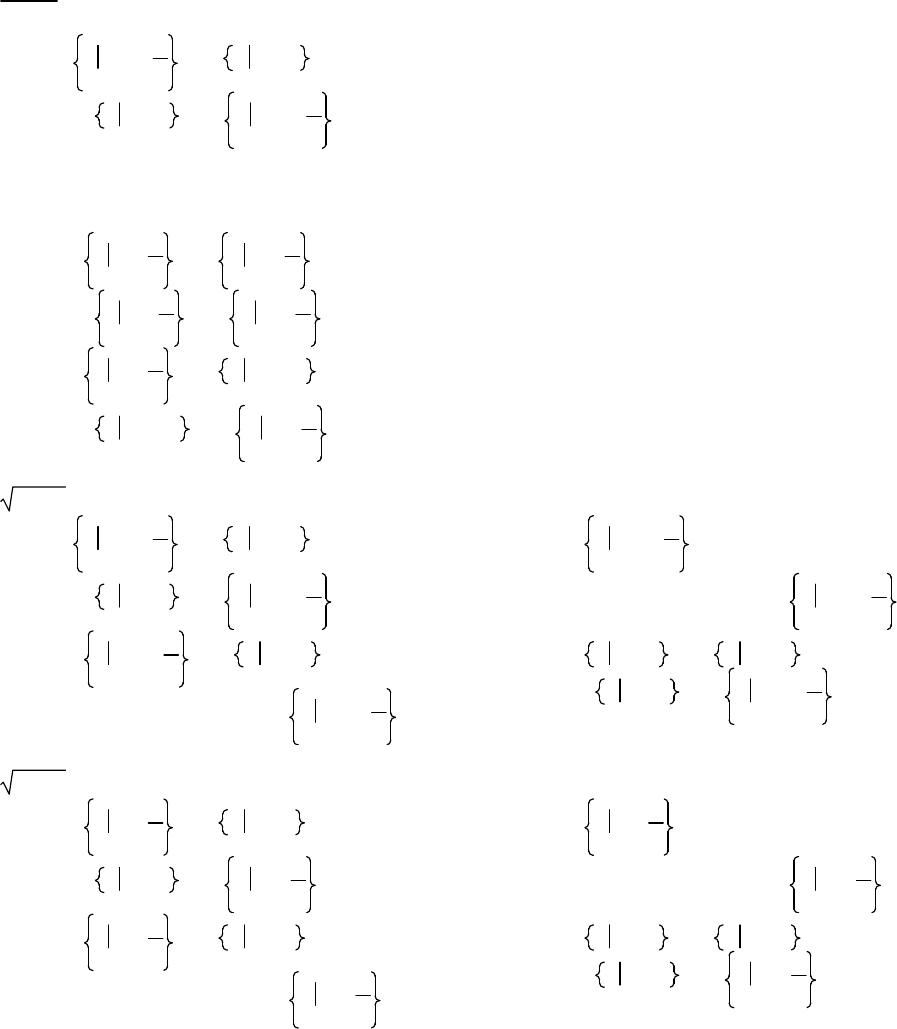
29) f(x)=5
2x+3
A) f(x):D=xx≠–3
2,R=yy≠0 ;
f–1(x):D=xx≠0 ,R=yy≠–3
2
B) f(x):Disallrealnumbers
,
Risallrealnumbers;
f–1(x):Disallrealnumbers,Risallrealnumbers
C) f(x):D=xx≠5
2,R=yy≠5
3;
f–1(x):D=xx≠5
3,R=yy≠5
2
D) f(x):D=xx≠3
2,R=yy≠–3 ;
f–1(x):D=xx≠–3 ,R=yy≠3
2
30) f(x)=5x+4
A) f(x):D=xx≥–4
5,R=yy≥0 ;
f–1(x):D=xx≥0 ,R=yy≥–4
5
B) f(x):D=xx≥–4
5,Risallrealnumbers;
f–1(x):Disallrealnumbers,R=yy≥–4
5
C) f(x):D=xx≥–4
5,R=yy≥0 ;
f–1(x):Disallrealnumbers,R=yy≥–4
5
D) f(x):D=xx≥0
,
R=yy≥0 ;
f–1(x):D=xx≥0 ,R=yy≥–4
5
31) f(x)=3–5x
A) f(x):D=xx≤3
5,R=yy≥0 ;
f–1(x):D=xx≥0 ,R=yy≤3
5
B) f(x):D=xx≤3
5,Risallrealnumbers;
f–1(x):Disallrealnumbers,R=yy≤3
5
C) f(x):D=xx≤3
5,R=yy≤0 ;
f–1(x):Disallrealnumbers,R=yy≤3
5
D) f(x):D=xx≥0
,
R=yy≥0 ;
f–1(x):D=xx≥0 ,R=yy≥3
5
SHORTANSWER.Writethewordorphrasethatbestcompleteseachstatementoranswersthequestion.
Solvetheproblem.
32) TheprofitPforsellingxitemsisgivenbytheequationP(x)=2x–500.Expressthesalesamountxasa
functionoftheprofitP.
33) Thefunctionf(x)=|x|–5isnotone–to–one.
(a)Findasuitablerestrictiononthedomainoffsothatthenewfunctionthatresultsisone–to–one.
(b)Findtheinverseoff.
Page17
34) TheweightWofabirdʹsbrain(inounces)isrelatedtothevolumeVofthebirdʹsskull(incubicounces)
throughthefunctionW(V)=3.36 3V+1.15.
(a) ExpresstheskullvolumeVasafunctionofbrainweightW.
(b) Predicttheskullvolumeofabirdwhosebrainweighs2oz.
MULTIPLECHOICE.Choosetheonealternativethatbestcompletesthestatementoranswersthequestion.
35) Theaccompanyingtablesrepresentafunctionfthatconvertssecondstohoursandafunctiongthat
convertshourstodays.
x86,400 172,800 259,200 345,600 432,000
f(x) 24 48 72 96 120
x24 48 72 96 120
g(x) 1234 5
Express(f–1∘g–1)(x)symbolically.
A) (f–1∘g–1)(x)=86,400x B) (f–1∘g–1)(x)=x
86,400
C) (f–1∘g–1)(x)=86,400x2D) (f–1∘g–1)(x)=x2
86,400
36) Toremodelabathroom,acontractorcharges$30 perhourplusmaterialcosts,whichamountto$4230.
Therefore,thetotalcosttoremodelthebathroomisgivenbyf(x)=30x+4230wherexisthenumberof
hoursthecontractorworks.Findaformulaforf–1(x).Whatdoesf–1(x)compute?
A) f–1(x)=x
30
–141;Thiscomputesthenumberofhoursworkedifthetotalcostisxdollars.
B) f–1(x)=x
30
–141;Thiscomputesthetotalcostifthecontractorworksxhours.
C) f–1(x)=x
30
–4230;Thiscomputesthenumberofhoursworkedifthetotalcostisxdollars.
D) f–1(x)=x
30
–4230;Thiscomputesthetotalcostifthecontractorworksxhours.
Findaformulafortheinverseofthefunctiondescribedbelow.
37) Asize8dressinCountryCissize34 inCountryD.AfunctionthatconvertsdresssizesinCountryCto
thoseinCountryDisf(x)=x+26.
A) f–1(x)=x–26 B) f–1(x)=x+26 C) f–1(x)=x
–26 D) f–1(x)=x
26
38) Asize2dressinCountryCissize44 inCountryD.AfunctionthatconvertsdresssizesinCountryCto
thoseinCountryDisf(x)=2(x+20).
A) f–1(x)=x
2
–20 B) f–1(x)=x–20
2C) f–1(x)=x
2
+20 D) f–1(x)=x–20
39) Asize32dressinCountryCissize8 inCountryD.AfunctionthatconvertsdresssizesinCountryCto
thoseinCountryDisf(x)=x
2
–8.
A) f–1(x)=2(x+8) B) f–1(x)=2(x–8) C) f–1(x)=2x+8D)f
–1(x)=x+8
Page18

40) 32°Fahrenheit=0°Celsius.AfunctionthatconvertstemperaturesinCelsiustothoseinFahrenheit is
f(x)=9
5x+32.
A) f–1(x)=5
9(x–32) B) f–1(x)=9
5x+32 C) f–1(x)=5
9(x+32) D) f–1(x)=x+32
41) Anorganizationdeterminesthatthecostperpersonofcharteringabusisgivenbytheformula
C(x)=300+6x
x,
wherexisthenumberofpeopleinthegroupandC(x)isindollars.
A) C–1(x)=300
x–6B) C–1(x)=300
x+6C) C–1(x)=300 +x
6D) C–1(x)=6
x–300
6.3 ExponentialFunctions
1 EvaluateExponentialFunctions
MULTIPLECHOICE.Choosetheonealternativethatbestcompletesthestatementoranswersthequestion.
Approximatethevalueusingacalculator.Expressanswerroundedtothreedecimalplaces.
1) 34.2
A) 100.904 B) 74.088 C) 12.600 D) 27.000
2) 64.66
A) 4228.485 B) 10,240.366 C) 27.960 D) 46,656.000
3) 2.7061.509
A) 4.491 B) 3.045 C) 4.083 D) 14.787
4) 2.7π
A) 22.655 B) 21.994 C) 8.482 D) 36.462
5) 6 5
A) 54.954 B) 13.416 C) 125.000 D) 3888.000
6) e2.86
A) 17.462 B) 17.399 C) 7.774 D) 15.154
7) e–1.3
A) 0.273 B) –3.534 C) –0.273 D) 0.573
Determinewhetherthegivenfunctionisexponentialornot.Ifitisexponential,identifythevalueofthebasea.
8)
x H(x)
–18
013
118
223
328
A) Notexponential B) Exponential;a=8
C) Exponential;a=5 D) Exponential;a=13
Page19

9)
x H(x)
–13
8
01
18
3
264
9
3512
27
A) Exponential;a=8
3B) Exponential;a=3
8
C) Exponential;a=8 D) Notexponential
Solvetheproblem.
10) ThefunctionD(h)=8e–0.4hcanbeusedtodeterminethemilligramsDofacertaindruginapatientʹs
bloodstreamhhoursafterthedrughasbeengiven.Howmanymilligrams(totwodecimals)willbe
presentafter12hours?
A) 0.07mg B) 972.08 mg C) 4.76 mg D) 0.49 mg
11) TheformulaP=14.7e–0.21xgivestheaverageatmosphericpressure,P,inpoundspersquareinch,atan
altitudex,inmilesabovesealevel.Findtheaverageatmosphericpressureforanaltitudeof2.3miles.
Roundyouranswertothenearesttenth.
A) 9.1lb/in.2B) 7.8lb/in.2C) 11.0lb/in.2D) 8.4lb/in.2
SHORTANSWER.Writethewordorphrasethatbestcompleteseachstatementoranswersthequestion.
12) Arumorisspreadatanelementaryschoolwith1200studentsaccordingtothemodel
N=1200(1–e–0.16d)whereNisthenumberofstudentswhohaveheardtherumoranddisthenumber
ofdaysthathaveelapsedsincetherumorbegan.Howmanystudentswillhaveheardtherumorafter5
days?
MULTIPLECHOICE.Choosetheonealternativethatbestcompletesthestatementoranswersthequestion.
13) Thefunctionf(x)=700(0.5)x
/
60modelstheamountinpoundsofaparticularradioactivematerialstoredin
aconcretevault,wherexisthenumberofyearssincethematerialwasputintothevault.Findtheamount
ofradioactivematerialinthevaultafter190years.Roundtothenearestwholenumber.
A) 78pounds B) 562pounds C) 1108 pounds D) 111 pounds
SHORTANSWER.Writethewordorphrasethatbestcompleteseachstatementoranswersthequestion.
14) Instrumentsonasatellitemeasuretheamountofpowergeneratedbythesatelliteʹspowersupply.The
timetandthepowerPcanbemodeledbythefunctionP=50e–t/300,wheretisindaysandPisinwatts.
Howmuchpowerwillbeavailableafter378days?Roundtothenearesthundredth.
Page20
15) Acancerpatientundergoingchemotherapyisinjectedwithaparticulardrug.Thefunctio
n
D(h)=4e–0.35hgivesthenumberofmilligramsDofthisdrugthatisinthepatientʹsbloodstreamhhours
afterthedrughasbeenadministered.Howmanymilligramsofthedrugwereinjected?Tothenearest
milligram,howmuchofthedrugwillbepresentafter2hours?
MULTIPLECHOICE.Choosetheonealternativethatbestcompletesthestatementoranswersthequestion.
16) Agrocerystorenormallysells8jarsofcaviarperweek.UsethePoissonDistributionP(x)=8xe–8
x!
tofind
theprobability(tothreedecimals)ofselling7jarsinaweek.(x!=x·(x–1)·(x–2)·…·(3)(2)(1)).
A) 0.14 B) 0.977 C) 0.279 D) 14.357
17) If6x=5,whatdoes6–2xequal?
A) 1
25 B) 25 C) –25 D) 1
10
18) If2–x=1
3,whatdoes4xequal?
A) 9 B) –9C)3 D)
1
9
2 GraphExponentialFunctions
MULTIPLECHOICE.Choosetheonealternativethatbestcompletesthestatementoranswersthequestion.
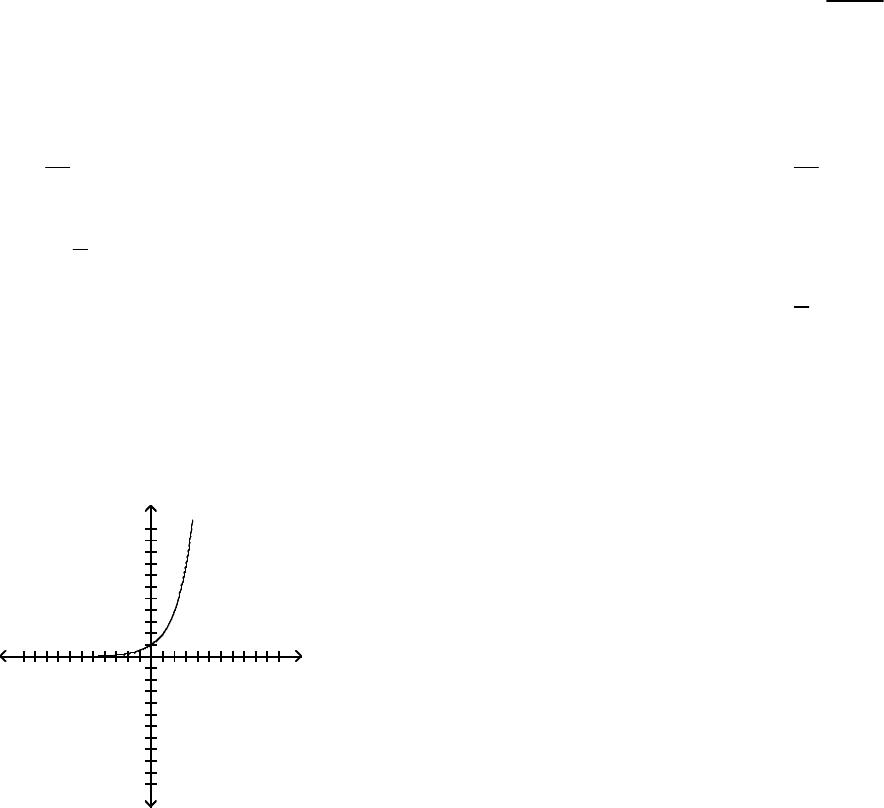
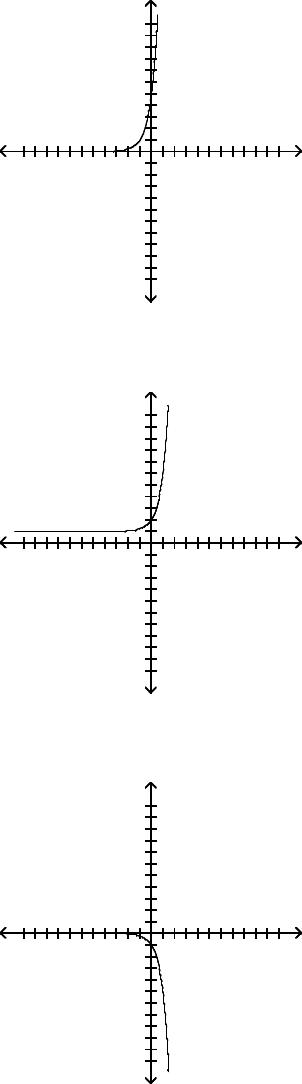
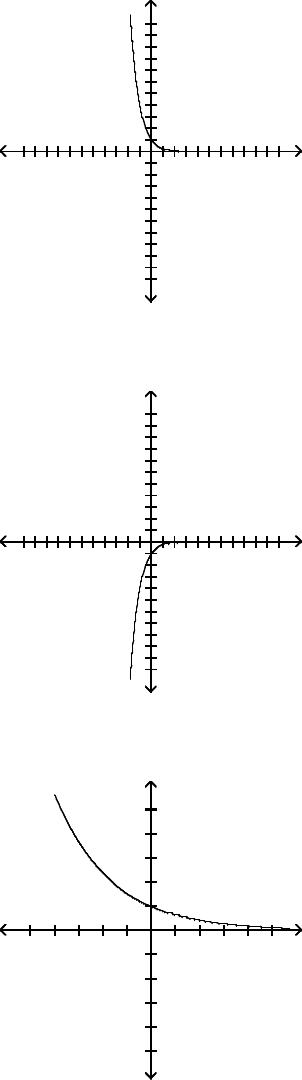
Thegraphofanexponentialfunctionisgiven.Matchthegraphtooneofthefollowingfunctions.
1)
x
-10 -5 5 10
y
10
5
-5
-10
x
-10 -5 5 10
y
10
5
-5
-10
A) f(x)=2xB) f(x)=2x+2C) f(x)=2x+2 D) f(x)=2x–2
Page21
2)
x
-10 -5 5 10
y
10
5
-5
-10
x
-10 -5 5 10
y
10
5
-5
-10
A) f(x)=5x+1B) f(x)=5xC) f(x)=5x+1 D) f(x)=5x–1
3)
x
-10 -5 5 10
y
10
5
-5
-10
x
-10 -5 5 10
y
10
5
-5
-10
A) f(x)=5x+1 B) f(x)=5xC) f(x)=5x+1D) f(x)=5x–1
4)
x
-10 -5 5 10
y
10
5
-5
-10
x
-10 -5 5 10
y
10
5
-5
-10
A) f(x)=–5xB) f(x)=5xC) f(x)=5–xD) f(x)=–5–x
Page22
5)
x
-10 -5 5 10
y
10
5
-5
-10
x
-10 -5 5 10
y
10
5
-5
-10
A) f(x)=4–xB) f(x)=4xC) f(x)=–4xD) f(x)=–4–x
6)
x
-10 -5 5 10
y
10
5
-5
-10
x
-10 -5 5 10
y
10
5
-5
-10
A) f(x)=–4–xB) f(x)=4xC) f(x)=–4xD) f(x)=4–x
7)
x
-5 5
y
5
-5
x
-5 5
y
5
-5
A) y=0.65xB) y=3.5xC)y=2.4xD) y=0.32x
Page23
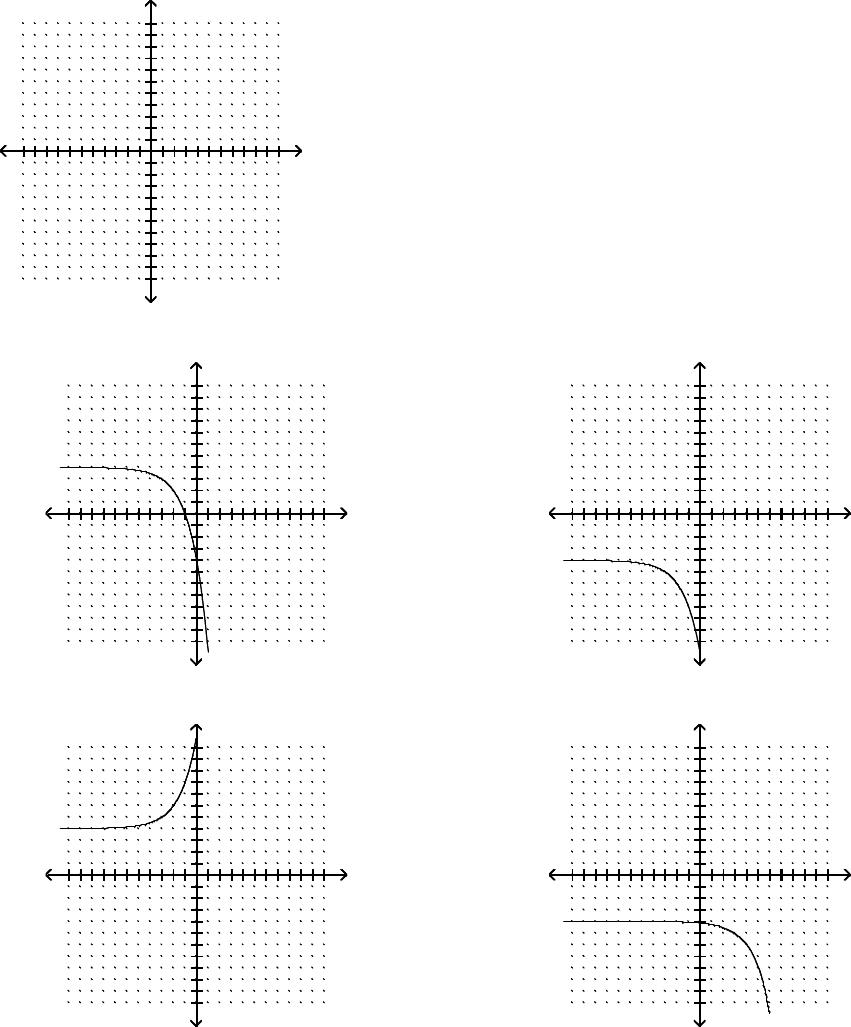
Usetransformationstographthefunction.Determinethedomain,range,andhorizontalasymptoteofthefunction.
8) f(x)=–2x+3+4
x
-10 -5 5 10
y
10
5
-5
-10
x
-10 -5 5 10
y
10
5
-5
-10
A) domainoff:(–∞
,
∞);rangeoff:(–∞
,
4);
horizontalasymptote:y=4
x
-10 -5 5 10
y
10
5
-5
-10
x
-10 -5 5 10
y
10
5
-5
-10
B) domainoff:(–∞
,
∞);rangeoff:(–∞
,
–4);
horizontalasymptote:y=–4
x
-10 -5 5 10
y
10
5
-5
-10
x
-10 -5 5 10
y
10
5
-5
-10
C) domainoff:(–∞
,
∞);rangeoff:(–4,∞);
horizontalasymptote:y=4
x
-10 -5 5 10
y
10
5
-5
-10
x
-10 -5 5 10
y
10
5
-5
-10
D) domainoff:(–∞
,
∞);rangeoff:(–∞
,
–4);
horizontalasymptote:y=–4
x
-10 -5 5 10
y
10
5
-5
-10
x
-10 -5 5 10
y
10
5
-5
-10
Page24
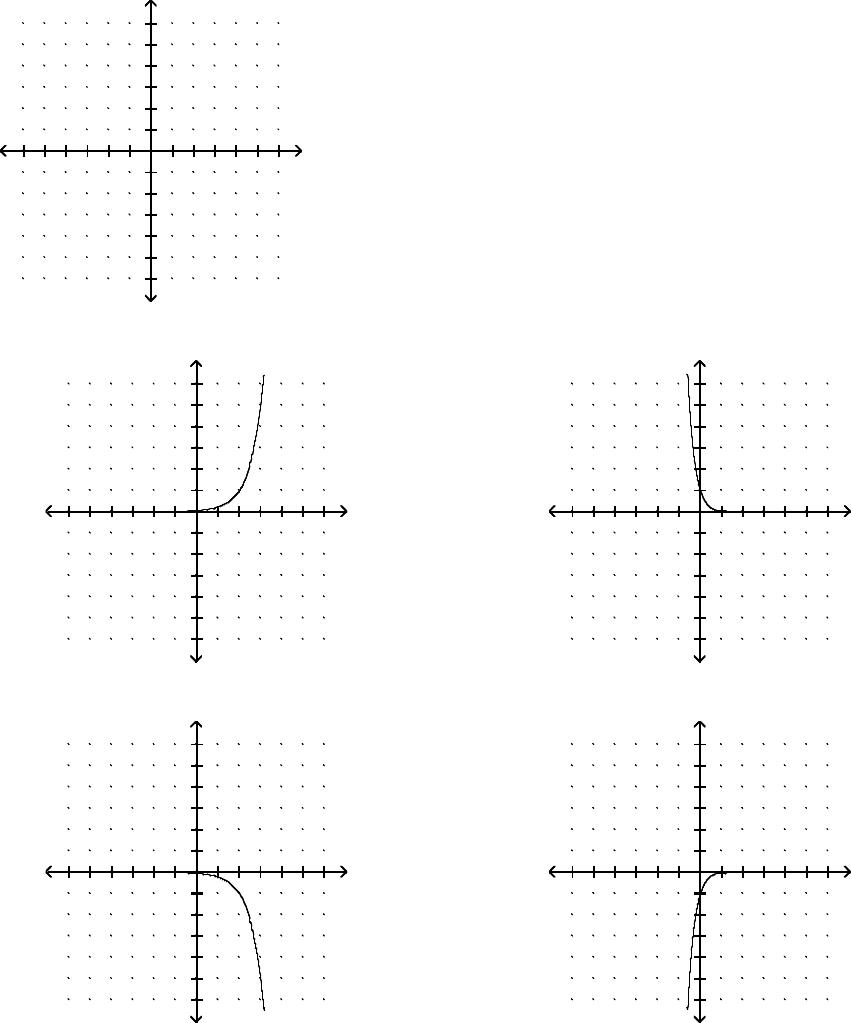
9) f(x)=5(x–2)
x
-6 6
y
6
-6
x
-6 6
y
6
-6
A) domainoff:(–∞
,
∞);rangeoff:(0,∞)
horizontalasymptote:y=0
x
-6 6
y
6
-6
x
-6 6
y
6
-6
B) domainoff:(–∞
,
∞);rangeoff:(0,∞)
horizontalasymptote:y=0
x
-6 6
y
6
-6
x
-6 6
y
6
-6
C) domainoff:(–∞
,
∞);rangeoff:(–∞
,
0)
horizontalasymptote:y=0
x
-6 6
y
6
-6
x
-6 6
y
6
-6
D) domainoff:(–∞
,
∞);rangeoff:(–∞
,
0)
horizontalasymptote:y=0
x
-6 6
y
6
-6
x
-6 6
y
6
-6
Page25
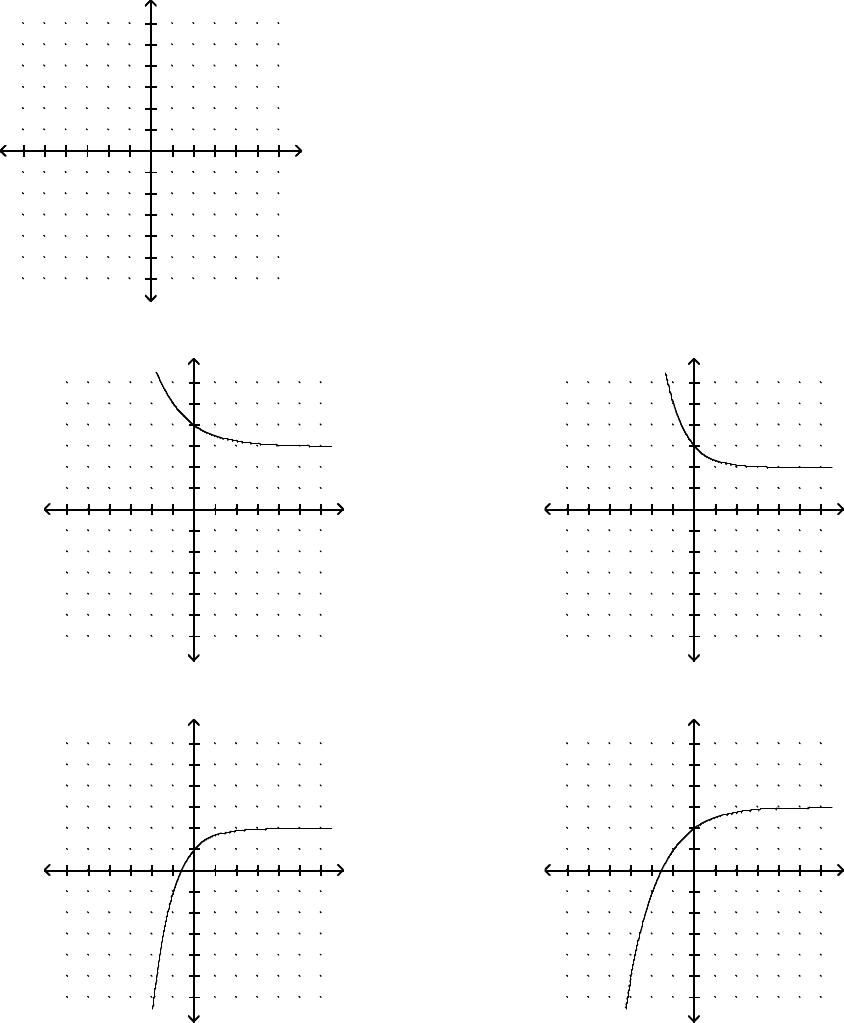
10) f(x)=2–x+3
x
-6 -4 -2 2 4 6
y
6
4
2
-2
-4
-6
x
-6 -4 -2 2 4 6
y
6
4
2
-2
-4
-6
A) domainoff:(–∞
,
∞);rangeoff:(3
,
∞)
horizontalasymptote:y=3
x
-6 -4 -2 2 4 6
y
6
4
2
-2
-4
-6
x
-6 -4 -2 2 4 6
y
6
4
2
-2
-4
-6
B) domainoff:(–∞
,
∞);rangeoff:(2
,
∞)
horizontalasymptote:y=2
x
-6 -4 -2 2 4 6
y
6
4
2
-2
-4
-6
x
-6 -4 -2 2 4 6
y
6
4
2
-2
-4
-6
C) domainoff:(–∞
,
∞);rangeoff:(2
,
∞)
horizontalasymptote:y=2
x
-6 -4 -2 2 4 6
y
6
4
2
-2
-4
-6
x
-6 -4 -2 2 4 6
y
6
4
2
-2
-4
-6
D) domainoff:(–∞
,
∞);rangeoff:(3
,
∞)
horizontalasymptote:y=3
x
-6 -4 -2 2 4 6
y
6
4
2
-2
-4
-6
x
-6 -4 -2 2 4 6
y
6
4
2
-2
-4
-6
Page26
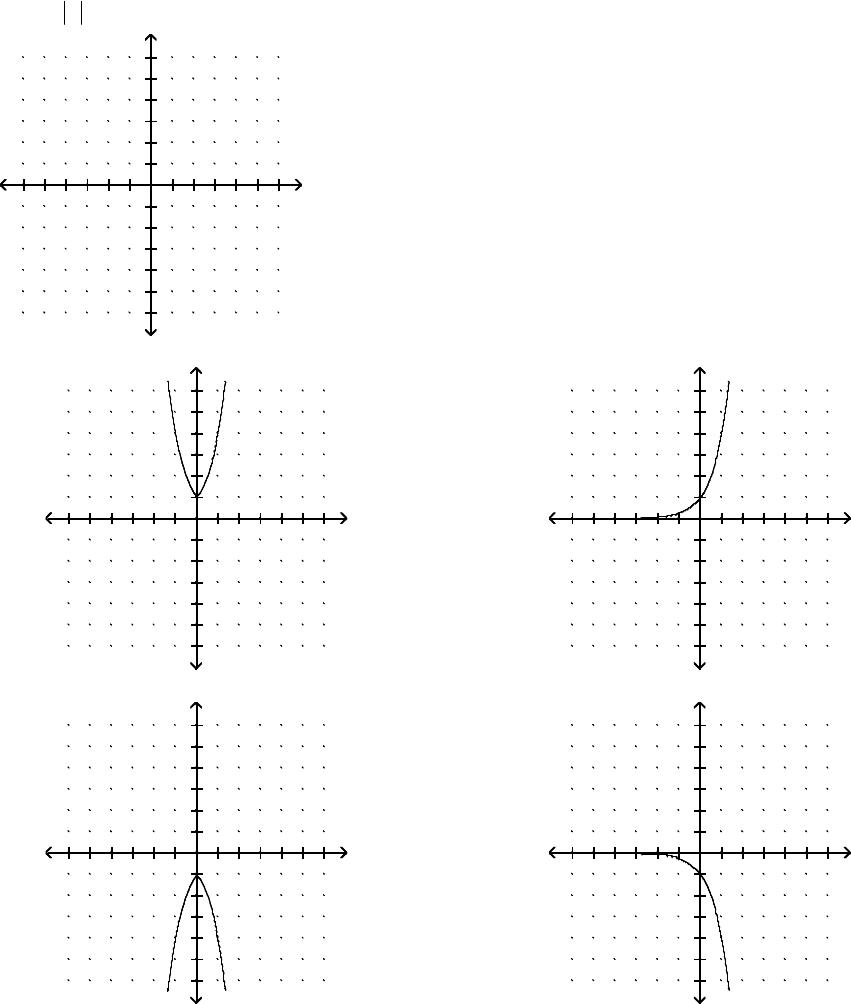
Graphthefunction.
11) f(x)=4x
x
-6 -4 -2 2 4 6
y
6
4
2
-2
-4
-6
x
-6 -4 -2 2 4 6
y
6
4
2
-2
-4
-6
A)
x
-6 -4 -2 2 4 6
y
6
4
2
-2
-4
-6
x
-6 -4 -2 2 4 6
y
6
4
2
-2
-4
-6
B)
x
-6 -4 -2 2 4 6
y
6
4
2
-2
-4
-6
x
-6 -4 -2 2 4 6
y
6
4
2
-2
-4
-6
C)
x
-6 -4 -2 2 4 6
y
6
4
2
-2
-4
-6
x
-6 -4 -2 2 4 6
y
6
4
2
-2
-4
-6
D)
x
-6 -4 -2 2 4 6
y
6
4
2
-2
-4
-6
x
-6 -4 -2 2 4 6
y
6
4
2
-2
-4
-6
Page27
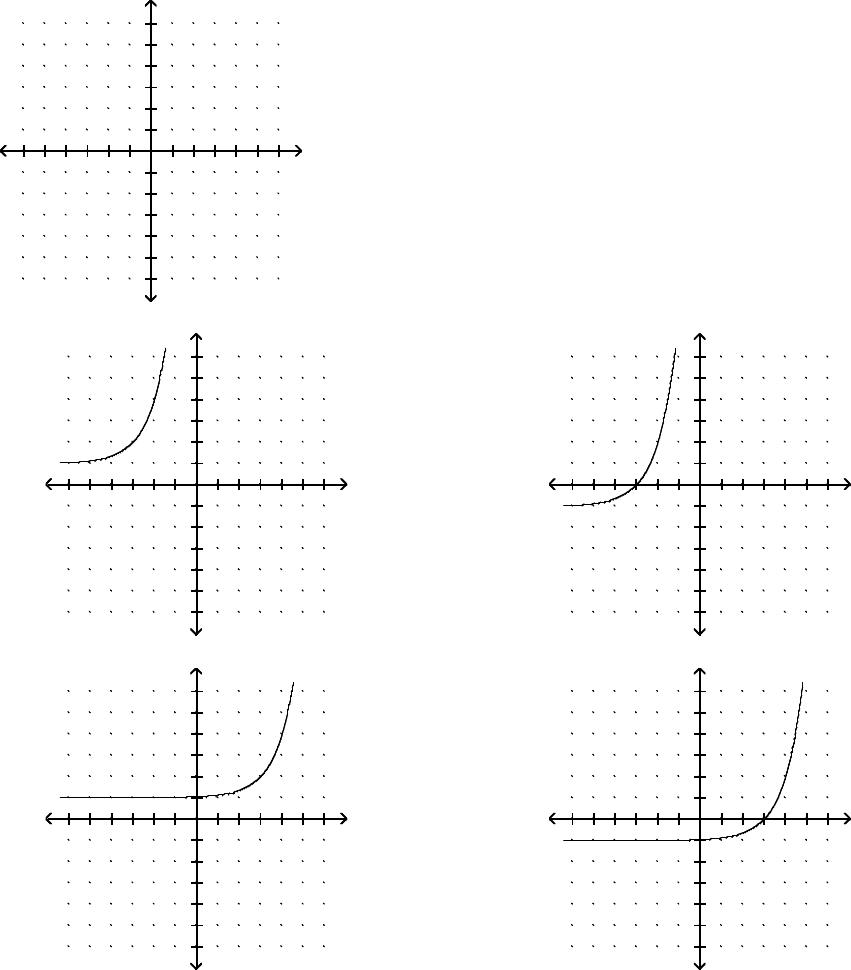
12) f(x)=3(x+3)+1.
x
-6 -4 -2 2 4 6
y
6
4
2
-2
-4
-6
x
-6 -4 -2 2 4 6
y
6
4
2
-2
-4
-6
A)
x
-6 -4 -2 2 4 6
y
6
4
2
-2
-4
-6
x
-6 -4 -2 2 4 6
y
6
4
2
-2
-4
-6
B)
x
-6 -4 -2 2 4 6
y
6
4
2
-2
-4
-6
x
-6 -4 -2 2 4 6
y
6
4
2
-2
-4
-6
C)
x
-6 -4 -2 2 4 6
y
6
4
2
-2
-4
-6
x
-6 -4 -2 2 4 6
y
6
4
2
-2
-4
-6
D)
x
-6 -4 -2 2 4 6
y
6
4
2
-2
-4
-6
x
-6 -4 -2 2 4 6
y
6
4
2
-2
-4
-6
Page28
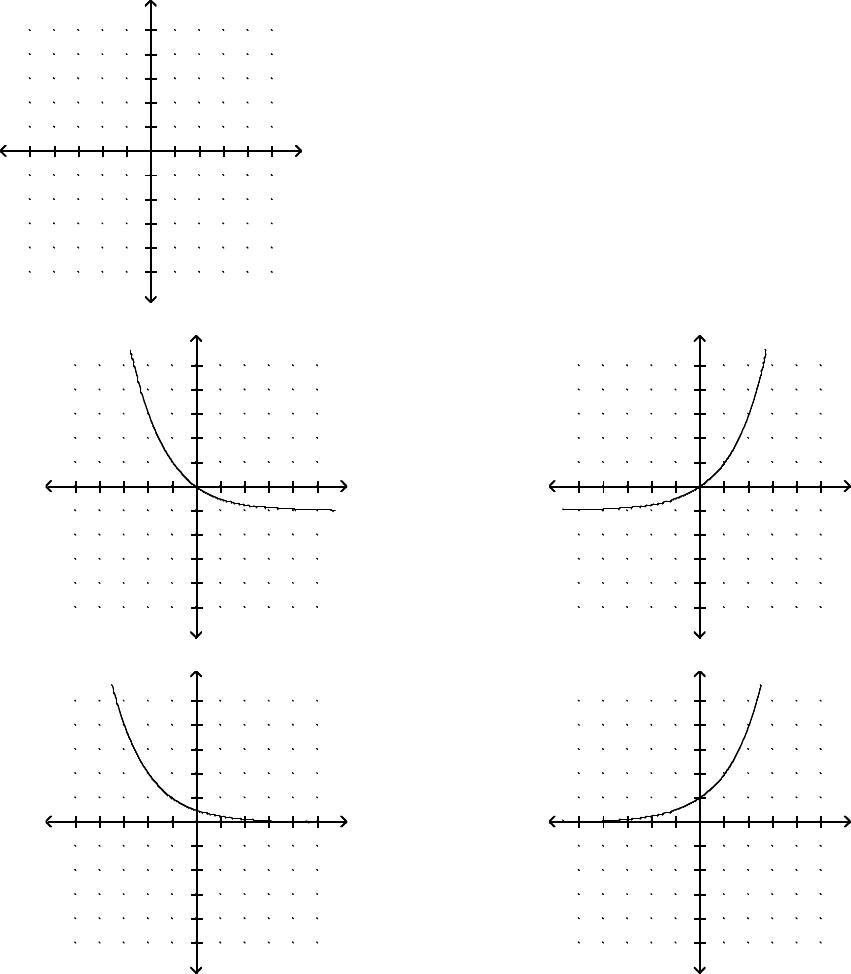
13) f(x)=2–x–1
x
-5 -4 -3 -2 -1 1 2 3 4 5
y
5
4
3
2
1
-1
-2
-3
-4
-5
x
-5 -4 -3 -2 -1 1 2 3 4 5
y
5
4
3
2
1
-1
-2
-3
-4
-5
A)
x
-5 -4 -3 -2 -1 1 2 3 4 5
y
5
4
3
2
1
-1
-2
-3
-4
-5
x
-5 -4 -3 -2 -1 1 2 3 4 5
y
5
4
3
2
1
-1
-2
-3
-4
-5
B)
x
-5 -4 -3 -2 -1 1 2 3 4 5
y
5
4
3
2
1
-1
-2
-3
-4
-5
x
-5 -4 -3 -2 -1 1 2 3 4 5
y
5
4
3
2
1
-1
-2
-3
-4
-5
C)
x
-5 -4 -3 -2 -1 1 2 3 4 5
y
5
4
3
2
1
-1
-2
-3
-4
-5
x
-5 -4 -3 -2 -1 1 2 3 4 5
y
5
4
3
2
1
-1
-2
-3
-4
-5
D)
x
-5 -4 -3 -2 -1 1 2 3 4 5
y
5
4
3
2
1
-1
-2
-3
-4
-5
x
-5 -4 -3 -2 -1 1 2 3 4 5
y
5
4
3
2
1
-1
-2
-3
-4
-5
Page29
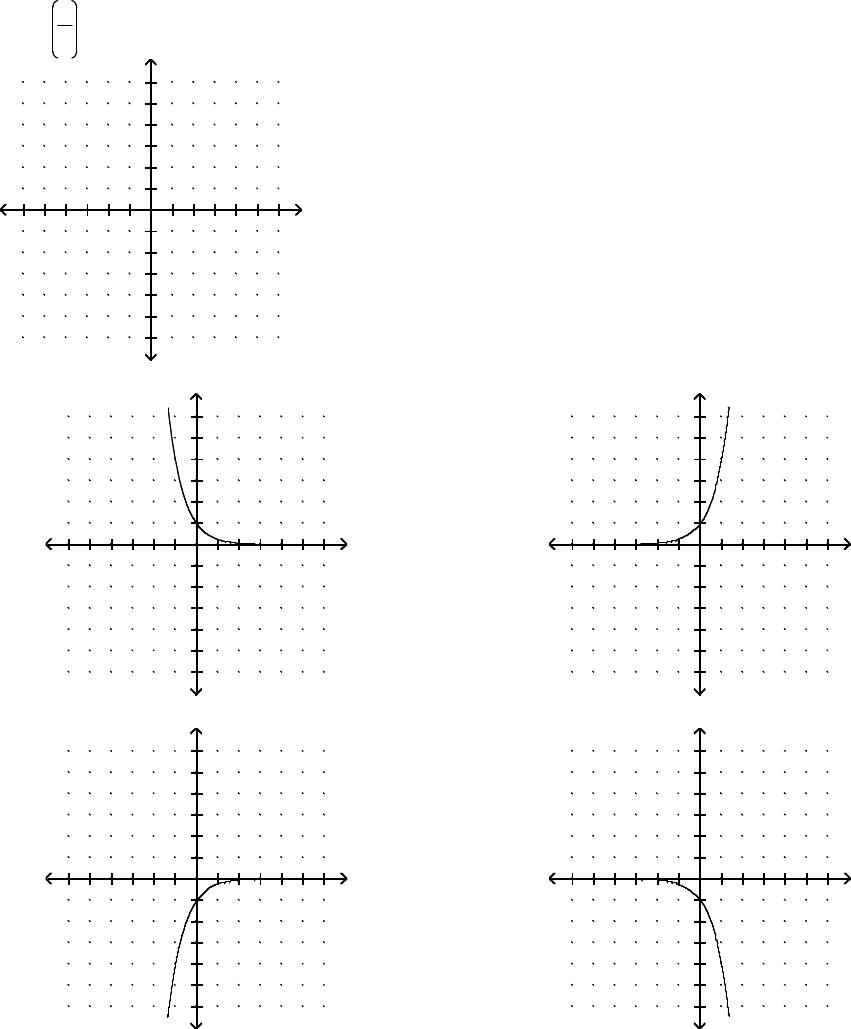
14) f(x)=1
4
x
x
-6 -4 -2 2 4 6
y
6
4
2
-2
-4
-6
x
-6 -4 -2 2 4 6
y
6
4
2
-2
-4
-6
A)
x
-6 -4 -2 2 4 6
y
6
4
2
-2
-4
-6
x
-6 -4 -2 2 4 6
y
6
4
2
-2
-4
-6
B)
x
-6 -4 -2 2 4 6
y
6
4
2
-2
-4
-6
x
-6 -4 -2 2 4 6
y
6
4
2
-2
-4
-6
C)
x
-6 -4 -2 2 4 6
y
6
4
2
-2
-4
-6
x
-6 -4 -2 2 4 6
y
6
4
2
-2
-4
-6
D)
x
-6 -4 -2 2 4 6
y
6
4
2
-2
-4
-6
x
-6 -4 -2 2 4 6
y
6
4
2
-2
-4
-6
Page30
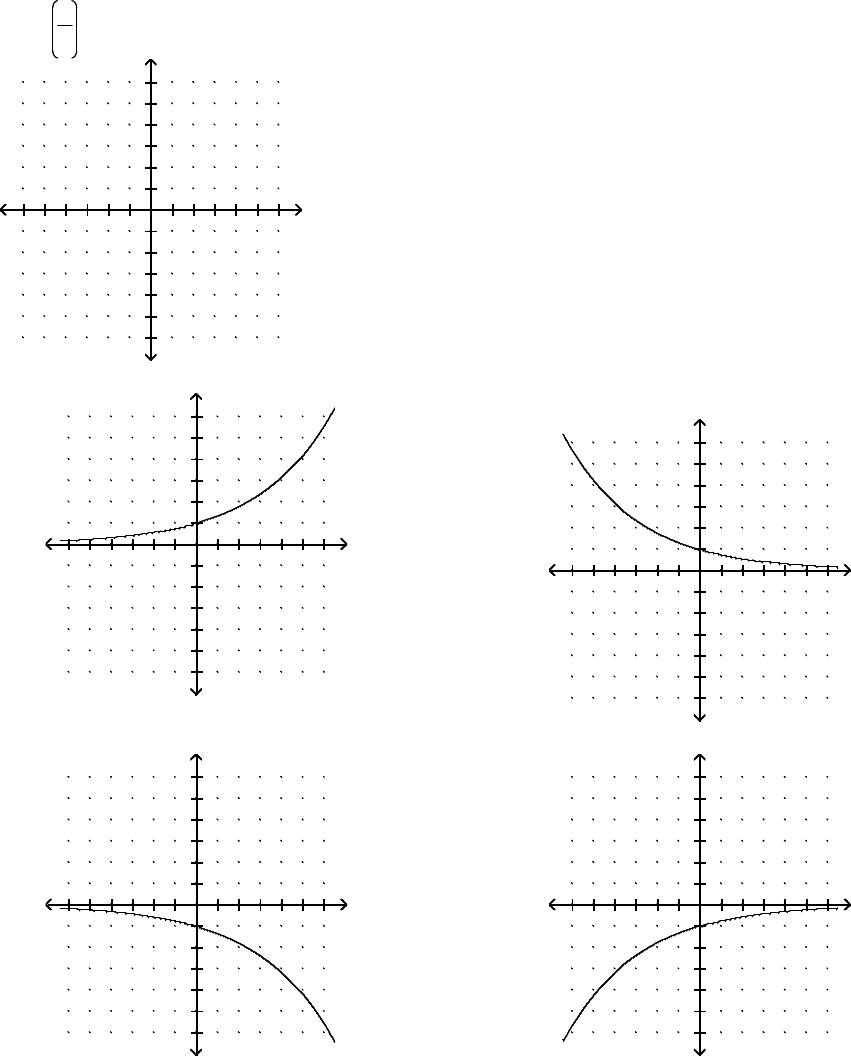
15) f(x)=4
3
x
x
-6 -4 -2 2 4 6
y
6
4
2
-2
-4
-6
x
-6 -4 -2 2 4 6
y
6
4
2
-2
-4
-6
A)
x
-6 -4 -2 2 4 6
y
6
4
2
-2
-4
-6
x
-6 -4 -2 2 4 6
y
6
4
2
-2
-4
-6
B)
x
-6 -4 -2 2 4 6
y
6
4
2
-2
-4
-6
x
-6 -4 -2 2 4 6
y
6
4
2
-2
-4
-6
C)
x
-6 -4 -2 2 4 6
y
6
4
2
-2
-4
-6
x
-6 -4 -2 2 4 6
y
6
4
2
-2
-4
-6
D)
x
-6 -4 -2 2 4 6
y
6
4
2
-2
-4
-6
x
-6 -4 -2 2 4 6
y
6
4
2
-2
-4
-6
Page31
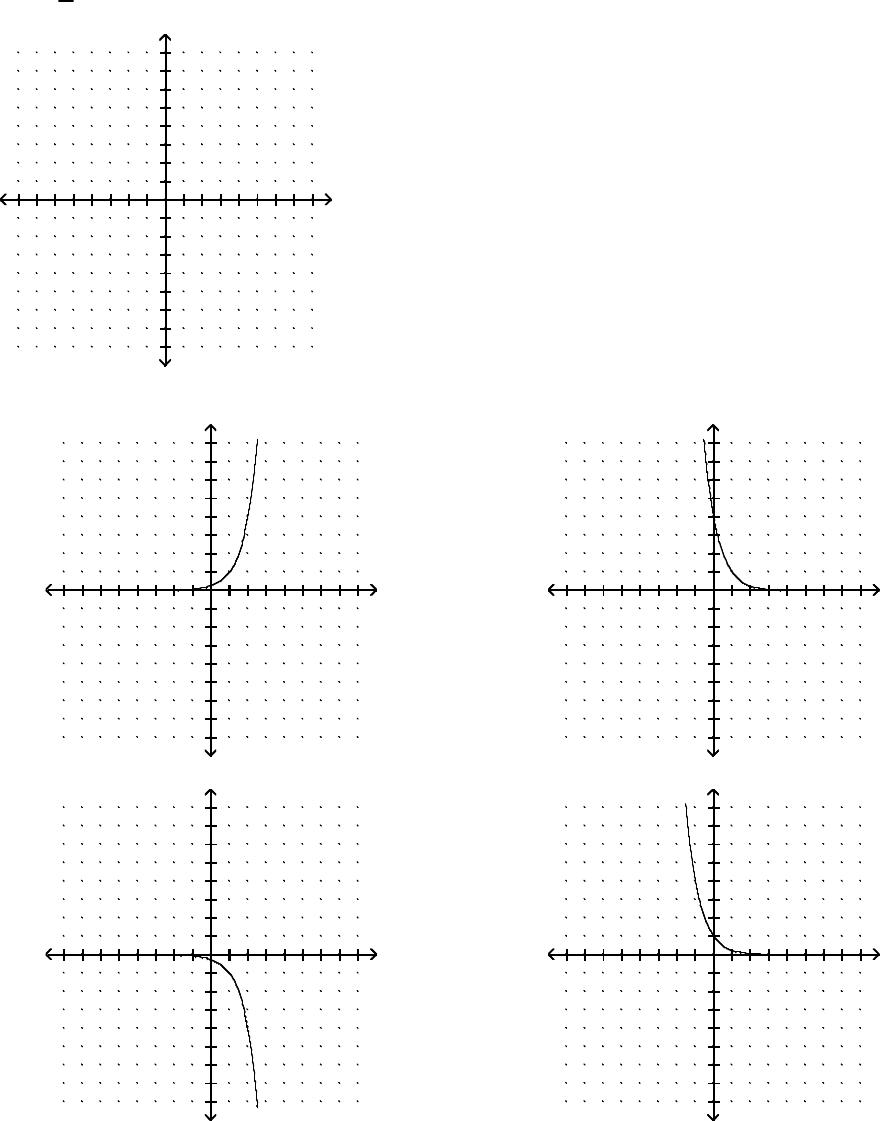
16) f(x)= 1
4
·4x.
x
–8–6–4–2 2468
y
8
6
4
2
-2
-4
-6
-8
x
–8–6–4–2 2468
y
8
6
4
2
-2
-4
-6
-8
A)
x
-8 -6 -4 -2 2 4 6 8
y
8
6
4
2
-2
-4
-6
-8
x
-8 -6 -4 -2 2 4 6 8
y
8
6
4
2
-2
-4
-6
-8
B)
x
-8 -6 -4 -2 2 4 6 8
y
8
6
4
2
-2
-4
-6
-8
x
-8 -6 -4 -2 2 4 6 8
y
8
6
4
2
-2
-4
-6
-8
C)
x
-8 -6 -4 -2 2 4 6 8
y
8
6
4
2
-2
-4
-6
-8
x
-8 -6 -4 -2 2 4 6 8
y
8
6
4
2
-2
-4
-6
-8
D)
x
-8 -6 -4 -2 2 4 6 8
y
8
6
4
2
-2
-4
-6
-8
x
-8 -6 -4 -2 2 4 6 8
y
8
6
4
2
-2
-4
-6
-8
Page32
3 DefinetheNumbere
MULTIPLECHOICE.Choosetheonealternativethatbestcompletesthestatementoranswersthequestion.
Graphthefunction.
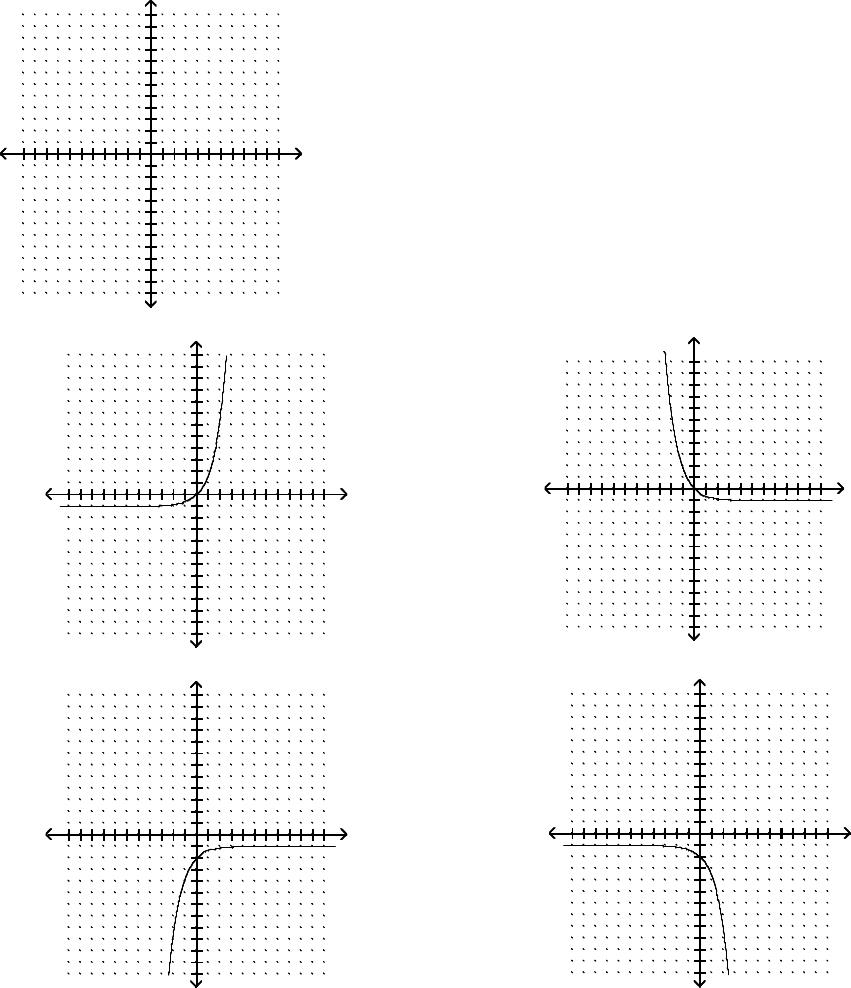
1) f(x)=–1+ex
x
-10 -5 5 10
y
10
5
-5
-10
x
-10 -5 5 10
y
10
5
-5
-10
A)
x
-10 -5 5 10
y
10
5
-5
-10
x
-10 -5 5 10
y
10
5
-5
-10
B)
x
-10 -5 5 10
y
10
5
-5
-10
x
-10 -5 5 10
y
10
5
-5
-10
C)
x
-10 -5 5 10
y
10
5
-5
-10
x
-10 -5 5 10
y
10
5
-5
-10
D)
x
-10 -5 5 10
y
10
5
-5
-10
x
-10 -5 5 10
y
10
5
-5
-10
Page33
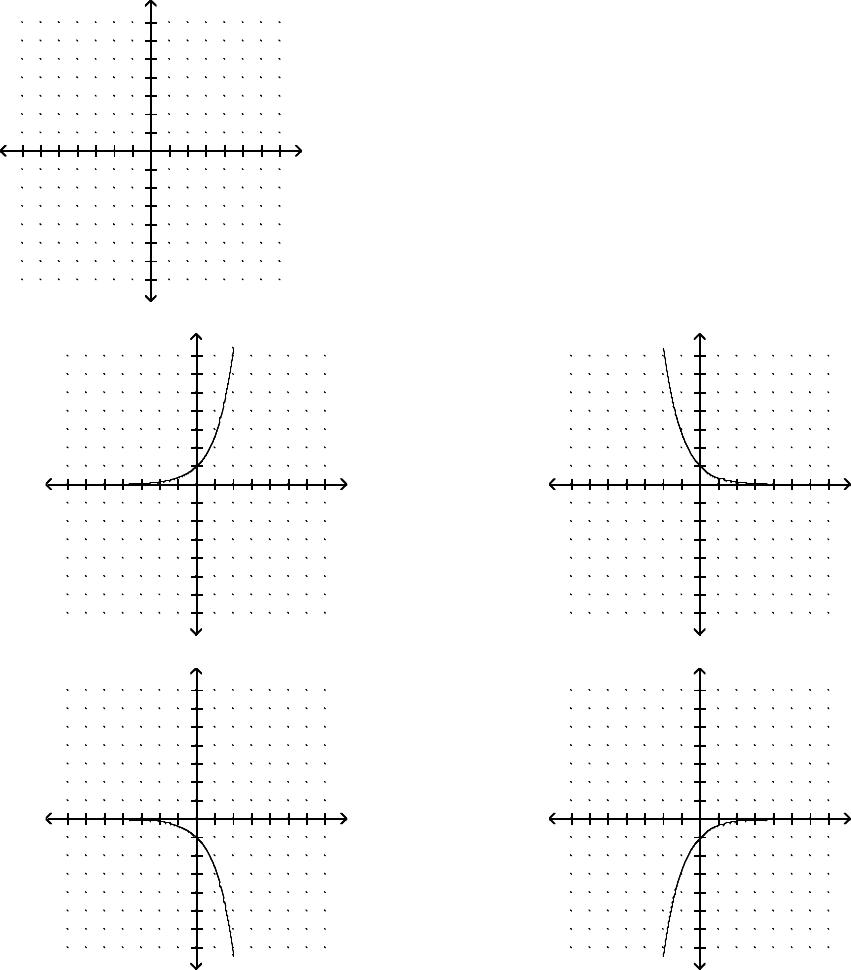
2) f(x)=ex
x
-6 -4 -2 2 4 6
y
6
4
2
-2
-4
-6
x
-6 -4 -2 2 4 6
y
6
4
2
-2
-4
-6
A)
x
-6 -4 -2 2 4 6
y
6
4
2
-2
-4
-6
x
-6 -4 -2 2 4 6
y
6
4
2
-2
-4
-6
B)
x
-6 -4 -2 2 4 6
y
6
4
2
-2
-4
-6
x
-6 -4 -2 2 4 6
y
6
4
2
-2
-4
-6
C)
x
-6 -4 -2 2 4 6
y
6
4
2
-2
-4
-6
x
-6 -4 -2 2 4 6
y
6
4
2
-2
-4
-6
D)
x
-6 -4 -2 2 4 6
y
6
4
2
-2
-4
-6
x
-6 -4 -2 2 4 6
y
6
4
2
-2
-4
-6
Page34
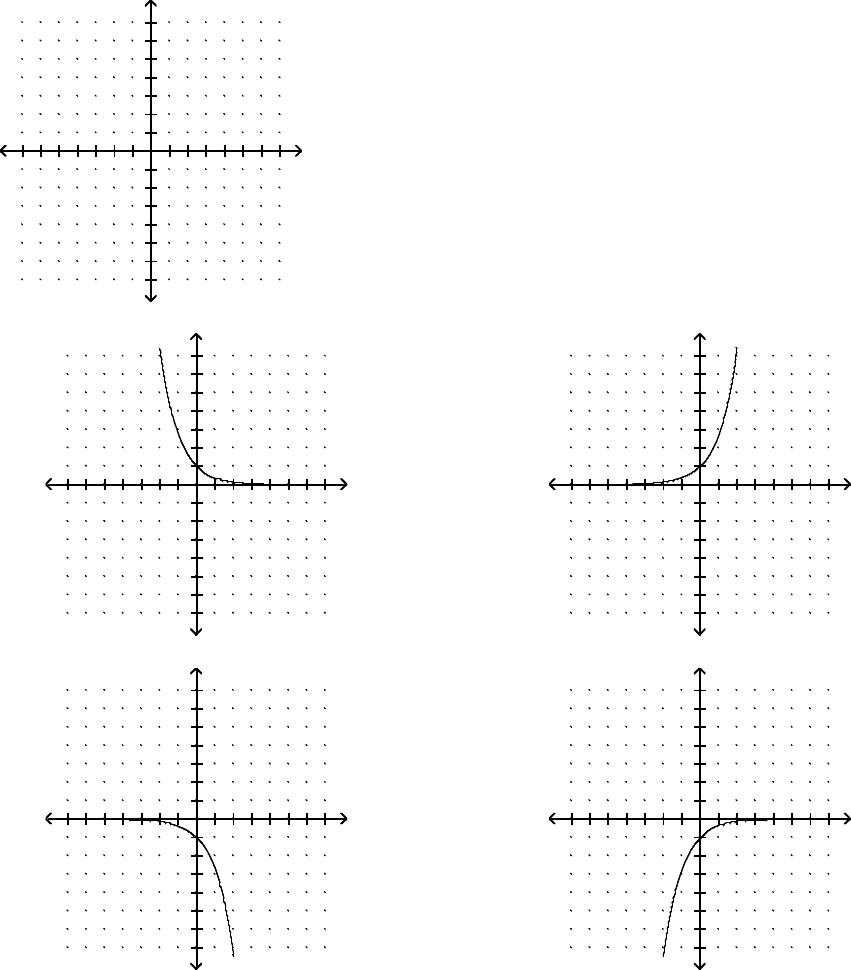
3) f(x)=e–x
x
-6 -4 -2 2 4 6
y
6
4
2
-2
-4
-6
x
-6 -4 -2 2 4 6
y
6
4
2
-2
-4
-6
A)
x
-6 -4 -2 2 4 6
y
6
4
2
-2
-4
-6
x
-6 -4 -2 2 4 6
y
6
4
2
-2
-4
-6
B)
x
-6 -4 -2 2 4 6
y
6
4
2
-2
-4
-6
x
-6 -4 -2 2 4 6
y
6
4
2
-2
-4
-6
C)
x
-6 -4 -2 2 4 6
y
6
4
2
-2
-4
-6
x
-6 -4 -2 2 4 6
y
6
4
2
-2
-4
-6
D)
x
-6 -4 -2 2 4 6
y
6
4
2
-2
-4
-6
x
-6 -4 -2 2 4 6
y
6
4
2
-2
-4
-6
Page35
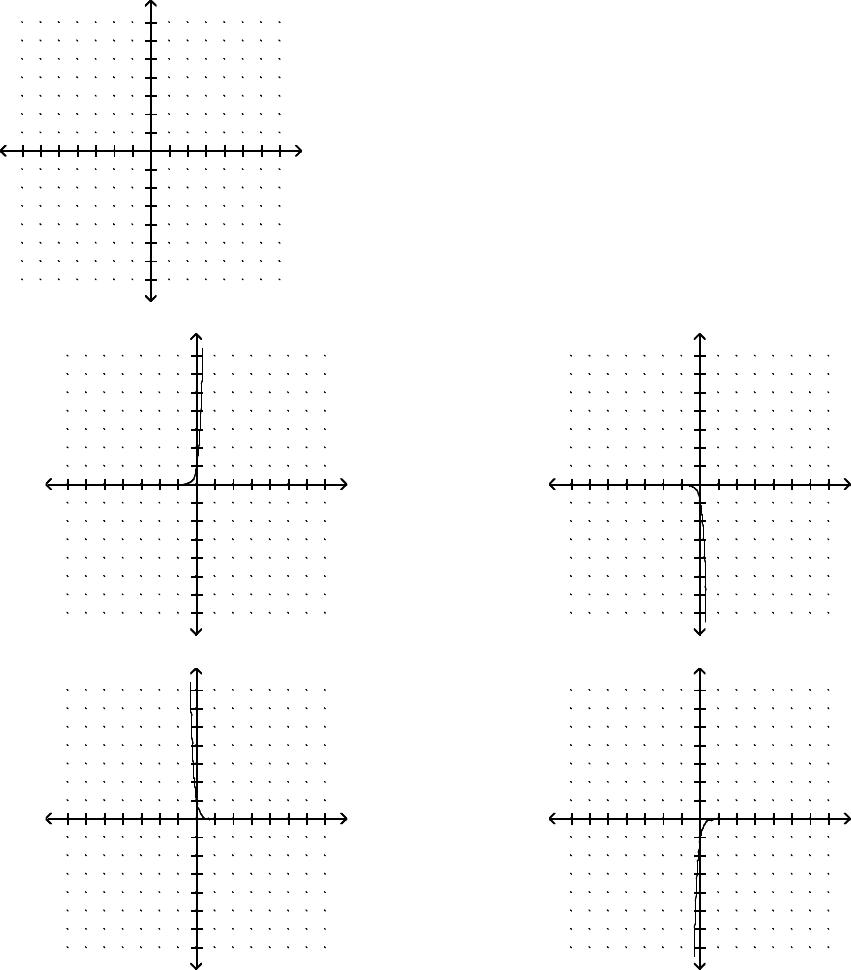
4) f(x)=e6x
x
-6 -4 -2 2 4 6
y
6
4
2
-2
-4
-6
x
-6 -4 -2 2 4 6
y
6
4
2
-2
-4
-6
A)
x
-6 -4 -2 2 4 6
y
6
4
2
-2
-4
-6
x
-6 -4 -2 2 4 6
y
6
4
2
-2
-4
-6
B)
x
-6 -4 -2 2 4 6
y
6
4
2
-2
-4
-6
x
-6 -4 -2 2 4 6
y
6
4
2
-2
-4
-6
C)
x
-6 -4 -2 2 4 6
y
6
4
2
-2
-4
-6
x
-6 -4 -2 2 4 6
y
6
4
2
-2
-4
-6
D)
x
-6 -4 -2 2 4 6
y
6
4
2
-2
-4
-6
x
-6 -4 -2 2 4 6
y
6
4
2
-2
-4
-6
Page36
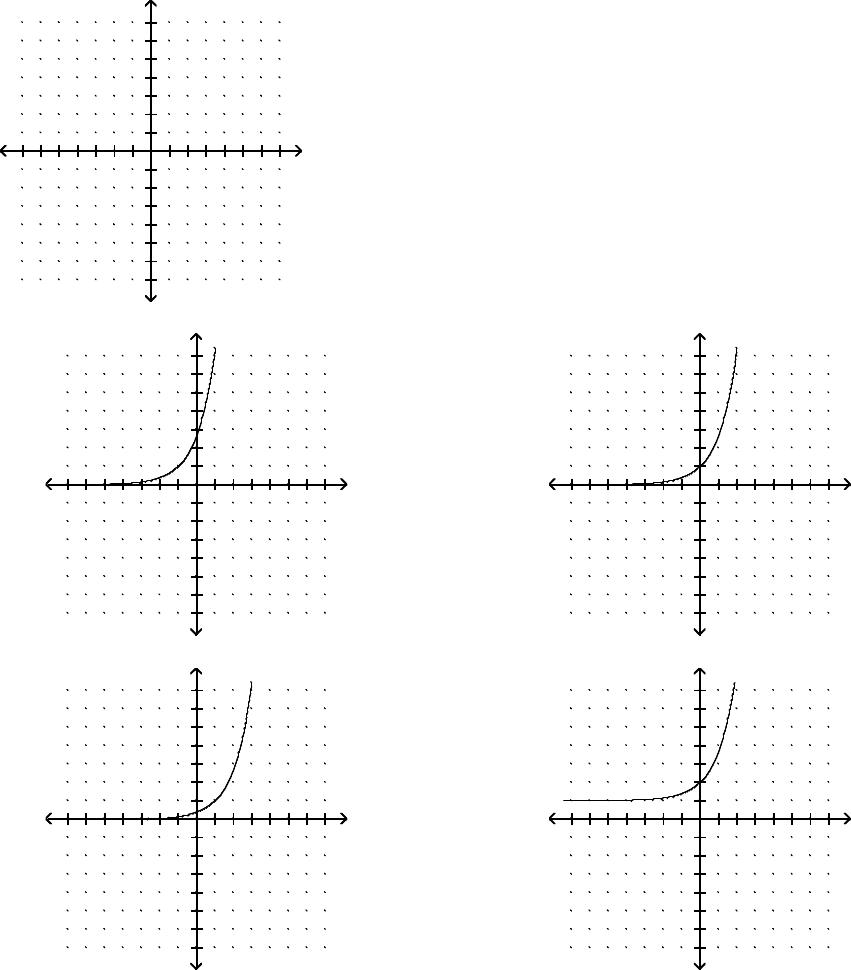
5) f(x)=ex+1
x
-6 -4 -2 2 4 6
y
6
4
2
-2
-4
-6
x
-6 -4 -2 2 4 6
y
6
4
2
-2
-4
-6
A)
x
-6 -4 -2 2 4 6
y
6
4
2
-2
-4
-6
x
-6 -4 -2 2 4 6
y
6
4
2
-2
-4
-6
B)
x
-6 -4 -2 2 4 6
y
6
4
2
-2
-4
-6
x
-6 -4 -2 2 4 6
y
6
4
2
-2
-4
-6
C)
x
-6 -4 -2 2 4 6
y
6
4
2
-2
-4
-6
x
-6 -4 -2 2 4 6
y
6
4
2
-2
-4
-6
D)
x
-6 -4 -2 2 4 6
y
6
4
2
-2
-4
-6
x
-6 -4 -2 2 4 6
y
6
4
2
-2
-4
-6
Page37
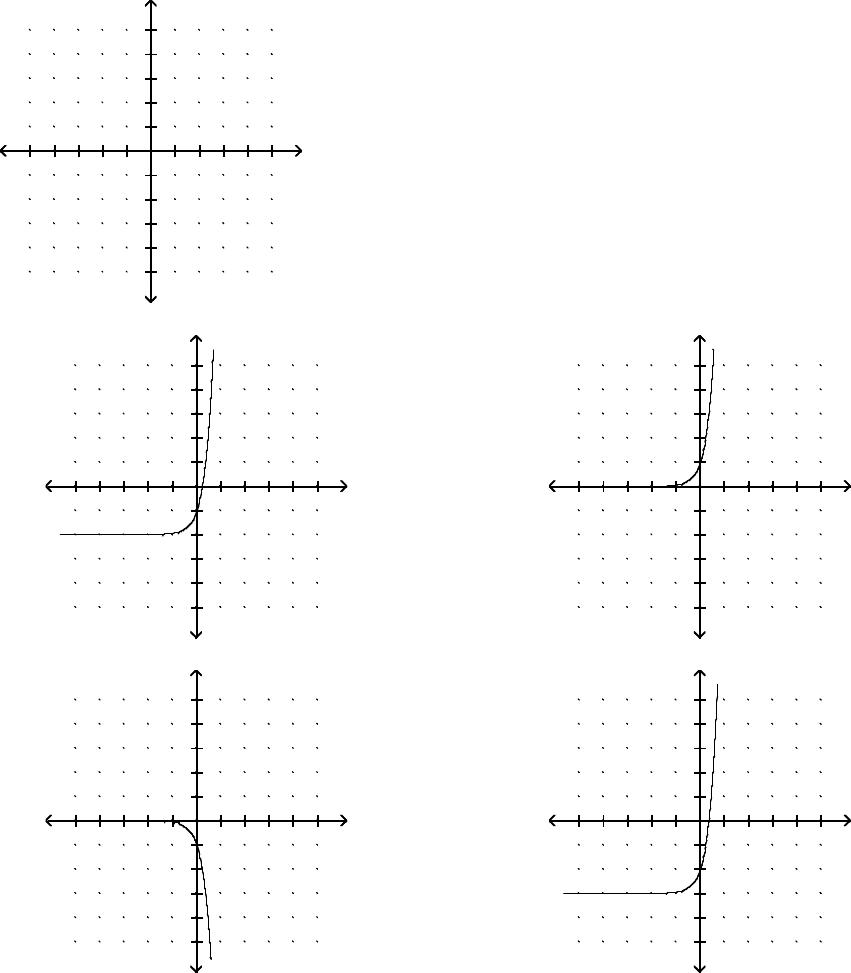
6) f(x)=e3x–2
x
-5 -4 -3 -2 -1 1 2 3 4 5
y
5
4
3
2
1
-1
-2
-3
-4
-5
x
-5 -4 -3 -2 -1 1 2 3 4 5
y
5
4
3
2
1
-1
-2
-3
-4
-5
A)
x
-5 -4 -3 -2 -1 1 2 3 4 5
y
5
4
3
2
1
-1
-2
-3
-4
-5
x
-5 -4 -3 -2 -1 1 2 3 4 5
y
5
4
3
2
1
-1
-2
-3
-4
-5
B)
x
-5 -4 -3 -2 -1 1 2 3 4 5
y
5
4
3
2
1
-1
-2
-3
-4
-5
x
-5 -4 -3 -2 -1 1 2 3 4 5
y
5
4
3
2
1
-1
-2
-3
-4
-5
C)
x
-5 -4 -3 -2 -1 1 2 3 4 5
y
5
4
3
2
1
-1
-2
-3
-4
-5
x
-5 -4 -3 -2 -1 1 2 3 4 5
y
5
4
3
2
1
-1
-2
-3
-4
-5
D)
x
-5 -4 -3 -2 -1 1 2 3 4 5
y
5
4
3
2
1
-1
-2
-3
-4
-5
x
-5 -4 -3 -2 -1 1 2 3 4 5
y
5
4
3
2
1
-1
-2
-3
-4
-5
Page38
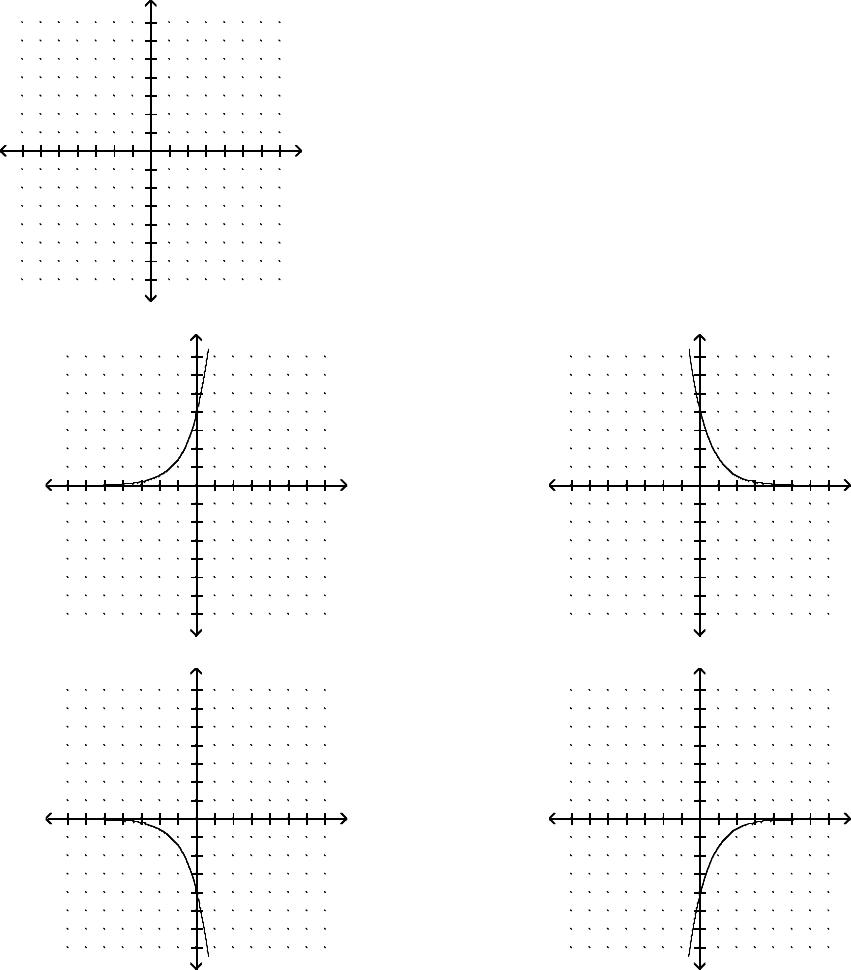
7) f(x)=4ex
x
-6 -4 -2 2 4 6
y
6
4
2
-2
-4
-6
x
-6 -4 -2 2 4 6
y
6
4
2
-2
-4
-6
A)
x
-6 -4 -2 2 4 6
y
6
4
2
-2
-4
-6
x
-6 -4 -2 2 4 6
y
6
4
2
-2
-4
-6
B)
x
-6 -4 -2 2 4 6
y
6
4
2
-2
-4
-6
x
-6 -4 -2 2 4 6
y
6
4
2
-2
-4
-6
C)
x
-6 -4 -2 2 4 6
y
6
4
2
-2
-4
-6
x
-6 -4 -2 2 4 6
y
6
4
2
-2
-4
-6
D)
x
-6 -4 -2 2 4 6
y
6
4
2
-2
-4
-6
x
-6 -4 -2 2 4 6
y
6
4
2
-2
-4
-6
Page39
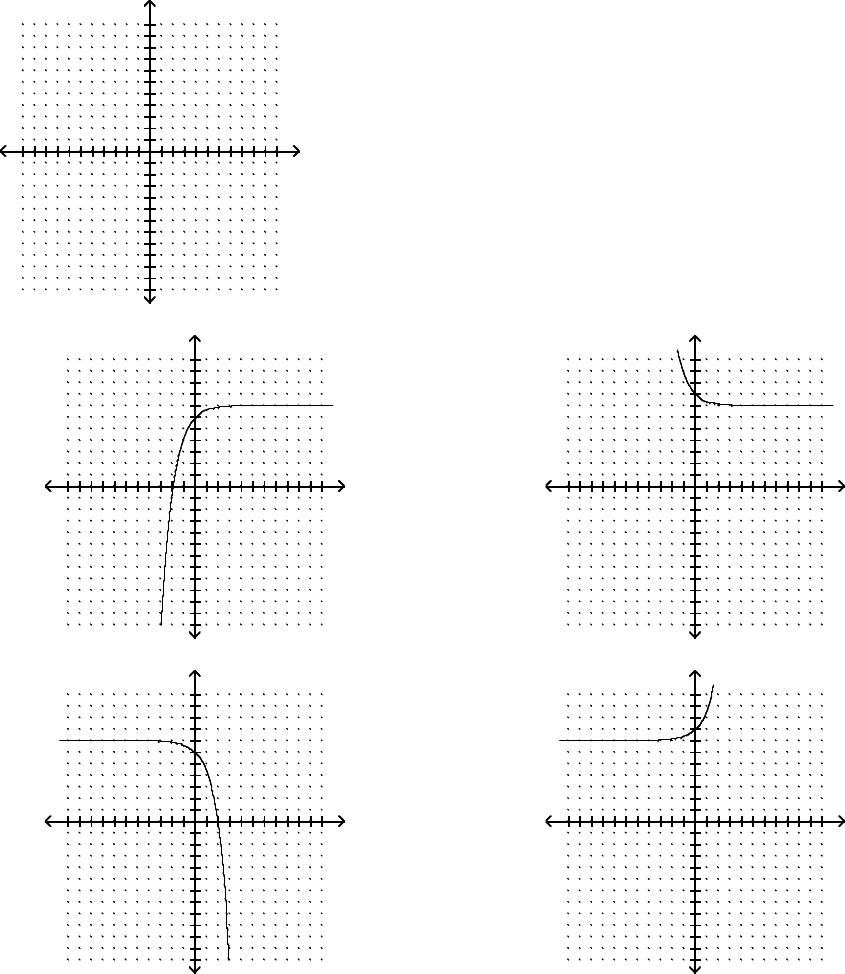
8) f(x)=7–e–x
x
-10 -5 5 10
y
10
5
-5
-10
x
-10 -5 5 10
y
10
5
-5
-10
A)
x
-10 -5 5 10
y
10
5
-5
-10
x
-10 -5 5 10
y
10
5
-5
-10
B)
x
-10 -5 5 10
y
10
5
-5
-10
x
-10 -5 5 10
y
10
5
-5
-10
C)
x
-10 -5 5 10
y
10
5
-5
-10
x
-10 -5 5 10
y
10
5
-5
-10
D)
x
-10 -5 5 10
y
10
5
-5
-10
x
-10 -5 5 10
y
10
5
-5
-10
Page40
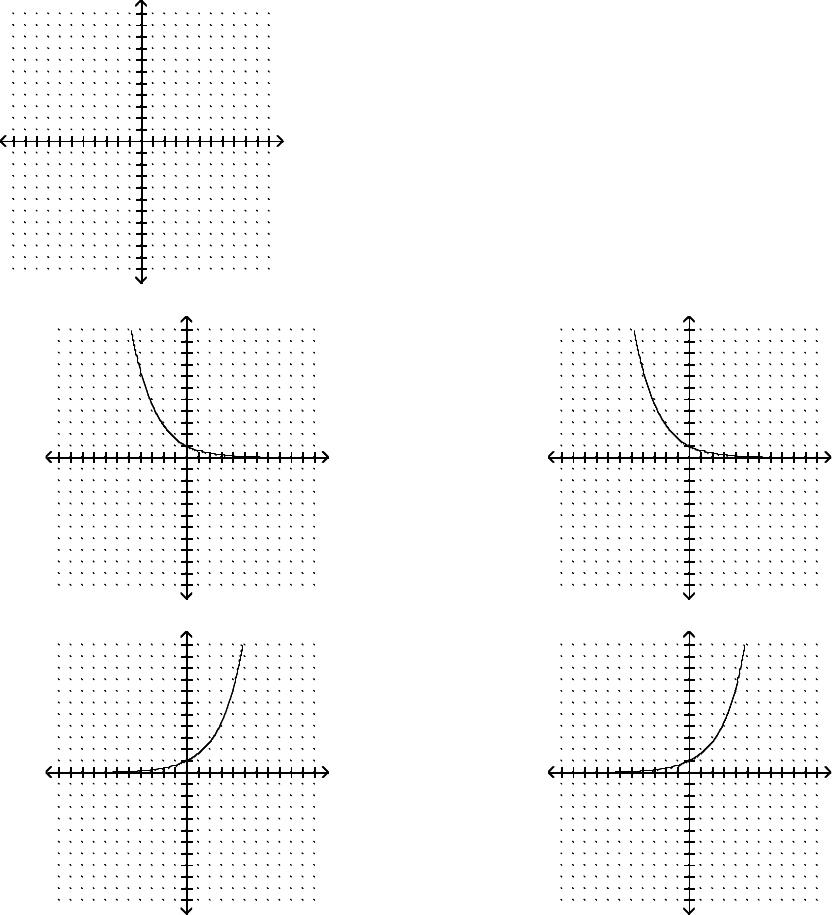
9) f(x)=e–0.5x
x
-10 -5 5 10
y
10
5
-5
-10
x
-10 -5 5 10
y
10
5
-5
-10
A)
x
-10 -5 5 10
y
10
5
-5
-10
x
-10 -5 5 10
y
10
5
-5
-10
B)
x
-10 -5 5 10
y
10
5
-5
-10
x
-10 -5 5 10
y
10
5
-5
-10
C)
x
-10 -5 5 10
y
10
5
-5
-10
x
-10 -5 5 10
y
10
5
-5
-10
D)
x
-10 -5 5 10
y
10
5
-5
-10
x
-10 -5 5 10
y
10
5
-5
-10
Page41
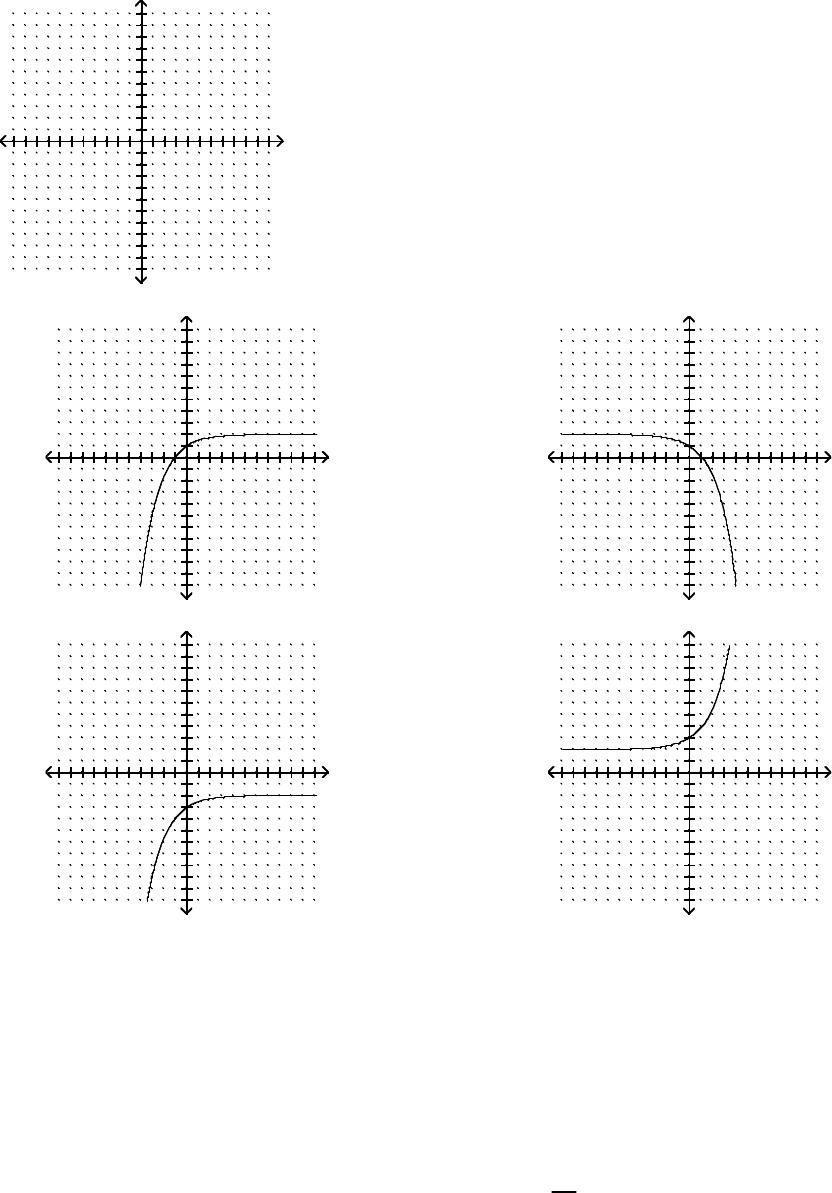
10) f(x)=2–e–0.64x
x
-10 -5 5 10
y
10
5
-5
-10
x
-10 -5 5 10
y
10
5
-5
-10
A)
x
-10 -5 5 10
y
10
5
-5
-10
x
-10 -5 5 10
y
10
5
-5
-10
B)
x
-10 -5 5 10
y
10
5
-5
-10
x
-10 -5 5 10
y
10
5
-5
-10
C)
x
-10 -5 5 10
y
10
5
-5
-10
x
-10 -5 5 10
y
10
5
-5
-10
D)
x
-10 -5 5 10
y
10
5
-5
-10
x
-10 -5 5 10
y
10
5
-5
-10
4 SolveExponentialEquations
MULTIPLECHOICE.Choosetheonealternativethatbestcompletesthestatementoranswersthequestion.
Solvetheequation.
1) 21+2x=32
A) {2} B) {16} C) {4} D) {–2}
2) 14x=1
A) {0} B) {1} C) { 1
14}D)
∅
Page42
3) 4–x=1
64
A) {3} B) {–3} C) 1
16 D) 1
3
4) 47–3x=1
16
A) {3} B) 1
4C) {4} D) {–3}
5) 3x=1
27
A) {–3} B) {3} C) 1
9D) 1
3
6) 3x=27
A) {3} B) {9} C) {4} D) {2}
7) 4(3x–5)=256
A) {3} B) 1
64 C) {128} D) {–3}
8) 1
2
x=8
A) {–3} B) 1
3C) {3} D) –1
3
9) 5
7
x=343
125
A) {–3} B) 1
3C) {3} D) –1
3
10) 3–x=1
9
A) {2} B) {–2} C) 1
3D) 1
2
11) 2x2–3=64
A) {3,–3} B) { 35,–35} C) {3} D) {6}
12) 92x·27(3–x)=1
9
A) {–11} B) {–8}
C) 9+87
6,9–87
6D) {10}
Page43
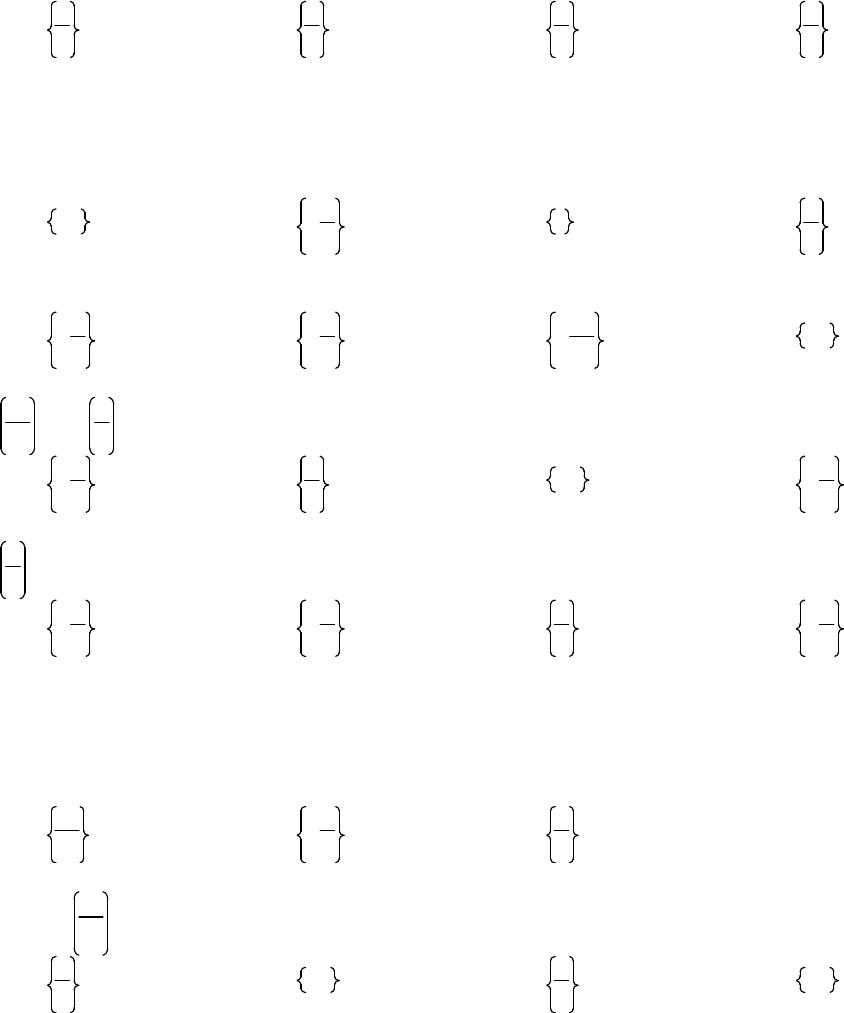
13) 16x=32
A) 5
4B) 4
5C) 1
4D) 1
5
14) 3(11–4x)=27
A) {2} B) {3} C) {1} D) {–2}
15) 1253x–2=31252x
A) –6B) –1
6C) 6 D) 1
6
16) 16x–4=643x
A) –8
7B) –2
7C) –16
5D) –2
17) 64
27
x+1=3
4
x–1
A) –1
2B) 1
2C) –1 D) –1
4
18) 1
3
6x+5=9x–1
A) –3
8B) –1
2C) 7
6D) –4
7
19) (ex)x·e28=e11x
A) {4
,
7} B) {–4
,
–7} C) {4} D) {7}
20) e4x–1=(e6)–x
A) 1
10 B) –1
2C) 7
5D) {0}
21) ex–5=1
e2
x+2
A) 1
3B) –9 C) 7
3D) –7
Solvetheproblem.
22) Therabbitpopulationinaforestareagrowsattherateof4%monthly.Ifthereare220rabbitsinApril
,
findhowmanyrabbits(roundedtothenearestwholenumber)shouldbeexpectedbynextApril.Use
y=220(2.7)0.04t
A) 354 B) 285 C) 367 D) 341
Page44

23) Threebacteriaareplacedinapetridish.Thepopulationwilltriple everyday.Theformulaforthenumber
ofbacteriainthedishondaytis
N(t)=3(3)t
wheretisthenumberofdaysafterthethreebacteriaareplacedinthedish.Howmanybacteriaareinthe
dishfourdaysafterthethreebacteriaareplacedinthedish?
A) 243 B) 36 C) 192 D) 10
24) Thebacteriaina8–litercontainerdoubleevery4 minutes.After57 minutesthecontainerisfull.Howlong
didittaketofillaquarterofthecontainer?
A) 49min B) 14.3 min C) 42.8 min D) 28.5 min
25) ThenumberofbooksinasmalllibraryincreasesaccordingtothefunctionB=7200e0.03t,wheretis
measuredinyears.Howmanybookswillthelibraryhaveafter1years?
A) 7419 B) 10,965 C) 25,247 D) 7715
26) Acityisgrowingattherateof0.6%annually.Iftherewere4,770,000 residentsinthecityin1995
,
findhow
many(tothenearestten–thousand)werelivinginthatcityin2000.Usey=4,770,000(2.7)0.006t
A) 4,910,000 B) 390,000 C) 12,880,000 D) 4,940,000
27) Theamountofaradioactivesubstancepresent,ingrams,attimetinmonthsisgivenbytheformula
y=8000(3)–0.2t.Findthenumberofgramspresentin2years.Ifnecessary,roundtothreedecimalplaces.
A) 41.012 B) 5155.152 C) 4.101 D) 515.515
28) Findtheamountinasavingsaccountattheendof10 yearsiftheamountoriginallydepositedis$3000 and
theinterestrateis5.5%compoundedsemiannually.
Use:A=P1+r
n
ntwhere:
A=finalamount
P=$3000(theinitialdeposit)
r=5.5%=0.055(theannualrateofinterest)
n=2(thenumberoftimesinterestiscompoundedeachyear)
t=10(thedurationofthedepositinyears)
A) $5161.29 B) $5677.41 C) $61,650.00 D) $3934.95
29) Letitiaborrows$3750atarateof10.5%compoundedmonthly.FindhowmuchLetitiaowesattheendof4
years.
Use:A=P1+r
n
ntwhere:
A=finalamount
P=$3750(theamountborrowed)
r=10.5%=0.105(theannualrateofinterest)
n=12(thenumberoftimesinterestiscompoundedeachyear)
t=4(thedurationoftheloaninyears)
A) $5696.94 B) $6266.63 C) $181,575.00 D) $3882.98
30) Supposethatf(x)=5x.Whatisf(4)?Whatpointisonthegraphoff?
A) 625;(4
,
625) B) 625;(4
,
5) C) 1024;(4
,
1024) D) 1024;(5
,
1024)
Page45

31) Supposethatf(x)=2x.Iff(x)=1
64,whatisx?
A) –6 B) 6 C) 2 D) –2
32) Supposethatf(x)=4x+3.Whatisf(6)?Whatpointisonthegraphoff?
A) 4099;(6
,
4099) B) 4096;(6
,
4096) C) 4096;(3
,
4096) D) 4099;(6
,
4096)
33) Supposethatf(x)=3x+1.Iff(x)=1/28,whatisx?
A) –3 B) 3 C) 1 D) –1
6.4 LogarithmicFunctions
1 ChangeExponentialStatementstoLogarithmicStatements&LogarithmicStatementstoExponentialStatements
MULTIPLECHOICE.Choosetheonealternativethatbestcompletesthestatementoranswersthequestion.
Changetheexponentialexpressiontoanequivalentexpressioninvolvingalogarithm.
1) 53=125
A) log 5125=3 B) log 125 5=3 C) log 3125 =5 D) log 53=125
2) 5–2=1
25
A) log 51
25
=–2 B) log 1/25 5= –2 C) log –21
25
=5 D) log 5–2=1
25
3) 62=x
A) log 6x=2 B) log x6=2 C) log 2x=6 D) log 62=x
4) 45
/
2=32
A) log 432=5
2B) log 32 4=5
2C) log 232
log 54
=4 D) log 54=5
2
5) 10x=1000
A) log 10 1000=x B) log x1000 =10 C) log 1000 10 =x D) log 1000 x=10
6) ex=11
A) ln11=x B) log11 x=eC)lnx=11 D) logxe=11
Changethelogarithmicexpressiontoanequivalentexpressioninvolvinganexponent.
7) log 1
/
416=–2
A) 1
4
–2=16 B) 1
4
2=16 C) (–2)1
/
4=16 D) 161
/
4=2
8) log 41
16
=–2
A) 4–2=1
16 B) 24=1
16 C) 416=2D)
1
16
2=4
Page46
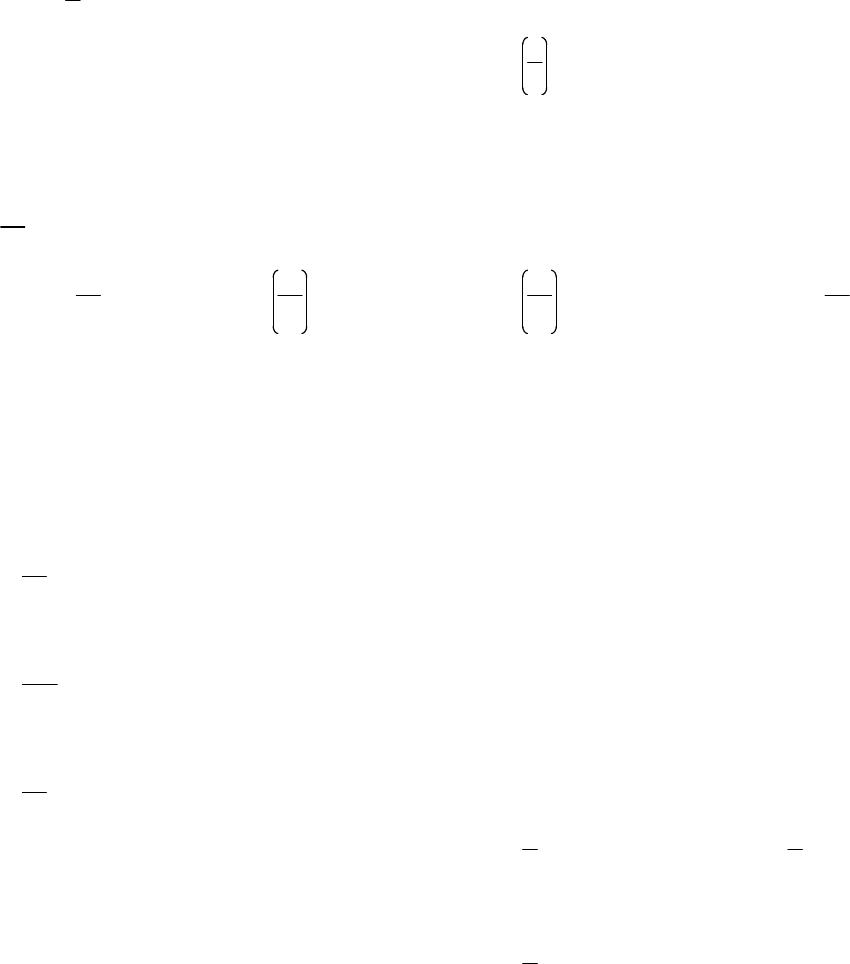
9) log 464=3
A) 43=64 B) 34=64 C) 464=3D)64
3=4
10) log 2x=3
A) 23=xB)3
2=xC)2
x=3D)x
3=2
11) log b64=3
A) b3=64 B) 3b=64 C) 643=bD)64
b=3
12) log 39=x
A) 3x=9B)x
3=9C)9
x=3D)9
3=x
13) logb49=2
3
A) b2/3=49 B) 492/3=bC)
2
3
b=49 D) b3/2=49
14) lnx=4
A) e4=xB)e
x=4C)4
e=xD)x
4=e
15) ln1
e4
=–4
A) e–4=1
e4B) 1
e4
e=–4C)
1
e4
–4=eD)
–4e=1
e4
2 EvaluateLogarithmicExpressions
MULTIPLECHOICE.Choosetheonealternativethatbestcompletesthestatementoranswersthequestion.
Findtheexactvalueofthelogarithmicexpression.
1) log464
A) 3 B) 64 C) 12 D) 4
2) log61
36
A) –2 B) 2 C) 6 D) –6
3) log71
343
A) –3 B) 3 C) 49 D) –49
4) log41
64
A) –3B)3 C)
1
3D) –1
3
5) log 41
A) 0 B) 4 C) 1
4D) 1
Page47

6) log1/4256
A) –4B)4 C)
1
4D) –1
4
7) log 44
A) 1
2B) 4 C) 1
4D) 1
8) log 10 10
A) 1 B) 10 C) 1
10 D) –1
9) lnl
A) 0 B) 1 C) e D) –1
10) lne
A) 1 B) 0 C) e D) –1
11) lne8
A) 8 B) e C) 1
8D) 1
Useacalculatortoevaluatetheexpression.Roundyouranswertothreedecimalplaces
12) log4
5
A) –0.097 B) –0.223 C) –10.319 D) 0.097
13)
ln8
5
0.88
A) 0.534 B) –0.598 C) –3.677 D) 0.598
14) log2+log2
ln2–ln9
A) –0.400 B) 0.000 C) –0.922 D) 0.208
15) elog80+ln7
log3+ln50
A) 1.622 B) 0.735 C) 0.877 D) –2.073
Solvetheproblem.
16) ThepHofachemicalsolutionisgivenbytheformula
pH=–log10[H+]
where[H+]istheconcentrationofhydrogenionsinmolesperliter.
FindthepHifthe[H+]=6.8×10⁻¹.
A) 0.17 B) 1.83 C) 1.17 D) 0.83
Page48
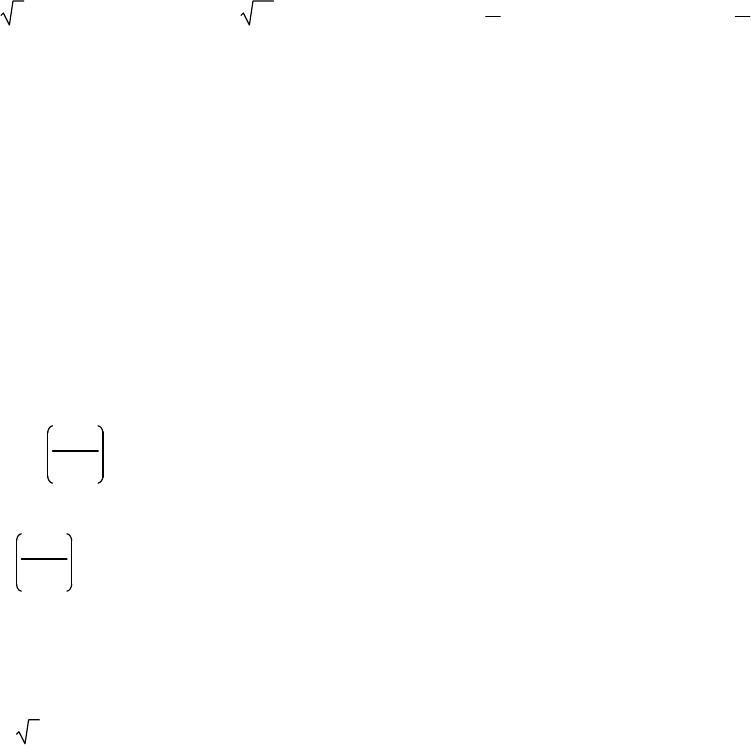
17) Thelongjumprecord,infeet,ataparticularschoolcanbemodeledbyf(x)=18.9+2.4ln(x+1) wherexis
thenumberofyearssincerecordsbegantobekeptattheschool.Whatistherecordforthelongjump
21yearsafterrecordstartedbeingkept?Roundyouranswertothenearesttenth.
A) 26.3ft B) 26.2 ft C) 26.1 ft D) 21.3 ft
18) Thefunctionf(x)=1+1.4ln(x+1)modelstheaveragenumberoffree–throwsabasketballplayercanmake
consecutivelyduringpracticeasafunctionoftime,wherexisthenumberofconsecutivedaysthe
basketballplayerhaspracticedfortwohours.After16daysofpractice,whatistheaveragenumberof
consecutivefreethrowsthebasketballplayermakes?
A) 5consecutivefreethrows B) 6 consecutivefreethrows
C) 8consecutivefreethrows D) 9 consecutivefreethrows
19) ThenumberofmendyingofAIDS(inthousands)since1987ismodeledbyy=17.3+10.06(lnx), wherex
representsthenumberofyearsafter1987.UsethismodeltopredictthenumberofAIDSdeathsamong
menin1994.Expressanswerroundedtothenearesthundredmen.
A) 36,900men B) 37,000men C) 25,800men D) 26,000men
20) Findasothatthegraphoff(x)=logaxcontainsthepoint(9
,
12).
A) 12 9B) 912 C) 4
3D) 3
4
3 DeterminetheDomainofaLogarithmicFunction
MULTIPLECHOICE.Choosetheonealternativethatbestcompletesthestatementoranswersthequestion.
Findthedomainofthefunction.
1) f(x)=log(x+9)
A) (–9
,
∞)B)(9
,
∞) C) (0,∞) D) (1,∞)
2) f(x)=ln(–1–x)
A) (–∞
,
–1) B) (–1
,
∞)C)(
–∞
,
1) D) (1
,
∞)
3) f(x)=log5(25–x2)
A) (–5
,
5) B) [–5
,
5] C) (–∞
,
–5)∪(5
,
∞)D)(
–25
,
25)
4) f(x)=log10x+6
x–4
A) (–∞
,
–6)∪(4
,
∞)B)(
–6
,
4) C) (4
,
∞)D)(
–∞
,
–6)
5) f(x)=ln1
x+6
A) (–6
,
∞)B)(6
,
∞) C) (0,∞) D) (1,∞)
6) f(x)=2–ln(6x)
A) (0,∞)B)(
–2
,
6) C) (6
,
∞)D)(
–∞
,
2)∪(6
,
∞)
7) f(x)=lnx
A) (0,∞) B) (1,∞)C)(
–∞
,
1) D) (–∞
,
0)
Page49
4 GraphLogarithmicFunctions
MULTIPLECHOICE.Choosetheonealternativethatbestcompletesthestatementoranswersthequestion.
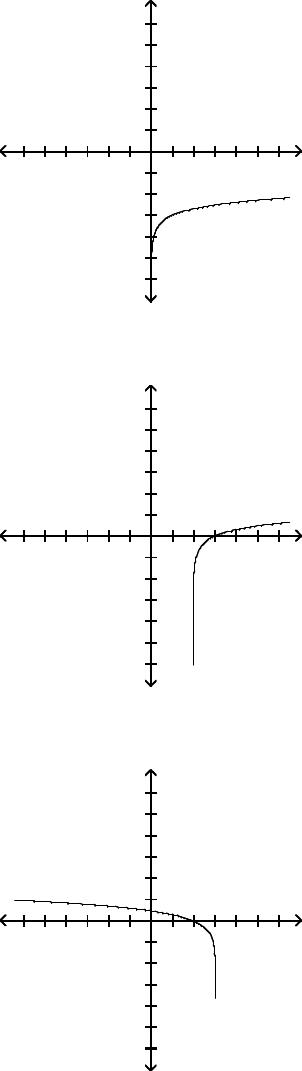
Thegraphofalogarithmicfunctionisshown.Selectthefunctionwhichmatchesthegraph.
1)
x
-5 5
y
5
-5
x
-5 5
y
5
-5
A) y=logx–3B)y=3–logxC)y=log(3 –x) D) y=log(x–3)
2)
x
-5 5
y
5
-5
x
-5 5
y
5
-5
A) y=log(x–2) B) y=2–logxC)y=log(2 –x) D) y=logx–2
3)
x
-5 5
y
5
-5
x
-5 5
y
5
-5
A) y=log(3–x) B) y=3–logxC)y=log(x–3) D) y=logx–3
Page50
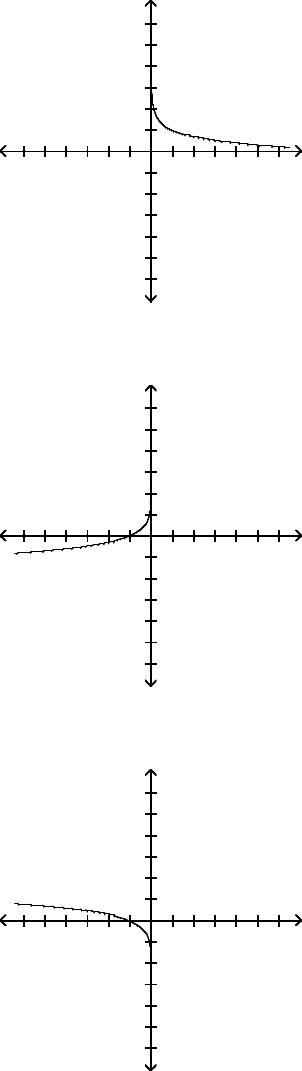
4)
x
-5 5
y
5
-5
x
-5 5
y
5
-5
A) y=1–logxB)y=log(x–1) C) y=log(1 –x) D) y=logx–1
5)
x
-5 5
y
5
-5
x
-5 5
y
5
-5
A) y=–log(–x) B) y=log(–x) C) y= –logxD)y=logx
6)
x
-5 5
y
5
-5
x
-5 5
y
5
-5
A) y=log(–x) B) y=–log(–x) C) y= –logxD)y=logx
Page51
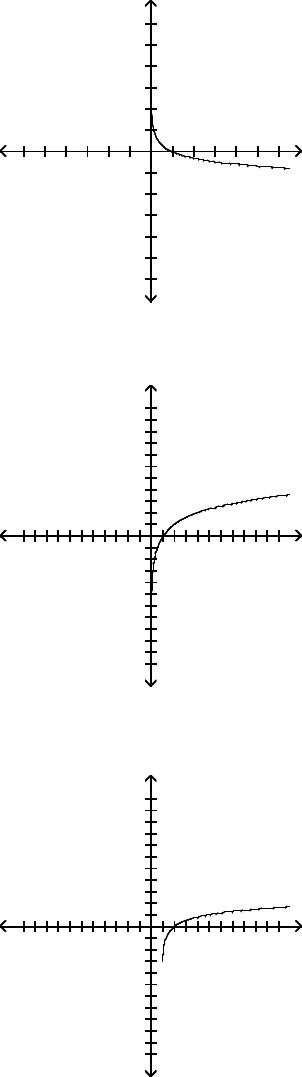
7)
x
-5 5
y
5
-5
x
-5 5
y
5
-5
A) y=–logxB)y=log(–x) C) y= –log(–x) D) y=logx
8)
x
-10 -5 5 10
y
10
5
-5
-10
x
-10 -5 5 10
y
10
5
-5
-10
A) y=log 2xB)y=log 2(x+1) C) y=log 2(x–1) D) y=log 2x+1
9)
x
-10 -5 5 10
y
10
5
-5
-10
x
-10 -5 5 10
y
10
5
-5
-10
A) y=log 4(x–1) B) y=log 4xC)y=log 4(x+1) D) y=log 4x–1
Page52
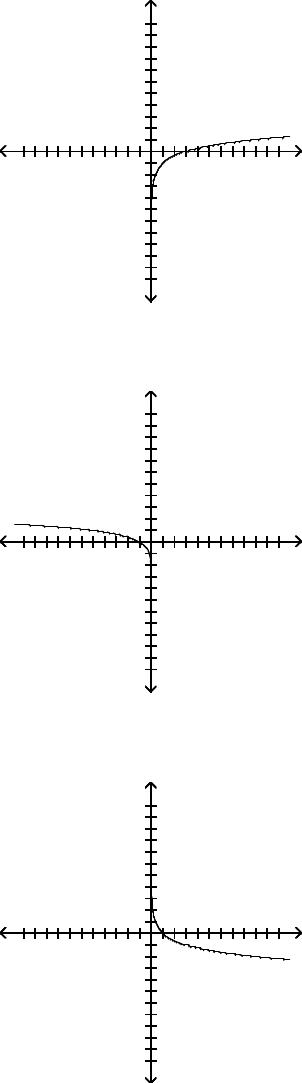
10)
x
-10 -5 5 10
y
10
5
-5
-10
x
-10 -5 5 10
y
10
5
-5
-10
A) y=log 3x–1B)y=log 3xC)y=log 3(x+1) D) y=log 3(x–1)
11)
x
-10 -5 5 10
y
10
5
-5
-10
x
-10 -5 5 10
y
10
5
-5
-10
A) y=log 5(–x) B) y=–log 5xC)y=1–log 5xD)y=log 5x
12)
x
-10 -5 5 10
y
10
5
-5
-10
x
-10 -5 5 10
y
10
5
-5
-10
A) y=–log 3xB)y=log 3(–x) C) y=1–log 3xD)y=log 3x
Page53
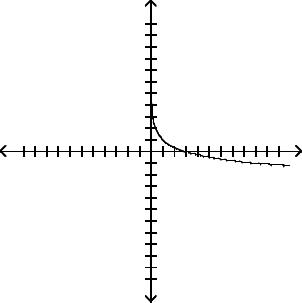
13)
x
-10 -5 5 10
y
10
5
-5
-10
x
-10 -5 5 10
y
10
5
-5
-10
A) y=1–log 3xB)y=log 3(–x) C) y= – log 3xD)y=log 3x
Page54
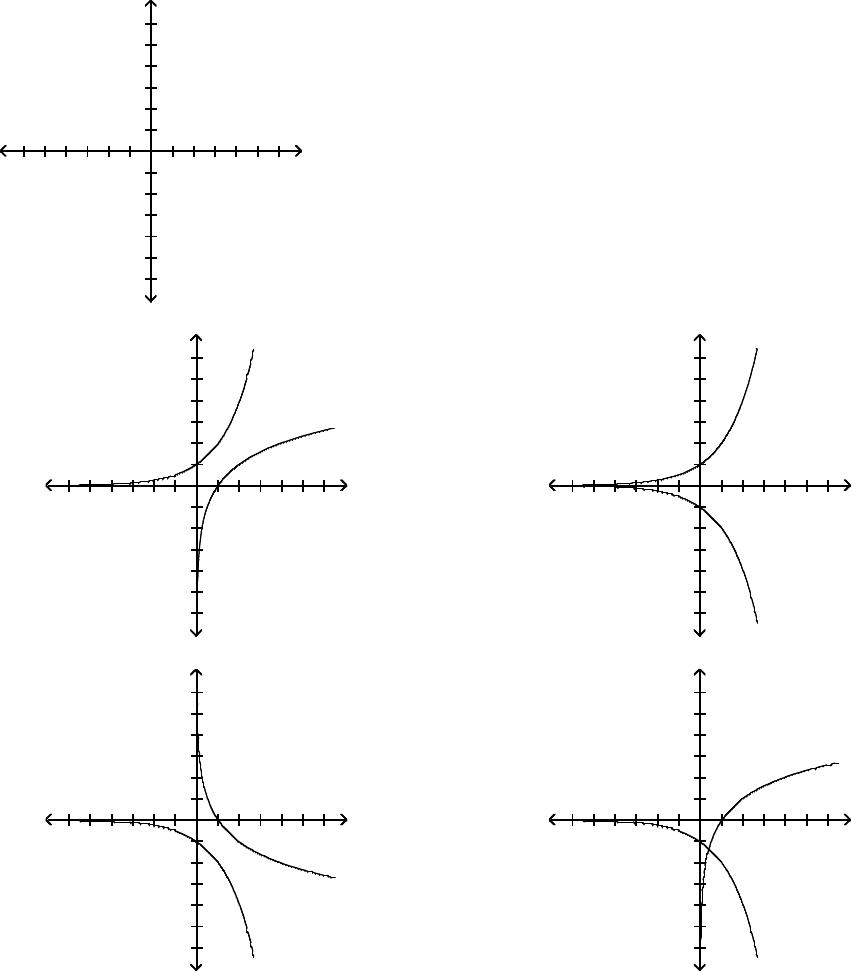
GraphthefunctionanditsinverseonthesameCartesianplane.
14) f(x)=log2x
x
-5 5
y
5
-5
x
-5 5
y
5
-5
A)
x
-5 5
y
5
-5
x
-5 5
y
5
-5
B)
x
-5 5
y
5
-5
x
-5 5
y
5
-5
C)
x
-5 5
y
5
-5
x
-5 5
y
5
-5
D)
x
-5 5
y
5
-5
x
-5 5
y
5
-5
Page55
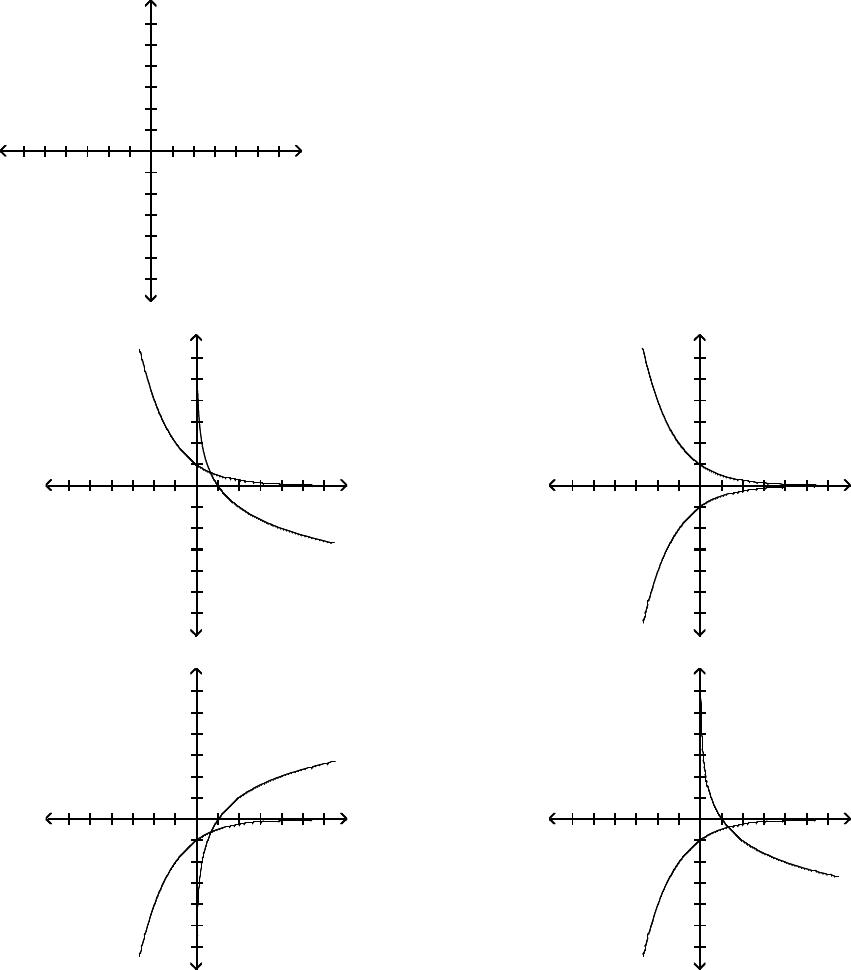
15) f(x)=log1/2x
x
-5 5
y
5
-5
x
-5 5
y
5
-5
A)
x
-5 5
y
5
-5
x
-5 5
y
5
-5
B)
x
-5 5
y
5
-5
x
-5 5
y
5
-5
C)
x
-5 5
y
5
-5
x
-5 5
y
5
-5
D)
x
-5 5
y
5
-5
x
-5 5
y
5
-5
Page56
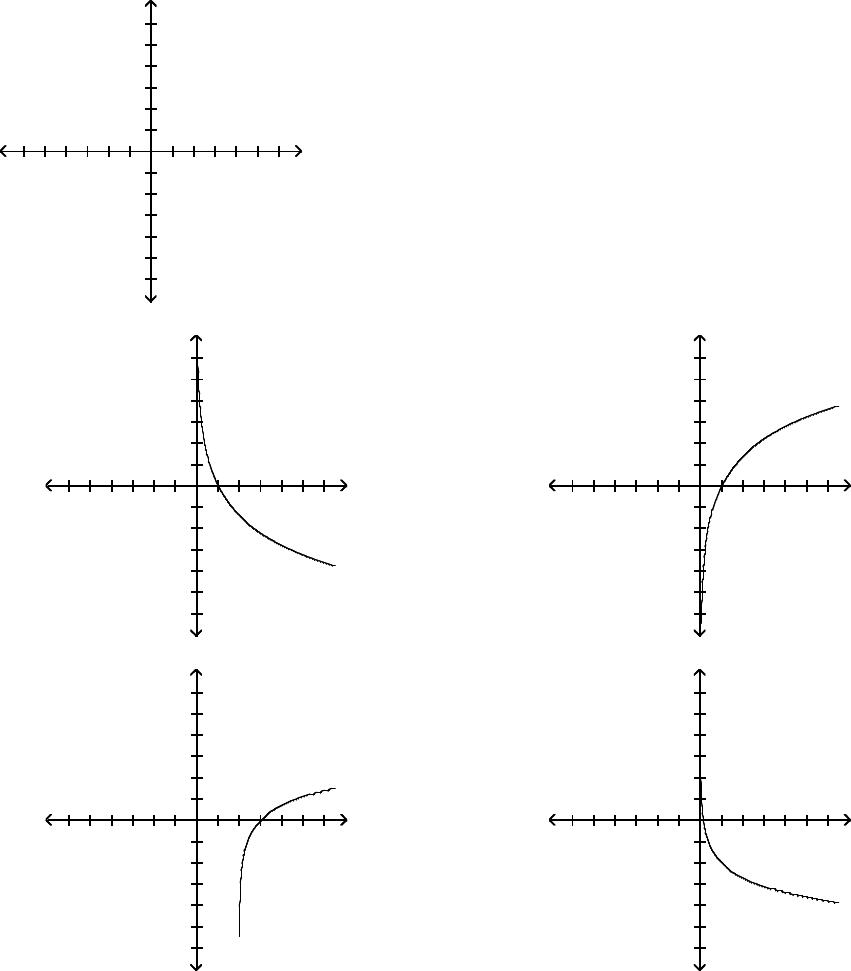
Graphthefunction.
16) f(x)=–2lnx
x
-5 5
y
5
-5
x
-5 5
y
5
-5
A)
x
-5 5
y
5
-5
x
-5 5
y
5
-5
B)
x
-5 5
y
5
-5
x
-5 5
y
5
-5
C)
x
-5 5
y
5
-5
x
-5 5
y
5
-5
D)
x
-5 5
y
5
-5
x
-5 5
y
5
-5
Page57
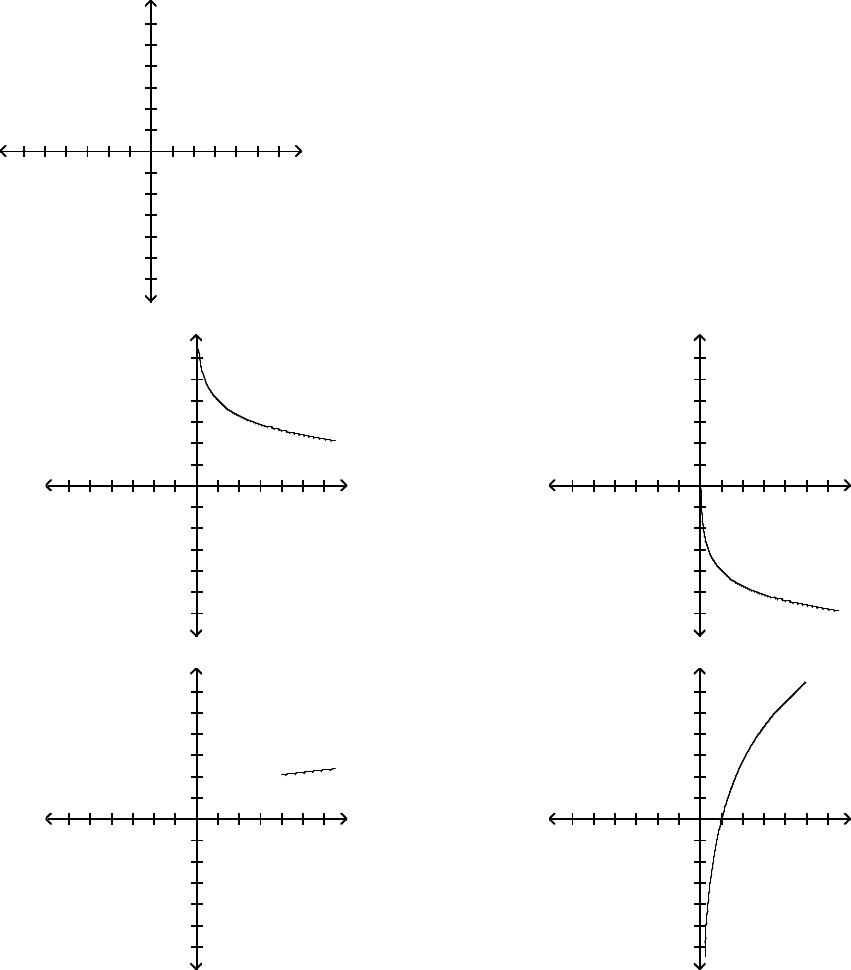
17) f(x)=4–lnx
x
-5 5
y
5
-5
x
-5 5
y
5
-5
A)
x
-5 5
y
5
-5
x
-5 5
y
5
-5
B)
x
-5 5
y
5
-5
x
-5 5
y
5
-5
C)
x
-5 5
y
5
-5
x
-5 5
y
5
-5
D)
x
-5 5
y
5
-5
x
-5 5
y
5
-5
Page58
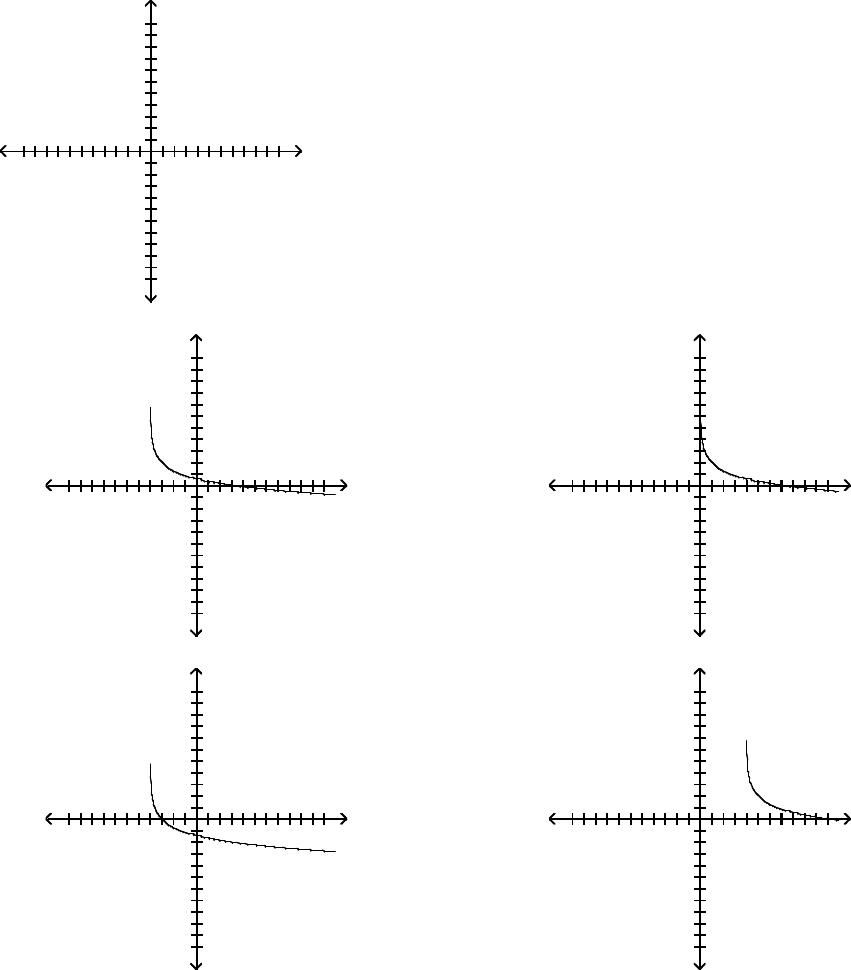
18) f(x)=2–ln(x+4)
x
-10 -5 5 10
y
10
5
-5
-10
x
-10 -5 5 10
y
10
5
-5
-10
A)
x
-10 -5 5 10
y
10
5
-5
-10
x
-10 -5 5 10
y
10
5
-5
-10
B)
x
-10 -5 5 10
y
10
5
-5
-10
x
-10 -5 5 10
y
10
5
-5
-10
C)
x
-10 -5 5 10
y
10
5
-5
-10
x
-10 -5 5 10
y
10
5
-5
-10
D)
x
-10 -5 5 10
y
10
5
-5
-10
x
-10 -5 5 10
y
10
5
-5
-10
Page59
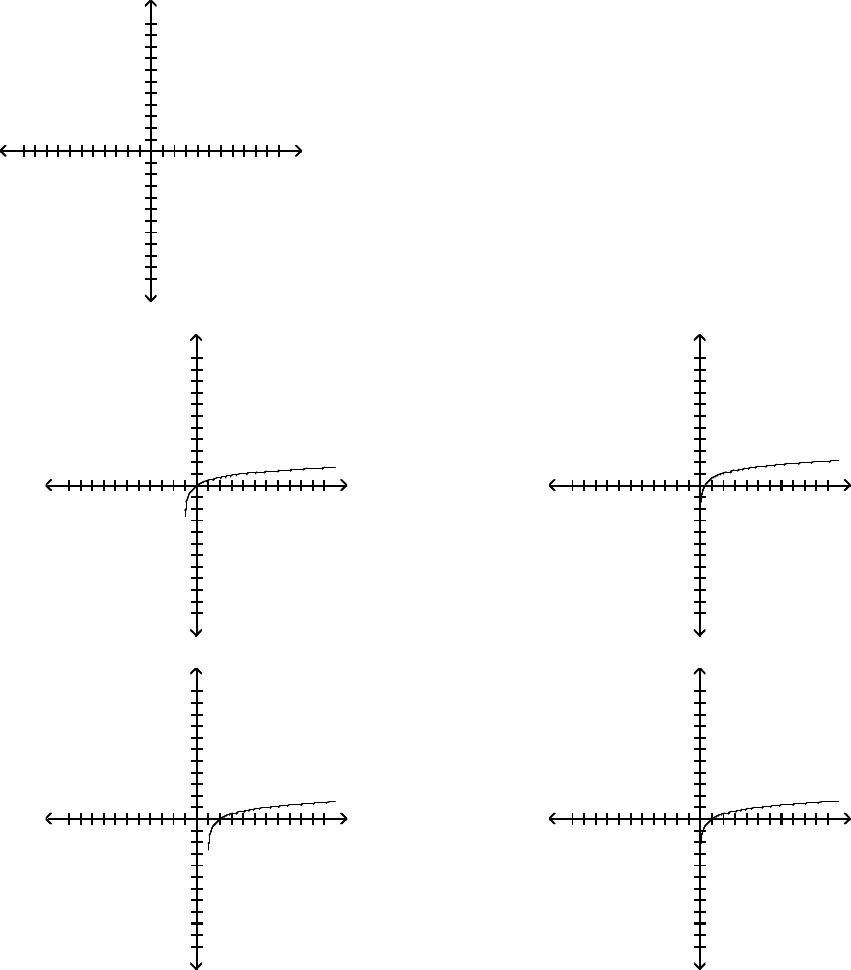
19) f(x)=log 5(x+1)
x
-10 -5 5 10
y
10
5
-5
-10
x
-10 -5 5 10
y
10
5
-5
-10
A)
x
-10 -5 5 10
y
10
5
-5
-10
x
-10 -5 5 10
y
10
5
-5
-10
B)
x
-10 -5 5 10
y
10
5
-5
-10
x
-10 -5 5 10
y
10
5
-5
-10
C)
x
-10 -5 5 10
y
10
5
-5
-10
x
-10 -5 5 10
y
10
5
-5
-10
D)
x
-10 -5 5 10
y
10
5
-5
-10
x
-10 -5 5 10
y
10
5
-5
-10
Page60
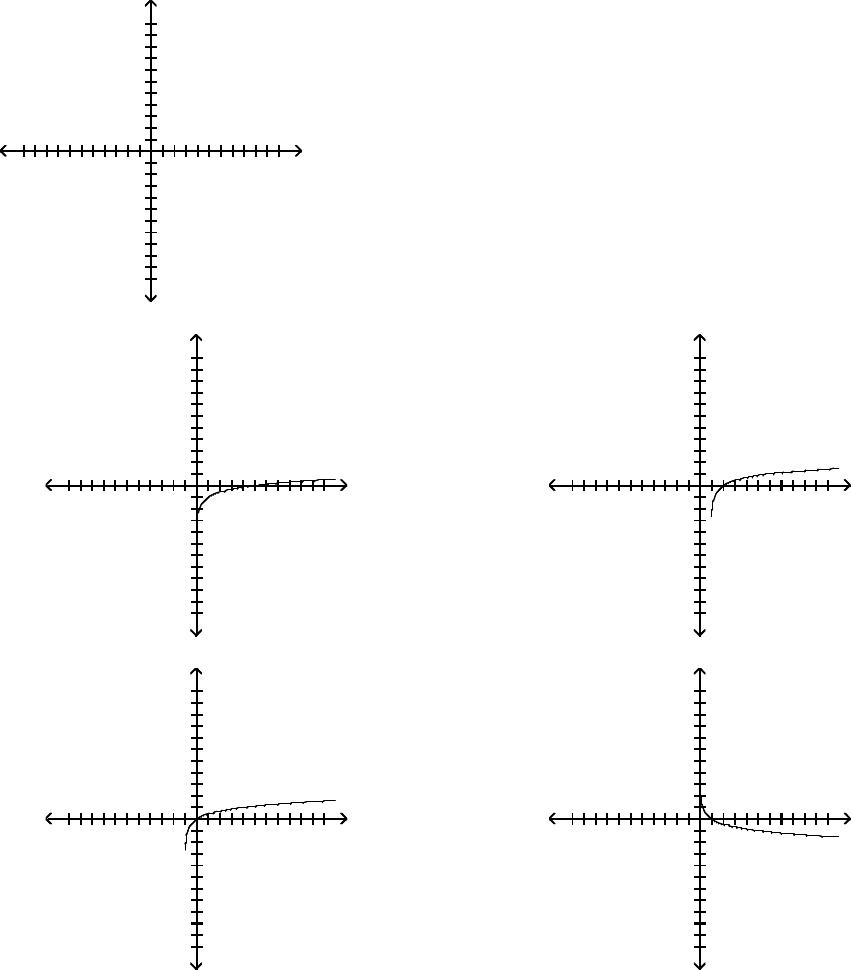
20) f(x)=–1+log 5x
x
-10 -5 5 10
y
10
5
-5
-10
x
-10 -5 5 10
y
10
5
-5
-10
A)
x
-10 -5 5 10
y
10
5
-5
-10
x
-10 -5 5 10
y
10
5
-5
-10
B)
x
-10 -5 5 10
y
10
5
-5
-10
x
-10 -5 5 10
y
10
5
-5
-10
C)
x
-10 -5 5 10
y
10
5
-5
-10
x
-10 -5 5 10
y
10
5
-5
-10
D)
x
-10 -5 5 10
y
10
5
-5
-10
x
-10 -5 5 10
y
10
5
-5
-10
Page61
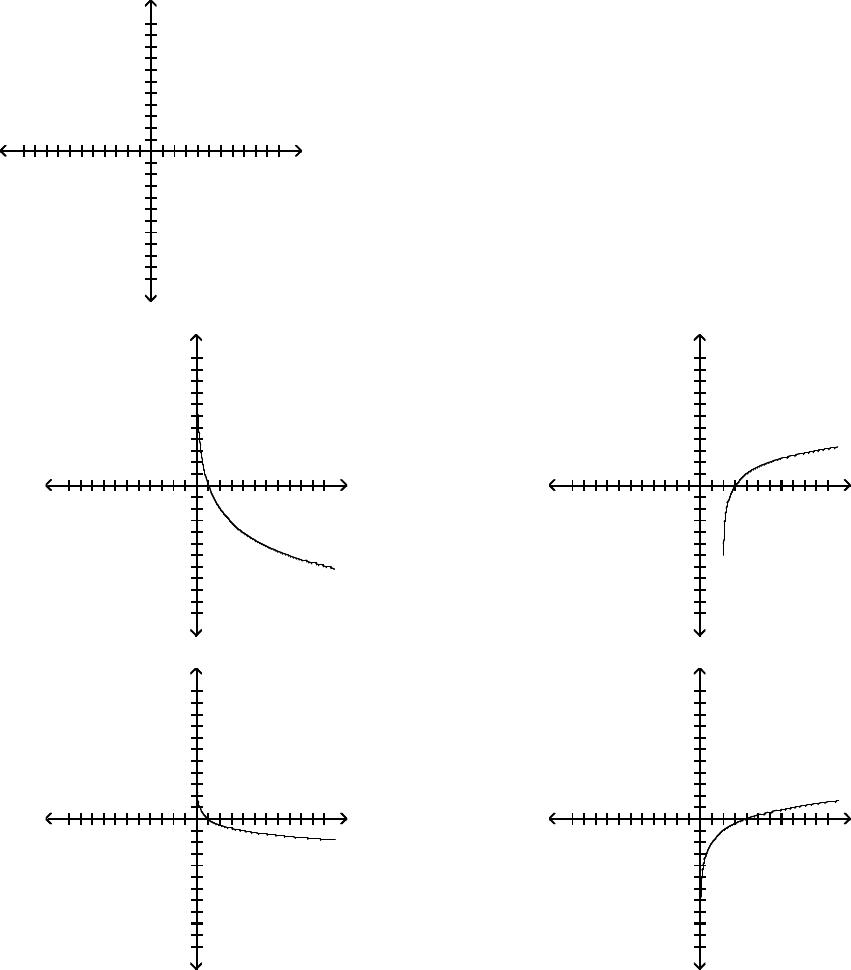
21) f(x)=–2 log 2x
x
-10 -5 5 10
y
10
5
-5
-10
x
-10 -5 5 10
y
10
5
-5
-10
A)
x
-10 -5 5 10
y
10
5
-5
-10
x
-10 -5 5 10
y
10
5
-5
-10
B)
x
-10 -5 5 10
y
10
5
-5
-10
x
-10 -5 5 10
y
10
5
-5
-10
C)
x
-10 -5 5 10
y
10
5
-5
-10
x
-10 -5 5 10
y
10
5
-5
-10
D)
x
-10 -5 5 10
y
10
5
-5
-10
x
-10 -5 5 10
y
10
5
-5
-10
Page62
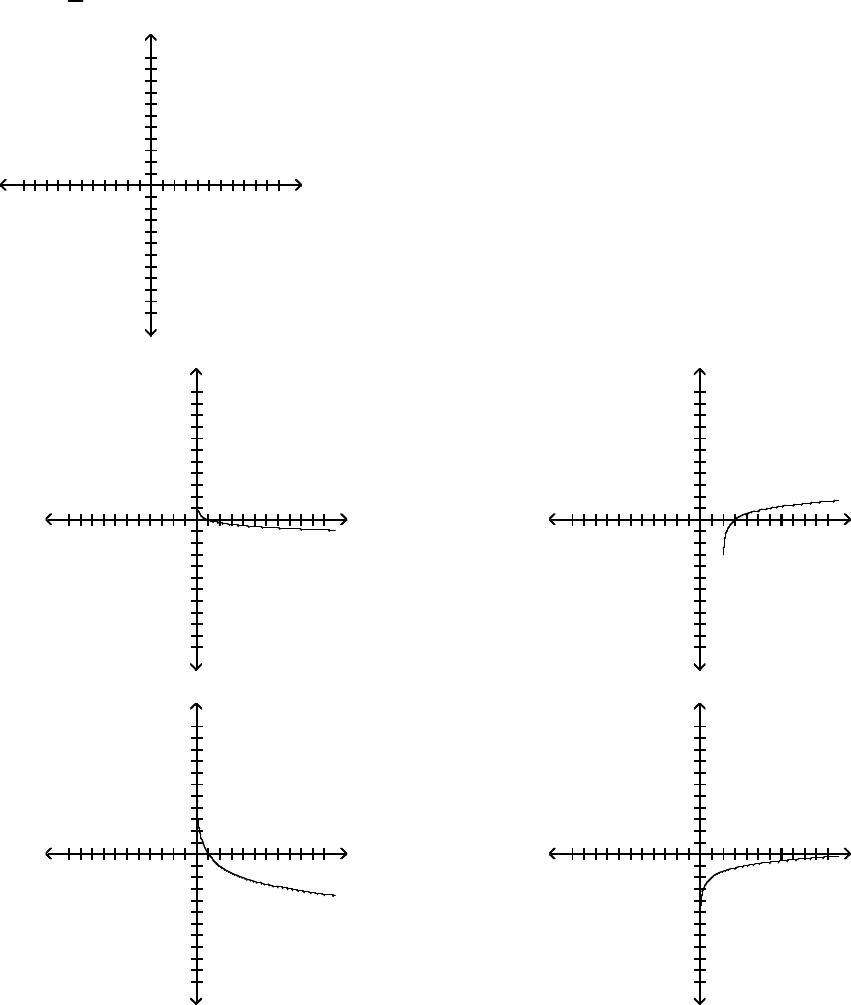
22) f(x)=–1
2log 4x
x
-10 -5 5 10
y
10
5
-5
-10
x
-10 -5 5 10
y
10
5
-5
-10
A)
x
-10 -5 5 10
y
10
5
-5
-10
x
-10 -5 5 10
y
10
5
-5
-10
B)
x
-10 -5 5 10
y
10
5
-5
-10
x
-10 -5 5 10
y
10
5
-5
-10
C)
x
-10 -5 5 10
y
10
5
-5
-10
x
-10 -5 5 10
y
10
5
-5
-10
D)
x
-10 -5 5 10
y
10
5
-5
-10
x
-10 -5 5 10
y
10
5
-5
-10
5 SolveLogarithmicEquations
MULTIPLECHOICE.Choosetheonealternativethatbestcompletesthestatementoranswersthequestion.
Solvetheequation.
1) log 5x=3
A) {125} B) {15} C) {8} D) {243}
2) log 525=x
A) {2} B) {125} C) {5} D) {30}
Page63
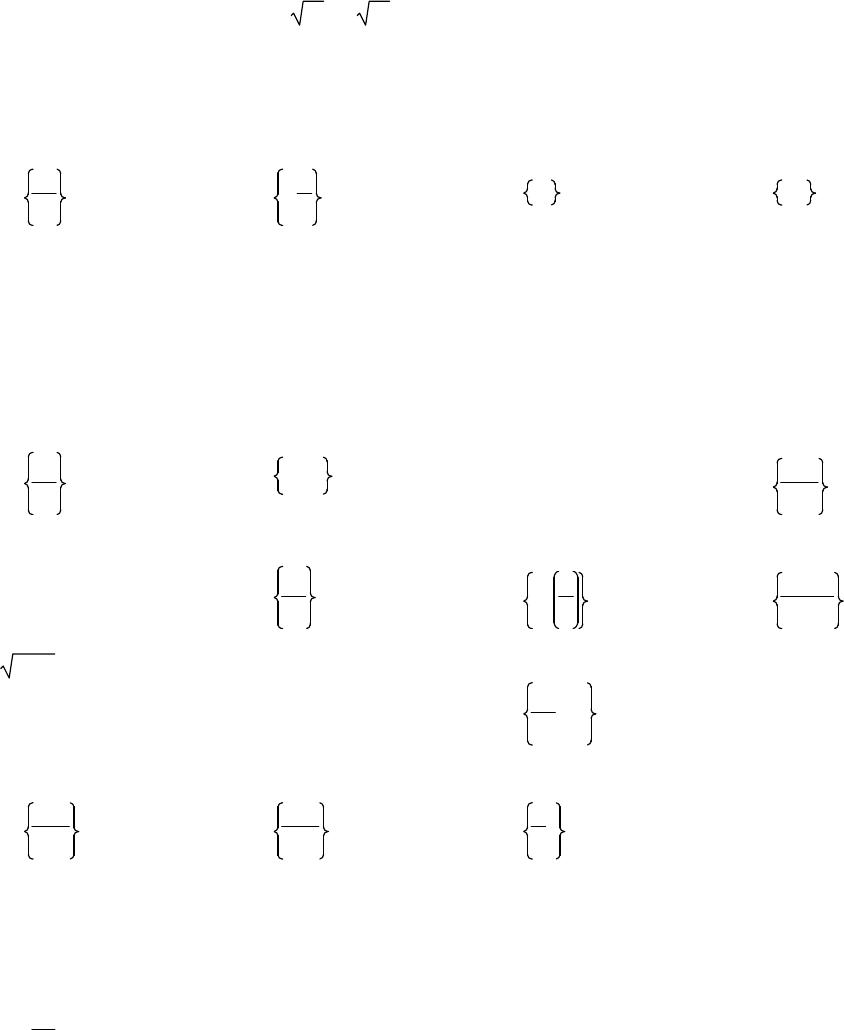
3) log10x2=4
A) {100
,
–100} B) {2 10,–210} C) {1024} D) {10,000}
4) log 5(x–3)=1
A) {8} B) {2} C) {4} D) {–2}
5) log 5(x–2)=–1
A) 11
5B) –9
5C) 11 D) –9
6) log4(x2–3x)=1
A) {4
,
–1} B) {–4
,
1} C) {4} D) {1}
7) log42(x2–x)=1
A) {–6
,
7} B) {6
,
7} C) {1,42} D) {–6
,
–7}
8) 4ln8x=24
A) e6
8B) e 3
/
4C) {e6}D)
6
ln8
9) 4+7lnx=6
A) {e 2
/
7}B)
e2
7C) ln2
7D) 2
7ln1
10) lnx+7=3
A) {e6–7} B) {e6+7} C) e3
2
+7 D) {e3–7}
11) e3x=7
A) ln7
3B) ln3
7C) 7
3e D) {3ln7}
12) e x+4=7
A) {ln7–4} B) {e7+4} C) {e28} D) {ln11}
TheloudnessL(x),measuredindecibels,ofasoundofintensityx,measuredinwattspersquaremeter,isdefined
asL(x)=10log(x
I0),whereI0=10–12wattpersquaremeteristheleastintensesoundthatahumanearcandetect.
Determinetheloudness,indecibels,ofthesound.
13) AparticularBoeing747jetlinerproducesnoiseataloudnesslevelof113decibels.Findtheintensityleve
l
(roundtothenearesthundredth)inwattpersquaremeterforthisnoise.
A) 0.20wattpersquaremeter B) 0.10wattpersquaremeter
C) 0.40wattpersquaremeter D) 0.80wattpersquaremeter
14) AtarecentPhishrockconcert,soundintensityreachedalevelof0.50wattpersquaremeter.Totheneares
t
wholenumber,calculatetheloudnessofthissoundindecibels.
A) 117decibels B) 123decibels C) 107decibels D) 112decibels
Page64

15) AtarockconcertbyTheWho,themusicregisteredaloudnesslevelof120decibels.Thehumanthreshold
ofpainduetosoundaverages130decibels.Computetheratiooftheintensitiesassociatedwiththesetwo
loudnessleveltodeterminebyhowmuchtheintensityofasoundthatcrossesthehumanthresholdof
painexceedsthatofthisparticularrockconcert.
A) Theintensityofasoundthatcrossesthehumanthresholdofpainis10timesasintenseasthisrock
concert.
B) Theintensityofasoundthatcrossesthehumanthresholdofpainis100timesasintenseasthisrock
concert.
C) Theintensityofasoundthatcrossesthehumanthresholdofpainis1000timesasintenseasthisrock
concert.
D) Theintensityofasoundthatcrossesthehumanthresholdofpainis0.1timesasintenseasthisrock
concert.
16) Youhavetwofriends,JimandAmy.Jimalwaysyellswhenhespeaks,andAmyalwayswhispers.The
loudnessofJimʹsvoiceis120decibels,andtheloudnessofAmyʹsvoiceis20decibels.Determinehow
manytimesasintenseJimʹsvoiceisascomparedatAmyʹs.
A) Jimʹsvoiceis1010timesasintenseasAmyʹs. B) Jimʹsvoiceis100.1timesasintenseasAmyʹs.
C)
J
imʹsvoiceis100timesasintenseasAmyʹs. D)
J
imʹsvoiceis1000timesasintenseasAmyʹs.
TheRichterscaleconvertsseismographicreadingsintonumbersformeasuringthemagnitudeofanearthquake
accordingtothisfunctionM(x)=logx
x0,wherex0=10–3.
17) Whatisthemagnitudeofanearthquakewhoseseismographicreadingis7.5 millimetersatadistanceo
f
100kilometersfromitsepicenter?Roundtheanswertothenearesttenth.
A) 3.9 B) 2.9 C) 2.6 D) 875.1
18) Whatisthemagnitudeofanearthquakewhoseseismographicreadingis7.6millimetersatadistanceo
f
100kilometersfromitsepicenter?Roundtheanswertofourdecimalplaces.
A) 3.8808 B) 0.38808 C) 2.0281 D) 0.20281
19) Whatisthemagnitudeofanearthquakewhoseseismographicreadingis0.94millimetersatadistanceo
f
100kilometersfromitsepicenter?Roundtheanswertofourdecimalplaces.
A) 2.9731 B) 0.9731 C) –0.0269 D) –3.0269
20) Findthemagnitude(toonedecimalplace)ofanearthquakewhoseseismographicreadingis2000
millimetersatadistanceof100kilometersfromitsepicenter.Roundtheanswertothenearesttenth.
A) 6.3 B) 6.4 C) 7.3 D) 5.9
21) Twoearthquakesdifferby0.1whenmeasuredontheRichterscale.Howwouldtheseismographic
readingsdifferatadistanceof100kilometersfromtheepicenter?
A) Theearthquakeofgreatermagnitudehasaseismographicreadingthatis100.1≈1.26timesthatofthe
lesserearthquake.
B) Theearthquakeofgreatermagnitudehasaseismographicreadingthatis100.01≈1.02timesthatof
thelesserearthquake.
C) Theearthquakeofgreatermagnitudehasaseismographicreadingthatis10timesthatofthelesser
earthquake.
D) Theearthquakeofgreatermagnitudehasaseismographicreadingthatis100timesthatofthelesser
earthquake.
Page65
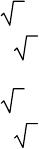
Solvetheproblem.
22) TheformulaD=6e–0.04hcanbeusedtofindthenumberofmilligramsDofacertaindruginapatientʹs
bloodstreamhhoursafterthedrughasbeengiven.Whenthenumberofmilligramsreaches2,thedrugis
tobegivenagain.Whatisthetimebetweeninjections?
A) 27.47hr B) 30.29 hr C) 44.79 hr D) 17.33 hr
23) Between7:00AMand8:00AM,trainsarriveatasubwaystationatarateof8 trainsperhour(0.13 trains
perminute).Thefollowingformulafromstatisticscanbeusedtodeterminetheprobabilitythatatrain
willarrivewithintminutesof7:00AM.
F(t)=1–e–0.13t
Determinehowmanyminutesareneededfortheprobabilitytoreach90%.
A) 17.71min B) 0.71 min C) 5.56 min D) 8.49 min
24) pH=–log10[H+]Findthe[H+]ifthepH=8.4.
A) 3.98×10⁻⁹B) 3.98×10⁻⁸C) 2.51×10⁻⁸D) 2.51×10⁻⁹
25) pH=–log10[H+]FindthepHifthe[H+]=5.1×10⁻⁸.
A) 7.29 B) 8.71 C) 8.29 D) 7.71
6.5 PropertiesofLogarithms
1 WorkwiththePropertiesofLogarithms
MULTIPLECHOICE.Choosetheonealternativethatbestcompletesthestatementoranswersthequestion.
Usethepropertiesoflogarithmstofindtheexactvalueoftheexpression.Donotuseacalculator.
1) log554
A) 4 B) 20 C) 5 D) 1
2) lne5
A) 5 B) e C) 5 D) 25
3) lne3
A) 3 B) e C) 3 D) 9
4) log369+log364
A) 1 B) 36 C) 9 D) 4
5) log1632–log162
A) 1 B) 16 C) 32 D) 2
6) log424–log46
A) 1 B) 4 C) 6 D) 24
7) log416·log1664
A) 3 B) 4 C) 16 D) 64
8) eln9
A) 9 B) e9C) 8 D) ln9
Page66

9) 10log32–log4
A) 8 B) 32 C) 100,000,000 D) log28
10) eloge2121
A) 11 B) 121 C) e11 D) e121
Supposethatln2=aandln5=b.Usepropertiesoflogarithmstowriteeachlogarithmintermsofaandb.
11) ln10
A) a+bB)ab C)a–bD)lna+lnb
12) ln5
2
A) b–aB)
a
bC) a+bD)
lna
lnb
13) ln4
A) 2a B) a2C) ab D) 4a
14) ln20
A) 2a+bB)a+bC)4b D)2a+2b
15) ln740
A) 1
7(3a+b) B) 3
7(a+b) C) 3
7(a–b) D) 1
7(a3+b)
2 WriteaLogarithmicExpressionasaSumorDifferenceofLogarithms
MULTIPLECHOICE.Choosetheonealternativethatbestcompletesthestatementoranswersthequestion.
Writeasthesumand/ordifferenceoflogarithms.Expresspowersasfactors.
1) log 58
19
A) log 58–log 519 B) log 519 –log 58 C) log 58+log 58 D) log 58÷log 519
2) log 19 14 m
n
A) log 19 14+1
2
log 19 m–log 19 n B) log 19 n–log 19 14–1
2
log 19 m
C) log 19 14·1
2
log 19 m÷log 19 n D) log 19 (14 m)–log 19 n
3) log 5x5
y8
A) 5 log 5x–8 log 5y B) 5 log 5x+8 log 5yC)
5
8log 5x
yD) 8 log 5y–5 log 5x
Page67
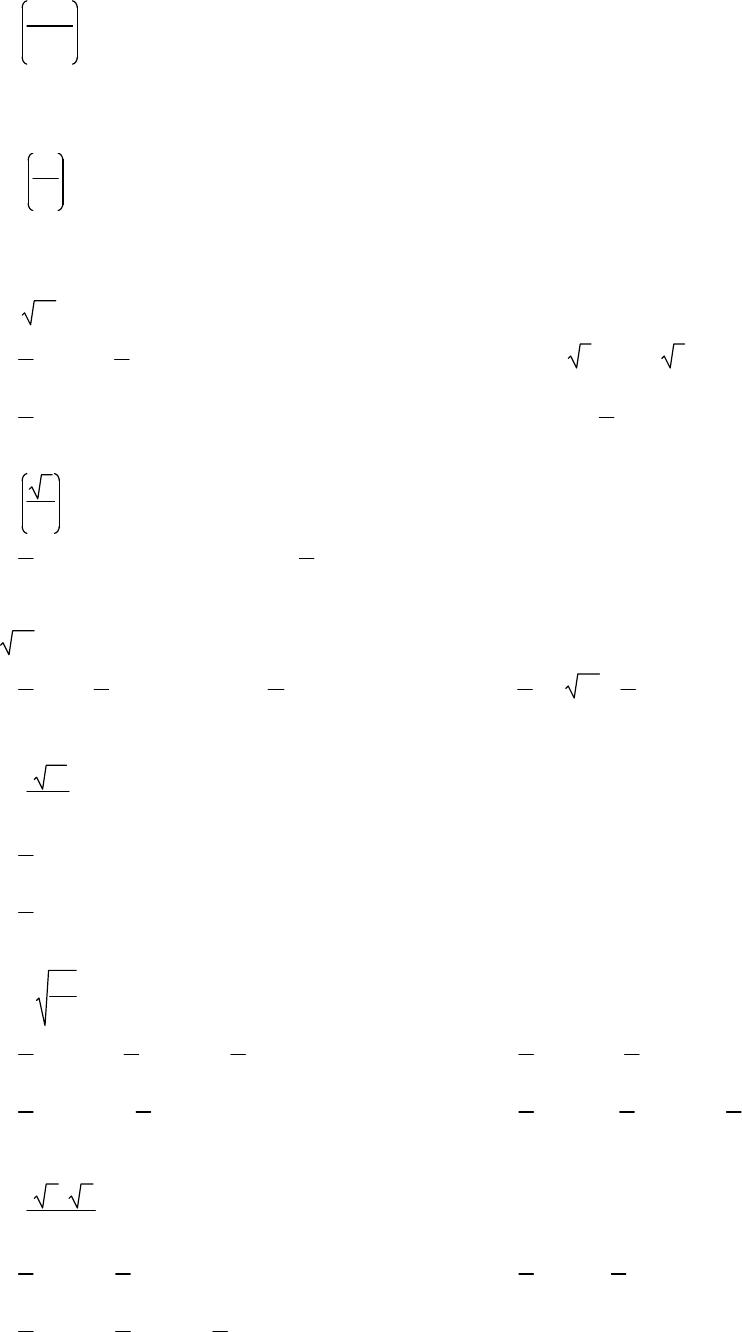
4) log 4x+1
x2
A) log 4(x+1)–2 log 4x B) log 4(x+1)+2 log 4x
C) 2 log 4x–log 4(x+1) D) log 4(x+1)–log 4x
5) log w9x
4
A) log w9+log wx–log w4 B) log w5x
C) log w9x–log w4 D) log w9+log wx+log w4
6) log 36x
A) 1
2log 36+1
2log 3x B) log 36+log 3x
C) 1
2log 36x D) log 36+1
2log 3x
7) log 2x
8
A) 1
2log 2x–3B)6–1
2
log 2x C) log 2x–3D)
–3 log 2x
8) ln4ey
A) 1
4
lny+1
4B) y
4C) 1
4
ln4ey+1
4D) 4lny+4
9) log 5
718
q2p
A) 1
7
log 518–2log 5q–log 5pB)7log 518 –2log 5q–log 57
C) 1
7
log 518–2log 5q–2log 5p D) log 518 –log 5q–log 5p
10) log 19 xy
12
A) 1
2log 19 x+1
2log 19 y–1
2log 19 12 B) 1
2log 19 x+1
2log 19 y–log 19 12
C) 1
2log 19 xy–1
2log 19 12 D) 1
2log 19 x·1
2log 19 y÷1
2log 19 12
11) log 3
2p7q
t2
A) 1
2log 3p+1
7log 3q–2 log 3tB)
1
2log 3p·1
7log 3q÷2 log 3t
C) 2
3log 3p+7
3log 3q–2
3log 3t D) 2 log 3p+7 log 3q–2 log 3t
Page68

SHORTANSWER.Writethewordorphrasethatbestcompleteseachstatementoranswersthequestion.
12) logb3x
5y8
z2
MULTIPLECHOICE.Choosetheonealternativethatbestcompletesthestatementoranswersthequestion.
13) log1–1
x3
A) logx3–log1–3logx B) log1–3log1–3logx
C) log(x–1)+log(x2+x+1)–3logx D) log(x–1)+log(x2+1)–3logx
14) ln(x+5)(x–8)
(x–2)3
5
/
2,x>8
A) 5
2ln(x+5)+5
2ln(x–8)–15
2ln(x–2) B) 5
2ln(x2+13x–40)–15
2ln(x–2)
C) 5ln(x+5)–2ln(x–8)–15
2ln(x–2) D) ln(x+5)+ln(x–8)+ln5–15ln(x–2)–ln2
15) ln(5x) 91+2x
(x–8)7
,x>8
A) ln5+lnx+1
9ln(1+2x)–7ln(x–8) B) ln5+lnx–9ln(1+2x)–7ln(x–8)
C) ln5+lnx+1
9ln(1+2x)–ln7–ln(x–8) D) 5lnx+2
9ln(1+2x)–7ln(x–8)
3 WriteaLogarithmicExpressionasaSingleLogarithm
MULTIPLECHOICE.Choosetheonealternativethatbestcompletesthestatementoranswersthequestion.
Expressasasinglelogarithm.
1) log cm+log cn
A) log cmn B) log cm·log cn C) log c(mn) D) log cm
n
2) 3 log bt–log bs
A) log bt3
sB) log bt3÷log bs C) log b(t3–s) D) log b3t
s
3) 5 log a10+3 log a3
A) log a10533B) log a(50 +9)
C) log a105
33D) log a105·log a33
Page69

4) ( log ax–log ay)+4 log az
A) log axz4
yB) log axz4y C) log ax
z4yD) log a4xz
y
5) 5 log ax–5
6log ay+1
4log aw–4 log az
A) log ax5w1
/
4
y5/6z4B) log a5x–5
6y+1
4w–4z
C) log ax5z4
w1/4y5/6 D) log ax5y5
/
6
w1/4z4
6) 3 log 6x+5 log 6(x–6)
A) log 6x(x–6)15 B) log 6x3(x–6)5C) 15log 6x(x–6) D) log 6x(x–6)
7) 3loga(2x+1)–2loga(2x–1)+2
A) logaa2(2x+1)3
(2x–1)2B) loga2(x+1) C) loga(2x+1)+2 D) loga(2x+3)
8) lnx2–7x–18
x–7
–lnx2–5x–14
x+1
+ln(x2–18x+81), x>0
A) ln(x–9)3(x+1)
(x–7)2B) ln3(x–9)(x+1)
2(x–7) C) ln(x–9)3
(x–7)2(x+1)
D) ln3(x–9)
2(x–7)(x+1)
9) 56log88x+log8(56x4)–log856
A) log8x11 B) log8x11
/
8C) log8x12
/
7D) log8x15
/
4
4 EvaluateLogarithmsWhoseBaseIsNeither10Nore
MULTIPLECHOICE.Choosetheonealternativethatbestcompletesthestatementoranswersthequestion.
UsetheChange–of–BaseFormulaandacalculatortoevaluatethelogarithm.Roundyouranswertothreedecimal
places.
1) log 480.26
A) 3.163 B) 1.904 C) 0.316 D) 20.065
2) log 30.485
A) –0.659 B) –0.314 C) –1.518 D) 6.186
3) log 6.5 266
A) 2.983 B) 2.425 C) 0.335 D) 40.923
4) log 4.7 2.1
A) 0.479 B) 0.322 C) 2.086 D) 0.447
5) log 225.8
A) 9.379 B) 4.689 C) 0.151 D) 0.107
Page70
UsetheChange–of–BaseFormulaandacalculatortoevaluatethelogarithm.Roundyouranswertotwodecimal
places.
6) log7.798
A) 2.25 B) 1.99 C) 0.45 D) 12.73
7) log3.62.2
A) 0.62 B) 0.34 C) 1.62 D) 0.61
8) log 2117.1
A) 13.74 B) 6.87 C) 0.15 D) 0.07
9) log325
A) 2.93 B) 0.34 C) 3.22 D) 1.10
SHORTANSWER.Writethewordorphrasethatbestcompleteseachstatementoranswersthequestion.
10) log(2/3)19
Solvetheproblem.
11) Findthevalueoflog34·log45·log56·log67·log78·log89
MULTIPLECHOICE.Choosetheonealternativethatbestcompletesthestatementoranswersthequestion.
GraphthefunctionusingagraphingutilityandtheChange–of–BaseFormula.
12) logx–3(x+3)
x
123456789
y
5
4
3
2
1
-1
-2
-3
-4
x
123456789
y
5
4
3
2
1
-1
-2
-3
-4
Page71
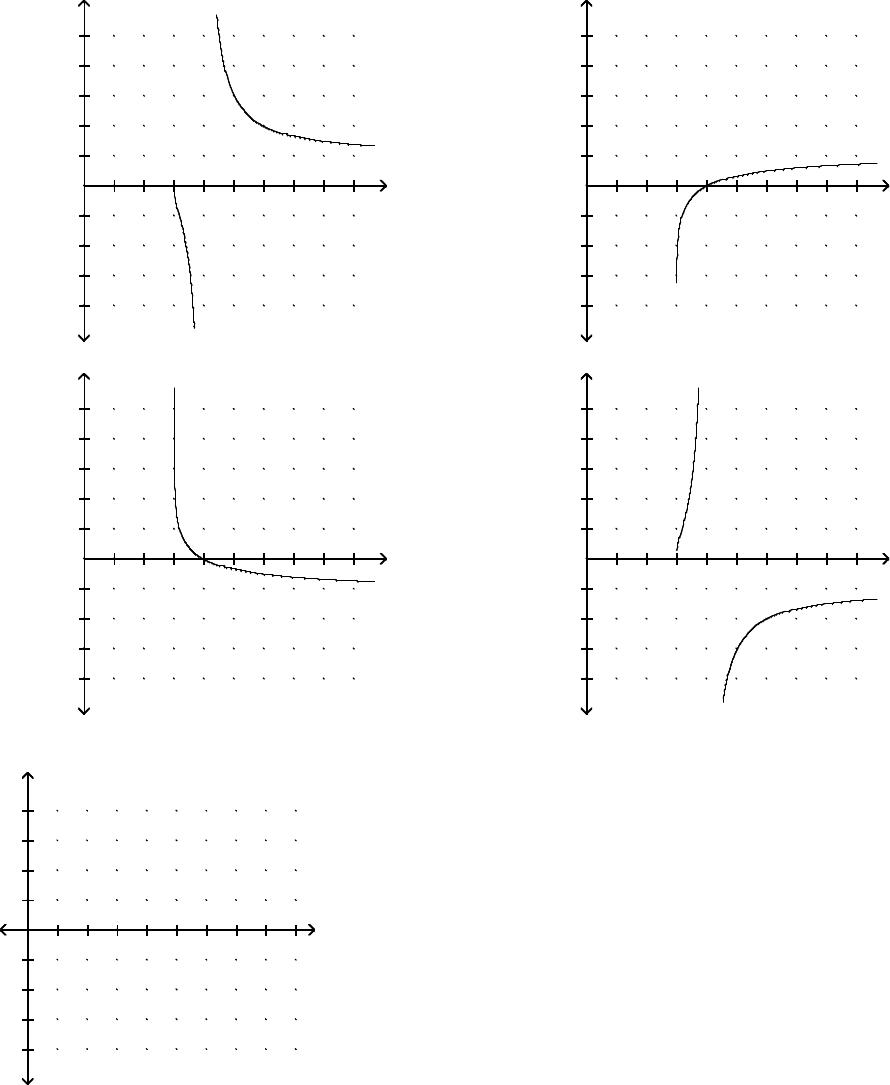
A)
x
123456789
y
5
4
3
2
1
-1
-2
-3
-4
x
123456789
y
5
4
3
2
1
-1
-2
-3
-4
B)
x
123456789
y
5
4
3
2
1
-1
-2
-3
-4
x
123456789
y
5
4
3
2
1
-1
-2
-3
-4
C)
x
123456789
y
5
4
3
2
1
-1
-2
-3
-4
x
123456789
y
5
4
3
2
1
-1
-2
-3
-4
D)
x
123456789
y
5
4
3
2
1
-1
-2
-3
-4
x
123456789
y
5
4
3
2
1
-1
-2
-3
-4
13) y=log10x
x
2 4 6 8 10 12 14 16 18
y
4
3
2
1
-1
-2
-3
-4
x
2 4 6 8 10 12 14 16 18
y
4
3
2
1
-1
-2
-3
-4
Page72
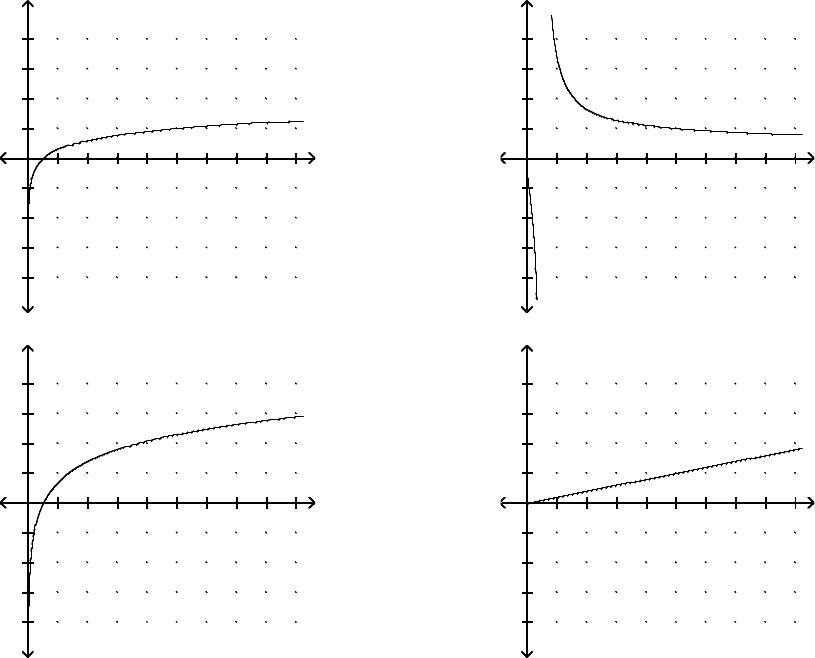
A)
x
2 4 6 8 10 12 14 16 18
y
4
3
2
1
-1
-2
-3
-4
x
2 4 6 8 10 12 14 16 18
y
4
3
2
1
-1
-2
-3
-4
B)
x
2 4 6 8 10 12 14 16 18
y
4
3
2
1
-1
-2
-3
-4
x
2 4 6 8 10 12 14 16 18
y
4
3
2
1
-1
-2
-3
-4
C)
x
2 4 6 8 10 12 14 16 18
y
4
3
2
1
-1
-2
-3
-4
x
2 4 6 8 10 12 14 16 18
y
4
3
2
1
-1
-2
-3
-4
D)
x
2 4 6 8 10 12 14 16 18
y
4
3
2
1
-1
-2
-3
-4
x
2 4 6 8 10 12 14 16 18
y
4
3
2
1
-1
-2
-3
-4
Page73
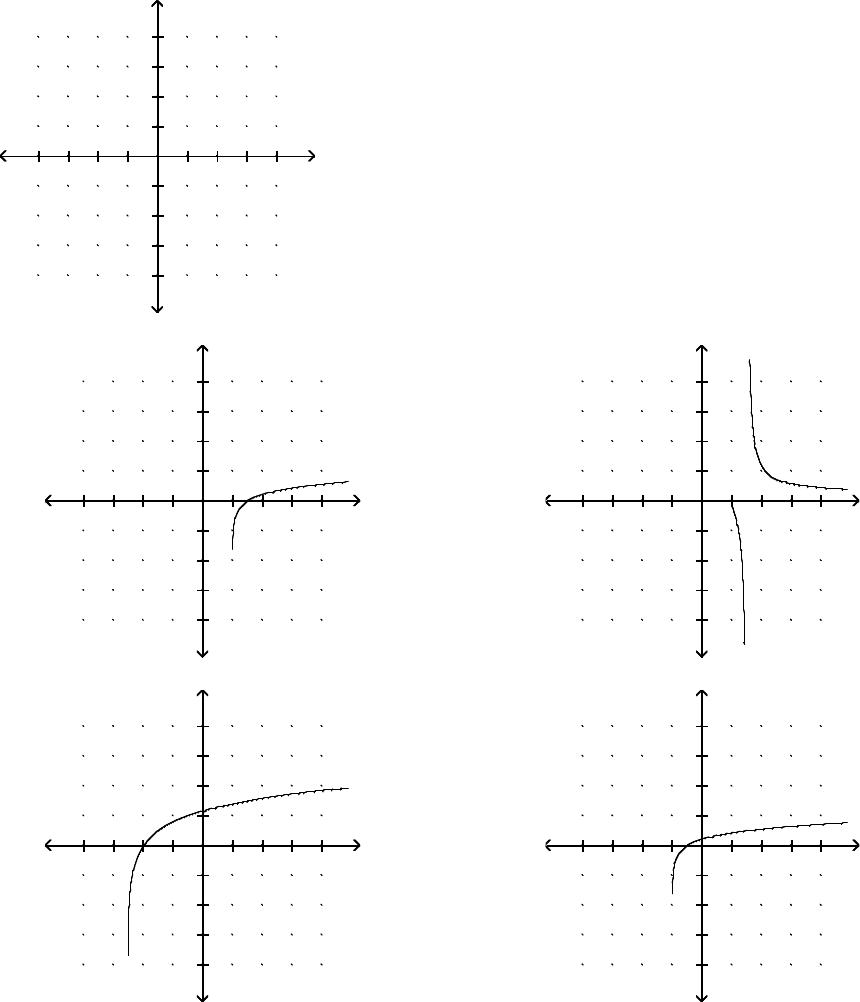
14) y=log5(x–2)
x
-8 -6 -4 -2 2 4 6 8
y
8
6
4
2
-2
-4
-6
-8
x
-8 -6 -4 -2 2 4 6 8
y
8
6
4
2
-2
-4
-6
-8
A)
x
-8 -6 -4 -2 2 4 6 8
y
8
6
4
2
-2
-4
-6
-8
x
-8 -6 -4 -2 2 4 6 8
y
8
6
4
2
-2
-4
-6
-8
B)
x
-8 -6 -4 -2 2 4 6 8
y
8
6
4
2
-2
-4
-6
-8
x
-8 -6 -4 -2 2 4 6 8
y
8
6
4
2
-2
-4
-6
-8
C)
x
-8 -6 -4 -2 2 4 6 8
y
8
6
4
2
-2
-4
-6
-8
x
-8 -6 -4 -2 2 4 6 8
y
8
6
4
2
-2
-4
-6
-8
D)
x
-8 -6 -4 -2 2 4 6 8
y
8
6
4
2
-2
-4
-6
-8
x
-8 -6 -4 -2 2 4 6 8
y
8
6
4
2
-2
-4
-6
-8
6.6 LogarithmicandExponentialEquations
1 SolveLogarithmicEquations
MULTIPLECHOICE.Choosetheonealternativethatbestcompletesthestatementoranswersthequestion.
Solvetheequation.
1) log 3x=5
A) {243} B) {15} C) {125} D) {1.46}
2) log 4(x–4)=3
A) {68} B) {60} C) {85} D) {77}
Page74
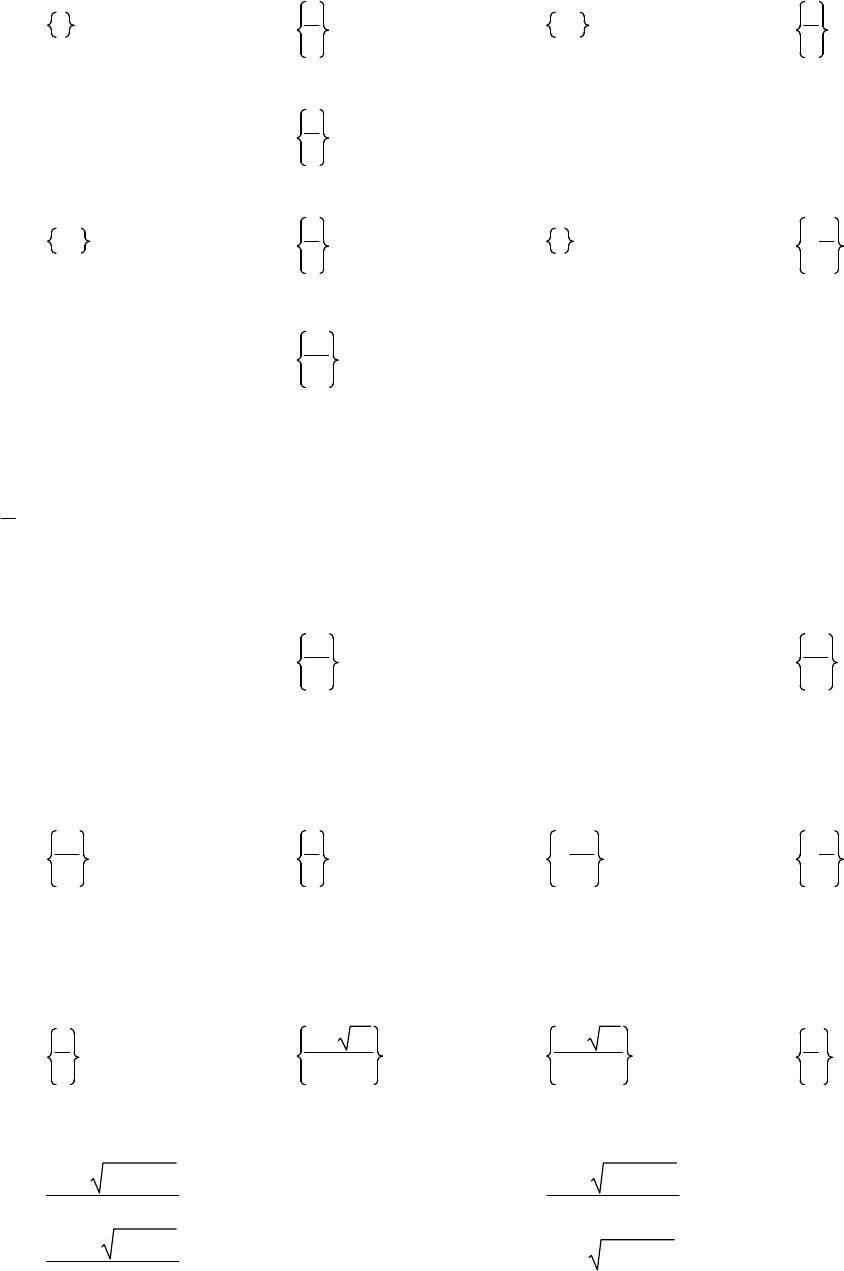
3) log(x+4)=log(4x+1)
A) 1 B) 3
5C) –1 D) 5
3
4) log(5+x)–log(x–3)=log5
A) {5} B) 3
2C) {–5} D) ∅
5) log(5x)=log4+log(x–1)
A) –4B) 3
4C) 4 D) –4
9
6) log 9(2x+4)=log 9(2x+7)
A) {0} B) 11
3C) {3} D) ∅
7) log3x+log3(x–24)=4
A) {27} B) {–3,27} C) {53} D) ∅
8) 1
3
log 2(x+6)=log 8(3x)
A) {3} B) {3,0} C) {9} D) ∅
9) log2(3x–2)–log2(x–5)=4
A) {6} B) 38
5C) {18} D) 3
13
10) log 3(x–2)+log 3(x–8)=3
A) {11} B) {11
,
–1} C) {–1} D) {12}
11) log 5(x+1)=1+log 5(x–4)
A) 21
4B) 5
4C) –21
4D) –5
4
12) log 21 (x–4)=1–log 21 x
A) {7} B) {–7} C) {3} D) {–3}
13) 2+log3(2x+5)–log3x=4
A) 5
7B) 1±46
9C) 1+46
9D) 5
4
Solvetheequation.Expressirrationalanswersinexactformandasadecimalroundedto3decimalplaces.
14) lnx+ln(x+3)=–1
A) –3+9+4e–1
2
≈0.118 B) –3–9+4e–1
2
≈–3.118
C) –3+29+e–1
2
≈1.561 D) –3+9+4e–1≈0.236
Page75
Solvetheproblem.
15) f(x)=log2(x+6)andg(x)=log2(x–2).
Solvef(x)=3.Whatpointisonthegraphoff?
A) {3},(3
,
3) B) {3},(3
,
15) C) {9},(3
,
3) D) {9},(3
,
9)
16) f(x)=log6(x+4)andg(x)=log6(x–1).
Solveg(x)=2.Whatpointisonthegraphofg?
A) {37},(37
,
2) B) {2},(2
,
37) C) {35},(35
,
2) D) {36},(36
,
2)
17) f(x)=log4(x+1)andg(x)=log4(2x–2).
Solvef(x)=g(x).
A) {3},(3
,
log4(4)) B) {3},(3
,
log4(3)) C) {3},(3
,
log4(1)) D) Nosolution.
18) f(x)=log3(x+1)andg(x)=log3(x–3).
Solvef(x)=g(x).Dothegraphsoffandgintersect?Ifso,where?
A) {4},(4
,
log3(5)) B) {4},(4
,
log3(4))
C) {4},(4
,
log3(1)) D) Nosolution.Nointersection.
19) f(x)=log2(x–6)andg(x)=log2(5x–8).
Solvef(x)+g(x)=6.
A) {8} B) {256} C) {–8} D) {–256}
20) Thefunctionf(x)=1+1.3ln(x+1)modelstheaveragenumberoffree–throwsabasketballplayercan
makeconsecutivelyduringpracticeasafunctionoftime,wherexisthenumberofconsecutivedaysthe
basketballplayerhaspracticedfortwohours.Afterhowmanydaysofpracticecanthebasketballplayer
makeanaverageof7consecutivefreethrows?
A) 100days B) 102days C) 470 days D) 472 days
21) ThepHofasolutionrangesfrom0to14.AnacidhasapHlessthan7.PurewaterisneutralandhasapH
of7.ThepHofasolutionisgivenbypH=–logxwherexrepresentstheconcentrationofthehydrogen
ionsinthesolutioninmolesperliter.FindthehydrogenionconcentrationifthepH=7.
A) 10–7B) 107C) 1.95 D) 0.14
22) ThepHofasolutionrangesfrom0to14.AnacidhasapHlessthan7.PurewaterisneutralandhasapH
of7.ThepHofasolutionisgivenbypH=–logxwherexrepresentstheconcentrationofthehydrogen
ionsinthesolutioninmolesperliter.FindthehydrogenionconcentrationifthepH=6.4.
A) 3.98×10⁻⁷B) 3.98×10⁻⁶C) 2.51×10⁻⁶D) 2.51×10⁻⁷
2 SolveExponentialEquations
MULTIPLECHOICE.Choosetheonealternativethatbestcompletesthestatementoranswersthequestion.
Solvetheequation.
1) 5x=125
A) {3} B) {25} C) {4} D) {2}
2) 2(1+2x)=32
A) {2} B) {16} C) {4} D) {–2}
Page76
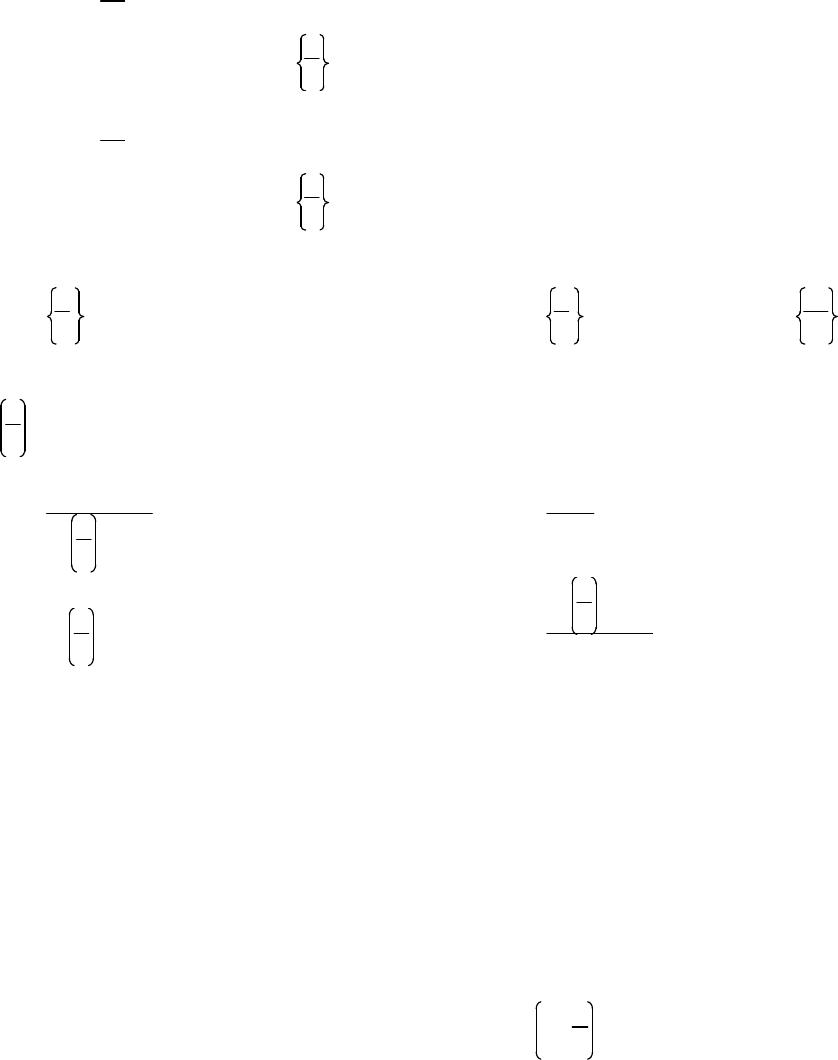
3) 4(7–3x)=1
16
A) {3} B) 1
4C) {4} D) {–3}
4) 3(6+3x)=1
27
A) {–3} B) 1
9C) {9} D) {3}
5) 3·52t–1=75
A) 3
2B) {3} C) 1
2D) 13
10
Solvetheequation.Expressirrationalanswersinexactformandasadecimalroundedto3decimalplaces.
6) 1
3
x=91–x
A) ln9
ln1
3
+ln9
≈2.000 B) ln18
ln54
≈0.725
C) ln1
3
–ln9≈–3.296 D)
ln1
3
+ln9
ln9
≈0.500
Solvetheproblem.
7) f(x)=4x+3andg(x)=4–x+5.
Findthepointofintersectionofthegraphsoffandgbysolvingf(x)=g(x).
A) (1,256) B) (1,64) C) (256
,
1) D) (64
,
1)
8) f(x)=2xandg(x)=15.
Findthepointofintersectionofthegraphsoffandgbysolvingf(x)=g(x).
A) (log215
,
15) B) (log215
,
0) C) (15
,
15) D) (log215
,
2)
9) Findouthowlongittakesa$3500investmenttodoubleifitisinvestedat8%compoundedsemiannually.
Roundtothenearesttenthofayear.UsetheformulaA=P1+r
n
nt.
A) 8.8yr B) 9yr C) 8.6 yr D) 9.2yr
10) TheformulaA=118e0.041tmodelsthepopulationofaparticularcity,inthousands,tyearsafter1998.
Whenwillthepopulationofthecityreach201thousand?
A) 2011 B) 2012 C) 2013 D) 2014
11) Thepopulationofaparticularcountrywas29 millionin1980;in1986
,
itwas33million.Theexponential
growthfunctionA=29ektdescribesthepopulationofthiscountrytyearsafter1980.Usethefactthat6
yearsafter1980thepopulationincreasedby4milliontofindktothreedecimalplaces.
A) 0.022 B) 0.231 C) 1.144 D) 0.032
Page77
3 SolveLogarithmicandExponentialEquationsUsingaGraphingUtility
MULTIPLECHOICE.Choosetheonealternativethatbestcompletesthestatementoranswersthequestion.
Useagraphingcalculatortosolvetheequation.Roundyouranswertotwodecimalplaces.
1) log2x+log6x=2
A) {2.72} B) {0.43} C) {1.65} D) {3.3}
2) log4(x+2)–log5(x–1)=1
A) {2.00} B) {1.75} C) {–0.69} D) {2.05}
3) ex=–x
A) {–0.57} B) {0.57} C) {–1.05} D) {1.05}
4) ex–lnx=3
A) {1.14} B) {2.17} C) {1.27} D) {0.57}
5) ex=x5
A) {1.30} B) {–0.79} C) {2.54} D) {–0.71}
6) ex=x2–1
A) {–1.15} B) {0} C) {–0.71} D) {2.54}
7) e2x=x+3
A) {0.65} B) {0.27} C) {3.65} D) {3.27}
8) ln(2x)=–x+3
A) {1.75} B) {0.95} C) {4.75} D) {3.95}
6.7 FinancialModels
1 DeterminetheFutureValueofaLumpSumofMoney
MULTIPLECHOICE.Choosetheonealternativethatbestcompletesthestatementoranswersthequestion.
Findtheamountthatresultsfromtheinvestment.
1) $1,000investedat12%compoundedannuallyafteraperiodof3 years
A) $1404.93 B) $404.93 C) $1254.40 D) $1573.52
2) $1,000investedat9%compoundedsemiannuallyafteraperiodof12 years
A) $2876.01 B) $1876.01 C) $2812.66 D) $2752.17
3) $14,000investedat15%compoundedsemiannuallyafteraperiodof3 years
A) $21,606.22 B) $7606.22 C) $21,292.25 D) $20,098.81
4) $480investedat14%compoundedquarterlyafteraperiodof3 years
A) $725.31 B) $245.31 C) $711.14 D) $700.79
5) $12,000investedat4%compoundedquarterlyafteraperiodof5 years
A) $14,642.28 B) $2642.28 C) $14,599.83 D) $14,497.31
Page78

Solvetheproblem.
6) Findtheamountowedattheendof8yearsif$5000isloanedatarateof5%compoundedmonthly.
A) $7452.93 B) $12,911.25 C) $9093.60 D) $8060.16
SHORTANSWER.Writethewordorphrasethatbestcompleteseachstatementoranswersthequestion.
7) If$5,000isinvestedfor6yearsat5%,compoundedcontinuously,findthefuturevalue.
8)
J
ohnForgetsalotdeposited$100ata3%annualinterestrateinasavingsaccountfiftyyearsago,andthen
hepromptlyforgothehaddoneit.Recently,hewascleaningouthishomeofficeanddiscoveredthe
forgottenbankbook.Howmuchmoneyisintheaccount?
9) Meikeearned$1565intipswhileworkingasummerjobatacoffeeshop.Shewantstousethismoneyto
takeatriptoEuropenextsummer.Ifsheplacesthemoneyinanaccountwhichpays6.5%compounded
continuously,howmuchmoneywillshehaveinninemonths?
10) Carlahasjustinheritedabuildingthatisworth$250,000.Thebuildingisinahighdemandarea,andthe
valueofthebuildingisprojectedtoincreaseatarateof25%peryearforthenext4years.Howmuchmore
moneywillshemakeifshewaitsfouryearstosellthebuildinginsteadofsellingnow?
2 CalculateEffectiveRatesofReturn
MULTIPLECHOICE.Choosetheonealternativethatbestcompletesthestatementoranswersthequestion.
Findtheeffectiverateofinterest.
1) 13%compoundedcontinuously
A) 13.883% B) 13.451% C) 13.089% D) 13.374%
2) 8.1%compoundedcontinuously
A) 8.437% B) 8.551% C) 8.189% D) 8.474%
3) 50.09%compoundeddaily
A) 64.964% B) 50.213% C) 50.295% D) 50.995%
4) 11.5%compoundedmonthly
A) 12.126% B) 11.623% C) 11.705% D) 12.405%
5) 6 1
4%compoundedmonthly
A) 6.29% B) 6.43% C) 6.39% D) 6.25%
6) 8.25%compoundedquarterly
A) 8.509% B) 8.373% C) 8.455% D) 9.155%
SHORTANSWER.Writethewordorphrasethatbestcompleteseachstatementoranswersthequestion.
7) 4 3
4%compoundedquarterly
Page79

MULTIPLECHOICE.Choosetheonealternativethatbestcompletesthestatementoranswersthequestion.
Solvetheproblem.
8) Alocalbankadvertisesthatitpaysinterestonsavingsaccountsattherateof3%compoundedmonthly.
Findtheeffectiverate.Roundanswertotwodecimalplaces.
A) 3.04% B) 3.40% C) 3.44% D) 36%
9) Whichofthetworateswouldyieldthelargeramountin1year:5.4%compoundedmonthly or5.3%
compoundeddaily?
A) 5.4%compoundedmonthly
B) 5.3%compoundeddaily
C) Theywillyieldthesameamount.
10) Whichofthetworateswouldyieldthelargeramountin1year:9%compoundedmonthlyor91
4%
compoundedannually?
A) 9%compoundedmonthly
B) 9 1
4%compoundedannually
C) Theywillyieldthesameamount.
3 DeterminethePresentValueofaLumpSumofMoney
MULTIPLECHOICE.Choosetheonealternativethatbestcompletesthestatementoranswersthequestion.
Findthepresentvalue.Roundtothenearestcent.
1) Toget$5600after3yearsat12%compoundedannually
A) $3985.97 B) $1614.03 C) $4464.29 D) $7117.8
2) Toget$10,500after3yearsat10%compoundedannually
A) $7888.81 B) $2611.19 C) $8677.69 D) $7513.15
3) Toget$2000after3yearsat7%compoundedsemiannually
A) $1627.00 B) $373 C) $1632.60 D) $1683.95
4) Toget$25,000after6yearsat6%compoundedsemiannually
A) $17,534.50 B) $7465.5 C) $17,624.01 D) $18,060.53
5) Toget$6500after6yearsat7%compoundedquarterly
A) $4286.35 B) $2213.65 C) $4331.22 D) $4361.36
6) Toget$10,000after2yearsat18%compoundedmonthly
A) $6995.44 B) $8363.87 C) $11,956.18 D) $5000.00
Solvetheproblem.
7) Whatprincipalinvestedat8%compoundedcontinuouslyfor4yearswillyield$1190?Roundtheanswer
totwodecimalplaces.
A) $1638.78 B) $864.12 C) $1188.62 D) $627.48
SHORTANSWER.Writethewordorphrasethatbestcompleteseachstatementoranswersthequestion.
8) Whatprincipalinvestedat6%,compoundedcontinuouslyfor3years,willyield$1500?Roundtheanswer
totwodecimalplaces.
Page80
MULTIPLECHOICE.Choosetheonealternativethatbestcompletesthestatementoranswersthequestion.
9) Howmuchmoneyneedstobeinvestednowtoget$2000after4yearsat8%compoundedquarterly?
Expressyouranswertothenearestdollar.
A) $1457 B) $584 C) $1848 D) $2746
4 DeterminetheRateofInterestorTimeRequiredtoDoubleaLumpSumofMoney
MULTIPLECHOICE.Choosetheonealternativethatbestcompletesthestatementoranswersthequestion.
Solvetheproblem.Roundyouranswertothreedecimals.
1) Whatannualrateofinterestisrequiredtodoubleaninvestmentin7 years?
A) 10.409% B) 5.204% C) 9.902% D) 16.993%
2) Whatannualrateofinterestisrequiredtotripleaninvestmentin7 years?
A) 15.694% B) 8.497% C) 16.993% D) 10.409%
3) Howlongwillittakeforaninvestmenttodoubleinvalueifitearns7.5%compoundedcontinuously?
A) 9.242years B) 9.682 years C) 4.621 years D) 14.648 years
4) Howlongwillittakeforaninvestmenttotripleinvalueifitearns10.75%compoundedcontinuously?
A) 10.22years B) 10.76 years C) 5.11 years D) 6.448 years
Solvetheproblem.
5) Howlongdoesittake$1125totripleifitisinvestedat7%interest,compoundedquarterly?Roundyour
answertothenearesttenth.
A) 15.8years B) 15.8months C) 18.1years D) 18.1months
SHORTANSWER.Writethewordorphrasethatbestcompleteseachstatementoranswersthequestion.
6) Howlongdoesittake$1700todoubleifitisinvestedat5%interest,compoundedmonthly?Roundyour
answertothenearesttenth.
7) Gillianhas$10,000toinvestinamutualfund.Theaverageannualrateofreturnforthepastfiveyearswas
12.25%.Assumingthisrate,determinehowlongitwilltakeforherinvestmenttodouble.
MULTIPLECHOICE.Choosetheonealternativethatbestcompletesthestatementoranswersthequestion.
8) IfEmeryhas$1600toinvestat5%peryearcompoundedmonthly,howlongwillitbebeforehehas
$2300?Ifthecompoundingiscontinuous,howlongwillitbe?(Roundyouranswerstothreedecimal
places.)
A) 7.273yrs,7.258yrs B) 0.62 yrs,0.605 yrs
C) 122.642yrs,7.658 yrs D) 0.087 yrs,0.726 yrs
9) Cindywillrequire$16,000in4yearstoreturntocollegetogetanMBAdegree.Howmuchmoneyshould
sheaskherparentsfornowsothat,ifsheinvestsitat12%compoundedcontinuously,shewillhave
enoughforschool?(Roundyouranswertothenearestdollar.)
A) $9901 B) $10,168 C) $25,857 D) $6126
10) Traceyboughtadiamondringappraisedat$1500 atanantiquestore.Ifdiamondshaveappreciatedin
valueatanannualrateof12%,whatwasthevalueofthering5yearsago?(Roundyouranswertothe
nearestdollar.)
A) $851 B) $823 C) $2644 D) $452
Page81
11) TheFeldmansboughttheirfirsthousefor$20
,
000. Overtheyearstheymovedthreetimesintobiggerand
biggerhouses.Now,42yearslater,theyarereadytoretireandwantasmallerhouselikethefirstonethey
bought.Ifinflationinpropertyvalueshasaveraged3.5%peryearduringthattime,howmuchwillsucha
housecostthemnow?(Roundyouranswertothenearestdollar.)
A) $84,825 B) $86,985 C) $4716 D) $4599
12) Larryhas$2900toinvestandneeds$3300 in18 years.Whatannualrateofreturnwillheneedtogetin
ordertoaccomplishhisgoal?(Roundyouranswertotwodecimals.)
A) 0.72% B) 1.3% C) 2.3% D) 3.3%
SHORTANSWER.Writethewordorphrasethatbestcompleteseachstatementoranswersthequestion.
13) Aventurecapitalfirminvested$2,000,000inanewcompanyin1995.In1999,theysoldtheirstakeinthe
companyfor$10,500,000.Whatwastheaverageannualrateofreturnontheirinvestment?
14)
J
uliofiguresthathecansave$5000peryear.If,attheendofeachyear,heinveststhemoneyinacertificate
ofdeposit(CD)whichpays7%interestannually,howmuchmoneywillhehavesavedinsixyears?
6.8 ExponentialGrowthandDecayModels;NewtonʹsLaw;LogisticGrowthandDecayModels
1 FindEquationsofPopulationsThatObeytheLawofUninhibitedGrowth
MULTIPLECHOICE.Choosetheonealternativethatbestcompletesthestatementoranswersthequestion.
Solvetheproblem.
1) ThesizePofasmallherbivorepopulationattimet(inyears)obeysthefunctionP(t)=700e0.12tifthey
haveenoughfoodandthepredatorpopulationstaysconstant.Afterhowmanyyearswillthepopulation
reach1400?
A) 5.78yrs B) 54.59 yrs C) 14.11 yrs D) 16.22 yrs
2) Conservationiststagged110black–nosedrabbitsinanationalforestin1990.In1992
,
theytagged220
black–nosedrabbitsinthesamerange.Iftherabbitpopulationfollowstheexponentiallaw,howmany
rabbitswillbeintherange8yearsfrom1990?
A) 1760 B) 3520 C) 131 D) 262
SHORTANSWER.Writethewordorphrasethatbestcompleteseachstatementoranswersthequestion.
3) Therevenueforadot.comcompanyisprojectedtodoubleeachyearforthefirst5years.Iftherevenuefor
thefirstyearis$2million,writeafunctionshowingtherevenueRafterxyears.Whatistherevenuefor
thefourthyear?
4) Inanetworkingmarketingplanforacompany,eachdistributorisexpectedtorecruit3newdistributors.
Jackwasthefirstdistributorhiredbythecompany,soheisconsideredalevel1distributor.The3people
herecruitsareconsideredlevel2distributors.Thepeoplerecruitedbythelevel2distributorsare
consideredlevel3distributors,andsoon.WriteafunctionthatmodelsthenumberofdistributorsDat
eachlevelL.Howmanydistributorswouldtherebeatthefifthlevel?
5) Thebacteriainacontainerquadrupleseveryday.Ifthereareinitially100bacteria,writeanequationtha
t
modelsthenumberofbacteriaAafterddays.Howmanybacteriawilltherebeafter1week?
Page82
6) Theconcentrationofalcoholinapersonʹsbloodismeasurable.SupposethattheriskR(givenasapercent)
ofhavinganaccidentwhiledrivingacarcanbemodeledbytheequation
R=5ekx
wherexisthevariableconcentrationofalcoholinthebloodandkisaconstant.
Supposethataconcentrationofalcoholinthebloodof0.07resultsina10%risk(R=10)ofanaccident.
Findtheconstantkintheequation.
Usingthisvalueofk,whatistheriskiftheconcentrationis0.11?
MULTIPLECHOICE.Choosetheonealternativethatbestcompletesthestatementoranswersthequestion.
7) During1991,200,000peoplevisitedRaveAmusementPark.During1997,thenumberhadgrownto
834,000.Ifthenumberofvisitorstotheparkobeysthelawofuninhibitedgrowth,findtheexponential
growthfunctionthatmodelsthisdata.
A) f(t)=634,000e0.238t B) f(t)=200,000e0.248t
C) f(t)=634,000e0.248t D) f(t)=200,000e0.238t
SHORTANSWER.Writethewordorphrasethatbestcompleteseachstatementoranswersthequestion.
8) Acultureofbacteriaobeysthelawofuninhibitedgrowth.If140,000bacteriaarepresentinitiallyandthere
are609,000after6hours,howlongwillittakeforthepopulationtoreachonemillion?
9) ThesizePofacertaininsectpopulationattimet(indays)obeysthefunctionP=700e0.03t.Afterhow
manydayswillthepopulationreach1500?
MULTIPLECHOICE.Choosetheonealternativethatbestcompletesthestatementoranswersthequestion.
10) Thevalueofaparticularinvestmentfollowsapatternofexponentialgrowth.Intheyear2000,you
investedmoneyinamoneymarketaccount.Thevalueofyourinvestmenttyearsafter2000isgivenby
theexponentialgrowthmodelA=9400e0.062t.Howmuchdidyouinitiallyinvestintheaccount?
A) $9400.00 B) $10,001.25 C) $582.80 D) $4700.00
11) Thevalueofaparticularinvestmentfollowsapatternofexponentialgrowth.Intheyear2000,you
investedmoneyinamoneymarketaccount.Thevalueofyourinvestmenttyearsafter2000isgivenby
theexponentialgrowthmodelA=9400e0.059t.Whenwilltheaccountbeworth$16,957?
A) 2010 B) 2011 C) 2012 D) 2009
12) Thevalueofaparticularinvestmentfollowsapatternofexponentialgrowth.Intheyear2000,you
investedmoneyinamoneymarketaccount.Thevalueofyourinvestmenttyearsafter2000isgivenby
theexponentialgrowthmodelA=6600e0.068t.Bywhatpercentageistheaccountincreasingeachyear?
A) 7.0% B) 7.2% C) 7.4% D) 7.5%
13) Thepopulationofaparticularcountrywas22 millionin1985;in1993
,
itwas31million.Theexponential
growthfunctionA=22ektdescribesthepopulationofthiscountrytyearsafter1985.Usethefactthat8
yearsafter1985thepopulationincreasedby9milliontofindktothreedecimalplaces.
A) 0.043 B) 0.275 C) 0.816 D) 0.053
Page83
2 FindEquationsofPopulationsThatObeytheLawofDecay
MULTIPLECHOICE.Choosetheonealternativethatbestcompletesthestatementoranswersthequestion.
Solvetheproblem.
1) Thehalf–lifeofsilicon–32is710years.If100 gramsispresentnow,howmuchwillbepresentin600
years?(Roundyouranswertothreedecimalplaces.)
A) 55.668 B) 94.311 C) 0.286 D) 0
2) Thehalf–lifeofplutonium–234is9hours.If70 milligramsispresentnow,howmuchwillbepresentin5
days?(Roundyouranswertothreedecimalplaces.)
A) 0.007 B) 47.627 C) 1.488 D) 27.779
3) Afossilizedleafcontains19%ofitsnormalamountofcarbon14.Howoldisthefossil(tothenearest
year)?Use5600yearsasthehalf–lifeofcarbon14.
A) 13,393 B) 23,745 C) 1699 D) 35,439
4) Thehalf–lifeofaradioactiveelementis130days,butyoursamplewillnotbeusefultoyouafter80%of
theradioactivenucleioriginallypresenthavedisintegrated.Abouthowmanydayscanyouusethe
sample?
A) 312 B) 297 C) 287 D) 302
SHORTANSWER.Writethewordorphrasethatbestcompleteseachstatementoranswersthequestion.
5) Thehalf–lifeofcarbon–14is5700years.Findtheageofasampleinwhich8%oftheradioactivenuclei
originallypresenthavedecayed.
6) Thehalf–lifeofradiumis1690years.If150gramsispresentnow,howlong(tothenearestyear)tillonly
100gramsarepresent?
7) Assumethatthehal
f
–lifeofCarbon–14is5700years.Findtheage(tothenearestyear)ofawoodenaxein
whichtheamountofCarbon–14is30%ofwhatitoriginallyhad.
MULTIPLECHOICE.Choosetheonealternativethatbestcompletesthestatementoranswersthequestion.
8) Strontium90decaysataconstantrateof2.44%peryear.Therefore,theequationfortheamountPof
strontium90aftertyearsisP=P0e–0.0244t.Howlongwillittakefor15gramsofstrontiumtodecayto5
grams?Roundanswerto2decimalplaces.
A) 45.03years. B) 4.50years C) 450.25years D) 40.50years
SHORTANSWER.Writethewordorphrasethatbestcompleteseachstatementoranswersthequestion.
9) Ifasinglepaneofglassobliterates15%ofthelightpassingthroughit,thenthepercentPoflightthat
passesthroughnsuccessivepanescanbeapproximatedbytheequation
P=100e–0.15n
Howmanypanesarenecessarytoblockatleast50%ofthelight?
10) Bob,theincredibleshrinkingman,loseshalfofhisheighteachdayafterhewasexposedtoamysterious
formofcosmicradiation.Howmanydaysbeforeheisliterallyʺknee–hightoagrasshopperʺ?Assumethat
agrasshopperʹskneeis4millimetershighandthatBobis2meterstall.Roundyouranswertothenearest
wholeday.(1000millimeters=1meter)
Page84
11) Theformula
D=8e–0.6h
canbeusedtofindthenumberofmilligramsDofacertaindrugthatisinapatientʹsbloodstreamhhours
afterthedrughasbeenadministered.Thedrugistobeadministeredagainwhentheamountinthe
bloodstreamreaches4milligrams.Whatisthetimebetweeninjections?
12) Between8:30a.m.and9:30a.m.,carsdrivethroughtheCappuccinoExpressatarateof12carsperhour
(0.2perminute).Thefollowingformulafromprobabilitycanbeusedtodeterminetheprobabilitythata
carwillarrivewithintminutesof8:30a.m.
F(t)=1–e–0.2t
Determinehowmanyminutesareneededfortheprobabilitytoreach0.6.
13) Arumorisspreadatanelementaryschoolwith1200studentsaccordingtothemodel
N=1200(1–e–0.16d)whereNisthenumberofstudentswhohaveheardtherumoranddisthenumber
ofdaysthathaveelapsedsincetherumorbegan.Howmanydaysmustelapsefor500tohaveheardthe
rumor?
MULTIPLECHOICE.Choosetheonealternativethatbestcompletesthestatementoranswersthequestion.
14) ThefunctionA=Aoe–0.00866xmodelstheamountinpoundsofaparticularradioactivematerialstoredin
aconcretevault,wherexisthenumberofyearssincethematerialwasputintothevault.If700poundsof
thematerialareinitiallyputintothevault,howmanypoundswillbeleftafter30years?
A) 540pounds B) 110pounds C) 131 pounds D) 933 pounds
15) ThefunctionA=Aoe–0.0077xmodelstheamountinpoundsofaparticularradioactivematerialstoredin
aconcretevault,wherexisthenumberofyearssincethematerialwasputintothevault.If500pounds
ofthematerialareplacedinthevault,howmuchtimewillneedtopassforonly292poundstoremain?
A) 70years B) 75years C) 80 years D) 140 years
16) Theamountofacertaindruginthebloodstreamismodeledbythefunctiony=y0e–0.40t,wherey0is
theamountofthedruginjected(inmilligrams)andtistheelapsedtime(inhours).Supposethat10
milligramsareinjectedat10:00A.M.Ifasecondinjectionistobeadministeredwhenthereis1milligram
ofthedrugpresentinthebloodstream,approximatelywhenshouldthenextdosebegiven?Expressyour
answertothenearestquarterhour.
A) 3:45P.M B) 12:30P.M C) 5:45P.M D) 5:30P.M
Page85
3 UseNewtonʹsLawofCooling
MULTIPLECHOICE.Choosetheonealternativethatbestcompletesthestatementoranswersthequestion.
Solvetheproblem.
1) Sandymanagesaceramicsshopandusesa750°F kilntofireceramicgreenware.Afterturningoffherkiln,
shemustwaituntilitstemperaturegaugereaches195°Fbeforeopeningitandremovingtheceramic
pieces.Ifroomtemperatureis75°Fandthegaugereads700°Fin9minutes,howlongmustshewaitbefore
openingthekiln?AssumethekilncoolsaccordingtoNewtonʹsLawofCooling:
U=T+(Uo–T)ekt.
(Roundyouranswertothenearestwholeminute.)
A) 202minutes B) –427 minutes C) –307 minutes D) 90minutes
2) Athermometerreading94°Fisplacedinsideacoldstorageroomwithaconstanttemperatureof37°F. If
thethermometerreads86°Fin10minutes,howlongbeforeitreaches52°F?Assumethecoolingfollows
NewtonʹsLawofCooling:
U=T+(Uo–T)ekt.
(Roundyouranswertothenearestwholeminute.)
A) 88minutes B) –32minutes C) –2 minutes D) 28minutes
3) Athermometerreading11°Cisbroughtintoaroomwithaconstanttemperatureof20°C.Ifthe
thermometerreads16°Cafter3minutes,whatwillitreadafterbeingintheroomfor7minutes?Assume
thecoolingfollowsNewtonʹsLawofCooling:
U=T+(Uo–T)ekt.
(Roundyouranswertotwodecimalplaces.)
A) 18.64°C B) 21.36°C C) 7.24°C D) 19.97°C
4) Athermometerreading38°Fisbroughtintoaroomwithaconstanttemperatureof80°F.Ifthe
thermometerreads44°Fafter6minutes,whatwillitreadafterbeingintheroomfor8minutes?Assume
thecoolingfollowsNewtonʹsLawofCooling:
U=T+(Uo–T)ekt.
(Roundyouranswertotwodecimalplaces.)
A) 45.8°F B) 114.2°F C) 35.13°F D) 67.76°F
5) Acupofcoffeeisheatedto194°andisthenallowedtocoolinaroomwhoseairtemperatureis72°. After
11minutes,thetemperatureofthecupofcoffeeis140°.Findthetimeneededforthecoffeetocooltoa
temperatureof102°.AssumethecoolingfollowsNewtonʹsLawofCooling:
U=T+(Uo–T)ekt.
(Roundyouranswertoonedecimalplace.)
A) 26.4minutes B) 29.7minutes C) 15.1minutes D) 41.1minutes
SHORTANSWER.Writethewordorphrasethatbestcompleteseachstatementoranswersthequestion.
6) Athermometeristakenfromaroomat71°Ftotheoutdoorswherethetemperatureis14°F. Determine
whatthereadingonthethermometerwillbeafter5minutes,ifthereadingdropsto45°F after1minute.
AssumethecoolingfollowsNewtonʹsLawofCooling:
U=T+(Uo–T)ekt.
(Roundyouranswertotwodecimalplaces.)
Page86

7) Thetemperature(indegreesFahrenheit)ofadeadbodythathasbeencoolinginaroomsetat70° is
measuredas88°.Onehourlater,thebodytemperatureis87.5°.Howlong(tothenearesthour)beforethe
firstmeasurementwasthetimeofdeath,assumingthatthebodytemperatureofthedeceasedatthetime
ofdeathwas98.6°.AssumethecoolingfollowsNewtonʹsLawofCooling:
U=T+(Uo–T)ekt.
8) Afullycookedturkeyistakenoutofanovensetat200°C(Celsius)andplacedinasinkofchilledwaterof
temperature4°C.After3minutes,thetemperatureoftheturkeyismeasuredtobe50°C.Howlong(tothe
nearestminute)willittakeforthetemperatureoftheturkeytoreach15°C?Assumethecoolingfollows
NewtonʹsLawofCooling:
U=T+(Uo–T)ekt.
(Roundyouranswertothenearestminute.)
4 UseLogisticModels
MULTIPLECHOICE.Choosetheonealternativethatbestcompletesthestatementoranswersthequestion.
Solvetheproblem.
1) ThelogisticgrowthmodelP(t)=1430
1+30.78e–0.346t
representsthepopulationofabacteriuminaculture
tubeafterthours.Whatwastheinitialamountofbacteriainthepopulation?
A) 45 B) 46 C) 44 D) 50
2) ThelogisticgrowthmodelP(t)=970
1+26.71e–0.339t
representsthepopulationofabacteriuminaculture
tubeafterthours.Whenwilltheamountofbacteriabe750?
A) 13.31hours B) 8.93 hours C) 7.41 hours D) 3.03 hours
3) ThelogisticgrowthmodelP(t)=220
1+54e–0.159t
representsthepopulationofaspeciesintroducedintoa
newterritoryaftertyears.Whenwillthepopulationbe70?
A) 20.29years B) 17.89 years C) 7.72 years D) 5.31 years
4) ThelogisticgrowthmodelP(t)=180
1+44e–0.19t
representsthepopulationofaspeciesintroducedintoa
newterritoryaftertyears.Whatwillthepopulationbein20years?
A) 91 B) 183 C) 99 D) 180
5) ThelogisticgrowthmodelP(t)=1
1+11.5e–0.818t
representstheproportionofthetotalmarketofanew
productasitpenetratesthemarkettyearsafterintroduction.Whenwilltheproducthave75%ofthe
market?
A) 4.33years B) 2.63 years C) 5.33 years D) 3.63 years
6) In1990,thepopulationofacountrywasestimatedat4million.Foranysubsequentyearthepopulation,
P(t)(inmillions),canbemodeledbytheequationP(t)=240
5+54.99e–0.0208t,wheretisthenumberofyears
since1990.Estimatetheyearwhenthepopulationwillbe21million.
A) approximatelytheyear2088 B) approximatelytheyear2041
C) approximatelytheyear2016 D) approximatelytheyear2093
Page87

SHORTANSWER.Writethewordorphrasethatbestcompleteseachstatementoranswersthequestion.
7) In1992,thepopulationofacountrywasestimatedat5million.Foranysubsequentyear,thepopulation,
P(t)(inmillions),canbemodeledusingtheequationP(t)=250
5+44.99e–0.0208t,wheretisthenumberof
yearssince1992.Determinetheyearwhenthepopulationwillbe39million.
MULTIPLECHOICE.Choosetheonealternativethatbestcompletesthestatementoranswersthequestion.
8) Inatownwhosepopulationis3000,adiseasecreatesanepidemic.Thenumberofpeople,N,infectedt
daysafterthediseasehasbegunisgivenbythefunction
N(t)=3000
1+21.2e–0.54t .Findthenumberofinfectedpeopleafter10days.
A) 2737people B) 142people C) 1000people D) 2000people.
9) Thelogisticgrowthfunctionf(t)=520
1+6.4e–0.28t
describesthepopulationofaspeciesofbutterflies
tmonthsaftertheyareintroducedtoanon–threateninghabitat.Howmanybutterflieswereinitially
introducedtothehabitat?
A) 70butterflies B) 520butterflies C) 6 butterflies D) 2butterflies
10) Thelogisticgrowthfunctionf(t)=600
1+6.5e–0.22t
describesthepopulationofaspeciesofbutterflies
tmonthsaftertheyareintroducedtoanon–threateninghabitat.Whatisthelimitingsizeofthebutterfly
populationthatthehabitatwillsustain?
A) 600butterflies B) 80butterflies C) 7 butterflies D) 1200 butterflies
11) Thelogisticgrowthfunctionf(t)=760
1+18.0e–0.16t
describesthepopulationofaspeciesofbutterflies
tmonthsaftertheyareintroducedtoanon–threateninghabitat.Howmanybutterfliesareexpectedinthe
habitatafter13months?
A) 234butterflies B) 520butterflies C) 762 butterflies D) 9880 butterflies
12) Thelogisticgrowthfunctionf(t)=13,000
1+259.0e–1.9t
modelsthenumberofpeoplewhohavebecomeillwith
aparticularinfectiontweeksafteritsinitialoutbreakinaparticularcommunity.Howmanypeople
becameillwiththisinfectionwhentheepidemicbegan?
A) 50people B) 13,000 people C) 259 people D) 260 people
13) Thelogisticgrowthfunctionf(t)=57,000
1+2849e–1.9t
modelsthenumberofpeoplewhohavebecomeillwith
aparticularinfectiontweeksafteritsinitialoutbreakinaparticularcommunity.Howmanypeoplewere
illafter5weeks?
A) 46,981people B) 57,000 people C) 100 people D) 59,850 people
14) Thelogisticgrowthfunctionf(t)=54,000
1+770.4e–1.8t
modelsthenumberofpeoplewhohavebecomeillwith
aparticularinfectiontweeksafteritsinitialoutbreakinaparticularcommunity.Whatisthelimitingsize
ofthepopulationthatbecomesill?
A) 54,000people B) 108,000 people C) 770 people D) 771 people
Page88

6.9 BuildingExponential,Logarithmic,andLogisticModelsfromDat
a
1 BuildanExponentialModelfromData
SHORTANSWER.Writethewordorphrasethatbestcompleteseachstatementoranswersthequestion.
Solvetheproblem.
1) Thepopulation(inhundredthousands)fortheColonialUnitedStatesinten–yearincrementsfortheyears
1700–1780isgiveninthetable.(Source:1998InformationPleaseAlmanac)
Decade
0
1
2
3
4
Population
251
332
466
629
906
Decade
5
6
7
8
Population
1171
1594
2148
2780
Statewhetherthedatacanbemoreaccuratelymodeledusinganexponentialfunctionoralogarithmic
function.Usingagraphingutility,findamodelforpopulation(inhundredthousands)asafunctionof
decadessince1700.
2) Abiologisthasabacteriasample.Sherecordstheamountofbacteriaeveryweekfor8weeksandfinds
thattheexponentialfunctionofbestfittothedataisA=150·1.79t.Expressthefunctionofbestfitinthe
formA=A0ekt.
3) Amusicstoremanagercollecteddataregardingpriceandquantitydemandedofcassettetapesever
y
weekfor10weeks,andfoundthattheexponentialfunctionofbestfittothedatawasp=25·0.89q.
Expressthefunctionofbestfitintheformp=p0ekq,andusethisexpressiontopredictthequantity
demandedifthepriceis$8.50.
MULTIPLECHOICE.Choosetheonealternativethatbestcompletesthestatementoranswersthequestion.
4) Alifeinsurancecompanyusesthefollowingratetableforannualpremiumsforwomenfortermlife
insurance.Useagraphingutilitytofitanexponentialfunctiontothedata.Predicttheannualpremiumfor
awomanaged70years.
Age 35 40 45 50 55 60 65
Premium $103 $133 $190 $255 $360 $503 $818
A) y=8.94e0.068x,$1044 B) y=6.367e0.068x,$743
C) y=0.0000398x4.06,$1233 D) y= –9306.4+2516.3ln(x),$1723
Page89
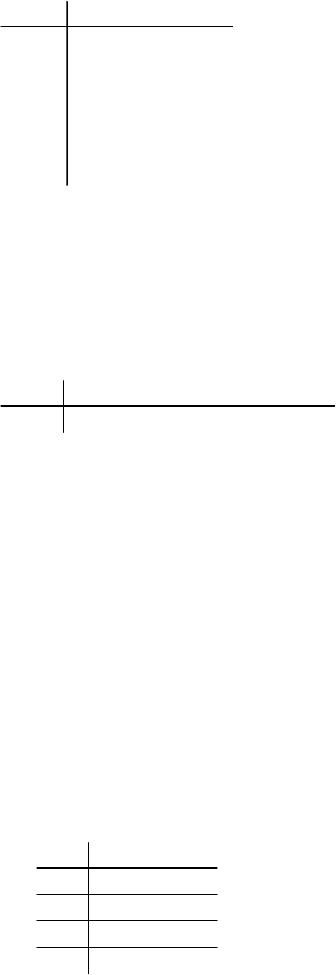
5) MoneymagazinereportsthatthepercentageoftradingdaysinwhichtheDasdaqlosesorgains2%or
morehasbeenincreasingsince1995indicatingmorevolatilityintheDasdaq.Useagraphingutilitytofit
anexponentialfunctiontothedata.Predictthepercentageoftradingdaysin2001havingsuchswingsin
value.
Year %oftradingdays
1995,02
1996,15
1997,28
1998,318
1999,423
2000,549
A) y=2.353e0.610x,91days B) y=1.278e0.611x,92days
C) y=1.669x1.706,46days D) y=1.849e0.531x,76days
6) Anuclearscientisthasasampleof100mg ofaradioactivematerialwhichhasahalf–lifeinhours.She
monitorstheamountofradioactivematerialoveraperiodofadayandobtainsthefollowingdata.Usea
graphingutilitytofitanexponentialfunctiontothedata.Predicttheamountofmaterialremainingat40
hours.
Hours 0 5 10 15 20 25 30
mg 100 68.3 45.2 31.3 21.5 14.6 9.8.
A) y=100e–0.077x,4.6mg B) y=100e–0.077x,6.7mg
C) y=86e–0.071x,5.0mg D) y=92e–0.0686x,5.9mg
2 BuildaLogarithmicModelfromData
SHORTANSWER.Writethewordorphrasethatbestcompleteseachstatementoranswersthequestion.
Solvetheproblem.
1) Datarepresentingthepriceandquantitydemandedforhand–heldelectronicorganizerswereanalyzed
everydayfor15days.Thelogarithmicfunctionofbestfittothedatawasfoundtobep=398–73ln(q).
Usethistopredictthenumberofhand–heldelectronicorganizersthatwouldbedemandediftheprice
were$275.
2) Theratesofdeath(innumberofdeathsper100,000population)for1–4yearoldsintheUnitedStates
between1980–1995aregivenbelow.(Source:NCHSDataWarehouse)
Year RateofDeath
1980 91.4
1985 74.5
1990 69.3
1995 61.3
Alogarithmicequationthatmodelsthisdataisy=822.99–167.55lnxwherexrepresentsthenumberof
yearssince1900.Usethisequationtopredicttherateofdeathfor1–4yearoldsin2005.
Page90
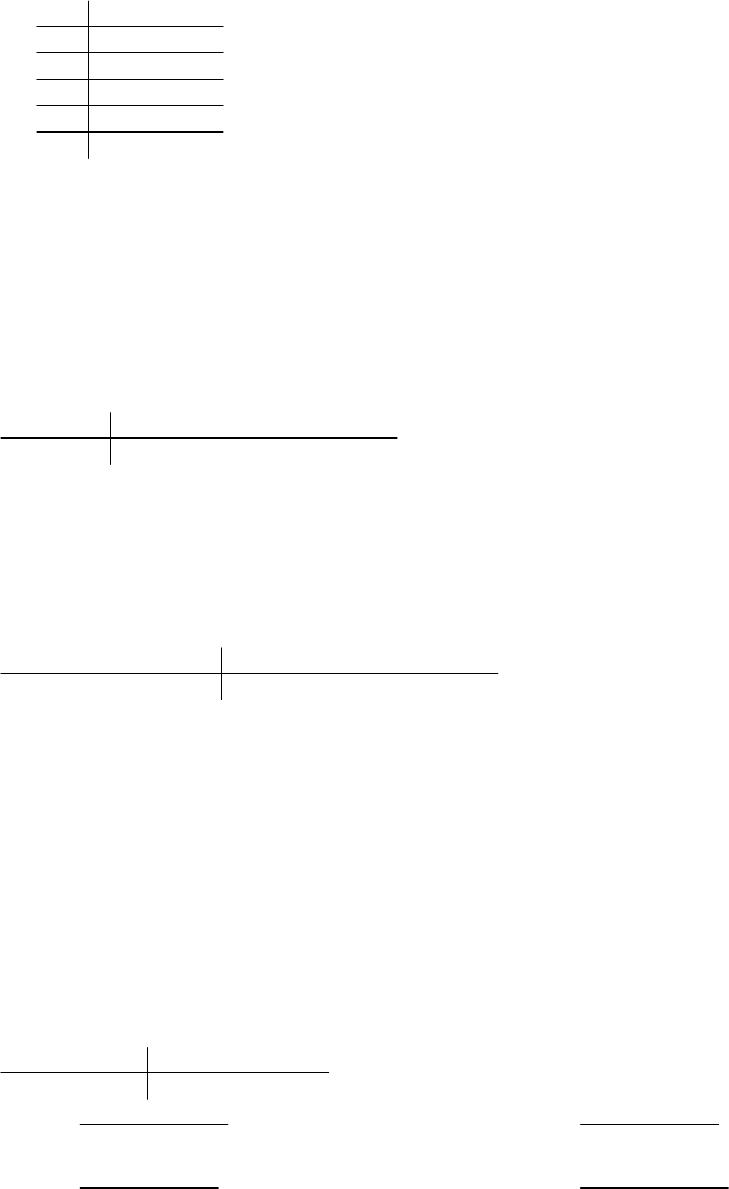
3) Theratesofdeath(innumberofdeathsper100,000population)for20–24yearoldsintheUnitedStates
between1985–1993aregivenbelow.(Source:NCHSDataWarehouse)
Year RateofDeath
1985 134.9
1987 154.7
1989 162.9
1991 174.5
1993 182.2
Alogarithmicequationthatmodelsthisdataisy=57.76+48.56lnxwherexrepresentsthenumberof
yearssince1980andyrepresentstherateofdeathinthatyear.Usethisequationtopredicttheyearin
whichtherateofdeathfor20–24yearoldsfirstexceeds200.
MULTIPLECHOICE.Choosetheonealternativethatbestcompletesthestatementoranswersthequestion.
4) Afterintroducinganinhibitorintoacultureofluminescentbacteria,ascientistmonitorstheluminosit
y
producedbytheculture.Useagraphingutilitytofitalogarithmicfunctiontothedata.Predictthe
luminosityafter20hours.
Time,hrs 234581015
Luminosity 77.4 60.8 54.5 45.8 30.0 24.3 10.5
A) y=98.75–32.66ln(x),0.91 B) y=112.97–45.97ln(x),–24.74
C) y=107.55–41ln(x),–15.27 D) y=100.5–32.7ln(x),2.54
5) InaPsychologyclass,thestudentsweretestedattheendofthecourseonafinalexam.Thentheywere
retestedwithanequivalenttestatsubsequenttimeintervals.Theiraveragescoresaftertmonthsaregiven
inthetable.
Time,t(inmonths) 1 2345
Score,y(inpercentage) 86.2 85.7 85.4 85.2 85.0
Usingagraphingutility,fitalogarithmicfunctiony=a+blnxtothedata.Usingthefunctionyou
found,estimatehowlongwillittakeforthetestscorestofallbelow84%.Expressyouranswertothe
nearestmonth.
A) 20months B) 10months C) 12months D) 8months
3 BuildaLogisticModelfromData
MULTIPLECHOICE.Choosetheonealternativethatbestcompletesthestatementoranswersthequestion.
Solvetheproblem.
1) Amechanicistestingthecoolingsystemofaboatengine.Hemeasurestheengineʹstemperatureove
r
time.Useagraphingutilitytofitalogisticfunctiontothedata.Whatisthecarryingcapacityofthecooling
system?
time,min 5 10152025
temperature,°F 100 180 270 300 305
A) y=314.79
1+7.86e–0.246x,315°F B) y=314.79
1+7.86e–1.22x ,315°F
C) y=311.63
1+8.1e–0.253x,312°F D) y=306.53
1+7.92e–0.254x,307°F
Page91
Ch.6 ExponentialandLogarithmicFunctions
AnswerKey
6.1 CompositeFunctions
1 FormaCompositeFunction
Page92
2 FindtheDomainofaCompositeFunction
6.2 One–to–OneFunctions;InverseFunctions
1 DetermineWhetheraFunctionIsOne–to–One
3 ObtaintheGraphoftheInverseFunctionfromtheGraphoftheFunction
4 FindtheInverseofaFunctionDefinedbyanEquation
Page93
6.3 ExponentialFunctions
1 EvaluateExponentialFunctions
Page94
2 GraphExponentialFunctions
3 DefinetheNumbere
4 SolveExponentialEquations

6.4 LogarithmicFunctions
1 ChangeExponentialStatementstoLogarithmicStatements&LogarithmicStatementstoExponentialStatements
2 EvaluateLogarithmicExpressions
Page96

3 DeterminetheDomainofaLogarithmicFunction
4 GraphLogarithmicFunctions
5 SolveLogarithmicEquations
6.5 PropertiesofLogarithms
1 WorkwiththePropertiesofLogarithms
2 WriteaLogarithmicExpressionasaSumorDifferenceofLogarithms
3 WriteaLogarithmicExpressionasaSingleLogarithm
4 EvaluateLogarithmsWhoseBaseIsNeither10Nore
Page98

6.6 LogarithmicandExponentialEquations
1 SolveLogarithmicEquations
2 SolveExponentialEquations
3 SolveLogarithmicandExponentialEquationsUsingaGraphingUtility
Page99
6.7 FinancialModels
1 DeterminetheFutureValueofaLumpSumofMoney
2 CalculateEffectiveRatesofReturn
3 DeterminethePresentValueofaLumpSumofMoney
4 DeterminetheRateofInterestorTimeRequiredtoDoubleaLumpSumofMoney
Page100
6.8 ExponentialGrowthandDecayModels;NewtonʹsLaw;LogisticGrowthandDecayModels
1 FindEquationsofPopulationsThatObeytheLawofUninhibitedGrowth
2 FindEquationsofPopulationsThatObeytheLawofDecay
3 UseNewtonʹsLawofCooling
4 UseLogisticModels
Page101
6.9 BuildingExponential,Logarithmic,andLogisticModelsfromDat
a
1 BuildanExponentialModelfromData
2 BuildaLogarithmicModelfromData
3 BuildaLogisticModelfromData
Page102