Chapter 06 – Cytogenetics – Karyotypes and Chromosome Aberrations
True / False
1. Trisomy 21 is the only autosomal trisomy that allows survival into adulthood.
a.
True
b.
False
True
2. Turner syndrome is not associated with intellectual disability.
a.
True
b.
False
True
3. Amniocentesis is not performed on mothers over the age of thirty-five.
a.
True
b.
False
False
4. Using fetal DNA from the mother’s blood for prenatal testing is a noninvasive procedure.
a.
True
b.
False
True
5. Submetacentric describes a chromosome whose telomeres are attached to the centromeres.
a.
True
b.
False
False
6. Down syndrome can be caused by either trisomy 21 or a Robertsonian translocation.
a.
True
b.
False
True
7. Chromosomes are usually studied and photographed while they are in anaphase of mitosis.
a.
True
b.
False
False
preparation.
8. The risk of having a child with Down syndrome due to a chromosomal translocation is independent of maternal age.
a.
True
b.
False
True
9. Leukemia is often associated with chromosomal translocations.
a.
True
b.
False
True
10. Viral infections are not considered a risk factor for autosomal trisomy because a virus cannot affect human
chromosome arrangement.
a.
True
b.
False
False
of a chromosome set.
Chapter 06 – Cytogenetics – Karyotypes and Chromosome Aberrations
Multiple Choice
11. Polyploidy is characterized by ____.
a.
the failure of homologous chromosomes to separate properly during meiosis
b.
a condition in which one chromosome is present in three copies
c.
a condition in which one member of a chromosomal pair is missing
d.
a chromosomal number that is not an exact multiple of the haploid set
e.
a chromosomal number that is a multiple of the normal haploid chromosomal set
e
Bloom’s: Understand
6-5 Variations in Chromosome Number
humans.
12. The most common type of polyploidy in humans is ____.
a.
trisomy
b.
monosomy
c.
triploidy
d.
tetraploidy
e.
haploidy
c
Bloom’s: Understand
6-5 Variations in Chromosome Number
humans.
13. The risk for Down syndrome increases ____.
a.
when the mother is over thirty-five years old
b.
when the father is over thirty-five years old
c.
when the father is over fifty years old
d.
for dizygotic twins
e.
for monozygotic twins
a
Bloom’s: Remember
6-6 What Are the Risks for Autosomal Trisomy?
HUHE.CUMM.16.6-6-2 – Explain why maternal age is the leading risk factor for trisomy.
14. If nondisjunction occurs during meiosis I, ____.
a.
two gametes will be normal and two will be missing one chromosome
b.
two gametes will be normal and two will have one extra chromosome
Bloom’s: Understand
6-6 What Are the Risks for Autosomal Trisomy?
autosomal trisomy.
Chapter 06 – Cytogenetics – Karyotypes and Chromosome Aberrations
c.
three gametes will be normal and one will have two extra chromosomes
d.
all gametes will be normal
e.
all gametes will be abnormal
e
Bloom’s: Understand
6-5 Variations in Chromosome Number
tetraploidy occur, and list the characteristics of each genetic condition.
15. Studies of sex chromosome aneuploidy reveal that ____ necessary for survival.
a.
the X chromosome is not
b.
the Y chromosome is not
c.
two copies of the X chromosome are
d.
two copies of the Y chromosome are
e.
at least one copy of both the X and the Y chromosome is
b
Bloom’s: Understand
6-7 Sex Chromosome Aneuploidy
chromosome disorders.
16. One important difference between amniocentesis and chorionic villus sampling is that ____.
a.
chorionic villus sampling is more routine
b.
amniocentesis can diagnose chromosome disorders, while chorionic villus sampling cannot
c.
chorionic villus sampling can be done earlier in the pregnancy than amniocentesis
d.
maternal risks are higher with chorionic villus sampling
e.
the risk of miscarriage is higher with amniocentesis than with chorionic villus sampling
c
Bloom’s: Understand
6-4 Analyzing Karyotypes
identify its uses, and list its advantages over amniocentesis.
17. About ____ percent of children with Down syndrome are severely intellectually disabled.
a.
five
b.
ten
c.
twenty-five
d.
thirty
e.
forty
b
Bloom’s: Remember
6-1 Facing a Life-Changing Decision
outline the range of disabilities that could occur in an affected child.
18. Spindle fibers attach to the ____ of a chromosome during cell division.
a.
centromere
b.
telomere
c.
cell membrane
d.
short arms
e.
gametes
a
Bloom’s: Understand
6-2 The Human Chromosome Set
of a chromosome set.
19. When constructing a karyotype, the chromosome images are arranged in pairs according to ____________________
and ____________________.
a.
size; telomere location
b.
size; centromere location
c.
banding pattern; centromere location
d.
banding pattern; telomere location
e.
size; banding pattern
b
Bloom’s: Understand
6-3 Making a Karyotype
preparation.
20. The letters G, Q, R, and C, used to describe the appearance of chromosomes, refer to the ____.
a.
position of the bands
b.
staining procedure used to reveal the bands
c.
number of arms per chromosome
d.
number of centromeres per chromosome
e.
position of the centromeres
b
Bloom’s: Remember
6-4 Analyzing Karyotypes
techniques used in karyotype analysis.
21. Most triploid zygotes probably arise from ____.
a.
incomplete meiosis I
b.
incomplete meiosis II
c.
incomplete mitosis
d.
nondisjunction
e.
dispermy
e
Bloom’s: Remember
22. More than ____ percent of couples decide to terminate a Down syndrome pregnancy.
a.
ten
b.
thirty
c.
fifty
d.
seventy
e.
ninety
e
Bloom’s: Remember
6-1 Facing a Life-Changing Decision
outline the range of disabilities that could occur in an affected child.
23. Regions at the ends of chromosomes that prevent chromosomes from sticking to each other are called ____.
a.
satellites
b.
telomeres
c.
centromeres
d.
q zones
e.
p zones
b
Bloom’s: Remember
6-2 The Human Chromosome Set
of a chromosome set.
24. A deletion in the short arm of chromosome 5 is associated with ____ syndrome, which causes intellectual disability,
defects in facial development, and an abnormal larynx.
a.
Down
b.
Klinefelter
c.
Turner
d.
cri du chat
e.
XYY
d
Bloom’s: Remember
6-8 Structural Changes Within and Between Chromosomes
HUHE.CUMM.16.6-8-2 – Explain the cause of cri du chat syndrome and list its symptoms.
25. One type of polyploidy is ____.
a.
aneuploidy
b.
trisomy
c.
triploidy
d.
deletion
6-5 Variations in Chromosome Number
humans.
Chapter 06 – Cytogenetics – Karyotypes and Chromosome Aberrations
e.
translocation
c
Bloom’s: Understand
6-5 Variations in Chromosome Number
humans.
26. About ____ percent of all newborns are affected with an abnormal karyotype.
a.
0.001
b.
0.01
c.
0.05
d.
0.5
e.
1.0
c
Bloom’s: Remember
6-9 What Are Some Consequences of Aneuploidy?
major cause of miscarriage.
27. Autism, Alzheimer disease, Parkinson’s disease, and schizophrenia are all associated with ____.
a.
copy number variants
b.
fragile sites
c.
inversions
d.
deletions
e.
translocations
a
Bloom’s: Understand
6-10 Other Forms of Chromosome Changes
fragile sites.
28. The major physical symptom associated with Klinefelter syndrome is ____.
a.
facial deformation
b.
fertility problems
c.
short stature
d.
intellectual disability
e.
heart abnormalities
b
Bloom’s: Understand
6-7 Sex Chromosome Aneuploidy
29. Deletion of an entire autosome ____.
Chapter 06 – Cytogenetics – Karyotypes and Chromosome Aberrations
a.
causes XYY syndrome
b.
causes Down syndrome
c.
causes no physical symptoms
d.
is lethal
e.
is called polyploidy
d
Bloom’s: Understand
6-8 Structural Changes Within and Between Chromosomes
chromosomes, including duplications, translocations, deletions, and inversions.
30. In a(n) ____ translocation, two nonhomologous chromosomes exchange parts and no genetic information is gained or
lost from the cell in the exchange.
a.
cri du chat
b.
XXY
c.
copy number
d.
Robertsonian
e.
reciprocal
e
Bloom’s: Understand
6-8 Structural Changes Within and Between Chromosomes
relationship of Robertsonian translocations to Down syndrome.
Completion
31. A chromosome that has a centrally-placed centromere is called ____________________.
metacentric
Bloom’s: Remember
6-2 The Human Chromosome Set
of a chromosome set.
32. The karyotype designation for an infant with a deletion in the short arm of chromosome 5 (cri du chat syndrome) is
____________________
46, del(5p)
Bloom’s: Analyze
6-8 Structural Changes Within and Between Chromosomes
HUHE.CUMM.16.6-8-2 – Explain the cause of cri du chat syndrome and list its symptoms.
33. Researchers have suggested that all live-born infants with Turner syndrome are actually ____________________,
with both 46,XX and 45,X cells present in their bodies.
mosaics
34. The karyotype designation for a female with X chromosome trisomy is ____________________.
35. There are ____________________ chromosomes in a human tetraploid cell.
36. The long arm of a chromosome is called the ____________________ arm.
37. One possible explanation for why ____________________ is a primary risk factor for autosomal trisomy is that
oocytes remain in meiosis I until ovulation, which could take place many years after birth, making them more susceptible
to damage.
38. One technique for chromosome analysis is called ____________________, which uses chromosome-specific DNA
sequences attached to fluorescent dyes to target specific chromosomal regions.
39. Approximately 40% of all children with Down syndrome have congenital ____________________ defects.
40. Fragile sites appear as ____________________ or ____________________ at specific sites on a chromosome.
41. A chromosome whose centromere is placed very close to, but not at, one end is called a(n) ____________________
chromosome.
42. Amniocentesis collects cells from the fluid surrounding the fetus in order to prepare a(n) ____________________.
43. Part of a chromosome moves to another, nonhomologous chromosome during ____________________.
44. Changes in the number of copies of chromosomal DNA segments and the genes they contain are called
____________________.
45. Karyotypes prepared from chorionic villus cells can be used to identify many ____________________ abnormalities.
46. Early investigators associated the tendency to violent criminal behavior with the ____________________ karyotype,
but there is no evidence of a direct link between the two.
47. A condition in which both copies of a chromosome are inherited from one parent is called ____________________.
48. The FRAX A site near the tip of the long arm of the X chromosome is associated with a form of intellectual disability
known as Martin-Bell syndrome, or ____________________.
49. Almost all chromosomally abnormal embryos and fetuses are ____________________ as pregnancy progresses.
50. Free fetal DNA (ffDNA) originates from the breakdown of fetal cells and their nuclei in the ____________________.
Essay
51. Define aneuploidy and describe the sex chromosome aneuploidies involved in Turner syndrome, Klinefelter
syndrome, and XYY syndrome; list characteristics of each disorder.
52. Define the term translocation and describe the two major types and their phenotypic consequences.
53. Define the terms triploidy and autosomal trisomy and describe characteristics and consequences of each genetic
disorder.
54. There are no cases of –XX or Y individuals, but X individuals do exist. Propose an explanation for this statistic.
55. Explain how to determine if a nondisjunction occurred during meiosis I or meiosis II and what the genetic
consequences are for the resulting fertilized gametes.
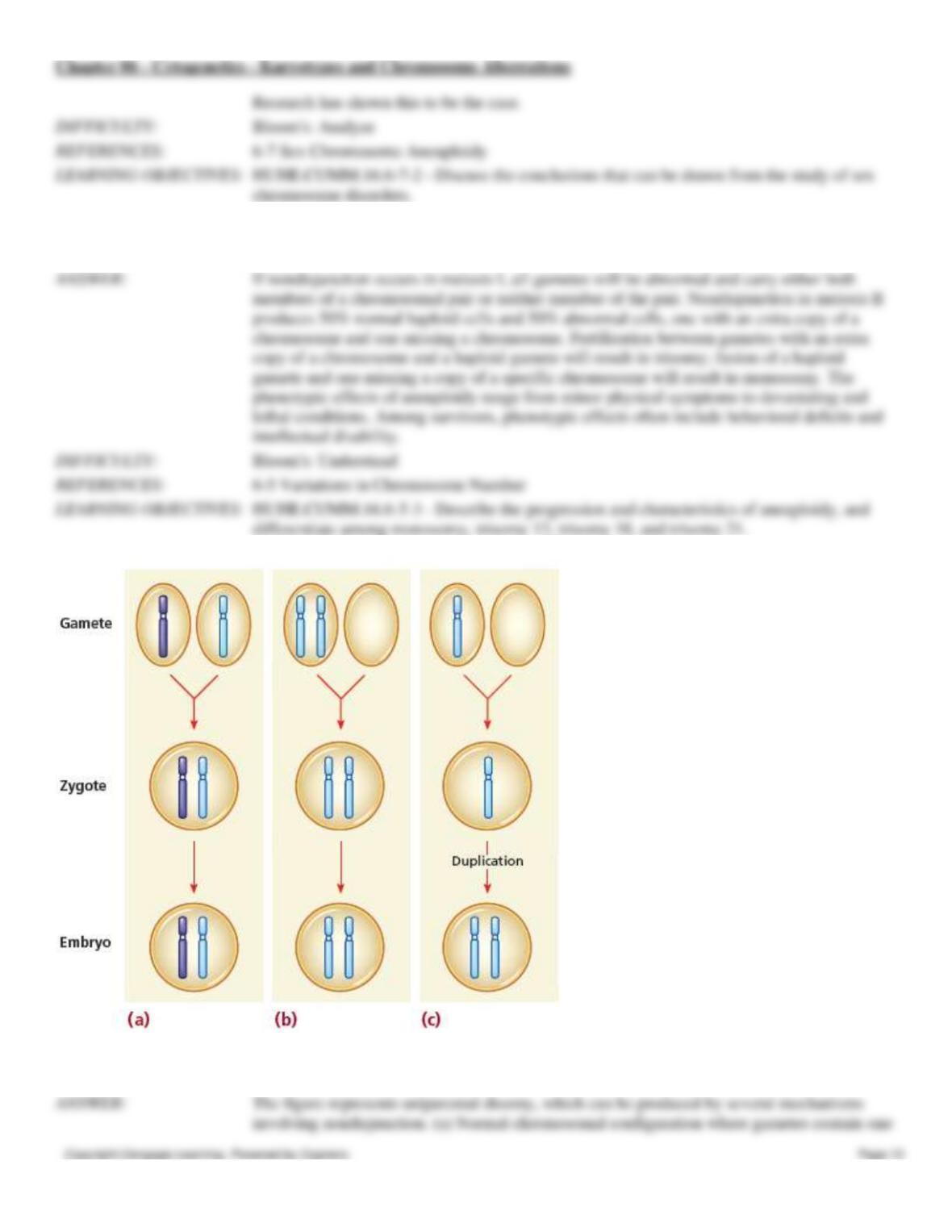
56. Describe normal embryo formation and two mechanisms of nondisjunction represented in the figure and identify the
consequences of these chromosomal anomalies.
57. Explain how the terms diploid and haploid relate to human chromosome number in both autosomes and sex cells.
58. Explain why geneticists believe that almost all chromosomally abnormal embryos and fetuses are eliminated as
pregnancy progresses.
59. List at least three types of information provided by a karyotype and interpret the chromosomal structural abnormality
written as 46,XX,t(18q).
60. Describe two processes that would result in a triploid zygote.