Exam
Name___________________________________
MULTIPLE CHOICE. Choose the one alternative that best completes the statement or answers the
question.
Factor.
1)
3x2+
11x – 20
1)
A)
(3x – 4)(x + 5)
B)
(3x – 5)(x + 4)
C)
(3x + 5)(x – 4)
D)
(3x + 4)(x – 5)
Factor completely. If unfactorable, indicate that the polynomial is prime.
2)
(a + b)x2–4(a + b)x –60(a + b)
2)
A)
(ax +6b)(ax –10b)
B)
(a +b)(x –6)(x +10)
C)
(a + b)(x +6)(x –10)
D)
prime
Solve the problem.
3)
3)
A machine produces open boxes using square sheets of plastic. The machine cuts equal–sized
squares measuring 3 inches on a side from each corner of the sheet, and then shapes the plastic
into an open box by turning up the sides. If each box must have a volume of 675 cubic inches,
find the length of one side of the open box.
A)
15 in.
B)
14 in.
C)
21 in.
D)
18 in.
Factor out the GCF from the polynomial.
4)
48m7– 108m5+ 60m2
4)
A)
12(4m7– 9m5+ 5m2)
B)
–m2(–48m5– 108m3– 60)
C)
m2(48m5– 108m3+ 60)
D)
12m2(4m5– 9m3+ 5)
5)
3x6y + 12x4
5)
A)
3x4y(x2+ 4)
B)
3x5( xy + 4x)
C)
3x4(x2y + 4)
D)
x4(3x2y + 12)
Factor the polynomial using the greatest common binomial factor.
6)
6)
x(x +13) –3(x +13)
A)
(x2+13x)(3x +39)
B)
(x +13)(x –3)
C)
(x –13)(x +3)
D)
(x +13)(x +3)
7)
7)
9x(x – y) + (x – y)
A)
9x(x – y)
B)
(x – y)(9x + 1)
C)
10x(a – y)
D)
(9x2+9y) + (x – y)
Factor completely using the grouping method to factor trinomials. If unfactorable, indicate that the polynomial is
prime.
8)
10y2+ 21y + 9
8)
A)
(2y + 3)(5y + 3)
B)
prime
C)
(10y + 3)(y + 3)
D)
(2y – 3)(5y – 3)
Factor.
9)
z2– 14z + 49
9)
A)
(z – 7)2
B)
(z – 7)(z + 7)
C)
(z – 14)(z + 14)
D)
(z + 7)2
Factor completely. If unfactorable, indicate that the polynomial is prime.
10)
r2– 2r +
1
10)
A)
(r – 1)2
B)
(r + 1)2
C)
(r – 2)(r + 2)
D)
(r + 1)(r – 1)
11)
25 –(x +
4y)2
11)
A)
(5 + x +4y)(5– x –4y)
B)
(5 +4xy)(5–4xy)
C)
(5 + x + y)(5– x – y)
D)
(5 + x –4y)(5– x –4y)
3
Factor out the GCF from the polynomial.
12)
60x9y8+ 72x6y5– 60x2y3
12)
A)
cannot be factored
B)
12x2y3(5x7y5+ 6x4y2– 5)
C)
12x2(5x7y8+ 6x4y5– 5y3)
D)
12(5x9y8+ 6x6y5– 5x2y3)
Factor completely. If unfactorable, indicate that the polynomial is prime.
13)
27k4t2–75k2t4
13)
A)
3(3k2t +5kt2)(3k2t –5kt2)
B)
3k2t2(3k +5t)(3k –5t)
C)
3k2t2(3k –5t)2
D)
3(3k2t +5kt2)2
Factor by grouping.
14)
x4–x3+4x – 4
14)
A)
(x3– 1)(x + 4)
B)
(x3+ 4)(4x – 1)
C)
(x3– 4)(x – 1)
D)
(x3+4)(x – 1)
Factor completely, or state that the polynomial is prime.
15)
36x2+ 49
15)
A)
(6x – 7)2
B)
(6x + 7)(6x – 7)
C)
(6x + 7)2
D)
prime
4
16)
5x2+
56x + 11
16)
A)
(5x – 1)(x – 11)
B)
(5x + 11)(x + 1)
C)
(5x + 1)(x + 11)
D)
prime
17)
x3+4x2+ x +4
17)
A)
(x2+ 1)(x +4)
B)
(4x2+4)(x +
1)
C)
(x2+4)(x + 1)
D)
(x2+ 1)(4x +4)
Solve the problem.
18)
18)
Express the combined areas of the three rectangles as the product of two binomials.
5x
8
Area =46x
square units 3x 2
A)
15x2+ 52
B)
(5x + 1)(3x + 16)
C)
(5x + 2)(3x + 8)
D)
(5x + 8)(3x + 2)
19)
19)
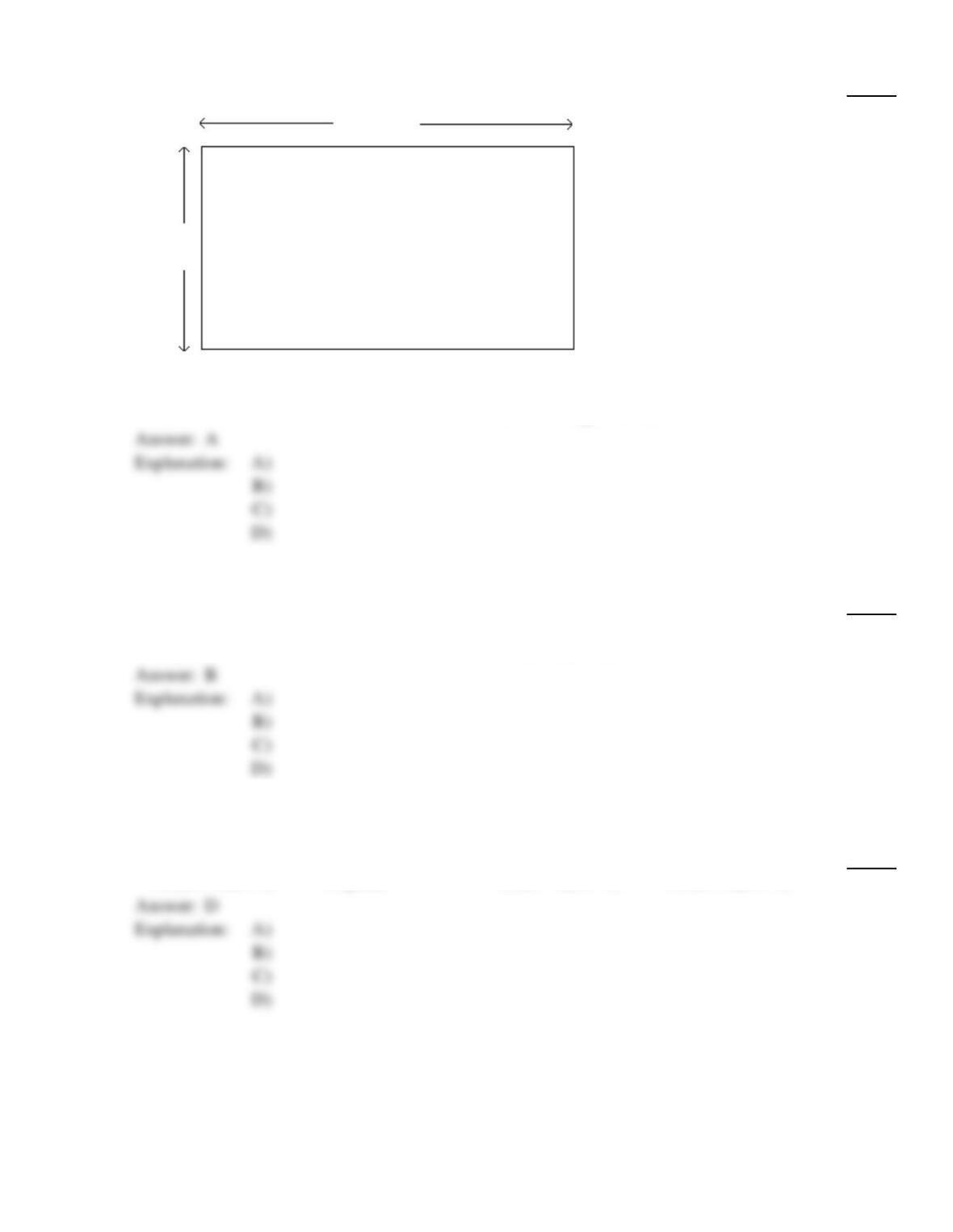
The length and area of the rectangle are given. Express the width as a binomial.
2x – 3
?Area of rectangle =6x2– 17x + 12
A)
3x – 4
B)
2x + 4
C)
3x – 3
D)
Not enough information.
Factor completely, or state that the polynomial is prime.
20)
4x2– 28xy + 40y2
20)
A)
4(x + 5y)(x + 2y)
B)
4(x – 5y)(x – 2y)
C)
prime
D)
4(x – 5)(x – 2)
Factor completely using the grouping method to factor trinomials. If unfactorable, indicate that the polynomial is
prime.
21)
20x2+ 27x + 9
21)
A)
(20x + 3)(x + 3)
B)
prime
C)
(4x – 3)(5x – 3)
D)
(4x + 3)(5x + 3)
6
Solve the equation.
22)
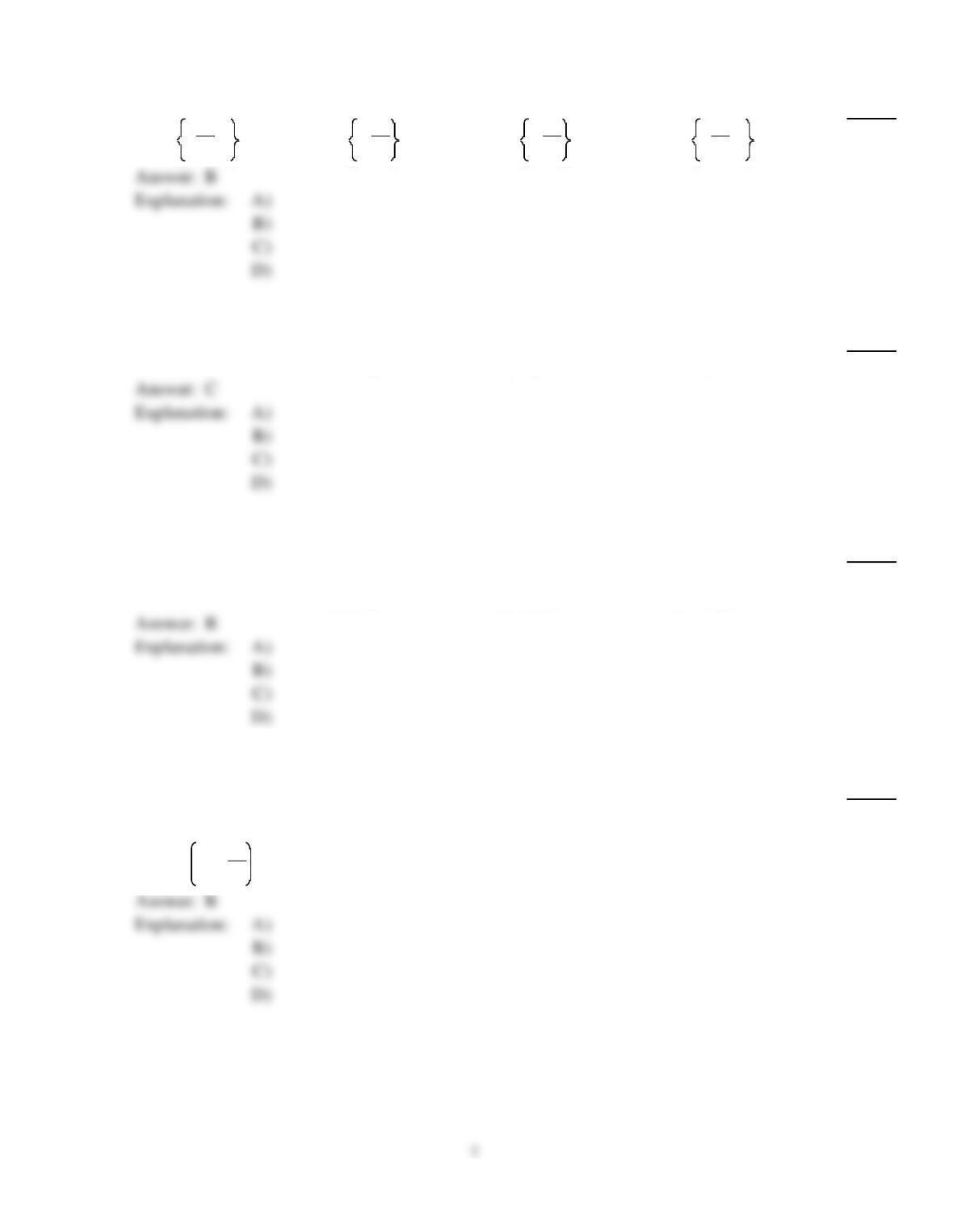
13x2– 7x = 0
22)
A)
–13
7, 0
B)
0, 7
13
C)
0, 13
7
D)
–7
13 , 0
Find the greatest common factor of the monomials.
23)
15y4, 135y7, and 225y5
23)
A)
2025y3
B)
135y4
C)
15y4
D)
15y3
Solve the problem.
24)
24)
A window washer accidentally drops a bucket from the top of a 400–foot building. The height h
of the bucket after t seconds is given by h = – 16t2+400. When will the bucket hit the ground?
A)
25 sec
B)
5 sec
C)
80 sec
D)
–5 sec
Factor out the GCF from the polynomial.
25)
17x4– 11
25)
A)
17(x4– 187)
B)
cannot be factored
C)
17 x4–11
17
D)
17(x4– 11)
26)
26)
20x +10
A)
5(4x +2)
B)
2(10x + 5)
C)
10(2x)
D)
10(2x + 1)
Solve the problem.
27)
27)
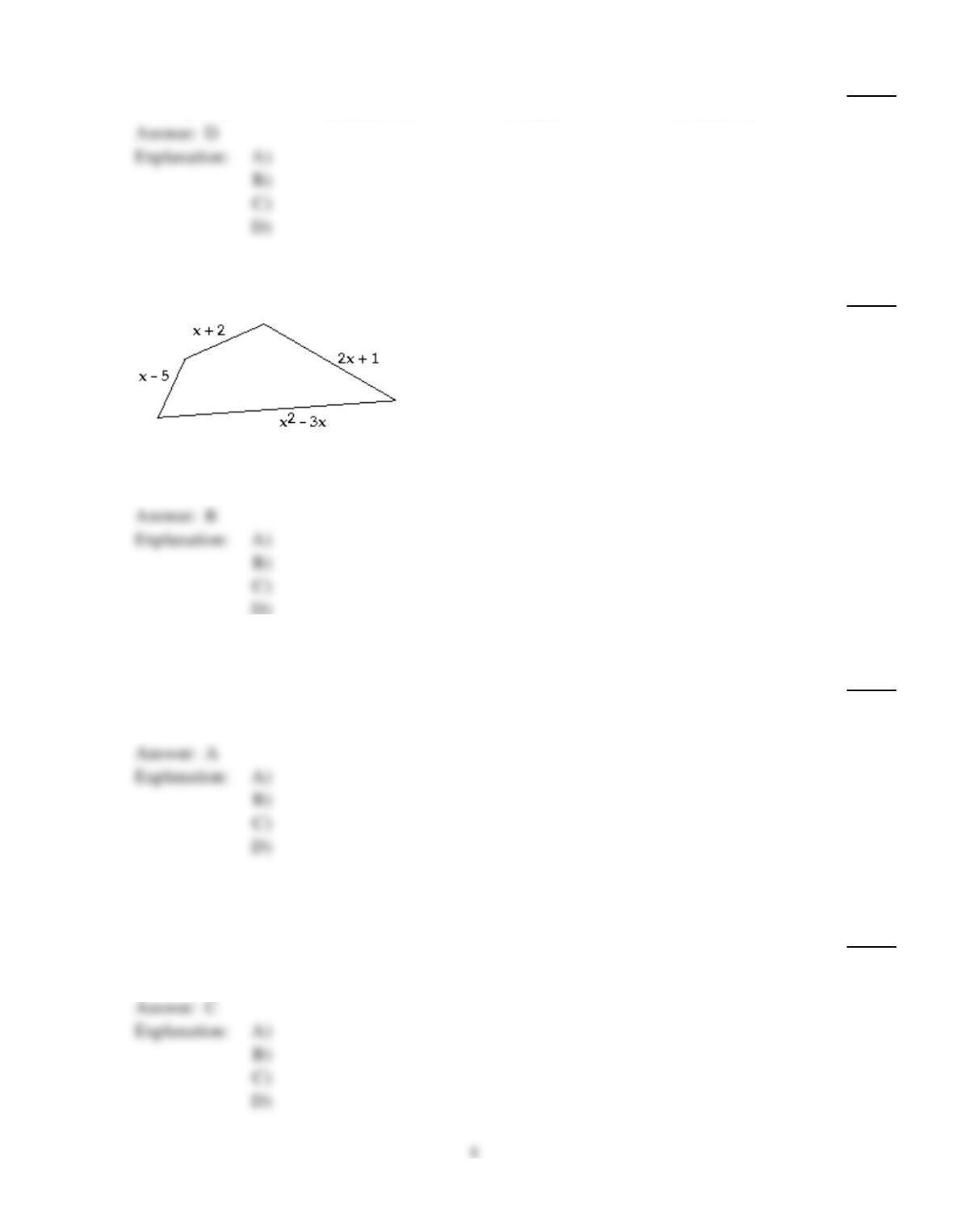
The perimeter of the quadrilateral is 88 inches. Find the lengths of the sides.
A)
12 in., 21 in., 70 in., 5 in.
B)
11 in., 19 in., 54 in., 4 in.
C)
10 in., 20 in., 54 in., 4 in.
D)
3 in., 3 in., –2 in., –4 in.
A)
D)
Factor out the GCF from the polynomial.
28)
18x9y9+ 63x7y7+ 54x5y5
28)
A)
9x5y5(2x4y4+ 7x2y2+ 6)
B)
9(2x9y9+ 7x7y7+ 6x5y5)
C)
–9x5y5(–2x4y4+ 7x2y2– 6)
D)
9x5(2x4y9+ 7x2y7+ 6y5)
A)
D)
Factor completely using the grouping method to factor trinomials. If unfactorable, indicate that the polynomial is
prime.
29)
6x2– 5xt – 4t2
29)
A)
prime
B)
(2x – t)(3x + 4t)
C)
(2x + t)(3x – 4t)
D)
(6x + t)(x – 4t)
A)
A)
D)
Factor completely using the trial and error method to factor trinomials. If unfactorable, indicate that the polynomial is
prime.
30)
24x2– 104x – 80
30)
A)
8(3x – 2)(x + 5)
B)
prime
C)
(24x + 16)(x – 5)
D)
8(3x + 2)(x – 5)
Factor completely. If unfactorable, indicate that the polynomial is prime.
31)
125x2+ 100xy + 20y2
31)
A)
5(5x – 2y)2
B)
5(5x + 2y)2
C)
5(25x2+ 20xy +4y2)
D)
5( x + 2y)(x – 2y )
32)
x2+16x +64 –25 y2
32)
A)
(x +8+5y)(x +8–5y)
B)
(x –8+5y)(x –8–5y)
C)
(x +5y)(x –5y)
D)
(x +16 +5y)(x +16 –5y)
33)
36k2– 49m2
33)
A)
(6k – 7m)2
B)
prime
C)
(6k + 7m)2
D)
(6k + 7m)(6k – 7m)
Factor out the GCF from the polynomial.
34)
64x8y9– 40x2y7+ 64x6y3
34)
A)
x2y3(64x6y6– 40y4+ 64x4)
B)
8x2y3(8x6y6– 5y4+ 8x4)
C)
8x2(8x6y9– 5y7+ 8x4y3)
D)
8(8x8y9– 5x2y7+ 8x6y3)
Factor completely. If unfactorable, indicate that the polynomial is prime.
35)
49x2– 70xy + 25y2
35)
A)
(7x – 5y)2
B)
(49x+ 1)(x + 25)
C)
(7x + 5y)2
D)
(7x – 5y)(7x + 5y)
Solve the equation.
36)
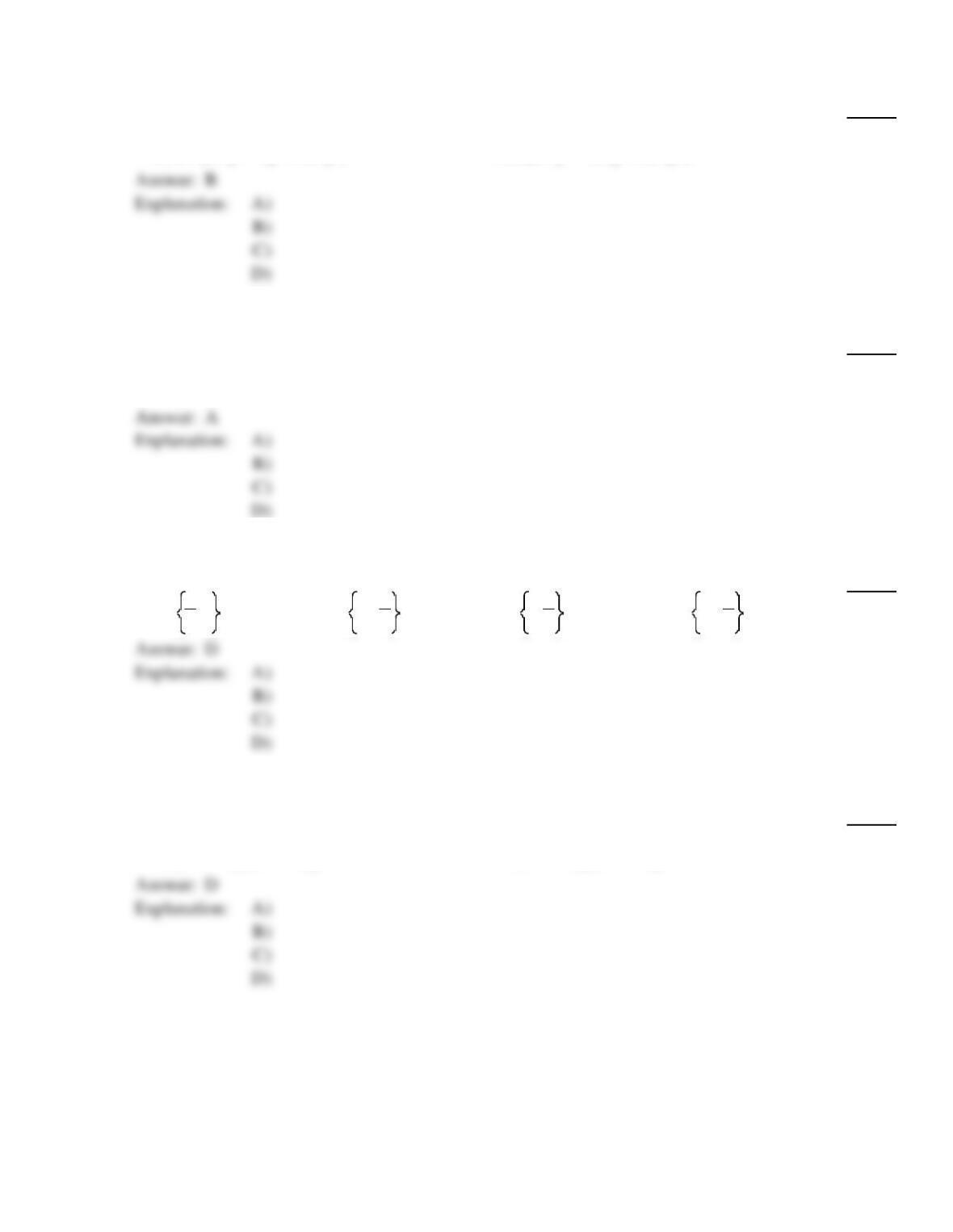
3x2– 4x – 7 = 0
36)
A)
3
7, 1
B)
–1, 3
7
C)
0, 3
7
D)
–1, 7
3
Factor completely. If unfactorable, indicate that the polynomial is prime.
37)
25 –(x +3y)2
37)
A)
(5 +3xy)(5–3xy)
B)
(5 + x + y)(5– x – y)
C)
(5 + x –3y)(5– x –3y)
D)
(5 + x +3y)(5– x –3y)
10
Solve the equation.
38)
3x2– 18x + 24 = 0
38)
A)
{0, 2, 4}
B)
{2, 4}
C)
{2, 3, 4}
D)
{–4, –2}
Factor completely.
39)
x2(y – 5) – 12x(y – 5) + 20(y – 5)
39)
A)
(x – 10)(x + 2)(y – 5)
B)
(x – 10)(x – 2)(y – 5)
C)
(x +10)(x – 2)(y – 5)
D)
(x +10)(x + 2)(y – 5)
Factor completely using the trial and error method to factor trinomials. If unfactorable, indicate that the polynomial is
prime.
40)
10y2+ 45y – 25
40)
A)
(10y – 5)(y + 5)
B)
5(2y + 1)(y – 5)
C)
prime
D)
5(2y – 1)(y + 5)
Factor completely, or state that the polynomial is prime.
41)
18y3+ 81y2– 45y
41)
A)
9y(2y – 1)(y + 5)
B)
prime
C)
y(18y – 9)(y + 5)
D)
9y(2y + 1)(y – 5)
11
Factor completely. If unfactorable, indicate that the polynomial is prime.
42)
4k3m – 36k2m2+ 81km3
42)
A)
km(2k + 9m)2
B)
prime
C)
km(2k – 9m)2
D)
km(2k – 9m)(2k + 9m)
Factor out the GCF from the polynomial.
43)
8m9– 18m5+ 10m2
43)
A)
2(4m9– 9m5+ 5m2)
B)
m2(8m7– 18m3+ 10)
C)
2m2(4m7– 9m3+ 5)
D)
–2m2(4m7+ 9m3– 5)
Factor completely. If unfactorable, indicate that the polynomial is prime.
44)
x2– 10x + 100
44)
A)
prime
B)
(x + 10)(x – 10)
C)
(x – 10)2
D)
(x + 10)2
Factor completely.
45)
5x6+
40x5– 45x4
45)
A)
5x4(x2+ 8x – 9)
B)
5x4(x – 1)(x + 9)
C)
x4(x – 1)(5x + 45)
D)
x4(5x – 5)(x + 9)
12
Factor completely. If unfactorable, indicate that the polynomial is prime.
46)
x2(x – 3) – 3x(x – 3) + 2(x – 3)
46)
A)
(x – 1)(x + 2)(x – 3)
B)
(x – 1)(x – 2)(x – 3)
C)
(x – 3)(x + 1)(x + 2)
D)
(x – 3)(x + 1)(x – 2)
Find the greatest common factor of the monomials.
47)
2x2 and 12
47)
A)
6
B)
2x2
C)
2
D)
2x
Solve the equation.
48)
x2–64 =63x
48)
A)
{–64, 1}
B)
{–1, 64}
C)
{–8}
D)
{–8, 8}
Factor completely.
49)
2x2– 2x – 12
49)
A)
2(x – 2)(x + 3)
B)
2(x + 2)(x – 3)
C)
(2x + 4)(x – 3)
D)
prime
Factor completely using the grouping method to factor trinomials. If unfactorable, indicate that the polynomial is
prime.
50)
6z2– 5z – 6
50)
A)
(6z + 2)(z – 3)
B)
(3z – 2)(2z + 3)
C)
prime
D)
(3z + 2)(2z – 3)
Factor completely using the trial and error method to factor trinomials. If unfactorable, indicate that the polynomial is
prime.
51)
3x2+
34x + 11
51)
A)
(3x – 1)(x – 11)
B)
(3x + 1)(x + 11)
C)
prime
D)
(3x + 11)(x + 1)
Factor completely, or state that the polynomial is prime.
52)
9x2– 4
52)
A)
(3x – 2)2
B)
prime
C)
(3x + 2)2
D)
(3x + 2)(3x – 2)
53)
x3–x2+5x – 5
53)
A)
(x – 1)(x + 1)(x + 5)
B)
(x2+5)(x – 1)
C)
(x2– 5)(x – 1)
D)
(x2+ 5)(5x – 1)
14