
Name:
Class:
Date:
Chapter 06: Consumer Choice and Demand
True / False
1. Different people may have different tastes, but their tastes normally do not change rapidly over time.
a. True
b. False
2. Marginal utility can be objectively measured and compared between one individual and another.
a. True
b. False
3. The law of diminishing marginal utility states that the marginal utility of my tenth pistachio is less than the marginal
utility of my third pistachio, other things constant.
a. True
b. False
4. The marginal utility of the fifth hot dog is less than the marginal utility of the second hot dog, other things constant.
a. True
b. False
5. As a consumer buys more of a good, the total utility from consumption of the good always increases at an increasing
rate.
a. True
b. False
6. If marginal utility is negative, total utility declines, but is not necessarily negative.
a. True
b. False
7. The marginal utility from an additional unit of a good is positive when consumption of an extra unit of the good causes
disutility.
a. True
b. False
8. Positive marginal utility implies increasing total utility.
a. True
b. False

Name:
Class:
Date:
Chapter 06: Consumer Choice and Demand
9. Demand curves usually slope downward because of the income and substitution effects of a price change of a good and
the law of diminishing marginal utility.
a. True
b. False
10. The fact that paper towels are available free of cost in a washroom suggests that the marginal utility of paper towels
diminishes to zero for each individual.
a. True
b. False
11. A free good will be consumed up to the point at which its marginal utility is positive.
a. True
b. False
12. A utility-maximizing consumer equalizes marginal utilities across all goods.
a. True
b. False
13. Consumers must understand the economist’s law of diminishing marginal utility in order to maximize their
satisfaction.
a. True
b. False
14. The law of diminishing marginal utility explains why an individual’s demand curve is elastic.
a. True
b. False
15. Suppose the marginal utility of a unit of good x = MUx, the marginal utility of a unit of good y = MUy, Px= price of a
unit of good x, and Py= price of a unit of a good y. If MUx/Px > MUy/Py, the consumer can increase utility by buying
more of good x.
a. True
b. False
16. Suppose the marginal utility of a unit of good x = MUx, the marginal utility of a unit of good y = MUy, Px= price of a
unit of good x, and Py= price of a unit of a good y. If MUx/Px > MUy/Py, the consumer should maintain his or her current
allocation of expenditures.
a. True
b. False
Name:
Class:
Date:
Chapter 06: Consumer Choice and Demand
17. Suppose the marginal utility of a unit of good x = MUx, the marginal utility of a unit of good y = MUy, Px= price of a
unit of good x, and Py= price of a unit of a good y. If MUx/Px > MUy/Py, the consumer should consume more of good x
and less of good y.
a. True
b. False
18. Joshua consumes pizza and cola in such a way that the marginal utility of per dollar spent on the last piece of pizza is
3 units and that of the last cola is 1.5 units. Thus, Joshua should spend more on pizza and less on cola in order to
maximize his utility.
a. True
b. False
19. The market demand curve is the sum of individual quantities demanded at each price.
a. True
b. False
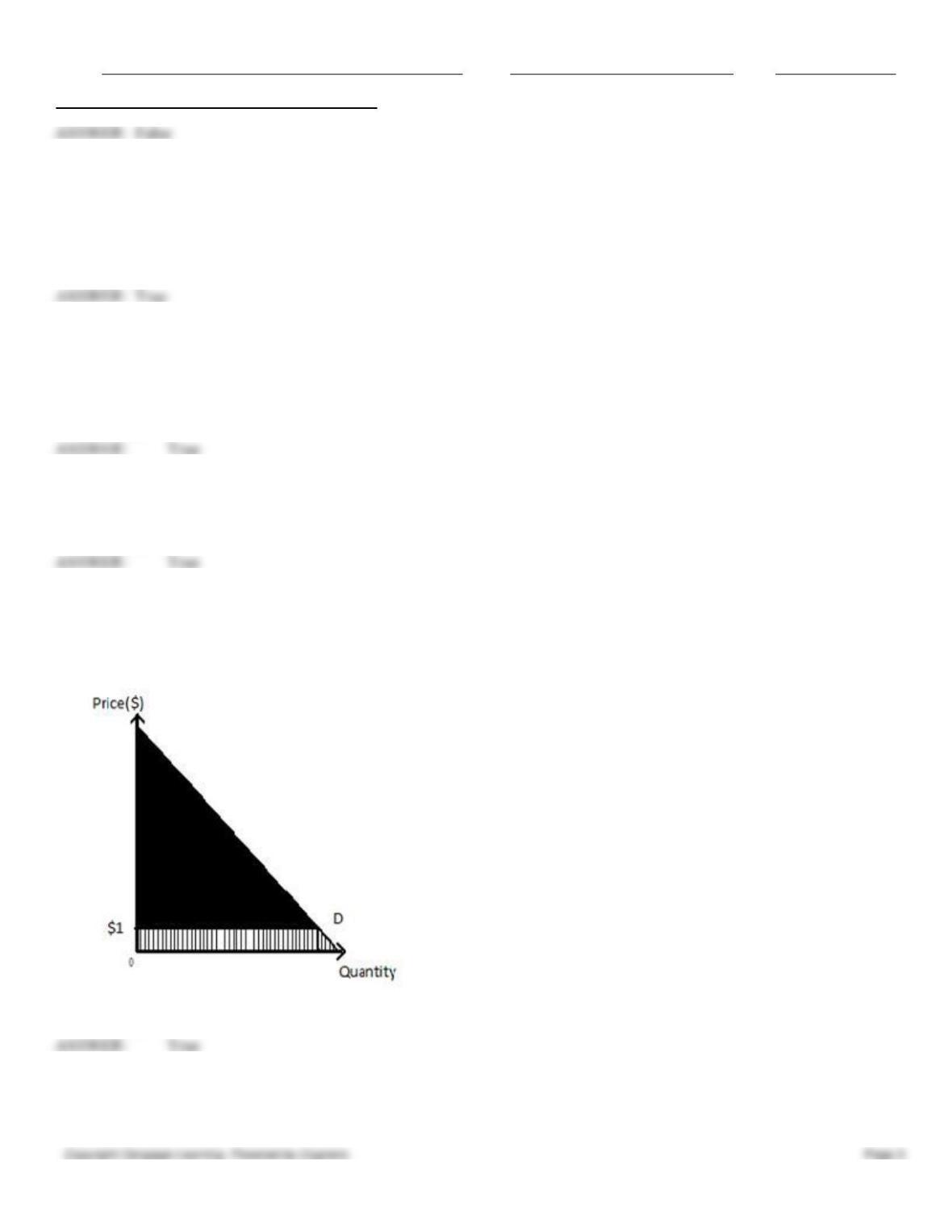
20. The following diagram shows the demand curve for medical benefits. A $1 payment for services would reduce
consumer surplus, yet would still leave beneficiaries with a substantial consumer surplus.
Figure 6.9
a. True
b. False
21. For any given price, the more elastic is the demand for a good, the greater will be the consumer surplus.
a. True

Name:
Class:
Date:
Chapter 06: Consumer Choice and Demand
b. False
22. The consumption of goods and services has both a money price and a time price.
a. True
b. False
23. Opportunity cost is measurable only when prices are known.
a. True
b. False
24. A business executive who buys a portable computer so that she can work while flying is trying to reduce the cost of
traveling.
a. True
b. False
25. Differences in the opportunity cost of time among consumers do not have any effect on consumption patterns.
a. True
Multiple Choice
26. Utility is:
a. easily measured because all people derive the same utility from consumption.
b. easily measured because it is an objective concept.
c. easily measured because it is a subjective concept.
d. hard to measure because it is a subjective concept.
e. hard to measure because it is an objective concept.
27. Which of the following is true of units of utility?
a. They evaluate the purchasing power of consumers.
b. They cannot be compared across consumers.
c. They apply to goods but not to services.
d. They do not exist for very wealthy individuals.
e. They are negative for inferior goods.
28. Which of the following statements is not true of consumer preferences?
a. Pat enjoys her second cotton candy less than her first.
b. Bill enjoys his third cotton candy less than his second.
c. Arnie enjoys two cotton candies more than one cotton candy.

Name:
Class:
Date:
Chapter 06: Consumer Choice and Demand
d. Arnie enjoys two cotton candies more than Pat enjoys one cotton candy.
e. Bill and Arnie enjoy their third cotton candies less than they do their first.
29. Which of the following statements is true of utility?
a. It is possible to precisely measure the utility an individual receives from consuming a particular good or service.
b. It is always possible to determine whether Darlene or Julie gets more utility from consuming two units of the
same good.
c. The utility of goods can be measured while that of services cannot.
d. Utility is a subjective measure of satisfaction an individual receives from consuming a good or service.
e. The concept of utility is useful only if there is no scarcity.
30. Consumer preferences:
a. do not vary from one consumer to another.
b. have little to do with personal tastes and income.
c. are not influenced by the utility derived from a particular good.
d. determine the utility derived from goods.
e. can be objectively measured and compared across individuals.
31. Utility is:
a. the sense of pleasure or satisfaction derived from consuming goods and services.
b. the addition to total satisfaction resulting from an additional unit of consumption.
c. the ratio of the units of a good consumed to its price.
d. objectively measured and compared across individuals.
e. the difference in the total satisfaction derived from the consumption of any two products.
32. Consumer tastes and preferences:
a. are determined solely by advertising.
b. are relatively stable over time.
c. do not vary from one consumer to another.
d. are irrelevant to utility analysis.
e. can be measured in terms of units of utility.
33. Utility is determined by _____.
a. consumer income
b. the prices of goods and services
c. consumer surplus of all buyers in the market
d. consumer expenditure
e. consumer tastes and preferences
34. Marginal utility is the:
a. overall satisfaction obtained from consuming a good.

Name:
Class:
Date:
Chapter 06: Consumer Choice and Demand
b. additional satisfaction obtained from consuming one more unit of a good.
c. average satisfaction obtained from consuming a good.
d. increase in satisfaction that results from consuming 1 percent less of a good.
e. additional cost of purchasing one more unit of a good.
35. Marginal utility is:
a. the total satisfaction derived from consuming a given amount of a product.
b. the addition to total satisfaction resulting from an additional unit of consumption.
c. the difference in the total satisfaction derived from the consumption of any two products.
d. the cost of consuming one more unit of a good.
e. the total satisfaction per unit of consumption.
36. Total utility is the:
a. sum of all marginal utilities.
b. price paid for one unit of a good.
c. product of all marginal utilities.
d. total expenditure on all units of a good the consumer buys.
e. difference between the marginal utilities of the first and second unit of a good consumed.
37. The law of diminishing marginal utility states that:
a. total utility falls as more of a good is consumed, other things constant.
b. total utility falls as marginal utility falls, other things constant.
c. marginal utility increases as total utility falls, other things constant.
d. marginal utility falls as more of a good is consumed, other things constant.
e. marginal utility falls as less of a good is consumed, other things constant.
38. According to the law of _____, the marginal utility received from each additional unit of a good consumed declines,
other things constant.
a. increasing marginal returns
b. marginal rate of substitution
c. supply
d. diminishing marginal utility
e. increasing marginal rate of substitution
39. Diminishing marginal utility means that:
a. as one consumes more of a good, other things constant, the total satisfaction obtained from consuming the good
tends to fall.
b. as one hires more labor, other things constant, the total amount of output produced begins to fall.
c. as one hires more units of labor, other things constant, the marginal product of labor begins to fall.
d. as one consumes more of a good, other things constant, the additional satisfaction obtained from each additional
unit of the good tends to fall.
e. as one consumes more of a good, other things constant, the extra satisfaction obtained from each extra good
becomes negative.

Name:
Class:
Date:
Chapter 06: Consumer Choice and Demand
40. Which of the following illustrates the law of diminishing marginal utility?
a. The marginal utility of Diane’s second Coke is greater than the marginal utility of her third pretzel, other things
constant.
b. The marginal utility of Diane’s second Coke is greater than the marginal utility of Ken’s third pretzel, other things
constant.
c. The marginal utility of Diane’s second Coke is greater than the marginal utility of her third Coke, other things
constant.
d. The total utility of one Coke is greater than the total utility of two Cokes, other things constant.
e. The marginal utility of Diane’s second Coke is greater than the marginal utility of Ken’s third Coke, other things
constant.
41. The law of diminishing marginal utility states that as one consumes more and more of a good, other things constant,
_____.
a. total utility keeps on increasing
b. marginal utility always stays positive
c. marginal utility approaches but never becomes zero
d. marginal utility keeps on increasing
e. marginal utility eventually declines
42. The marginal utility of a second copy of today’s New York Times is:
a. infinite.
b. practically zero.
c. positive and greater than the marginal utility of the first copy.
d. equal to the marginal utility of the first copy.
e. 50 cents.
43. The reason why Diana does not drink five cups of coffee at breakfast is that:
a. the marginal utility derived from the fifth cup of coffee is negative.
b. the marginal satisfaction derived from the fifth cup of coffee rises.
c. the total utility from the consumption of coffee rises as she consumes more coffee.
d. the total utility from the consumption of coffee becomes negative as she consumes more coffee.
e. the marginal satisfaction derived from all five cups of coffee is constant.
44. “The second glass of Evian water was very good. May I have another?” Which of the following is necessarily true
regarding this statement?
a. The marginal utility of the second glass of water was negative.
b. The marginal utility of the first glass of water was zero.
c. The marginal utility of the second glass of water was positive.
d. The water is available free of cost.
e. The marginal utility of the third glass of water will be negative.

Name:
Class:
Date:
Chapter 06: Consumer Choice and Demand
45. “I don’t feel so good; I shouldn’t have had that last doughnut.” Which of the following supports this statement?
a. The marginal utility of the last doughnut was positive.
b. The marginal utility of doughnuts is still increasing.
c. The total utility from eating doughnuts is negative.
d. The marginal utility of the last doughnut was negative.
e. The marginal utility of the next doughnut will be positive.
46. Carvel advertises a football-shaped ice cream cake for $7; you can buy a second one for only $4. What do they know
about consumer preferences?
a. Consumers would never buy a second ice cream cake.
b. Two cakes are worth less to the consumer than one.
c. Marginal utility of ice cream cakes diminishes.
d. Consumers only value the first cake at $4.
e. Consumers value all cakes they eat at $4.
47. Newspaper vending machines illustrate the publishers’ belief that the:
a. average utility of two identical papers is zero or less.
b. total utility from two identical newspapers is zero or less.
c. marginal utility of a second identical newspaper is zero or less.
d. marginal utility of a second identical newspaper is greater than the marginal utility of the first newspaper.
e. total utility from two identical newspapers is less than the total utility from the first newspaper.
48. Negative marginal utility implies that:
a. total utility is negative.
b. marginal utility increases as additional units of a good are consumed.
c. the price of a good increases as additional units are consumed.
d. the total revenue spent by a consumer on a good decreases as more of the good is purchased.
e. total utility decreases as additional units of a good are consumed.
49. When total utility falls, marginal utility is _____.
a. at its maximum
b. infinite
c. positive
d. negative
e. zero
50. The following table shows the marginal utility of each additional unit of pretzel for a consumer. The first column of
the table shows the number of pretzels consumed in a day, and the second column of the table shows the marginal utility
of each additional unit of pretzel. The marginal utility of the third pretzel is _____ units.
Table 6.1

Name:
Class:
Date:
Chapter 06: Consumer Choice and Demand
Pretzels Marginal Utility
1 30
2 20
3 5
4 −15
a. 5
b. 10
c. 15
d. −0.15
e. 55
51. The following table shows the marginal utility of each additional unit of pretzel for a consumer. The first column of
the table shows the number of pretzels consumed in a day, and the second column of the table shows the marginal utility
of each additional unit of pretzel. The total utility derived from the consumption of three pretzels is _____ units.
Table 6.1
Pretzels Marginal Utility
1 30
2 20
3 5
4 −15
a. 5
b. 15
c. 40
d. 55
e. 70
52. The following table shows the total utility derived from consumption of a good. The first column of the table shows
the number of units of the good consumed in a day, and the second column of the table shows the total utility derived
from that consumption. The marginal utility of an additional unit of the good diminishes after consumption of the _____
unit of the good.
Table 6.2
Units consumed Total Utility
0 0
1 30
2 65
3 85
4 89
5 88
a. first
b. second
c. third
d. fourth
e. fifth

Name:
Class:
Date:
Chapter 06: Consumer Choice and Demand
53. If marginal utility is positive, then total utility is:
a. constant
b. negative
c. increasing
d. decreasing
e. zero
54. The following table shows the total utility and marginal utility derived from the consumption of scones. The first
column of the table represents the number of scones a consumer consumes in a day. The second column of the table
presents the total utility derived from that consumption, and the third column shows the marginal utility of each additional
scone. The total utility derived from the consumption of three scones is _____ units.
Table 6.3
Scones Total utility Marginal utility
1 10 –
2 18 –
3 24 6
4 28 –
5 30 2
a. 34
b. 6
c. 22
d. 12
e. 24
55. The following table shows the total utility and marginal utility derived from the consumption of scones. The first
column of the table represents the number of scones a consumer consumes in a day. The second column of the table
presents the total utility derived from that consumption, and the third column shows the marginal utility of each additional
scones. The marginal utility of the second scone is _____ units.
Table 6.3
Scones Total utility Marginal utility
1 10 –
2 18 –
3 24 6
4 28 –
5 30 2
a. 12
b. 9
c. 8
d. 19
e. 6
56. The following table shows the total utility and marginal utility derived from the consumption of scones. The first
column of the table represents the number of scones a consumer consumes in a day. The second column of the table

Name:
Class:
Date:
Chapter 06: Consumer Choice and Demand
presents the total utility derived from that consumption, and the third column shows the marginal utility of each additional
scone. The marginal utility of the fourth scone is _____ units.
Table 6.3
Scones Total utility Marginal utility
1 10 –
2 18 –
3 24 6
4 28 –
5 30 2
a. 4
b. 7
c. 6
d. 24
e. 2
57. The following table shows the total utility and marginal utility derived from the consumption of scones. The first
column of the table represents the number of scones a consumer consumes in a day. The second column of the table
presents the total utility derived from that consumption, and the third column shows the marginal utility of each additional
scone. The total utility derived from the consumption of five scones is _____ units.
Table 6.3
Scones Total utility Marginal utility
1 10 –
2 18 –
3 24 6
4 28 –
5 30 2
a. 82
b. 30
c. 34
d. 27
e. 2
58. The following table shows the total utility and marginal utility derived from the consumption of scones. The first
column of the table represents the number of scones a consumer consumes in a day. The second column of the table
presents the total utility derived from that consumption, and the third column shows the marginal utility of each additional
scone. The marginal utility of the first scone is _____ units.
Table 6.3
Scones Total utility Marginal utility
1 10 –
2 18 –
3 24 6
4 28 –
5 30 2
a. 0
Name:
Class:
Date:
Chapter 06: Consumer Choice and Demand
b. 2
c. 8
d. 9
e. 10
59. The following table shows the total utility and marginal utility derived from the consumption of plums. The first
column of the table represents the number of plums a consumer consumes in a day and the second column of the table
presents the total utility derived from that consumption. The marginal utility of the third plum is:
Table 6.4
Plums Total Utility
0 0
1 10
2 18
3 24
4 28
5 30
a. 4 units.
b. 6 units.
c. 8 units.
d. 9 units.
e. 24 units.
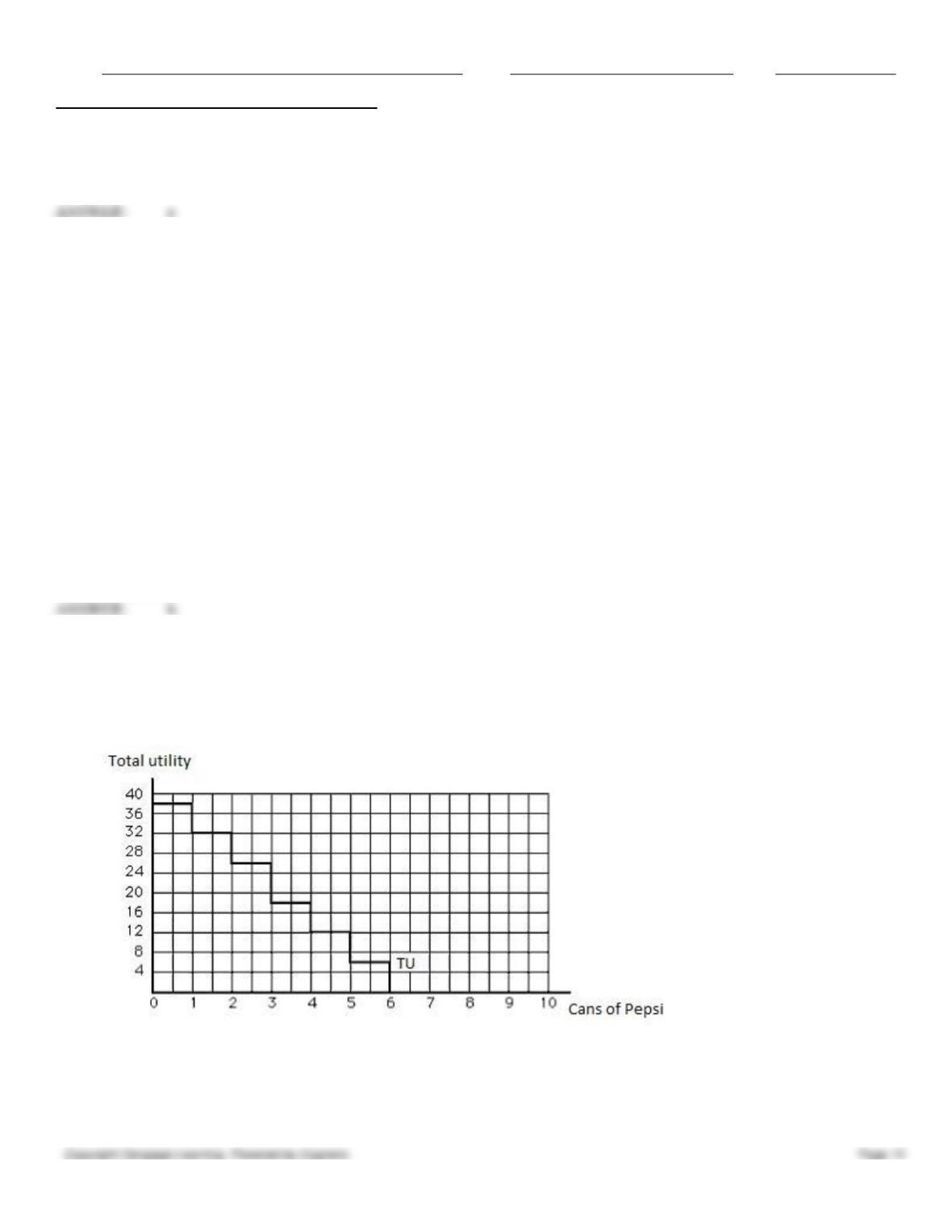
60. The following graph shows the total utility (TU) derived by a consumer from the consumption of Pepsi. Which of the
following is true of the total utility derived from the consumption of four cans of Pepsi?
Figure 6.1
a. A fourth can of Pepsi increases total utility by 12 units.
b. A fourth can of Pepsi increases total utility by 18 units.
c. A fourth can of Pepsi increases total utility by 20 units.
d. All four cans of Pepsi together yield a total utility of 114 units.
Name:
Class:
Date:
Chapter 06: Consumer Choice and Demand
e. All four cans of Pepsi together yield a total utility of 322 units.
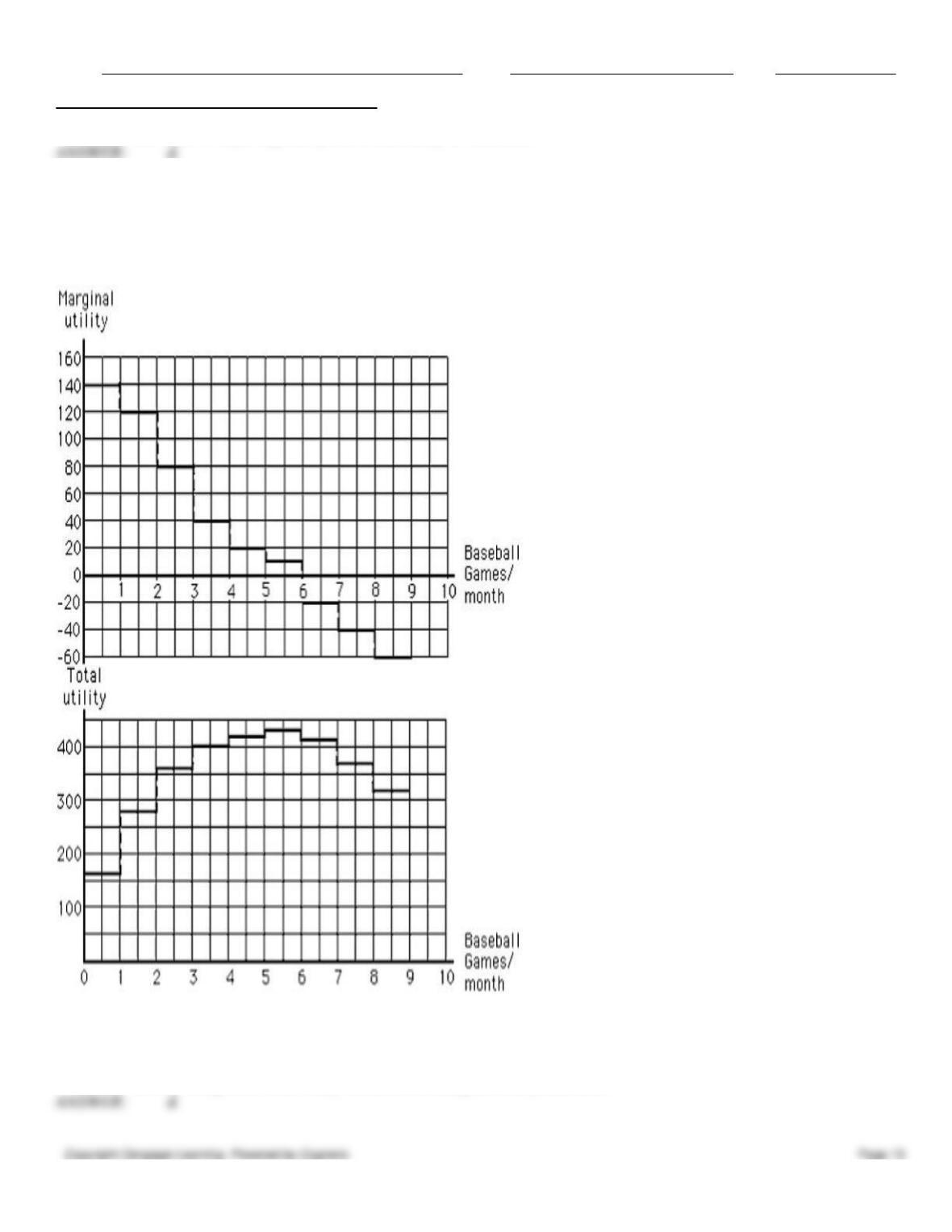
61. The following graph shows the marginal utility derived by a consumer from watching an additional baseball game
every month. Which of the following is true of the total and marginal utilities derived from watching the baseball games?
Figure 6.2
a. For all the ten games, total utility decreases as marginal utility decreases.
b. For all the ten games, total utility increases as marginal utility increases.
c. For the last four games, both total and marginal utility increases.
d. For the first six games, total utility increases as marginal utility decreases.
e. For the first six games, total utility decreases as marginal utility increases.

Name:
Class:
Date:
Chapter 06: Consumer Choice and Demand
62. If a good is offered free of charge, one would:
a. never stop consuming it.
b. stop consuming it when its marginal utility begins to fall.
c. stop consuming it when its marginal utility begins to increase.
d. stop consuming it when its marginal utility has declined to zero.
e. never consume it because it has no market value.
63. A consumer’s utility is maximized when the marginal utilities derived from additional units of goods:
a. are less than their market prices.
b. are equal to the total utilities derived from the consumption.
c. are maximized.
d. are equal to the opportunity costs of producing additional units of goods.
e. are exactly proportional to their market prices.
64. Which of the following is true when the price of a good is zero?
a. A consumer will consume additional units of the good as long as total utility derived from consumption is
positive.
b. A consumer will consume an infinite quantity of the good as the good is available free of cost.
c. A consumer will consume additional units of the good as long as marginal utility is positive.
d. A consumer will consume the entire amount of the good available in the market.
e. A consumer will consume until total utility derived from consumption becomes zero.
65. Suppose John goes to a wedding reception where free drinks are served. He will drink until the marginal utility of an
additional drink is _____.
a. infinite
b. zero
c. one
d. less than zero
e. greater than one
66. If Dalene’s marginal benefit from consuming another cookie is greater than the price of the cookie, then _____.
a. Dalene will not purchase any more cookies as the opportunity cost of purchasing another cookie will be more than
its price
b. Dalene will purchase more cookies as her total utility is zero
c. Dalene will purchase more cookies as her marginal utility will decrease with the additional purchase
d. Dalene will purchase more cookies as her marginal utility will increase with the additional purchase
e. Dalene will not purchase any more cookies as a reallocation of her budget will decrease her utility
67. Suppose Enid could increase her total utility by purchasing one more book and one less DVD. Which of the following
is true?
a. The marginal utility of an additional DVD exceeds the marginal utility of an additional book.
b. The marginal utility of an additional book exceeds the marginal utility of an additional DVD.
c. The marginal utility of an additional DVD is negative.

Name:
Class:
Date:
Chapter 06: Consumer Choice and Demand
d. The marginal utility of per dollar spent on books exceeds that of DVDs.
e. The marginal utility of per dollar spent on books equals that of DVDs.
68. As long as scarcity exists, _____.
a. product prices play no role in consumers’ utility maximization
b. income plays no role in consumers’ utility maximization
c. income and product prices should both be considered for consumers’ utility maximization
d. consumers maximize utility by consuming all products until the marginal utilities of additional amounts is zero
e. consumers would increase consumption of all products as long as total utility is positive
69. According to the utility theory, in “consumer equilibrium,” households have:
a. consumed as much of every commodity as they would like.
b. spent their incomes in such a way that their overall satisfaction is maximized.
c. spent their incomes in such a way that their marginal utility is maximized.
d. spent their incomes in such a way that their marginal utility is zero for every product consumed.
e. spent their incomes in such a way that their total utility is zero.
70. Annie reallocates her budget until the ratios of marginal utilities of goods equal the ratios of their prices. Which of the
following is true of Annie’s behavior?
a. She ensures that her expected marginal utilities from goods are equal to zero.
b. She ensures that her marginal utility from each good is less than that good’s marginal cost.
c. She maximizes her total utility derived from the consumption of goods.
d. She adjusts her baskets of goods until marginal utilities of all goods become negative.
e. She maximizes her marginal utilities from goods and minimizes her disutility from consumption.
71. As a consumer allocates income between good A and good B, total utility is maximized when:
a. marginal utility of A = marginal utility of B
b. marginal utility of A = marginal utility of B = 0
c. price of A = price of B
d. marginal utility of A/price of A = marginal utility of B/price of B = 0
e. marginal utility of A/price of A = marginal utility of B/price of B
72. Suppose Jason’s marginal utility of the $50-per-serving caviar is 100 units and that of the $1-per-serving popcorn is
10 units. Which of the following combinations of snacks would he prefer to buy?
a. If he has $49, then he will buy one serving of caviar and zero servings of popcorn.
b. If he has $53, he will buy one serving of caviar and two servings of popcorn.
c. Irrespective of the amount of money he has, he will always buy popcorn.
d. If he has $50, then he will buy one serving each of the caviar and popcorn.
e. Irrespective of the amount of money he has, he will always buy caviar.

Name:
Class:
Date:
Chapter 06: Consumer Choice and Demand
73. If Jennie spends her income on ice cream and biscuits and the price of ice cream is three times the price of biscuits,
then:
a. she maximizes her utility by buying equal quantities of ice cream and biscuits.
b. she maximizes her utility by buying three times as much ice cream as biscuits.
c. she maximizes her utility by buying three times as many biscuits as ice cream.
d. she buys biscuits and ice cream until the marginal utility of ice cream is three times the marginal utility of
biscuits.
e. she buys biscuits and ice cream until the marginal utility of biscuits is three times the marginal utility of ice
cream.
74. Suppose Annie allocates her income between calzones and juices and that she has not yet spent her entire income. If
the marginal utility of a fourth calzone is 100 units and the marginal utility of a third glass of juice is 50 units, she will:
a. eat the fourth calzone as one unit of a calzone has a higher marginal utility than a glass of juice.
b. drink the third glass of juice because she had only two glasses of juice.
c. consider the total utility derived from the consumption of three calzones and two glasses of juice before deciding
what to consume next.
d. consider the relative prices of calzones and juices before deciding what to consume next.
e. consider whether her marginal utilities are diminishing or not before deciding what to consume next.
75. Suppose the marginal utility of a unit of good x = MUx, the marginal utility of a unit of good y = MUy, Px= price of a
unit of good x, and Py= price of a unit of a good y. A utility-maximizing consumer who purchases two goods, x and y,
allocates her budget in such a way that _____.
a. MUx = MUy
b. TUx = TUy
c. MUx/Py = MUy/Px
d. TUx/Py = TUy/Px
e. MUx/Px = MUy/Py
76. The following table shows John’s total utility derived from billiards and bowling games. Assume John has $30 to
spend on a game of billiards and/or a game of bowling. A game of billiards costs him $4, and a game of bowling costs
him $2. Which of the following is John’s utility-maximizing combination of the games of billiards and the games of
bowling?
Table 6.5
Quantity Total Utility
Games of billiards Games of bowling
0 0 0
1 100 70
2 180 130
3 240 180
4 272 210
5 288 218
6 292 222

Name:
Class:
Date:
Chapter 06: Consumer Choice and Demand
a. Four games of billiards and four games of bowling
b. Five games of billiards and two games of bowling
c. Three games of billiards and eight games of bowling
d. Five games of billiards and five games of bowling
e. Twelve games of bowling
77. Suppose Sally allocates her budget between two goods, A and B. She spends her entire income on a combination of A
and B, for which the ratio of marginal utility of good A to its price exceeds the ratio of marginal utility of good B to its
price. She can increase her total utility by buying:
a. more A and less B.
b. more B and less A.
c. more A without changing her consumption of B.
d. less B without changing her consumption of A.
e. more B and more A.
78. Suppose Shawn dines at a restaurant that serves clams at a fixed price and crab legs at a varied, market-determined
price. The marginal utility of an order of crab legs is 100 units, and the marginal utility of an order of clams is 50 units.
Shawn orders crab legs in one week but he orders clams in the next week. This means that in the second week:
a. the price of crab legs has increased three times more than that of clams.
b. the price of clams has dropped three times less than that of clams.
c. the price of clams has dropped four times less than that of clams.
d. the price of clams has increased four times more than that of clams.
e. the price of crab legs has increased more than twice that of clams.
79. Mark’s marginal utility of a third waffle is 10 units and marginal utility of a second slice of ham is 30 units. If Mark
eats the third waffle, which of the following statements is true?
a. The price of a waffle is five times more than the price of a slice of ham.
b. The price of a waffle is less than one-fourth the price of a slice of ham.
c. The price of a waffle is less than one-third the price of a slice of ham.
d. The price of a waffle is four times more than the price of a slice of ham.
e. The price of a waffle is three times more than the price of a slice of ham.
80. Fernando allocates his lunch money between pizza and Coke. A slice of pizza costs $1.50 and a can of Coke costs $1.
The marginal utility of the last slice of pizza Fernando ate that day was 30 units, and the marginal utility of the last can of
Coke was 25 units. If Fernando decides to spend all of his lunch money, then identify the correct statement.
a. Fernando allocates his money so as to maximize his total utility.
b. Fernando’s total utility would have been greater if he had purchased more Coke and less pizza.
c. Fernando’s total utility would have been greater if he had purchased more pizza and less Coke.
d. Fernando could have increased his total utility by purchasing more Coke and the same quantity of pizza.
e. Fernando could have increased his total utility by purchasing more pizza and the same quantity of Coke.
81. The following table indicates Sharona’s marginal utilities from the additional consumption of goods A and B. The first
and third columns of the table show the quantities of goods A and B consumed. The second and the fourth columns show

Name:
Class:
Date:
Chapter 06: Consumer Choice and Demand
Sharona’s marginal utilities from each additional unit of goods A and B consumed. The price of A is $2 per unit and the
price of B is $4 per unit. If Sharona’s budget is $12, then which of the following combinations would maximize her total
utility?
Table 6.6
QA MUA QB MUB
1 24 1 48
2 22 2 44
3 18 3 36
4 12 4 24
a. 0 units of A; 3 units of B
b. 4 units of A; 1 unit of B
c. 4 units of each good
d. 1 unit of A; 4 units of B
e. 2 units of each good
82. Which of the following is an example of diminishing marginal utility?
a. A person buying additional goods after getting a pay raise
b. A person eating more Twinkies but enjoying each successive Twinkie less than the previous one
c. A person giving some of his income to a needy person
d. A person who spends more hours studying than his fellow students
e. A person buying goods as long as their marginal utility is greater than zero
83. Dale spends his entire budget in such a way that the marginal utility per dollar spent on each good is identical. Which
of the following is true?
a. His marginal utility will be zero if he reallocates his income.
b. He can increase his utility if he reallocates his income.
c. He will reduce his utility if he reallocates his income.
d. He will minimize his marginal utility if he reallocates his income.
e. He will maximize his marginal utility if he reallocates his income.
84. If total utility can be increased by purchasing a little more milk and a little less ice cream, the:
a. marginal utility of milk is greater than that of ice cream
b. marginal utility of ice cream is greater than that of milk
c. ratio of marginal utility of milk to its price is greater than that of ice cream
d. ratio of marginal utility of milk to its price is lesser than that of ice cream
e. marginal utility of ice cream is negative
85. Arnold is a utility-maximizing consumer. If he thinks his last dollar spent on playing golf yields less satisfaction than
the last dollar spent on movies, he should:
a. play more golf so that the total satisfaction derived from golf increases.
b. spend less on movies so that the marginal satisfaction of a movie increases.
c. play less golf and spend more on movies.
d. not play golf at all.