ch06.doc Page 1
Chapter 6
Accounting for Capital Projects and Debt Service
TRUE/FALSE (CHAPTER 6)
1. The resources to service all general long-term debt of governments are typically accounted
for in debt service funds.
2. When governments establish capital projects funds, they may choose to maintain a separate
fund for each major project, or they may choose to combine two or more projects in a single
fund.
3. Governments are required to integrate budgetary account information in their debt service
and capital projects funds only when control cannot readily be established by means other
than a budget.
4. Capital projects funds do not report long-term obligations in the fund.
5. When bonds are issued at a premium, the capital projects fund can transfer those excess
resources to the debt service fund.
6. When bonds are issued at a discount, the debt service fund usually transfers an amount to the
capital projects fund to make up for the deficiency.
7. In accounting for costs incurred on a major construction project in a capital projects fund, the
construction outlays would be reported in the fund as general capital assets.
8. Debt service funds are maintained to account for resources accumulated to pay interest and
principal on general long-term debt—that is, long-term debt associated primarily with
governmental activities.
9. In contrast to the accounting for debt service fund expenditures, the interest revenue on bonds
held as investments should be accrued in the period the revenue is earned.
10. Special assessments are imposed nonexchange transactions, similar to property tax levies.
11. The interest paid on debt issued for public purposes by state and local governments is
generally subject to federal taxation.
12. Nongovernmental not-for-profits must account for defeasances differently than governments
do.
13. In the statement of revenues, expenditures, and changes in fund balance of a debt service
fund, the fund balance amount should be reported as restricted for debt service.
14. Governments should account for special assessment debt service transactions in a debt
service fund, even if they are not obligated to pay the debt.
ch06.doc Page 2
15. Arbitrage is the process of negotiating resolution of conflicts between the federal government
and municipalities over the applicability of federal regulations.
16. Sound fiscal policy dictates that the maturity of debt should be no longer than the life of the
assets it is used to finance.
17. Proceeds of debt issued to finance a capital project should be reported in a capital projects
fund as a liability until the project is completed.
18. Special assessment debt to be paid from a water utility fund should be accounted for in that
fund along with the related capital improvements.
ch06.doc Page 3
MULTIPLE CHOICE (CHAPTER 6)
1. The capital projects fund of a government is accounted for using which of the following bases
of accounting?
a) Budgetary basis.
b) Cash basis.
c) Modified accrual basis.
d) Accrual basis.
2. In which fund type would a government’s capital projects fund be found?
a) Governmental fund type.
b) Proprietary fund type.
c) Fiduciary fund type.
d) Governmental activities.
3. The debt service fund of a government is accounted for using which of the following bases of
accounting?
a) Budgetary basis.
b) Cash basis.
c) Modified accrual basis.
d) Accrual basis.
4. In which fund type would a government’s debt service fund be found?
a) Governmental fund type.
b) Proprietary fund type.
c) Fiduciary fund type.
d) Governmental activities.
5. With regard to the resources dedicated to the acquisition of capital assets that will be used in
general government activities, which of the following is true?
a) Governments must maintain capital projects funds for resources that are legally restricted
to the acquisition of capital assets.
b) Governments may maintain capital projects funds for resources that are legally restricted
to the acquisition of capital assets.
c) Governments may account for any resources dedicated (whether legally or not) to the
acquisition of capital assets in any of the governmental funds.
d) Governments must account for all resources set aside for capital asset acquisition in a
capital projects fund.
6. Salt City issued $5 billion of bonds at face value to fund the reconstruction of major interstate
highways in and around the city. The bond underwriters withheld $2 million for underwriting
fees and remitted the balance to the city. Assuming the city maintains its books and records
in a manner that facilitates the preparation of fund financial statements, how should the
underwriting fee be recorded in the capital projects fund?
a) Reduce other financing sources by $2 million.
b) Reduce bonds payable by $2 million.
c) Increase expenditures by $2 million.
d) It would not be accounted for in the capital projects fund.
ch06.doc Page 4
7. Sugar City issued $2 million of bonds to fund the construction of a new city office building.
The bonds have a stated rate of interest of 5 percent and were sold at 101. Which of the
following entries should be made in the capital projects fund to record this event?
a) Debit Cash $2.02 million; Credit Bonds payable $2 million and Premium on bonds
payable $0.02 million.
b) Debit Cash $2.02 million; Credit Bonds payable $2 million and Other financing sources
$0.02 million.
c) Debit Cash $2.02 million; Credit Other financing sources $2.02 million.
d) Debit Cash $2.02 million; Credit Other financing sources $2 million and Revenue $0.02
million.
Use the following information to answer questions 8 and 9
Voters in Lincoln School District approved the construction of a new high school and approved
an $8 million bond issue with a stated rate of interest of 6 percent to fund the construction. Bids
were received and the low bid was $8 million. When the bonds were issued, they sold for face
value less bond underwriting fees of $0.5 million. The school board voted to fund the balance of
the construction by a transfer from the general fund.
8. The entry in the capital projects fund to record the receipt of the bond proceeds should be
a) Debit Cash $7.5 million; Credit Bonds payable $7.5.
b) Debit Cash $7.5 million; Credit Other financing sources $7.5.
c) Debit Cash $7.5 million and Expenditures $0.5 million; Credit Bonds payable $8 million.
d) Debit Cash $7.5 million and Expenditures $0.5 million; Credit Other financing sources
$8 million.
9. The entry in the capital projects fund to record the additional funding for the construction
should be
a) Debit Due from general fund $0.5 million; Credit Other financing sources—
nonreciprocal transfer-in $0.5 million.
b) Debit Due from general fund $0.5 million; Credit Revenue $0.5 million.
c) Debit Cash $0.5 million; Credit Due to general fund $0.5 million.
d) Debit Other financing sources $0.5 million; Credit Due to general fund $0.5 million.
Use the following information to answer questions 10 and 11
Voters in Phillips City approved the construction of a new city hall building and approved a $5
million bond issue with a stated rate of interest of 6 percent to fund the construction. When the
bonds were issued, they sold for 101. What are appropriate entries related to the premium?
10. In the capital projects fund
a) Debit Cash $50,000; Credit Revenues $50,000; no other entries required.
b) Debit Cash $50,000; Credit Other financing sources—nonreciprocal transfer-in $50,000;
no other entries required.
c) Debit Cash $50,000; Credit Revenues; ALSO
Debit Other financing uses—nonreciprocal transfer-out $50,000; Credit Cash $50,000.
d) Debit Cash $50,000; Credit Other financing sources—Bond premium $50,000; ALSO
Debit Other financing uses—nonreciprocal transfer-out $50,000; Credit Cash $50,000.
ch06.doc Page 5
11. In the debt service fund
a) Debit Cash $50,000; Credit Revenues $50,000; no other entries required.
b) Debit Cash $50,000; Credit Other financing sources—nonreciprocal transfer-in $50,000;
no other entries required.
c) Debit Other financing sources—nonreciprocal transfer-out $50,000; credit Cash $50,000.
d) No entry in the debt service fund.
Use the following information to answer question 12 and 13.
The voters in Ohio City approved the construction of a new city hall building and approved a $10
million bond issue with a stated rate of interest of 6 percent to fund the construction. When the
bonds were issued, they sold for 99. Assuming that the city has agreed to transfer money from its
general fund to make up the difference, what are appropriate entries related to the discount?
12. In the capital projects fund
a) Debit Due from general fund $100,000; Credit Revenues $100,000.
b) Debit Due from general fund $100,000; Credit Other financing sources—nonreciprocal
transfer-in $100,000; no other entries required.
c) Debit Other financing uses—nonreciprocal transfer-out $100,000; Credit Cash $100,000.
d) No entry in the capital projects fund.
13. In the debt service fund
a) Debit Cash $100.000; Credit Revenues $100,000; no other entries required.
b) Debit Cash $100,000; Credit Other financing sources—nonreciprocal transfer-in
$100,000; No other entries required.
c) Debit Other financing sources—nonreciprocal transfer-out $100,000; credit Cash
$100,000.
d) No entry in the debt service fund.
14. Sister City was notified by the state that it has been awarded a $5 million grant to aid in the
construction of a senior citizens center. At the time of the notification what is the appropriate
entry in the capital projects fund? Assume that the city has met all eligibility requirements
and maintains its books and records in a manner to facilitate the preparation of fund financial
statements.
a) No entry at the time of the notification.
b) Debit Grants receivable $5 million; Credit Revenue $5 million.
c) Debit Grants receivable $5 million; Credit Deferred inflow of resources $5 million.
d) Debit Grants receivable $5 million; credit Other financing sources—nonreciprocal
transfer-in $5 million.
15. Previously Rose City issued bonds with a face value of $10 million to construct a new city
maintenance facility. Assume that the city maintains its books and records in a manner that
facilitates the preparation of fund financial statements. What is the appropriate entry when the
city receives a progress billing from the contractor?
a) Debit Building; Credit Cash.
b) Debit Building; Credit Accounts payable.
c) Debit Expenditures; Credit Accounts payable.
d) No entry is required.
ch06.doc Page 6
16. Previously Atomic City had issued bonds with a face value of $10 million to construct a new
city hall. Because the money will not be needed for several months, the city invested the
bond proceeds in U.S. Government securities. Assume that the city maintains its books and
records in a manner that facilitates the preparation of fund financial statements. What is the
appropriate entry when the city receives interest on the investments?
a) Debit Cash; Credit Revenue.
b) Debit Cash; Credit Other financing sources.
c) Debit Cash; Credit Deferred inflow of resources.
d) No entry required.
17. Avon City issued bonds for the purpose of financing a major capital improvement. Which
fund is the most appropriate fund in which to record the receipt of the bond proceeds?
a) General fund.
b) Special revenue fund.
c) Capital projects fund.
d) Debt service fund.
18. Use of a debt service fund is required.
a) When financial resources are being accumulated for the purpose of paying for capital
asset acquisition.
b) When financial resources are being accumulated for the purpose of paying principal and
interest when it matures.
c) For all bonded debt service payments.
d) For all debt service payments.
19. Six years ago Hill City issued $10 million of 6 percent term bonds, due 30 years from the
date of issue. Interest on the bonds is payable semi-annually on January 1 and July 1. Hill
City has a September 30 fiscal year-end. The amount of interest payable that should be
included on the balance sheet for the debt service fund of Hill City at September 30 is
a) $ -0-.
b) $150,000.
c) $300,000.
d) $600,000.
ch06.doc Page 7
Use the following information to answer questions 20 and 21.
Several years ago, the City of Russell issued $7 million of 6 percent serial bonds at 101.
Principal payments of $350,000 are due each June 30 for 20 years. Interest on the bonds is
payable each December 31 and June 30. As of June 30, 2015, the city has not paid the June 30
principal and interest payment.
20. The amount of interest payable (assuming an outstanding balance of $4,000,000 of bonds)
that should be included on the balance sheet for the debt service fund of the City of Russell at
June 30, 2015 is
a) $ -0-.
b) $168,000.
c) $210,000.
d) $420,000.
21. The amount of bonds payable that should be included on the balance sheet for the debt
service fund of the City of Russell at June 30, 2015 is
a) $0.
b) $350,000.
c) $700,000.
d) $3,150,000.
22. Sue City has outstanding $5 million in general obligation term bonds used to finance the
construction of the new City Library. Sue City has a June 30 fiscal year-end. Interest at 6
percent is payable each January 1 and July 1. The principal of the bonds is due 10 years in
the future. The city budgeted the July 1, 2015 interest payment in the budget for the fiscal
year ended June 30, 2015. On June 30, cash was transferred from the general fund to the debt
service fund to make the required payment. The maximum amount of interest payable that
may be included on the balance sheet of the debt service fund of Sue City at June 30 is
a) $ -0-
b) $150,000.
c) $300,000.
d) $3,000,000.
Use the following information to answer questions 23 and +24
Lewis County uses a fiscal agent to distribute payments of interest to bondholders. Interest
payments are due on July 1 of each year. The fiscal agent requires the county to transfer by June
20 the cash necessary to make the July 1 payments.
23. How should Lewis County account for the amount transferred on June 20 if the county
maintains its books and records in a manner that facilitates the preparation of fund financial
statements?
a) Debit Cash with fiscal agent and expenditures; Credit Cash and interest payable.
b) Debit Cash with fiscal agent and interest expense; Credit Cash and interest payable.
c) Debit Expenditures; Credit Cash.
d) Debit Cash with fiscal agent; Credit Cash.
24. What entry should be made on July 1 related to the interest payment?
a) Debit Interest payable; Credit Cash.
b) Debit Interest payable; Credit Cash with fiscal agent.
c) Debit Expenditure; Credit Cash with fiscal agent.
d) No entry required.
ch06.doc Page 8
25. Cascade County issued $1 million of 6 percent term bonds at 101. These bonds will be used
to finance the construction of highways. The entry in the debt service fund to record the
receipt of cash should be
a) Debit Cash $10,000; Credit Revenue, $10,000.
b) Debit Cash $10,000; Credit Other financing sources—nonreciprocal transfer-in, $10,000.
c) Debit Cash $1,010,000; Credit Bonds payable $1,000,000 and premium on bonds
$10,000.
d) Debit Cash $1,010,000; Credit Other financing sources—nonreciprocal transfer-in
$1,010,000.
Use the following information to answer questions 26 and 27
Calhoun County makes annual transfers from the general fund to the debt service fund to pay
principal and interest on long-term debt.
26. When the county makes the transfer the entry in the debt service fund should be
a) Debit Cash; Credit Revenue.
b) Debit Cash; Credit Other financing sources—nonreciprocal transfer-in.
c) Debit Cash; Credit Interest payable.
d) Debit Cash with fiscal agent; Credit Other financing sources—nonreciprocal transfer-in.
27. In the debt service fund, what is the appropriate entry when the principal payment is made?
a) Debit Bonds payable; Credit Cash.
b) Debit Expenditures; Credit Cash.
c) Debit Other financing uses—nonreciprocal transfer-out; Credit Cash.
d) No entry is required.
Use the following information to answer questions 28 – 29.
The citizens of a specific area of the City of Arlington approved the construction of sidewalks in
their residential neighborhood and approved a $1 million bond issue to finance construction of
those sidewalks. The citizens agreed to assess themselves for 20 years in an amount sufficient to
pay principal and interest on the bonds. The city will oversee the construction of the sidewalks
and act as agent for servicing the debt. The city does not guarantee the debt nor does it assume
any legal or moral obligation for the bonds.
28. The proceeds of the bond issue should be recorded in which fund of the City of Arlington?
a) Agency fund.
b) Special assessment fund.
c) Capital projects fund.
d) Debt service fund.
29. When the city collects the special assessment, it should be accounted for in which fund of the
City of Arlington?
a) Agency fund.
b) Special assessment fund.
c) Capital projects fund.
d) Debt service fund.
ch06.doc Page 9
Use the following information to answer questions #30 – #32.
The citizens of a specific area of the City of Arlington approved the construction of sidewalks in
their residential neighborhood and approved a $1 million bond issue to finance construction of
those sidewalks. The citizens agreed to a special assessment on their property for 20 years in an
amount sufficient to pay principal and interest on the bonds. The city will oversee the
construction of the sidewalks and act as agent for servicing the debt. If the special assessment is
not sufficient to make the principal and interest payments, the city will assume the obligations.
30. The proceeds of the bond issue should be recorded in which fund of the City of Arlington?
a) Agency fund.
b) Special assessment fund.
c) Capital projects fund.
d) Debt service fund.
31. When the city collects the special assessment, it should be accounted for in which fund of the
City of Arlington?
a) Agency fund.
b) Special assessment fund.
c) Capital projects fund.
d) Debt service fund.
32. When the City of Arlington levies the special assessment tax, the best entry would be
a) Debit Special assessments receivable; Credit Revenues.
b) Debit Special assessments receivable; Credit Deferred inflow of resources.
c) Debit Special assessments receivable; Credit Liability.
d) Debit Special assessments receivable; Credit Fund balance.
33. Adams County has outstanding $10 million in bonds issued to construct a sewer system in a
specific area of the county. The taxpayers in that area voted for the construction and the
bonds and agreed to assess themselves to pay the principal and interest on the bonds. The
county contracted for the construction and issued the bonds but assumed no legal or moral
obligation for the bonds. If the special assessment payments are not sufficient to make the
required principal and interest payments, the county will not make up the difference. The
liability for the $10 million of bonds should appear in which fund financial statements?
a) Capital projects fund.
b) Special assessment fund.
c) Debt service fund.
d) The bond liability should not appear in the fund financial statements of Adams County.
34. The City of Twin Falls issued $5 million in special assessment bonds to finance major
reconstruction of the turbines and facilities used in generating electricity that is sold to the
citizens in the surrounding area. The electric power distribution activities are accounted for
in an enterprise fund, which will service the debt. If the city is legally obligated for the debt,
the appropriate entry in the city’s Electric Enterprise Fund to record this event is
a) Debit Plant assets; Credit Bonds payable.
b) Debit Plant assets; Credit Contributed capital.
c) Debit Plant assets; Credit Contributed revenue.
d) No entry should be made in the Electric Enterprise Fund.
ch06.doc Page 10
35. The City of Twin Falls issued $5 million in special assessment bonds to finance major
reconstruction of the turbines and facilities used in generating electricity that is sold to the
citizens in the surrounding area. The electric power distribution activities are accounted for
in an enterprise fund, which service the debt. If the city is NOT legally obligated for the debt,
the appropriate entry in the city’s Electric Enterprise Fund to record this event is
a) Debit Plant assets; Credit Bonds payable.
b) Debit Plant assets; Credit Capital contributions.
c) Debit Plant assets; Credit Retained earnings.
d) No entry should be made in the Electric Enterprise Fund.
36. In early 2014, Jackson City issued $10 million of 6 percent term bonds to finance a highway
construction project. Because of problems related to the Endangered Species Act, the city
deferred highway construction that year. In early 2015, the city entered into contracts for
construction that will begin in summer 2015 and be completed by summer 2016. When the
city realized they would not need the bond proceeds in 2015, they invested the proceeds in
risk-free federal government securities bought to yield 7 percent. What potential arbitrage
liability, if any, should the city recognize as a result of the year 2015 transactions?
a) None.
b) The amount of the earnings from the federal government securities.
c) The amount of the interest paid on the term bonds.
d) The difference between the earnings from the federal government securities and the
interest paid on the bonds.
37. Harbor City issued 6 percent tax-exempt bonds and used the proceeds to acquire federal
government securities yielding 7 percent. After paying the interest on the tax-exempt bonds,
the city cleared 1 percent. This is an example of
a) An illegal act.
b) Poor fiscal management.
c) Arbitrage.
d) Debt refunding.
38. The City of St. Joe had outstanding $5 million of 6 percent bonds with a call provision. Due
to changes in the prevailing interest rates, the city issued new bonds at 4.5 percent and used
the proceeds to call the 6 percent bonds. This is an example of
a) Debt retirement.
b) Debt refunding.
c) In-substance defeasance.
d) Economic defeasance.
ch06.doc Page 11
Use the following information to answer question 39 and 40.
Due to changes in the prevailing interest rates, Washington County has decided to issue new 5
percent bonds and place the proceeds with a trustee in a manner structured to satisfy all the
GASB requirements for an in-substance defeasance of an existing 6.5 percent bond issue. The
6.5 percent bonds were originally issued to fund highway projects and the debt is reported in the
governmental activities column of the government-wide statement of net position. The old 6.5
percent bonds are still actively traded in the bond market and will be until their maturity. The
new 5 percent bonds will be sold to an institutional buyer who may also sell them in the bond
market.
a) 39. What amount of gain or loss should be recognized on this transaction?None.
b) The difference between the total principal and interest payments on the old debt and the
total principal and interest payments on the new debt.
c) The difference between the present value of the principal and interest payments on the
old debt and the present value of the principal and interest payments on the new debt.
d) The difference between the economic cost and the call price.
40. Which bonds should be reported on the government-wide statement of net position?
a) Neither the 6.5 percent nor the 5 percent bonds.
b) Both the 6.5 percent bonds and the 5 percent bonds.
c) Only the 6.5 percent bonds.
d) Only the 5 percent bonds.
41. A government has elected to issue new debt and use the proceeds to redeem existing debt
because there is an economic gain in doing so. There is, however, an “accounting loss”
associated with these events. The accounting loss is defined as
a) The present value of the principal and interest payments on the new debt less the present
value of the principal and interest payments on the old debt.
b) The present value of the principal and interest payments on the old debt less the present
value of the principal and interest payments on the new debt.
c) The cash paid to redeem the old debt less the book value of the old debt.
d) The face value of the new debt less the cash paid to redeem the old debt.
42. The City of Williamsburg decided to defease old 6 percent bonds carried in its Electric
Enterprise Fund with new 4.5 percent bonds. As a result of the defeasance, the city incurred
an accounting loss. The loss should be recognized
a) As an adjustment to retained earnings since it is applicable to prior periods.
b) In the year of the defeasance.
c) Over the remaining life of the old bonds or the new bonds, whichever is shorter.
d) It should not be recognized.
ch06.doc Page 12
43. Assuming that the government is not obligated in any manner, the debt service transactions
of a special assessment bond issue should be reported in a(n)
a) Debt service fund
b) Enterprise fund
c) Special revenue fund
d) Agency fund
44. Which of the following is not characteristics of a capital projects?
a) Involves long-lived assets
b) Usually requires long-range planning and extensive financing
c) Usually has a year-to-year focus
d) None of the above
e)
45. In its governmental fund financial statements, a government should recognize revenue from
special assessments
a) In the year it imposes a special assessment.
b) In the year an assessment is due.
c) In the year an assessment is paid.
d) In the year an assessment becomes available for expenditure.
46. How should the fund balance of a debt service fund generally be incorporated into the
government-wide statement of net position?
a) Net position—investment in capital assets, net of related debt
b) Net position—unassigned
c) Net position—unrestricted
d) Net position—restricted
47. The repayment of bond principal should be reported in the fund statements of a debt service
fund as a/an
a) Reduction of bonds payable.
b) Expenditure.
c) Other financing use.
d) Direct reduction of fund balance.
48. Under existing federal statutes, arbitrage, as it applies to state and local governments is
a) Illegal.
b) Illegal unless the government can demonstrate a “just cause” for engaging in it.
c) Legal in some circumstances, but the government may be required to remit arbitrage
earnings to the federal government.
d) Illegal unless there is no more than a 2 percent difference between interest earned and
interest paid.
ch06.doc Page 13
PROBLEMS (CHAPTER 6)
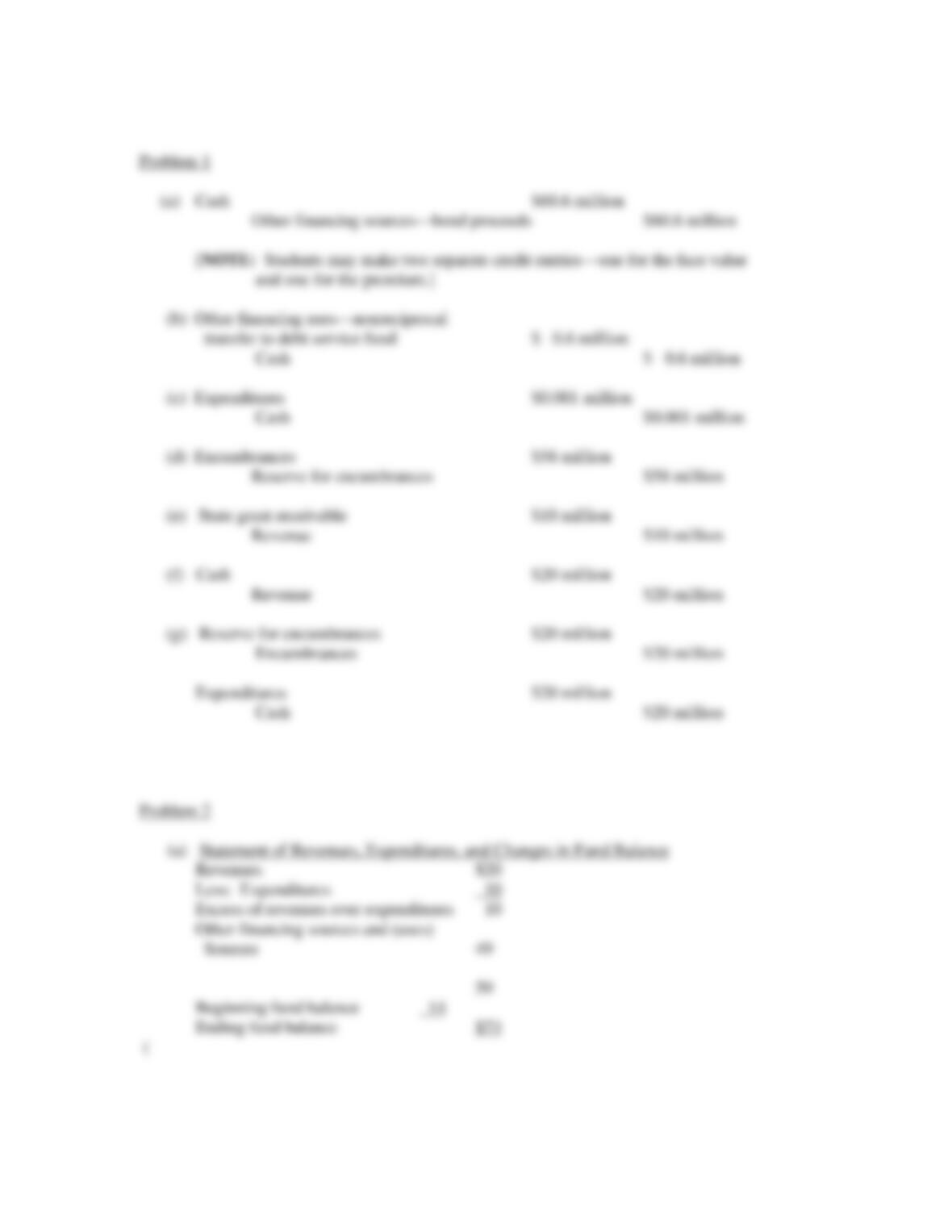
1. The voters of Salinas City authorized the construction of a new north-south expressway for a
total cost of no more that $90 million. The voters also approved the issuance of $60 million
of 5 percent general obligation bonds. The balance of the necessary funds will come from the
following sources: $20 million from a federal grant and $10 million from a state grant. The
city controls expenditures in capital project funds through project management. The city
does not formally incorporate budgetary entries in the capital projects fund but it does use
encumbrance accounting for control purposes.
REQUIRED: Assume that the city maintains its books and records in a manner that facilitates
the preparation of the fund financial statements. Prepare journal entries in the capital projects
fund, for the following transactions. The city
(a) Issues $60 million of 5 percent general obligation bonds at 101.
(b) Transfers the premium to the appropriate fund.
(c) Incurs bid-related expenditures of $1,000.
(d) Signs a contract with the lowest competent bidder for $58 million.
(e) Receives notice from the state that the grant has been approved and the proceeds will be
forwarded to the city in the state’s current fiscal year.
(f) Receives the federal grant in full.
(g) Pays a progress billing from the contractor for $12 million.
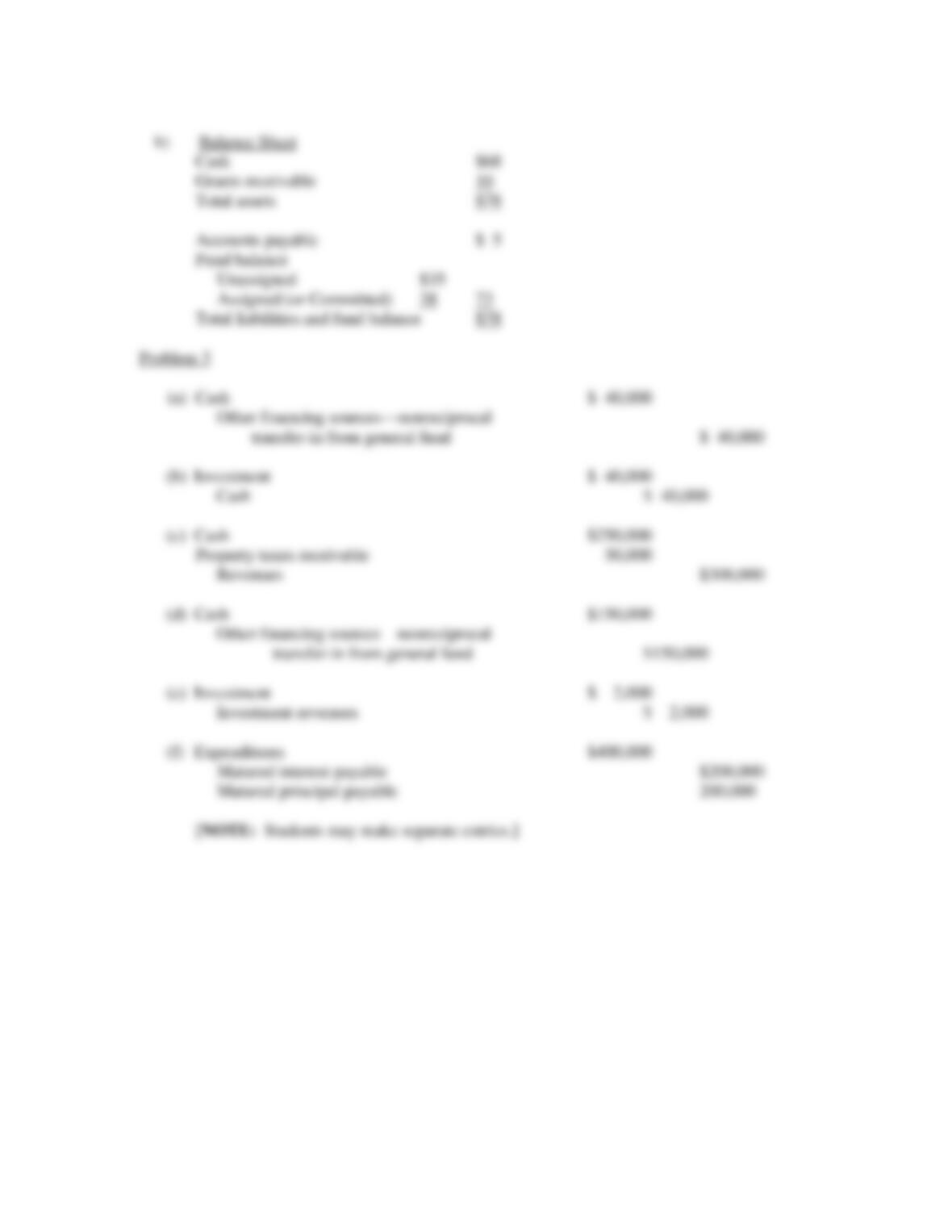
2. Clark City has the following balances in the accounts of its capital projects fund at year-end
before closing entries. All accounts have normal balances. All amounts are in millions of
dollars.
REQUIRED: (a) Prepare an operating statement for the capital projects fund.
(b) Prepare a balance sheet for the capital projects fund.
Cash $ 68
Accounts payable $ 5
Encumbrances $ 38
Expenditures $ 10
Fund balance—Unassigned $ 14
Grants receivable $ 10
Other financing sources $ 50
Other financing uses $ 1
Reserve for encumbrances $ 38
Revenues $ 20
ch06.doc Page 14
3. In 2014 the voters of Solis City authorized the construction of a new swimming pool for a
total cost of no more that $4 million. The voters also approved the issuance of $4 million of
20-year, 5% general obligation serial bonds to be repaid by a special property tax. Interest on
these bonds is payable annually on June 30. On June 30, 2014, the city sold the bonds at 101
and signed contracts for the construction of the swimming pool. Principal payments of
$200,000 are due each June 30, beginning in 2015. If the property tax revenue is not
sufficient to make the necessary principal and interest payments, the city is obligated to
transfer the necessary monies from the general fund to the debt service fund. The city does
not formally incorporate budgetary entries in the debt service fund but it does use
encumbrance accounting for control purposes. The city has a June 30 fiscal year-end.
REQUIRED: Assume that the city maintains its books and records in a manner that
facilitates the preparation of the fund financial statements. Prepare journal entries in the debt
service fund for the following transactions.
(a) The city immediately transferred the premium to the debt service fund. The debt service
fund may not use the premium to pay principal or interest until the year 2029.
(b) On June 30, the city invested the premium in a 10-year 5% certificate of deposit (CD) at a
local financial institution. The CD pays interest annually on June 30. Interest is
automatically reinvested in the CD.
(c) Property taxes in the amount of $250,000 were collected by June 30, 2015. The city
expects to collect another $50,000 by August 31.
(d) The city transferred to the debt service fund the cash necessary to make the June 30, 2015
principal and interest payments. The checks will be mailed on July 1.
(e) The city recognized interest earned on the CD.
(f) The city recognized the appropriate liabilities in the debt service fund.
ch06.doc Page 15
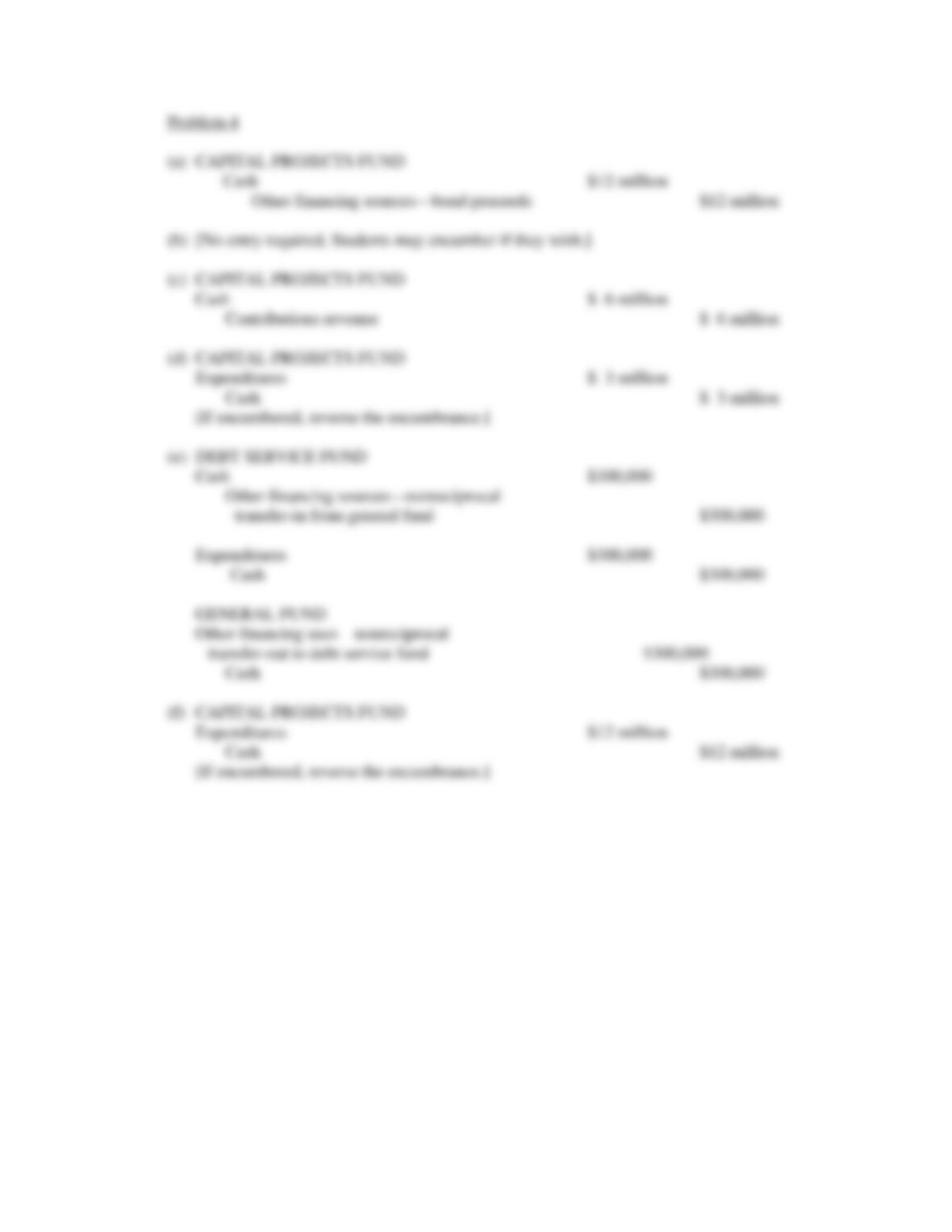
4. Augur City received voter approval to issue $12 million of 5% bonds to construct a city
office building. The estimated total cost of construction is $18 million. The city hopes to
raise the balance needed through private donations. The city has a June 30 fiscal year-end.
REQUIRED: Assume that the city maintains its books and records in a manner that
facilitates the preparation of the fund financial statements. Prepare journal entries to record
the following transactions. Indicate in which fund the entry should be made.
(a) On July 1 the city issued $12 million of 5% serial bonds at face to fund construction of
the new office building. The bonds pay interest on January 1 and July 1. The first
principal payments are due five years hence.
(b) On July 15 the city signed a $18 million contract with a local construction company for
construction of the buildings.
(c) On September 1 a local benefactor donated $6 million cash for the office building.
(d) On October 1, the contractor requested a progress payment of $3 million for the
earthwork and foundation work on the new building. The city paid the contractor.
(e) On January 1, the city transferred from the general fund the amount necessary to make
the first interest payment. The city made the first interest payment on the bonds.
(f) On June 1 the contractor requested and received a progress payment of $12 million.
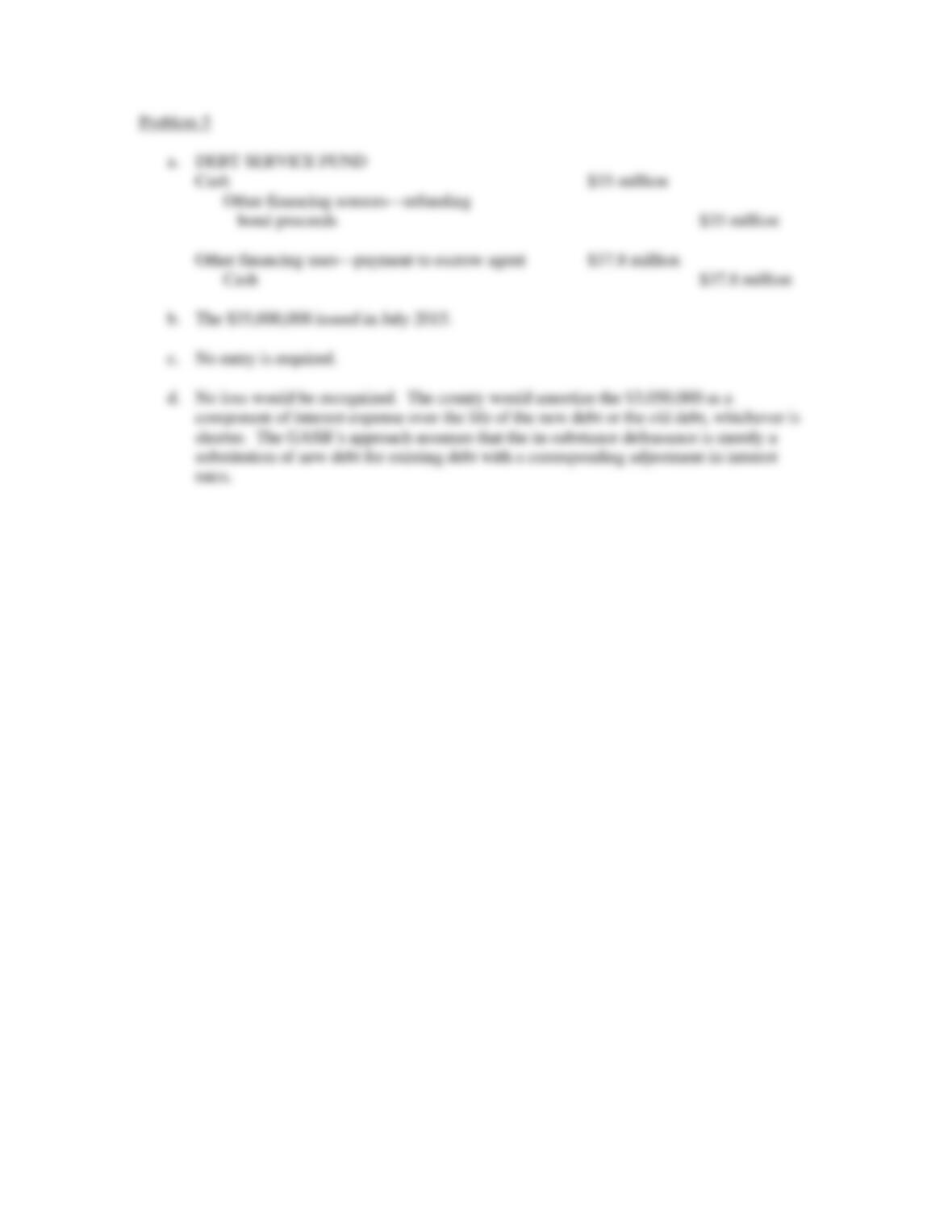
5. Raygun County had outstanding $35 million in Series 1995 general obligation bonds on June
30, 2015. The bonds were issued at an interest rate of 10 percent with interest payable on
June 30 and December 31. In July 2015, interest rates declined substantially, and the county
issued refunding bonds in the amount of $35 million at 5 percent. The proceeds of the
refunding bonds were placed in escrow along with $2,800,000 held in the county’s debt
service fund as a sinking fund for the 1995 debt. The proceeds of the refunding bonds and
the sinking fund amount would be used in December 2015 (the call date) to purchase the
1995 debt at a 3 percent call premium, totaling $1,050,000, plus accrued interest of
$1,750,000. The County had $250,000 of unamortized debt issue costs on the 1995 bonds,
which it reported in its government-wide financial statements. This amount combined with
the call premium resulted in a $3,050,000 “loss” on the refunding. REQUIRED:
(a) What journal entries should the county make in July 2015 to record the in-substance
defeasance of the 1995 debt in its debt service fund?
(b) What debt should be reported in the county’s government-wide financial statements at
July 2015?
(c) What journal entry should be made in the county’s debt service fund in December 2015
to record the purchase of the old debt at the call date?
(d) How should the “loss” on the refunding be recognized in the government-wide financial
statements? Why did the GASB choose this method of recognition?
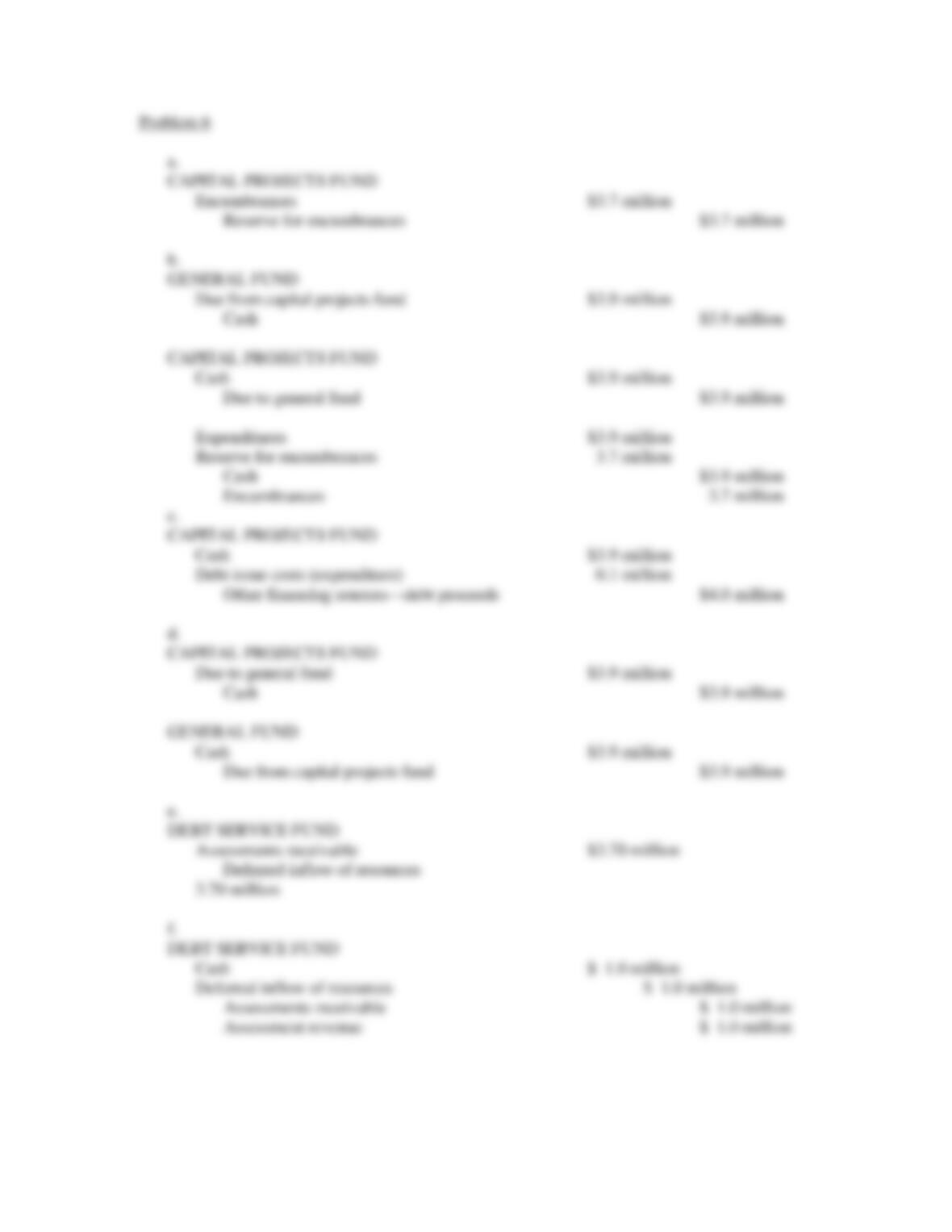
ch06.doc Page 16
6. In 20151, the citizens living on Carmelo Avenue agreed to a capital improvement special
assessment to replace sidewalks on both sides of the avenue. The city will oversee the
construction, issue special assessment debt to pay for it, and bill (assess) homeowners for
their portion of the cost. The estimated cost of the project is $4.0 million. The city itself will
be responsible for 25 percent of the cost ($1,000,000). Also, the city also has indicated it will
be responsible for any defaults on the part of homeowners. Because the city uses a separate
capital projects fund for the project, it does not integrate budgetary accounts. However it
does use encumbrance accounting. REQUIRED: Provide journal entries for the city’s funds
and discussion as follows. Be sure to indicate in which fund the entry should be recorded.
(a) The city puts the project out for bid and accepts the lowest competitive bid of $3.7
million.
(b) The contractor does the work and bills the city for $3.9 million—$0.2 million over the
contracted amount. The city council approves the overage. The city lends resources
from its general fund to pay the bill, pending issuance of special assessment debt.
(c) The city issues $4.0 million in 10-year special assessment debt. The city receives $3.9
million, an amount that is net of debt issue costs of $0.1 million.
(d) The capital projects fund repays the city’s general fund.
(e) The city assesses taxpayers on Carmelo Avenue a total of $3.7 million in special
assessments. The city has an enforceable legal claim against those taxpayers on the date
of the assessment.
(f) Several taxpayers pay their assessments immediately. During 2015, the city receives a
total of $1.0 million in special assessment revenues.
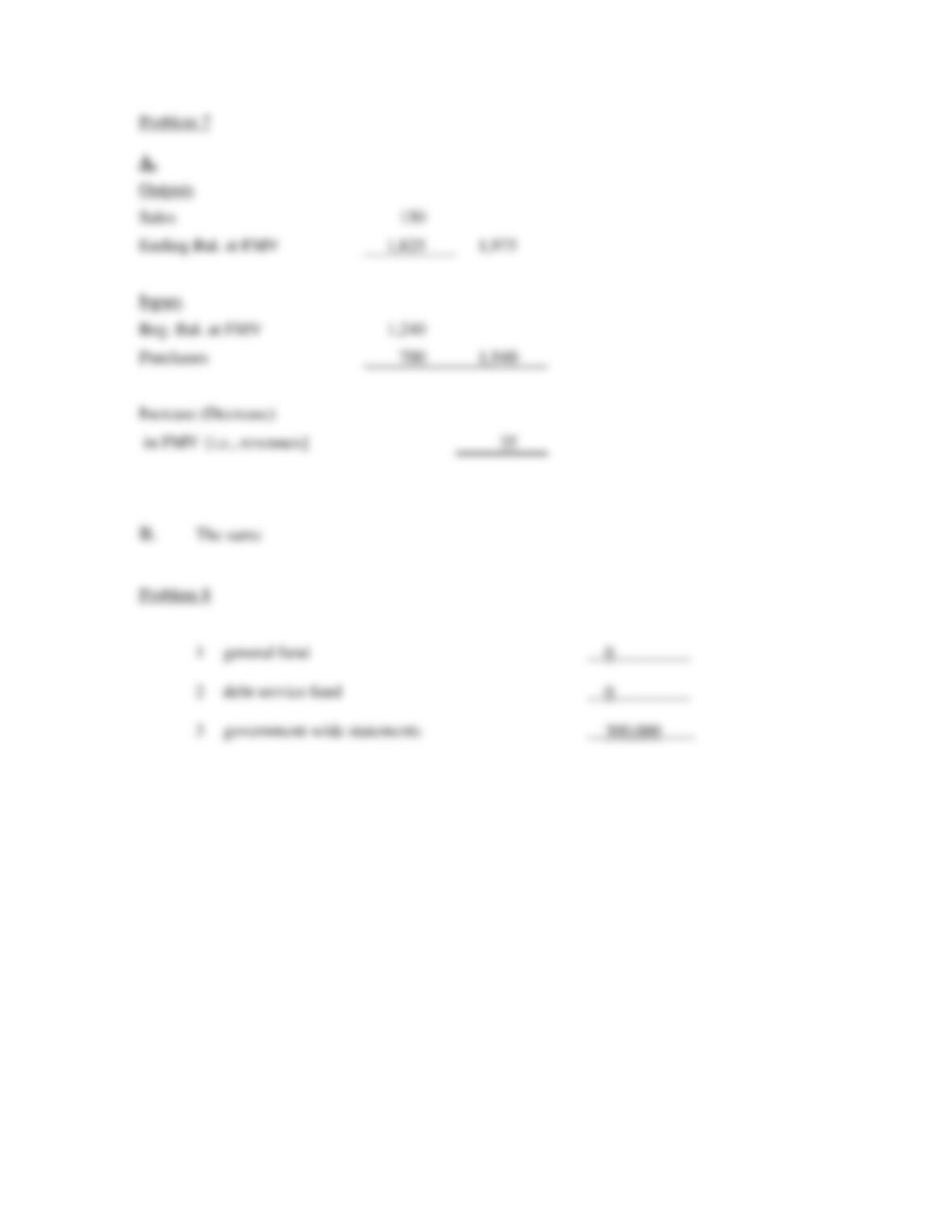
7. A government held the following equity securities in its debt service fund as of January 1,
2015. During 2015 it engaged in the following transactions as indicated.
Beginning Bal.
Ending Bal.
Security
Cost
FMV
Purch.
Sales
Cost
FMV
A
600
800
600
840
B
380
300
380
275
C
100
140
150
–
D
700
700
710
Total
1,080
1,240
700
150
1,680
1,825
A. Ignoring dividends, what would be the effect of the transactions on 2015 debt service
fund revenues or expenditures?
B. What would be the effect of the transactions on 2015 government-wide revenues or
expenses?
ch06.doc Page 17
8. On October 1, 2015, the Central School District issued $20 million of 6 percent bonds at par
to construct a new junior high school. The first interest payment of $600,000 is due on
March 31, 2016. In December 2015 the district transferred $600,000 from its general fund to
a debt service fund to cover the March 2016 interest payment. How much interest
expense/expenditure should the district recognize for 2015 in its
1. general fund? ____________
2. debt service fund? ____________
3. government-wide statements? _____________
ch06.doc Page 18
ESSAYS (CHAPTER 6)
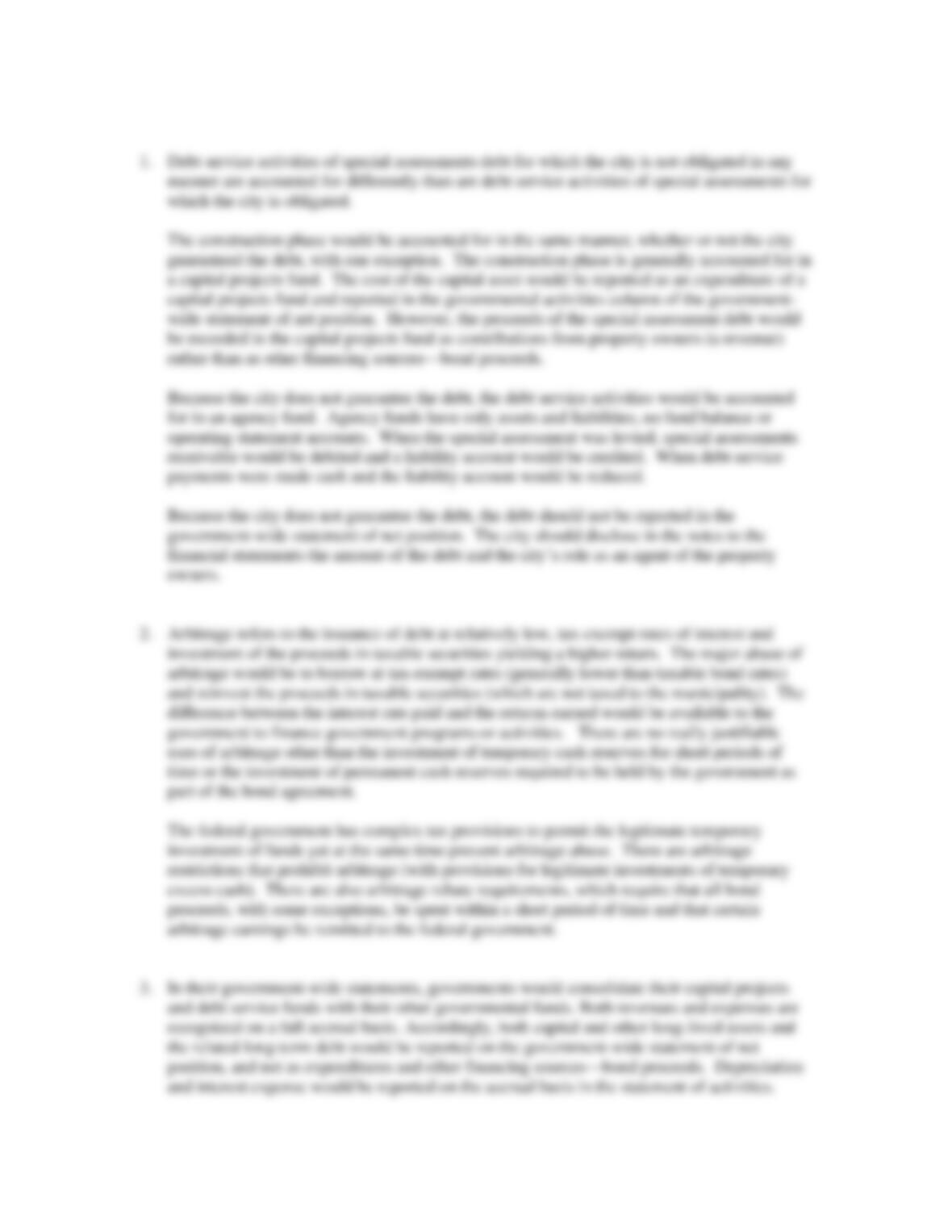
1. The citizens of a defined geographical area of Eagle City authorized a special assessment to
be levied on their properties to finance the reconstruction of the sewer system infrastructure
that serves the area. The city will solicit bids, oversee reconstruction, issue the debt in the
name of the city, and service the debt. The city is NOT obligated in any manner for the debt
but will collect the special assessments and make principal and interest payments to the
bondholders. Discuss the appropriate accounting for the construction phase and the debt
service phase of this project. Justify the required accounting and financial reporting for these
two phases of this project.
2. What is arbitrage? What are its potential uses and/or abuses? How are potential abuses
regulated?
3. How should governments report their capital projects and debt service activities in their
government-wide financial statements?
4. Governments often receive interest on the temporary investment of capital debt proceeds.
Some believe that governments are inconsistent in the way they report interest and other
earnings on investments compared to interest on their debt. Explain this comment. Do you
believe the reporting is inconsistent?
5. When bonds are issued for capital projects, premiums are generally not accounted for as the
mirror image of discounts. Why not?
6. When a government issues bonds at a discount, where should it report the discount on its (a)
fund statements and (b) government-wide statements?

ch06.doc Page 19
ANSWERS TO TRUE/FALSE (CHAPTER 6)

ch06.doc Page 20
ANSWERS TO MULTIPLE CHOICE (CHAPTER 6)
ch06.doc Page 21
ANSWERS TO PROBLEMS (CHAPTER 6)
ch06.doc Page 22
ch06.doc Page 23
ch06.doc Page 24
ch06.doc Page 25
ch06.doc Page 26
ch06.doc Page 27
ANSWERS TO ESSAYS (CHAPTER 6)
ch06.doc Page 28