Chapter 6: Accounting for Merchandising Businesses
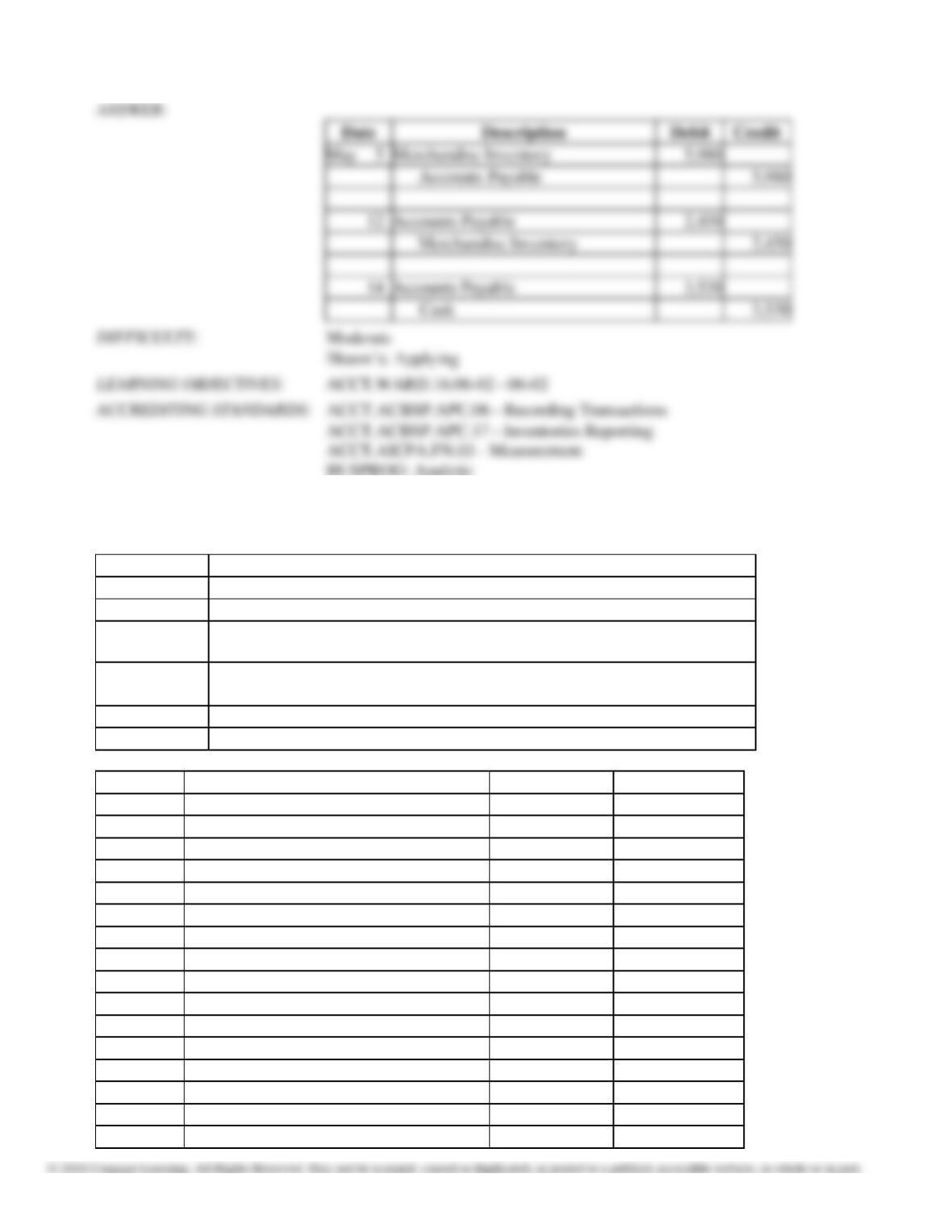
May 5
Merchandise Inventory
5,980
Accounts Payable
2,450
Accounts Payable
Cash
3,530
200.
Record the following transactions for Sparky’s Pet Shop using the general journal form provided below.
Assume
Sparky’s uses a perpetual inventory system. Omit transaction descriptions from entries:
Date
Transaction
August 1
Purchased $6,000 of merchandise on account, terms 2/10, n/30.
3
Returned $1,500 of merchandise purchased on August 1 due to defects.
7
Recorded cash sales for the first week of August, $9,750; cost of the
merchandise was $4,000.
10
Made sale on account to a local breeder for $500, terms 1/10 net 30; cost of the
merchandise was $200.
11
Paid for the merchandise purchased on August 1, less return.
20
Received payment from sale of August 10. The customer took the discount.
Date
Description
Debit
Credit
Chapter 6: Accounting for Merchandising Businesses
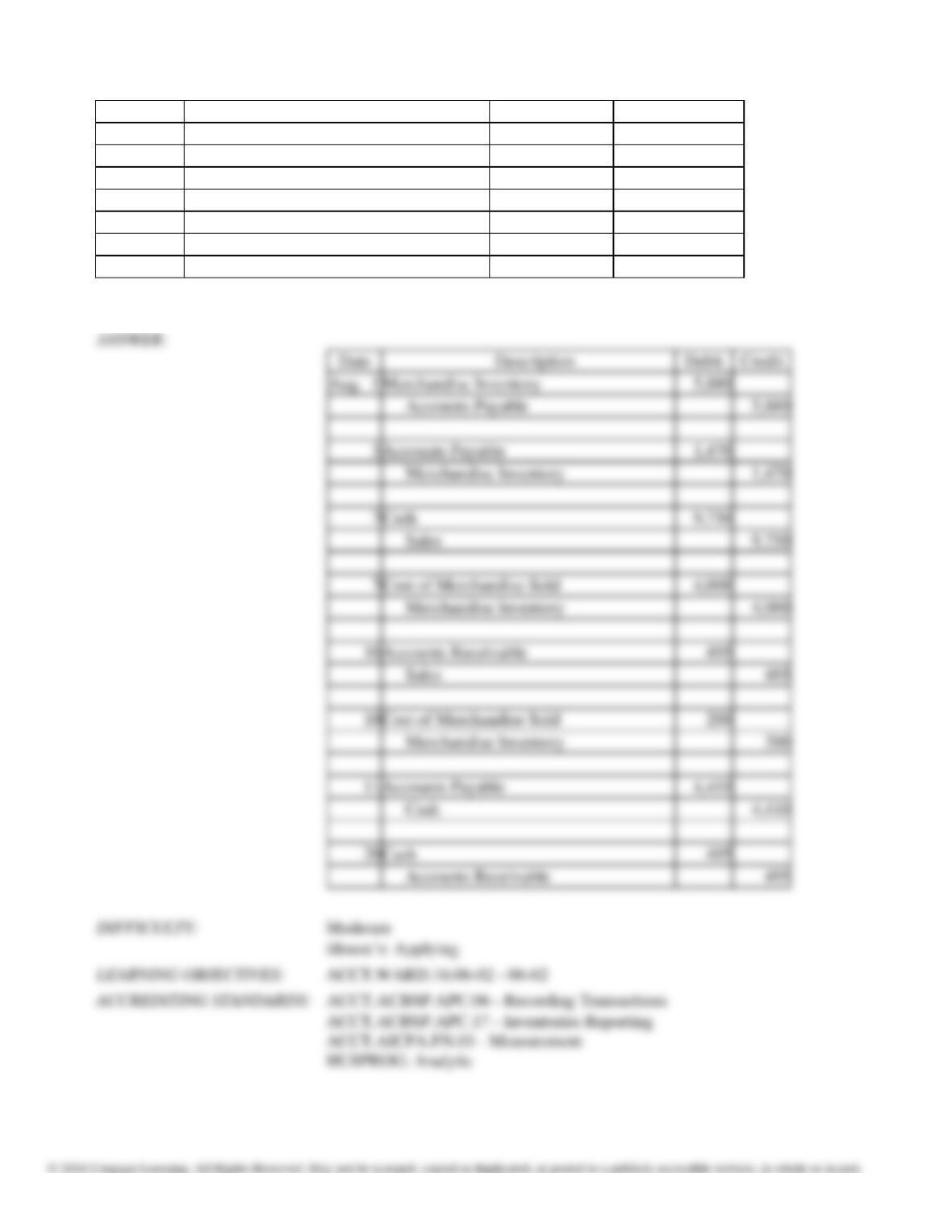
Aug. 1
Merchandise Inventory
Accounts Payable
Cash
Cost of Merchandise Sold
Accounts Receivable
Cost of Merchandise Sold
Accounts Payable
Cash
Chapter 6: Accounting for Merchandising Businesses
201.
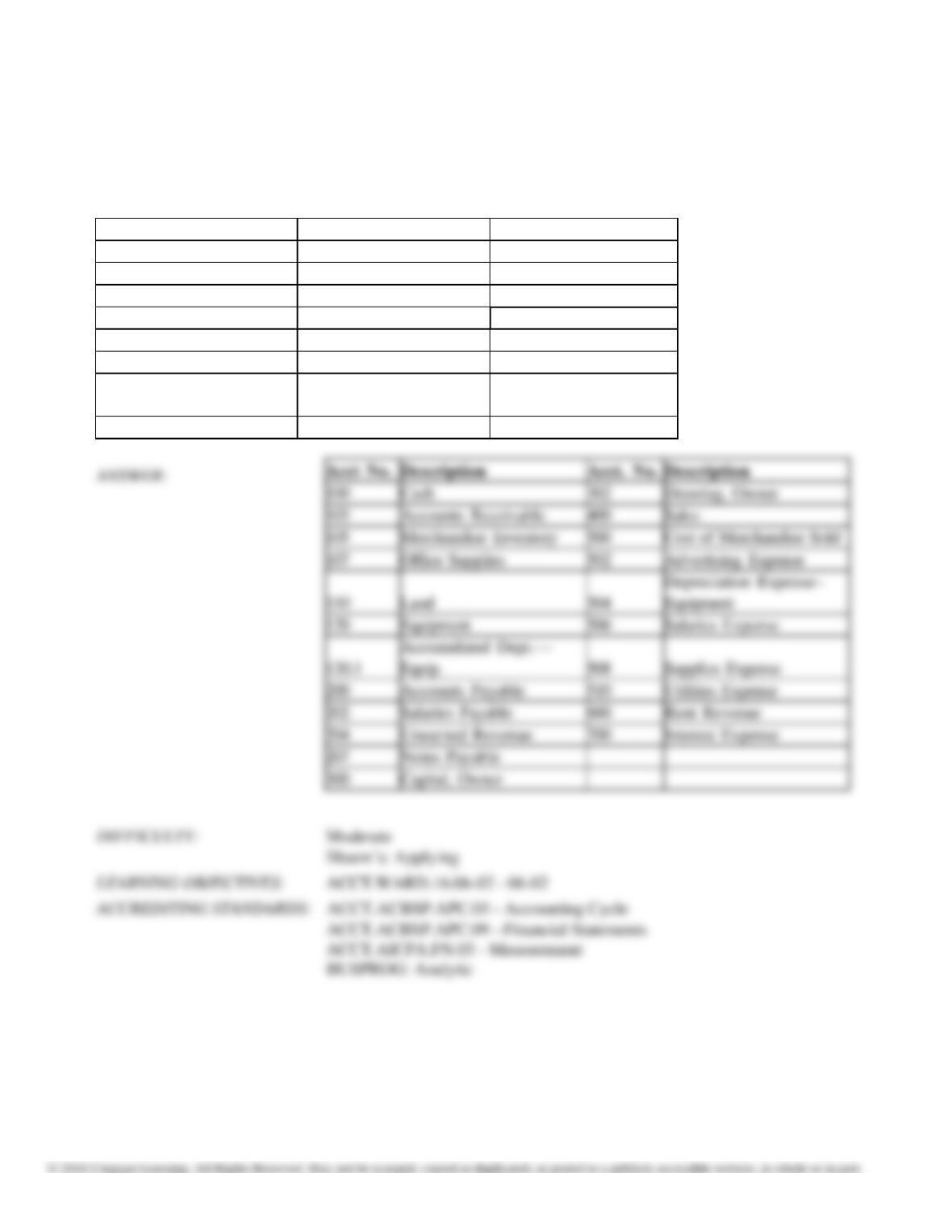
Journalize the following transactions for both Abbott Co. (seller) and Dalton Co. (buyer). Assume both
the
companies use the perpetual inventory system.
July 3 Abbott Co. sold merchandise on account to Dalton Co., $7,500, terms FOB
shipping
point, net/eom. The cost of the merchandise sold was $4,400.
5 Dalton Co. paid $275 freight charges on purchase from Abbott Co.
9 Abbott Co. issued Dalton Co. a credit memo for merchandise returned,
$2,250.
The cost of the merchandise returned was $1,325.
11 Abbott Co. received payment from Dalton Co. for purchase of July 3.
Abbott Co.
Dalton Co.
Date
Description
Debit
Credit
Description
Debit
Credit
Chapter 6: Accounting for Merchandising Businesses
Chapter 6: Accounting for Merchandising Businesses
202.
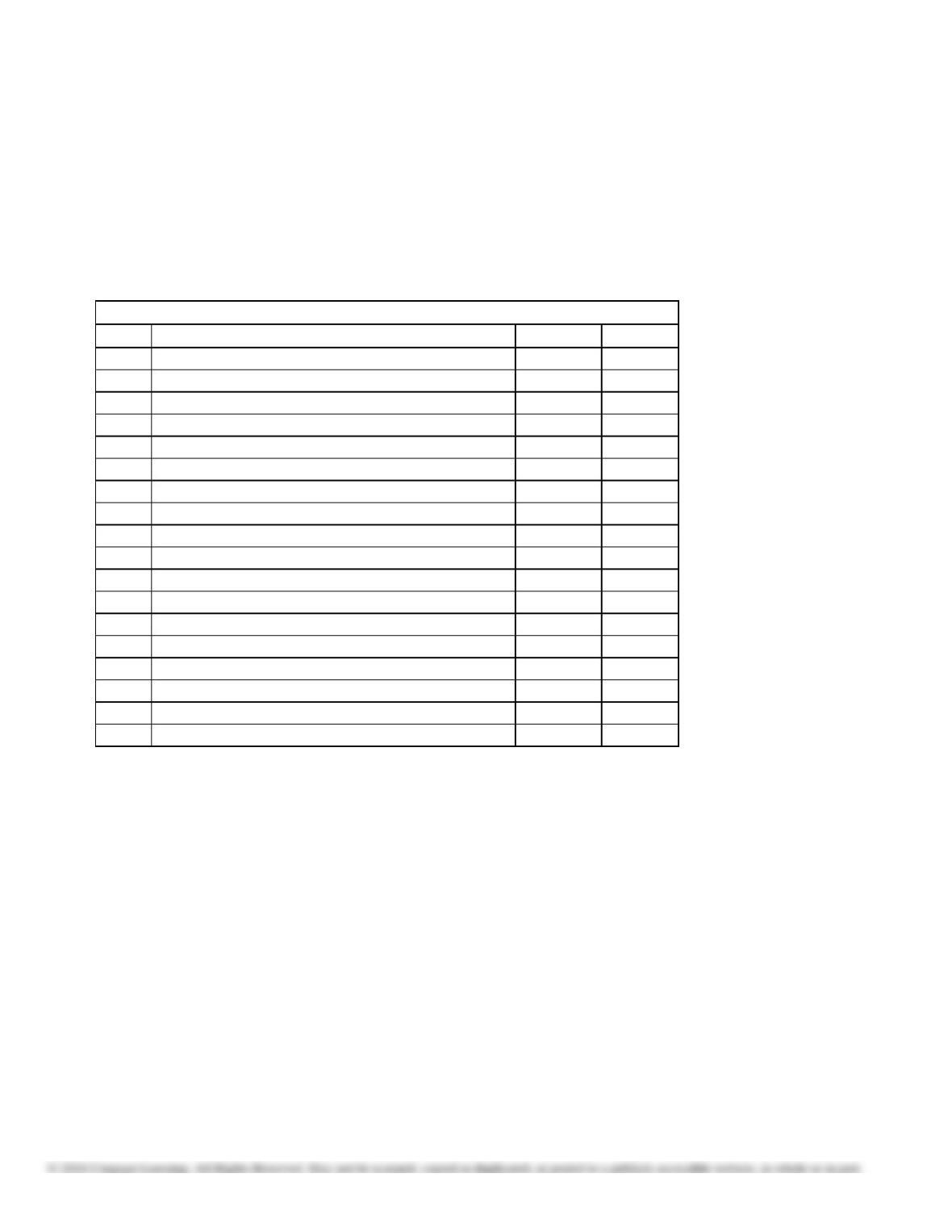
Using the list of accounts below, construct a chart of accounts for a merchandising business that rents out a portion
of its building, and assign account numbers and arranging the accounts in balance sheet and income statement
order
(“1” for assets, and so on). Each account number should have three digits. Contra accounts should be
designated
with a decimal of the account (100.1 for contra of account 100). Assets and liabilities should be in order
of liquidity,
expenses should be in alphabetical order.
Accounts Payable
Equipment
Sales
Accounts Receivable
Interest Expense
Supplies Expense
Accumulated Depr.—Equip.
Land
Unearned Revenue
Advertising Expense
Merchandise Inventory
Utilities Expense
Capital, Owner
Notes Payable
Cash
Office Supplies
Cost of Merchandise Sold
Rent Revenue
Depreciation Expense—
Equip.
Salaries Expense
Drawing, Owner
Salaries Payable
Cash
Drawing, Owner
Accounts Receivable
Sales
Merchandise Inventory
Cost of Merchandise Sold
Office Supplies
Advertising Expense
Depreciation Expense–
Equipment
Salaries Expense
Accumulated Depr.—
Equip.
Accounts Payable
Utilities Expense
Salaries Payable
Rent Revenue
Unearned Revenue
Interest Expense
Notes Payable
Capital, Owner
Chapter 6: Accounting for Merchandising Businesses
203.
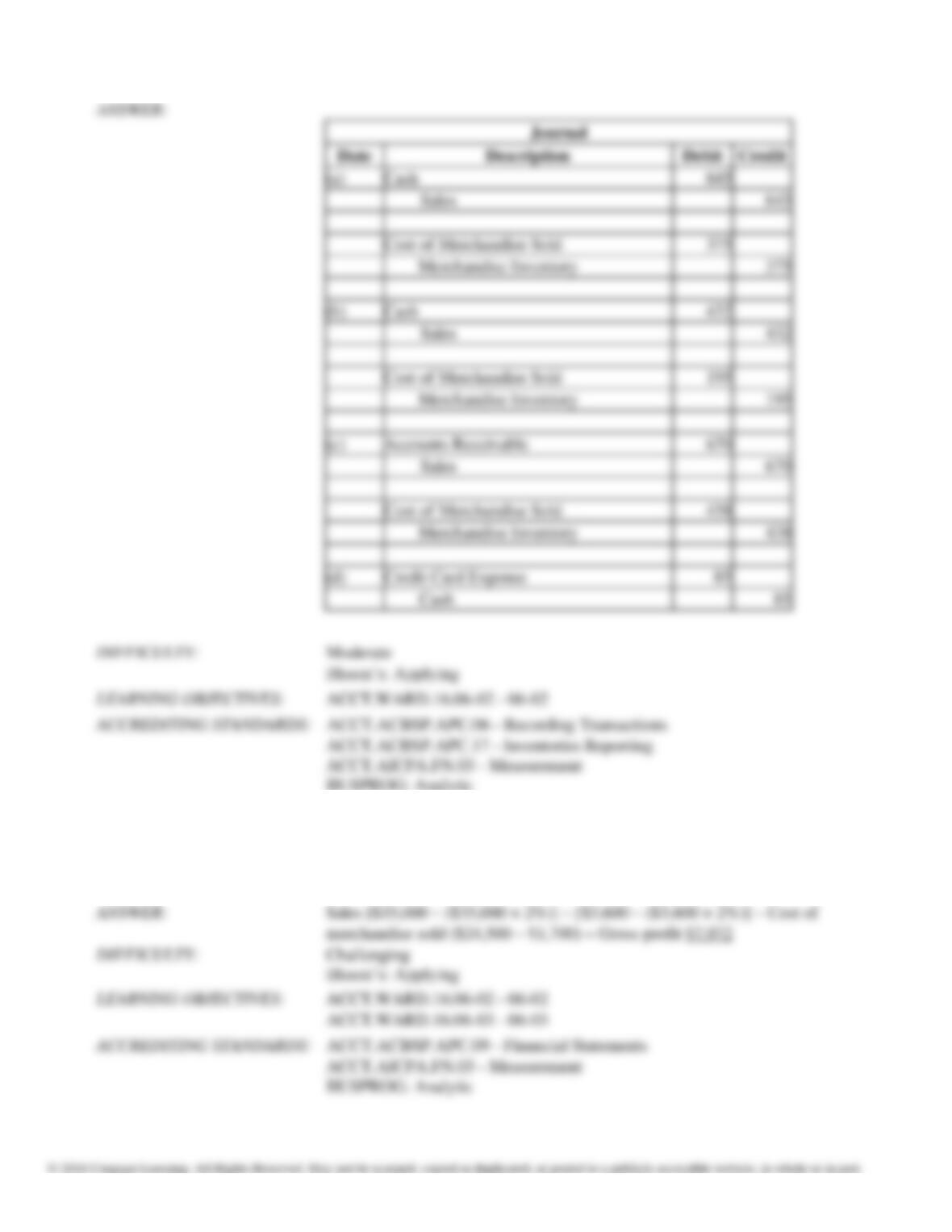
Journalize the following transactions for the Evans Company. Assume the company uses a perpetual
inventory
system.
(a)
Sold merchandise for $645. The cost of merchandise sold was $375.
(b)
Sold merchandise for $432 and accepted VISA as the form of payment.
The cost of merchandise sold was $195.
(c)
Sold merchandise on account for $670. The cost of merchandise sold was $438.
(d)
Paid credit card fees for the month of $85.
Journal
Date
Description
Debit
Credit
Chapter 6: Accounting for Merchandising Businesses
204.
Abbey Co. sold merchandise to Gomez Co. on account, $35,000, terms 2/15, net 45. The cost of the
merchandise
sold is $24,500. Abbey Co. issued a credit memo for $3,600 for merchandise returned that
originally cost $1,700. Gomez Co. paid the invoice within the discount period. What is the amount of gross
profit earned by
Abbey Co. on the above transactions?
Chapter 6: Accounting for Merchandising Businesses
205.
Calculate the gross profit for Jonas Company based on the following data:
Sales
$764,000
Selling expenses
52,500
Cost of merchandise sold
538,000
206.
Which of the following accounts would be included in the chart of accounts of a merchandising company using the
(a) periodic inventory system, (b) perpetual inventory system, or (c) both systems?
(1) Purchases
(2) Merchandise Inventory
(3) Sales
(4) Purchases Discounts
(5) Cost of Merchandise Sold
(6) Freight In
(7) Delivery Expense
Chapter 6: Accounting for Merchandising Businesses
207.
Using the letter preceding each account, arrange the following selected accounts in the order they would
normally
appear in a chart of accounts of a company that uses a multiple-step income statement.
(a)
Accounts Payable
(b)
Accounts Receivable
(c)
Merchandise Inventory
(d)
Miscellaneous Selling Expense
(e)
Interest Expense
(f)
Income Summary
(g)
Misc. Admin. Expense
(h)
Freight Out
208.
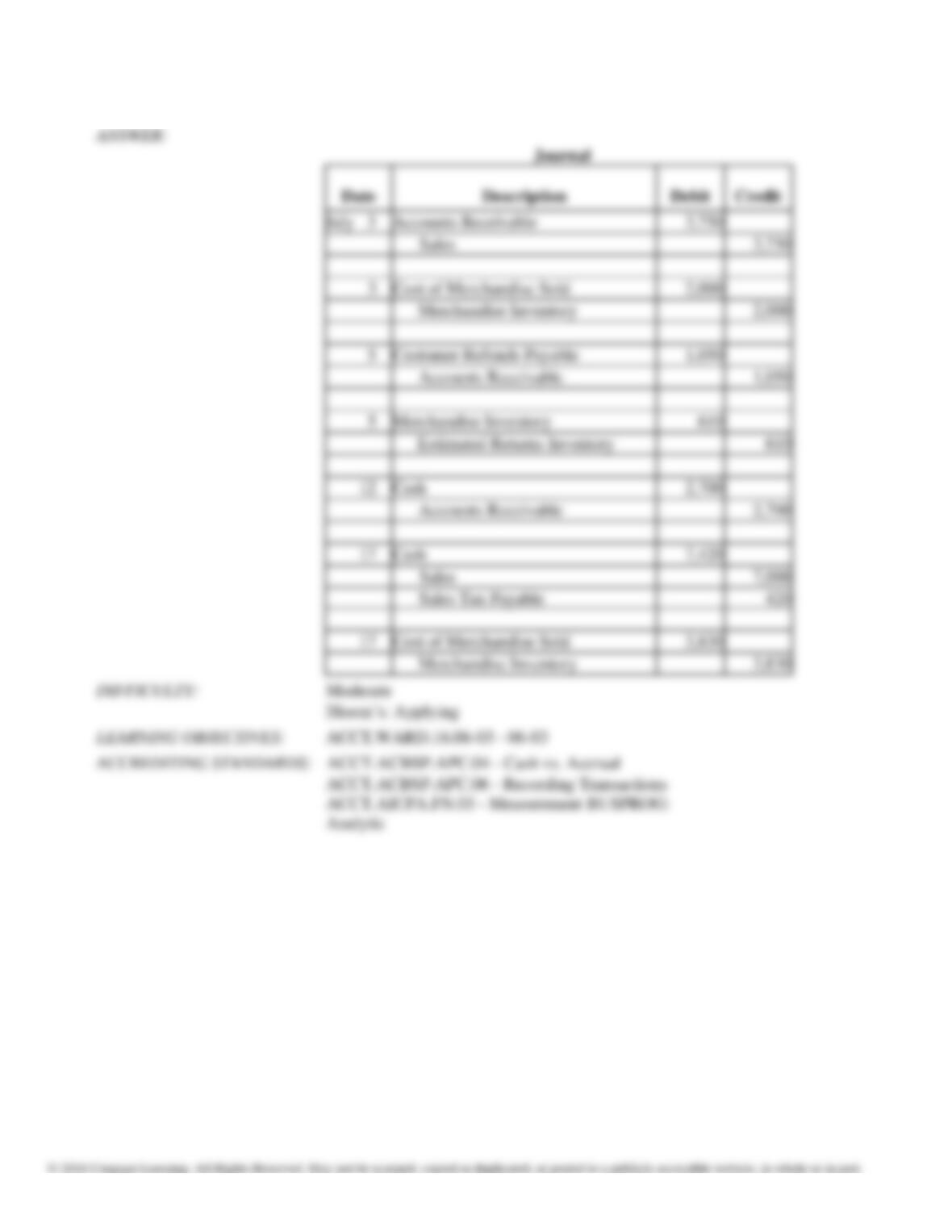
Journalize the following transactions assuming the perpetual inventory system:
July 3 Sold merchandise on account for $3,750 including terms. The cost of the
merchandise sold was $2,000.
5 Issued credit memo for $1,050 for merchandise returned from sale on July 3.
The
cost of the merchandise returned was $610.
12 Received check for the amount due for sale on July 3 less return on July 5.
17 Sold merchandise for $7,000 plus 6% sales tax to cash customers. The cost of the
merchandise sold was $3,830.
Date
Description
Debit
Credit
Chapter 6: Accounting for Merchandising Businesses
Chapter 6: Accounting for Merchandising Businesses
209.
Using the following data taken from Hsu’s Imports Inc. which uses a periodic inventory system, determine the
gross profit to be reported on the income statement for the year ended March 31.
Merchandise inventory, April 1
$ 193,250
Merchandise inventory, March 31
180,100
Purchases
1,079,600
Purchases returns and allowances
51,200
Purchases discounts
18,500
Sales
1,860,000
Freight in
19,250
Chapter 6: Accounting for Merchandising Businesses
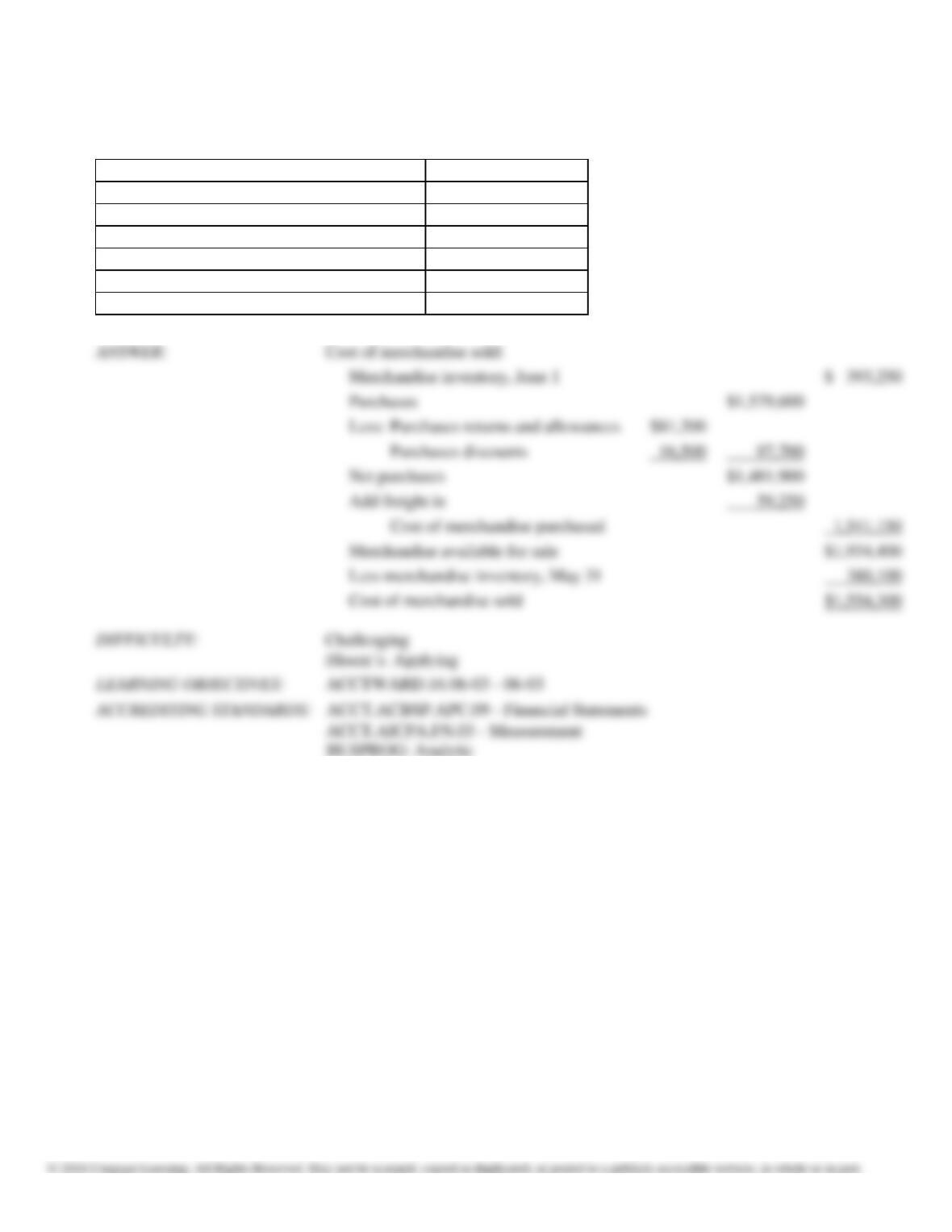
210.
Using the following data taken from Hsu’s Imports Inc. which uses a periodic inventory system, prepare the cost of
merchandise sold section of the income statement for the year ended March 31.
Merchandise inventory, April 1
$ 193,250
Merchandise inventory, March 31
180,100
Purchases
1,079,600
Purchases returns and allowances
51,200
Purchases discounts
18,500
Sales
1,860,000
Freight in
19,250
Chapter 6: Accounting for Merchandising Businesses
211.
Using the following data taken from Payton Inc. which uses a periodic inventory system, prepare the cost of
merchandise sold section of the income statement for the year ended May 31.
Merchandise inventory, June 1
$ 393,250
Merchandise inventory, May 31
380,100
Purchases
1,579,600
Purchases returns and allowances
81,200
Purchases discounts
16,500
Sales
2,060,000
Freight in
59,250