Chapter 6 – A Framework for Audit Evidence
1
AUDT.JOHN.16.107 – Directional Testing
68. Directional testing is important to an auditor because of which of the following factors?
a.
Certain accounts are more prone to be misstated by overstatement than others.
b.
The auditor must remain organized when conducting an audit.
c.
The primary concern of the auditor is the understatement of asset and revenue accounts.
d.
It tests for existence and completeness simultaneously.
1
AUDT.JOHN.16.107 – Directional Testing
United States – AK – AICPA BB-Critical thinking
69. Which of the following assertions is the primary assertion that is satisfied by physically observing the
client’s count of inventory?
a.
Rights.
b.
Valuation.
c.
Completeness.
d.
Existence.
d
1
AUDT.JOHN.16.109 – Basic Audit Procedures and the Assertion(s) each Tests
United States – AK – AICPA BB-Critical thinking
70. When the auditor used the audit procedure vouching she is primarily concerned with which of the following
assertions?
a.
Completeness.
b.
Existence.
c.
Authorization.
d.
Classification.
b
1
AUDT.JOHN.16.109 – Basic Audit Procedures and the Assertion(s) each Tests
United States – AK – AICPA BB-Critical thinking
71. Observation suffers from which of the following limitations?
a.
Observation of processing is rarely unobtrusive.
Chapter 6 – A Framework for Audit Evidence
b.
Observation of processing on one day does not necessarily indicate how transactions were processed
on a different day.
c.
All the above.
d.
None of the above.
AUDT.JOHN.16.109 – Basic Audit Procedures and the Assertion(s) each Tests
United States – AK – AACSB-Analytical skills
United States – AK – AICPA BB-Critical thinking
72. The extent of procedures is affected mostly by which of the following factors?
a.
The sheer volume of procedures to be applied by the auditor.
b.
The time of year in which the client takes a physical inventory in the warehouse.
c.
The auditor’s judgment that misstatements are probable in certain balances.
d.
The availability of the client’s staff at or near the balance sheet date.
AUDT.JOHN.16.109 – Basic Audit Procedures and the Assertion(s) each Tests
United States – AK – AACSB-Analytical skills
United States – AK – AICPA BB-Critical thinking
73. An audit program is created to specify which of the following?
a.
The type of audit opinion to be rendered based upon procedures performed.
b.
The audit procedures that will be performed every year for the client.
c.
How an auditor should think while performing audit procedures.
d.
Audit objectives and procedures to be followed during the audit process.
AUDT.JOHN.16.106 – Nature and Purposes of Audit Programs
United States – AK – AACSB-Analytical skills
United States – AK – AICPA BB-Critical thinking
74. Which one of the following is the primary reason for documenting audit work?
a.
To prevent litigation by other parties that question the audit performance.
b.
To provide a stand-alone medium that gives audit conclusions and supports the opinion.
c.
To give the client a full reporting of all work performed on their behalf.
d.
To supply a point of reference for all auditors performing the work subsequently.
75. To be considered reliable evidence, confirmations must be controlled by which of the following individuals?
a.
A client employee responsible for accounts receivable.
b.
An external auditor.
c.
A client’s internal audit department.
d.
A client’s controller or CFO.
AUDT.JOHN.16.104 – Audit Procedures and the Assertion(s) Each Tests
United States – AK – AACSB-Analytical skills
United States – AK – AICPA BB-Critical thinking
76. Conclusions are typically documented by auditors in which type of work paper?
a.
Audit planning memo.
b.
Audit program.
c.
Audit memoranda.
d.
Representation letter.
AUDT.JOHN.16.105 – Purposes and Contents of Audit Programs
United States – AK – AACSB-Analytical skills
United States – AK – AICPA BB-Critical thinking
77. Which of the following is an example of poorly-developed audit documentation?
a.
Clear communication as to how testing was performed, the results and conclusions.
b.
Organization and assembly of documentation in an orderly fashion.
c.
Headings that include the name and signature of the client representative that the auditor interacted
with while performing testing.
d.
Authenticated identification of the person responsible for completing the procedure and conclusions.
AUDT.JOHN.16.105 – Purposes and Contents of Audit Programs
United States – AK – AACSB-Analytical skills
United States – AK – AICPA BB-Critical thinking
78. The processes used by management in developing estimates include which of the following?
a.
Controls over the process.
b.
The reliability of underlying data in developing the estimate.
c.
Use of outside experts by management (for example, how they were used and their expertise).
d.
All of the above.
79. Which of the following is the primary source for evidence to corroborate the existence of pending litigation?
a.
Vendor confirmations.
b.
Disclosures in financial statements.
c.
Management representation letters.
d.
Attorney confirmations.
d
1
AUDT.JOHN.16.104 – Audit Procedures and the Assertion(s) Each Tests
United States – AK – AICPA BB-Critical thinking
80. Performance of audit procedures at an interim date causes the risk of material misstatement occurring
between the interim date and the end of the year to do which of the following?
a.
Decrease.
b.
Increase.
c.
Remain the same.
d.
Become more difficult to ascertain.
1
AUDT.JOHN.16.104 – Audit Procedures and the Assertion(s) Each Tests
United States – AK – AICPA BB-Critical thinking
81. What is determined to be appropriate and sufficient will be affected by which of the following?
a.
The client’s risk of material misstatement.
b.
The risk of material weakness in internal controls.
c.
Either a or b.
d.
None of the above.
1
AUDT.JOHN.16.102 – Appropriateness and Sufficiency of Evidence
United States – AK – AICPA BB-Critical thinking
82. Audit documentation should contain which of the following?
a.
A heading that includes the name of the audit client, an explanatory title, and the balance sheet date.
b.
The initials or electronic signature of the auditor performing the audit test and the date the test was
completed.
Estimates
United States – AK – AICPA BB-Critical thinking
Chapter 6 – A Framework for Audit Evidence
c.
The initials or electronic signature of the manager or partner who reviewed the documentation and
the date the review was completed.
d.
All of the above.
AUDT.JOHN.16.111 – Audit documentation
United States – AK – AACSB-Analytical skills
83. Which of the following is not an estimate that requires significant auditor judgment and skepticism?
a.
Obligations for pension plans.
b.
Valuation of goodwill.
c.
Allowance for bad debt.
d.
Common stock and related additional paid-in capital.
AUDT.JOHN.16.110 – Uniqueness of Procedures for Testing Management’s
United States – AK – AACSB-Analytical skills
United States – AK – AICPA BB-Critical thinking
84. Which of the following is not a type of internal documentation?
a.
Legal documents.
b.
Business documents.
c.
Third-party documents.
d.
Accounting documents.
AUDT.JOHN.16.109 – Basic Audit Procedures and the Assertion(s) each Tests
United States – AK – AACSB-Analytical skills
United States – AK – AICPA BB-Critical thinking
85. Which of the following is a factor that the auditor should consider as they affect the reliability and relevance
of information produced by a management’s specialist?
a.
Competence, capabilities, and objectivity of that specialist.
b.
Work performed by that specialist.
c.
Appropriateness of that specialist’s work as audit evidence for the relevant assertion.
d.
All of the above.
86. When using confirmations with outside parties, the auditor must assure which of the following about the
outside party?
a.
The outside party exists.
b.
The outside party is able to respond objectively and independently.
c.
The outside party is unbiased in responding.
d.
All the above.
AUDT.JOHN.16.104 – Audit Procedures and the Assertion(s) Each Tests
United States – AK – AICPA BB-Critical thinking
87. Each of the audit procedures that an auditor could select possesses which of the following characteristics?:
a.
Audit procedures take time, effort, and money.
b.
Audit procedures are difficult to perform.
c.
Audit procedures require multiple people from the firm to perform.
d.
All of the above.
AUDT.JOHN.16.112 – Cost of Evidence
United States – AK – AICPA BB-Critical thinking
88. Which of the following types of audit evidence is the most reliable?
a.
Evidence from the client’s organization.
b.
Evidence from a poorly controlled system.
c.
Directly observable evidence.
d.
Facsimiles of documents.
AUDT.JOHN.16.113 – Persuasiveness of Evidence
United States – AK – AICPA BB-Critical thinking
89. Which of the following types of audit evidence is the least reliable?
a.
Evidence from the client’s organization.
b.
Evidence derived from a well-controlled system.
c.
Evidence from independent outside sources.
d.
Original documents.
United States – AK – AICPA BB-Critical thinking
90. In evaluating cost of evidence, which of the following evidence qualities of the audit usually has the lowest
cost?
a.
High quality.
b.
Medium quality.
c.
Low quality.
d.
All cost the same.
1
AUDT.JOHN.16.112 – Cost of Evidence
United States – AK – AICPA BB-Critical thinking
91. Recalculations of the client’s computations would not include which of the following types of evidence?
a.
Cutoff.
b.
Footing.
c.
Extension.
d.
Cross-footing.
1
AUDT.JOHN.16.114 – Types of Evidence
United States – AK – AICPA BB-Critical thinking
92. Vouching of transactions deals with which of the following?
a.
Testing forward.
b.
Testing backward.
c.
Testing at a point in time.
d.
Directional testing either forward or backward.
b
1
AUDT.JOHN.16.114 – Types of Evidence
United States – AK – AICPA BB-Critical thinking
93. Reprocessing of transactions involves which of the following?
a.
Testing forward.
b.
Testing backward.
1
AUDT.JOHN.16.113 – Persuasiveness of Evidence
United States – AK – AICPA BB-Critical thinking
Chapter 6 – A Framework for Audit Evidence
c.
Testing at a point in time.
d.
Directional testing either forward or backward.
AUDT.JOHN.16.114 – Types of Evidence
United States – AK – AICPA BB-Critical thinking
94. Which of the following characteristics are not normally included in good audit documentation?
a.
Initials of the person preparing and reviewing the document.
b.
An assessment of whether the test indicates the possibility of material misstatement in an account.
c.
A cross-reference.
d.
All are included in good audit documentation.
AUDT.JOHN.16.111 – Audit documentation
United States – AK – AICPA BB-Critical thinking
95. A date at which audit evidence is collected earlier than the balance sheet date is referred to as what?
a.
Subsequent date.
b.
Cutoff period.
c.
Significant date.
d.
Interim date.
AUDT.JOHN.16.104 – Audit Procedures and the Assertion(s) Each Tests
United States – AK – AICPA BB-Critical thinking
96. The auditor normally considers both underlying accounting data and corroborating information in the audit
process. Underlying accounting data does not include which of the following items?
a.
Evidence of controls.
b.
Minutes of meetings.
c.
Checks, invoices, and contracts.
d.
General and subsidiary ledger.
AUDT.JOHN.16.114 – Types of Evidence
97. The written record that forms the basis for the auditor’s conclusions is referred to as what?
a.
Audit documentation.
b.
Audit adjustment.
c.
Accounting records.
d.
Footing.
AUDT.JOHN.16.106 – Nature and Purposes of Audit Programs
United States – AK – AICPA BB-Critical thinking
98. Why is the appropriateness of audit evidence obtained by the auditor important in forming an audit opinion?
Describe the qualities information should have to be considered appropriate by the auditor.
relative truthfulness of the assertion.
AUDT.JOHN.16.102 – Appropriateness and Sufficiency of Evidence
United States – AK – AICPA BB-Critical thinking
99. Directional testing
Explain the meaning of “directional testing” and identify the reasons why directional testing leads to audit
efficiency. Give examples of directional testing for the existence and completeness assertions.
100. Proper audit documentation
Audit documentation serves as the primary support of an audit. Give at least six examples of the components of
proper working paper documentation.
101. Reliability of audit evidence
The Auditing Standards Board established guidelines to assist auditors in evaluating the reliability of audit
evidence. Discuss the criteria for the more reliable types of evidence and include an example for each.
102. Sufficient appropriate evidential matter
Discuss the importance of the phrase “sufficient appropriate evidence is to be obtained…”
How do auditing standards define sufficiency and appropriateness?
103. Audit assertions and procedures on Cash balances
Identify and demonstrate the audit assertions and different approaches to the obtaining audit evidence for an
audit of cash balances in a financial statement audit.
104. Distinguish between internal documentation and external documentation as types of audit evidence. Give
two examples of each. Which type is considered more reliable?
105. Audit program
Discuss the purpose of the audit program and its importance to the auditor.
106. Audit standards of proper documentation
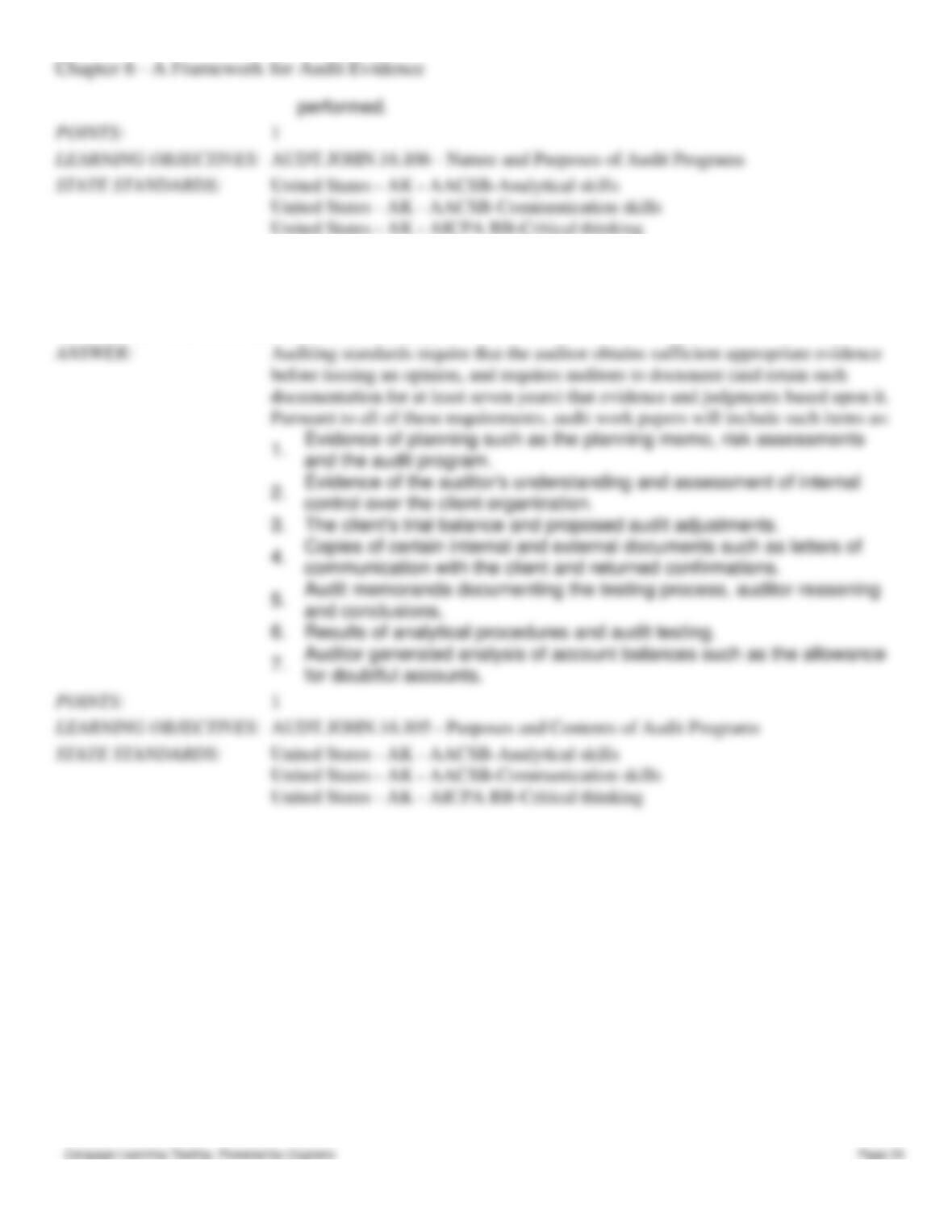
Discuss the audit standards that must be applied to the auditor’s documentation. Give five examples the types of
documentation will be found in the audit work papers.
1
AUDT.JOHN.16.105 – Purposes and Contents of Audit Programs
United States – AK – AACSB-Communication skills
United States – AK – AICPA BB-Critical thinking
107. Audit procedures
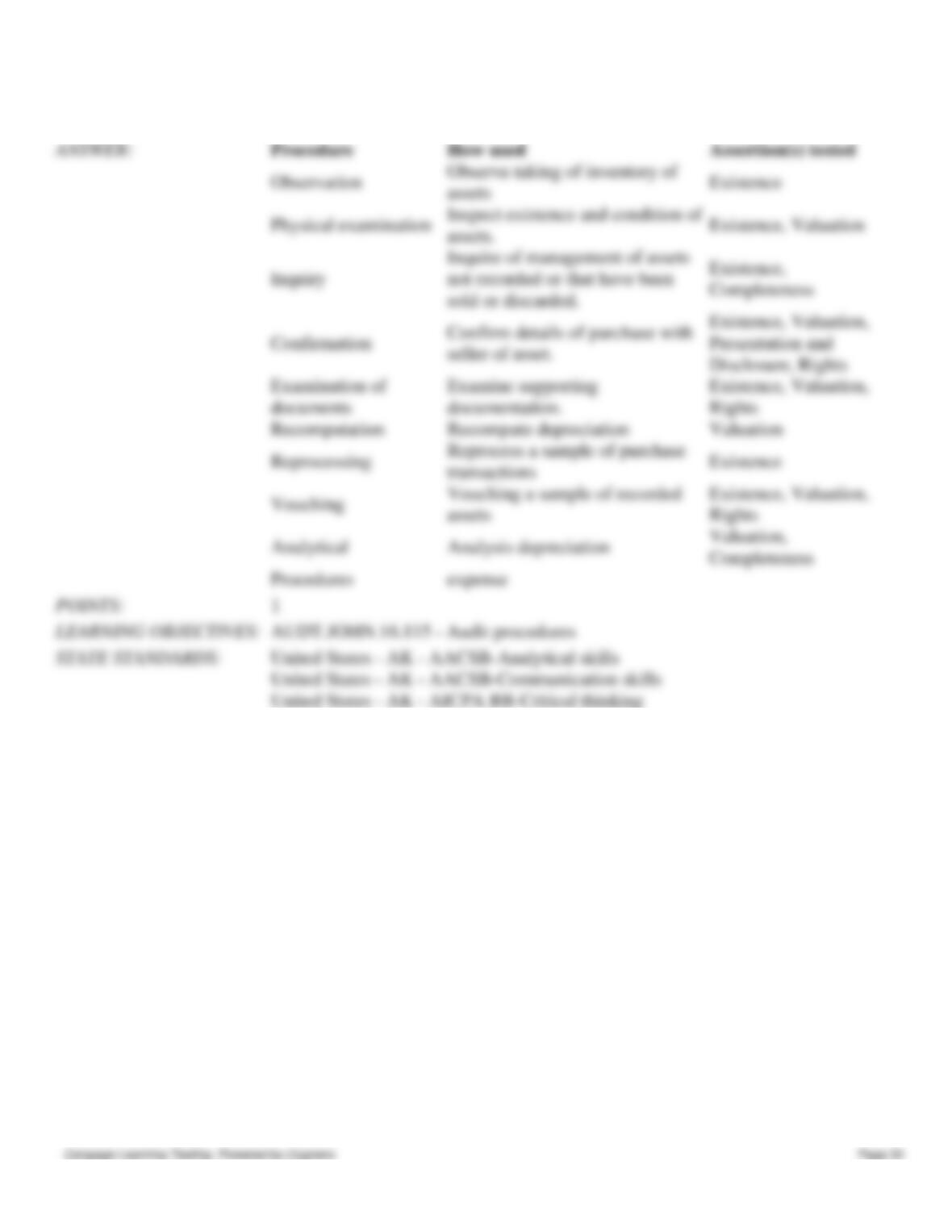
Discuss how each of the following procedures could be used in the audit of fixed assets, e.g., various types of
equipment used in the business.
Procedure
How used
Assertion(s) tested
Observation
Physical examination
Inquiry
Confirmation
Examination of
documents
Recomputation
Reprocessing
Vouching
1
AUDT.JOHN.16.106 – Nature and Purposes of Audit Programs
Chapter 6 – A Framework for Audit Evidence
Analytical
Procedures
How used
Assertion(s) tested
assets
assets.
sold or discarded.
Disclosure, Rights
documents
documentation.
Rights
Recomputation
Recompute depreciation
Valuation
transactions
assets
Rights
Procedures
expense
1
AUDT.JOHN.16.115 – Audit procedures
United States – AK – AICPA BB-Critical thinking
108. Audit procedures
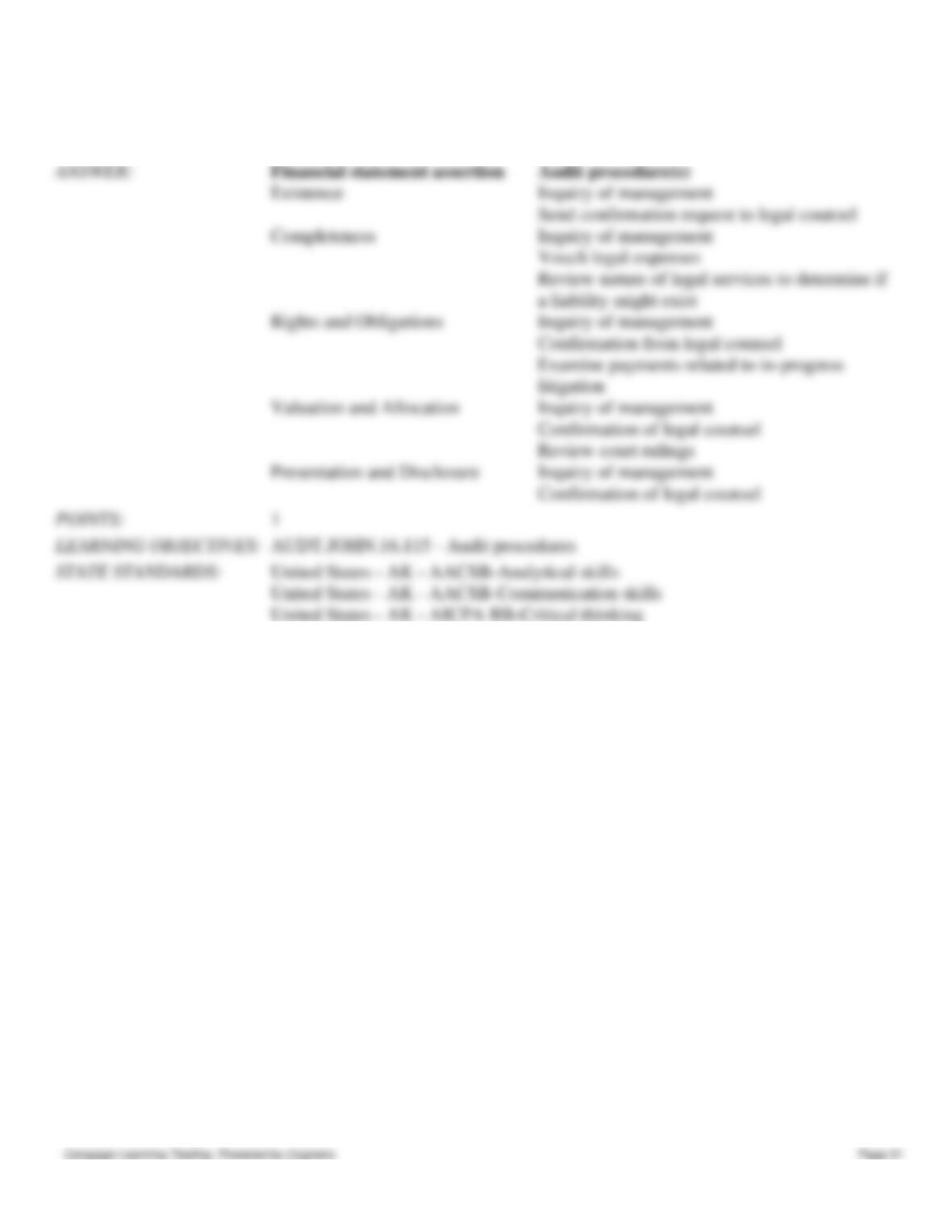
Businesses often have litigation against them that the auditor has to identify and adequately disclose. List the
financial assertions that apply to Contingencies. For each assertion indicate two or three audit procedures that
would address that assertion.
Organize you answer as follows:
Financial statement assertion
Audit procedure(s)
Chapter 6 – A Framework for Audit Evidence
Inquiry of management
Send confirmation request to legal counsel
Inquiry of management
Vouch legal expenses
a liability might exist
Rights and Obligations
Inquiry of management
Confirmation from legal counsel
Valuation and Allocation
Inquiry of management
Confirmation of legal counsel
Review court rulings
Presentation and Disclosure
Inquiry of management
Confirmation of legal counsel
AUDT.JOHN.16.115 – Audit procedures
United States – AK – AICPA BB-Critical thinking